
Kind of a Mess

The narrative which had been forming
Was prices were constantly warming
While job growth was strong
The bears were all wrong
And buyers of stocks were now swarming
 
But Friday the data was less
Impressive, and kind of a mess
At first, NFP
Was weak, all agree
Then ISM caused more distress


It is remarkable how quickly a narrative can change, that’s all I can say!  One week ago, the story was all about how the economy continued to perform well overall, that inflation remained sticky at levels higher than targeted and that the Fed would stick with higher for longer with a chance of a rate hike on the table.  This morning, in the wake of a clearly dovish Powell press conference and softer than expected ISM and employment data, the narrative appears to be coalescing around the idea that cuts are back on the table while a recession can no longer be ruled out.

The table below, courtesy of the Chicago Mercantile Exchange, shows the current probabilities for Fed funds based on futures pricing for the December 2024 contract as well as how they have evolved over the past week and month.

Source: CME

When calculating how much is priced into the market, one simply multiplies the size of the cut by its stated probability and voila, the answer appears.  To save you the trouble of doing the math, the current market pricing shows that as of this morning, the market is pricing in 47.6bps of cuts by year-end, so essentially two cuts.  One week ago, that number was 34.8bps while one month ago it was 65.7bps.  in other words, we have seen a bit of movement in this sentiment indicator.  And really, that’s exactly what this is, a measure of the market’s sentiment and expectations of how Fed funds are going to evolve over time.  

What should we make of this information?  Well, anecdotally, for the past several weeks I have not been reading about recession at all.  The no-landing scenario seemed to be the favorite as the soft-landing idea ebbed amid too high inflation readings.  But this morning, in concert with the Fed funds futures market, I have seen several stories discussing that a recession is on the horizon now and coming into view.  The ISM data was clearly a problem as both the Manufacturing (49.2) and Services (49.4) numbers slipped below the 50.0 boom/bust line while the Chicago PMI release was abysmal at 37.9.  Even worse, the Prices paid data for both Manufacturing (60.9) and Services (59.2) rose sharply, exactly what Chair Powell did not want to see.  In fact, this data rhymes with the Q1 GDP data which showed the mix of activity was turning toward less growth (1.6%) and more inflation (3.7%) for a given amount of activity.

Now, Powell was very clear that he saw neither the ‘stag’ nor the ‘flation’ sides of the idea that the US was slipping into stagflation, and certainly compared to the situation in the 1970’s, we are nowhere near that type of situation.  But there is a bit of whistling past the graveyard here, I believe, as slowing real growth and rising prices are not the combination that any central bank wants to have to fight.  When Mr Volcker took over the role as Fed Chair in 1979, he pretty quickly decided that it was more important to fight inflation first, and deal with any recession later, hence the double-dip recessions of 1980 and 1982.  But that set the stage for structurally lower interest rates for two generations.

Based on Powell’s press conference comments as well as the tone of many of the mainstream media stories that are currently in print regarding the economic situation, it appears to this poet as though Mr Powell may be far more willing to allow inflation to run hotter than target for longer as he tries to prevent a sharp recession, especially ahead of the presidential election.  With rate hikes no longer an option, any semblance of higher inflation will be met with words alone, and that will not do the trick.  I have maintained for a long time that if the Fed eased policy before inflation was squashed, it would be bad for bonds, bad for the dollar and good for commodities and stocks.  I am now coming to believe that we are entering this environment, and that while the initial move in bonds may be higher (lower yields) as it becomes clear that inflation remains with us, bond investors will quickly decide that the risk/reward in an inflationary environment is quite poor, and we will see the back end of the curve sell off.

After those cheery thoughts for a Monday morning, let’s look at how markets have behaved overnight.  Friday’s rip-roaring rally in the US was mostly followed by strength throughout Asia where markets were open (Japan and South Korea were closed) with China, Hong Kong, Australia, and Taiwan all having good sessions, up between 0.75% and 1.25%.  It should also be no surprise that European bourses are all in the green this morning as rate pressures eased and adding to the happiness were PMI Services reports that were generally on target or slightly better than the flash numbers.  In other words, all is right with the world!  Finally, US futures are also firmer by a bit this morning, up 0.2% or so with the main talk still about Apple’s massive stock repurchase program as well as the Berkshire Hathaway AGM this past weekend.

Of course, bonds were the big mover on Friday, with yields plummeting in the wake of the softer than expected NFP data, where not only were claims lower, but so was earnings data and the Unemployment Rate ticked up to 3.9%.  The initial move was a 9bp decline in the 10yr and and 10bps in the 2yr although by Friday’s close, both markets had retraced half of those declines.  This morning, though, yields are sliding again with 10yr Treasuries down 3bps and all European sovereigns following suit, falling 4bps.  (As an aside, on Friday, the European yields followed Treasuries tick for tick.). With Japan closed, there was no JGB movement overnight.

In the commodity markets, crude oil (+1.0%) is bouncing today from yet another weak performance on Friday as the weaker economic data is weighing on the demand story there.  However, regarding geopolitics and the middle east, this morning’s headlines regarding Israel telling Palestinians to leave Rafah has the market on edge.  But metals markets are back on fire this morning with both precious (Au +0.7%, Ag +2.1%) and industrial (Cu +2.0%, Al +1.1%) rallying on the lower interest rate, higher inflation story that is percolating through markets.

Finally, the dollar, too, is under pressure this morning continuing its trend from last week, although it is not collapsing by any stretch with the DXY still trading just above 105.00.  There is a great deal of discussion as to whether the BOJ/MOF have been successful in their efforts to stem the yen’s decline permanently.  It is clear that their two bouts of intervention (neither officially admitted) has done a good job in the short run.  The story here, though, is all about interest rates.  If, and this is a big if, the Fed is truly turning their sights on cutting rates with any help at all from inflation showing signs of ebbing again, then the higher dollar thesis is going to run into real trouble.  I have made no bones about the idea that the dollar’s strength was entirely reliant on the fact that the Fed was the most hawkish of all the main central banks.  If that is no longer the case, then the dollar is going to come under universal pressure and the yen probably has the most to recover.

**This is really critical for JPY asset and receivables hedgers.  There is no better time to consider using purchased options or zero premium collars than right now.  If the recent movement is a head fake, and the inflation story in the US grows such that the Fed puts hikes back on the table, then you will have put hedges in place.  But…if this is the beginning of a truly new narrative, where US rates are going to decline, USDJPY can fall a very long way in a very short time.  Look at the 5-year chart of USDJPY below.  It was in 2022 when USDJPY was trading at 115 and that had been the level for several years.  we can go back there in a hurry, believe me!**
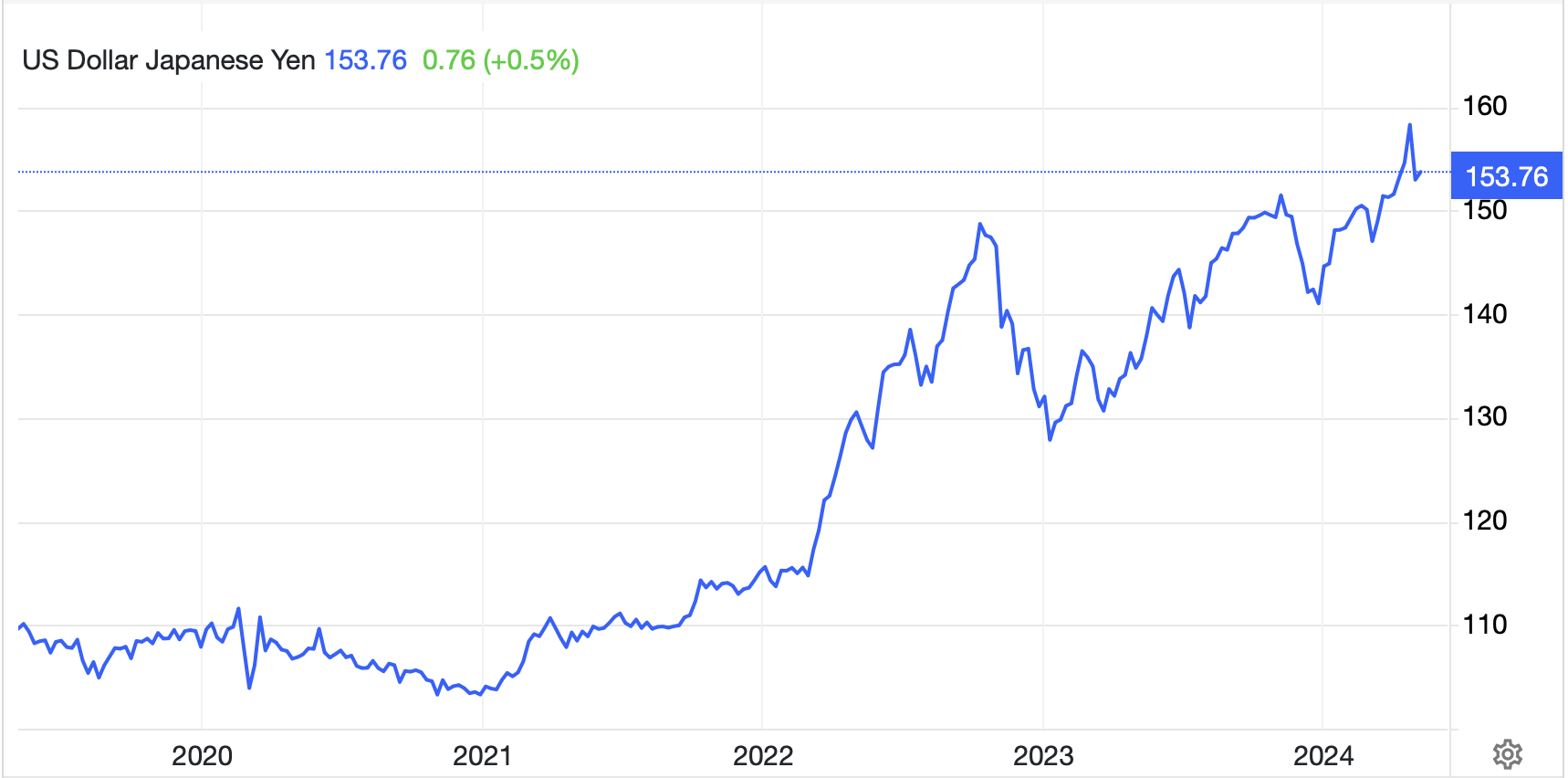
Source: tradingeconomics.com

As to the rest of the currencies out there, you will not be surprised that ZAR (+0.5%) is top of the heap this morning although a thought must be given to CLP’s 2.25% gain on Friday (market not open yet) as it rallied alongside copper’s rally.  Ironically, the one currency that is under pressure this morning is JPY (-0.5%), but remember, it has risen 4% from the levels when the BOJ first intervened, so a little bounce is no surprise.

Turning to the data this week, it is an incredibly light week, with CPI not coming until next week.

TuesdayConsumer Credit$15B
ThursdayInitial Claims212K
 Continuing Claims1895K
FridayMichigan Sentiment77.0
Source: tradingeconomics.com

As well, we have eight Fed speakers including NY president Williams and vice-Chair Jefferson.  It will be very interesting to hear how they play the apparent pivot.  While I expect that the governors are all on board, the regional presidents will have more leeway to speak their mind I believe.

And that’s what we have for today.  I believe that things have changed and that the Fed is now very clearly far more willing to allow inflation to run hotter.  Be very wary of your bond positions and watch for the dollar to remain under pressure until something else changes.

Good luck

Adf

Looks Askance

On Wednesday, twas John Williams chance
To help explain, though at first glance
Inflation is sinking
No Kool-aid, he’s drinking
So, at cuts, he still looks askance

And backing him up in this view
Was Retail Sales, which really grew
There’s no indication
That US inflation
Is going to fall down near two

The pushback by FOMC speakers continued yesterday as NY Fed president Williams was the latest to explain that although things were heading in the right direction, the committee was unlikely to cut rates anywhere nearly as quickly as the market is pricing.  Here are the money lines, “My base case is that the current restrictive stance of monetary policy will continue to restore balance and bring inflation back to our 2 percent longer-run goal. I expect that we will need to maintain a restrictive stance of policy for some time to fully achieve our goals, and it will only be appropriate to dial back the degree of policy restraint when we are confident that inflation is moving toward 2 percent on a sustained basis.” [Emphasis added]. Once again, the idea that the Fed is going to cut rates in March seems awfully remote, at least based on what they are telling us.

Now, it is entirely possible that the data starts to deteriorate more rapidly with growth clearly falling and Unemployment starting to rise more rapidly and if that were to occur, I think a March cut would not be impossible.  But then yesterday we saw a much better than expected Retail Sales print, (headline +0.6%, ex autos +0.4%) with the Y/Y growth up to 5.6% (nominal).  Data like that is not indicative of a collapse in economic activity.  The fact that much of it is reliant on a combination of massive fiscal stimulus and increased credit card debt does not mean the growth is false.  It merely sets up for weakness later.

In the end, the Fed funds futures market is backing away a bit further from that March rate cut with the probability reduced to 61% now from 70% just a week ago.  It can be no surprise that between the Williams comments and the stronger data, Treasury yields backed up 5bps and equity markets suffered a bit more, down about -0.5%.

To me, the key question is, at what point will the market accept that 6 rate cuts are not the most likely outcome this year?  Clearly, they are not ready to do so yet, although based on the equity market performance so far this year, there is a little bit of nervousness, at least, making its way through the investment community.  Analyzing the price action over the past month and considering the information that we have gotten since the last FOMC meeting, the outlier seems to be Powell’s dovishness at the press conference, not the macroeconomic data nor the commentary from other Fed speakers.  Of course, Powell’s voice is clearly the most important, but when both Waller and Williams, his two top lieutenants, reiterate that maintaining restrictive policy is the right move for now, I have to believe that the next FOMC statement is going to reiterate that stance.

What does all this say about the future?  Well, since everything is data dependent, or at least that’s what they tell us, then we need to continue to watch the data to help understand the reaction function.  The problem is that there is no consistency in the data.  For instance, in addition to yesterday’s strong Retail Sales data, we saw stronger than expected NFP and higher than expected CPI readings, all three being critical real data points.  On the flip side, we have seen weaker than expected ISM data, both manufacturing and services and Tuesday’s Empire State Manufacturing Index fell to -43.7, a level only exceeded by the Covid readings in early 2020.  In fact, that index has fallen more than 50 points in the past two months.  The upshot is that we continue to see negative survey data and solid real data.  So, I ask you, which set of data is the Fed watching more closely?

FWIW my assessment of the situation is as follows: the Fed is aware of the goldilocks narrative but has not bought into it at this stage, at least not Powell and his two key lieutenants, and they are the ones that matter. Whatever the survey data, if the hard data holds up, they are going to maintain policy right where it is.  While we know they care about surveys (look at their focus on inflation expectations), I think Powell is still very afraid of being Arthur Burns redux.  Right now, it looks like the outlier was the Powell press conference, not all the push back.  I changed my entire thesis based on that pivot and that may have been a mistake.  However, if we start to see weaker hard data, so Housing softens, PCE is soft, GDP misses expectations or something like that, look for goldilocks to make a return.  Otherwise, regardless of the survey data, I fear risk assets are going to have trouble as are bond markets which have priced in a lot of rate cuts.

Speaking of push back, we continue to hear ECB speakers on the same page as the Fed, rate cuts are not coming on the market’s current timeline.  June seems to be the earliest it will happen there unless the Fed cuts sooner.  I continue to believe given the very weak growth profile in Europe that Madame Lagarde is quite anxious to get started cutting rates, but she knows she cannot do so yet.  I imagine that Interpol will have an APB out on goldilocks pretty soon as they want to capture her and keep her in the public’s eye.

One other thing to mention away from the financial markets is what appears to be a further escalation of fighting in the Middle East.  Last night, Pakistan retaliated against Iran with missile strikes of their own, ostensibly killing Pakistani militants who were based in Iran.  Whatever the rationale may be for these moves, the one truism is that things in the Middle East are getting more dangerous and that is going to pressure oil prices higher.  We have seen that this morning, with small gains, but I would suggest that will be the direction of travel if this keeps up.

Ok, on to markets where yesterday’s lackluster US equity performance was largely ignored as Japanese stocks were just barely lower, Chinese and Hong Kong stocks finally rebounded a bit and the rest of APAC saw more gainers than losers.  European markets are firmer this morning, in what could well be a trading bounce as there was no data to encourage the process and US futures are firmer at this hour (7:30) by about 0.5%.

After yesterday’s continuation bounce in yields, this morning we are seeing a bit of a pullback with Treasury and most European sovereign yields lower by about 2bps.  The one outlier is Japan, where JGB yields picked up 3bps, although that could well be a delayed response to yesterday’s Treasury price action as the Japanese data overnight was quite soft (Machinery Orders and IP both falling in November) and not indicative of tighter policy in the future.

Aside from oil’s modest gains, gold has rebounded a bit this morning, up 0.5%, arguably on the increased tensions in Iran/Pakistan but the base metals are under pressure today.  Lately, it is very difficult to glean much information from the base metals as confusion over whether Chinese growth is real, and how overall growth is progressing seems to be keeping traders on the sidelines.

Finally, the dollar is backing off its highs from yesterday, but the movement has not been large, about 0.2% broadly across both G10 and EMG currencies.  The most noteworthy outlier is ZAR, where the rand has rallied 0.85% on the back of that gold strength.

On the data front today, Housing Starts (exp 1.48M), Building Permits (1.426M), Initial Claims (207K), Continuing Claims (1845K) and Philly Fed (-7) all show up at 8:30.  As well, Atlanta Fed president Raphael Bostic speaks twice today, early and late, so it will be very interesting to hear if he is going to push back further on the Powell pivot or agree with it.

Today brings both hard and survey data, so if it all lines up one way or the other, perhaps it will be a driver.  But my take is we will continue to see a mixed picture and so will be highly reliant on Fedspeak as after Bostic today, we get Daly and Barr tomorrow and then the quiet period.  I think a risk rebound is in order just because things have been weak.  But I am worried about the longer-term trend now that Powell is seeming more and more like the outlier, not the driver.

Good luck
Adf

On the Brink

Most pundits worldwide seem to think
The Fed is now right on the brink
Of both raising rates
And having debates
On how soon the BS should shrink

And so, today’s Minutes are key
To see if the FOMC
Has made up its mind
That they’re now behind
The curve, and need hurry QT

I am old enough to remember the last time the Fed decided that they wanted to shrink their balance sheet and normalize policy, way back in 2018.  As I recall, when first mooted, then Fed Chair Janet Yellen (she of Treasury Secretary fame) described the process of the gradual reduction as ‘like watching paint dry.’  Who knew drying paint was so exciting!  Of course, she couldn’t bring herself to even start the process.  Ultimately, the combination of slowly raising the Fed Funds rate and simultaneously reducing the size of the balance sheet (which all occurred on Powell’s watch) led to a declining stock market throughout Q4 2018 with the largest Christmas Eve sell-off ever seen in stocks as the culmination of the events.  Two days later, Chairman Powell explained he was just kidding, and tighter monetary policy was a thing of the past.

But that was then.  It’s different this time!

Actually, it’s not.  In fact, what we have learned from observing markets for many years is that it is never different.  While the catalysts may change, market responses remain pretty much the same time and again.  So, here we are three years later with the Fed’s balance sheet having more than doubled in the intervening period, equity markets having made 70 record highs in the past twelve months and the 10-year bond yielding half what it was back then. Inflation is raging, as opposed to the situation back then, and GDP, while higher than back then, has clearly peaked and is reversing some of the pandemic-induced policy giddiness.  But human nature is still the same.  Greed and fear remain the constants and investor and trader responses to policy decisions are pretty cut and dried.  You can be confident that if longer date interest rates rise, whether in a steepening or flattening yield curve, the rationale for the mega cap stocks to maintain their value is going to diminish quickly.  And as they are the ‘generals’ of the equity market rally, when they start to fall, so will everything else, including the indices.  Ask yourself how long the Fed, whose members are virtually all multi-millionaires and hold large equity portfolios, are going to sit by and allow the stock market to correct just because some Austrian school monetary hawks believe in sound money.  Exactly.

However, we have not yet reached the point where the markets have started to decline substantially, as, of course, the Fed has not yet started to even raise interest rates, let alone shrink the balance sheet.  But that is the growing consensus view amongst the punditry, that today’s FOMC Minutes from the December meeting are going to reveal the level of interest to begin that part of policy normalization.  Many analysts continue to highlight the fact that inflation is becoming such a problem that the Fed will be forced to stay the course this time.  I wish it were so, but strongly believe that history has shown they will not.  Rather, they will change the inflation calculations and continue to explain that the alternative is worse.

Yesterday, Minneapolis Fed President Neel Kashkari, the most dovish of all FOMC members, explained that he believes the Fed Funds rate needs to rise 0.50% this year as, “…inflation has been higher and more persistent than I had expected.”   It is comments such as this that have the analyst community convinced the Fed is really going to tighten this time.  But we have heard these before as well.  This is not to say that the Minutes won’t hint at QT, they very well could do so.  However, when the rubber meets the road and risk assets are falling sharply in price, the Fed will exhibit its underlying Blepharospasm, and tighter policy will be a thing of the past (as will a stronger dollar!)

Now, leading up to the Minutes, let’s take a look at what happened last night.  In the wake of a bit of equity market schizophrenia in the US, we have seen a mixed picture.  Yesterday saw the NASDAQ fall sharply (there’s that concern over higher rates) while the Dow managed to rally.  Overnight saw the Nikkei (+0.1%) bide its time but the Hang Seng (-1.6%) and Shangahi (-1.0%) both suffer on a combination of the ongoing property sector problems as well as more lockdowns in country.  Europe, on the other hand, has managed to stay in the green (DAX +0.6%, CAC +0.5%, FTSE 100 +0.2%) after PMI Services data was released a little bit softer than forecast, but still seen as quite positive.  In a way, this was a ‘bad news is good’ idea as softening growth means the ECB doesn’t need to respond to Europe’s very high inflation readings so dramatically.  Alas, US futures are flat except for NASDAQ futures, which are lower by -0.4%.

In the bond market, while yesterday saw an early sell off in Treasuries, it was mostly unwound by the end of the day and this morning yields are little changed at 1.645%.  As to Europe, yesterday also saw Gilt yields rally sharply, 12.5 bps, but they have consolidated today, falling 1bp while the rest of the continent has seen much less movement.  Clearly, there is far less concern over ECB activity than either Fed or BOE.

As to the commodity space, oil (+0.3%) is edging higher and NatGas (+2.3%) is firming on the cold weather in the Northeast.  (Of course, compared to what happened in Kazakhastan, where the government was kicked out by the president because of high energy prices, this seems rather tame!)  Metals prices are mixed with gold (+0.2%) still hanging around $1800, while copper (-0.6%) is clearly less enamored of the current economic situation.

Finally, the dollar is under modest pressure this morning, with SEK (+0.5%) the leading G10 gainer after printing the strongest PMI data around, while JPY (+0.4%) has simply rebounded from its very sharp decline yesterday, although it remains in a very clear downtrend for now.  the rest of the G10 is modestly firmer vs. the dollar at this hour, but nothing to write home about.

In the EMG space, ZAR (+0.9%) is the leader, also seeming to benefit on the back of last week’s liquidity induced decline and seeing a rebound.  We are also seeing strength in PHP (+0.7%) and CZK (+0.6%) with the latter benefitting from expectations for further rate hikes while the former benefitted from a much lower than expected CPI print of just 3.6%.  Meanwhile, on the downside, IDR (-0.4%) was the worst performer as the infection rate rose sharply and KRW (-0.25%) fell after North Korea launched another ballistic missile and rejected further talks with the US.

On the data front, ADP Employment (exp 410K) leads this morning and then the Minutes are released at 2:00pm.  Aside from the Minutes, there are no speakers scheduled, so the dollar will need to take its cues from other markets.  Keep an eye on the 10-year as a continued rally in yields should see further dollar strength.

Good luck and stay safe
Adf