
The “very near future” is when
The US and China, again
Will restart their talks
Assuming no balks
By either of these august men
That’s all that the market required
For buyers to get so inspired
Can this idea last?
Or will it have passed
Ere market resolve has expired
While all and sundry have been very confident that President Trump’s attempt to alter the structure of the global economy and world trade to a more beneficial one, in his view for the US, will fail dismally and that we are doomed to stagflation as prices rise and the economy sinks, it seems these same economic analysts have forgotten that there are two sides to the supply/demand equation. I have written before that despite all the slings and arrows that have been aimed at Trump, the US has a very strong hand in the trade game given it is THE CONSUMER OF LAST RESORT. Virtually every nation in the world has built an economy designed to be able to manufacture stuff cheaply and sell it into the largest economy in the world.
And US consumers are remarkable in their ability to continue to consume at high levels despite what appear to be significant headwinds, whether high financing costs, limited savings or slowing economic activity. But a funny thing is happening on the way to this mooted US stagflation, it’s not happening yet. In fact, as described by economist Daniel Lacalle in his most recent post, it seems that the biggest problem is not that Americans cannot find what they want to buy, it is that they only bought all this stuff because it was cheap. They will not accept significant price rises and so inventory is building up at factories while ships are stuck with containers full of stuff nobody wants, at the price. Could it be that President Trump read the room better than the economists?
I use this as preamble to yesterday’s massive equity rebound which was, ostensibly, triggered by comments from Treasury Secretary Bessent that substantive trade talks with China would begin in the “very near future.” Subsequent soothing comments by the President indicated that the days of 125% tariffs were numbered but there would be tariffs in place. As well, Mr Trump explicitly said he has no intention to fire Fed Chair Powell, despite his recent diatribe that Powell is always late to the party and should cut rates. Certainly, I agree the Fed is, and will always be, late to the party as long as they use a data driven approach. After all, by the time economic change is reflected in the data, whatever is going to change has already done so. However, I don’t yet see the rationale for cutting rates given the current economic data and the fact that inflation remains a problem.
As of this morning, following significant equity rallies around the world, one might come to believe that all the world’s problems have been successfully addressed. The fact that one would be wrong in that belief is the best example of ‘the market is not the economy’. But, hey, let’s take the rallies when they come!
From a market perspective, that was really the big story yesterday and continuing into today. Flash PMI data is not that exciting, and all the other headlines revolve around the ongoing immigration/deportation issues plus RFK Jr’s edict to remove petroleum-based food coloring from foods. So, let’s look at the markets and recap the action.
The 2.5% to 3.0% gains in the US were followed by Tokyo (+1.9%) and Hong Kong (+2.4%) performing well but nothing like Taiwan (+4.5%). The laggard last night was China (+0.1%) with other regional exchanges showing gains between 0.5% and 1.5%. Net, I suppose everybody was happy. In Europe this morning, the screens are green as well, with Germany (+2.6%) leading the way followed by France (+2.2%) and the UK (+1.3%). Again, the trade story appears to be the leading driver. And, adding to the joy, US futures are also higher between 2.0% (DJIA) and 3.0% (NASDAQ) this morning as of 6:50. And to think, just two days ago I was assured that the end was nigh. A quick look at the S&P 500 chart below does give a flavor for just how much volatility we have seen on a day-to-day basis and how narrative changes continue to have huge impacts.
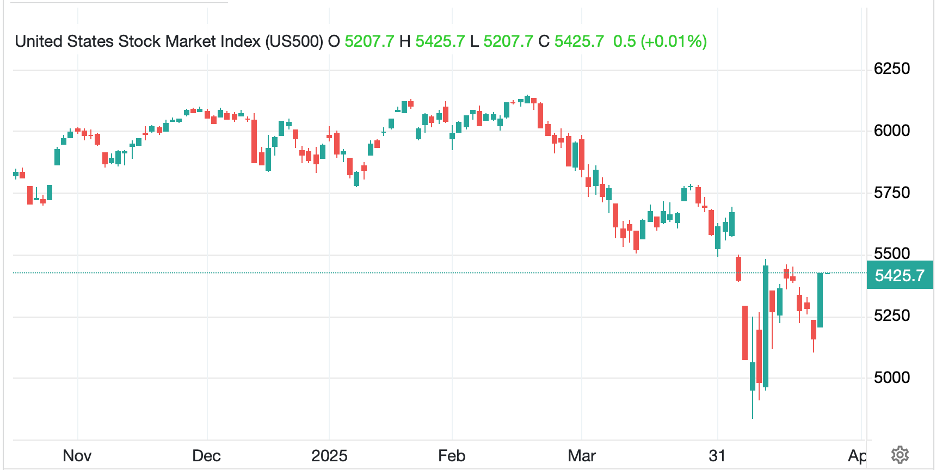
Source: tradingecomics.com
At the same time, Treasury yields have been retracing, lower by -8bps this morning with UK gilts (-6bps) also performing well, although continental European sovereigns are not seeing the same demand with bunds (+3bps) the laggard despite the weakest PMI readings with both Manufacturing and Services below 50.0, lower than last month and far lower than forecasts. The narrative of money leaving the US and heading back to Europe is certainly appealing, and seems quite reasonable as a long-term metric, but it is not clear to me that it will be driving daily price action in any market.
In commodities, oil (+1.0%) continues to edge higher although it has not yet come close to filling that massive gap lower from the beginning of the month.

Source: tradingeconomics.com
From a fundamental perspective, fears of a US recession, which remain high, as well as the IMF recently reducing their global growth forecast seem to be undermining the demand side of the equation. Meanwhile, the opportunity for significant new supply (Iran deal, Russia peace) seems quite real. I’m no oil trader but it strikes me the risk-reward here is for a further drop in prices. As to the metals markets, gold (-0.4%) fell more than $100/oz yesterday, so perhaps my view that the parabolic move was too much was correct. However, I believe this is a short-term, and much needed, correction with the long-term story fully intact. Meanwhile, silver (+1.4%) and copper (+0.4%) are modestly higher after quiet sessions yesterday.
Finally, the dollar is firmer this morning against most of its counterparts, but this is not a universal situation. While both the euro and pound have fallen -0.25%, AUD (+0.6%) is showing some oomph as it figures to be one of the key beneficiaries of a trade agreement between the US and China, no matter how far in the future. Other key gainers are KRW (+0.6%) and CNY (+0.3%), with both clearly benefitting from that same trade story. But otherwise, the dollar is mostly ascendent.
An aside here on the yen (-0.4%) which just two days ago traded below the key psychological level of 140 and this morning is back above 142. It strikes me that this is the first currency that will be reactive to any trade deal. As you can see from the below, long-term chart of the yen, it has spent the bulk of its time at far higher (dollar lower) levels. I suspect that any trade deal will include an effort to revalue the yen higher vs. the dollar, perhaps to its longer-term average of around 120.

Moving on to today’s data, we have New Home Sales (exp 680K) and then the Fed’s Beige Book at 2:00pm. I’m not sure when the surveys were taken for the Beige Book, but you can be sure they will express a great deal of uncertainty and discuss how it will reduce economic activity. You can also be sure that this will be hyped in the press. But now that everything is better (just look at the stock market) is this old news?
If we try to look past the daily gyrations to the bigger picture, I would contend the following is the case. Equity markets remain overvalued and are likely to weaken, the dollar is likely to slide as well as foreign investors slowly reallocate funds away from the US. Quite frankly, the Treasury story is much harder as the interplay between inflation and potential reduced government expenditure is highly uncertain right now, although one will eventually dominate. Finally, commodities remain far more important than their current relative weight in the global asset basket and I believe they have much further to climb in price. One poet’s views.
Good luck
Adf
 fxpoetry