
On Friday, the market was sure
The end was nigh, and we’d be poor
The dollar was sold
And stocks mem’ry-holed
While bonds sashayed like haute couture
But somehow, the end did not come
As markets around the world hum
Perhaps we should learn
That markets do churn
And pundits are typically dumb
I admit to being confused this morning as by Friday evening, the entire narrative was that the recession was here, equity markets had peaked, and the dollar was set to collapse. All the negative outcomes that have been prognosticated by doom pornsters were arriving and Friday was merely the first step.
And yet, here we are this morning, and not only did the sun rise in the East again, but equity markets throughout Asia also saw far more winners (China +0.4%, Hong Kong +0.9%, Korea +0.9%, India +0.5%, Singapore +1.0%, Thailand +1.25%, Philippines +0.7%) than laggards (Taiwan -0.2%, Malaysia -0.4%, Indonesia -1.0%, New Zealand -0.35%). As to Europe, it is universally green (DAX +1.25%, CAC +0.8%, IBEX +1.4%, FTSE 100 +0.3%) and US futures, at this hour (6:35) are higher by 0.7% or so.
Meanwhile, the dollar is higher against the euro (-0.15%), yen (-0.2%) and Swiss franc (-0.5%), although we have seen modest gains in some G10 currencies (GBP +0.15%, AUD +0.15%). And if we look across the EMG bloc, while KRW (+0.4%) has rallied along with CNY (+0.2%), those are the outliers with the rest of the space softer by about -0.2% or so. In other words, there has not yet been a wholesale rejection of the dollar on global foreign exchanges.
As to bond yields, after Friday’s dramatic decline, falling 15bps in the hour after the NFP report, they have largely stagnated, rising 1bp this morning. European sovereign yields have slipped about 3bps on average as they continue the Friday move having closed before all the fun was finished. In fact, while I have chosen the EURUSD exchange rate as a graph to depict the movement, basically every chart looks the same as this with a dislocation at the 8:30 mark on Friday and then a new range quickly established.
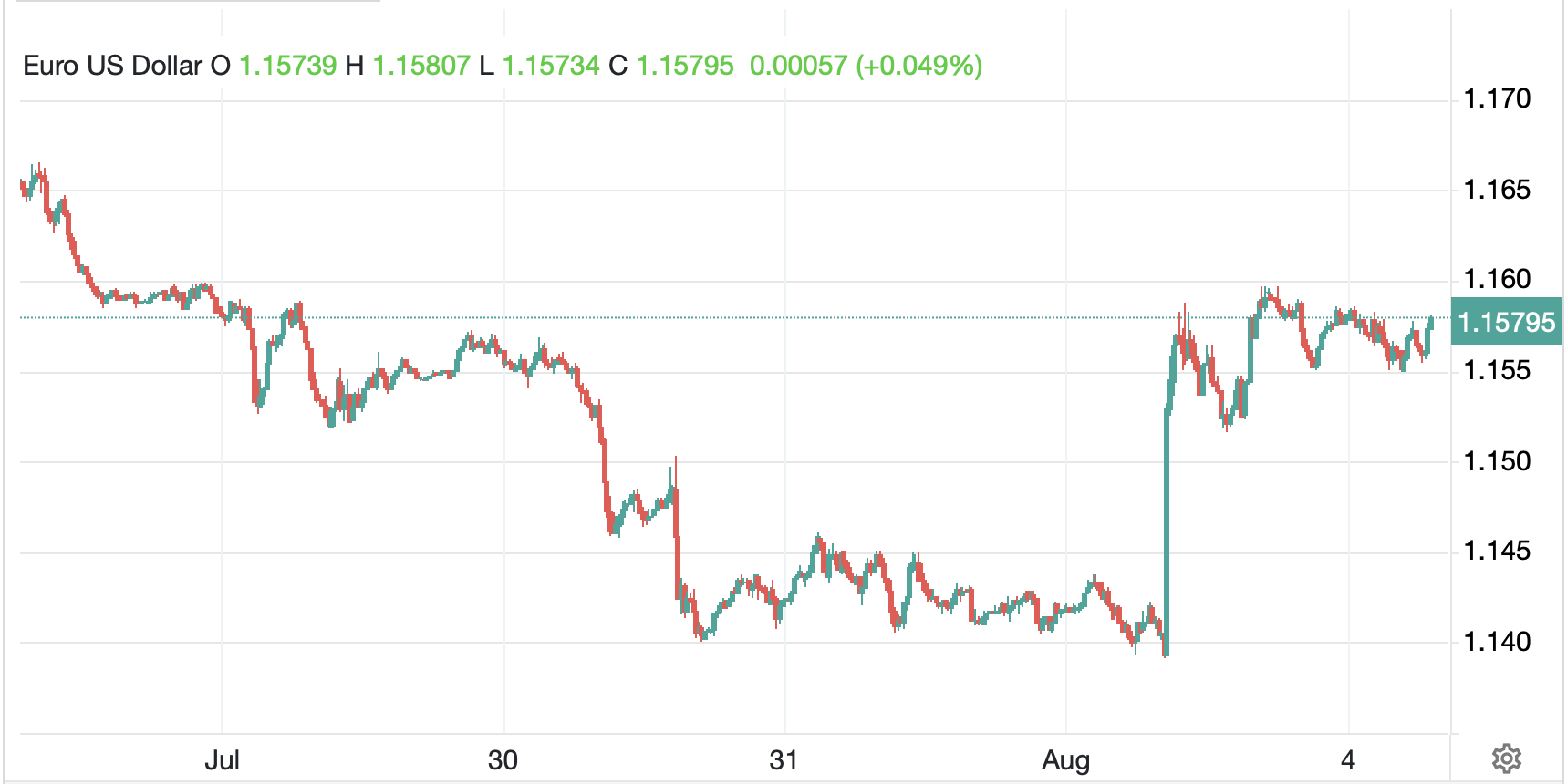
Source: tradingeconomics.com
I highlight this because so frequently, the narrative gets ahead of itself, and Friday was one of those days. Yes, as I explained last night, the NFP data was weak, albeit still positive regardless of the fireworks surrounding the firing of the BLS Commissioner. And remember, the idea that President Trump fired McEntarfar because the data displeased him does not mean she was not incompetent. Certainly, nothing in her career demonstrates keen economic insights. But that is still the talking point du jour.
However, that is a tired story at this point. In fact, arguably, the reason it is getting so much press is that there is precious little else new to discuss amid the summer doldrums. After all, the Russia Ukraine war continues apace with no end in sight, although it seems the rhetoric has increased with ex-president Medvedev seeming to threaten nuclear war and the US moving attack submarines closer to Russia.
Texas Democratic state legislators have fled the state to avoid a special session where redistricting is due to be completed, so that has a lot of headlines, but seems likely to end like the last time this occurred, with the redistricting being completed, and Fed Governor Adriana Kugler stepped down a few months earlier than her term ends which opens another seat on the Fed for Mr Trump to fill.
Of these stories, while our antenna should be raised given the Russia nuclear war scenario, it still seems a very low probability event, while Texas may matter in the midterm elections if they successfully redistrict as it is supposed to ensure another 5 Republican seats in the House. But a new Fed governor, perhaps a precursor to the next Chair will have tongues wagging in the market until the seat is filled, and then until Powell is gone.
So, take your pick as to what is important. Personally, I think the actual payroll data is the most important issue as we continue to see significant gyrations within the numbers. Less government hiring (I read that 154,000 federal employees took the buyout) is an unalloyed good for the nation. After all, if nothing else, given the average federal government employee salary is $106,382 (according to Grok) then that is about $16.4 billion less expenditure by the Federal government. Every little bit helps. In fact, all the data we have seen of late shows that the private sector continues to grow while the public sector is shrinking. Over time, that is undoubtedly a better situation for the US and will reflect in the value of US assets.
But that’s really all there is to discuss, so let’s look at the data upcoming this week:
| Today | Factory Orders | -4.9% |
| -ex Transport | 0.1% | |
| Tuesday | Trade Balance | -$61.6B |
| ISM Services | 51.5 | |
| Thursday | BOE Rate Decision | 4.00% (-0.25%) |
| Initial Claims | 220K | |
| Continuing Claims | 1947K | |
| Nonfarm Productivity | 1.9% | |
| Unit Labor Costs | 1.6% | |
| Mexican Rate Decision | 7.75% (-0.25%) |
Source: tradingeconomics.com
In other words, while we will hear from two more central banks as they cut rates (compared to a Fed that remains on hold, for now) it is hard to get that negative on the dollar. Fed funds futures are pricing an 87% chance of a rate cut in September and now a 56% chance of three cuts this year, one at each meeting left, so that will weigh on the buck a bit, but if the US is cutting because recession is arriving, the economic situation elsewhere will be more dire. After all, the US remains the consumer of last resort, and if the US pulls back, everyone else will feel it.
The big picture remains that the broader dollar trend is lower, but it is starting to make a case that trend is ending. The data this week is largely second tier, and we need to wait until next week for CPI. I have a feeling we will see very little net movement until then.
Good luck
Adf
 fxpoetry