
The Zeitgeist Could Shatter

While crime throughout DC has dropped
And Trump’s Fed demands haven’t stopped
The story today
That really holds sway
Is whether Nvidia’s topped
 
The war in Ukraine doesn’t matter
Nor does if the yield curve is flatter
‘Cause stonks must go higher
And that does require
Good news, or the zeitgeist could shatter


Some mornings things just are not that interesting in markets despite the ongoing events happening around the world.  Arguably, the biggest headlines revolve around the remarkable decline in crime in Washington DC, which while most of the mainstream media decried the President’s actions at first, has grown in popularity, even amongst his foes.  From a market perspective, the number of stories and editorials written about President Trump’s efforts to fire Fed governor Lisa Cook has risen exponentially, with many still trying to explain the Fed will lose its independence if Trump is successful.  (Given they have not been independent since 1987, I would take this with a grain of salt).  The other noteworthy story is that the EU is going to fast-track legislation to remove all tariffs throughout the EU on US industrial good imports, one of the results of the trade negotiations.

But, while those may be of passing interest, the thing in markets that really has tongues wagging is the fact that Nvidia is set to release their Q2 earnings this afternoon after the equity markets in the US close.  I must admit, thinking back to the tech bubble in 2000-01, I do not remember any single company garnering the amount of attention that Nvidia gets these days.  Perhaps Cisco Systems is the closest analogy, but it was nowhere near this level of interest and excitement.  While this is an imperfect analysis, I think it is worth looking at the charts of both Nvidia and Cisco (from finance.yahoo.com) to help you see the magnitude of the rise in each case.  It is certainly not hard to draw the conclusion that Nvidia may be peaking.  After all, if it declines by 75%, it will still have a market cap > $1 trillion!

NVDA
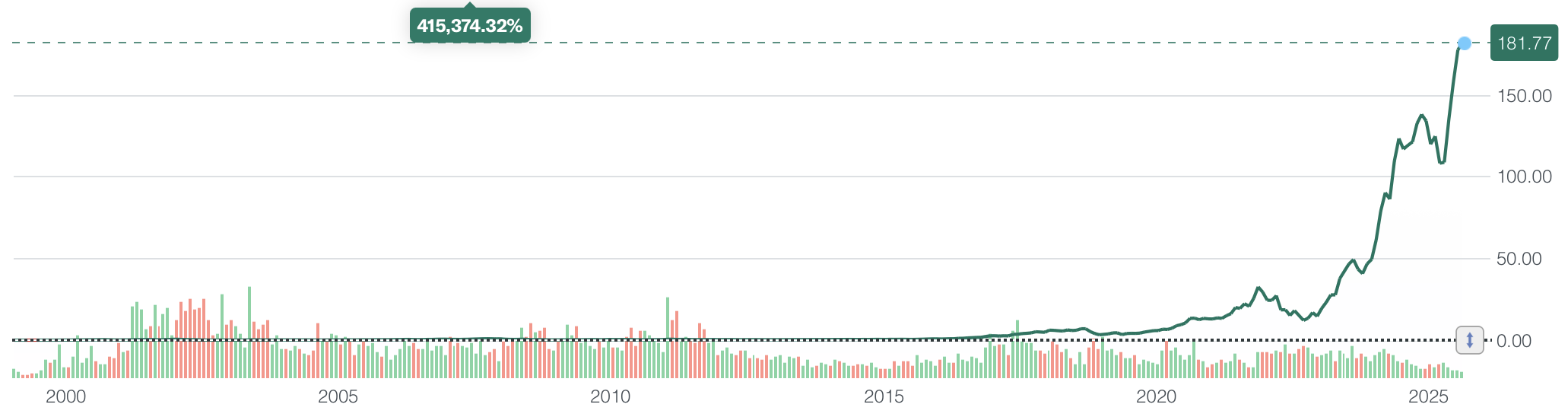
CSCO

I think it is reasonable to ask whether AI is a bubble.  I also think it is reasonable to ask whether the so-called hyperscalers, Meta, Microsoft, Alphabet and Amazon, are spending too much on building out their AI platforms.  This would be the case if the promised revenues never materialize.  Certainly, other than for Nvidia, those revenues are paltry at best so far.  But these are all observations from a poet who doesn’t follow the stock closely and simply cannot avoid some of the story because it is so prevalent everywhere.  FWIW, which is probably not very much, my take is that history has shown that new innovations, e.g. the automobile, electricity, the internet, can have remarkably wide-ranging implications but usually take far longer to achieve those ends than equity investors assume.  In other words, the idea that the megacap companies are overvalued seems pretty compelling.

Enough of my amateur equity analysis, and I’m sorry, but that is all that seems to be of interest today.  So, let’s look at how markets have behaved overnight ahead of the news this afternoon.  After modest afternoon rallies resulted in higher closes in the US yesterday, Japan (+0.3%) followed suit as did Australia (+0.3%), but both China (-1.5%) and Hong Kong (-1.3%) fell sharply, reversing some of their recent gains as Chinese industrial profits fell -1.7%, a worse than expected outcome, and it seemed to have triggered some profit taking.  With that in mind, I have read a number of analysts who have become of the opinion that Chinese equities are setting up for a much larger move higher based on additional stimulus as well as the fact that Chinese interest rates are the lowest in the world right now (ex-Switzerland).  Elsewhere in the region, India (-1.0%) lagged alongside China and most of the others had much less movement in either direction.

In Europe, the picture is mixed with the CAC (+0.4%) the leading gainer which looks very much like a reaction to the past two sessions’ sharp declines.  Spain (-0.4%) is lagging, although there is no particular news, and Germany (-0.15%) is also softer after the GfK Consumer Confidence report was released at a weaker than expected -23.6.  As to US futures, at this hour (7:25) they are ever so slightly higher.

In the bond market, despite all the anxiety over the Fed and Trump’s attempt to remove Governor Cook, 10-year yields are higher by 1bp after falling 3bps yesterday.  European sovereign yields are lower by -1bp across the board and JGB yields are unchanged.  In other words, while the media’s hair is on fire, clearly the market’s is not.

In the commodity space, oil (-0.1%) is little changed this morning, maintaining yesterday’s declines which appear to have been a result of Russia seeking to export more crude after Ukrainian attacks on Russian refineries have slowed output.  Gold (-0.6%) which saw a strong rally yesterday is falling back a bit, but remains in that tight range I showed yesterday, although both silver (-0.9%) and copper (-1.3%) are under more pressure this morning, likely on the back of a stronger dollar.

Speaking of the dollar, it is firmer across the board this morning, rising 0.5% vs. the euro, yen and Aussie, with slightly smaller gains vs. the other G10 currencies.  In emerging markets, ZAR (-0.85%) is the laggard, not surprisingly on the back of weaker precious metals prices, but PLN (-0.75%) is also under pressure on a combination of the weak euro and concerns over the lack of progress in the Russia/Ukraine war.  Even CNY (-0.15%) is weaker despite a renewed belief that China is going to allow the yuan to strengthen as part of any trade deal.

There is no front-line data to be released today, with only EIA oil inventories expecting a modest net draw.  Richmond Fed president Barking speaks at 12:45 but given he just explained his views yesterday, that he didn’t foresee much change in rates at all given the current state of the economy, I cannot imagine he will have changed that view.

And that’s all we have today.  I anticipate a lackluster session in all markets as traders await the Nvidia numbers later.  Of course, President Trump could surprise us all with an announcement on Russia, the Fed, or any of a number of other situations, but those are outside my ability to anticipate.  The market is still pricing an 87% chance of a September cut and an 80% chance of two cuts by December.  If the Fed gets aggressive, for whatever reason, the dollar will suffer.  But that is not yet the case, so range trading seems the best bet.

Good luck

Adf

One, Two, Three

On Monday, no one could agree
So, Powell unleashed; one, two, three
At least with respect
To how they dissect
The prospect for rate cuts they see
 
For Bostic, he sees only one
Before the committee is done
While Cook thinks that two
Are likely to do
And Goolsbee said three need be spun


During a session with very little new news, and ultimately, very little in the way of net market movement, it was quite interesting to hear from three different Fed speakers with somewhat different views of what the future holds.

In order of their views, as opposed to the timing of their comments, Atlanta Fed President Raphael Bostic reiterated his view from Friday in a different venue.  He explained that given the resilience of the economy, he sees little reason for any rate cuts in the near term and that his ‘dot’ was for just one cut this year, later in the year.  The thing about Bostic is he has proven to be flexible, arguably adhering to the Keynesian concept of, when the facts change, he changes his mind.  While it is not clear to me that the facts have actually changed, his perception of them certainly has.  At this point, it appears that he has become one of the more hawkish FOMC members and he is a current voter on the FOMC.

One step further toward the median we found Governor Lisa Cook, who explained that “the path of disinflation, as expected, has been bumpy and uneven, but a careful approach to further policy adjustments can ensure that inflation will return sustainably to 2% while striving to maintain the strong labor market.”  In other words, we have been surprised by the two consecutive hotter than expected CPI reports and so despite our fervent desire to cut rates as quickly as possible, if we were to do so, whatever credibility we still have would be thrown away.  At least, that is how I read her comments as she is a clear dove and desperate to cut.  To her credit, as a governor, she is making the effort to be a bit more restrained.

Lastly, we heard from Chicago Fed President, Austan Goolsbee, who during his interview (at Yahoo! Finance) quickly highlighted that his ‘dot’ was for three cuts this year.  He further explained that housing was the problem, at least with respect to their forecasts, and why they had expected inflation to decline more rapidly. Now, based on the housing data we continue to see, at least the price data, inflation is unlikely to decline much further at all.  Add in the fact that commodity prices, notably energy prices, have been rebounding for the past month and any hopes for another leg lower in either CPI or PCE are slipping away.  Also, Goolsbee is not a current voter, so many take his views a bit less seriously.

Now, let me ask, do you feel more enlightened?  Me neither.  If I were to assess the current situation, my read is that the majority of the FOMC really does want to cut rates as they believe they have done enough regarding inflation.  Frighteningly, there was an article in the FT this morning from Mohamed El-Erian, claiming that the time is ripe for allowing inflation to run hotter in order to support nominal growth.  We know that is every FinMin’s wet dream, but historically central bankers pushed back on that thesis.  However, El-Arian now claims that the central banks are on board as well.  If this is true, the only conclusion is that all fiat currencies are going to decline in value vs. stuff.  The relative pace of these declines will ebb and flow based on interest rate differentials and other circumstances, but it is not a net positive for the ordinary consumer.

Ok, let’s turn our attention to the overnight session and how markets are behaving.  The bulls have to be disappointed that the recent Fed speakers have not been more dovish, and we have seen that in another lackluster equity session in the US yesterday, with all three major indices lower by about -0.3%.  In Asia, while Japanese shares were essentially unchanged, we saw some strength in China and Hong Kong with the noteworthy story being President Xi’s invitation to keep several US CEOs currently visiting there, in country with the promise of a meeting with him.  The read is he is open to deeper business relationships.  As to the rest of the region, equity markets were mixed with some gainers and some laggards and no large movers.  As to Europe this morning, the color on the screen is green, with a few gains of 0.5% (Germany and Spain) and the rest much more subdued.  US futures are pointing higher at this hour (7:00), by about 0.5%, so the bulls are back.

In the bond market, yields have backed off a bit with Treasuries lower by 2bps and European sovereigns falling between 3bps (Germany) and 6bps (Italy) as the ECB speak continues to point to rate cuts clearly coming, with more hope for April making its way into the market, at least according to Italy’s Panetta.  In what cannot be a huge surprise, 10-year JGB yields remain unchanged as the idea of a tightening cycle there is slowly ebbing from traders’ minds.

In the commodity markets, oil (+0.2%) is creeping higher again as Russia has indicated it is going to restrict production alongside the lost output from refinery damage caused by Ukraine.  As well, after the UN Security Council vote yesterday, it appears that concerns are rising that there is no chance of a ceasefire anytime soon.  Meanwhile, gold (+1.2%) is screaming higher this morning and once again approaching $2200 as what appears to be a combination of growing geopolitical jitters combines with the growing awareness by market participants that inflation is not going to be addressed has investors seeking alternatives to fiat currencies.  Base metals, though, are not seeing the same boost, although are a touch higher overall.

Finally, the dollar is under some pressure this morning with most G10 currencies firmer, although the Swiss franc (-0.2%) is suffering a bit.  In fact, the biggest winner is NZD (+0.45%) but there is precious little to explain this movement.  One currency that is not gaining is the yen, which is unchanged on the session while the dollar remains just below its multi-decade highs set back in October 2022.  In the EMG bloc, the story is more mixed with some gainers (CZK +0.2%, HUF +0.3%) and some laggards (ZAR -0.3%, TWD -0.2%), but as you can see, the movement has been muted.

On the data front, this morning brings Durable Goods (exp 1.1%, 0.4% ex-transport) and Case Shiller Home Prices (6.7%). We also see Consumer Confidence (107.0) at 10:00.  There are no Fed speakers scheduled, but do not be surprised if there is an interview or two from a news source as they continue to try to tweak their message.

To me, the big picture is that there has been a clear relaxation by the Fed, and other central banks, in their attitude toward inflation.  As such, I expect to see risk assets perform and bonds lag.  However, regarding FX, it is all about the timing of the changes that are announced, or guided, rather than the absolute destruction in their value over time.  For now, though, the Fed remains the tightest policy around and the dollar should benefit because of that.

Good luck

Adf