
What He’s Sought

On Monday, the market did naught
As traders were giving much thought
To how Jay explains
The work that remains
For him to achieve what he’s sought

And so, while no change is expected
In rates, look at what is projected
The June dot plot showed
The Fed’s preferred road
Was four cuts will soon be effected

Once again, the overnight activity remains fairly dull as traders and investors around the world await the results of tomorrow’s FOMC meeting.  At this point, it seems quite clear the Fed will remain on hold tomorrow leaving Fed funds in a 5.25%-5.50% range while continuing their QT program.  With this in mind, all the excitement will come from the new Summary of Economic Projections (SEP) which includes the dot plot.  The dot plot is the graphical representation of the FOMC members’ expectations for the path of Fed funds going forward.  Below is the most recent release from the June meeting (chart from Bloomberg).
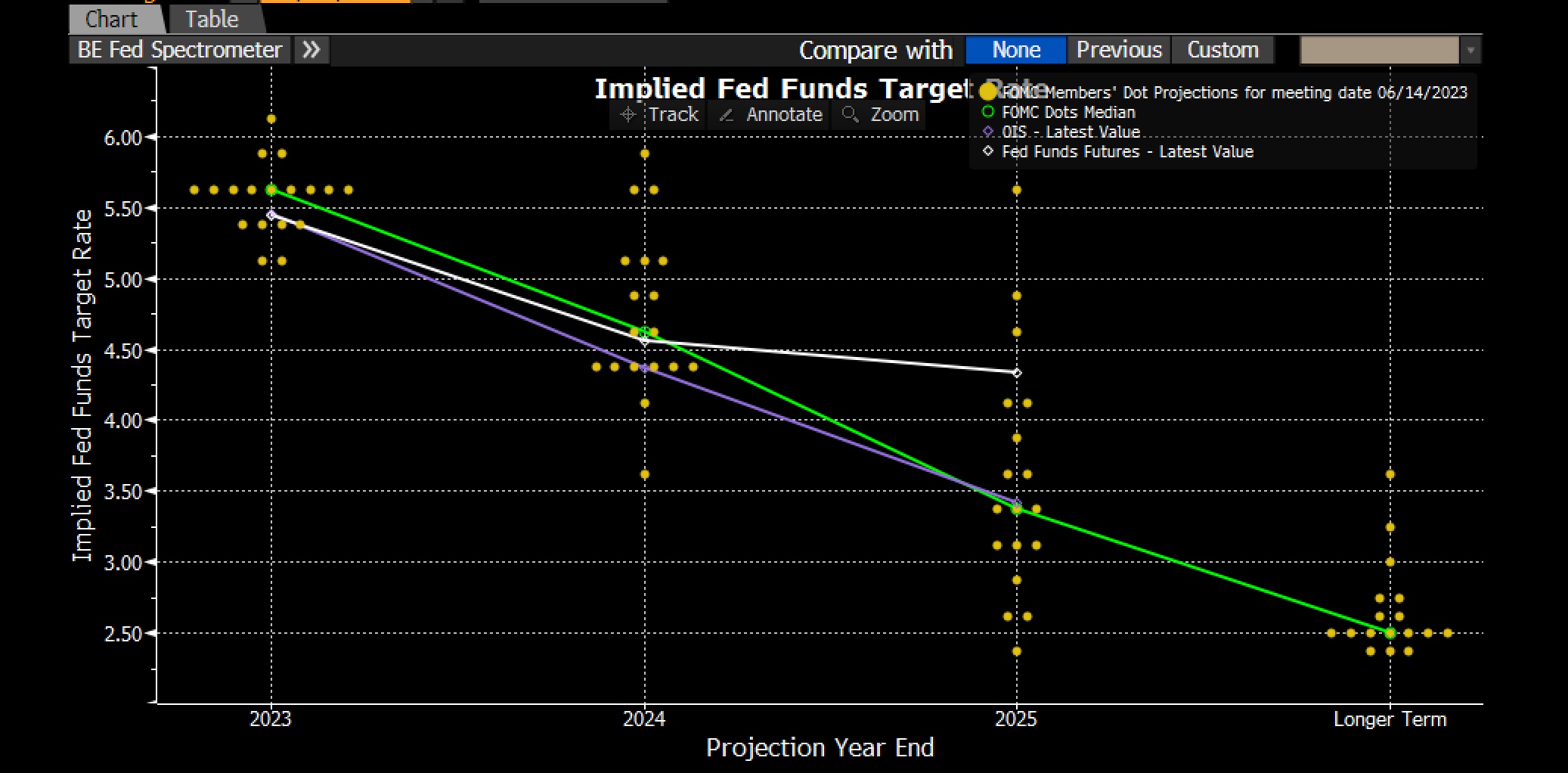
The chart shows each of the FOMC members’ forecasts for where Fed funds will be at the end of 2023, 2024, 2025 and over the long term.  The green line shows the median forecast which in June indicated a belief there will be one more rate hike in 2023 and then four rate cuts in 2024 with another five cuts in 2025 before eventually seeing Fed funds move back to the perceived ‘neutral’ rate of 2.5%.

However, let us consider how some alternative scenarios might evolve.  For instance, I continue to wonder why the Fed will be cutting rates by 100bps in 2024 if they no longer forecast a recession in the US.  After all, if the economy continues to chug along with rates at 5.5%, what purpose would be served by cutting rates?  And if the economy does enter a recession next year, something which seems realistic, then the Fed will be cutting far more than 100bps.  It’s funny, if you look at the dispersion of expectations for 2024, there is one member who feels certain a recession is coming, with an expected rate of 3.625%, and another one who sees higher for longer as lasting the entire year.  At least those two members are making some sense.  However, the idea that the Fed will cut just because, without a more severe economic shock, seems quite unlikely.  After all, Chairman Powell has invoked the ghost of Paul Volcker numerous times and explained they will not be fooled by a temporary decline in inflation.  Rather, they are in this for the long haul and will win the battle.

There are those who would argue that the Fed will cut rates, regardless of the economic situation, because the US cannot afford to continue to pay interest at the current level on their >$32 trillion in debt.  As such, Powell will feel enormous pressure from the administration to reduce rates to help the government.  Now, that is the exact opposite of central bank independence, but certainly not an impossible outcome.  But absent that type of situation, it strikes me that we remain a very long way from the Fed achieving their target inflation rate of 2.0%.  At this point, the one thing Powell has made abundantly clear is that he will not stop until they achieve that goal.  

Another fly in the rate cutting ointment is the price of oil.  Again, this morning it is higher, +0.8%, and now above $92/bbl and seemingly approaching the magical $100/bbl level.  In the wake of the Russian invasion of Ukraine, the Biden administration released some 300 million barrels from the US’s Strategic Petroleum Reserve (SPR) which helped moderate price increases at the time.  However, the ability to repeat that exercise does not exist as currently, the SPR only holds about 350 million barrels and there are actual physical constraints regarding the integrity of the salt domes in which the SPR is kept.  If too much is released, the domes could cave in.  When considering this alongside the ongoing production cuts from OPEC+ as well as the administration’s effective war on domestic oil production, it is reasonable to conclude that oil prices have higher to climb.  Working our way back to the Fed, the problem is that high energy prices ultimately become embedded in all prices, as even services require energy to be accomplished.  This underlying cost pressure is going to prevent any significant decline in the rate of inflation and, in turn, support the Fed’s higher for longer narrative for even longer.

Wrapping up the discussion, I would contend that absent a sharp recession, the Fed is not going to be pressured into cutting the Fed funds rate anytime soon.  Instead, I expect that we will continue to see longer end rates rise slowly as the combination of massive new issuance of Treasury debt and lingering inflation will require higher yields to find buyers.  Currently, the two largest non-Fed holders of Treasury securities are China and Japan, and both of them have been slowly liquidating their portfolios as they need dollars to sell in the FX markets in order to support their own currencies.  When push comes to shove, I expect that we will see US rates retain their advantage over other G10 currencies and that it will continue for a while to come.  As such, I continue to expect the dollar to outperform, at least until something really breaks.  However, what that something is remains open to debate.

Turning to the overnight session, which was quite uninteresting as mentioned above, we saw mixed to weaker performance in Asian equities, with only the Hang Seng managing to eke out any gains at all, while European bourses are mixed with the major exchanges all within 0.2% of yesterday’s closing levels.  Yesterday’s US performance was as close to unchanged as it could get while being open, and this morning’s futures market is showing tiny gains (<0.1%) at this hour (8:00).

Bond markets are somewhat mixed on the day, with Treasury yields backing up 2bps, while UK gilt yields are lower by 4bps and everything else is in between.  Eurozone final CPI for August was released with the headline ticking down 0.1% to 5.2%, but core unchanged at 5.3%, with both, obviously, still well above the ECB target.  Madame Lagarde must be praying quite hard for inflation to fall further as she made it clear she does not want to raise rates again.  In the end, the Eurozone has myriad problems with sticky high prices and slowing growth, an unenviable position.

Aside from oil’s gains, gold has been performing relatively well lately, which given the dollar’s resilience and higher interest rates seems somewhat odd.  One possible explanation is that there continues to be significant demand in Asia, where, for example, the Shanghai Gold exchange price is currently some $30/oz higher than on the COMEX, and this spread has been growing.  We have heard much about the record amount of gold buying by central banks this year, and this seems of a piece with that outcome.  However, looking at industrial metals, both copper and aluminum are softer this morning as the prospects for Chinese growth diminish and with them so do prospects for demand for those metals.

Finally, the dollar is a bit softer this morning vs. most of its G10 counterparts with NOK (+0.75%) leading the way higher on the back of oil’s continuing rally.  In fact, the entire commodity bloc is at the top of the charts today.  However, in the EMG bloc, we are seeing more of a mixed picture with an equal number of gainers and laggards and none showing exuberance in either direction.

On the data front today, we see Housing Starts (exp 1439K) and Building Permits (1440K) as well as Canadian CPI (3.8% headline, 3.7% core), with both measures rising and keeping pressure on the BOC.  There are still no speakers, so my take is that things will be dull until tomorrow’s FOMC announcement at 2:00pm.

Good luck

Adf
Baked in the Cake

A quarter is baked in the cake
Ere next time, when Jay takes a break
At least that’s the view
Of so many who
Get paid for, such statements, to make

The question, of course, is why Jay
Would wait, lest inflation’s at bay
The narrative, though,
Is all-in that low
Inflation is now here to stay

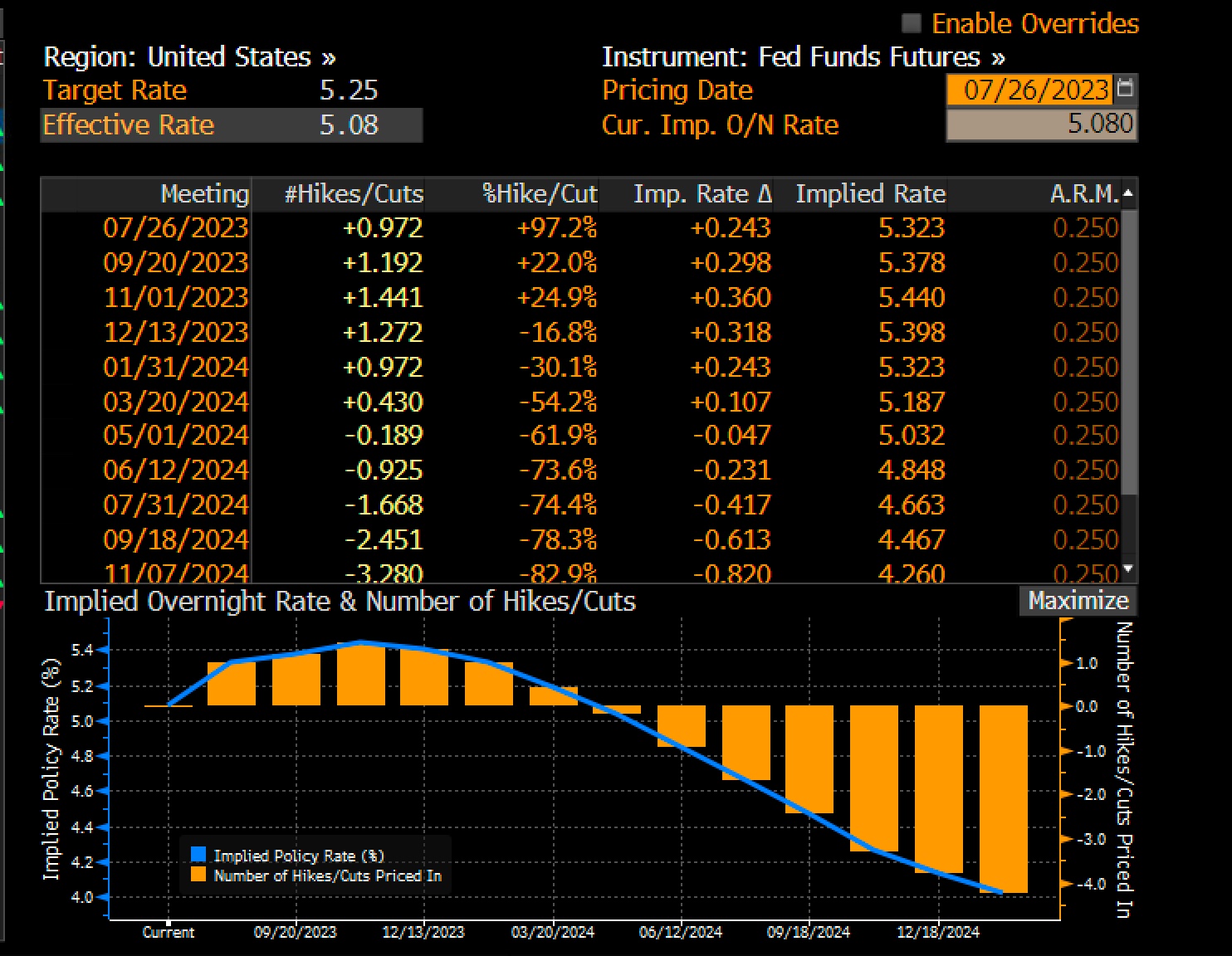
Well, it’s Fed Day so all focus will be there until this afternoon at 2:00 when the Statement is released and then, probably more importantly, at 2:30 when Chairman Powell begins his press conference.  Under the guise of a picture is worth a thousand words, I believe the next two charts, both unadulterated from Bloomberg are very effective at describing the current market expectations.  The first is a tabular and graphic depiction of the Fed funds futures market over the next year, which shows that today’s hike is fully priced in, and then there is a just under 50% probability of a hike either September or November.  After that, though, the market is convinced that Fed funds are going to fall, with more than 100 basis points of decline priced in through 2024.

Now, compare that to the second chart, the Dot Plot from the June FOMC meeting:

In truth, the two curves look pretty similar with perhaps the biggest difference the Fed’s current belief that they will absolutely hike twice before the end of 2023 rather than simply a 50% probability of such.  So, can we just assume this is the way things are going to be?  After all, if markets and the Fed agree on the same outcome, it seems likely to be realized, no?

Alas, this is where the narrative is based on crystal balls, not on data.  Whether it is the punditry or the Fed (or the FX Poet), nobody knows how things are actually going to play out.  One of the things that seems to be a throwaway line by every Fed speaker but is actually the most important part of the commentary is that their views are based on, ‘if the economy evolves as we expect it to.’  The problem is that the history of Fed prognostications is awful. 

Obviously, the most recent glaring error was the ‘inflation is transitory’ narrative that they peddled for a year while inflation was rising sharply for many very clear reasons.  Why we should think that their modelling prowess has improved since then is beyond me.  I have often opined that the problem for the Fed is that every one of their models is broken since they don’t accurately reflect the economy, not even a little bit.  Add to that the underlying premise which is that inflation is naturally at 2% and will head back there on its own, something with exactly zero empirical or theoretical support, and you have a recipe for policy errors.  

The latest policy error was the transitory delay, but perhaps the bigger problem for the Fed is the potential for a relatively unprecedented set of economic variables with higher than target inflation combined with slow economic activity yet low unemployment (due to the shrinkage of the labor force.). I don’t think their playbook has a play to address that problem and I fear that the politics of the outcome will have a disproportionate impact on any policies they implement.  If there is one thing of which we can be sure, it is that political solutions to economic problems are the worst kind with the longest-term negative impacts.  

It is for this reason that Powell’s press conference is so widely anticipated as that is where we will learn any new information.  But until then, I expect that markets will remain relatively benign.

A quick tour of the overnight session shows that there was no follow through to Monday night’s Chinese equity performance with the main exchanges in China and Japan all modestly lower.  Europe, however, is having a much tougher time this morning with the CAC (-2.0%) leading the way lower as concerns seem to be growing over the ongoing central bank tightening policies continuing into a recession.  There was vanishingly little data and no commentary of note, but we have seen some weaker than expected earnings numbers out of the continent, a sign that not all is well.  As to US futures, they are essentially unchanged at this hour (8:00) as investors await this afternoon’s Fed meeting.  I would be remiss, though, not to point out that there were several worse than expected earnings numbers, notably from Microsoft, which is a chink in the armor of the idea of infinite growth for AI.

Meanwhile, bond markets are under pressure in Europe with yields higher across the board there, on the order of 2.5bps to 3.5bps.  This appears to be a move based on expectations of continuing higher interest rates from the ECB.  Treasury yields, though, are unchanged on the day, and at 3.88%, currently sit right in the middle of the trading range we have seen for 2023.  As to JGB yields, they slipped 2bps last night with limited concern that Ueda-san is going to rock the boat tomorrow night.

Oil prices (-1.0%) are a bit softer, but this looks like a trading correction after a strong run higher rather than a fundamentally based story.  Base metals are also softer this morning as the Chinese inspired euphoria seems to have dissipated quickly while gold (+0.4%) is creeping higher despite rising yields and a modestly firmer dollar.  It appears to me there is an underlying bid to the yellow metal that will not go away regardless of the macro situation.

Finally, the dollar is slightly firmer this morning as risk aversion seems to be supporting the greenback.  JPY (+0.35%) is the G10 outlier on the plus side with the commodity bloc under the most pressure (AUD -0.7%, NOK -0.7%, SEK -0.5%).  In the emerging markets, THB (+0.7%) has been the best performer after a surprisingly positive Trade Balance with a large negative one anticipated.  However, the rest of the EMG space is mixed with some very weak currencies (HUF -1.0%, ZAR -0.9%) and some other modestly strong ones (BRL +0.4%, MYR +0.3%).  The forint story continues to revolve around central bank activity, with concerns they will ease policy with inflation still high, while the rand is simply suffering from its commodity basis.  Meanwhile, the real jumped after Fitch upgraded the country’s debt rating BB (stable) from BB-.

Ahead of the FOMC decision, we see New Home Sales (exp 725K) but that will be a nonevent given the afternoon’s agenda.  It is a fool’s errand to try to anticipate exactly how Powell will respond to the questions he receives, or even exactly how they will phrase their current views.  As such, today is one to watch and wait, then evaluate afterwards.

Good luck

Adf

Nothing to Fear

There is an old banker named Jay
Who, later, this St Patrick’s Day
Will tell us that rates
Right here in the States
Won’t change ‘til the jobless get pay

Inflation is nothing to fear
As there’s no sign it will appear
But should it arise
More tools he’ll devise
To kill it by end of this year

Welcome to Fed day folks, with the eyes of all market participants anxiously awaiting the stilted prose that is presented every six weeks.  At this point, there is no concern that the Fed is going to actually change policy as it stands, rather the anticipation is all about what they imply about the future path of activity.

Generally, the Fed statement will start off discussing the nature of the economy and their subjective assessment before going on to describe the actions they are taking.  As this is a quarter-end meeting, their team of PhD’s will have produced new economic forecasts, which based on the recently passed stimulus bill, as well as the recent trend of improving economic activity, is likely to highlight real GDP growth in 2021 of at least 5.0%.  There are many calls on the Street for growth rates topping 7% this year, so 5% would hardly be seen as aggressive.  In addition, while the Fed is acutely aware that inflation numbers are going to rise in the near-term, as the base effects of last year’s Covid inspired economic disaster will now form the comparison, we have consistently heard that any inflation will be transitory and so is of no concern at this time.

The question is, how will they justify continued ZIRP and QE with GDP growth of 5% or more?  And, the answer is that Chair Powell will simply focus on the unemployment situation and once again explain that until those 10 million jobs that were lost to Covid are regained, the Fed will be striving to achieve maximum employment.  It is doubtful there will be any mention of rising yields in the statement, but you can be sure that the first question in the press conference will take up the subject, as will a number of others.

The other thing we get at this quarter-end meeting is the latest dot plot, which is a compilation of each of the FOMC members’ views of where interest rates will be over the next 3 years as well as in the ‘long run’.  The median outcome for each year has become the key statistic and last time it showed that rates were not expected to rise until after 2023, although the longer term view was that 2.5% was likely over time.  However, currently the market is pricing a 0.25% rate hike by December 2022 and two more in 2023 which is far more than the Fed had indicated.  Of great interest to all will be whether this view is changing at the Fed, and some tightening is expected prior to 2023.  Certainly, the bond market is pushing that narrative, with yields continuing to press higher (10-year treasuries are +3bps this morning and, at 1.65%, trading at a new high for the move.)

Remember, too, that prior to the Fed’s quiet period, when the bond market was selling off and yields rising, Powell and friends showed insouciance over the issue, declaring it a vote of confidence in the economy.  At least two weeks ago, there was little concern over rising yields and how they might impact the Fed’s efforts to stimulate further job growth.  Is that still the case?  Since Powell last spoke, the 10-year yield has risen another 9 basis points and shows no signs, whatsoever, of stopping soon.

So, there you have it, the Fed needs to walk that fine line of explaining things are getting better but there is no reason for them to stop providing stimulus.  History has shown that the market reaction comes from the press conference, not the statement, as the nuance of some comment or answer to a question can easily be misinterpreted by market players, and more importantly these days, by algorithms.  FWIW, I anticipate that Powell will continue to slough off any concerns about rising yields and a steepening yield curve and remain entirely focused on the front end.  While I expect several more ‘dots’ to highlight a rise in rates, it would truly be shocking if the median changed.  And in the end, if the Fed looks comfortable with rising yields, they will continue to rise, and with them, I would look for the dollar to follow.

Ahead of the news, markets have been in a holding pattern.  In Asia, the major equity markets were essentially unchanged overnight, with no movement of even 0.05%.  European bourses are generally ever so slightly softer this morning (CAC -0.2%, FTSE 100 -0.3%) although the DAX (+0.1%) has managed to eke out a gain so far.  As to US futures, they too are mixed, with NASDAQ futures (-0.5%) amongst the worst performing of all markets today, although the other two main indices are little changed.

Not only are Treasury yields higher, but we are seeing that price action throughout Europe, with Bunds (+1.9bps), OATs (+2.0bps) and Gilts (+3.3bps) all following the Treasury market.  Either inflation concerns are starting to pick up, or belief in a rebound is starting to pick up, although given the continuation of lockdowns in Europe, and their recent extensions, the latter seems like a harder story to swallow.

Commodity prices are softer pretty much across the board, with oil (-1.15%) leading the way, although weakness in both the base and precious metals is evident as well as in the agricultural space.  And lastly, the dollar is beginning to edge higher as I type, although not by any significant amounts.  In the G10 space, AUD (-0.35%), SEK (-0.3%) and CHF (-0.3%) are the leading decliners although one would be hard pressed to find a fundamental rationale for the movement.  With all eyes on the Fed, essentially all movement so far has been position adjustments amid much lighter than normal trading activity.

In the Emerging markets, RUB (-1.25%) is the weakest of the bunch after a surprising comment by President Biden hit the tape, “Biden says he thinks Putin is a killer.”  Them’s fightin’ words, and it would not be surprising to see an escalation of a war of words going forward, although it is not clear this would impact any currency other than the ruble.  Beyond that, MXN (-0.5%) is the next worst performer, arguably following oil as well as the growing concerns that rising inflation in emerging markets is going to force policy tightening and slowing growth.  This evening, the Banco do Brazil will be announcing their policy with the market anticipating a 0.50% rate hike, the first of many as inflation there continues to run higher than target.  This is being seen as a harbinger of other central bank actions, where they will be forced to fight inflation at the expense of economic activity, and that typically is negative for a currency at the beginning of the battle.

On the data front, today brings Housing Starts (exp 1560K) and Building Permits (1750K) ahead of the FOMC decision this afternoon.  While those numbers are a bit softer than last month, the longer-term trend remains firmly upward.  And then it’s the Fed and Mr Powell’s comments that will drive everything.  Ahead of the Fed, I anticipate limited movement overall, but my expectations are that Powell will continue to ignore rising yields and focus strictly on the front end of the curve as well as the unemployment situation.  If the stories about Secretary Yellen being unconcerned about rising yields are correct, and they are quite believable, then look for the curve to steepen further, and the dollar to test key resistance levels against most of its counterparts.

Good luck and stay safe
Adf

Risk is in Doubt

The chatter before the Fed met
Was Powell and friends were all set
To ease even more
Until they restore
Inflation to lessen the debt

And while Jay attempted just that
His efforts have seemed to fall flat
Now risk is in doubt
As traders clear out
Positions from stocks to Thai baht

Well, the Fed meeting is now history and in what cannot be very surprising, the Chairman found out that once you have established a stance of maximum policy ease, it is very difficult to sound even more dovish.  So, yes, the Fed promised to maintain current policy “…until labor market conditions have reached levels consistent with the Committee’s assessments of maximum employment and inflation has risen to 2 percent and is on track to moderately exceed 2 percent for some time.”  And if you really parse those words compared to the previous statement’s “…maintain this target range until it is confident that the economy has weathered recent events and is on track to achieve its maximum employment and price stability goals”, you could make the case it is more dovish.  But the one thing at which market participants are not very good is splitting hairs.  And I would argue that is what you are doing here.  Between the old statement and Powell’s Jackson Hole speech, everybody already knew the Fed was not going to raise rates for a very long time.  Yesterday was merely confirmation.

In fact, ironically, I think the fact that there were two dissents on the vote, Kaplan and Kashkari, made things worse.  The reason is that both of them sought even easier policy and so as dovish as one might believe the new statement sounds, clearly some members felt it could be even more dovish than that.  At the same time, the dot plot added virtually nothing to the discussion as the vast majority believe that through 2023 the policy rate will remain pegged between 0.00%-0.25% where it is now.  Also, while generating inflation remains the animating force of the committee, according to the Summary of Economic Projections released yesterday, even their own members don’t believe that core PCE will ever rise above 2.0% and not even touch that level until 2023.

Add it all up and it seems pretty clear that the Fed is out of bullets, at least as currently configured with respect to their Congressional mandate and restrictions.  It will require Congress to amend the Federal Reserve Act and allow them to purchase equities in order to truly change the playing field and there is no evidence that anything of that nature is in the cards.  A look at the history of the effectiveness of QE and either zero or negative interest rates shows that neither one does much for the economy, although both do support asset markets.  Given those are the only tools the Fed has, and they are both already in full use (and not just at the Fed, but everywhere in the G10), it is abundantly clear why central bankers worldwide are willing to sacrifice their independence in order to cajole governments to apply further fiscal stimulus.  Central banks seem to have reached the limit of their capabilities to address the real economy.  And if (when) things turn back down, they are going to shoulder as much blame as elected officials can give with respect to who is responsible for the bad news.

With that as background, let’s take a peek at how markets have responded to the news.  Net-net, it hasn’t been pretty.  Equity markets are in the red worldwide with losses overnight (Nikkei -0.7%, Hang Seng -1.6%, Shanghai -0.4%) and in Europe (DAX -0.7%, CAC -0.8%, FTSE 100 -1.0%).  US futures are pointing lower after equity markets in the US ceded all their gains after the FOMC and closed lower yesterday.  At this time, all three futures indices are lower by about 1.0%.

Meanwhile, bond markets, which if you recall have not been tracking the equity market risk sentiment very closely over the past several weeks, are edging higher, at least in those markets truly seen as havens.  So, Treasury yields are lower by 2bps, while German bunds and French OATS are both seeing yields edge lower, but by less than one basis point.  However, the rest of the European government bond market is under modest pressure, with the PIGS seeing their bonds sell off and yields rising between one and two basis points.  Of course, as long as the ECB continues to buy bonds via the PEPP, none of these are likely to fall that far in price, thus yields there are certainly capped for the time being.  I mean even Greek 10-year yields are 1.06%!  This from a country that has defaulted six times in the modern era, the most recent being less than ten years ago.

Finally, if we look to the FX markets, it can be no surprise to see the dollar has begun to reverse some of its recent losses.  Remember, the meme here has been that the Fed would be the easiest of all central banks with respect to monetary policy and so the dollar had much further to fall.  Combine that with the long-term theme of macroeconomic concerns over the US twin deficits (budget and current account) and short dollars was the most popular position in the market for the past three to four months.  Thus, yesterday’s FOMC outcome, where it has become increasingly clear that the Fed has little else to do in the way of policy ease, means that other nations now have an opportunity to ease further at the margin, changing the relationship and ultimately watching their currency weaken versus the dollar.  Remember, too, that essentially no country is comfortable with a strong currency at this point, as stoking inflation and driving export growth are the top two goals around the world.  The dollar’s rebound has only just begun.

Specifically, in the G10, we see NOK (-0.5%) as the laggard this morning, as it responds not just to the dollar’s strength today, but also to the stalling oil prices, whose recent rally has been cut short.  As to the rest of the bloc, losses are generally between 0.15%-0.25% with no specific stories to drive anything.  The exception is JPY (+0.2%) which is performing its role as a haven asset today.  While this is a slow start, do not be surprised to see the dollar start to gain momentum as technical indicators give way.

Emerging market currencies are also under pressure this morning led by MXN (-0.7%) and ZAR (-0.6%).  If you recall, these have been two of the best performing currencies over the past month, with significant long positions in each driving gains of 5.3% and 7.1% respectively.  As such, it can be no surprise that they are the first positions being unwound in this process.  But throughout this bloc, we are seeing weakness across the board with average declines on the order of 0.3%-0.4%.  Again, given the overall risk framework, there is no need for specific stories to drive things.

On the data front, yesterday’s Retail Sales data was a bit softer than expected, although was generally overlooked ahead of the FOMC.  This morning saw Eurozone CPI print at -0.2%, 0.4% core, both still miles below their target, and highlighting that we can expect further action from the ECB.  At home, we are awaiting Initial Claims (exp 850K), Continuing Claims (13.0M), Housing Starts (1483K), Building Permits (1512K) and the Philly Fed index (15.0).

Back on the policy front, the BOE announced no change in policy at all, leaving the base rate at 0.10% and not expanding their asset purchase program.  However, in their effort to ease further they did two things, explicitly said they won’t tighten until there is significant progress on the inflation goal, but more importantly, said that they will “engage with regulators on how to implement negative rates.”  This is a huge change, and, not surprisingly the market sees it as another central bank easing further than the Fed.  The pound has fallen sharply on the news, down 0.6% and likely has further to go.  Last night the BOJ left policy on hold, as they too are out of ammunition.  The fear animating that group is that risk appetite wanes and haven demand drives the yen much higher, something which they can ill afford and yet something which they are essentially powerless to prevent.  But not today.  Today, look for a modest continuation of the dollar’s gains as more positions get unwound.

Good luck and stay safe
Adf