
The IEA, last night, proposed
That since, Hormuz Strait, has been closed
Strategic reserves
Designed to ease nerves
Ought be released and not opposed

But so far, it’s not been approved
Despite the fact it is behooved
So, oil is higher
As every supplier
Embraces their, margins, improved
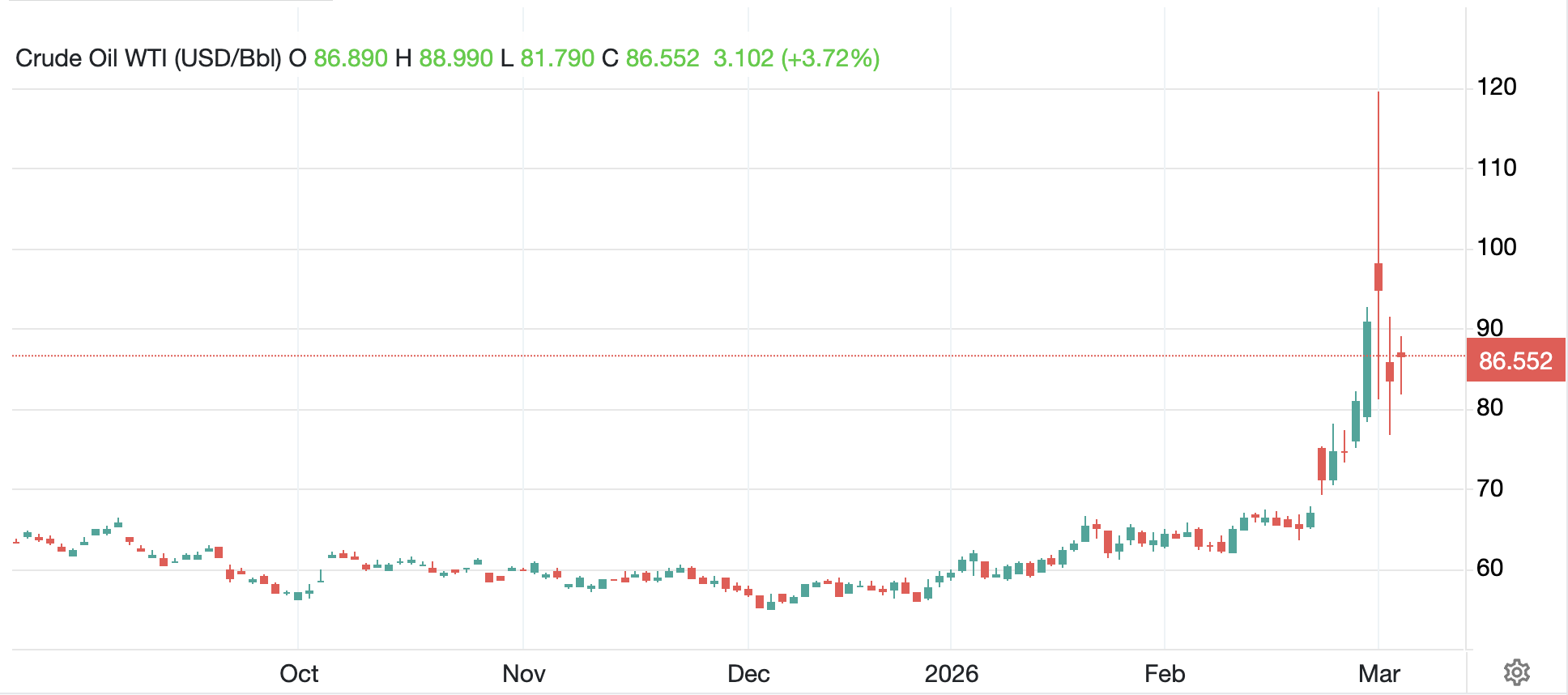
It is somewhat ironic that the biggest story of the evening, the IEA’s recommendation that nations around the world release between 300 million and 400 million barrels of strategic petroleum reserves has not helped mitigate the rise in oil prices. After falling sharply yesterday, this morning, WTI (+4.5%) is rebounding sharply again. A look at the chart below reminds me of silver from late January, and certainly, as the following chart demonstrates, daily volatility in that market has made a significant step higher from its pre runup levels.
Source: tradingeconomics.com
One need only look at the size of the daily candles to understand that movement each day has increased substantially since then.

Source: tradingeconomics.com
Of course, the countervailing news that is driving oil higher is that Iran has begun to mine the Strait of Hormuz, which will make resuming transit more difficult when hostilities cease. In fact, that appears to be the newest front in the war, with the US attacking the small boats Iran is using to try to lay mines. It seems this is similar to the drug boat attacks the US carried out in the Caribbean late last year prior to the exfiltration of Venezuelan President Maduro.
Again, the interesting thing to me about Iran’s actions is that by closing the Strait, they cut off 90% of their own revenue, and as they are actively fighting a war, that seems a major hindrance. After all, Iran is nowhere near self-sufficient in anything a nation needs to continue its existence.
But the fog of war is just that, a situation that prevents clear understanding of all that is ongoing in the area. As we sit, fortunately, thousands of miles away from the action, and everything we read is spun by whoever is writing it, it remains extremely difficult to get a good understanding of the situation in Iran, either tactically or strategically. All we have is the market price action as an indicator.
But before we look at markets, it is worth mentioning that CPI is released this morning with the following expectations: Headline (0.3% M/M, 2.4% Y/Y) and Core (0.2% M/M, 2.5% Y/Y). The problem with this data is twofold. First, it continues to be polluted by the impact of the government shutdown last autumn, but more importantly, it is for February, and the Iranian action has been entirely in March, so there will be no impact from the dramatic rise in oil prices in the data. Ultimately, in this case, the data is almost certainly going to be ignored by the Fed, to the extent they even look at CPI rather than PCE. Of course, the PCE data will have the same problems.
So, let’s turn to markets now. Yesterday’s nondescript price action in the US was followed by a more positive tone in Asia, arguably on the IEA news. While there were some laggards (India -1.7%, Indonesia -0.7%, HK -0.25%), the bulk of the region did just fine with Tokyo (+1.4%) and China (+0.6%) both nicely in positive territory, although that was nothing compared to Taiwan (+4.1%). Otherwise, the rest of the region was positive somewhere between +0.5% and 1.0%. Europe, however, is having a less positive morning with most major bourses lower on the day (Germany -0.7%, France -0.3%, UK -0.6%, Italy -0.3%) with only Spain (+0.3%) managing a gain in the session. Energy continues to be the biggest concern here although as I type at 7:25 this morning, we are getting the first word of SPR releases from several nations including Germany and Japan. Perhaps there won’t be a coordinated release after all. Meanwhile, US futures at this hour are basically unchanged.
In the bond market, yields rose yesterday afternoon in the US and have edged another 1bp higher this morning while European sovereign yields all catch up to yesterday’s US move with gains of between 5bps and 8bps on the continent. It is important to remember that there is a strong correlation between oil prices and 10-year yields, as would be expected based on the direct connection between oil prices and inflation. The chart below shows the past week’s movement in the two markets. The long-term correlation averages +0.61% with a range of +0.5% to +0.7% according to Grok.

Source: tradingeconomics.com
Again, referring back to today’s CPI, we can expect that CPI next month is going to be higher than this month, even if the war ends today.
In the metals markets, weakness is the order of the day although gold (-0.1%) is just barely so. However, those metals with industrial uses are faring worse this morning led by platinum (-2.4%) but both silver (-1.75%) and copper (-1.7%) are under pressure. A potential explanation here is that continued high oil prices will weaken economic activity and therefore demand for these metals. The counter argument is that war is inflationary at all times, and metals tend to do well in those periods.
Finally, the dollar is slightly firmer across the board, but movement has been de minimis overall. The noteworthy exception is AUD (+0.6%) which has been rallying recently on concerns (hopes?) that the RBA is getting set to raise rates at their meeting on Monday (Sunday night here). In fact, the Aussie has traded to its highest level in almost four years, although I have a hard time understanding the attraction given the softened state of economic activity there (recent GDP reading of 0.8% Y/Y) and an energy policy only the Europeans could love as they continue to prohibit nuclear power and shut down coal despite having abundant resources in both. But, in the FX world, relative interest rates mean a lot, and the perception of a hawkish central bank is apparently enough to overcome bad fiscal and energy policy.
And that’s really all for today. We do see the EIA oil inventory data, with a small net draw expected and Fed Governor Bowman speaks, although it is at the ABA’s Summit on Regulation, so there will likely be no monetary policy discussion as this is the quiet period.
Where do we go from here? Your guess is as good as mine. We are already seeing oil prices slip a bit with the announcement of the SPR releases, although they remain higher on the day. The war continues to drive all the narratives so if you are trading, keep abreast of that news. If you are not trading, though, avoid it at all costs, it will make for much happier days!
Good luck
Adf
 fxpoetry