
Demoralizing

Complaints among traders are rising
That markets are demoralizing
Liquidity’s shrinking
And now they are thinking
They might need to alter trade sizing
 
But can anyone be surprised
That markets are not immunized
From ongoing impacts
Of tariffs and new tax
Which President Trump advertised?


While headlines around the world have focused on the ongoing trade war negotiations, and peace talks between Russia and Ukraine and all of the political machinations in the US as President Trump continues to fight both the courts and Democrats to implement his agenda, markets are generally at a loss as to what to do.  Is the news bullish for stocks?  Bearish? What about bonds or the dollar or oil?  I cannot remember a time when there was so little clarity on expected future outcomes.  Well, I can actually, but it was a very long time ago.  Prior to the Black Monday stock market crash in the US in October 1987, the reality was there were many views fighting to be heard, but rarely consensus as to what would happen in markets.  Successful traders were those with trading intuition and positions were sized much smaller because you never knew when you might need to reverse course.

Since then, however, we have seen a steady diet of central bank intervention every time there is an indication that growth may be slowing, or markets may be having a bad day.  This process went into overdrive in the wake of the GFC (which, BTW, was a product of that central bank intervention warping markets) when QE was implemented in the US and then elsewhere throughout the G10.  In fact, then Chairman Bernanke was explicit that this was his goal.  He called it the portfolio rebalance channel and the idea was the Fed would buy all the Treasuries, driving yields lower and promise to keep rates very low for a long time thus forcing encouraging investors to move up the risk scale to corporate debt, high-yield debt and equities.  As well, QE pumped enormous amounts of liquidity into the financial system.  This combination of actions led to a huge expansion of risk taking and the creation of strategies like risk parity which were designed to lever up assets to increase returns.

It was all great as long as the Fed and other central banks kept expanding the available liquidity.  Alas, trees don’t grow to the sky and when the Fed, in 2018/19 tried to finally reduce the balance sheet and initiated their first QT program, things got hairy in September and halted them in their tracks.  It turns out that markets had become addicted to liquidity continually increasing and like any addict, responded negatively to the loss of its fix.

Of course, Covid ensued and the next gusher of liquidity, this time both fiscal and monetary, was initiated by governments and central banks around the world, so any idea that investors and traders were chastised by the events of 2019 were quickly forgotten and position sizes ramped up again along with market performance.

But there is a new sheriff in town, as has been mentioned by many in the Trump administration, and the old rules are not likely to work in the new environment.  As the US government has taken hold of virtually all the market’s bandwidth, relegating the Fed to a sideshow, traders and investors are suddenly finding that the old ways of doing things, buy the dip and lever up, are no longer the best way to get along.  With the ongoing efforts by the Trump administration to shrink the government and reduce flows to financial markets, the lessons of the post-GFC financial market are losing their validity.  

This was perfectly expressed in a Bloomberg article this morning where traders were complaining that when they wanted to adjust a position they had to “wait longer to execute an order until there’s better liquidity in certain instances.”  Of course, we all know how difficult it is to wait so I’m sure that you are just as sympathetic towards these traders as I am.  There was an interesting chart in the article (below) showing that futures liquidity in S&P 500 contracts had fallen to the lowest in two years and was clearly at the lower end of the recent spectrum.  Doesn’t your heart just bleed?

I have been clear that President Trump is the virtual avatar of volatility and one of the key characteristics of a volatile market is that liquidity dries up.  While prices may not move much on a particular day, trends disappear and when moves occur, they tend to be large, and often discontinuous.  This is true in all markets, so be prepared as we go forward.

As it happens, yesterday was a day with very little net movement, although some decent gyrations intraday in some markets.  For instance, in the bond market, yields, which opened the day much higher fell sharply after weaker than anticipated data then rebounded throughout the day finishing little changed from Monday’s levels.  The chart below shows the 7bp range resulting in zero movement net.
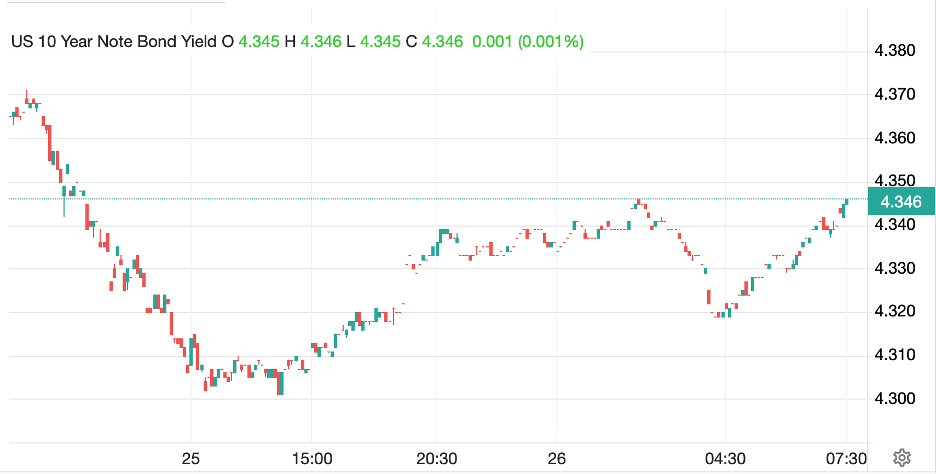
Source: tradingeconomics.com

Too, US equity markets traded both sides of unchanged all day, with some choppiness but no net directional movement.

Source: tradingeconomics.com

My point is that this is likely a portent of the future.  There are too many known unknowns for traders and investors to have confidence in taking a side.  Now, we are only two months into the new administration, and they have been working hard to get things done quickly.  It is possible that the fight drags on for the rest of the year or longer, with no clear outcomes on key issues regarding extending the tax cuts and a finalized tariff policy.  In this case, I would anticipate market activity to continue to be lower volumes and choppy price action with a lack of direction.  Or perhaps, lower risk asset prices as investors get scared.  The lesson is the processes that had become normalized in the post GFC world are clearly no longer in play.  Hedge accordingly.

So, as we look at overnight activity, yesterday’s US market activity didn’t inspire much movement in Asia where we saw some gainers (Nikkei +0.65%, Hang Seng +0.6%) and laggards (CSI 300 -0.3%, India -0.9%) but no consistency at all.  The PBOC is subtly altering their monetary policy toolkit which some are seeing as a modest ease, but clearly equity markets didn’t get that message.  Meanwhile, comments from the newest BOJ member, Koeda, explained she was not sure her previous analysis of the economy leaving the zero-rate world is valid now that rates are all the way up to 0.50%!

European shares are softer on the continent, down about -0.5% in most places but UK shares have gained slightly, +0.2%, after inflation data was released a tick lower than expected across both headline and core measures.  While the BOE stood pat last week, as expected, this has encouraged some traders to believe that a cut could come sooner than previously thought.  As to US futures, at this hour (7:45), they are basically unchanged.

Treasury yields, after yesterday’s choppiness, are creeping higher today (+3bps) but that is not following through in Europe, where sovereign yields are all flat to slightly lower today.  It seems difficult for investors to get excited about Germany’s rearming plan if the overall economy remains in the doldrums.  As well, tariff tensions have investors uncertain what to do, so doing nothing is the default.

In the commodity markets, oil (+0.9%) is higher from the close yesterday, but yesterday’s close was slightly softer than when I last wrote.  As such, we have still not quite made it to $70/bbl.  There are many crosscurrents in this market between tariffs, sanctions, potential Ukraine peace and Trump’s goal of drill, baby, drill.  As to metals, the star of the show continues to be copper (+1.5% today, +15% in the past month) which is now trading at all-time highs across the entire curve.  This has helped support both gold (+0.3%) and silver (+0.3%) although the former doesn’t need that much help, I think.

Finally, the dollar is mixed this morning, with the pound (-0.3%) lagging on the idea that the BOE may ease again sooner than previously thought, while AUD (+0.3%), CAD (+0.2%) and CLP (+0.3%) are all firmer on the commodity market strength.  Here, too, I expect that liquidity will diminish and trends will be hard to find until there is more clarity on policy outcomes in the US.

On the data front, this morning brings Durable Goods (exp -1.0%, +0.2% ex Transport) and then the EIA oil inventory data with a small build expected.  We also hear from two more Fed speakers, but they are just not driving markets right now.  Choppiness is the rule here, with short-term direction very difficult to discern.  I am still on board my ultimate lower dollar, higher commodity train, but that is subject to change if policies change as well.

Good luck

Adf

Worse Than Just Sloth

With payrolls on everyone’s mind
The overnight range was confined
The bulls live in fear
That job growth’s still clear
While bears worry payrolls declined

But, looking beyond NFP
There’s something the bulls fail to see
Liquidity’s growth
Is worse than just sloth
It’s shrinking to quite a degree

Before I start this morning, please know I will be on vacation next week so there will be no poetry again until the 16th.

Now, to start this morning, all eyes are on the payroll report where the market is definitely in the ‘bad is good’ frame of mind.  Median analyst expectations are as follows:

Nonfarm Payrolls170K
Private Payrolls160K
Manufacturing Payrolls5K
Unemployment Rate3.7%
Average Hourly Earnings0.3% (4.3% Y/Y)
Average Weekly Hours34.4
Participation Rate62.9%

Source: tradingeconomics.com

We know that Wednesday’s ADP number was quite weak, and we know that Tuesday’s JOLTS number was quite strong.  Yesterday’s Initial Claims data was also a harbinger of strength with the weekly number falling to 207K.  If we look at the ISM employment sub-indices, both showed relative strength with the Manufacturing number rising above 50 for the first time in 5 months while the Services employment index remains at a healthy 53.4 level.  Much of what I have read over the past several weeks has focused on the idea that companies are still reluctant to lose employees as they remember how difficult it was to hire post the Covid fiasco.   I have a funny feeling we are going to see a better than expected number this morning, as between the JOLTS and Claims data it feels like we’re due for a pop.  However, I believe we need to see a print above 200K to have a meaningful impact on the markets.

To be clear, if I am correct, I would look for bond yields to retest their recent highs, equities to fall and the dollar to rebound from its recent consolidation/correction.

But let’s discuss the dollar for a moment and a data point that gets short shrift these days, the Trade Balance.  A brief history lesson shows that once upon a time, the Trade Balance was the most important monthly release for the FX market.  This was during the Reagan years when US policy was highly focused on the trade deficit with Japan and concerns over whether Japan was going to replace the US as the preeminent global economy.  (We know how that worked out!). But the point is trade data used to matter.  One of the things that gets little attention these days but is directly impacted by the trade data is the amount of global USD liquidity that exists. Despite all the hyperventilation over the concept of dedollarization, the reality is that the dollar has never been a more integral part of the global financial system than now.  The reason for this is the fact that there is somewhere north of $275 trillion of USD debt outstanding around the world, according to the IMF, and the US portion is only on the order of $95 trillion.  This means the rest of the world needs to service $180 trillion of debt, paying USD interest.   

How, you may ask, does everybody get those dollars to pay the interest on that debt?  Well, one of the keys had been the US running a massive trade deficit, buying stuff and sending dollars all over the world.  Those dollars were used to service the debt.  But lately, the US trade deficit has been declining pretty steadily, with yesterday’s better than expected reading of -$58.3 billion a continuation of the last two years’ trend from the worst print of -$105B in March 2022.   The thing is, if the US trade deficit is shrinking, we are not sending as many dollars out into the world for everyone else to use.  There has also been a great deal of discussion lately about how M2 money supply has been shrinking at an unprecedentedly fast rate, yet another sign that liquidity is drying up.  One consequence of these two factors, shrinking M2 and a shrinking trade deficit, is that foreigners need to bid more aggressively for the dollars they need to service and repay their USD notional debt.  This has been a key driver in the dollar’s recent strength and there is no sign this is going to change in the near future.

But shrinking liquidity also weighs on other things, notably risk assets.  Again, think about the post GFC era when QE’s 1 through infinity were ongoing and all the calls for inflation to ramp up never materialized.  Well, as I wrote during that time and is becoming clearer today, there was plenty of inflation, it was just concentrated in asset prices like stocks, bonds and real estate, as opposed to everyday items like groceries, clothing and dining out.  At this point, we realize that the Covid fiscal stimulus around the world is what unleashed the recent bout of inflation, and that central banks are working feverishly to halt this trend.  Combine the Fed leading the way, having raised rates the furthest of the major central banks, and the fact that there are less dollars around due to shrinking money supply and trade deficits, and you come up with a good understanding of why the dollar remains well bid.  Regardless of the short-term impact of numbers like today’s NFP, the underlying structural effects continue to point to dollar strength.

With that structural backdrop in mind, a look at today’s price activity shows modest net activity ahead of the data.  Asian equity markets that were open had a mixed session with the Nikkei sliding while the Hang Seng managed some solid gains (+1.6%) and mainland Chinese markets remained closed, set to reopen on Monday.  European bourses, though, are having an ok day, with gains on the order of 0.5% or so after better than expected Factory Orders data from Germany.  As to US futures, they are currently (7:30) higher by 0.1% and trading in a tight range.

Bond yields are backing up again with Treasuries and most of Europe higher by 3bps or so.  One move that has been growing lately is the Bund-BTP spread, which is now 202bps, right at the level where the ECB has historically started to get a bit nervous.  If this spread continues to widen look for more ECB talk about, first, how the market is wrong, and then second, how the TPI, their program to buy BTPs and sell Bunds, is likely to be appropriate.  At 250bps, their hair will be on fire, but that still feels pretty far off.

Oil prices, which are unchanged today, appear to be consolidating after a hellacious week where they fell >$10/bbl.  The thing is demand data continues to point to growth and supply data continues to point to limits.  The recent price action has all the earmarks of Russian disinformation a trading response to the massive run higher through the summer where a lot of trend followers got into the market too late.  Longer term, the direction here remains higher in my view.  As to the metals markets, they also are consolidating after a rough period with gold unchanged though silver, copper and aluminum are all higher between 0.3% and 0.9% this morning.  Again, we have seen a pretty sharp decline here, so this feels like a trading reaction, not a fundamental thing.

Finally, the dollar is a bit firmer this morning as we await the data.  USDJPY continues to hold the 149 level and it looks to be merely a matter of time before we test 150 again.  According to the flow data from the BOJ, there was no indication that they intervened earlier this week which implies there was some rate checking.  However, it is very clear they remain quite concerned over the movement.  One currency that has really seen some movement lately is MXN, which after a long period of strength on the back of a very stout monetary policy by Banxico, has given back 10% in the past 5 weeks.  Interestingly, the US is running a growing trade deficit with Mexico, which should help alleviate some pressure on the peso, but right now, the difference in tone between the Fed’s higher for longer and Banxico’s we are done is the driver.

Aside from payrolls this morning we see consumer Credit (exp $11.7B) and hear from Governor Waller at noon.  Yesterday’s Fed speak was much of a muchness with no changes in tone overall.  At this point, all we can do is wait.

Good luck, good weekend and until Monday October 16th

Adf

Sand on the Beach

The central bank known as the Fed
Injected more funds, it is said
Than sand on the beach
While they did beseech
The banks, all that money to spread

But lately the numbers have shown
Liquidity, less, they condone
Thus traders have bid
For dollars, not quid
Nor euros in every time zone

A funny thing seems to be happening in markets lately, which first became evident when the dollar decoupled from equity markets a few days ago. It seemed odd that the dollar managed to rally despite continued strength in equity markets as the traditional risk-on stance was buy stocks, sell bonds, dollars and the yen. But lately, we are seeing stock prices continue higher, albeit with a bit tougher sledding, while the dollar has seemingly forged a bottom, at least on the charts.

The first lesson from this is that markets are remarkably capable at sussing out changes in underlying fundamentals, certainly far more capable than individuals. But of far more importance, at least with respect to understanding what is happening in the FX market, is that dollar liquidity, something the Fed has been proffering by the trillion over the past three months, is starting to, ever so slightly, tighten. This is evident in the fact that the Fed’s balance sheet actually shrunk this week, to “only” $7.14 trillion from last week’s $7.22 trillion. While this represents just a 1% shrinkage, and seemingly wouldn’t have that big an impact, it is actually quite a major change in the market.

Think back to the period in March when the worst seemed upon us, equity markets were bottoming, and central banks were panicking. The dollar was exploding higher at that time as both companies and countries around the world suddenly found their revenue streams drying up and their ability to service and repay their trillions of dollars of outstanding debt severely impaired. That was the genesis of the Fed’s dollar swap lines to other central banks, as Chairman Jay wanted to insure that other countries would have temporary access to those needed dollars. At that time, we also saw the basis swap bottom out, as borrowing dollars became prohibitively expensive, and in the end, many institutions decided to simply buy dollars on the foreign exchange markets as a means of securing their payments.

However, once those swap lines were in place, and the Fed announced all their programs and started growing the balance sheet by $75 billion/day, those apocalyptic fears ebbed, investors decided the end was not nigh and took those funds and bought stocks. This explains the massive rebound in the equity markets, as well as the dollar’s weakness that has been evident since late March. In fact, the dollar peaked and the stock market bottomed on the same day!

But as the recovery starts to gather some steam, with recent data showing that while things are still awful, they are not as bad as they were in April or early May, the Fed is reducing the frequency of their dollar swap operations to three times per week, rather than daily. They have reduced their QE purchases to less than $4 billion/day, and essentially, they are mopping up some of that excess liquidity. FX markets have figured this out, which is why the dollar has been pretty steadily strengthening for the past seven sessions. As long as the Fed continues down this path, I think we can expect the dollar to continue to perform.

And this is true regardless of what other central banks or nations do. For example, yesterday’s BOE action, increasing QE by £100 billion, was widely expected, but interestingly, is likely to be the last of their moves. First, it was not a unanimous vote as Chief Economist, Andy Haldane, voted for no change. The other thing is that expectations for future government Gilt issuance hover in the £70 billion range, which means that the BOE will have successfully monetized the entire amount of government issuance necessary to address the Covid crash. But regardless of whether this appears GBP bullish, it is dwarfed by the Fed activities. Positive Brexit news could not support the pound, and now it is starting to pick up steam to the downside. As I type, it is lower by 0.3% on the day which follows yesterday’s greater than 1% decline and takes the move since its recent peak to more than 3.4%.

What about the euro, you may ask? Well, it too has been suffering as not only is the Fed beginning to withdraw some USD liquidity, but the ECB, via yesterday’s TLTRO loans has injected yet another €1.3 trillion into the market. While the single currency is essentially unchanged today, it is down 2.0% from its peak on the 10th of June. And this pattern has repeated itself across all currencies, both G10 and EMG. Except, of course, for the yen, which has rallied a bit more than 1% since that same day.

Of course, in the emerging markets, the movement has been a bit more exciting as MXN has fallen more than 5.25% since that day and BRL nearly 10%. But the point is, this pattern is unlikely to stop until the Fed stops withdrawing liquidity from the markets. Since they clearly take their cues from the equity markets, as long as stocks continue to rally, so will the dollar right now. Of course, if stocks turn tail, the dollar is likely to rally even harder right up until the Fed blinks and starts to turn on the taps again. But for now, this is a dollar story, and one where central bank activity is the primary driver.

I apologize for the rather long-winded start but given the lack of interesting idiosyncratic stories in the market today, I thought it was a good time for the analysis. Turning to today’s session, FX market movement has been generally quite muted with, if anything, a bias for modest dollar strength. In fact, across both blocs, no currency has moved more than 0.5%, a clear indication of a lack of new drivers. The liquidity story is a background feature, not headline news…at least not yet.

Other markets, too, have been quiet, with equity markets around the world very slightly firmer, bond markets very modestly softer (higher yields) and commodity markets generally in decent shape. On the data front, the only noteworthy release was UK Retail Sales, which rebounded 10.2% in May but were still lower by 9.8% Y/Y. This is the exact pattern we have seen in virtually every data point this month. As it happens, there are no US data points today, but we do hear from four Fed speakers, Rosengren, Quarles, Mester and the Chairman. However, they have not changed their tune since the meeting last week, and certainly there has been no data or other news which would have given them an impetus to do so.

The final interesting story is that China has apparently recommitted to honoring the phase one trade deal which means they will be buying a lot of soybeans pretty soon. The thing is, I doubt it is because of the trade deal as much as it is a comment on their harvest and the fact they need them. But the markets have largely ignored the story. In the end, at this point, all things continue to lead to a stronger dollar, so hedgers, take note.

Good luck, good weekend and stay safe
Adf

Overrun

Our planet, third rock from the sun
Has clearly now been overrun
By Covid-19
Whose spread is unseen
And cannot be fought with a gun

It is certainly difficult, these days, to keep up with the latest narrative about how quickly the virus will continue to spread and when we will either flatten the infection curve or will get past its peak. Every day brings a combination of optimistic views, that within a few weeks’ things will settle down, as well as pessimistic views, that millions will die from the virus and it will be many months before life can return to any semblance of normal. And the thing is, both sets of opinions can come from reasonably well-respected sources. Adding to the confusion is the fact that there is still a huge political divide in the US, and that many comments are politically tinged in order to gain advantage. After all, while it has not been the recent focus, there is still a presidential election scheduled for November, a scant seven plus months from now.

With this as the baseline, it cannot be that surprising that we have seen the extraordinary volatility present throughout markets in recent weeks. And while volatility may have peaked, it is not about to fall back to the levels present two months ago. In fact, the one thing of which I am certain is it will take a long time for markets to settle back into the rhythms that had seemed so pleasing and normal for so many years.

Something else to note is that while central banks seem to have been able to positively impact market behavior in recent days, the cost of doing so has gone up dramatically. For example, during the financial crisis, the widely hated TARP bill had a price tag of $700 billion, clearly a large number. And yet that is one-third of what the present stimulus bill will cost. And the Fed? Well it took them three months in 2008 to expand their balance sheet by $1 trillion. This time it took less than three weeks. And they are not even close to done!

It is the latter point that brings the greatest risk to markets, the fact that the cost of addressing market failures has grown far faster than the global economy. This is a result of the serial bubble blowing that we have seen since October 1987, when the Maestro himself, then Fed Chair Alan Greenspan, promised the Fed would support markets and not allow things to collapse. That inaugurated a pattern of central bank behavior that prevented markets of any kind from clearing excesses because the political fallout would have been too great. But as we have seen, each bubble blown since has had a larger and larger price tag to overcome. The question now is, have we reached the limits of what policymakers can do to prevent markets from clearing? Certainly, they will never admit that is the case, but much smarter people than me have made the case that their capabilities have been stretched to the limit.

It is with this as background that I think it makes sense to discuss what we have seen this week alone! Using the S&P 500 as our proxy, we saw a sharp decline on Monday, over 4%, and then a three-day rebound of nearly 18%! In fact, from its lows on Monday, the rebound has been more than 20%. Many in the financial press have been saying this is now a bull market. My view is that is bull***t. A bull market needs to be defined as a market where prices are rising on the back of strong underlying fundamentals and where long-term prospects are strong. The recent fixation on 20% movements as defining a bull or bear market are completely outdated. Instead, I think the case is far easier to make that we are ensconced in the beginning of a bear market, where the long-term, or at least medium-term, fundamentals are quite weak and prospects are uncertain, at best, and realistically quite negative for the coming quarters. Declaring a bull market on the same day that Initial Unemployment Claims printed at nearly 3.3 million, far and away the highest in history, is ridiculous! I fear that the movement this week in stocks and the dollar, is not the beginning of a new trend, but a reactive bounce to previous price action.

Turning to the dollar, after a remarkable rally in the buck throughout the month of March, it too has fallen sharply during the past several sessions. The proximate cause was the Fed, which when it announced its laundry list of new programs on Monday evening was able to calm immediate fears over a lack of USD liquidity. It appears that the dollar’s two week run of strength was driven by global fears over a shortage of dollar liquidity available coming into quarter end next week. We saw this in the movement of basis swap spreads, which blew out in favor of dollars, and we saw this in the FX forward market, where every price that encompassed the turn was no longer linearly interpolated. But the Fed has thrown $5 trillion at the problem and for now, that seems like it is enough, at least for this quarter. Markets have settled, and the fear over coming up short of dollars has abated for the time being.

But this is not over, not by a longshot. Navigating the next few months will be quite difficult as we are sure to see more negative news regarding the virus, followed by policy attempts to address that news. Until a solid case is made that globally, the peak of the infection curve is behind us, we are going to remain in a tenuous market state with significant volatility.

Finishing with a brief look at the dollar this morning, it is actually having a mixed session. In the G10, NOK continues to be the most volatile currency by far, down 1.3% this morning after an intervention led 14% rally in the past week. Of course, that was after it fell nearly 29% in the previous two weeks! And you thought only EMG currencies were volatile! But the rest of the G10 space shows JPY strength, +0.9%, as repatriation flows help the currency, and then much lesser movements in both directions from the rest of the bloc.

In the emerging markets, the story is similar, with KRW the biggest gainer, +1.8% overnight, as the BOK confirmed its recent activity qualifies as QE, and more importantly, that they will continue to do everything necessary to support the economy. Meanwhile, on the opposite end of the spectrum is the Mexican peso, which has fallen 1.5% this morning after Standard & Poor’s downgraded the country’s credit rating by a notch to BBB and left them on negative watch. The peso, too has had a wild ride this month, declining nearly 6 full pesos at its worst level, or 30%, before rallying back sharply this week by 10% at its peak, now more like 8.2%. Again, the point is that we can expect ongoing sharp movements in both directions for now.

With spot today being month-end, I realize many companies will be active in their balance sheet rolling programs. Forward bid-ask spreads continue to be wider than normal but have definitely moderated from what we saw in the past two weeks. This is the new normal though, so for the next several months, be prepared for wider pricing than we all learned to love.

Good luck, good weekend and stay safe
Adf