
Jay Was Thinking

If anyone thought Jay was thinking
‘Bout raising rates while growth was sinking
The chairman was clear
That long past next year
Their balance sheet will not be shrinking

The money quote: “We’re not thinking about raising rates. We’re not even thinking about thinking about raising rates,” said Mr. Powell.  And this pretty much sums up the Fed stance for the time being.  While there are those who are disappointed that the Fed did not add to any programs or announce something like YCC or, perhaps, more targeted forward guidance, arguably the above quote is even more powerful than one of those choices.  Frequently it is the uncertainty over a policy’s duration that is useful, not the policy itself.  Uncertainty prevents investors from anticipating a change and moving markets contrary to policymakers’ goals.  So, for now, there is no realistic way to anticipate the timing of the next rate hike.  Perhaps the proper question is as follows: is timing the next hike impossible because of the lack of clear targets?  Or is it impossible because there will never be another rate hike?

What the Fed did tell us (via the dot plot) is that only two of the seventeen FOMC members believe interest rates will be above 0.0% in 2022 (my money is on Esther and Mester, the two most hawkish members), but mercifully, not a single dot in the dot plot was in negative territory.  They also expressed a pretty dour view of the economy as follows:


  2020 2021 2022
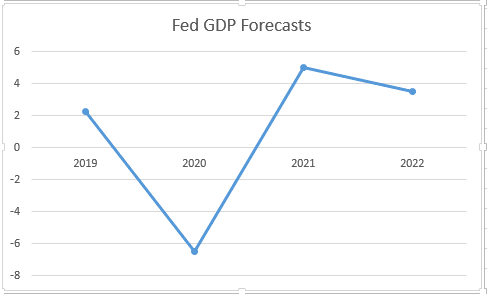
Real GDP -6.5% 5.0% 3.5%
Core PCE 1.0% 1.5% 1.7%
Unemployment 9.3% 6.5% 5.5%

Source: Bloomberg

It is, of course, the 11.5% gain from 2020 to 2021 that encourages the concept of the V-shaped recovery as evidenced by simply plotting the numbers (including 2019’s 2.3% to start).

Screen Shot 2020-06-11 at 9.30.05 AM

So, perhaps the bulls are correct, perhaps the stock market is a screaming buy as growth will soon return and interest rates will remain zero for as far as the eye can see.  There is, however, a caveat to this view, the fact that the Fed is notoriously bad at forecasting GDP growth over time.  In fact, they are amongst the worst when compared with Wall Street in general.  But hey, at least we understand the thesis.

Another interesting outcome of the meeting was the tone of the press conference, where Chairman Jay sounded anything but ebullient over the current economic situation, especially the employment situation.  And it is this takeaway that had the biggest market impact.  After the press conference, equity markets in the US sold off from earlier highs (the NASDAQ set another all-time high intraday) and Treasuries rallied with yields falling again.  In other words, despite the prospect of Forever ZIRP (FZ), equity investors seemed to lose a bit of their bullishness.  This price action has been in place ever since with Asian equity markets all falling (Nikkei -2.8%, Hang Seng -2.3%, Shanghai – 0.8%) and Europe definitely under pressure (DAX -2.1%, CAC -2.2%, FTSE 100 -2.0%).  US futures are also lower with the Dow (-1.9%) currently the laggard, but even NASDAQ futures are lower by 1.1% at this hour.

It should be no surprise that bond markets around the world are rallying in sync with these equity declines as the combination of risk-off and the prospect for FZ lead to the inevitable conclusion that lower long term rates are in our future.  This also highlights the fact that the Fed’s concern over the second part of its mandate, stable prices, has essentially been set aside for another era.  The belief that inflation will remain extremely low forever is clearly a part of the current mindset.  Yesterday’s CPI (0.1%, 1.2% core) was simply further evidence that the Fed will ignore prices going forward.  So, 10-year Treasury yields are back to 0.7% this morning, 20 basis points below last Friday’s closing levels.  In other words, the impact of last Friday’s NFP number has been erased in four sessions.  But we are seeing investors rotate from stocks to bonds around the world, perhaps getting a bit nervous about the frothiness of the recent rallies.  (Even Hertz, the darling of the Robinhooders, is looking like Icarus.)

With risk clearly being jettisoned around the world, it should be no surprise that the dollar has stopped falling, and in fact is beginning to rally against almost all its counterparts.  While haven assets like CHF (+0.2%) and JPY (+0.1%) are modestly higher, NOK (-0.9%) and AUD (-0.85%) are leading the bulk of the G10 lower.  Norway is suffering on, not only broad dollar strength, but oil’s weakness this morning, with WTI -3.1% on the session.  As to Aussie, the combination of weaker commodity prices, the strong dollar, and market technicals as it once again failed to hold the 0.70 level, have led to today’s decline.

Emerging market activity is also what you would expect in a risk-off session, with MXN (-1.6%), ZAR (-1.1%) and RUB (-0.7%) leading the way lower.  Obviously, oil is driving both MXN and RUB, while ZAR is suffering from the weakness in the rest of the commodity complex.  I think the reason that the peso has fallen so much further than the ruble is that MXN has seen remarkable gains over the past month, more than 13% at its peak, and so seems overdue for a correction.  One notable exception to this price action today is THB, which is higher by 0.65% on a combination of reports of a fourth stimulus package and a breach of the 200-day moving average which got technicians excited.

This morning’s data brings the latest Initial Claims data (exp 1.55M), as well as Continuing Claims (20.0M) and PPI (-1.2%, 0.4% core).  While nobody will care about the latter, there will be ongoing intense scrutiny on the former as Chairman Jay made it abundantly clear that employment is the only thing the Fed is focused on for now.  With the FOMC meeting behind us, we can expect to start to hear from its members again, but on the schedule, nothing happens until next week.

It is not hard to make the case that both the euro and pound have been a bit toppish at recent levels, and with risk decidedly off today, further declines there seem quite viable.


Good luck and stay safe

Adf

Value, Nought

In college Econ 101
Professors described the long run
As when we all died
Like Keynes had replied
Debating a colleague for fun

However, the rest that they taught
Has turned out to have, value, nought
Their models have failed
While many have railed
That people won’t do what they ought

Observing market activity these days and trying to reconcile price action with the theories so many of us learned in college has become remarkably difficult. While supply and demand still seem to have meaning, pretty much every construct more complex than that turns out to have been a description of a special case and not a general model of behavior. At least, that’s one conclusion to be drawn from the fact that essentially every forecast made these days turns out wrong while major pronouncements, regarding the long-term effect of a given policy, by esteemed economists seem designed to advance a political view rather than enhance our knowledge and allow us to act in the most effective way going forward. Certainly, as merely an armchair economist, my track record is not any better. Of course, the difference is that I mostly try to highlight what is driving markets in the very short term rather than paint a picture of the future and influence policy.

I bring this up as I read yet another article this morning, this by Stephen Roach, a former Chairman of Morgan Stanley Asia and current professor at Yale, about the imminent collapse of the dollar and the end of its status as the world’s reserve currency. He is not the first to call for this, nor the first to call on the roster of models that describe economic activity and determine that because one variable has moved beyond previous boundaries, doom was to follow. In this case growth of the US current account deficit will lead to the end of the dollar’s previous role as reserve currency. Nor will he be the last to do so, but the consistent feature is that every apocalyptic forecast has been wrong over time.

This has been true in Japan, where massive debt issuance by the government and massive debt purchases by the BOJ were destined to drive inflation much higher and weaken the yen substantially. Of course, we all know that the exact opposite has occurred. This has been true around the world where negative interest rates were designed to encourage borrowing and spending, thus driving economic growth higher, when it only got half the equation right, the borrowing increase, but it turns out spending on shares was deemed a better use of funds than spending on investment, despite all the theories that said otherwise.

Ultimately, the point is that despite the economics community having built a long list of very impressive looking and sounding models that are supposed to describe the workings of the economy, those models were built based on observed data rather than on empirical truths. Now that the data has changed, those models are just no longer up for the task. In other words, when it comes to forecasting models, caveat emptor.

Turning to the markets this morning, equity markets seem to have stopped to catch their collective breath after having recouped all of their March losses. In fact, the NASDAQ actually set a new all-time high yesterday, amid an economy that is about to print a GDP number somewhere between -20% and -50% annualized in Q2.

I get the idea of looking past the short-run problems, but it still appears to me that equity traders are ignoring long-run problems that are growing on the horizon. These issues, like the wave of bankruptcies that will significantly reduce the number of available jobs, as well as the potential for behavioral changes that will dramatically reduce the value of entire industries like sports and entertainment, don’t appear to be part of the current investment thesis, or at least have been devalued greatly. And while in the long-run, new companies and activities will replace all these losses, it seems highly unlikely they will replace them by 2021. Yet, yesterday saw US equity indices rally for the 7th day in the past eight. While this morning, futures are pointing a bit lower (SPU’s and Dow both lower by 1.2%, NASDAQ down by 0.7%), that is but a minor hiccup in the recent activity.

European markets are softer this morning as well, with virtually every major index lower by nearly 2% though Asian markets had a bit better showing with the Hang Seng (+1.1%) and Shanghai (+0.6%) both managing gains although the Nikkei (-0.4%) edged lower.

Bond markets are clearly taking a closer look at the current risk euphoria and starting to register concern as Treasury yields have tumbled 5bps this morning after a 4bp decline yesterday. We are seeing similar price action in European markets, albeit to a much lesser extent with bunds seeing yields fall only 2bps since yesterday. But, in true risk-off fashion, bonds from the PIGS have all seen yields rise as they are clearly risk assets, not havens.

And finally, the dollar is broadly stronger this morning with only the other havens; CHF (+0.3%) and JPY (+0.4%) gaining vs. the buck. On the downside, AUD is the laggard, falling 1.4% as a combination of profit taking after a humongous rally, more than 27% from the lows in March, and a warning by China’s education ministry regarding the potential risks for Chinese students returning to university in Australia have weighed on the currency. Not surprisingly, NZD is lower as well, by 1.1%, and on this risk-off day, with oil prices falling 2.5%, NOK has fallen 1.0%. But these currencies’ weakness has an awful lot to do with the dollar’s broad strength.

In the emerging markets, the Mexican peso, which had been the market’s darling for the past month, rallying from 25.00 to below 21.50 (13.5%) has reversed course this morning and is down by 1.4%. But, here too, weakness is broad based with RUB (-0.95%), PLN (-0.7%) and ZAR (-0.6%) all leading the bloc lower. The one exception in this space was KRW (+0.6%) after the announcement of some significant shipbuilding orders for Daewoo and Samsung Heavy Industries improved opinions of the nation’s near-term trade situation.

Turning to the data, although it’s not clear to me it matters much yet, we did see some horrific trade data from Germany, where their surplus fell to €3.5 billion, its smallest surplus in twenty years, and a much worse reading than anticipated as exports collapsed. Meanwhile, Eurozone Q1 GDP data was revised ever so slightly higher, to -3.6% Q/Q, but really, everyone wants to see what is happening in Q2. At home, the NFIB Small Biz Index was just released at a modestly better than expected 94.4 but has been ignored. Later this morning we see the JOLT’s Jobs data (exp 5.75M), but that is for April so seems too backward-looking to matter.

Risk is on its heels today and while hopes are growing that the Fed may do something new tomorrow, for now, given how far risk assets have rallied over the past two weeks, a little more consolidation seems a pretty good bet.

Good luck and stay safe
Adf

Playing Hardball

Last night China shocked one and all
With two policy shifts not too small
They’ve now become loath
To target their growth
And in Hong Kong they’re playing hardball

It seems President Xi Jinping was pining for the spotlight, at least based on last night’s news from the Middle Kingdom. On the economic front, China abandoned their GDP target for 2020, the first time this has been the case since they began targeting growth in 1994. It ought not be that surprising since trying to accurately assess the country’s growth prospects during the Covid-19 crisis is nigh on impossible. Uncertainty over the damage already done, as well as the future infection situation (remember, they have seen a renewed rise in cases lately) has rendered economists completely unable to model the situation. And recall, the Chinese track record has been remarkable when it comes to hitting their forecast, at least the published numbers have a nearly perfect record of meeting or beating their targets. The reality on the ground has been called into question many times in the past on this particular subject.

The global economic community, of course, will continue to forecast Chinese GDP and current estimates for 2020 GDP growth now hover in the 2.0% range, a far cry from the 6.1% last year and the more than 10% figures seen early in the century. Instead, the Chinese government has turned its focus to unemployment with the latest estimates showing more than 130 million people out of a job. In their own inimitable way, they manage not to count the rural unemployed, meaning the official count is just 26.1M, but that doesn’t mean those folks have jobs. At this time, President Xi is finding himself under much greater pressure than he imagined. 130 million unemployed is exactly the type of thing that leads to revolutions and Xi is well aware of the risks.

In fact, it is this issue that arguably led to the other piece of news from China last night, the newly mooted mainland legislation that will require Hong Kong to enact laws curbing acts of treason, secession, sedition and subversion. In other words, a new law that will bring Hong Kong under more direct sway from Beijing and remove many of the freedoms that have set the island territory apart from the rest of the country. While Covid-19 has prevented the mass protests seen last year from continuing in Hong Kong, the sentiments behind those protests did not disappear. But Xi needs to distract his population from the onslaught of bad news regarding both the virus and the economy, and nothing succeeds in doing that better than igniting a nationalistic view on some subject.

While in the short term, this may work well for President Xi, if he destroys Hong Kong’s raison d’etre as a financial hub, the downside is likely to be much greater over time. Hong Kong remains the financial gateway to China’s economy largely because the legal system their remains far more British than Chinese. It is not clear how much investment will be looking for a home in a Hong Kong that no longer protects private property and can seize both people and assets on a whim.

It should be no surprise that financial markets in Asia, particularly in Hong Kong, suffered last night upon learning of China’s new direction. The Hang Seng fell 5.6%, its largest decline since July 2015. Even Shanghai fell, down 1.9%, which given China’s announcement of further stimulus measures despite the lack of a GDP target, were seen as positive. Meanwhile, in Tokyo, the Nikkei slipped a more modest 0.9% despite pledges by Kuroda-san that the BOJ would implement even more easing measures, this time taking a page from the Fed’s book and supporting small businesses by guaranteeing bank loans made in a new ¥75 trillion (~$700 billion) program. It is possible that markets are slowly becoming inured to even further policy stimulus measures, something that would be extremely difficult for the central banking community to handle going forward.

The story in Europe is a little less dire, although most equity markets there are lower (DAX -0.4%, CAC -0.2%, FTSE 100 -1.0%). Overall, risk is clearly not in favor in most places around the world today which brings us to the FX markets and the dollar. Here, things are behaving exactly as one would expect when investors are fleeing from risky assets. The dollar is stronger vs. every currency except one, the yen.

Looking at the G10 bloc, NOK is the leading decliner, falling 1.1% as the price of oil has reversed some of its recent gains and is down 6% this morning. But other than the yen’s 0.1% gain, the rest of the bloc is feeling it as well, with the pound and euro both lower by 0.4% while the commodity focused currencies, CAD and AUD, are softer by 0.5%. The data releases overnight spotlight the UK, where Retail Sales declined a remarkable 18.1% in April. While this was a bit worse than expectations, I would attribute the pound’s weakness more to the general story than this particular data point.

In the EMG bloc, every market that was open saw their currency decline and there should be no surprise that the leading decliner was RUB, down 1.1% on the oil story. But we have also seen weakness across the board with the CE4 under pressure (CZK -1.0%, HUF -0.75%, PLN -0.5%, RON -0.5%) as well as weakness in ZAR (-0.7%) and MXN (-0.6%). All of these currencies had been performing reasonably well over the past several sessions when the news was more benign, but it should be no surprise that they are lower today. Perhaps the biggest surprise was that HKD was lower by just basis points, despite the fact that it has significant space to decline, even within its tight trading band.

As we head into the holiday weekend here in the US, there is no data scheduled to be released this morning. Yesterday saw Initial Claims decline to 2.44M, which takes the total since late March to over 38 million! Surveys show that 80% of those currently unemployed expect it to be temporary, but that still leaves more than 7.7M permanent job losses. Historically, it takes several years’ worth of economic growth to create that many jobs, so the blow to the economy is likely to be quite long-lasting. We also saw Existing Home Sales plummet to 4.33M from March’s 5.27M, another historic decline taking us back to levels last seen in 2012 and the recovery from the GFC.

Yesterday we also heard from Fed speakers Clarida and Williams, with both saying that things are clearly awful now, but that the Fed stood ready to do whatever is necessary to support the economy. This has been the consistent message and there is no reason to expect it to change anytime soon.

Adding it all up shows that investors seem to be looking at the holiday weekend as an excuse to reduce risk and try to reevaluate the situation as the unofficial beginning to summer approaches. Trading activity is likely to slow down around lunch time so if you need to do something, early in the morning is where you will find the most liquidity.

Good luck, have a good holiday weekend and stay safe
Adf


Enough Wherewithal

The Chairman explained to us all
The Fed has enough wherewithal
To counter the outbreak
But, too, Congress must take
More actions to halt the shortfall

The US equity markets led global stocks lower after selling off in the wake of comments from Chairman Powell yesterday morning. In what was a surprisingly realistic, and therefore, downbeat assessment, he explained that while the Fed still had plenty of monetary ammunition, further fiscal spending was necessary to prevent an even worse economic and humanitarian crisis. He also explained that any recovery would take time, and that the greatest risk was the erosion of skills that would occur as a huge swathe of the population is out of work. It cannot be a surprise that the equity markets sold off in the wake of those comments, with a weak session ending on its lows. It is also not surprising that Asian markets overnight followed US indices lower (Nikkei -1.75%, Hang Seng -1.45%, Shanghai -1.0%), nor that European markets are all in the red this morning (DAX -1.6%, CAC -1.7%, FTSE 100 -2.2%). What is a bit surprising is that US futures, at least as I type, are mixed, with the NASDAQ actually a touch higher, while both the Dow and S&P 500 see losses of just 0.2%. However, overall, risk is definitely on its back foot this morning.

But the Chairman raised excellent points regarding the timeline for any recovery and the potential negative impacts on economic activity going forward. The inherent conflict between the strategy of social distance and shelter in place vs. the required social interactions of so much economic activity is not a problem easily solved. At what point do government rules preventing businesses from operating have a greater negative impact than the marginal next case of Covid-19? What we have learned since January, when this all began in Wuhan, China, is that the greater the ability of a government to control the movement of its population, the more success that government has had preventing the spread of the disease. Alas, from that perspective, the inherent freedoms built into the US, and much of the Western World, are at extreme odds with those government controls/demands. As I have mentioned in the past, I do not envy policymakers their current role, as no matter the decision, it will be called into question by a large segment of the population.

What, though, are we now to discern about the future? Despite significant fiscal stimulus already enacted by many nations around the world, it is clearly insufficient to replace the breadth of lost activity. Central banks remain the most efficient way to add stimulus, alas they have demonstrated a great deal of difficulty applying it to those most in need. And so, despite marginally positive news regarding the slowing growth rate of infections, the global economy is not merely distraught, but seems unlikely to rebound in a sharp fashion in the near future. Q2 has already been written off by analysts, and markets, but the question that seems to be open is what will happen in Q3 and beyond. While we have seen equity weakness over the past two sessions, broadly speaking equity markets are telling us that things are going to be improving greatly while bond markets continue to point to a virtual lack of growth. Reading between the lines of the Chairman’s comments, he seems to be siding with the bond market for now.

Into this mix, we must now look at the dollar, and its behavior of late. This morning had seen modest movement until about 6:30, when the dollar started to rally vs. most of its G10 counterparts. As I type, NOK, SEK and AUD are all lower by 0.5% or so. The Aussie story is quite straightforward as the employment report saw the loss of nearly 600K jobs, a larger number than expected, with the consequences for the economy seen as potentially dire. While restrictions are beginning to be eased there, the situation remains one of a largely closed economy relying on central bank and government largesse for any semblance of economic activity. As to the Nordic currencies, SEK fell after a weaker than expected CPI report encouraged investors to believe that the Riksbank, which had fought so hard to get their financing rate back to 0.00% from several years in negative territory, may be forced back below zero. NOK, however, is a bit more confusing as there was no data to see, no comments of note, and the other big key, oil, is actually higher this morning by more than 4%. Sometimes, however, FX movement is not easily explained on the surface. It is entirely possible that we are seeing a large order go through the market. Remember, too, that while the krone is the worst performing G10 currency thus far in 2020, it has managed to rally more than 7% since late April, and so we are more likely seeing some ordinary back and forth in the markets.

One other comment of note in the G10 space was from BOE Governor Andrew Bailey, who reiterated that negative interest rates currently have no place in the BOE toolkit and are not necessary. While the comments didn’t impact the pound, which is lower by 0.25% as I type, it continues to be an important distinction as along with Chairman Powell, the US and the UK are the only two G10 nations that refuse to countenance the idea of NIRP, at least so far.

In the emerging markets, what had been a mixed and quiet session earlier has turned into a pretty strong USD performance overall. The worst performer is ZAR, currently down 0.9% the South African yield curve bear-steepens amid continued unloading of 10-year bonds by investors. But it is not just the rand falling this morning, we are seeing weakness in the CE4 (CZK -0.7%, HUF -0.5%, PLN -0.4%) and once again the Mexican peso is finding itself under strain. While the CE4 appear to simply be following the lead of the euro (-0.35%), perhaps with a bit more exuberance, I think the peso continues to be one of the more interesting stories out there.

Both MXN and BRL have been dire performers all year, with the two currencies being the worst two performers in the past three months and having fallen more than 20% each. Both currencies continue to be extremely volatile, with daily ranges averaging in excess of 2% for the past two months. The biggest difference is that BRL has seen a significant amount of direct intervention by the BCB to prevent further weakness, while MXN continues to be a 100% free float. The other thing to recall is that MXN is frequently seen as a proxy for all LATAM because of its relatively better liquidity and availability. The point is, further problems in Brazil (and they are legion as President Bolsonaro struggles to rule amid political fractures and Covid-19) may well result in a much weaker Mexican peso. This is so even if oil prices rebound substantially.

Turning to data, we see the weekly Initial Claims number (exp 2.5M) and Continuing Claims (25.12M), but otherwise that’s really it. While we have three more Fed speakers, Kashkari, Bostic and Kaplan, on the calendar, I think after yesterday’s Powell comments, the market may be happier not to hear their views. All the evidence points to an overbought risk atmosphere that needs to correct at some point. As that occurs, the dollar should retain its bid overall.

Good luck and stay safe
Adf

Risk Off’s Set To Soar

Though April saw rallies galore
In equities, bonds and much more
The first days of May
Seem set to convey
A tale that risk-off’s set to soar

Last week finished on a down note for risk appetite, as we saw equities decline sharply on Friday, at least in those markets that were open, as well as the first cracks in the rebound in currencies vs. the dollar. This morning, those trends are starting to reassert themselves and we look to be heading toward a full-blown risk-off session.

A quick recap reminds us that Thursday, which was month end, saw a modest decline in equities which was easily attributed to portfolio rebalancing. After all, the April rally was impressive in any context, let alone the current situation where huge swathes of the global economy have been shuttered for more than a month. Friday, while a holiday in many markets around the world, saw far more significant equity market declines in countries that were open, with US markets falling between 2.5% and 3.2%. The weekend saw loads of stories highlighting the adage, ‘Sell in May and go away’, as an appropriate strategy this year. This was compounded by the far more bearish take by Warren Buffett regarding the US economy, where he explained that Berkshire Hathaway had exited its positions in airline stocks and instead had grown its cash pile to $138 billion. These are not the signs of confidence that investors crave, and so this morning, European equity markets are all much lower, led by the CAC (-4.0%) and DAX (-3.5%). While both China and Japan were closed for holidays, the Hang Seng had a terrible performance, falling 4.2%, and we saw sharp declines throughout the rest of Emerging Asia. Meanwhile, US futures markets are all lower by about 1% as I type.

I guess the question at hand remains the sustainability of last month’s price action. Right now, there are two key subjects where the underlying narrative is up for grabs; risk appetite and inflation. For the former, there is a large contingent who believe that the worst is over with respect to Covid-19, and its spread is abating. This means that over the course of the next few weeks and months, economies are going to reopen and that the situation will return to normal. There is much talk of a V-shaped recovery on the strength of the extraordinary efforts of central banks and governments around the world. The flip side of this argument is that despite the tentative steps toward reopening economies worldwide, the pace of recovery will be significantly slower than the pace of the decline. Concerns about how much of the economy has been irrevocably destroyed, with small businesses worldwide closing, and unemployment everywhere rising sharply, are rife. While we are still in the first half of Q1 earnings season, the data to date have not been pretty, and remember, the virus only became a significant issue in March, generally. This implies that the bearish view may have more legs, and it is the side I believe fits the fact pattern more accurately.

The inflation narrative is just as fierce, with the hard money advocates all decrying the central bank activity as opening the door to currency collapses and hyperinflation right around the corner. Meanwhile, the other side of the argument looks to the history of the past twenty years, where Japan has been printing yen and effectively monetizing its debt, while still unable to achieve any sort of inflation at all. In this case, I think the deflationistas make the best case for the near term, as the combination of unprecedented demand destruction as well as extraordinary growth in debt both point to slower growth and price declines in the short and medium term. However, that is not to ignore the fact that central banks have gone far outside the boundaries of what had traditionally been viewed as their bailiwick, and especially if we do see a debt jubilee of some type, where government debt owned by a nation’s own central bank is forgiven, then the opportunity for a significant inflationary outcome remains on the table. Just not right away.

Adding it up for today points to a reduced risk appetite as evidenced by those equity markets that are open. Bond markets have not played along as one might have expected, with Treasury yields lower by only 1bp, and Bund yields, along with the rest of Europe’s, actually higher this morning. That price action seems to be a response to concerns over the outcome of the German Constitutional Court’s ruling due tomorrow, regarding the legality of QE, the PEPP and, perhaps more critically, the necessity of the ECB to follow the Capital Key when purchasing bonds.

In the FX markets, the dollar has resumed its role as king of the world, rallying against every currency except the yen, which has essentially stayed flat. In the G10 space, NOK is the leading decliner, down 1.2% as oil prices are back on the schneid with WTI down 6.3% this morning. But we are seeing the pound (-0.8%) and Swedish krone (-0.7%) under significant pressure as well. GBP traders are looking ahead to Thursday’s BOE meeting where expectations are rising for another bout of policy ease, which fits in with the broad risk-off framework. The krone, meanwhile, is suffering as the Riksbank finds itself in a difficult spot regarding its QE program. It seems that despite its claims that it would be purchasing not only government bonds, but corporates as well, that is illegal based on the bank’s guiding legislation, and so there is some monetary policy confusion now undermining the currency.

In the EMG space, IDR (-1.45%) and RUB (-1.3%) have been the weakest performers, with the ruble suffering from both weaker oil prices as well as the recent increase in the pace of infections in Russia. While things there are already under pressure, they could well get worse before they get better. Meanwhile, Indonesia saw a reversal of half of last week’s currency gains as PMI data (27.5) highlighted just how weak the near-term looks for the island nation. While the bulk of the rest of the space has suffered on the back of the overall risk-off sentiment, there has been a later reversal in ZAR, where the rand is now higher by 0.75% after its PMI data surprised one and all by printing at 46.1, well above expectations and a very modest decline compared to March, albeit still in contractionary territory.

On the docket this week, we see a great deal of information culminating in the payroll report on Friday, and that is certain to be frightful.

Today Factory Orders -9.4%
Tuesday Trade Balance -$44.2B
  ISM Non-Manufacturing 37.8
Wednesday ADP Employment -20.5M
Thursday Initial Claims -3.0M
  Continuing Claims -19.6M
  Nonfarm Productivity -5.5%
  Unit Labor Costs 3.8%
  Consumer Credit $15.0B
Friday Nonfarm Payrolls -21.3M
  Private Payrolls -21.7M
  Manufacturing Payrolls -2.25M
  Unemployment Rate 16.0%
  Average Hourly Earnings 0.3% (3.3% Y/Y)
  Average Weekly Hours 33.5
  Participation Rate 61.6%

Source: Bloomberg

The range of expectations for the payroll number highlight the ongoing confusion, with estimates between -840K and -30.0M. Regardless, the number will be a record, of that there is no doubt.

In addition to all this data, we hear from the RBA and the BOE on Thursday, with further ease on the cards, and we get to hear from five different Fed speakers. In these unprecedented times, as policymakers struggle to keep up with the economic destruction, we will soon become inured to shocking data. But that will not make it any better, and I fear that shock or not, risk appetites will continue to diminish as the month, and year, progresses. This means that the dollar is likely to retain its bid for a while yet.

Good luck and stay safe
Adf

A Bit Out of Sorts

The ECB stepped to the plate
Effectively cutting the rate
At which it will lend
To help countries spend
As well, to help prices inflate

But last night some earnings reports
Put traders a bit out of sorts
And too, from Down Under
It’s really no wonder
The data inspired some shorts

With many markets globally closed today for the May Day holiday, one would have expected fairly limited price action overall. One would have been wrong. In fact, despite the best efforts of the ECB yesterday to demonstrate further support for the European economies, it turns out that disappointing data has suddenly been recognized. This data story started last evening with key Tech earnings reports from two of the FAANG stocks, both disappointing on the profit side and calling into question the ability of even these companies to be able to withstand the remarkable demand shrinkage caused by Covid-19.

Then, though most of Asia was closed for the holiday, Australia (Manufacturing Index) and New Zealand (Consumer Confidence) both reported weaker than expected economic data. Suddenly, it seems that data was an important issue for markets, a change of recent heart. And there is one more thing to remember, the calendar turned the page. The calendar matters because, especially given the remarkable price action in April, there was a significant amount of month-end rebalancing in institutional portfolios. Remember, we saw a sharp rally in stocks, so it should be no surprise that they were sold off in order for portfolios to get back to desired asset allocations.

Taking it all together resulted in some serious equity market declines in the few markets open overnight, with the Nikkei (-2.85%) and Australia’s ASX 200 (-5.0%) putting in truly awful performances. Meanwhile, in Europe, only the FTSE 100 is trading today, and it is lower by 2.1%. US futures are following suit, currently down around 2.0% across the board.

So, what of the ECB’s actions? Well, they effectively cut interest rates by lowering the rate at which TLTRO funds are borrowed by 0.25%, to -0.25%. That means that Eurozone banks which lend new money to companies can earn to fund themselves. A pretty sweet deal if they charge a positive rate on the loans. In addition, they created yet another loan program, the PELTRO, which has even lower rates, as low as -1.0% funding costs for banks lending under this criterion. Of course, the problem remains that while many companies may borrow in order to try to get through the current ceasing of activity, future growth opportunities will simply be further hindered by the additional debt on corporate balance sheets. Two other things of note from the ECB are that they did not increase their QE programs as there remains considerable concern that the German Constitutional Court may rule next week that QE is illegal, essentially funding governments throughout the Eurozone, and that will call into question everything they have done. The second was the dire forecast from Madame Lagarde that Eurozone growth could see GDP shrink 12% in 2020, which if you consider yesterday’s Q1 data (-3.8% Q/Q) implies a modest rebound by year end.

Turning to the FX markets, it can be no surprise that both AUD (-1.0%) and NZD (-0.8%) are the worst performing currencies in the G10 space. Not only did both report lousy data, but both (AUD +17%, NZD +13%) have been rallying pretty steadily since their nadir on March 19. Thus, if the paradigm is changing back to the future is not as bright, I would look for both these currencies to give up much of last month’s rally. Meanwhile, the oil proxies, CAD (-0.6%) and NOK (-0.7%) are both suffering from oil’s modest declines this morning, with WTI ceding about 2.0% of its recent spectacular gains. After all, even ignoring the odd dip into negative territory two weeks ago, oil has rallied more than 200% since that fateful day, based on the June WTI contract. On the plus side, we see JPY (+0.35%) on what appears to be a modest risk-off trade, leading the way higher, with the rest of the bloc +/- 0.2% and lacking any new information.

EMG currencies have been largely spared movement overnight as the APAC bloc was closed for the holiday although CNH has managed to fall 0.6% in the absence of a domestic market. The three main deliverable EMG currencies, MXN (-1.4%), ZAR (-1.4%) and TRY (-0.7%) have a decidedly risk-off tone to their price action, with the peso being truly impressive. Since Tuesday, we have seen MXN first rally 5.0% then decline 4.1% from its peak. Net it is stronger, but the current trend seems to point to further weakness. Again, if the risk appetite from April begins to wane further, these currencies have the opportunity to fall significantly.

On the data front, this morning brings Construction Spending (exp -3.5%) and ISM Manufacturing (36.0) with the Prices Paid (33.0) and New Orders (30.0) indices looking equally dire. Yesterday we learned that Personal Income fell sharply, and Personal Spending fell even more sharply, a record-breaking 7.5% decline. Initial Claims data was a touch weaker than the median forecast at 3.84M with Continuing Claims (which lag the Initial claims data by a week) not rising quite as much as expected, to ‘just’ 18.0M.

Ultimately, the history of Covid-19’s impact will be written as the most extraordinary destruction of demand in history. The US (and global) economy had evolved from a manufacturing base a century ago, to a service-based economy par excellence. Nobody considered what shelter-in-place and social distancing would do to that construct. It is becoming increasingly clear that the answer to that is those restrictions will cause extreme economic damage that is likely to take several years to recoup. Alas, we are not done with this disease, and the restrictions will continue to wreak havoc on the global economy, and asset values, for a while yet. We have not seen the last of risk-off, nor the last of the dollar’s strength.

Good luck, good weekend and stay safe
Adf
 

How Far Did It Sink?

This morning the data we’ll see
Is highlighted by GDP
How far did it sink?
And is there a link
Twixt that and the FOMC?

Which later today will convene
And talk about Covid-19
What more can they do
To help us all through
The havoc that we all have seen

Market activity has been somewhat mixed amid light volumes as we await the next two important pieces of information to add to the puzzle. Starting us off this morning will be the first look at Q1 GDP in the US. Remember, the virus really didn’t have an impact on the US economy until the first week of March, although the speed of its impact, both on markets and the broad economy were unprecedented. A few weeks ago, I mentioned that I created a very rough model to forecast Q1 GDP and came up with a number of -13.6% +/- 2%. This was based on the idea that economic activity was cut in half for the last three weeks of the month and had been reduced by 25% during the first week. My model was extremely rough, did not take into account any specific factors and was entirely based on anecdotal evidence. After all, sheltering in home, it is exceedingly difficult to survey actual activity. As it turns out, my ‘forecast’ is much more bearish than the professional chattering classes which, according to the Bloomberg survey, shows the median expectation is for a reading of -4.0%, with forecasts ranging from 0.0% to -10.0%. Ultimately, a range of forecasts this wide tells us that nobody has any real idea what this number is going to look like.

Too, remember that while things have gotten worse throughout April, as much of the nation has been locked down, the latest headlines highlight how many places will be easing restrictions in the coming days and weeks. So, it appears that the worst of the impact will straddle March and April, an inconvenient time for quarterly reporting. In the end, the issue for markets is just how much devastation is already reflected in prices and perhaps more importantly, how quick of a recovery is now embedded in the price. It is this last point which gives me pause as to the current levels in equity markets, as well as the overall risk framework. The evidence points to a strong investor belief that the trillions of dollars of support by central banks and governments around the world is going to ensure that V-shaped rebound. If that does not materialize (and I, for one, am extremely skeptical it will), then a repricing of risk is sure to follow.

The other key feature today is the FOMC meeting, with the normal schedule of a 2:00 statement release and a 2:30 press conference. There are no updated forecasts due to be released, and the general consensus is that the Fed is unlikely to add any new programs to the remarkable array of programs already initiated. Arguably, the biggest question for today’s meeting is will they try to clarify their forward guidance regarding the future path of rates and policy or is it still too early to change the view that policy will remain accommodative until the economy weather’s the storm.

While hard money advocates bash the Fed and many complain that their array of actions has actually crossed into illegality, Chairman Powell and his crew are simply trying to alleviate the greatest disruption any economy has ever seen while staying within a loose interpretation of the previous guidelines. Powell did not create the virus, nor did he spend a decade as Fed chair allowing significant financial excesses to be built up. For all the grief he takes, he is simply trying to clean up a major mess that he inherited. But market pundits make their living on being ‘smarter’ than the officials about whom they write, so don’t expect the commentary to change any time soon.

With that as prelude, a survey of this morning’s activity shows that equity markets in Europe are generally slightly higher, although a few, France and Switzerland, are in the red. Interestingly, Italy’s FTSE MIB is higher by 0.4% despite the surprise move by Fitch to cut Italy’s credit rating to BBB-, the lowest investment grade rating and now the same as Moody’s rating. S&P seems to have succumbed to political pressure last week and left their rating one notch higher at BBB although with a negative outlook. Though Italian stocks are holding in, BTP’s (Italian government bonds) have fallen this morning with yields rising 4bps. In fact, a conundrum this morning is the fact that the bond market is clearly in risk-off mode, with Treasury and bund yields lower (2bp and 3bp respectively) while PIGS yields are all higher. Meanwhile, European equities are performing fairly well, US equity futures are all higher by between 0.5%-1.0%, and the dollar is softer virtually across the board. These latter signal a more risk-on scenario.

Speaking of the dollar, it is lower vs. all its G10 counterparts except the pound this morning although earlier gains of as much as 1.0% by AUD and NZD have been cut by more than half as NY walks in. This currency strength is despite weaker than expected Confidence data from the Eurozone, although with an ECB meeting tomorrow, market participants are beginning to bet on Madame Lagarde adding to the ECB’s PEPP. Meanwhile, CAD and NOK seem to be benefitting from a small rebound in the price of oil, although that seems tenuous at best given the fear of holding the front contract after last week’s dip into negative territory on the previous front contract.

EMG currencies are also uniformly stronger this morning, led by IDR (+1.0%) after a well-received government bond issuance increased confidence the country will be able to get through the worst of the virus’ impact. We are also seeing ZAR (+0.9%) firmer on the modestly increased risk appetite, and MXN (+0.7%) follow yesterday’s rally of nearly 1.7% as the worst fears over a collapse in LATAM activity dissipate. Yesterday also saw Brazil’s real rebound 2.75%, which is largely due to aggressive intervention by the central bank. The background story in the country continues to focus on the political situation with the resignation of Justice Minister Moro and yesterday’s Supreme Court ruling that an investigation into President Bolsonaro could continue regarding his firing of the police chief. However, BRL had fallen nearly 14% in the previous two weeks, so some rebound should not be surprising. In fact, on a technical basis, a move back to 5.40 seems quite viable. However, in the event the global risk appetite begins to wane again, look for BRL to once again underperform.

Overall, this mixed session seems to be more likely to evolve toward a bit of risk aversion than risk embrasure unless the Fed brings us something new and unexpected. Remember, any positive sign from the GDP data just means that Q2 will be that much worse, not that things are better overall.

Good luck and stay safe
Adf

Still Disrespected

According to data last night
The future in Germany’s bright
While right now, it stinks
Most everyone thinks
By Q3, they’ll all be alright

And yet, markets haven’t reflected
The positive vibe ZEW detected
Stock markets are dire
The dollar is higher
While oil is still disrespected

The one constant in the current market and economic environment is that nothing is consistent. For example, in Germany, the lockdown measures were extended for two weeks the day before Frau Merkel said that they would start to ease some restrictions, allowing small shops to open along with some schools. Then, this morning, the ZEW surveys were released with the Current Situation index printing at a historically low -91.5, well below the already dire forecasts of a -77.5 print. And yet, the Expectations index rose to +28.2, far higher than the median forecast of -42.0. Essentially, the commentary was that while Q1 and Q2 would be awful, things would be right as rain in Q3. But here’s a contradiction to that view, Oktoberfest, due to begin in late September, has just been canceled despite the fact that it is five months away and that it is in the middle of Q3, when things are ostensibly going to be much better there. My point is that, right now, interpreting signals of future activity is essentially impossible. Alas, that is what I try to do each morning.

So, what have we learned in the past twenty-four hours? Arguably, the biggest story was oil where the May WTI futures contract closed at -$37.63/bbl. In other words, the contract buyer is paid to take delivery of oil. And that’s the rub, storage capacity is almost entirely utilized while demand destruction continues daily. The IEA reported that current global production is running around 100 million barrels/day, with current demand running around 70 million barrels per day. In other words, plenty of oil is looking for a temporary home, and more of it is coming out of the ground each day. Arguably, this is a great opportunity for the US government to take delivery for the Strategic Petroleum Reserve, especially since they would be getting paid for the oil. But that would require a nimbleness of action that is unlikely to be seen at any government level. This morning, June WTI futures are under further pressure, down by another 20% at $16.50/bbl as I type, simply indicating that there is limited hope for a rebound in the near term. But the curve remains in sharp contango, with prices at $30/bl in December and higher further out. This price action is simply the oil market’s manifestation of the current economic view; negative growth in Q1 and Q2 with a rebound coming in Q3. However, despite the logic, seeing any commodity, let alone the world’s most important commodity, trading below zero is a strange sight indeed.

With the oil market grabbing the world’s focus, it can be no surprise that the dollar has responded by rallying strongly, especially against those currencies that are seen as tightly linked to the price of oil. So, in the G10 space, NOK (-1.7%) and CAD (-0.7%) are suffering, with the Nokkie the worst performer in the group. But AUD (-0.95%), NZD (-1.25%) and GBP (-0.95%) are all under significant pressure as well. It seems that Kiwi has responded negatively to RBNZ Governor Orr’s musings regarding additional stimulus in May, while Aussie has suffered on the back of the weak pricing in energy markets as well as lousy employment data. Meanwhile, today’s pressure on the pound seems to stem from a renewal of the Brexit discussion, and how a hard exit will be deleterious. In addition, there are still those who claim the UK’s response to the pandemic has been inadequate and the impact there will be much worse than elsewhere. Interestingly, UK employment data released this morning did not paint as glum a picture as might have been expected. While we can ignore the Unemployment Rate, which is February’s number, the March Claims data was surprisingly moderate. I expect, however, that next month’s data will be far worse. And I continue to think the pound has far more downside than upside here.

Turning to the EMG bloc, we cannot be surprised to see RUB as the worst performer in the group, down 1.3%, nor, given the growing risk-off sentiment, that the entire space is lower vs. the dollar. As today is a day that ends in ‘y’, MXN is lower, falling 0.7% thus far, as the market is increasingly put off by both the ongoing oil price declines as well as the ongoing incompetence demonstrated by the AMLO administration. (As an aside here, it seems that many Mexican financial institutions see much further peso weakness in the future as they are actively selling pesos in the market.) The other underperformers are HUF (-0.85%), ZAR (-0.8%) and KRW (-0.75%). Working in reverse order, the won is suffering as questions arise about the health of North Korean leader Kim Jong-un, who according to some reports, is critically ill and close to death. The concern is there is no obvious successor in place, and no way to know what the future will hold. Meanwhile, the rand is under pressure from the weakness throughout the commodity space as well as the realization that the carry that can be earned by holding the currency has diminished to its lowest level since 2008. For a currency that has been dependent on foreign holdings, this is a real problem.

I guess, given that the euro is only lower by 0.2%, it is actually a top performer of the day, so perhaps the German data has been a support to the single currency. The thing is, given the export orientation of the German (and Eurozone) economy, unless things pick up elsewhere, growth expectations will need to be modified lower for Q3. Don’t be surprised if we see this in the survey data going forward.

Elsewhere, equity markets everywhere are in the red, with European indices down between 1.7% and 2.5%. Asian stock markets were also lower, by similar amounts, and after yesterday’s US declines, the futures this morning show losses of between 0.7% for the NASDAQ and 1.5% for the Dow. Bond yields continue to fall, with 10-year Treasuries lower by 3bps this morning, and overall, risk is being sold.

The only data this morning is Existing Home Sales from March, with the median expectation for a 9% decline to 5.25M. As to Fed speakers, the quiet period ahead of next Wednesday’s FOMC meeting has begun so there is nothing to hear there. Of course, given what they have already done, as well as the fact that every act is unanimously accepted, I don’t see any value add from their comments in the near-term.

Last week saw a net gain in the equity markets as the narrative embraced the idea that the infection curve was flattening and that we were past the worst of the impact. This week, despite the ZEW data, I would contend investors are beginning to understand that things will take a very long time to get back to normal, and that the chance for new lows is quite high. In this environment, the dollar is likely to remain well bid.

Good luck and stay safe
Adf


The Absolute Fact

It’s been one score years and one more
Since prices for oil hit this floor
Despite last week’s pact
The absolute fact
Is there’s no place for, it, to store

Q1 1999 was the last time the price of the front-month oil contract on the Comex was trading as low as it has this morning. As I type, it is currently at $13.55/bbl, down more than $4.70 on the session, which on a percentage basis is more than 25%! And you thought currency volatility was high. At any rate, it seems the major issue is that oil producers have no place left to store the stuff, and since demand has collapsed, the natural response is for the price to collapse as well. Now, in fairness, while this will garner the headlines, the market reality may be slightly different, because the May futures contract, which expires tomorrow, is no longer the active contract, that has moved to June. Now, the June contract is down nearly 10%, but is still trading above $22/bbl, so this morning’s excitement may have less long-term market impact than it seems at first. Nonetheless, it does point to just how disruptive the coronavirus has been to markets all around the world.

Of course, one should not be surprised by the currencies that have felt the repercussions of this oil price decline the most severely; MXN (-1.9%), RUB (-0.45%), NOK (-0.65%) and CAD (-0.7%). The peso has been one of the market’s favorite whipping boys all year, as it has declined nearly 22% thus far. ZAR (-25.7%) and BRL (-23.0%) are the only two currencies to underperform the peso. Thus, this morning’s nearly 2% decline cannot be a surprise. In fact, since March 2, truthfully before Covid was widely understood to be the threat it has become to Western economies, the average daily range in USDMXN has been 3.78% which works out to an annualized volatility of nearly 60%. The remarkable thing is how cheap MXN options are relative to actual movement. For example, this morning, 1-month implied volatility is trading on the order of 25%, clearly far less than the type of movement we have seen in the past seven weeks. And given oil’s extreme volatility, and the peso’s link to the price of oil, I expect that we are going to continue to see the peso trade like this for the foreseeable future. The implication here is that hedgers might want to consider owning some of this optionality to help manage the uncertainties of their exposures during this time.

Away from the oil story, though, we have an entirely different narrative forming regarding the virus and its impact on the broader economy. Despite a number of countries having extended their lockdown procedures into the second week of May, we are also getting the first signs that the peak of infections may have passed, and we are hearing from more and more quarters that reopening the economy is more critical given that fact. This has been a big part of the rationale behind the equity market rally we saw last week, which despite the evidence of just how awful Q1 earnings are going to be, was really remarkably robust.

There continue to be two strong storylines with bulls claiming that this is a temporary hit and given the amount of stimulus, both fiscal and monetary, that has been brought to bear on the problem, the ‘V’ shaped recovery is still a high probability outcome. The bears, on the other hand, continue to highlight that expectations for the economy going forward to look anything like it did three months ago are misguided, and that it will take far longer to achieve any real recovery. Structural changes will have been made resulting in a much higher unemployment rate, considerably less consumption and, thus, much weaker GDP growth. Earnings will suffer and stock prices alongside them. Last week’s price action, with both up and down days, was an excellent depiction of this battle. And this battle will continue until one side’s argument is borne out. In other words, equity market volatility is likely to be with us for many months to come as well.

So, turning to this morning’s session, we have actually seen equity markets somewhat softer, with most of Europe lower by a bit below 1.0% which followed Asia’s similarly modest weakness. US futures, though, are starting to come under more pressure, having only been down 0.5% early in the session, but now looking at 1.5% declines. Interestingly, Treasury yields have barely moved, with the 10-year lower by less than 1 basis point, although in Europe, the weakest economies (PIGS) have all seen their government bond yields rise by more than 8bps, a sign of risk being jettisoned. And finally, gold is little changed on the morning, although given the dollar’s broad rally since the beginning of March, it has held its value extremely well.

As to the rest of the FX market, the dollar is largely, albeit not universally stronger this morning, and has been gaining ground as risk has been selling off. NOK and CAD lead the way lower, but the pound is also feeling stress as Brexit (remember that?) comes back into view with discussions starting up again. There is a big question as to whether PM Johnson will concede to an extension of the current situation given the unprecedented disruption caused by Covid-19. Fears that he won’t, and that the UK will crash out with no deal are likely to start to come back if we don’t hear positive news on this front soon. In the EMG bloc, away from the peso, there were more losers than winners, but the magnitudes of movement this morning have been far less than what we have seen recently. Ultimately, if risk continues to be shed, I expect the dollar to remain well bid against all comers.

On the data front, we start to see a bigger range of March data, which will clearly have been impacted by the virus and response.

Tuesday Existing Home Sales 5.3M
Thursday Initial Claims 4.5M
  Continuing Claims 17.27M
  Markit Mfg PMI 38.0
  Markit Services PMI 31.3
  New Home Sales 644K
Friday Durable Goods -12.0%
  -ex Transport -6.0%
  Michigan Sentiment 68.0

Source: Bloomberg

As we have seen for the past several weeks, the Claims data is likely to be the most important, although the PMI data will be interesting as well. Of course, the question, at this point, is whether the market will have discounted what it perceives to be all the bad news and ignore this data. While we may see that again for another week or two, my sense is that at some point, investors will realize that the future is not quite so bright, and that risk is not where they want to be. That seems to be today’s short-term narrative, but it has not changed the bigger view yet.

Good luck and stay safe
Adf

Covid’s Attacks

We’re finally going to see
The data which shows the degree
Of all the impacts
By Covid’s attacks
On life as we knew it to be

Risk assets are under pressure this morning as market participants once again reevaluate the cost-benefit analysis of government actions during the ongoing Covid-19 crisis. The question which bedevils both politicians and markets is, what is the proper balance between restricting economic activity via lockdown orders to prevent further spread of the virus vs. maintaining economic activity in order to prevent the global economy from collapsing? The problem is there is no easy answer to this dilemma, and the reality is that every nation has a different tradeoff based on the nature of its economy as well as the social and cultural mores that exist there.

And so, every nation continues to go their own way as they try to figure out the response best suited for their own circumstances. What is beginning to change as time passes is the data reports that will be released in the coming days and weeks will now be reflective of the first periods of shutdowns and will offer the best indications yet of just how severe the economic damage, thus far, has been. Remember, most data are backward looking. In fact, other than the Initial Claims data, which is both timely and has been awful, analysts are simply guessing at the economic impact so far. Thus, much will be learned this week and next as we start to see the first measurements of how significant the impact has been to date. In fact, we start with today’s Retail Sales data (exp -8.0%, -5.0% ex autos), as well as Empire Manufacturing (-35.0), IP (-4.0%), Capacity Utilization (74.0%) and then the Fed’s Beige Book at 2:00. All of this data is for March, which means that the crisis was in full swing for the bulk of the period. Expectations, as can be seen above, are for substantial declines across the board. But are econometric models based on history going to be effective in forecasting unprecedented events? My money is on no. If the first pieces of data we have seen are any indication, then today’s numbers will be much worse than currently anticipated.

However, as any economist worth their salt will explain, markets are discounting instruments, always looking some period into the future, rather than looking backwards. And that is, no doubt, just as true now as before the Covid-19 outbreak. The question of the moment then becomes, just how far ahead is the market discounting? There seems to be a significant difference of opinion between the bond and equity markets, with the latter having a far more optimistic view than the former. In fact, the bond market appears to be pricing in a significantly longer period of economic disruption, as evidenced by the 30-year yield at 1.32%, than is the stock market, which has already retraced 50% of its initial decline.

One other thing to remember is that recent government actions indicate further delays in reopening economies, rather than any speeding up of the process. This is evidenced by this morning’s German announcement that they will be extending lockdown measures to May 3, from the previously expected April 19. And the Germans have had a measure of success in slowing the spread of the virus, with today being the sixth consecutive day of a lower count of new infections. So, for those nations where the infection rate is not slowing, like the US, it becomes that much more difficult to revert to any sense of normalcy.

History has shown that when the stock and bond markets tell different stories, like they are now, it is more frequent the bond market has things right. I see no reason that this situation is any different and expect that we are coming to the end of the equity market bounce. Risk is far more likely to be shed than added in the next few weeks, and that means that haven assets like the dollar and they yen should resume their climb.

With that in mind, let’s look at markets this morning. The dollar is definitely in the ascendant vs. its G10 brethren with NOK (-1.9%) the leading decliner after the OPEC+ talks led to a disappointing outcome and oil prices have fallen to new lows for the move with WTI touching $19.20/bbl earlier this morning. But Aussie (-1.8%) and Kiwi (-1.7%) are feeling the weight of weaker commodity prices and less confidence in China’s rebound as well. Even JPY, the best performer today is lower by 0.15%, just reinforcing that in the strange new world we inhabit, the dollar remains the single most attractive currency in which to hold assets.

In the Emerging markets, the story is similar with most currencies under pressure led by ZAR (-1.8%), MXN and RUB (both -1.7%) on the back of the weak oil/commodity story. However, we did see two gainers overnight, IDR (+0.45%) and THB (+0.3%). The former seems to be benefitting from the fact that the central bank there surprised markets and did not cut rates yesterday, as well as the positive economic impact of showing a small trade surplus, thus reducing external financing pressures. Meanwhile, the baht seems to be the beneficiary of an announcement of a new fiscal stimulus totaling nearly $31 billion, which is seen as quite substantial there. Otherwise, the bulk of this bloc has seen more modest losses, somewhere between 0.2% and 1.0%.

Having already discussed today’s data, I think the real question for FX markets today will be just how equity markets perform as a better indicator of risk sentiment. Europe has been under pressure all morning, with almost all markets there lower by about 2.0%. Meanwhile, US equity futures are pointing in the same direction, with losses currently pegged between 1.1% (NASDAQ) and 1.7%(S&P 500). Of course, the Retail Sales data will be out before the equity market opening, so there is ample opportunity for either a significantly worse opening in the event the data is even worse than expected, as well as an extension of the recent rally should the data somehow surprise on the high side. I fear the worst.

So be prepared for a risk-off session as we finally start to see just how badly the US economy has been damaged by Covid-19. Ironically, this implies that the dollar is set for further gains as the rest of the world is likely to be even worse off.

Good luck
Adf