
According to people we “trust”
The past which involved boom and bust
Will stay in the past
And now, at long last
The owning of stocks is a must
So, whether today’s NFP
Is weak or strong, what we foresee
Can best be expressed
By buying the best
That BlackRock will sell for a fee
Is it different this time? Have stocks reached a “permanently high plateau”? Has the global economy exited the cycle of ‘boom and bust’ which has existed since the beginning? These questions are relevant today after the release of BlackRock’s 2025 Global Outlook which explained that “Historical trends are being permanently broken in real time as mega forces, like the rise of artificial intelligence (AI), transform economies.”
BlackRock’s claim is simply the latest by a well-known investor that stock prices will never retreat again, and the future is unbelievably bright. “This time is different” has been said about virtually every bull market top, whether the real estate bubble, the tech bubble, the Japanese bubble, the Chinese real estate bubble or even the South Seas bubble hundreds of years ago. In fact, in order to inflate a bubble, the narrative must be, this time is different.
That permanently high plateau comment came from Irving Fisher, who while a very well-respected economist for his work on debt deflation (which came after the Depression started), famously made that comment on October 21, 1929, just days before the crash that led to the Great Depression.
So, the question is, has BlackRock defined the top in equity markets this time? I think it is worthwhile to take a longer-term perspective on market performance to try to answer that question, and more importantly, figure out what to do if this is the top. A look at the chart below, the last 50 years of the S&P 500, shows that every one of the major downturns we have seen, at least in my lifetime, has been nothing more than a blip.
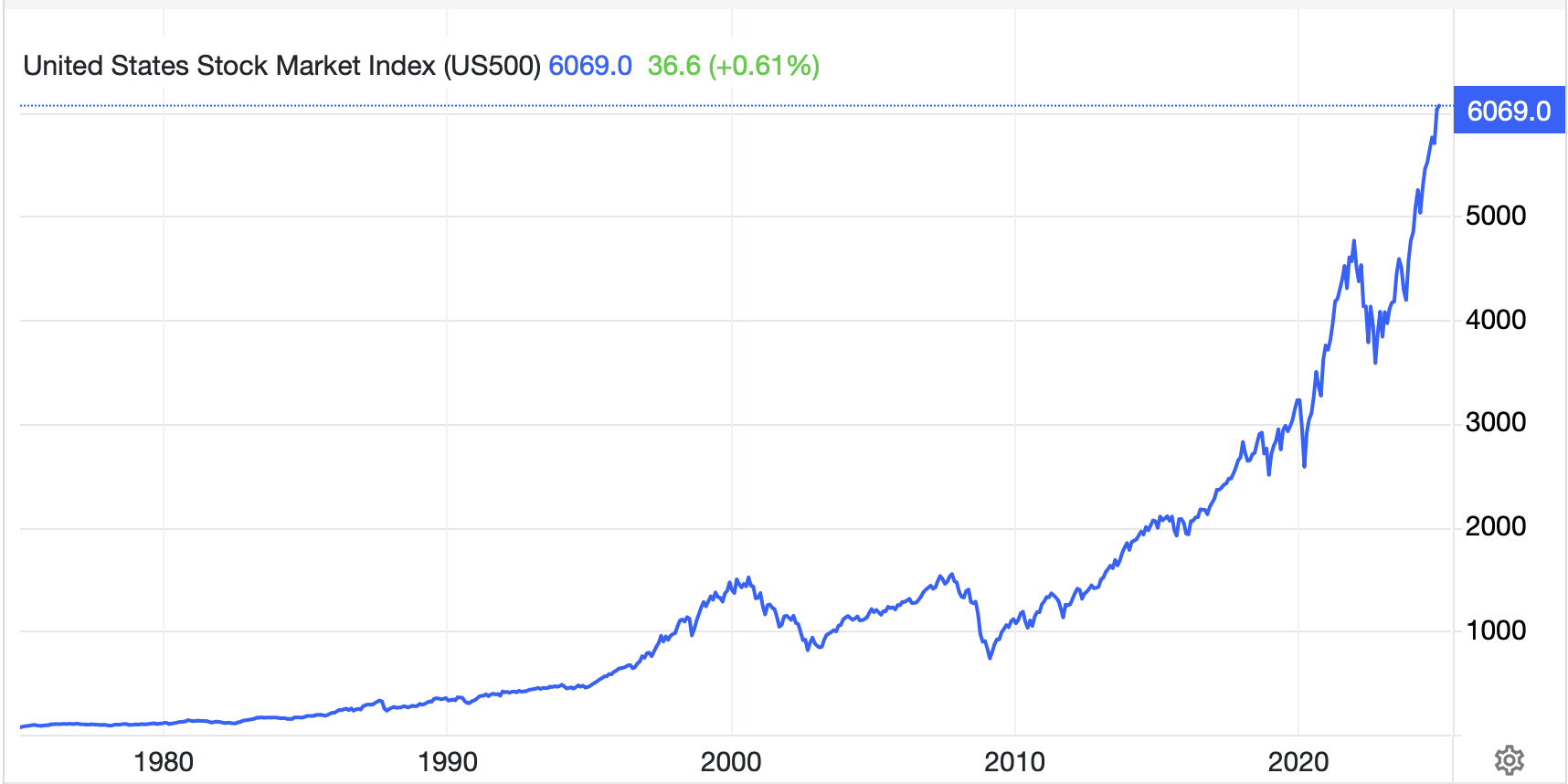
Source: tradingeconmics.com
For instance, the tech bubble was an anthill around 2000 on this chart, and the GFC crash, while described as the worst recession since the Great Depression, seems to be a pretty modest dip. Covid in 2020 was almost nothing and the biggest was really 2022, which saw the index slide 25% through the first 9 months of the year. Of course, part of this is the number itself. A 25% decline now would be ~1500 S&P points (or 11,000 Dow points), the type of thing that would freak out nearly everybody.
Is this possible? Certainly, it is, 25% declines have occurred pretty regularly through the history of the market. Is it likely? This is a much tougher question. BlackRock’s thesis is that this time is different; that AI is the game changer, and the future will be finally filled with flying cars and robots doing all our chores on the basis of unlimited free energy for everyone. Ok, that may be a slight exaggeration, but they are extremely optimistic that technology will continue to move forward and solve what currently appear to be intractable problems.
The one thing working in their favor, I think, is that governments and central banks around the world have essentially lost their tolerance for market corrections, whether that is in equity or fixed income markets, and so will do whatever they can to prevent any small slide from becoming a large one. Of course, the only thing they can do is print money to buy those assets that are falling in price. If that is the plan of action, then the future will be highly inflationary, that is the only clear outcome.
I have no idea how things will turn out. Perhaps BlackRock is correct, and we are about to embark on an entirely new segment of economic and financial history. Perhaps Elon will successfully help restructure the US government so it is efficient and focused on a more limited role, and that process will inspire other nations to follow suit. Perhaps pigs can fly as well. I hate to be a curmudgeon, but trees still don’t grow to the sky, whether they are created by AI or nature. Gravity remains undefeated. But I am wary when I read reports claiming this time is different. Forty plus years in the markets has taught me that is never the case. Tools may change, timelines may change, but ultimate outcomes remain the same.
Ok, as we await this morning’s NFP report, let’s see what happened overnight. Yesterday’s very modest declines in the US equity markets were followed by a slide in Japan (Nikkei -0.8%) and one in Australia (-0.6%) although this was predicated on weaker than expected GDP data, while Chinese shares (Hang Seng +1.6%, CSI 300 +1.3%) rallied on hopes that the economic conference next week is going to finally fire that long awaited Chinese bazooka! In Europe, the most interesting aspect is the CAC (+1.4%) is having a wonderful day after the French government fell and prospects for managing the economy there remain extremely uncertain. Perhaps that represents the idea that if the government is not interfering, French corporates can get on with the business of business unhindered and make more money. Or perhaps it is an assumption that the ECB will ease more forcefully to prevent a major mishap. After all, Madame Lagarde is French, so is likely not unbiased in the matter. As to US futures, at this hour (7:15) they are lower by -0.1% across the board as we await the data.
In the bond market, there is nothing going on at all. Treasury yields are unchanged on the day which is true of virtually every European sovereign with one exception, French OATs which have seen more buying and have slipped 2bps lower in the session. Here, too, it almost seems as though the market has decided the lack of a working government is better for France’s finances than when there is someone in power. One other thing to note is that JGB yields have edged lower by 1bp this morning and have fallen 4bps this week as USDJPY has traded higher over the same period. The most noteworthy thing here is that Toyoaki Nakamura, one of the most dovish BOJ members, explained that he was not against hiking rates, per se, and market participants took that as an opening for the BOJ to do just that and perhaps take a more pronounced stance against the ongoing inflation there. I’ll believe it when I see it.
In the commodity markets, apparently nobody needs oil (-0.8%) anymore as it continues to sell off. Remember just a few days ago we breached $70/bbl on the upside. Well, this morning we are below $68/bbl amid fears(?) that peace is breaking out in the Middle East with talk that Hamas is willing to release the hostages to achieve a cease fire. Arguably, a bigger issue is that much of the world (mostly China and Europe) have seen slowing economic activity and so demand estimates continue to decline along with the price. As to the metals markets, they have been bouncing around lately, not making any headway in either direction as it appears traders are waiting for more concrete clues about demand here as well. Gold (+0.2%) is the exception here, with demand not in question, just the timing of the next wave of central bank purchases.
Finally, the dollar is somewhat stronger overall this morning, notably vs. both AUD (-0.5%) and NZD (-0.4%) on the back of that weak GDP data. Away from that, the rest of the G10 is mostly a bit softer, but not seeing large moves with NOK (-0.4%) excepted on the weak oil prices. In the EMG bloc, declines are pretty consistent around the -0.2% range, but nothing really of note.
Now to the NFP data. Here’s what is forecast:
| Nonfarm Payrolls | 200K |
| Private Payrolls | 200K |
| Manufacturing Payrolls | 28K |
| Unemployment Rate | 4.2% |
| Average Hourly Earnings | 0.3% (3.9% y/Y) |
| Average Weekly Hours | 34.3 |
| Participation Rate | 62.6% |
| Michigan Sentiment | 73.0 |
Source: tradingeconomics.com
In addition, we hear from four more Fed speakers (Bowman, Goolsbee, Hammack and Daly) so it will be interesting to see how they perceive the amount of caution that is appropriate going forward. As a marker, this morning the Fed funds futures market is pricing a 70% probability of a December rate cut, down 4 points.
The big picture remains that the economy continues to outperform the naysayers, at least according to the official data. The fact that performance is spread unevenly does not matter to markets at this time. As such, it remains difficult for me to create the scenario where the dollar gives up substantial ground. If the Fed does cut in two weeks, I think it will be the last for a while unless we start to see some major revisions lower in the data. Maybe that starts this morning, but until then, you have to like the buck.
Good luck and good weekend
Adf
 fxpoetry