
Scapegoated

The people of Germany voted
With Friedrich Merz, at last, promoted
The nation, to lead
Though sure to misread
The sitch, with the Right still scapegoated


The result of the German Federal elections was very much as expected, the CDU/CSU won 28.5% of the votes and the largest share while AfD garnered 20.8%, the SPD just 16.4% (it’s worst showing in modern times) and the Greens gaining 11.6%.  A tail of other mostly very left-leaning parties made up the balance.  However, one cannot look at a map of the distribution of votes without noticing that the part of the country that was East Germany prior to the fall of the Berlin Wall, still sees things very differently than the rest of the nation.
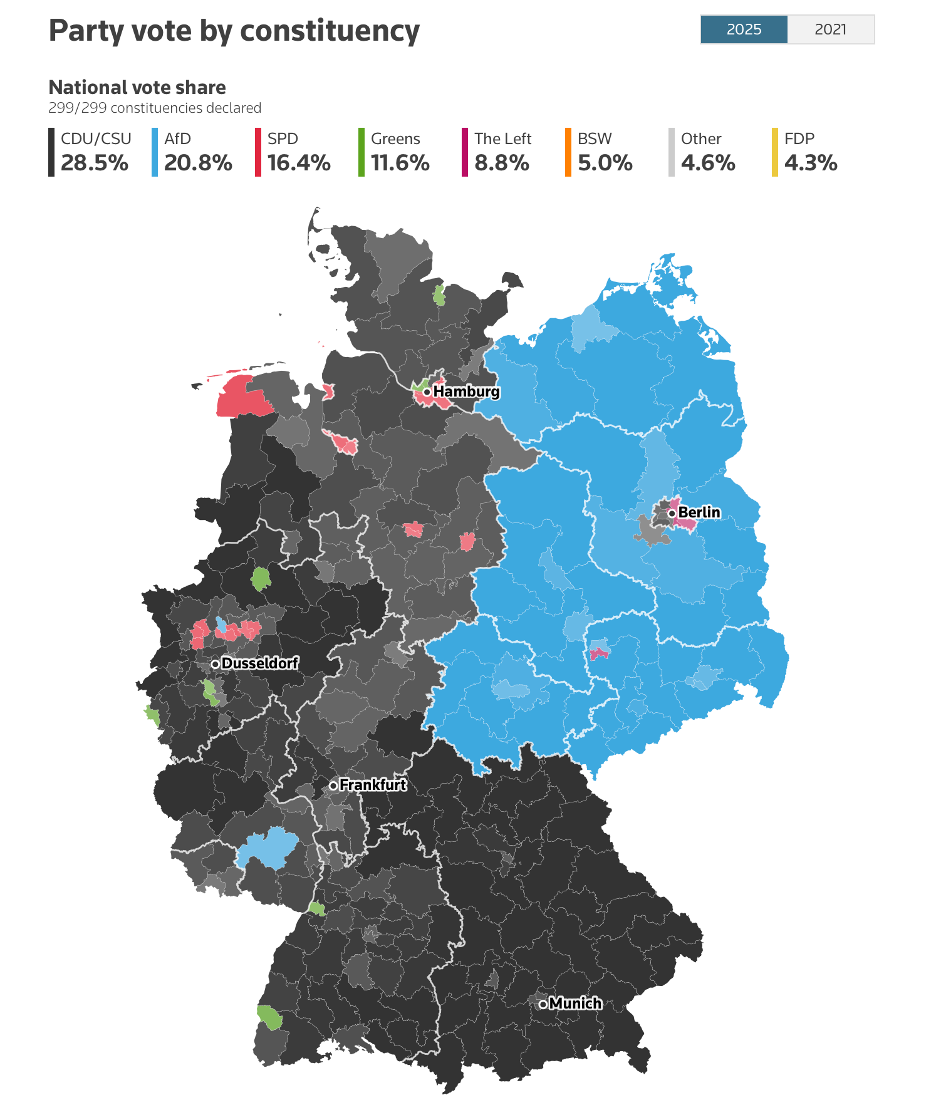
Source: Reuters.com

Regardless of the distribution, however, the outcome will result in some sort of coalition government, almost certainly to be a combination of the CDU and SPD.  On the surface, it would seem this left-right coalition will be doomed to failure, and that could well be the case, but because the consensus amongst the ‘right-thinking’ people in politics is that AfD is the devil incarnate, or perhaps more accurately, Hitler incarnate, Herr Merz will not be able to rule with a sure majority of conservative voters.

As with virtually every election, the economy is a top priority of the voters, especially since GDP growth, as measured, has essentially been zero for the past three years as per the below chart, and is mooted to stay there on present policies.

Source: tradingeconomics.com

One of the key issues that is currently under discussion there is the constitutionally enshrined ‘debt-brake’ which prevents the German government from running deficits of greater than 0.35% of GDP in any fiscal year.  In order to change the constitution, there needs to be a 2/3’s approval in the Bundestag, but AfD holds a blocking minority and one of their policy platforms has been fiscal prudence.

Arguably, this begs a larger question, what exactly constitutes economic growth?  For instance, if government debt is rising more quickly than economic output, is that actually a growing economy?  And is that process sustainable going forward?  It is quite interesting to look at the government debt dynamics of different nations and ask that question, especially since Germany’s situation really stands out.  

Perhaps, after looking at this group of charts, it is worth reevaluating exactly how much actual growth has been occurring and how much economic activity has simply been government borrowing recycled into the economy across all these nations.  Of course, this process has not been restricted to G-7 nations, it is a global phenomenon, with China doing exactly the same thing as are virtually all nations.  In fact, Germany is unique amongst large nations for bucking the trend.

The reason this issue matters is there is a limit to how far a government can increase its leverage ratio.  At some point, investors will stop buying debt which will force the central bank to buy the debt.  Of course, they will do so by printing more money and devaluing the currency.  We know this because we have seen it happen before many times throughout history with Germany’s Weimar Republic in 1923, Argentina in the 1980’s and Zimbabwe in 2007-2008 as just the most recent examples.  In fact, the reason the Germans have the debt brake is that there is a national memory of that hyperinflation from a century ago.

Circling back to the growth question, what is it that constitutes economic growth?  If you remember your college macroeconomics classes, this is the equation that is used to calculate economic activity in an economy:

            Y = C + I + G + NX

Where:

Y = GDP

C = Consumption

I = Investment

G = Government spending

NX = Net Exports

This equation is taken as gospel in the economics and political worlds.  However, it is not often recalled that it was created in the 1930’s by John Maynard Keynes.  It is not a law of nature, but merely was Keynes’ way of expressing something that had not been effectively measured previously.  Nearly 100 years later, though, perhaps it is time to reevaluate the process.  Remember, economies grew prior to Keynes creating this equation when government activity was a much smaller proportion of the economy.  But as we can see by the dramatic rise in government debt, that is no longer the case.  Perhaps Germany is a peek behind the GDP curtain that shows absent constantly increasing government borrowing, economic growth is stagnant.  Neil Howe’s Fourth Turning could well be the conclusion of this period of government excess, where things will be extremely volatile during the change, but less government will be the norm on the other side, at least for a few generations!

Ok, sorry for the history and theoretical discussion, but that chart of German government debt vs. the rest of the world was really eye-opening.  Let’s turn to markets from the overnight session.

After Friday’s sharp downward movement in the US, the picture in Asia was far more mixed.  Japan (+0.25%) managed a small gain while Hong Kong (-0.6%) and China (-0.2%) both lagged.  Elsewhere in the region, New Zealand (-1.8%) stood out for its weakness, although Korea, India and Taiwan were all softer in the session as well.  Ironically, it seems that better than expected Retail Sales data in NZ hurt sentiment for further policy ease by the RBNZ and concerns over trade with China given US pronouncements is also hurting the situation there, at least for today.

In Europe, Germany’s DAX (+0.9%) is leading the way higher after IfO Expectation data was released a touch better than forecast at 85.4.  However, it is important to remember that while this was a positive outcome, the average reading prior to Covid was between 95 and 103.  As to the rest of Europe, there are more gainers than laggards but little of real note absent any other data.  US futures at this hour (7:00) are pointing higher by at least 0.5% across the board.

In the bond market, Friday saw a very sharp decline in yields, -10bps in Treasuries, after weak readings in the Flash PMI data, especially services at 49.7, Existing Home Sales and Michigan sentiment.  That helped bring global yields lower.  This morning, Treasuries have bounced just 1bp and we are seeing similar rises in most of Europe.  JGB yields are also unchanged and have continued to consolidate near recent highs.

In the commodity markets, after a sharp sell-off on Friday on the back of stories about increased supply from Kurdistan, oil (0.0%) is unchanged this morning.  Meanwhile gold (+0.5%) is rebounding from its regular Friday sell-off, almost as though there were efforts by some to depress the price at the end of every week.  It will be interesting to see what happens this Friday which is month end as well.  As to silver and copper, they are little changed and dull this morning.

Finally, the dollar is asleep this morning, with very limited movement vs. almost any of its counterparts.  USDJPY remains below 150, but the yen has actually fallen -0.3% on the session, while the biggest movers are in Eastern Europe (CZK +0.8%, HUF +0.4%, PLN +0.35%), perhaps on the back of the German election results offering hope for a more useful German government.  We shall see about that.  Otherwise, nobody is concerned over the dollar right now.

On the data front this week, it is a quiet one with PCE data the highlight on Friday.

TodayChicago Fed Natl Activity0.21
TuesdayCase Shiller Home Prices4.4%
 Consumer Confidence103.0
WednesdayNew Home Sales680K
ThursdayInitial Claims220K
 Continuing Claims1874K
 Q4 GDP (2nd look)2.3%
 Real Consumer Spending4.2%
 Durable Goods2.5%
 -ex Transport0.3%
FridayPersonal Income0.3%
 Personal Spending0.2%
 PCE0.3% (2.5% Y/Y)
 Core PCE0.3% (2.6% Y/Y)
 Chicago PMI41.5

Source: tradingeconomics.com

In addition to the data, we also hear from seven Fed speakers over 9 venues, but again, are they really going to change the cautious approach at this stage?  And does it even matter?  For now, financial markets are far more focused on President Trump and his cabinet’s activities than interest rate policy which seems set to remain in place for a while.

When it comes to the dollar, nothing has changed my perspective on relative interest rates in the front end, with US rates likely to be far stickier at current levels than others, but the back end has a potentially different outcome.  Recall that Bessent and Trump are focused on the 10-year yield and getting that lower and seem far less concerned over the Fed for now.  To achieve that they will need to demonstrate the ability to reduce spending and the deficit situation.  While a promising start has been seen with DOGE, we are still a long way from a balanced budget.  My take is the dollar, writ large, is going to take its cues from the 10-year yield for now, so bonds are the market to watch.  If we see yields head back toward 4.0%, the dollar will decline and any significant move higher in yields will likely see the dollar climb as well.

Good luck

Adf
Taboo’s Been Broken

The calendar’s now turned the page
So, summer has moved to backstage
Thus, risk is retreating
And people are treating
The autumn as though it’s a phage
 
Meanwhile, German voters have spoken
And fears are a new trend’s awoken
Political leaning
Is rightward, thus meaning
A longstanding taboo’s been broken


Arguably, the biggest story from the long weekend was the voting in two German states, Thuringia and Saxony, where the Alternative for Germany (AfD) won one-third of the vote in each state thus destroying the traditional political calculus.  AfD is the right-wing party that has been described as neo-nazi and fascist regularly by the media (of course, the Republican party in the US has also been described in those same words), but more importantly, represents a complete rejection of the current status quo in Germany.  But perhaps the bigger concern for the German political elite is that an entirely new party, the Sarah Wagenknecht Alliance (BSW) won 15.5% and 11.5% of the votes in those two states respectively.  The BSW is a far-left party that espouses some of the same opinions, notably on immigration, as the AfD.  In other words, nearly half the electorate voted against the traditional parties as apparently people in Germany are not very happy.

To complete this story, the issue is that AfD, with which all parties have sworn against working in the parliament, has enough votes for a blocking minority, meaning they can (and almost certainly will) prevent the appointment of new judges and any constitutional changes that they don’t like.  As I said, the political calculus in Germany has changed significantly.  In fact, the parties in the current federal coalition (SPD, FDP and the Greens) saw their share of the vote fall to just 10.3% and 12.4%, respectively, in the two states.

I highlight this issue because it is indicative of the ongoing changes in Europe that may well undermine the single currency’s potential, and assumed, future strength based on the dollar’s assumed future weakness.  After all, whether or not the Fed embarks on a long period of rate cutting, or simply implements a token cut or two, given the political upheaval in Europe, is that going to be a good place for industry to invest?  Their energy policies have been hugely counterproductive, and Europe has about the most expensive energy in the Western world.  In fact, Volkswagen AG, has indicated it may be closing plants in Germany for the first time in the company’s long history.  It has simply become too expensive a place to do business.

This is not to imply that the euro (-0.25%) is going to collapse imminently.  Germany is only one of twenty nations in the Eurozone, albeit the largest economy by far.  But the story in Germany is not isolated to that nation.  We have seen similarly poor energy decisions and similar voter responses in other nations (notably the Netherlands, France and Austria). Whatever you think about the dollar, it is very difficult to get excited about the euro in my view.  

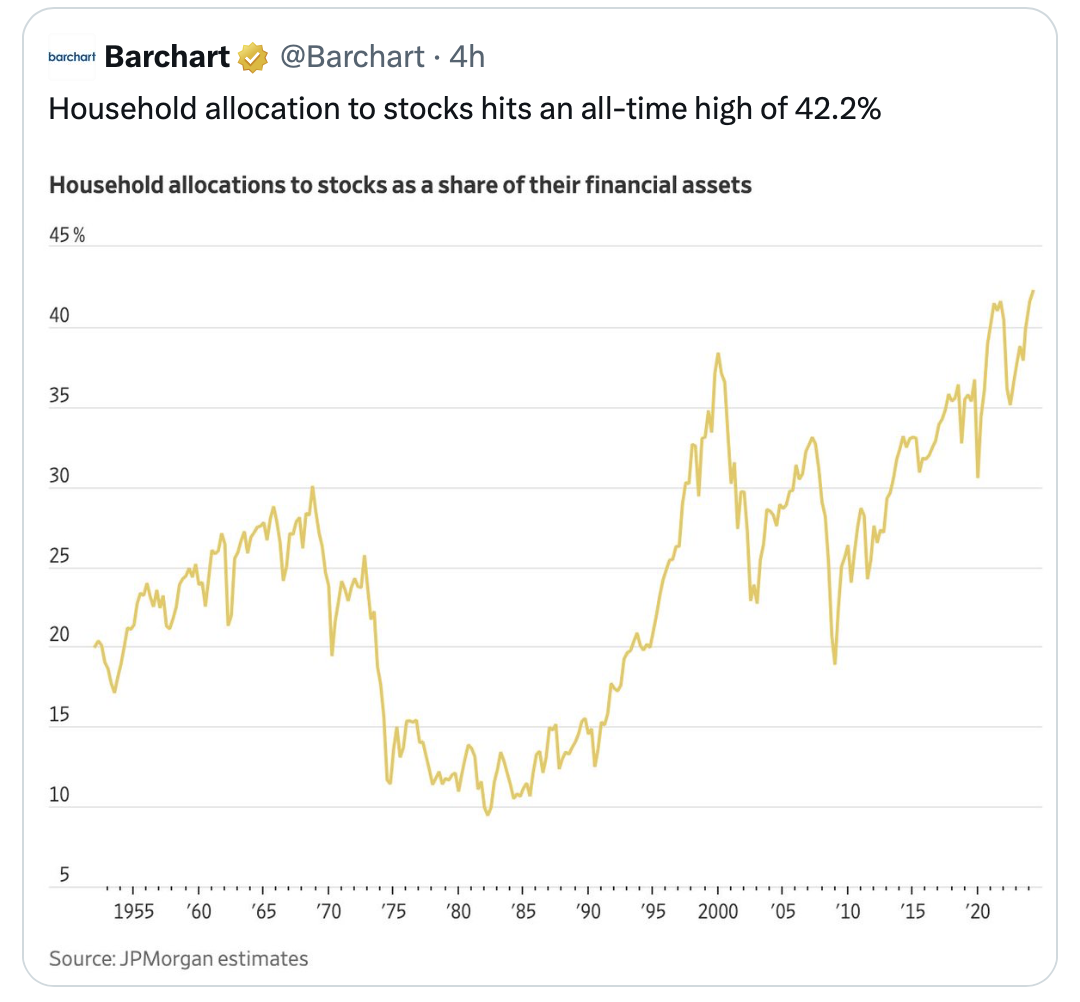
But let’s turn our attention to risk writ large.  I keep reading that September is historically the weakest month in the US equity markets and given the number of sources of strong repute that have written such, am willing to take that at face value.  As well, apparently, US households are the most bullish equities, or at least have the largest equity positions as a portion of their assets, in history (see chart below from @InvariantPersp1 on X).

It strikes me that the combination of extreme long positioning and a historical tendency for weakness may open up some downside in the equity markets, at least for a period.  Of course, if you are old enough to remember the yen carry trade debacle all the way back at the beginning of August, you know that even if we see a big downdraft, it can be reversed quite quickly.  And given both the Fed and ECB (and BOE) all meet later this month, it is not hard to believe that if equities were to decline sharply before their meetings, we could see larger than expected rate cuts across the board.  For now, the market continues to price a one-third probability of a 50bp cut by the Fed while expectations are for the ECB to cut in September and a 50% probability of an October cut.  

Net, do not be surprised if September has nearly as much volatility as August as the idea of max-long equity exposure into a slowing economy with still high inflation feels like a tenuous position.  We shall see.

Ok, let’s try to catch up to overnight activity, which has generally been of the risk-off variety.  Since Friday’s close, the story has been more negative than positive with Japanese (-1.1%) and Chinese (-1.5%) markets falling amid slightly softer than expected data and a more general malaise.  In Europe, too, things have been soft with today’s declines ranging from -0.2% (CAC) to -0.8% (Spain’s IBEX) and everything in between.  This is completely in sync with US futures markets which are all lower by at least -0.6% at this hour (7:20).  

Interestingly, while risk is under pressure, the traditional havens of government bonds are not seeing much benefit with Treasury yields edging higher by 1bp and similar moves throughout much of Europe although both Gilts and Bunds have seen yields edge lower by 1bp.  JGB yields have also edged higher by 1bp and are creeping, ever so slowly, back toward 1.00%.  This follows comments by BOJ Governor Ueda that he really means it when he says they BOJ will normalize policy.  The caveat is that will occur only if the economy meets their expectations with growth rising and inflation remaining high.  However, inflation continues to be fairly stable with services inflation actually declining there, thus undermining his message somewhat.

In the commodity markets, oil (-2.3%) has been taking it on the chin for the past week as the combination of the weaker demand story on a slowing global economy combines with growing confirmation that OPEC+ is going to end their production cuts starting next month, thus adding to supply, has weighed heavily on prices.  Back in January, I wrote a piece discussing my change of view on the long-term prospects for oil prices, which I flipped from bullish to bearish.  The essence of the piece was that there is plenty of oil around, it is political decisions that prevent its extraction.  As the politics of everything around the world continues to quickly change, I think this is an important baseline to keep in mind, although that doesn’t mean we won’t see short term spikes in oil’s price.  However, right now, it looks awful on the charts.

As to the metals markets, they have been under some pressure lately as well, notably copper and silver, with each of those falling more than 5% in the past week.  Gold, however, continues to find buyers as the bigger picture concerns of monetary debasement combine with still active central bank purchasers to support the barbarous relic.

Finally, the dollar is quite strong this morning, rallying against almost all its counterparts.  The commodity bloc are the laggards with AUD (-0.8%), NOK (-0.75%), NZD (-0.7%) and SEK (-0.5%) all suffering in the G10 with only JPY (+0.5%) rallying, arguably playing its haven role.  In the EMG bloc, ZAR (-0.8%), and the CE4 (-0.5% each) are under pressure along with KRW (-0.4%) and even CNY (-0.2%).  LATAM is the surprise with MXN (-0.1%) little changed at this hour.

On the data front, this is a big week that culminates in the payroll report on Friday.

TodayISM Manufacturing47.5
 Construction Spending0.0%
WednesdayTrade Balance-$78.9B
 JOLTs Job Openings8.10M
 Factory Orders4.6%
 -ex Transport-0.2%
ThursdayADP Employment145K
 Initial Claims230K
 Continuing Claims1870K
 Nonfarm Productivity2.4%
 Unit Labor Costs0.9%
 ISM Services51.1
FridayNonfarm Payrolls165K
 Private Payrolls138K
 Manufacturing Payrolls0K
 Unemployment Rate4.2%
 Average Hourly Earnings0.3% (3.7% Y/Y)
 Average Weekly Hours34.3
 Participation Rate62.6%

Source: tradingeconomics.com

Obviously, all eyes will be on NFP as the Fed has clearly turned its primary attention to the employment side of its mandate.  However, don’t fall asleep on the JOLTs data tomorrow, as that has also been part of Powell’s calculus. (seems there was a lot of calculus today, I hope you all managed to get through that in college 😂).  Remember, too, that CPI comes next week and then the FOMC meeting is the following week, so there is no respite.

This morning, risk feels unwanted.  With equity markets still within spitting distance of their all-time highs, it appears there is ample room for some down days ahead.  Of course, Friday will be key.  Regarding the dollar, for now, I believe the bounce continues.  But Friday will dictate the medium term, at least until the FOMC meeting.

Good luck

Adf

Risk Were Inbred

In China, the problems have spread
From property company dread
To shadow finance
Where folks took a chance
To earn more though risks were inbred

And elsewhere, the Argentine voters
Surprised governmental promoters
By choosing a man
Whose primary plan
Is ousting Peronist freeloaders

While the goal of this commentary is to remain apolitical, there are times when the politics impacts the markets and expectations for future movement so it must be addressed, though not promoted on either side.  Today, amid general summer doldrums, it seems there are more political stories around that are either having or have the potential to impact financial markets.

But first, a quick look in China where the latest problem to bubble to the surface comes from Zhongzhi Enterprise Group Company, one of the many shadow banking companies in the country.  These firms are conduits for investment by wealthier individuals and corporations who offer structured products and investments promising higher returns than the banking sector.  And they are quite large, with an estimated $2.9 trillion invested in the sector.  Well, Zhongzhi has roughly $138 billion under management and last week they apparently missed some coupon payments on several of these high-yielding investments.  While this is the first that we have heard of problems in the sector, given the terrible performance of the Chinese equity market as well as the ongoing collapse of the Chinese property market, my guess is this won’t be the last firm with a problem.  As has often been said, there is never just one cockroach when you turn on the lights.

As proof positive that there is really no difference between the Chinese and US governments, the first response by the Chinese was to set up a task force to investigate the risks at Zhongzhi and its brethren shadow banks.  That sounds an awful lot like what would happen here, no?  Anyway, depending on who is invested in Zhongzhi and whether they are politically important enough to bail out, I suspect that there will be government intervention of some sort.  Do not be surprised to hear about Chinese banks making extraordinary loans to the sector or guarantees of some kind put in place.  The last thing President Xi can afford at this time is a meltdown in a different sector of the financial space.

It can be no surprise that Chinese equity markets were under pressure again last night, with both the Hang Seng and CSI 300 falling sharply, nor that the renminbi has fallen to its weakest levels since the dollar’s overall peak last October.  I maintain that 7.50 is in the cards here and that it is simply a matter of time before we get there.  In the end, a weaker CNY is the least painful way for China to support its economy, especially since it is a big help to its export industries which remain the most important segment of the economy.  Later this week we will see the monthly Chinese data on investment and activity so it will be interesting to see how things are ostensibly progressing there.  However, this data must always be consumed with an appropriate measure of salt (or something stronger) as there is no independent way to determine its veracity.

Meanwhile, on the other side of the world, a presidential primary in Argentina resulted in a huge surprise with Javier Milei, a complete outsider and ostensible free market advocate, winning the most votes, more than 30%.  The election comes in October and the ruling Peronist party is at risk of being eliminated in the first round.  What struck a chord in the country was his plan to dollarize the economy and close the central bank as well as to shut down numerous government agencies.  Inflation there remains above 115% so it can be no surprise that someone who promised to change the process garnered a lot of support.

I raise this issue because in Germany, the AfD (Alternative für Deutschland) party is currently polling at >21%, the second largest party in the country, and that has a lot of people very concerned.  Like Senor Milei, the AfD’s platform is based on destruction of much of the current government setup.  Because this party is on the right, and given Germany’s dark history with the far right, the latest idea mooted has been to ban the party completely.  Now, certainly the idea of a resurrection of the Nazi party is abhorrent to everyone except some true extremists, but simply banning the party seems a ridiculous idea.  After all, the members will either create a new party with the same support or take over a smaller existing party and drive the platform in the desired direction.  

Support for Marine LePen in France continues to grow, as does support for right of center parties throughout Europe, especially Eastern Europe.  And of course, here in the US, the upcoming election has fostered even more polarization along partisan lines with the Republican party seeming to gain a lot of support of late.  All this implies that there is a chance of some real changes in the financial world that will accompany these political changes.  At this point, it is too early to determine how things will play out, but as we are currently in the Fourth Turning, as defined by historian Neil Howe, the part of civilization’s cycle when there is great unrest, I expect there will be a lot more change coming.  Food for thought.  And it is for this reason that hedging exposures is so critical.

Ok, last week’s inflation readings were mixed, with CPI a bit softer than forecast while PPI was a bit firmer.  But the one consistency was that Treasury yields rose regardless of the situation.  After a further 5bp rise on Friday, 10yr yields are unchanged at 4.15% this morning, an indication that inflation concerns remain front of mind for most investors.  I expect that the peak yields seen back in October will be tested again soon.  As to European sovereigns, while yields there are down a tick this morning, the trend there remains higher as well.

Equity markets, too, have had some trouble of late, sliding a few percent over the past several weeks.  While the move lower has been modest so far, there is clearly concern over a technical break lower should the indices break below their 50-day moving averages.  With yields heading higher, I fear that is the path of least resistance for now.

Oil prices are a touch softer this morning but remain well above $80/bbl and appear to be consolidating before their next leg higher.  Supply is still a consideration and given economic activity continues to outperform, I suspect higher is still the path going forward.  Metals prices are little changed this morning despite some incipient dollar strength, so keep that in mind as well.

Finally, the dollar is much stronger against its Asian counterparts and modestly stronger against most others this morning.  Continuing rises in US yields offer support for the greenback and increased turmoil elsewhere, along with the US economy seemingly outperforming all others have been the hallmarks of the dollar’s strength.  I don’t see that changing soon.

Data this week brings the following:

TuesdayRetail Sales0.4%
 -ex autos0.4%
 Empire Manufacturing-0.7
 Business Inventories0.1%
WednesdayHousing Starts1445K
 Building Permits1468K
 IP0.3%
 Capacity Utilization79.1%
 FOMC Minutes 
ThursdayInitial Claims240K
 Continuing Claims1700K
 Philly Fed-10.5

Source: Bloomberg

While Retail Sales will be watched for their economic portents, I think the Minutes will be the most interesting part of the week, especially as we have now had at least two FOMC voters, Harker and Williams, talk about cutting rates next year.  

For today, while US equity futures have edged higher so far, I feel like the dollar has legs for now.  This will be confirmed if yields continue to rise.

Good luck

Adf