A New Paradigm

No matter the asset you trade
For weeks, every move’s been a fade
As headlines decry
Each thing Trump does try
Investors are feeling betrayed
 
They want to go back to the time
When markets did, every day, climb
But that time has passed
And I would forecast
We’ve entered a new paradigm


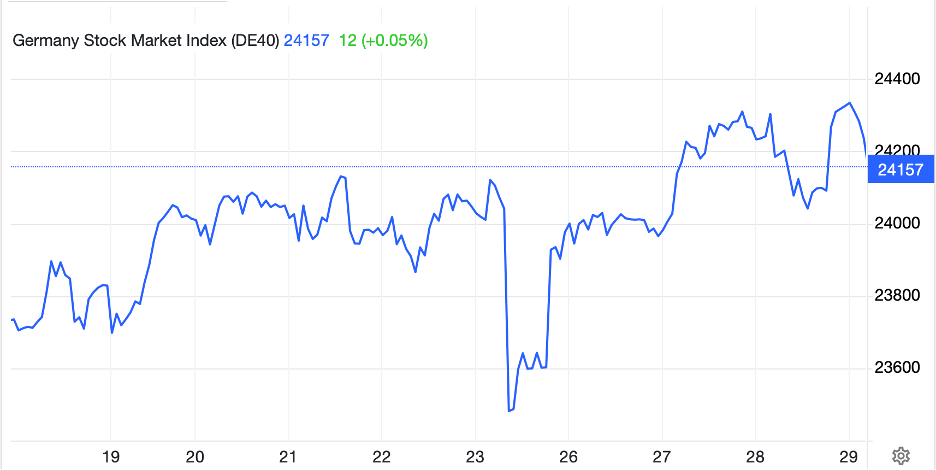
The following onslaught of charts from tradingeconomics.com are meant to highlight that for the past several weeks, basically nothing has gone on in markets.  Every day is like every other, and the only trend is a horizontal line.

Now, this is not to say that each movement is identical, just that any longer-term trends that may exist are not evident lately.  For traders, this can be terrific because there has been volatility which can be captured.  Of course, since much of the volatility has been headline bingo, that reduces the appeal.  But for longer term investors, it is a more difficult situation as those same headlines can call into question the underlying thesis of any or every trade.

Are the tariffs here to stay?  Or will they be overruled?  Is the “Big Beautiful Bill” going to be a benefit?  Or are there too many things hidden within that will impact the economy, markets and investor behaviors?  Is there going to be a Russia/Ukraine peace?  Is Iran going to sign a deal?  Will the US and China agree a trade deal?  Obviously, there are many very large issues currently outstanding with no clear resolutions in any of them as of now.  When you consider not only that the future is uncertain (which is always true) but the potential outcomes are diametrically opposed, it is easier to realize why markets are stuck in the mud.  But hey, nobody ever said trading was supposed to be easy!

There is, however, one issue I think worth highlighting that has seen an increase in discussion, and that is Section 899 of the reconciliation bill.  It is titled, “Enforcement of Remedies Against Unfair Foreign Taxes” and Bloomberg has a solid description here.  The essence of this clause is it increases taxes on nations, and individuals in those nations, who discriminate against US companies.  The idea is that Europe, especially, is busy enacting “Digital Services Taxes” which are designed to extract revenue from the large US tech companies that dominate particular spaces, like Meta, Google and Microsoft.  But these tax laws have thresholds such that essentially no other companies will be impacted.  This is the US response.  

Much of the discussion thus far has focused on the idea that this will discourage investment in US financial assets, potentially reducing the market for Treasury bonds and adding to the destruction of American exceptionalism in financial markets.  And it may well do that.  However, the thing to consider is that one of the reasons that the US has drawn so much investment is that there are so many investable securities here in the US, and that property rights remain sacrosanct.  Yes, taxation matters, but if you are a sovereign wealth fund with $100 billion in assets or more, where are you going to invest that money if not in the US, at least in some part?  And remember, this is only to be focused on nations with discriminatory taxes vs. US companies.  So, the Saudis, for example, or the Japanese need not worry.  It strikes me that at the margin, this could have a modest impact on prices, perhaps softening the dollar some and reducing future gains, but this is unlikely to end investment into the US.

Ok, let’s quickly run through the lack of overall movement last night.  Yesterday’s early US equity gains (triggered by the tariff ruling) faded all day and markets here closed very modestly higher.  In Asia, gains from yesterday were largely reversed as an appeals court stayed the ruling, so the tariffs remain in place as of now.  Thus Japan (-1.2%), Hong Kong (-1.2%) and China (-0.5%) basically reversed yesterday’s closings.  In Europe, though, things are a bit brighter. With gains across the board as inflation data released showed that it continues to drift lower across the continent.  This has encouraged traders to believe that more ECB rate cuts are coming, which was confirmed by the Bank of Italy’s Fabio Panetta, an ECB Governing Council Member, who exclaimed that inflation is nearly beaten.  Meanwhile, bank economists are now warning that further rate cuts need to come more quickly.  All this, of course, is music to equity investors’ ears.  As such, gains range from +0.3% (France) to 1.0% (Germany) and everywhere in between.  As to US futures, they are unchanged at this hour (7:30).

In the bond market, Treasury yields are unchanged this morning after sliding 8bps yesterday.  Interestingly, European sovereign yields, which also fell yesterday, have rebounded 3bps this morning despite the happy talk of more ECB rate cuts and the imminent death of inflation.  Too, last night saw yields decline in Japan (-3bps) and Australia (-11bps), following in the footsteps of yesterday’s Treasury market.

In the commodity markets, oil (+1.3%) is higher after EIA data yesterday showed modest inventory draws while gold (-0.75%) is giving back yesterday’s gains which came on the back of a weak dollar.  But as mentioned at the beginning of this piece, in the end, trends in both directions are on hold for now.

Finally, the dollar is firmer this morning, unwinding some of yesterday’s declines which grew throughout the day.  Right now, in the G10, the euro (-0.3%) is a pretty good proxy for the entire bloc, although JPY (+0.15%) is sticking out like a sore thumb.  In the EMG bloc, we see declines on the order of -0.5% (KRW, PLN, ZAR) although MXN (+0.2%) is also an aberration this morning.  Alas, I see no particular reason for this move.  However, as mentioned above, the recent trend is flat, although I cannot get over the idea that the dollar has further to decline going forward.

On the data front, this morning brings Personal Income (exp 0.3%), Personal Spending (+0.2%), PCE (0.1%, 2.2% Y/Y), and Core PCE (0.1%, 2.5% Y/Y) as well as the Goods Trade Balance (-$141.5B) all at 8:30.  Then we see Chicago PMI (45.0) and Michigan Consumer Sentiment (51.0) at 10:00.  There is one final Fed speaker this week, Atlanta’s Bostic this afternoon.  However, when it comes to the Fed, again yesterday we heard that patience is the watchword with no hurry to adjust policy right now.  As well, we learned that Chairman Powell had lunch with President Trump yesterday, where Trump asked him to lower rates, and Powell said they are following their long-proscribed tasks of responding to economic outcomes. 

There is nothing that seems likely to excite anyone today, so I look for a quiet session overall.  It seems unlikely that anything of note will be resolved, whether on a political or international relations basis, so look for a quiet session and a relatively early close as traders and investors head out for a summer weekend.

Good luck and good weekend

Adf
Need Some Revising

The punditry fears that the bond
Is starting to move far beyond
A level at which
The US can stitch
Together a plan to respond
 
Meanwhile, though yields broadly are rising
The dollar, it’s somewhat surprising
Continues to sink
Which makes some folks think
Their models now need some revising


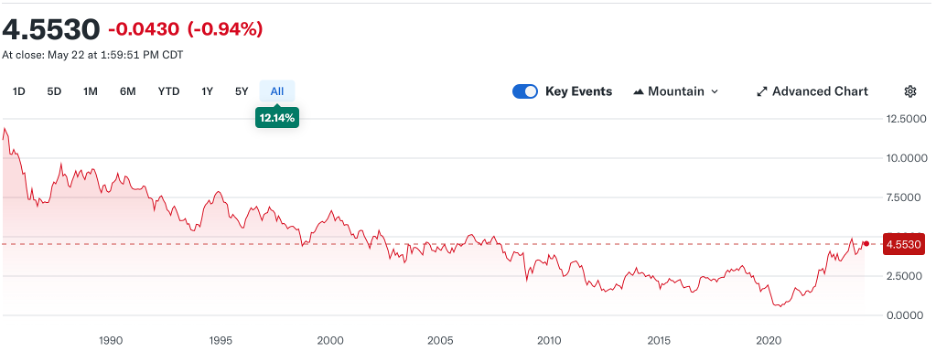
Perspective is an important thing to maintain when looking at markets as it is far too easy to get wrapped up in the short-term blips within a trend and accord them more importance than they’re due.  It is with that in mind that I offer the below chart of the 10-year US Treasury yield for the past 40 years.

Source: finance.yahoo.com

Lately, much has been made of the fact that 10-year yields have risen all the way back to where they were on…January 1st of this year.  But the long history of the bond market is that yields at 4.5% or so, which is their current level, is the norm, not the exception.  As you can see, in fact they were far higher for a long time.  Now, I grant that the amount of debt outstanding is an important piece of the puzzle when analyzing the risk in bonds, and the current situation is significant.  After all, even Moody’s finally figured out that the US’s debt metrics were lousy.  And under no circumstances am I suggesting that the fiscal situation in the US is optimal. 

But I also know that, as I wrote yesterday, the Fed is not going to allow the bond market to collapse no matter their view of President Trump.  Neither is the US going to default on its debt (beyond the slow pain of higher inflation) during any of our lifetimes.  I continue to read that the just-passed ‘Big, Beautiful Bill’ is going to result in deficits of 7% or more for the next decade, at least according to the CBO.  Alas, predicting the future is hard, and no one knows that better than the CBO.  Their track record is less than stellar on both sides of the equation, revenues and expenditures.  This is not to blame them, I’m sure they are doing their best, it is just an impossible task to create an accurate forecast of something with so many moving parts that additionally relies on human responses.

My point is that one needs to look at these forecasts with at least a few grains of salt.  While the current narrative is convinced that deficits are going to blow out and the nation’s finances are going to fall over the edge of the abyss, while the trend is in the wrong direction, my take is the end is a long way off.  In fact, the most likely outcome will be debt monetization around the world, as every government has borrowed more than they are capable of repaying without monetizing the debt.  The real question we need to answer is which nations will be able to do the best job of managing the situation on a relative basis.  And that, my friends, despite everything you read and hear about, is still likely to be the US.  This is not to say that US assets will not fall out of favor for a while relative to their recent behaviors, just that in the long run, no other nation has the resources and capabilities to thrive regardless of the future state of the world.

I guess the one caveat here would be that the entire global framework changes as the fourth turning evolves and old institutions die while new ones are formed.  So, the end of the IMF and World Bank, the end of SDR’s and even organizations like the UN cannot be ruled out.  And I have no idea what will replace them.  Regional accords may become the norm, CBDC’s may become the new money, and AI may run large swaths of both governments and the economy.  But in the end, at least nominally, government debt will be repaid in every G10 nation, of that I am confident.

One of the reasons I have waxed philosophical again is that market activity, despite all the chattering of the punditry, remains pretty dull.  For instance, in the bond market, despite all the talk, Treasury yields, after slipping a few bps yesterday, are unchanged today.  The same is true across Europe, with no sovereign bond having seen yields move by more than 1 basis point in either direction.  JGB’s overnight, despite CPI coming in a tick hotter than forecast, saw yields slip -4bps, following the US market from yesterday.  If the end is nigh, the bond market doesn’t see it yet.

In equities, yesterday’s lackluster session in the US was followed by a lackluster session in Asia (Nikkei +0.5%, CSI 300 -0.8%, Hang Seng +0.25%) with no overall direction and this morning in Europe, the movement has been even less interesting (CAC -0.5%, DAX +0.2%, FTSE 100 0.0%). Too, US futures are little changed at this hour (7:00).

In the commodity markets, gold (+0.9%) continues to chop around within a range that it entered back in early April.

Source: tradingeconomics.com

To me, this is the perfect encapsulation of all markets, hovering near recent highs, but unable to find a catalyst to either reject those highs, or leave them behind in a new paradigm.  You won’t be surprised that other metals are also a touch higher this morning (Ag +0.2%, Cu +0.7%), nor that oil (+0.3%) is also edging higher.  It strikes me that today’s commodity profile may be attributed to the dollar’s weakness.

So lastly, turning to the dollar, it is softer against virtually all its major counterparts this morning, with the euro (+0.6%) and pound (+0.6%) both having a good day.  In fact, the pound has touched 1.35 for the first time in three years.  But the dollar’s softness is widespread in both blocks; G10 (AUD +0.85%, NZD +1.0%, SEK +1.0%. NOK +1.0%, JPY +0.5% and even CAD +0.35%), and EMG (ZAR +0.7%, PLN +0.6%, KRW +1.0%, SGD +0.5% and CNY +0.35%).  The fact that SGD moved 0.5% is remarkable given its inherently low volatility.  But I assure you, Secretary Bessent is not upset with this outcome.

The only data this morning is New Home Sales (exp 692K) and we hear from yet another Fed speaker this afternoon, Governor Cook.  Chairman Powell will be speaking on Sunday afternoon, so that may set things up for next week, although with the holiday weekend, whatever he says is likely to be diluted by the time US markets get back to their desks on Tuesday.

In the end, the message is the end is not nigh, markets are adjusting to the changing realities of trade and fiscal policies, and monetary policies remain on a steady state.  The ECB is going to cut again, as will the BOE.  The BOJ is likely to hike again, and the Fed is going to sit on its hands for as long as possible.  The futures market is still pricing in two rate cuts this year, but I still don’t see that happening.  In fact, if the tax bill is enacted, I suspect that it will have a significantly positive impact on the economy, as well as on expectations for the economy, and interest rates are unlikely to fall much at all.  As well, absent a concerted international effort to weaken the dollar (those pesky Mar-a-Lago accords again), while the short-term direction of the dollar is lower, I’m not sure how long that will continue.  

Good luck and have a great holiday weekend

Adf