Many Critiques

This evening the president speaks
And pundits have many critiques
Meanwhile in Iran
There’s no clear game plan
As havoc, the president wreaks

But right now, seems traders don’t care
‘Bout Persia or any warfare
Instead, soft inflation
Has changed the narration
So, pundits, high rates now foreswear

Some days, it’s simply more difficult to find stories that bring coherence to the narrative.  But let me try.  Yesterday’s PPI data was also much cooler than forecast, although still clearly quite high on a year over year basis, but it certainly added to Tuesday’s CPI result and has changed a lot of views regarding the Fed’s future actions.  For instance, if we look at my favorite CME table for current probabilities of future rate moves, we see that there is now just a 10% probability of a hike in two weeks’ time, and just one hike priced in for the next 18 months.
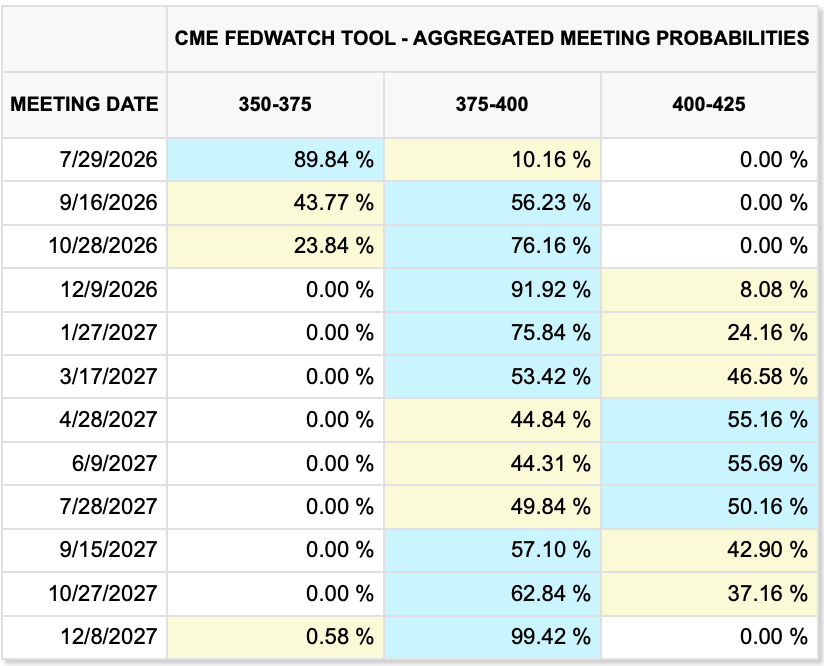
Remember, Monday, there was a 40% probability of a hike priced for the July meeting and two+ hikes priced through 2027.  (As I recall, I was an advocate of fading that price action.)  I expect that this will alter the narrative as calls for an immediate rate hike to burnish Warsh’s, and the Fed’s, credibility are likely to fade away.  In the meantime, he didn’t say anything new at the Senate testimony and the rest of the Fed talking heads continue to reiterate that they would be comfortable raising rates if inflation pressures rise.  Remarkably, they didn’t seem to notice the recent numbers.

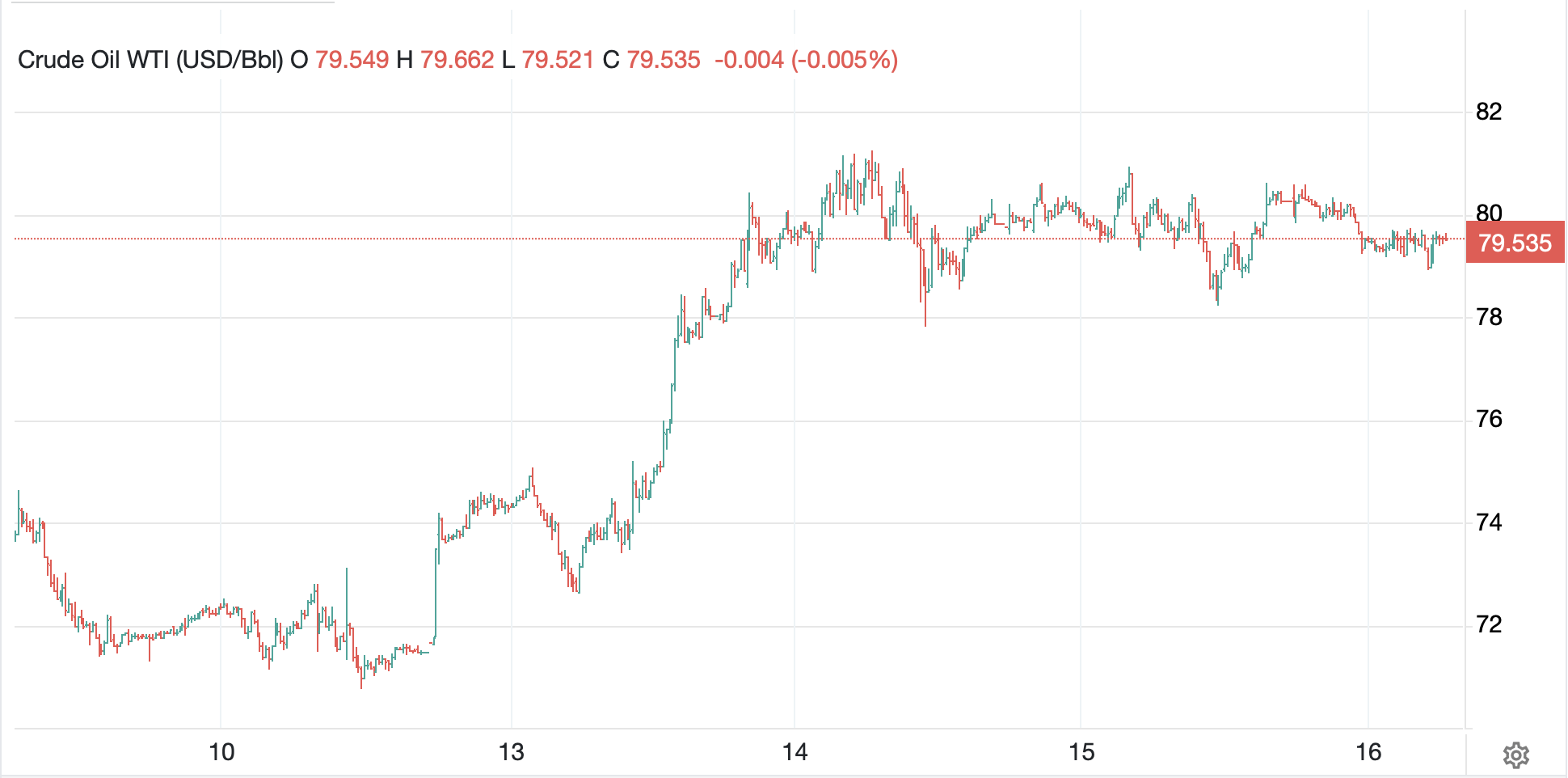
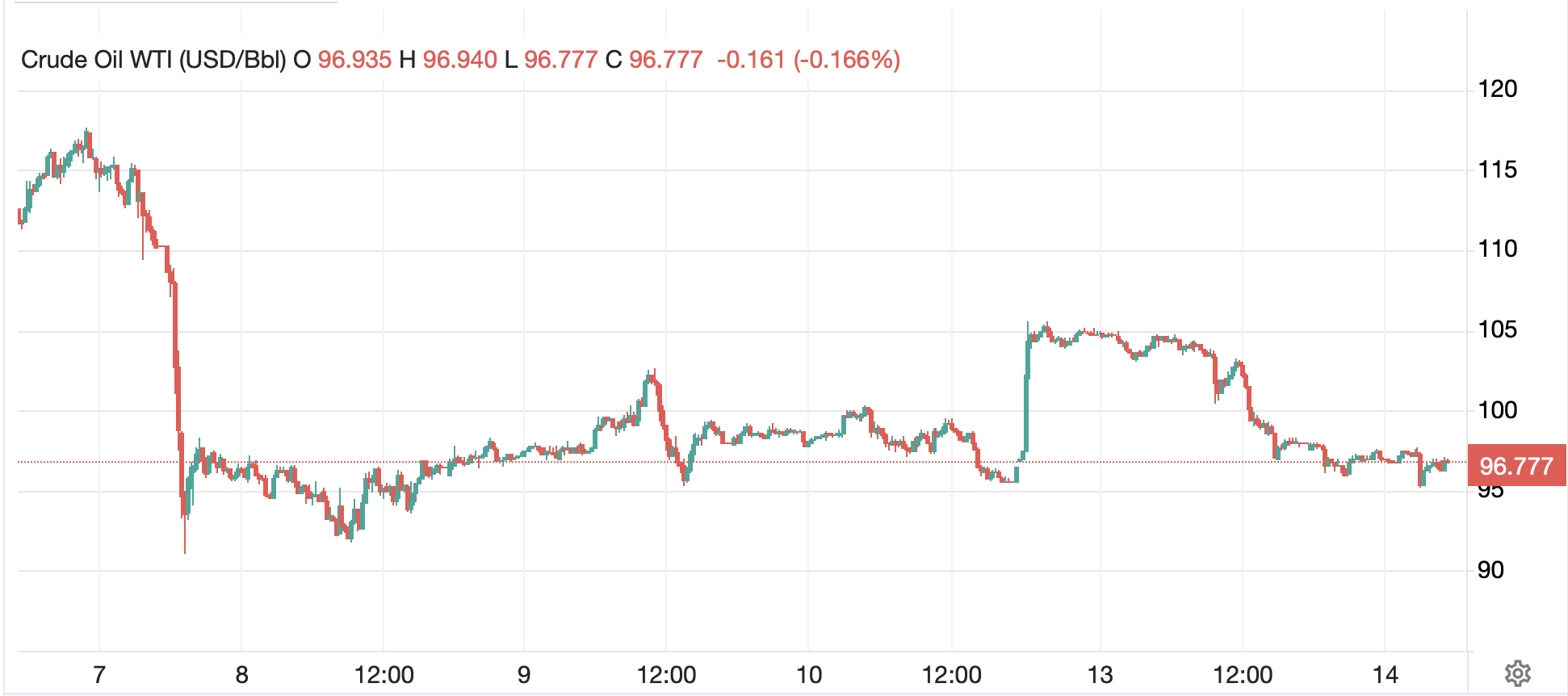
Turning to the Strait of Hormuz, the US blockade of Iranian vessels is back in force and there have been a significant number of new US attacks on Iranian military sites.  As well, the IRGC has fired drones/missiles at several tankers trying to exit the Strait on the Omani side.  I read this morning that the president is considering whether to escalate things by attacking Kharg or Qeshm Islands, two key Iranian strongholds, and my guess is if that were to be the case, the oil market would likely take a turn higher.  But right now, WTI is effectively unchanged on the day, and has been since Monday’s rise.  I guess $80/bbl +/- is the new home.
Source: tradingeconomics.com

As to the President’s speech tonight, the word is it is going to involve election related issues, seemingly regarding the integrity of elections, the SAVE Act and the results of the 2020 elections.  Recall, Tulsi Gabbard, before she resigned to care for her husband, declassified a great deal of information and some portion apparently was election related.  Alas, this will simply further stoke partisan feelings as there is very little evidence that showing proof of something political has the ability to change the opposing viewpoints of partisans.

So, away from oil, we are now into earnings season, and the big banks all had monster quarters while there is growing angst over the AI sector and whether the main players will be able to make the money that was assumed for so long.  So, while yesterday saw US indices trade higher, the overnight session has been far less positive.

Starting in Asia, Tokyo (-2.8%), China (-1.9%) and Korea (-6.4%) all felt the pain of semiconductor weakness although HK (+1.3%) bucked the trend with most of the rest of the region showing far less movement in either direction.  There was precious little data to drive things, so this clearly seemed to be tech sector woes.  In Europe, broad, but modest, weakness is today’s theme with both France and Germany lower by -0.65% with Spain (-0.5%) also under pressure and the UK (-0.3%) the best of the bunch after GDP data was mildly better than the last reading at 1.3% Y/Y in May.  While the Trade Balance improved a bit, IP was weak and although it has been spun as a positive report, it hardly quickens the pulse.  Meanwhile, at 7:20 this morning, NASDAQ futures are lower by -1.1% although the other two major indices are little changed.  Tech is definitely under pressure here.

In the bond market, this morning we are seeing yields higher by basically 2bps across the board in Treasuries and European sovereigns.  Much is being made of the French OAT 30-year yield this morning as it trades to its highest level since the GFC as per the below from barchart.com.
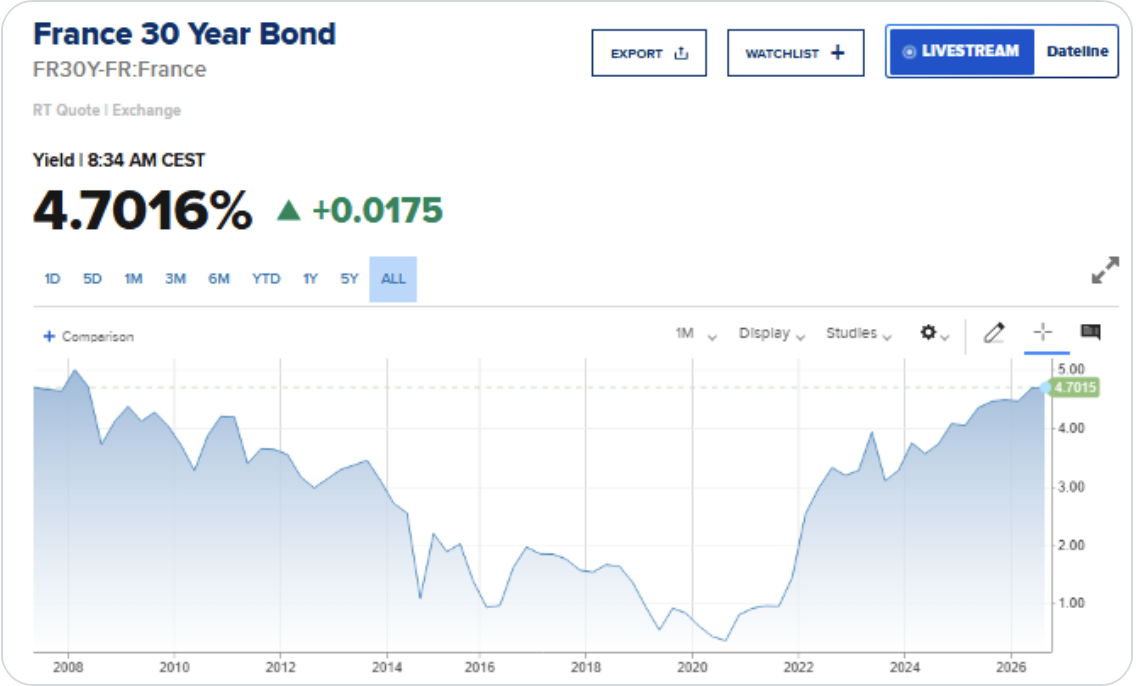
While this headline of the highest rate in X years is splashy, what we have been seeing consistently, across all nations, is that debt issuance continues to rise and central banks have not been absorbing nearly as much as they had in the more recent past.  This means that the private sector needs to buy bonds, and they are demanding higher yields.  Someone made the point (and I cannot remember where I first read it, but it is valid) that bond yields appear to be less about inflation concerns, per se, and more about the ability for markets to absorb the ever-increasing amount of debt being issued by governments…and companies.  Just look at how much debt is being issued by the hyperscalers to fund their AI buildout.  Regardless of what happens to the front end of the curve and central bank rate activities, it does feel like the back end of the curve is where the signal is going to be found going forward.

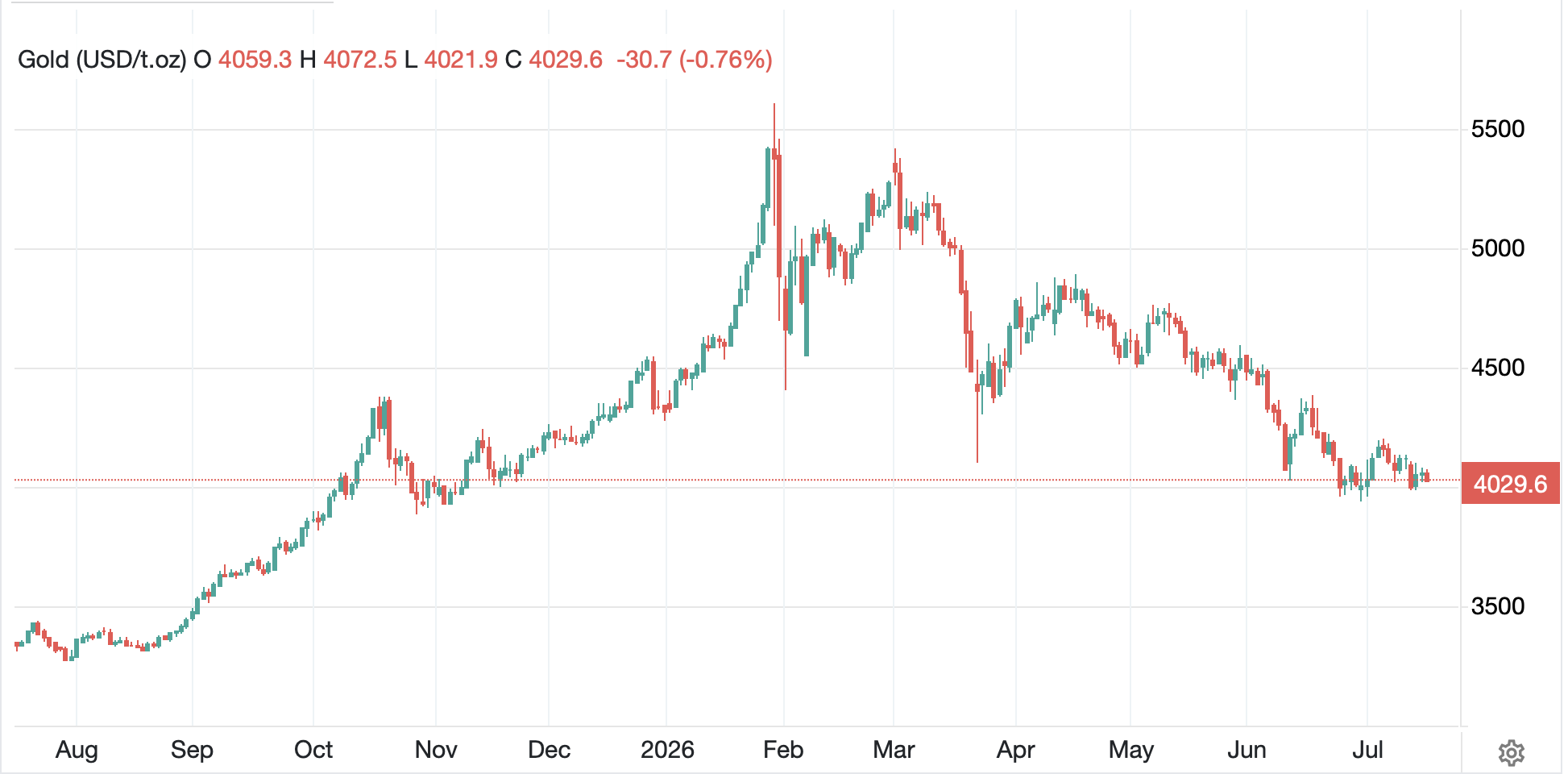
Precious metals continue to bat about, rallying and then giving those gains back, but net remain under pressure as gold (-0.75%) and silver (-1.9%) are both softer this morning although copper (+0.7%) continues to find support.  It is difficult to look at the gold chart and be optimistic about a reversal of fortune in the near-term.  
Source: tradingeconomics.com

However, as per the discussion above regarding the increasing issuance of government debt around the world, at some point, the larger fiat vs. physical stores of value question is going to reassert itself and gold will be one of the main beneficiaries of that story.  Alas, it has a history of doing nothing from a price perspective for years on end.

Finally, the dollar, which suffered yesterday, with the DXY slipping -0.5%, is not very interesting this morning.  the pound, interestingly, has slipped -0.3% despite what many are trying to spin as a positive GDP report.  The other noteworthy mover is KRW (+0.4%) on the back of the BOK raising interest rates by 25bps to 2.75% last night.  While this was widely expected, the rhetoric about faster growth driving the need for higher rates has been a boon to the won.  (And remember, this was despite the KOSPI getting crushed last night on weakness in the two big semiconductor firms.)

On the data front, this morning brings the weekly Initial (exp 217K) and Continuing (1820K) Claims as well as Retail Sales (0.2%, -0.1% ex autos) and the Philly Fed (13.0).  With the recent surprises in CPI and PPI, I’m sure there will be a lot of focus on this morning’s Retail Sales data.  Certainly, a weak number will feed into the new, growing narrative, that the economy is slowing and rate hikes are slipping from view.  But yesterday’s Empire Mfg number was quite strong. There are still many inconsistencies in the data, which if nothing else, allows every analyst to point to something and claim they are right.

Ultimately, to me the great concern is an escalation of US activity in Iran, especially bringing troops into play.  In that case, I think things would change a lot, and we could well see another jump in oil prices.  But absent that, right now there is a lot of noise, but not much signal.  I don’t think the big picture has changed, i.e. investment into the US remains strong and that is going to support both the economy and the dollar.  But there will be many twists and turns.

Good luck

Adf
Completely Reversed

The market response was, at first
That things moved from bad to now worst
But by session’s end
The short-term downtrend
Was over, completely reversed

The narrative now making rounds
Is by starting naval lockdowns
Trump’s turned Iran’s table
And thus, may be able
To finish the goal he expounds

The irony, to me, of the entire Iranian situation is that, generically, the US shouldn’t need to care about Iran anymore.  Back in 1979, when the US imported a majority of its oil, everything in the Middle East was critical for the economy as a whole, and therefore politically.  But that is no longer the case, and if the Iranian leadership had simply wanted to repress its own people and espouse its Muslim fundamentalism, without sponsoring terrorism around the world, Iran would have faded from the view of the US establishment.  While there would have undoubtedly been some who would say it was a terrible humanitarian crisis, and the US should do something about it, unfortunately those situations are rampant around the world.  

Don’t get me wrong, I think the Iranian regime has been one of the cruelest and most repressive on the planet, I’m simply highlighting that to the US, it was an oil source throughout history.  Now that it’s no longer a key oil source for the US, it has no political constituency in the US.  And yet, here we are with 3 aircraft carrier groups in the vicinity doing incalculable damage to the nation because that leadership was not satisfied to simply repress its own people but felt it was their mission to destroy other nations, notably Israel and the US.  That’s all I will say about the rationale for the current events.

But speaking of current events, it seems that President Trump’s decision to blockade the Strait of Hormuz has shown early signs of being quite effective.  Two stories have made that point, first that the Chinese have suddenly made their first comments about the war, explaining that free navigation through the Strait is an imperative and second, that the Iranians appear to be quite interested in a second set of discussions after the ones last weekend fell apart.

The interesting thing about markets is their ability to anticipate the way things work out, as despite the early panic over the weekend regarding the talks failing and the blockade being enforced, price action yesterday was entirely positive, reversing all the Sunday night fears.  Once again, the oil chart for the past week shows the continued ups and downs, with the latest leg back down.  This morning, WTI is lower by a further -2.3% and back well below $100/bbl.

Source: tradingeconomics.com

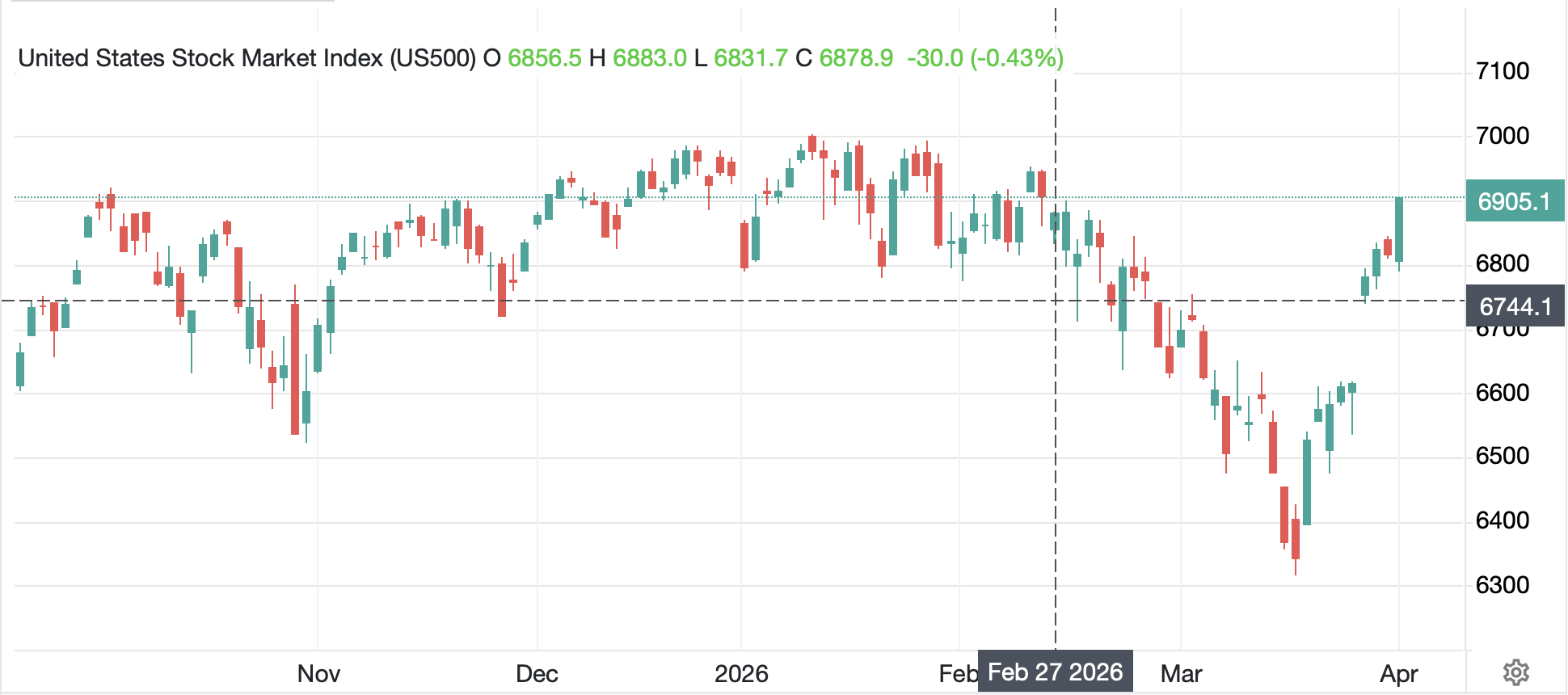
In truth, we cannot be surprised at either of these stories as the Iranian leadership knows it cannot live without its oil exports, nor the Chinese without its access to that oil.  While it is still unclear how things will evolve from here, a successful conclusion of the war, with Iran giving up its enriched uranium and pledging to stop trying to go nuclear is seemingly closer to fruition than before all this started.  Certainly, the market believes that is the case given the S&P 500 has traded back above its pre-war level and is now within 100 points of its all-time high just above 7000.

Source: tradingeconomics.com

And here’s the thing about the oil market.  As we know, every shortage is followed by a glut.  Every non-Gulf producer has been going full bore since this began and oil prices spiked, and this was alongside the massive releases from strategic petroleum reserves around the world.  If you add up the amount of oil that is sitting in tankers in the Persian Gulf, along with the amount that is in storage there, and the amount of both Russian and Iranian oil that had been in transit and unsanctioned, the numbers are staggeringly high.  The math I saw from Alyosha (Market Vibes) is somewhere around 600 million barrels are going to come flooding into the market in fairly short order once the Strait is reopened, and it will be reopened, of that I am certain.  At the same time, the war has reduced revenues of the gulf nations for the past 6 weeks, and they will want to be pumping as much as possible, at any price (remember, in Saudi Arabia, the cost per barrel to pump oil is estimated to be between $3 and $6, so $30/bbl oil is still profitable.). While this is not an investment discussion nor advice of any type, I have exited all my oil focused positions at this point.

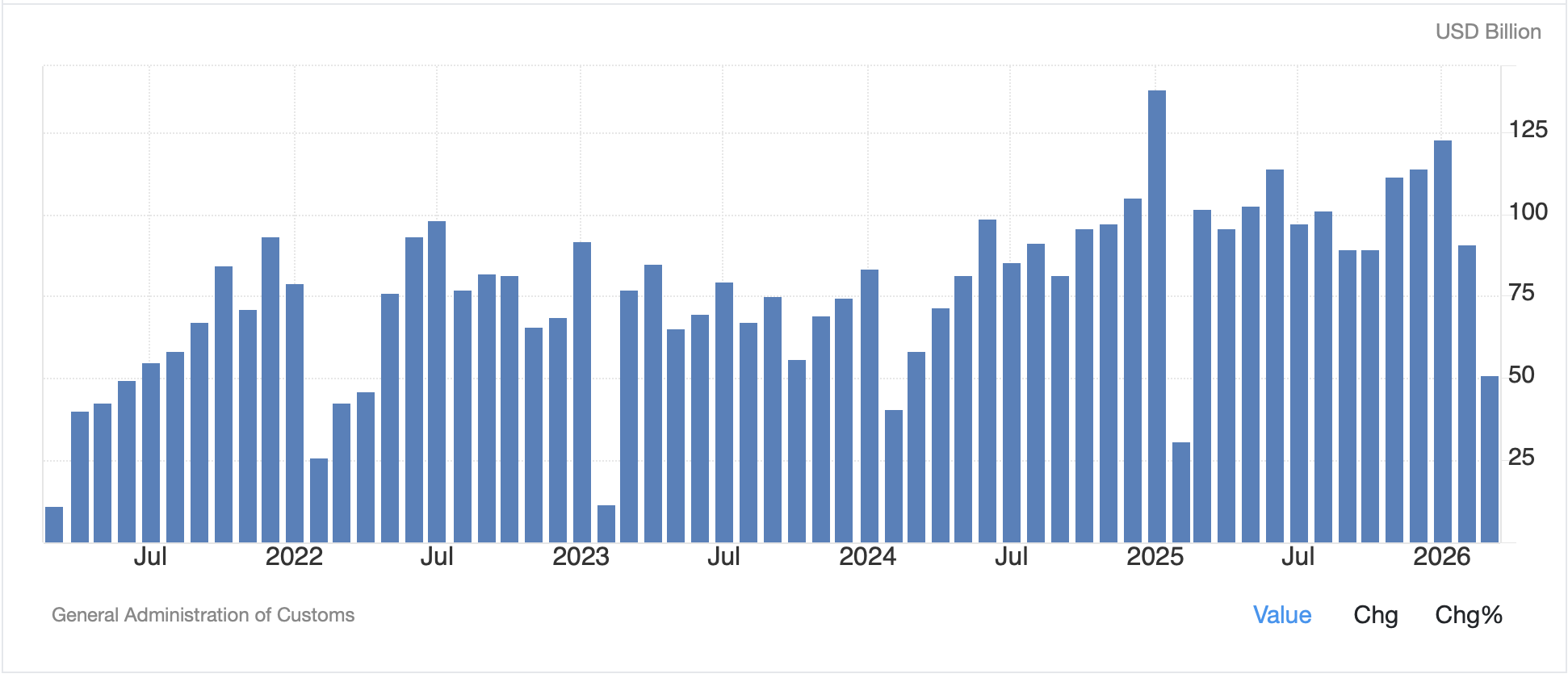
There is another related story here as well, this about the Chinese economy.  Last night they released their trade data, and it was substantially worse than expected.  As you can see from the chart below, the surplus barely topped $50 billion, compared to a consensus estimate of $112 billion with not only a massive increase in imports, 27.8% and likely highly energy related, but a significant decline in exports, just a 2.5% rise there.  Again, if you wonder why suddenly President Xi is interested in reopening the Strait of Hormuz, the fact that it seems to be having a direct impact on the Chinese economy is one of the reasons.

Source: tradingeconomics.com

(A note about the data above shows that each February, the export numbers decline as a result of the Chinese New Year celebrations but always rebound strongly in March.  And this was March data released that fell so sharply, a far more concerning outcome for Xi.)

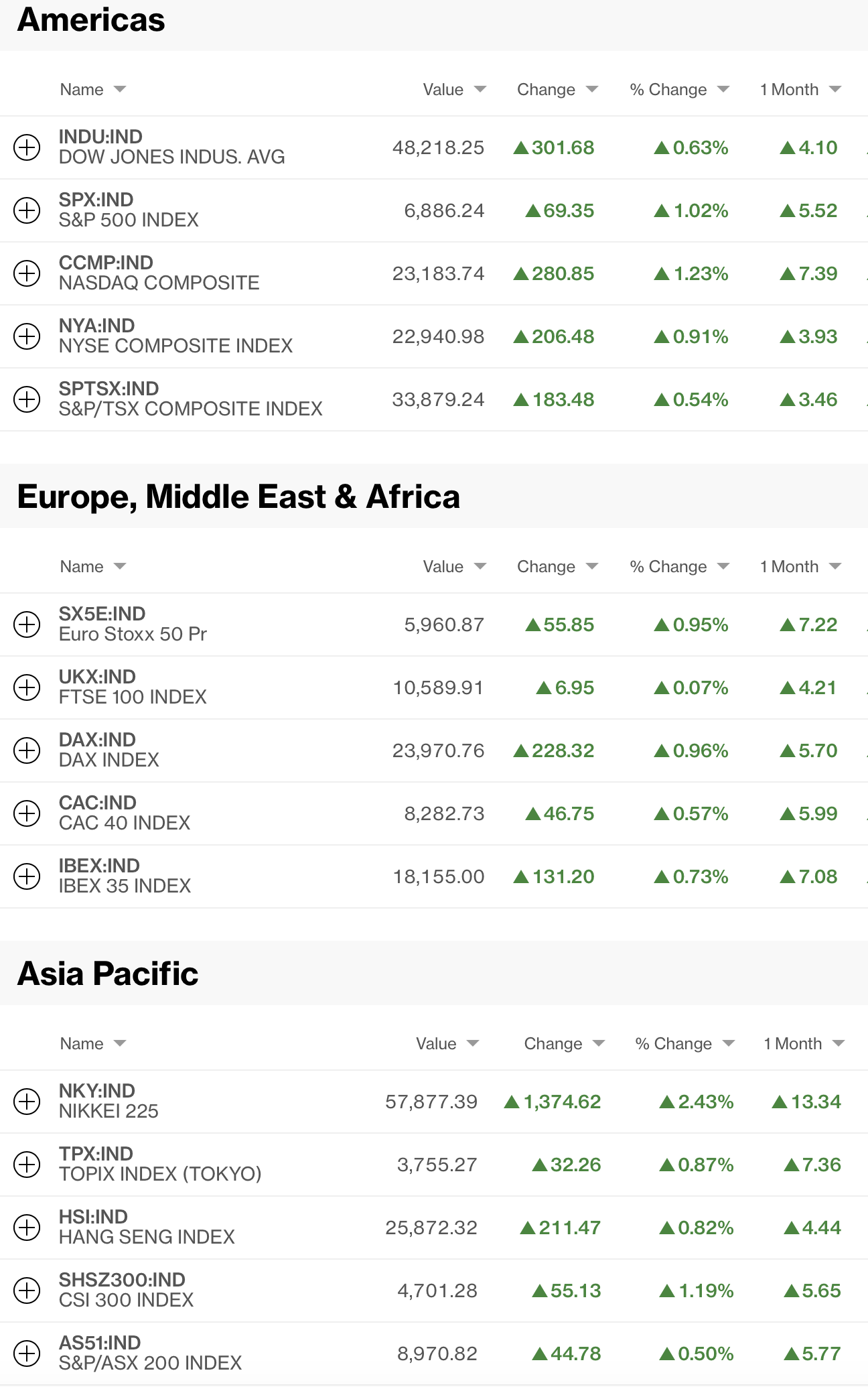
So, with all this in mind, how have other markets fared?  Well, equity investors around the world are over the moon as you can see from the Bloomberg screen shot below.  ‘Nuff said.

Bond yields have also fallen across the board as the decline in the price of oil, plus the idea that the war may end sooner than some had expected, thus reducing the inflationary pressures greatly, has bond investors grabbing for yield.  Yesterday saw Treasury yields slip -2.5bps though this morning they are unchanged.  In Europe, sovereign yields are all lower by between -3bps and -6bps while JGB yields fell -4bps overnight with even larger declines in the rest of Asia.  Fear is clearly not a factor this morning.

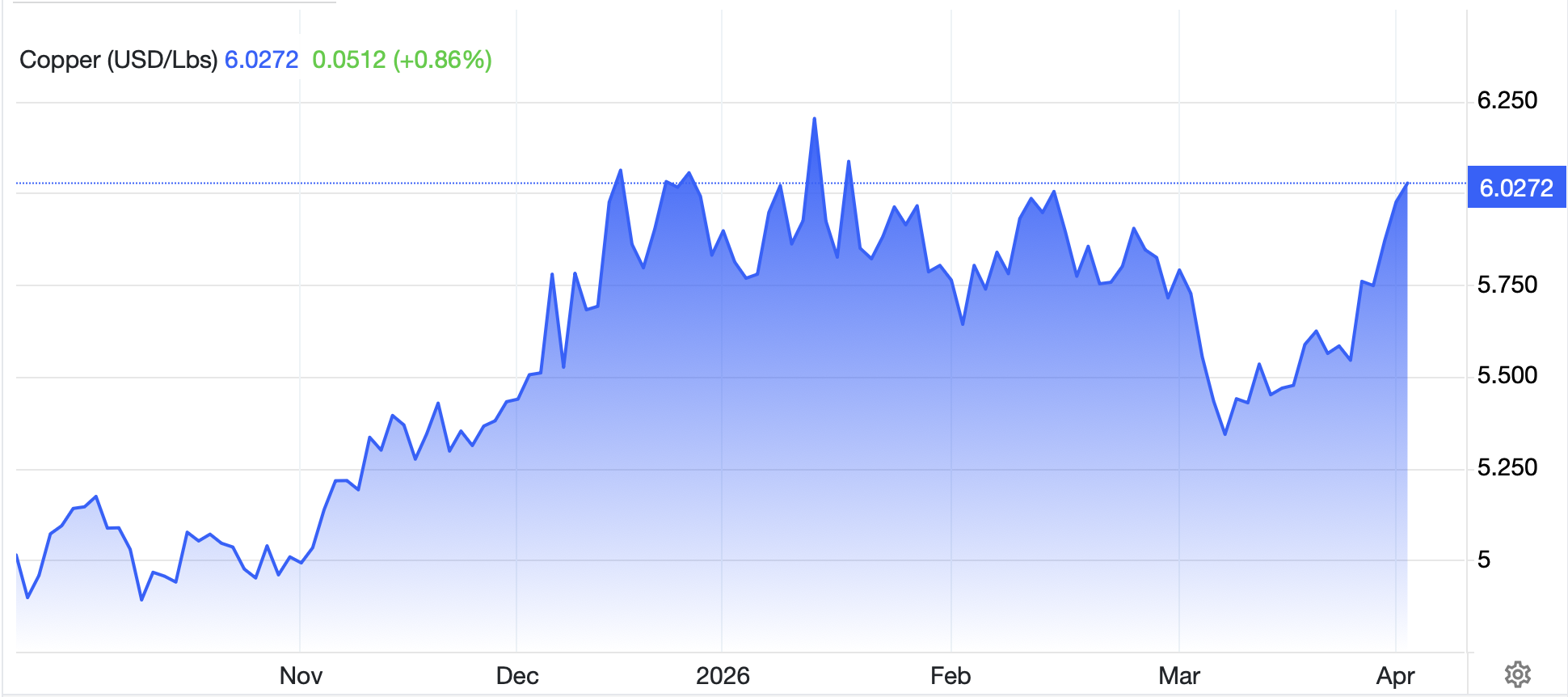
It should not be surprising that precious metals prices have rallied as well, between lower yields and a growing belief that forced sales have stopped.  So, gold (+0.5%), silver (+2.5%) and platinum (+0.5%) are all having a good day.  But so are the base metals with copper (+0.8%) not only recouping its war-related losses, but actually back within spitting distance of its all-time highs set in January above $6.00/lb.

Source: tradingeconomics.com

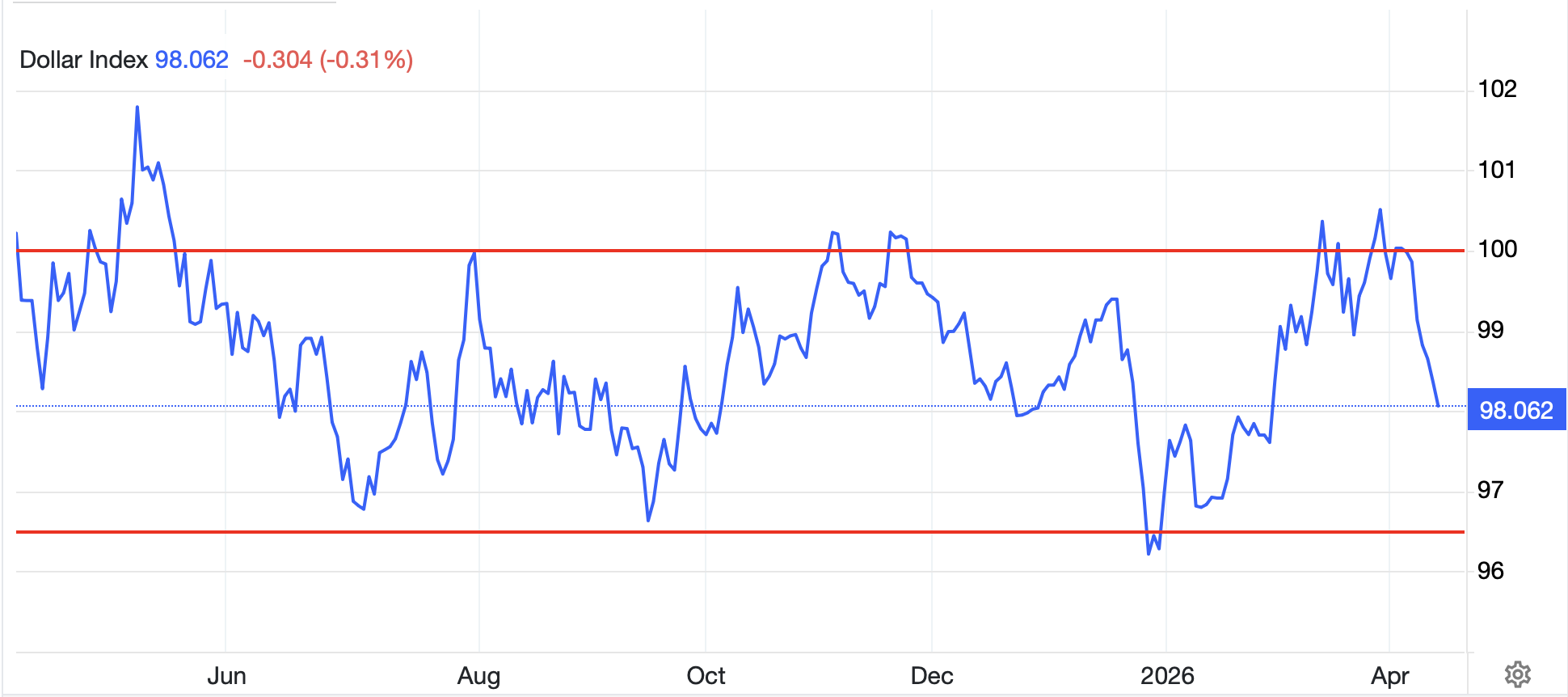
Finally, the dollar is giving back more of its war-related gains and lower across the board this morning, with G10 currencies gaining on the order of 0.3% to 0.4% across the board, while EMG currencies show similar gains with one major outlier, INR (+1.4%) easily explained by the fact that India has been the hardest hit economy from the war, and so the prospects it is ending have had a very beneficial impact on the rupee.  But to be clear regarding the dollar, all we have seen is that it has moved back to the middle of its yearlong trading range between 96.50 and 100.00 based on the DXY as per the below.

Source: tradingeconomics.com

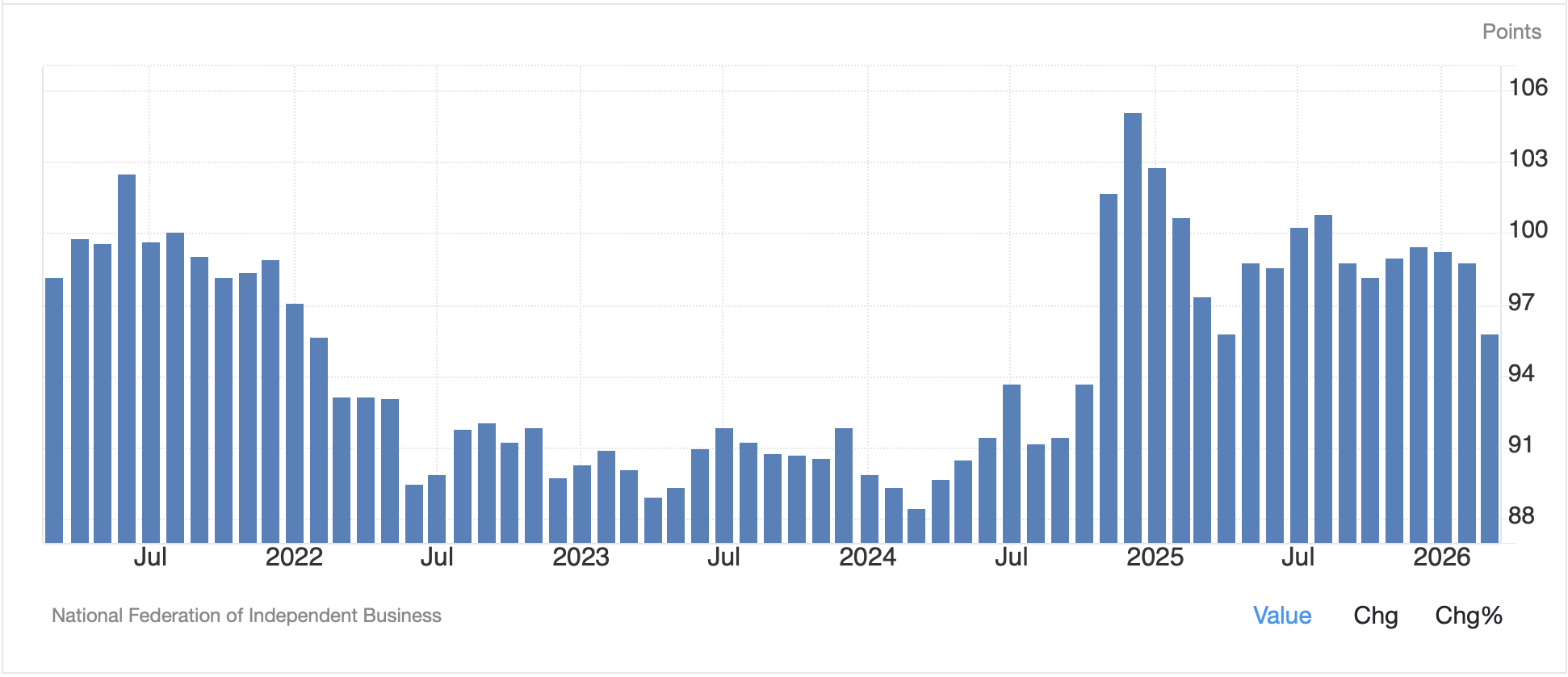
On the data front, yesterday’s Existing Home Sales numbers were weaker than forecast and many pundits have been claiming that as a signal of much greater economic weakness.  We shall see.  This morning we have already seen the NFIB Business Optimism Index released at a weaker than forecast 95.8, not a great sign, but as you can see below, still well above levels of a few years ago.

Source: tradingeconomics.com

We also get PPI (exp 1.1% M/M, 4.6% Y/Y headline, 0.5% M/M, 4.1% Y/Y core) and a few more Fed speakers.  With CPI already having been released, PPI loses much of its luster, although it helps economists estimate PCE a bit better.  One cannot be surprised that Governor Miran explained he expected to see inflation back to target by this time next year, but I am not holding my breath for that outcome.

Summing it all up this morning, risk is back baby!!!  If ever you were curious about whether markets anticipate events, today is exhibit A.  I certainly hope the market is correct and we are about to wind down the Iran war but be wary as it ain’t over til it’s over.  If it has ended, look for previous narratives to be resurrected regarding markets, notably the dollar’s demise, but I am not holding my breath over that either.

Good luck

Adf