
Wasn’t Whizzbang

There once was a time in the past
When earnings reports were forecast
If companies beat
It was quite a treat
If not, CEOs were harassed
 
But that was before Jensen Huang
Described the AI bell he rang
Nvidia now
Is what defines tao
Alas, last night wasn’t whizzbang


In what cannot be that great a surprise, given the remarkable hype that continues to surround Nvidia, their earnings were great, but not great enough to exceed the outsized expectations that have become commonplace.  And while revenues and earnings more than doubled, and their profit margins are above 50%, it wasn’t enough to satisfy the underlying belief that exists.  What is that belief?  The best I can tell is that the true believers are certain Nvidia will be the only company left on earth when AI takes over, and so it’s value will equate to global economic activity, currently approximately $105 trillion, so it has much further to climb.  Perhaps the oddest result was that there were actual ‘watch parties’ for the earnings release.  It is not clear to me if that is more hype than a Jensen Huang fan asking him to sign her breast or not, but it is certainly a lot of hype.
 
And yet, the world continues to turn this morning despite the disappointment and US stock futures are actually higher after a lackluster day yesterday where all three main indices declined. As is always the case, in hindsight, the hype is revealed for just what it was, but usually the rest of our lives feel no impact.  That said, it was clearly the market driver yesterday and will almost certainly continue to have an outsized impact on things for a while yet.  But let’s move on.
 
Said Bostic, I need to see more
Results on inflation before
I’m banging the drum
For that cut to come
‘Cause I don’t know what more’s in store

Back in the macro world, we heard from Atlanta Fed president Bostic last night and he was far more circumspect of a rate cutting cycle than the market currently believes was signaled by Chairman Powell last week in Jackson Hole.  As of this morning, the market continues to price a one-third probability of a 50bp cut in September, a total of 100bps of cuts in the rest of 2024 and a total of 225bps of cuts by the end of 2025.  Meanwhile, Mr Bostic explained, “I don’t want us to be in a situation where we cut and then we have to raise rates again.  So, if I’m going to err on one side, it’s going to be waiting longer just to make sure that we don’t have that up and down.”

Now, I know I’m not a Fed funds trader, or even a fixed income trader (I’m just an FX guy) but these comments didn’t sound like he was ready to start slashing rates anytime soon.  Bostic is a voter this year, and while I’m pretty sure the Fed is going to cut next month, I remain in the 25bp camp, and I might suggest that there are still several FOMC members who see no reason to cut rates quickly.  After all, absent a serious downturn in the labor market, and given the economy continues to perform reasonably well, at least according to the data they watch, what is the rationale for a cut?  And remember, if the Fed is cutting rates quickly it means they are responding to economic difficulties.  That doesn’t seem like an outcome we want to see.

Beyond those two stories, though, once again, there is a dearth of new information on which to make decisions.  China continues to struggle and there are now more bank analysts (UBS being the latest) who are lowering their forecasts for GDP growth there to the 4.5% range, well below President Xi’s 5.0% target.  The ongoing implosion of the Chinese property market continues to weigh heavily on the economy there and, as the chart below shows, the Chinese stock market.

A graph with blue lines and numbers

Description automatically generated

Source: Bloomberg.com

Aside from the irony of a strictly communist country even having the very essence of capitalism, an equity market, I believe the incredibly poor performance in Chinese shares is an ongoing signal that not all is well in China, regardless of what official statistical data they present.  President Xi has many problems to address, and I expect he will spend far more of his time trying to smooth international trade relations than anything else for the time being.  After all, the blank paper protests that led to the end of Covid restrictions in China are evidence that Xi is still subject to some popular sentiment.  If the economy were to crater, it would become a major problem for his power, and potentially his health.

Ok, let’s run through the overnight price action.  Asian markets were a mixed bag overnight with Japan essentially unchanged while China (-0.3%) continues to lag virtually all other markets.  The Hang Seng (+0.5%) managed a rally alongside India and Singapore, but there were more laggards including Australia, Korea, Indonesia and New Zealand.  But that is not the story in Europe this morning with all markets in the green led by the CAC (+0.7%) and DAX (+0.6%) on the back of somewhat softer German state inflation data (the national number is released at 8:00am) and what appears to be modestly better than expected Eurozone sentiment indices regarding services and industry, although consumers are still a bit unhappy.

In the bond market, everyone is asleep it seems as there has been no movement of more than 1 basis point in any major market.  Given the lack of new economic inputs, this should not be a great surprise.  I suspect that this morning’s US data, and especially tomorrow’s PCE data may shake things up if there are any unusual outcomes.

In the commodity markets, oil (+0.3%) has stopped falling for now as yesterday’s EIA inventory data showed a total draw of more than 4 million barrels, the 9th drawdown in the past 10 weeks and an indication that supply is falling to meet the alleged weakening demand.  Gold (+0.6%), which started off under pressure yesterday rebounded in the afternoon and continues this morning dragging silver along for the ride.  Copper (-1.9%) however, remains under pressure on both the softening demand story and a technical trading move.

Finally, the dollar, at least the DXY, is continuing to rebound from its Tuesday lows although there is a lot of mixed activity here with some gainers (AUD +0.55%, NZD +0.5%, ZAR +0.85%, CNY +0.6%) and some laggards (EUR -0.25%) along with the CE4 showing weakness.  The big outlier is CNY, which is showing one of its largest single day gains in the past year.  This seems a bit odd given the ongoing lackluster equity market performance and the data showing that foreign investment into China has reversed course and is now divestment.  None of that speaks to a currency’s strength, but as yet, I have not found a good rationale for the renminbi’s strength.  I will keep looking.

On the data front, we finally see some things this morning starting with Initial (exp 232K) and Continuing (1870K) Claims, the second look at Q2 GDP (2.8%) and all the attendant data that comes with that release (Real Consumer Spending +2.3%, PCE +2.6%, 2.9% core).  As well, Mr Bostic as back at it this afternoon at 3:30.  

My take is given the elevated importance of the employment report, today’s data that really matters will be the Claims numbers with any substantial miss (>15k different than forecast) leading to some price action and potential concerns.  But otherwise, Bostic certainly won’ change his tune in less than 24 hours, and the current market zeitgeist appears to be that the dollar, while headed lower, is going to chop to get there.  If we do see a high Claims number, above 245K, look for the dollar to fall more sharply, retracing its overnight bounce.

Good luck

Adf
Worries Abound

That smell in the market is fear
In truth, for the first time this year
As both bonds and stocks
Are now on the rocks
And no sign t’will soon disappear
 
The Fed is remaining on hold
Though elsewhere, rate cuts are foretold
But worries abound
As risk is unwound
That everything soon will be sold


It is very difficult to get excited about much in the markets these days as we see stocks, bonds and commodities all slide in price.  The fear in markets is palpable as investors and traders clearly remember 2022, when both stocks and bonds fell sharply and those holding the traditional 60/40 portfolio got crushed.  This is not to say that we are seeing the same thing right now, but the very fact that we can have both asset classes suffer simultaneously, even for a few days, is disconcerting to everyone.

It is difficult to pin down a specific driving force right now as opposed to the 2022 scenario when the Fed was raising the Fed funds rate aggressively amid a serious bout of inflation.  But currently, there are a relatively equal number of pundits and analysts on both sides of the inflation and growth debate.  With this as the case, it doesn’t seem logical that there would be a significant trend shift.

So, this morning let’s try to consider the current stories that may be driving this recent bout of investor skepticism.  On the macro side of things, while recent data hasn’t been awful, it has hardly been scintillating.  For instance, the recent Dallas Fed Manufacturing Index was quite weak, similar to what we saw with Philly and Empire State, but the Richmond number rebounded.  While we all await this morning’s second look at Q1 GDP (exp 1.3%, down from the initial reading of 1.6%), there is much more focus on tomorrow’s PCE data.  In fact, given the dour mood in the market, it is hard to remember that the CPI data earlier this month was seen as a slight positive.  

But bigger problems reside in the Retail Sales and consumption story on the micro side of things as we have been hearing from an increasing number of companies that customers are balking at higher prices.  Retail Sales were flat in April, hardly a sign of strength, and just this morning we had Walgreens say they will be cutting prices on 1500 items in their stores in an effort to stimulate sales.  We heard bad tidings from Target earlier this month, as well as McDonalds, Starbucks and Walmart.  

It is certainly difficult to hear these reports and come away feeling bullish about either the economy or the equity markets.  Yesterday’s Fed Beige Book was its usual mix of some good and some bad, but no strong trend in either direction.  Atlanta Fed president Bostic explained yesterday that “My outlook is that if things go according to what I expect — inflation goes slowly, the labor market slowly and orderly moves back into a sort of a weaker stance, but a stable-growth stance — I’m looking at the end of the year, the fourth quarter, as the time where we might actually think about and be prepared to reduce rates.”  That sounds like a December cut, a far cry from expectations just last week, let alone the beginning of the year.

In fact, I challenge you to come up with a bullish piece of news that may drive sentiment back toward overall risk bullishness.  Arguably, the only thing around is Nvidia, which is pretty thin gruel on which to sustain a global economy!  And ask yourself, how much of that is overdone?

Looking elsewhere in the world doesn’t make you feel much better either.  For instance, in Europe, while a rate cut next week seems certain, this morning’s Unemployment release showing a decline to 6.4%, the lowest level ever recorded, is hardly cause for the ECB to get aggressive in cutting rates further.  Similarly to the US, with unemployment so low, and inflation remaining well above target, please explain why any central bank would feel compelled to cut rates.

Summing up, it is quite easy to make the case that risk assets have gotten far ahead of themselves on the hope that the global interest rate structure was going to decline thus allowing the leverage that had been implemented during the post-Covid ZIRP and NIRP regimes to be refinanced at more attractive levels.  However, as the data continues to show more resilience than expected in both the employment and inflation regimes, central banks find themselves with few good reasons to cut rates despite their very clear bias to do so.  And now that each move and utterance they make is scrutinized so closely, they have limited incentive to act.  Here’s my take; while we may see some initial rate cuts by the ECB, BOE and BOC, do not look for a long cycle absent a significant decline in inflation or sharp rise in unemployment, neither of which seems imminent.

Ok, the negativity in the US yesterday followed through to Asia with all markets lower there, some by a bunch like the Nikkei (-1.3%) and the Hang Seng (-1.3%) while others were merely down by -0.5% or so.  However, in Europe this morning, bourses have edged a bit higher with one outlier, Spain’s IBEX (+1.25%) the biggest beneficiary after inflation numbers from that nation proved cooler than expected.  Alas, at this hour (7:30) US futures are lower by -0.5% or so after a weak Salesforce earnings report last night.

In the bond market, the last two days of higher yields has halted for now with Treasury yields lower by 2bps and European sovereigns trading in a similar manner.  Yesterday’s 7-year Treasury auction was also soft, although the bid-to-cover ratio was 2.37, not as low as the 5-year the day before.  However, confidence in the ability of the market to continue to absorb the number of Treasuries required to fund the government deficit appears to be slipping, at least a little.

In the commodity markets, oil is unchanged this morning, consolidating its recent gains as traders await the latest OPEC news from a meeting scheduled for next week.  In the metals markets, gold is also little changed this morning but both silver and copper are under pressure as they continue to give back some of their recent substantial gains.  For instance, even after today’s -2.2% performance in silver, it is higher by 4% in the past week and 17% in the past month.  

Finally, the dollar is under some pressure this morning following several days of strength on the back of the higher US yield story.  The biggest G10 movers are CHF (+0.7%) and JPY (+0.6%) as the former responds to comments from the SNB hinting that further rate cuts may be delayed over concerns of the franc weakening too quickly, while the latter looks mostly like a trading response as there were no comments or data to drive things. After all, despite the threat of intervention, the yen has been sliding consistently of late.  In the EMG bloc, it is a different story as the only noteworthy gainer is CNY (+0.25%) while ZAR (-0.7%) on the back of uncertainty regarding the election outcome, and KRW (-0.5%) on the back of continued weakness in the KOSPI index, cannot find any support today.

On the data front, in addition to the GDP data mentioned above, we see the weekly Initial (exp 218K) and Continuing (1800K) Claims as well as the Goods Trade Balance (-$91.8B).  Alongside the GDP data are a series of other indices like Final Sales (2.0%) and Real Consumer Spending (2.5%) which are important numbers to get a more holistic view of the economy.  Of course, it wouldn’t be a day ending in “Y” if we didn’t have more Fed speakers, with two more on the docket, Williams and Logan.

It is tough to fight a sentiment that is turning negative.  While I would expect the dollar to benefit from this, right now it is a mixed picture.  I doubt either Fed speaker will break new ground, so I fear that the overall negativity is going to be today’s key theme.  Lower stocks, lower bonds and a mixed dollar like we’ve seen overnight seem likely to be what we see in the US.

Good luck

Adf

One, Two, Three

On Monday, no one could agree
So, Powell unleashed; one, two, three
At least with respect
To how they dissect
The prospect for rate cuts they see
 
For Bostic, he sees only one
Before the committee is done
While Cook thinks that two
Are likely to do
And Goolsbee said three need be spun


During a session with very little new news, and ultimately, very little in the way of net market movement, it was quite interesting to hear from three different Fed speakers with somewhat different views of what the future holds.

In order of their views, as opposed to the timing of their comments, Atlanta Fed President Raphael Bostic reiterated his view from Friday in a different venue.  He explained that given the resilience of the economy, he sees little reason for any rate cuts in the near term and that his ‘dot’ was for just one cut this year, later in the year.  The thing about Bostic is he has proven to be flexible, arguably adhering to the Keynesian concept of, when the facts change, he changes his mind.  While it is not clear to me that the facts have actually changed, his perception of them certainly has.  At this point, it appears that he has become one of the more hawkish FOMC members and he is a current voter on the FOMC.

One step further toward the median we found Governor Lisa Cook, who explained that “the path of disinflation, as expected, has been bumpy and uneven, but a careful approach to further policy adjustments can ensure that inflation will return sustainably to 2% while striving to maintain the strong labor market.”  In other words, we have been surprised by the two consecutive hotter than expected CPI reports and so despite our fervent desire to cut rates as quickly as possible, if we were to do so, whatever credibility we still have would be thrown away.  At least, that is how I read her comments as she is a clear dove and desperate to cut.  To her credit, as a governor, she is making the effort to be a bit more restrained.

Lastly, we heard from Chicago Fed President, Austan Goolsbee, who during his interview (at Yahoo! Finance) quickly highlighted that his ‘dot’ was for three cuts this year.  He further explained that housing was the problem, at least with respect to their forecasts, and why they had expected inflation to decline more rapidly. Now, based on the housing data we continue to see, at least the price data, inflation is unlikely to decline much further at all.  Add in the fact that commodity prices, notably energy prices, have been rebounding for the past month and any hopes for another leg lower in either CPI or PCE are slipping away.  Also, Goolsbee is not a current voter, so many take his views a bit less seriously.

Now, let me ask, do you feel more enlightened?  Me neither.  If I were to assess the current situation, my read is that the majority of the FOMC really does want to cut rates as they believe they have done enough regarding inflation.  Frighteningly, there was an article in the FT this morning from Mohamed El-Erian, claiming that the time is ripe for allowing inflation to run hotter in order to support nominal growth.  We know that is every FinMin’s wet dream, but historically central bankers pushed back on that thesis.  However, El-Arian now claims that the central banks are on board as well.  If this is true, the only conclusion is that all fiat currencies are going to decline in value vs. stuff.  The relative pace of these declines will ebb and flow based on interest rate differentials and other circumstances, but it is not a net positive for the ordinary consumer.

Ok, let’s turn our attention to the overnight session and how markets are behaving.  The bulls have to be disappointed that the recent Fed speakers have not been more dovish, and we have seen that in another lackluster equity session in the US yesterday, with all three major indices lower by about -0.3%.  In Asia, while Japanese shares were essentially unchanged, we saw some strength in China and Hong Kong with the noteworthy story being President Xi’s invitation to keep several US CEOs currently visiting there, in country with the promise of a meeting with him.  The read is he is open to deeper business relationships.  As to the rest of the region, equity markets were mixed with some gainers and some laggards and no large movers.  As to Europe this morning, the color on the screen is green, with a few gains of 0.5% (Germany and Spain) and the rest much more subdued.  US futures are pointing higher at this hour (7:00), by about 0.5%, so the bulls are back.

In the bond market, yields have backed off a bit with Treasuries lower by 2bps and European sovereigns falling between 3bps (Germany) and 6bps (Italy) as the ECB speak continues to point to rate cuts clearly coming, with more hope for April making its way into the market, at least according to Italy’s Panetta.  In what cannot be a huge surprise, 10-year JGB yields remain unchanged as the idea of a tightening cycle there is slowly ebbing from traders’ minds.

In the commodity markets, oil (+0.2%) is creeping higher again as Russia has indicated it is going to restrict production alongside the lost output from refinery damage caused by Ukraine.  As well, after the UN Security Council vote yesterday, it appears that concerns are rising that there is no chance of a ceasefire anytime soon.  Meanwhile, gold (+1.2%) is screaming higher this morning and once again approaching $2200 as what appears to be a combination of growing geopolitical jitters combines with the growing awareness by market participants that inflation is not going to be addressed has investors seeking alternatives to fiat currencies.  Base metals, though, are not seeing the same boost, although are a touch higher overall.

Finally, the dollar is under some pressure this morning with most G10 currencies firmer, although the Swiss franc (-0.2%) is suffering a bit.  In fact, the biggest winner is NZD (+0.45%) but there is precious little to explain this movement.  One currency that is not gaining is the yen, which is unchanged on the session while the dollar remains just below its multi-decade highs set back in October 2022.  In the EMG bloc, the story is more mixed with some gainers (CZK +0.2%, HUF +0.3%) and some laggards (ZAR -0.3%, TWD -0.2%), but as you can see, the movement has been muted.

On the data front, this morning brings Durable Goods (exp 1.1%, 0.4% ex-transport) and Case Shiller Home Prices (6.7%). We also see Consumer Confidence (107.0) at 10:00.  There are no Fed speakers scheduled, but do not be surprised if there is an interview or two from a news source as they continue to try to tweak their message.

To me, the big picture is that there has been a clear relaxation by the Fed, and other central banks, in their attitude toward inflation.  As such, I expect to see risk assets perform and bonds lag.  However, regarding FX, it is all about the timing of the changes that are announced, or guided, rather than the absolute destruction in their value over time.  For now, though, the Fed remains the tightest policy around and the dollar should benefit because of that.

Good luck

Adf

Good…or Bad

FinMin Suzuki
Noted that a weaker yen
Might be good…or bad

One of the great things about finance and central bank officials is their ability to twist language into pretzels while trying to make their case in any given situation.  Last night offered another great example from Japanese FinMin Shun’ichi Suzuki with this being the money quote, “From that standpoint, I’m closely watching market moves with a strong sense of urgency.”  It is not clear how you watch something with urgency, but if you are the MOF official in charge of explaining why your currency has been declining so rapidly, I guess you have to say something.  (As an aside, I might simply point out that the interest rate differential between the US and Japan is now 5.5%, having risen from 0.35% over the past two years and that might have something to do with the FX move.)

As previously mentioned, the MOF is moving up its ladder of pre-intervention activities as detailed on Wednesday, arguably now somewhere between numbers 2 and 3.  The biggest problem Japan has is that there is a quickly declining probability that the US is going to be easing policy as soon as had been previously thought, and so the incentive to own yen remains diminished.  The second biggest problem they have is their economy has slipped into recession and so the urgency for Ueda-san to tighten policy is also diminished.  While USDJPY has been hovering just above 150 for a few days, I expect that it is going to grind higher still and force Suzuki-san to continue to climb that numeric ladder.  The one saving grace for Suzuki is that as we approach fiscal year-end in Japan, there is likely to be a seasonal flow of funds back home for dressing up balance sheets.  That could well keep things in check until sometime in April, but all signs are that the market is going to test him again before too long.

On Tuesday, the data was hot
On Thursday, it really was not
So, which one describes
The ‘conomy’s vibes?
Or have, now, stagflation, they wrought?

The CPI data on Tuesday certainly opened a rift between the narrative of smoothly declining inflation leading to numerous Fed rate cuts this year and what appears to be a more realistic situation where any further decline in inflation comes in fits and starts if it comes at all.  The narrative explanation for the sticky inflation was that economic activity was so strong that it should be expected.  But if the economy is truly that strong, someone needs to explain how Retail Sales can decline -0.8% in January, why Industrial Production would decline -0.1% and why Capacity Utilization would fall back to 78.5% despite all the government support for reshoring activity.  In an ironic twist, the other two releases yesterday, Philly Fed and Empire State Manufacturing, were both better than forecast.  This is a complete reversal of the pattern we have seen for the past 2 years where survey data is lousy but hard numbers remained strong.

In the end, it appears that market participants have given up on the macro data and are back to buying any dip with abandon.  I will be the first to explain that the economic outlook remains very cloudy.  To date, it appears that the excessive deficit spending has been successful in maintaining steady GDP growth.  Of course, excessive deficit spending is not something that can continue forever.  As Herbert Stein explained in 1985, “if something can’t go on forever, it will stop.”

This leads to the question; how long until forever?  If we have learned nothing else in the past decades it is that when governments involve themselves directly in economic activity and financial markets, forever is delayed. Things take MUCH more time than we expect for them to play out.  Simply consider how long Japan has been running massive budget deficits, NIRP and QE without destroying their economy.  (30 years.)

Of course, forever in the economy and forever in the markets are two very different things and while the government may be able to delay a reckoning in economic activity, we must be very careful around how markets behave with the same catalysts and inputs.  My point is any risk-off outcome will be important for your investing and hedging decisions, but not necessarily change the trajectory of GDP.  After all, there is always more money to be printed.  In fact, it is this issue that drives my longer-term inflation thesis.  Every government will do whatever they think they need to prevent a serious economic contraction and high on the list of actions will be much easier monetary policy.  Watch closely for things like QT to end or another BTFP-like program to continue to force liquidity into markets.

Ok, let’s look at how things finished the week.  As I said, the market no longer cares about bad data and simply continued to add to risk assets.  Yesterday saw gains in the major indices in the US which was followed by gains throughout Asia and most of Europe, all of them pretty substantial.  In fact, the only red numbers on my screen are in Spain’s IBEX which is suffering on the back of Spanish central banker Pablo Hernandez de Cos explained that several Spanish banks may suffer due to the ongoing drought in Spain and its negative impact on the economy there.  US futures are basically pointing higher again this morning as well.

In the bond market, though, yields are edging higher around the world.  Treasury yields are up 4bps today and pushing back to that peak seen immediately following the CPI print on Tuesday.  European sovereign yields are all higher by between 3bps and 4bps although JGB yields are unchanged on the day.  Ultimately, I continue to see the case for yields to climb from these levels as there is no indication that inflation is truly ending.

Oil markets powered higher yesterday, rising nearly 2% despite the huge build in inventories as concerns over supply being unable to keep up with ever growing demand have reemerged.  As well, the fact that any cease fire in the Israel-Hamas war seems to be a distant memory has some on edge that things can get worse in the Middle East overall.  As to the metals markets, gold managed to regain the $2000/oz level yesterday and is hanging right there this morning.  On a brighter note, both copper (+1.5%) and aluminum (+0.5%) are firmer this morning, perhaps in anticipation of China’s reopening next week, or perhaps because the dollar has stopped rising.

Speaking of the dollar, it is mixed this morning with the yen (-0.3%) and KRW (-0.3%) the laggards while ZAR (+0.3%) seems to be benefitting from the metals price action.  Broadly speaking, I still like the greenback for as long as the US maintains the tightest policy around.

On the data front, to finish the week we see PPI (exp 0.6% headline, 1.6% ex food & energy) as well as housing data with Starts (1.46M) and Building Permits (1.509M).  Finally, at 10:00 we see Michigan Sentiment (80.0).  We also hear from two more Fed speakers, Governor Michael Barr and SF President Mary Daly.  Yesterday, Atlanta Fed president Bostic explained he was not worried by Tuesday’s CPI print, but not yet convinced they had beaten inflation.  I have a feeling we will hear a lot of that sentiment for the time being.

Heading into the weekend, despite Tuesday’s shocking data, risk assets have performed well overall, with the S&P 500 making its 11th new all-time high this year yesterday.  I don’t know what will derail this train, and for now, there is nothing obvious to do so.  As such, I would keep with the trend overall, that means modestly higher stocks, yields grinding higher and the dollar edging higher as well.  I know that doesn’t seem to make much sense, but that’s what we’ve got.

Good luck and good weekend
Adf

Quite Restrictive

The Fed keeps on spinning the tale
They’re watching like hawks so that they’ll
Be able to jump
In case Donald Trump
Does not look like going to jail
Be able to act
And not be attacked
If ‘flation forecasts start to fail
 
Twas Bostic’s turn yesterday to
Explain that the policy skew
Is still quite restrictive
Though that’s not predictive
Of what they may finally do
 
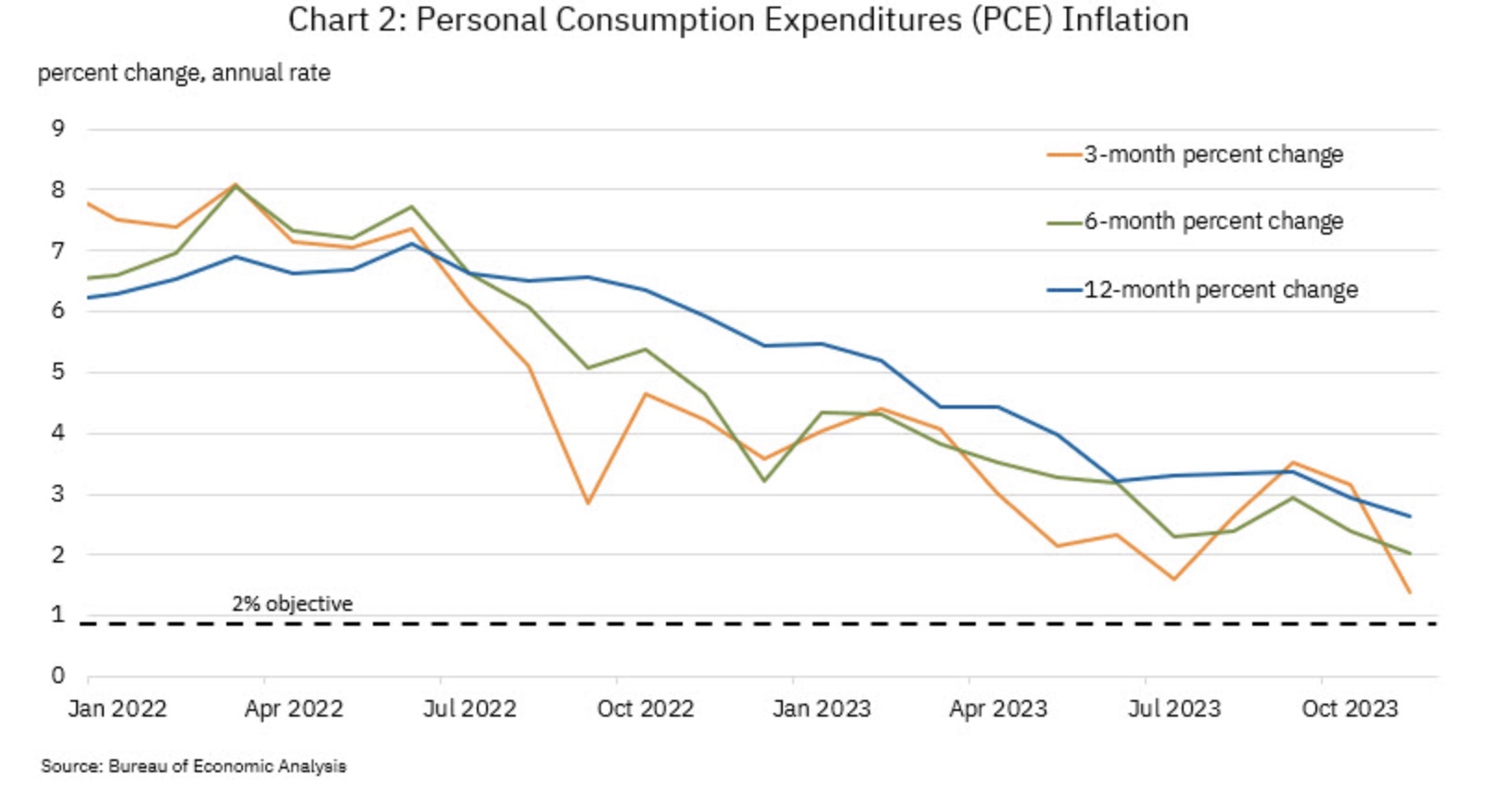
Atlanta Fed President Raphael Bostic was the latest FOMC member to regale us with his views on current policy settings amid two speeches yesterday.  The essence of his comments lines up with what we have heard for the past two weeks; policy is sufficiently restrictive to help drive inflation down to their 2% target, but they will be vigilant if that is not the outcome.  One of the things that he mentioned, and that has been a really popular chart crime over the past few months, at least for the doves, is he discussed annualizing the most recent three months of PCE data and the most recent 6 months of PCE data as proof that they are doing a good job.  In fact, in one of his two presentations, he used the following chart:

Unquestionably, if you look at the orange line, which represents the annualized value of the past 3 months, it shows that PCE is “now” running below their target.  But let me ask you a question, looking back to H1 of 2022, when inflation was peaking.  Both the 3-month and 6-month changes were well above the annual number at the time.  Do any of you remember the focus on those short-term nonsense numbers?  Me neither.  My point is the only number that matters is the actual annual one as that is their target.  Any indication that it is flattening or turning higher, just like the CPI data did earlier this month, is going to put paid to this story.  While I have no idea where next week’s data is going to print, we must be wary of the narrative spin on the actual data.  If we know one thing about the Fed, by definition, they are reactive.  That is what following the data means.  If they were predictive, they would move before the data, but they never do that. 
 
So, all this talk of cutting before inflation gets too low is not monetary policy.  However, we cannot rule out a cut based on the political implications as they view rate cuts as a way to boost the economy and try to ensure the current president is re-elected rather than the likely Republican candidate gets back in.  Alas, for now, we will have to live with the spin.  Today we hear from two more Fed speakers, SF’s Mary Daly and Governor Michael Barr.  I suspect we will hear exactly the same message from both.  Too early for cuts, but they are ready when the time comes.
 
Meanwhile, across the pond, the preponderance of ECB speakers has been very clear that March is off the table for a rate cut but June seems to be what they see as likely.  Here, too, they see the trend as their friend, but inflation readings are still nowhere near their 2.0% target.  However, it is clear that the pain of higher rates is having a much larger impact on Europe than on the US as GDP data continues to deteriorate.  Germany is in recession and much of the rest of the continent is on its way.  The benefit for Madame Lagarde is that the Europeans did not inject nearly as much stimulus during the Covid years as the US, so it is likely the Eurozone economy is following a better-known path.  In the end, though, they are very anxious for the Fed to get started as they really want to start cutting rates, I believe, but with inflation still far above target and the Fed still holding on, they would have no rational explanation for their actions.
 
One last thing to note is CPI in Japan was released last night and it fell to 2.6% headline and 2.3% core.  Any idea that the BOJ was going to need to tighten policy in the near-term to fight too high inflation has been dissipating quickly.  It turns out that they may have been correct to leave policy unchanged as now they do not need to do anything to be in the right spot.  The market response mostly made sense as the yen weakened with the dollar now above 148, while the Nikkei rose another 1.4% and is pushing those recent 30+ year highs.  The weird thing, though, was the JGB market which saw yields rally 4bps, back to their highest level in a month.  I have been unable to find any solid explanation for this move as certainly it is not fundamental.
 
Anyway, let’s look at the rest of the overnight session to see how things are feeling as we close the week.  After a solid US equity session yesterday, most of Asia had a good go of things with rallies pretty much everywhere except China and Hong Kong.  The equity markets in both those nations have been under significant pressure lately and show no signs of turning.  While the market is not the economy, President Xi has already called for the end of short sales and is now leaning on domestic institutions to not sell at all.  With the property market already in the tank, a rapidly declining stock market is not a good look for the concept of prosperity for all.  Europe, though, is modestly higher this morning and US futures are also in the green following yesterday’s session.
 
In the bond markets, Treasury yields are little changed on the day, but remain above the 4.10% level that some are calling a key technical spot.  European sovereigns, though, are all rallying more aggressively with yields falling between 3bps and 7bps despite what are continuous calls for the ECB to maintain tight policy for longer than the market is pricing.  Perhaps investors are feeling better about inflation prospects if the ECB holds the line.
 
After a rally yesterday, oil prices are essentially unchanged this morning.  The unrest in the Red Sea continues with the Houthis firing more missiles and fewer and fewer ships willing to transit the area while yesterday’s tit-for-tat Iran-Pakistan missile attacks are now merely history.  The fact that oil remains below $74/bbl implies it is not really pricing any possibility of a larger Middle East conflict.  That seems pretty hubristic to me as the probabilities seem to be far larger than zero.  As to the metals markets, both precious and base metals are firmer this morning in sync with softer yields and a softer dollar. 
 
Speaking of the dollar, while it is ever so slightly lower on a DXY basis this morning, it continues to hold the bulk of its gains for the past month.  Versus G10 currencies, the picture is mixed with GBP (-0.2%) underperforming after absolutely abysmal Retail Sales data was released this morning, but the rest of this bloc is higher by about 0.2% or so on average.  In the EMG space, the direction is broadly for currency strength, but the movement remains modest at best, on the order of 0.1%-0.3%.  In other words, not much is going on here.
 
On the data front, yesterday brought a mixed picture with Housing data slightly better than expectations, although starts fell compared to last month.  Initial Claims printed at 187K, their lowest in a very long time, but Philly Fed was at a worse than expected -10.6, not as bad as Empire State, but still not too bullish!  Today brings Michigan Sentiment (exp 70.0) and Existing Home Sales (3.82M) as well as the above-mentioned Fed speakers.  After today, the Fed is in their quiet period, so we will have to make up our own minds as to what the data means.
 
For now, the market seems quite comfortable buying dips and as evidenced by the Fed funds futures market, is still pricing a 55% chance of a March cut.  While that probability is shrinking slowly, there are still 6 cuts priced in for the year.  At this point, my thesis of the market fighting the Fed for the first half of the year before capitulating to higher inflation prospects and higher yields amid slowing growth remains my best guess.  But that is just me.  Absent something really surprising from Daly or Barr, I suspect that there will be limited price movement going into the weekend.
 
Good luck and good weekend
Adf
 

Prices Will Grow

As markets await CPI
It’s funny to watch the Fed try
Explaining inflation
Will lack the duration
To send expectations sky-high

But even their own surveys show
That most people already know
Inflation is here
And well past next year
The level of prices will grow

Each month the Federal Reserve Bank of New York publishes the results of a survey of consumer expectations on inflation.  Yesterday, they published the September results and, lo and behold, the data showed that 1-year inflation expectations rose to 5.31%, by far the highest point since the survey began in 2013.  The 3-year data rose to its highest ever level of 4.19%, also well above the Fed’s 2.0% target.  And yet somehow, the authors of the report explained that inflation expectations remain well anchored.  Their claim is that if you look at the 5-year expectations, they remain near the levels seen before the pandemic, indicating that there should be no concern.  I don’t know about you, but 3 years of inflation running above 4.0% seems a lot longer than transitory.

Of course, it’s not just the analysts at the NY Fed who are unwilling to admit to the increasingly obvious situation, we continue to hear the same from other officials.  For instance, Treasury Secretary Janet Yellen, in a televised interview yesterday remarked, “I believe it’s [inflation] transitory, but I don’t mean to suggest these pressures will disappear in the next month or two.”  She then raised the specter of shortages by commenting, “There’s no reason for consumers to panic over the absence of goods they’re going to want to acquire at Christmas.”  Now, don’t you feel better?

In fairness, however, there are several Fed members who have finally admitted that the transitory emperor has no clothes.  Atlanta Fed President Raphael Bostic explained yesterday, “It is becoming increasingly clear that the feature of this episode that has animated price pressures – mainly the intense and widespread supply-chain disruptions – will not be brief.  By this definition, then, the forces are not transitory.”  As well, we heard from St Louis Fed President James Bullard, “I have to put some probability on a scenario where inflation stays high or even goes higher.”

At this point, it’s fair to ask, which is it?  Clearly there is a split at the Fed with some regional presidents recognizing that inflation has risen sharply and has all the appearances of being persistent, while Fed governors seem more likely to lean toward the transitory fable.  Perhaps what explains this split is the regional presidents have a far different constituency than do the Fed governors.  The Fed presidents are trying to address the issues extant in their respective geographies, so rising inflation matters to them.  Meanwhile, the governors, despite the claim that the Fed is apolitical, serve their masters in Congress and the White House, who believe they need to continue QE and ZIRP forever to continue spending money in unconscionable sums while not suffering from the slings and arrows of the bond market vigilantes.  But remember this too, every Fed governor votes at every meeting while only a handful of regional presidents vote (granted, Bostic is one of those right now.)  I fear we will continue to hear transitory for a while yet.

All this is a prelude to two key pieces of information today, this morning’s CPI release (exp 5.3% headline, 4.0% core) and the FOMC Minutes from the September meeting to be released at 2:00pm.  The one thing that has been very clear lately is that interest rate markets are beginning to buy into the persistence of inflation.  While Treasury yields have edged lower by 1.6bps this morning, in the past 3 weeks, those yields have risen 26 basis points.  And this is a global phenomenon with Bund yields, for instance, having risen 20 basis points over the same period despite a 4.1bp decline today.  Investors are starting to pressure the central bank community with respect to interest rates, driving them higher as fears of rising inflation abound worldwide.  While some, central banks have recognized the reality on the ground (Norway, New Zealand, numerous EMG nations) and others have paid lip service to the idea of raising rates (the UK, Canada), the two biggest players, the Fed and ECB, will not even discuss raising rates, although the Fed continues to tease us with talk of tapering.

However, I will ask again, do you believe the Fed will taper (tighten) policy if GDP growth is more clearly abating?  My view remains that they may actually start to taper, but that it will be a short-lived process as weak GDP growth will dissuade them from doing anything to worsen that side of the ledger.  While eventually, weaker GDP growth will result in demand destruction and reduced price pressures, that is likely to take a very long time.  Hence, the idea of stagflation remains very viable going forward.

Now it’s time to look at markets.  Equities have had a mixed session thus far with Asia (Nikkei -0.3%, Hang Seng -1.4%, Shanghai +0.4%) seeing both gainers and losers and Europe (DAX +0.7%, CAC +0.25%, FTSE 100 -0.1%) seeing similar mixed price action.  UK data showed August GDP was a tick lower than forecast and is clearly slowing from its previous pace, arguably weighing on the FTSE.  As to US futures, they are edging higher ahead of the data with gains in the 0.1%-0.3% range after yesterday’s modest declines.

We’ve already discussed bonds so a look at commodities shows that oil (-0.6%) is retreating for the moment as is NatGas (-1.5%), while we are seeing strength in gold (+0.7%) and copper (+1.7%).  In fact, the entire metals complex is stronger today as apparently, weaker energy prices are good for industrial activities.

As to the dollar, it is under some modest pressure today across the board.  In the G10, SEK (+0.35%) and CHF (+0.35%) lead the way with JPY (0.0%) the laggard.  However, there are no specific stories that seem to be driving things, rather this is a broad-based dollar correction from recent strength.  The same situation holds in the EMG bloc with ZAR (+0.75%) the leader followed by much lesser movement of KRW (+0.4%), CZK (+0.35%) and PLN (+0.35%).  The won has responded to comments from the central bank that it is closely watching the exchange rate and will not be afraid to step in if it becomes destabilized.  That is a euphemism for much weaker, as the currency had fallen nearly 9% in the previous four months.  As to the others, recent weakness seems to merely being consolidated with nothing new driving price action.

While the Fed may not care much about CPI, the rest of us do care.  And really, so do they, but it doesn’t tell their story very well.  At any rate, while it is entirely reasonable that we see a continued flatlining of price rises, the risks remain to the upside as at some point, housing inflation is going to show up in the data.  And that, my friends, is going to be significant and persistent!  Ahead of the number, don’t look for much.  If we see a high print, expect the dollar to regain this morning’s losses, though, as the market will become that much surer the taper is on its way.

Good luck and stay safe
Adf