
Markets Ain’t Fair

The pundits, when looking ahead
All fear that their theses are dead
‘Cause bitcoin’s imploding
And that is corroding
The views they have tried to embed
 
The thing is, it’s simply not clear
What caused this excessive new fear
But those with gray hair
Know markets ain’t fair
And force us to all persevere


It all came undone yesterday around 10:45 in the morning for no obvious reason.  There was no data released then to drive trader reaction nor any commentary of note.  In fact, most of the punditry was still reveling in the higher Nvidia earnings and planning which Birkin bag they were going to buy for their girlfriends wives.  But as you can see from the NASDAQ chart below, in the ensuing two hours, the index fell by 4% and then slipped another 1% or so from there into the close, the level that is still trading at 6:30 this morning

Source: tradingeconomics.com

As a member in good standing of the gray hair club, I have seen this movie before, and I have always admired the following image as a perfect example of the way things work in markets.  
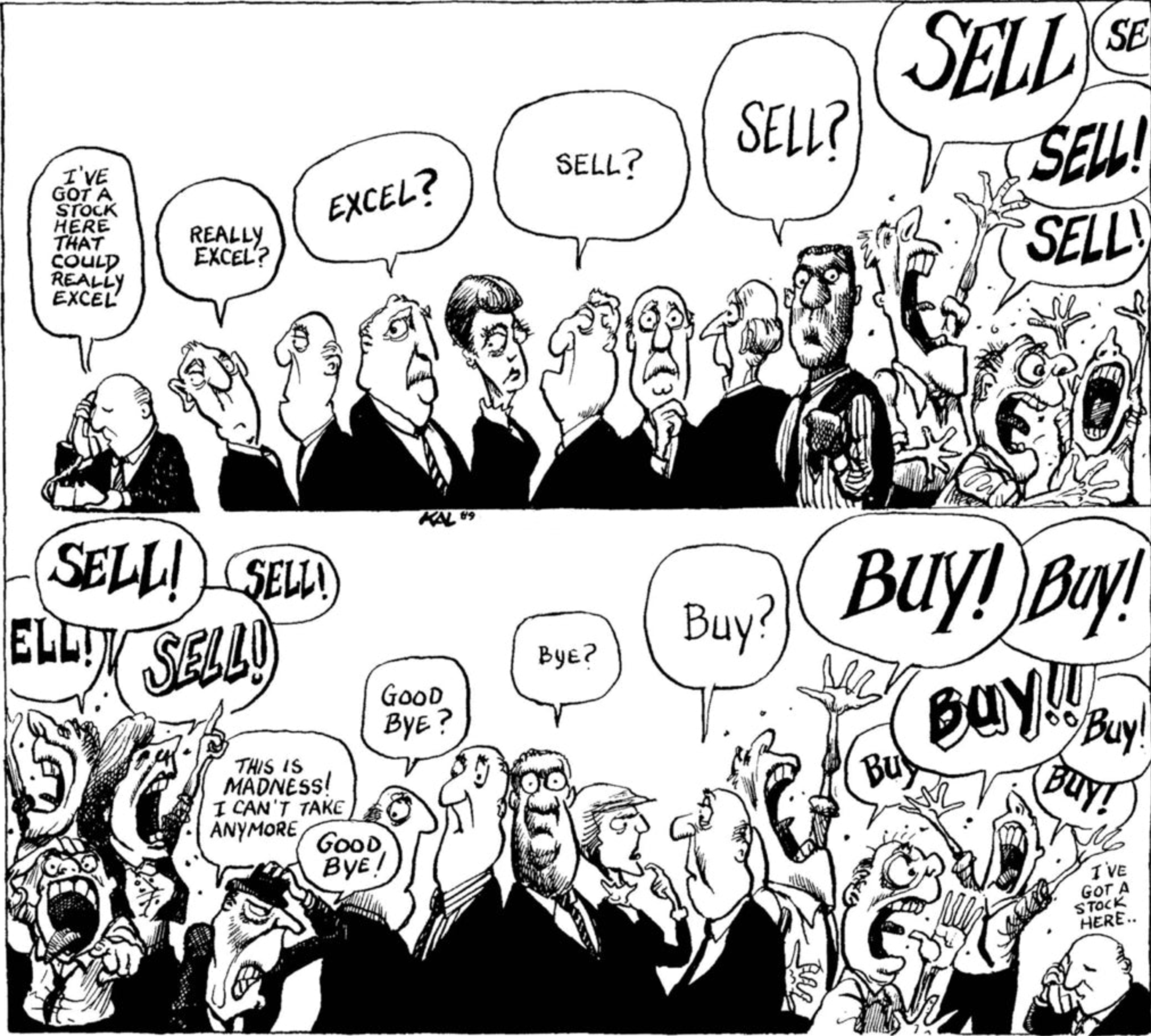
And arguably, this is all you need to know about how things work.  Sure, there are times when a specific data release or Fed comment is a very clear driver of market activity, but I would contend that is the exception rather than the rule.  The day following Black Monday in 1987, the WSJ asked noted Wall Street managers what caused the huge decline.  Former Bear Stearns Chairman, Ace Greenberg said it best when he replied, “markets move, next question.”  And that is the reality.  While I believe that macroeconomics offers important information for long-term investing theses, on any given day, anything can happen.  Yesterday is a perfect example of that reality.

But let us consider what we know about the overall financial situation.  The Damoclesian Sword hanging over everything is excessive leverage across the board.  I have often discussed the idea that global debt is more than 3X global GDP, a clear an indication that there will be repayment problems going forward.  And something that seems to have been driving recent equity market gains has been an increase in margin buying of stocks and leverage in general.  After all, the fact that there are ETFs that offer 3X leverage on a particular stock or strategy is remarkable.  But a look at the broad levels of leverage, as shown by the increase in margin debt in the chart below from Wolfstreet.com (a very worthwhile follow for free) tells me, at least, that when things turn, there is going to be an awful lot of selling that has nothing to do with value and everything to do with getting cash for margin calls.
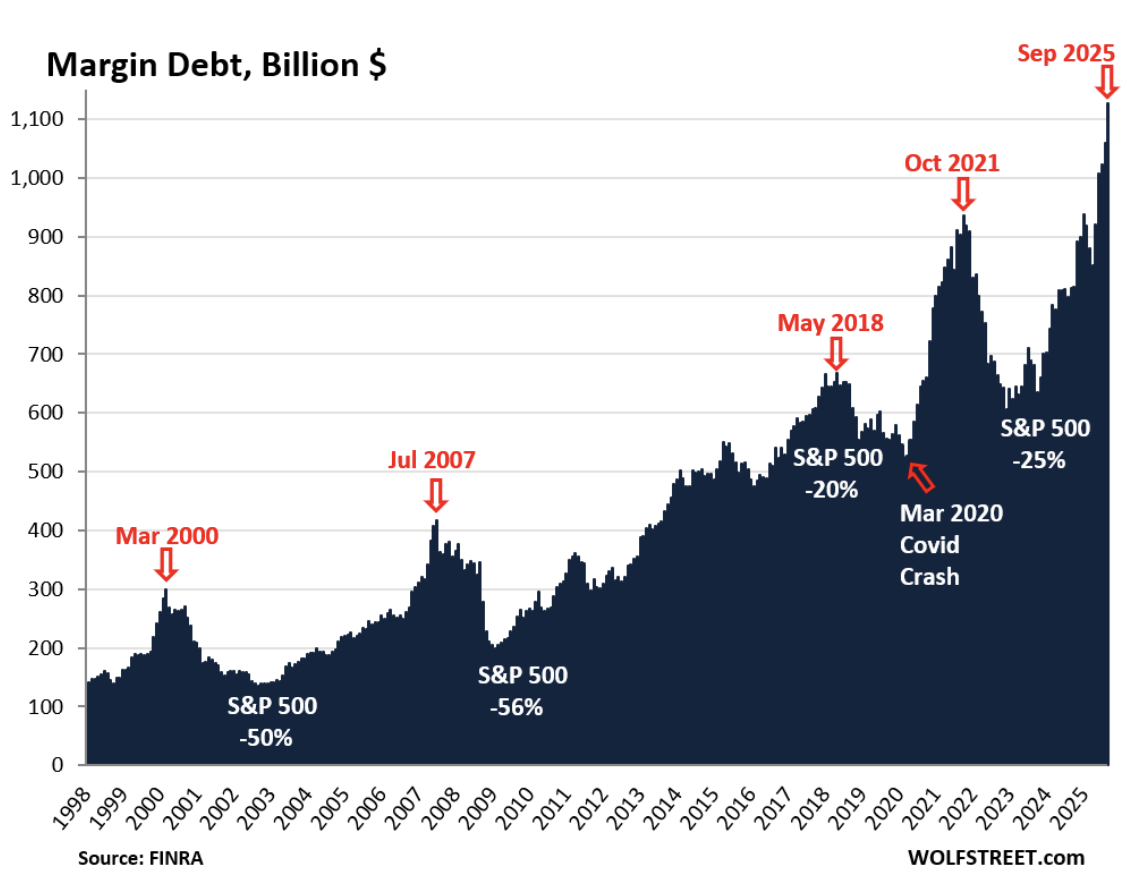
It is this process that drives down the good with the bad and as you can see in the chart, happens regularly.  I’m not saying that we are looking at a major reversal ahead, but as I wrote earlier this week, a correction seems long overdue.  Perhaps yesterday was the first step.

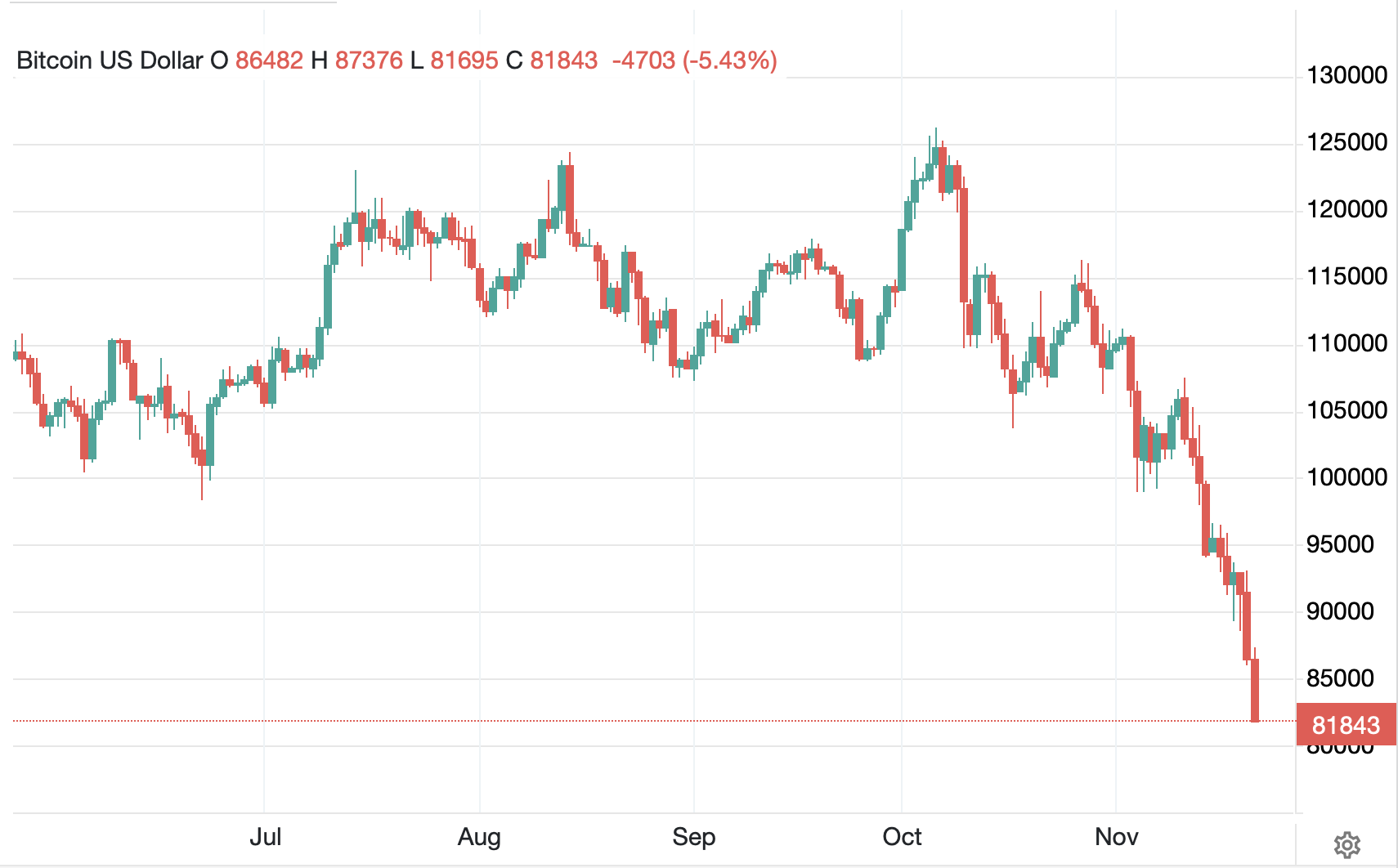
One last thing.  I mentioned Bitcoin at the top and I think it is worthwhile to look at the chart there to get a sense of just how speculative assets behave when times are tough.  Since its peak on October 6th, 46 days ago, it has declined ~45% as of this morning.  That, my friends, is a serious price adjustment!
Source: tradingeconomics.com

Ok, let’s see how other markets are behaving in the wake of this, as well as the recent news.  Remember, yesterday we saw a slew of old US data on employment, but it is all we have, so probably has more importance than it deserves.  After all, it is pre-shutdown and things have clearly changed since then.

Starting in Asia, it wasn’t pretty with the three main markets (Nikkei, Hang Seng, CSI 300) all declining by -2.40%.  Korea (-3.8%) and Taiwan (-3.6%) fared even worse but the entire region was under pressure.  The narrative that is forming as an explanation is that there is trouble in tech land, despite the Nvidia earnings, and since Asia is all about tech, you can see why it fell.

Meanwhile, the antithesis of tech, aka Europe, is also lower across the board this morning, albeit not as dramatically.  Spain’s IBEX (-1.3%) is leading the way down but weakness is pervasive; DAX (-0.8%), CAC (-0.4%), FTSE 100 (-0.4%), as all these nations also released their Flash PMI data which came in generally softer across the board.  But there is one other thing weighing on Europe and that is the publication of a 28-point peace plan designed to end the Russia/Ukraine war.  The plan comes from the US and essentially ignored Europe’s views as it is patently clear they are not interested in peace.  In fact, it appears peace will be quite the negative for Europe as it will undermine their rearmament drive and likely force governments there to focus on domestic issues, something which, to date, they have proven singularly incompetent to address.  In fact, if the war really ends, I suspect there are going to be several governments to fall in Europe with ensuing uncertainty in their economies and markets.  As to the US futures markets, at this hour (7:30) they are basically unchanged to leaning slightly higher.  Perhaps the worst is past.

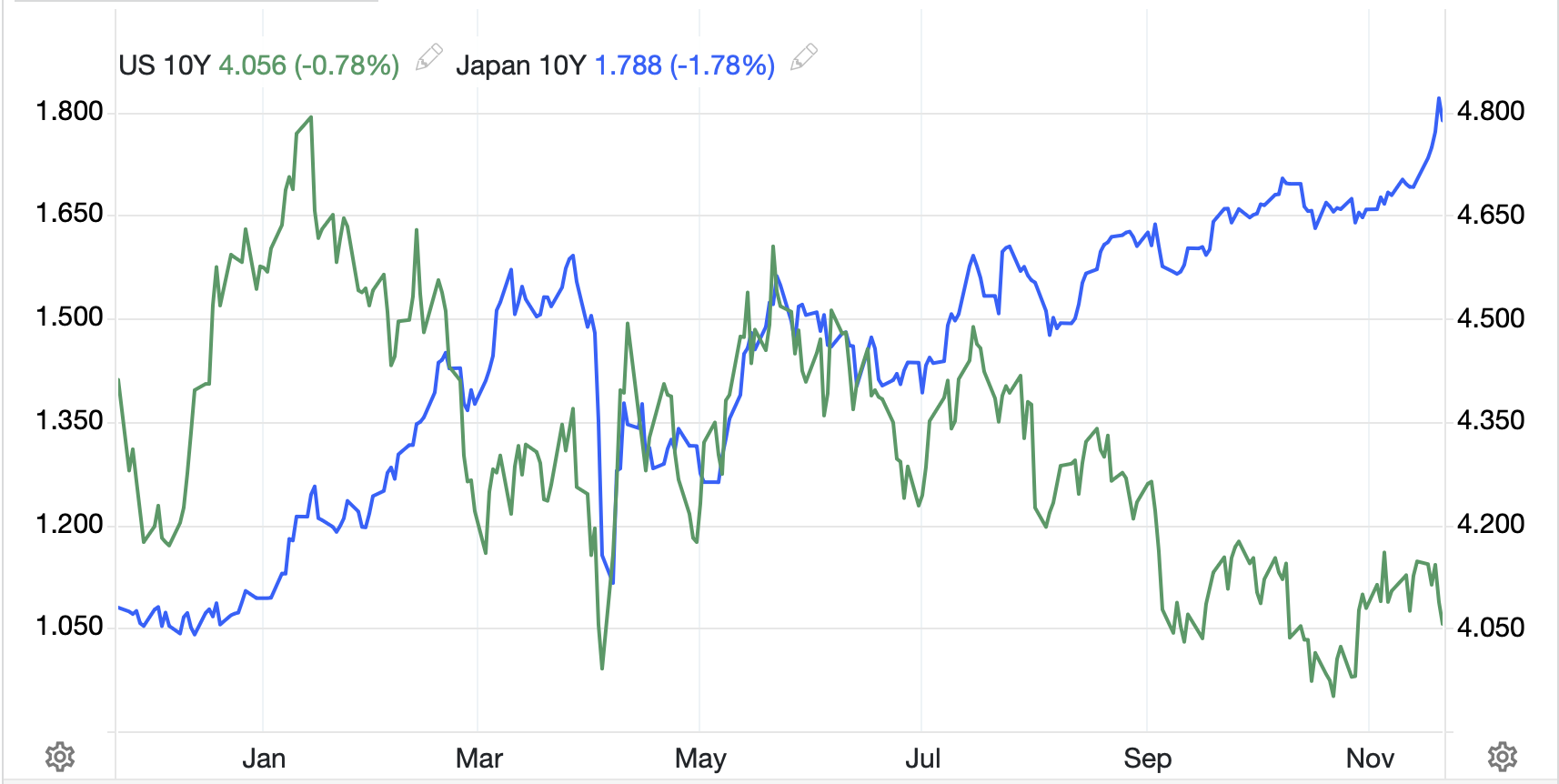
In the bond market, yields are lower across the board led by Treasuries (-4bps) while European sovereign yields have slipped -2bps to -3bps.  Certainly, the European data does not scream inflationary growth, but I have a feeling this is more about tracking Treasuries than anything else.  I say that because JGB yields also fell -4bps despite the passage of an even larger supplementary budget than expected, ¥21.7 trillion, which is still going to be paid for with more borrowing.  That is hardly the news to get investors to buy JGBs and I suspect yields will climb higher again going forward.  I think it is worth looking at the trend in US vs. Japanese 10-year yields to get a fuller picture of just how different things are in the two nations.  Of course, there is one thing that is similar, inflation continues to remain above their respective 2.0% targets and is showing no signs of returning anytime soon.
Source: tradingeconomics.com

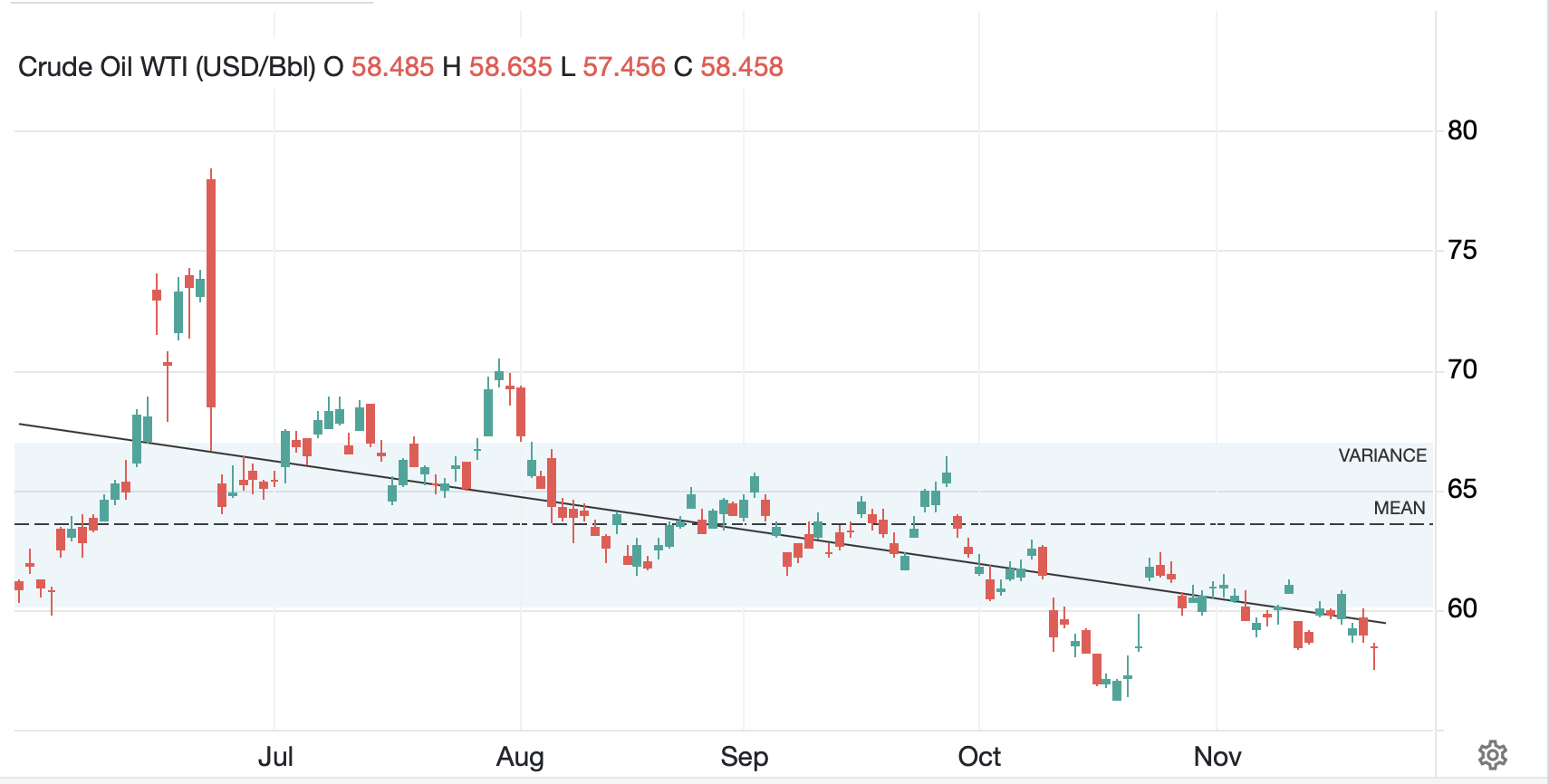
You will not be surprised to know that commodity prices remain extremely volatile.  Oil (-1.0%) had a bad day yesterday and is continuing lower this morning although as you can see from the chart below, it is off its worst levels of the session.  But the one thing that remains true despite the volatility is the trend remains lower.
Source: tradingeconomics.com

Metals markets also suffered yesterday and are under pressure this morning with gold (-0.4%) and silver (-2.5%) sliding.  One thing to remember is that when margin calls come, traders/investors sell what they can, not what they want, and given the liquidity that remains in both gold and silver, they tend to get sold to cover margin calls.  Too, today is the weekly option expiry in the SLV ETF and as my friend JJ (writes at Market Vibes) regularly explains, there is a huge amount of silver activity driven by the maturing positions.

Finally, the dollar continues to remain solidly bid, although is merely consolidating recent gains as it trades just above the key 100 level in the DXY.  Two things of note today are JPY (+0.5%) which responded to comments from not only the FInMin, but also Ueda-san explaining that a weak yen is driving inflation higher and might need to be addressed.  Step 4 of the dance toward intervention?  As to the rest of the G10, movement has been minimal.  But in the EMG bloc, INR (-1.1%) fell to record lows (dollar highs) after the RBI stepped away from its market support.  It sure seems like it is going to break through 90 soon and I imagine 100 is viable.  As well, ZAR (-0.7%) is suffering on the weaker metals prices, along with CLP (-0.5%) while BRL (-0.5%) slipped as talk of a more dovish central bank stance started percolating in markets.

Today’s data brings US Flash PMI (exp 52.0 Manufacturing, 54.6 Services) and Michigan Sentiment (50.5).  We hear from five more Fed speakers, with a mix of hawks and doves.  It will be interesting to see how the doves frame yesterday’s better than expected September NFP report as their entire thesis is softening labor growth is going to be the bigger problem than rising prices.

I, for one, am glad the weekend is upon us.  For today, I am at a loss for risk assets.  The case can be made either way and I have no strong insight.  However, the one thing that I continue to believe is the dollar is going to find support.  Remember, when things get really bad (and they haven’t yet) people still run to T-bills to hide, and that requires buying dollars.

Good luck and good weekend

Adf
I Am Your Savior

Investors are showing concern
‘Bout tariffs and Trump, so they spurn
The riskiest stuff
But that’s not enough
To help generate a return
 
Seems most of the holdings in favor
Are no longer risk takers’ flavor
How long before Jay
Will finally say
QE is here, I am your savior


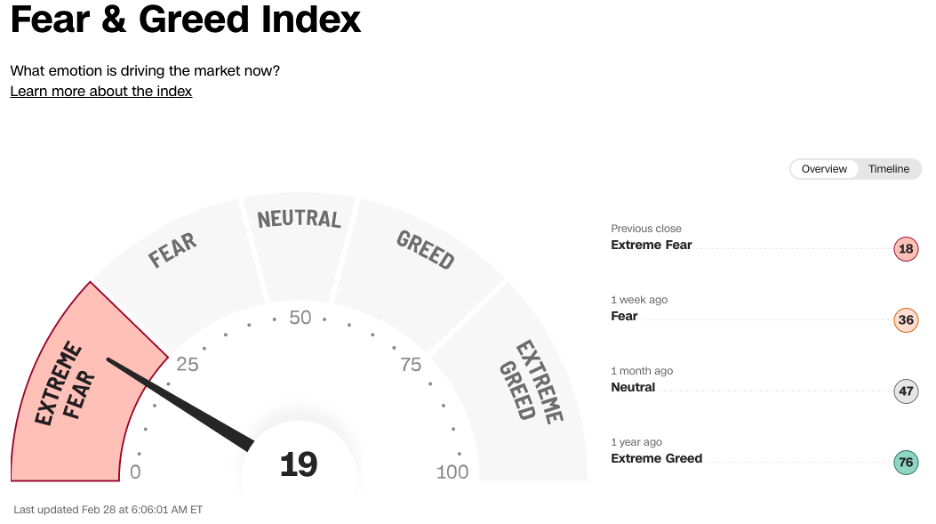
Have you bailed out on your risk exposures yet?  Because if not, it certainly seems you are behind the curve!  At least, that’s what it feels like this morning as trepidation underlies every player’s market activity.  Based on the commentary, as well as the Fear & Greed Index, you might think we are in a depression!

Source: cnn.com

But are things really that bad?  I know that the past week has seen a modest drawdown in equity prices, but after all, on February 20th, they reached yet another new all-time high, at least as per the S&P 500.  Since then, as you can see below, the decline has been less than 5%.  And while the market has traded below its 50-day moving average (blue line), a key technical indicator, it remains well above both the 200-day version of the same (purple line) and the longer-term trend line.  My point is it feels like the narrative is overstating the magnitude of the move thus far.

Source: tradingeconomics.com

Is this the beginning of the end?  While you can never rule that out, as major corrections can occur at any time, I have no reason to believe this will be the case.  Much has been made of yesterday’s Initial Claims print at 242K, much higher than forecast as a harbinger of future economic weakness.  However, looking at the past 3 years of weekly data here, while certainly in the upper levels of readings, it is not nearly the only occurrence and not nearly the highest reading.

Source: tradingeconomics.com

One data point does not make a trend and to my eye, looking at this chart, there is no discernible trend in either direction.  Yet part of the narrative evolution is that the DOGE cuts in government jobs, along with all the headline spending cuts, is setting the economy up for much slower growth in the short run.

In fact, this issue goes back to one about which I wrote several days ago here regarding the impact of government spending on actual economic activity.  The current view of economic activity includes government spending.  If President Trump’s goal is to reduce that spending, regardless of the net long-term benefits of such actions, GDP readings are going to decline initially.  Yes, there will be more productive use of capital with less regulation and less government, but that will take some time to become evident.  In the meantime, weaker economic activity is likely to be the outcome.

I have frequently written that there has not been a market clearing event since, arguably, October 1987, when equity markets plunged and erased significant excess and speculation.  Alas, newly minted (at the time) Fed Chair Greenspan stepped in and promised to support markets with ample liquidity the next day which opened the way for far more Fed intervention in markets leading up to Ben Bernanke and the first QE programs in the wake of the GFC in 2009 and every QE version since then.  While the movement so far does not remotely indicate the end of the world, based on the Fed’s history, once equity markets correct about 20%, they tend to become far more active in supporting the markets economy.  Will this time be different?  Given the Fed’s seeming underlying desperation to cut rates to begin with, my take is if the correction reaches 15% – 20%, we will see just that.

To sum things up, risk assets are under pressure on the basis of 1) excessive valuations, 2) the Trump efforts to reduce wasteful spending (which while wasteful is still spending and counted as economic activity), and 3) the idea that Trump’s imposition of tariffs is going to dramatically raise inflation and slow growth further.  Given the mainstream media’s inherent hatred of the president, they will certainly be playing up this theme for as long as they can as they try to force Trump to change tack.  But Trump, and Treasury Secretary Bessent, have been clear that their concern is 10-year bond yields, and getting them to lower levels.  A natural corollary of the current risk-off sentiment is that bond yields tend to decline.   Look at the chart below which shows that since Trump’s inauguration, 10-year yields are down nearly 40bps.  I would argue that Trump and Bessent are perfectly comfortable with the market right now.

Source: tradingeconomics.com

Ok, let’s move on to the overnight activity.  Sticking to the bond theme, while Treasuries, this morning, are unchanged, they did decline all yesterday afternoon and this morning European sovereigns are all lower by -2bps.  As well, JGB yields have also slipped by -3bps as we are seeing risk aversion evident all around the world.  Of course, the problem with all G10 nations (Germany excepted) is that they all have very high debt/GDP ratios and in Europe, especially, this is a problem as they have begun to realize they need to spend a great deal more on defense than they have in the past.  And all that spending is going to be funded by more borrowing.  The tension between additional issuance driving yields higher and risk aversion driving yields lower is going to be the theme of European bond markets for a while.

In the equity world, it is not a pretty picture anywhere in the world.  After yesterday’s US rout, with the NASDAQ (-2.8%) leading the way lower, Asian bourses were all in the red.  Japan (-2.9%), Hong Kong (-3.3%), China (-2.0%), Korea (-3.4%), India (-1.9%)… the list goes on across the entire region with only New Zealand (+0.5%) bucking the trend on some better than expected local earnings and consumer confidence data.  European markets, though, are in a bit better shape as they suffered yesterday and are consolidating those losses this morning with most markets trading +/- 0.3% on the session.  We have seen a lot of European inflation data this morning, most of it lower than forecast which has encouraged the view that the ECB will be cutting rates more aggressively going forward.  US futures, too, are higher at this hour (7:00), on the order of 0.5% as they bounce from yesterday’s, and truly the past week’s, declines.

In the commodity markets, oil (-1.25%) is back under pressure and back under $70/bbl.  The latest fear is that slowing economic activity around the world will reduce demand for the black sticky stuff and drive prices lower still.  Remember this, oil supply is restricted not by geology, but by politics.  As nations determine that cheaper energy is critical to their future, expect to see more effort to produce more oil.  Meanwhile, metals markets are also under pressure with gold (-0.5%) still falling despite its ostensible risk profile.  However, the barbarous relic remains well above $2800/oz and I continue to believe that this correction is just that, and not the reversal of a trend.  Too many things are happening around the world to induce more fear and in that scenario, gold is the oldest store of value around.  The rest of the metals complex is also under pressure with copper (-1.2%) slipping back a bit.  It is important to remember, though, that despite the recent declines, all the major metals are still nicely higher on the month.  

Finally, the dollar is a bit firmer again this morning after a rally yesterday as well.  In classic risk-off fashion, investors flocked to the dollar, arguably to buy Treasuries.  So, we are seeing weakness in NZD (-0.6%), JPY (-0.4%) and CHF (-0.3%) in the G10 and weakness in KRW (-0.5%), ZAR (-0.2%) amongst others in the EMG bloc.  Here the story remains the impacts of Trump’s tariffs and how they will be applied, if they will be applied, as well as a general fear factor which tends to help the dollar.  Consider, too, ideas that the ECB is going to cut rates will not help the single currency.

On the data front, this morning brings Personal Income (exp +0.3%), Personal Spending (0.1%), and the PCE data where Headline (0.3%, 2.5% Y/Y) and Core (0.3%, 2.6% Y/Y) will be the most important data points.  As well, we will see Chicago PMI (40.6) which has been below 50.0 in every month but one since August 2022.  

There is no question that the economic data has been softening lately.  We saw that with the Citi Surprise Index as well as the continuous stream of commentary by the economic bears who point to underlying pieces of data that point in that direction (whether housing or employment indicators and the recent weak PMI data).  

Consider this, an early recession in Trump’s term can be blamed on the Biden administration as well as set things up for future growth, certainly in time for the mid-term elections.  As well, it will likely help reduce the yield on the 10-year, an explicit goal.  This scenario likely means short-term weakness with an eye to longer term growth.  The dollar is likely to benefit early on, at least until the Fed steps in.

Good luck and good weekend

Adf

Worries Abound

That smell in the market is fear
In truth, for the first time this year
As both bonds and stocks
Are now on the rocks
And no sign t’will soon disappear
 
The Fed is remaining on hold
Though elsewhere, rate cuts are foretold
But worries abound
As risk is unwound
That everything soon will be sold


It is very difficult to get excited about much in the markets these days as we see stocks, bonds and commodities all slide in price.  The fear in markets is palpable as investors and traders clearly remember 2022, when both stocks and bonds fell sharply and those holding the traditional 60/40 portfolio got crushed.  This is not to say that we are seeing the same thing right now, but the very fact that we can have both asset classes suffer simultaneously, even for a few days, is disconcerting to everyone.

It is difficult to pin down a specific driving force right now as opposed to the 2022 scenario when the Fed was raising the Fed funds rate aggressively amid a serious bout of inflation.  But currently, there are a relatively equal number of pundits and analysts on both sides of the inflation and growth debate.  With this as the case, it doesn’t seem logical that there would be a significant trend shift.

So, this morning let’s try to consider the current stories that may be driving this recent bout of investor skepticism.  On the macro side of things, while recent data hasn’t been awful, it has hardly been scintillating.  For instance, the recent Dallas Fed Manufacturing Index was quite weak, similar to what we saw with Philly and Empire State, but the Richmond number rebounded.  While we all await this morning’s second look at Q1 GDP (exp 1.3%, down from the initial reading of 1.6%), there is much more focus on tomorrow’s PCE data.  In fact, given the dour mood in the market, it is hard to remember that the CPI data earlier this month was seen as a slight positive.  

But bigger problems reside in the Retail Sales and consumption story on the micro side of things as we have been hearing from an increasing number of companies that customers are balking at higher prices.  Retail Sales were flat in April, hardly a sign of strength, and just this morning we had Walgreens say they will be cutting prices on 1500 items in their stores in an effort to stimulate sales.  We heard bad tidings from Target earlier this month, as well as McDonalds, Starbucks and Walmart.  

It is certainly difficult to hear these reports and come away feeling bullish about either the economy or the equity markets.  Yesterday’s Fed Beige Book was its usual mix of some good and some bad, but no strong trend in either direction.  Atlanta Fed president Bostic explained yesterday that “My outlook is that if things go according to what I expect — inflation goes slowly, the labor market slowly and orderly moves back into a sort of a weaker stance, but a stable-growth stance — I’m looking at the end of the year, the fourth quarter, as the time where we might actually think about and be prepared to reduce rates.”  That sounds like a December cut, a far cry from expectations just last week, let alone the beginning of the year.

In fact, I challenge you to come up with a bullish piece of news that may drive sentiment back toward overall risk bullishness.  Arguably, the only thing around is Nvidia, which is pretty thin gruel on which to sustain a global economy!  And ask yourself, how much of that is overdone?

Looking elsewhere in the world doesn’t make you feel much better either.  For instance, in Europe, while a rate cut next week seems certain, this morning’s Unemployment release showing a decline to 6.4%, the lowest level ever recorded, is hardly cause for the ECB to get aggressive in cutting rates further.  Similarly to the US, with unemployment so low, and inflation remaining well above target, please explain why any central bank would feel compelled to cut rates.

Summing up, it is quite easy to make the case that risk assets have gotten far ahead of themselves on the hope that the global interest rate structure was going to decline thus allowing the leverage that had been implemented during the post-Covid ZIRP and NIRP regimes to be refinanced at more attractive levels.  However, as the data continues to show more resilience than expected in both the employment and inflation regimes, central banks find themselves with few good reasons to cut rates despite their very clear bias to do so.  And now that each move and utterance they make is scrutinized so closely, they have limited incentive to act.  Here’s my take; while we may see some initial rate cuts by the ECB, BOE and BOC, do not look for a long cycle absent a significant decline in inflation or sharp rise in unemployment, neither of which seems imminent.

Ok, the negativity in the US yesterday followed through to Asia with all markets lower there, some by a bunch like the Nikkei (-1.3%) and the Hang Seng (-1.3%) while others were merely down by -0.5% or so.  However, in Europe this morning, bourses have edged a bit higher with one outlier, Spain’s IBEX (+1.25%) the biggest beneficiary after inflation numbers from that nation proved cooler than expected.  Alas, at this hour (7:30) US futures are lower by -0.5% or so after a weak Salesforce earnings report last night.

In the bond market, the last two days of higher yields has halted for now with Treasury yields lower by 2bps and European sovereigns trading in a similar manner.  Yesterday’s 7-year Treasury auction was also soft, although the bid-to-cover ratio was 2.37, not as low as the 5-year the day before.  However, confidence in the ability of the market to continue to absorb the number of Treasuries required to fund the government deficit appears to be slipping, at least a little.

In the commodity markets, oil is unchanged this morning, consolidating its recent gains as traders await the latest OPEC news from a meeting scheduled for next week.  In the metals markets, gold is also little changed this morning but both silver and copper are under pressure as they continue to give back some of their recent substantial gains.  For instance, even after today’s -2.2% performance in silver, it is higher by 4% in the past week and 17% in the past month.  

Finally, the dollar is under some pressure this morning following several days of strength on the back of the higher US yield story.  The biggest G10 movers are CHF (+0.7%) and JPY (+0.6%) as the former responds to comments from the SNB hinting that further rate cuts may be delayed over concerns of the franc weakening too quickly, while the latter looks mostly like a trading response as there were no comments or data to drive things. After all, despite the threat of intervention, the yen has been sliding consistently of late.  In the EMG bloc, it is a different story as the only noteworthy gainer is CNY (+0.25%) while ZAR (-0.7%) on the back of uncertainty regarding the election outcome, and KRW (-0.5%) on the back of continued weakness in the KOSPI index, cannot find any support today.

On the data front, in addition to the GDP data mentioned above, we see the weekly Initial (exp 218K) and Continuing (1800K) Claims as well as the Goods Trade Balance (-$91.8B).  Alongside the GDP data are a series of other indices like Final Sales (2.0%) and Real Consumer Spending (2.5%) which are important numbers to get a more holistic view of the economy.  Of course, it wouldn’t be a day ending in “Y” if we didn’t have more Fed speakers, with two more on the docket, Williams and Logan.

It is tough to fight a sentiment that is turning negative.  While I would expect the dollar to benefit from this, right now it is a mixed picture.  I doubt either Fed speaker will break new ground, so I fear that the overall negativity is going to be today’s key theme.  Lower stocks, lower bonds and a mixed dollar like we’ve seen overnight seem likely to be what we see in the US.

Good luck

Adf

Naught but Naive

Right now, there are two distinct views
On prices and markets and news
For bulls it’s a time
For rapture sublime
While bears are all singing the blues

But there are still those who believe
The bullish view’s naught but naïve
Inflation’s not dead
And looking ahead
The bulls will have reason to grieve

As it is a US market holiday, with no equity or bond market trading, today’s observations will be brief.  While there are always two sides to the market story, I find that the recent gap between views is remarkably wide.  Perhaps this is because after more than a decade of ultralow interest rates, where whether one was bullish or bearish, the outcomes didn’t seem dramatically different, we are now in a situation where interest rates enter into investment decisions in a far more impactful manner.


Arguably, everything starts with the Fed, as well as its brethren central banks.  And this is the first place where opinions are so widely varied.  There is a growing camp that is certain that the Fed did not merely skip hiking rates last week while they observe the data, but that the rate hiking cycle is over.  This view is based on the strong belief that inflation is over, it is trending lower and that by the end of the year, not only will headline inflation be 2% or lower, but that core CPI will be following it down as well.  If this is your underlying belief set, it is easy to understand why you would be bullish on risk assets going forward.


The sequence goes something like this: tepid economic growth => rapidly falling inflation => end of Fed hiking cycle with eventual pivot to cuts => equity markets anticipating lower rates and growth rebound => Buy Stonks! 


Certainly, tepid economic growth seems to be the only part of the narrative that is widely accepted.  However, it is the inflation piece where different views start to drive the separation between camps.  Headline CPI (and likely PCE next week) has been falling on the back of the decline in energy and food prices compared with the immediate post Ukraine invasion situation.  The bullish argument also relies on the idea that due to the BLS methodology of incorporating housing inflation into its data with a significant lag, that the core number is going to start to decline sharply as well.  And it is this piece of the puzzle that is far harder to accept as a given. 


Thus far, there has been little to no evidence that core CPI is declining rapidly, in fact it is not declining at all and has been running around 5+% for a year now.  Perhaps wage pressures will collapse and eventually service prices will fall, but there is no evidence of that yet.  Perhaps home prices will fall sharply across the country, but there is no evidence of that either.  Rather, there are pockets of strength and pockets of weakness, but the overall data continues to show slow gains in prices.  As to straight rents (not OER), again, with Unemployment remaining low and wage gains evident, why is there a strong belief that rents are going to fall?  But all of this is part of the bull case, inflation is over, deflation is coming and the Fed is going to cut rates.  Oh yeah, AI!  AI is going to drive equity market values higher forever!


At the same time, the bear case essentially disagrees with the inflation collapsing thesis and points to the fact that the entire equity market rally this year has been on the narrowest breadth in history, with just 7  stocks accounting for the entire gain of the S&P 500.  So, 493 of the 500 companies are essentially unchanged on the year while 7 have had outsized gains and that is the definition of a bull market.  In the past, when market breadth had narrowed to levels currently seen, there has always been a retracement.  This is not to say that we are about to turn lower starting tomorrow (although risk was clearly off in the overnight session and in Europe as I type), but unless one is willing to believe that the entire economy will be driven by 7 companies going forward, changes seem likely.  And those changes mean repricing those seven leading companies lower.


Add to this view the idea that inflation will remain far stickier than the bullish narrative which means that interest rates are going to remain higher for longer (just like the Fed has explained) and having a bearish view is easier to understand.  Remember, too, there are a large percentage of companies in the S&P 500, something like 100 or so, that are zombies, defined as companies whose cash flows doesn’t cover their debt service and so they need to constantly borrow more to stay afloat.  There have already been more than 230 bankruptcies of companies with >$50 million in liabilities through the first four months of the year, a record pace.  Some are quite well-known, like Bed Bath & Beyond, and many are less famous.  But given T-bill yields are above 5%, there is much less search for yield and junk names have to pay a lot more for their funding.  Many of them will not be able to afford the new funding levels and will follow BB&B into bankruptcy.  This is not a bullish take.


So, that’s what we have, a growing gap between the bulls and the bears, with each side looking at the same data and seeing completely different things. (Sounds a lot like politics these days!)  Personally, I fall on the bearish side of the line, but you probably already knew that.  As time passes, I expect that we will see far less indication that inflation is over, and at some point, there will be capitulation.  But right now, the following graphic from CNN tells the story:

Good luck

adf