
Has, Now, the Bell Tolled?

The pundits are still talking gold
But what is the reason it sold?
Liquidity drying
Means selling, not buying
Of havens. Has, now, the bell tolled?


One of the great things about FinX (FKA FinTwit) is that there are still a remarkable number of very smart folks who post things that help us better understand market gyrations.  The recent parabolic rise and this week’s reversal in the price of the barbarous relic seem unrelated to any concept of fundamentals one might have.  After all, perhaps the only fundamental that impacts gold is the rate of inflation, and since we haven’t seen a reading there in a month, it seems unlikely that had anything to do with this price action.  However, there is a far more likely explanation for the move lower, which has been very impressive in any context.  First, look at the chart below from tradingeconomics.com which shows the daily bars for the past 6 months.  The rise since early September has been nothing short of remarkable.

This begs two questions; first, why did it rise so far so fast, and second, what the heck happened on Friday to turn it around so dramatically?

The first question has several pieces to its answer including ongoing concerns over fiat currencies in general (the debasement trade that became popular), increased central bank buying and a recent change in financial advisors’ collective thought process about the merits of holding gold in an investment portfolio.  In fact, I think it was Bank of America (but I could be wrong) that recently suggested that the 60:40 portfolio should really be 60:20:20 with the final 20% being gold!  Given the human condition of jumping on bandwagons, it is no surprise that this type of ‘analysis’ has become more popular lately.  Whatever the driver, or combination of drivers, the price action was remarkable and clearly overdone.  After all, compare the current price, even after the recent sharp decline, to the 50-day moving average (the blue line on the chart) as an indicator of the extreme aspect of the price action.

But let’s focus on the last few days and the sharp reversal, which takes me back to X.  There is an account there (@_The_Prophet_) who put out an excellent step by step rationale of what led up to yesterday’s dramatic decline and why it is important.  I cannot recommend it highly enough as a short read.

In sum, his point is, and I fully subscribe to this idea, that when things get tough, investors/traders/speculators sell what they can sell, not what they want to sell.  If liquidity is drying up for the funding of speculative assets that are highly leveraged, then when margin and collateral calls come, and they always do, those owners sell whatever they have that they can liquidate.  In this case, given the massive run up in the price of gold, there was a significant amount of value to be drawn down and utilized to satisfy those margin calls.  

History has shown this to be the case time and again.  I would point to the Long-Term Capital Management fiasco back in 1998 where the Nobel Prize winning fund managers quickly found out that liquidity was much more important than ideas and they were forced to sell out their Treasury holdings rather than their leveraged positions because the former had prices and the latter didn’t.  This ultimately led to the liquidation of their fund along with some $5 billion in capital.

There has been much discussion as to the nature of the recent rise in asset prices with many pundits calling it the everything bubble.  Bubbles are created when central banks pump significant liquidity into the system and this is no different.  We know the Fed has allegedly (look at the graph of M2 below to see how much they have been increasing money supply during their tightening) been trying to reduce its balance sheet (i.e. liquidity) but this could well be a sign that phase is over.  Typically, the next step is QE in some form, so beware.  And when that comes, you can be sure that gold will rally sharply once again!

Of course, while the gold move has been the most spectacular, we have seen a lot more market volatility in the past several sessions, so let’s look at how things behaved overnight.  Yesterday’s mixed US session was followed by more laggards than leaders in Asia with Japan essentially unchanged, while HK (-0.9%) and China (-0.3%) both slid a bit.  Recent comments by President Trump that he may not sit down with President Xi next week have investors and traders there nervous.  Elsewhere, Korea (+1.5%) and Thailand (+1.1%) had solid sessions while the rest of the region (Indonesia -1.0%, Malaysia -0.9%, Australia -0.7%) all lagged.

In Europe, the UK (+0.9%) is benefitting this morning from softer than expected inflation readings (3.8% vs 4.0% expected) which has tongues wagging that the BOE will now be cutting rates.  The market priced probability has risen to 60% for a cut this year, up from 40% yesterday, before this morning’s data release.  However, on the continent, only Spain (+0.6%) is showing any life on local earnings performance while the rest of the markets are all lower by varying degrees between -0.1% and -0.5%.  As to US futures, at this hour (7:20) they are unchanged.

Bond markets continue to see yields slide lower with Treasuries (-1bp) now nicely below 4.00% and trading at their lowest level in more than a year (see below)
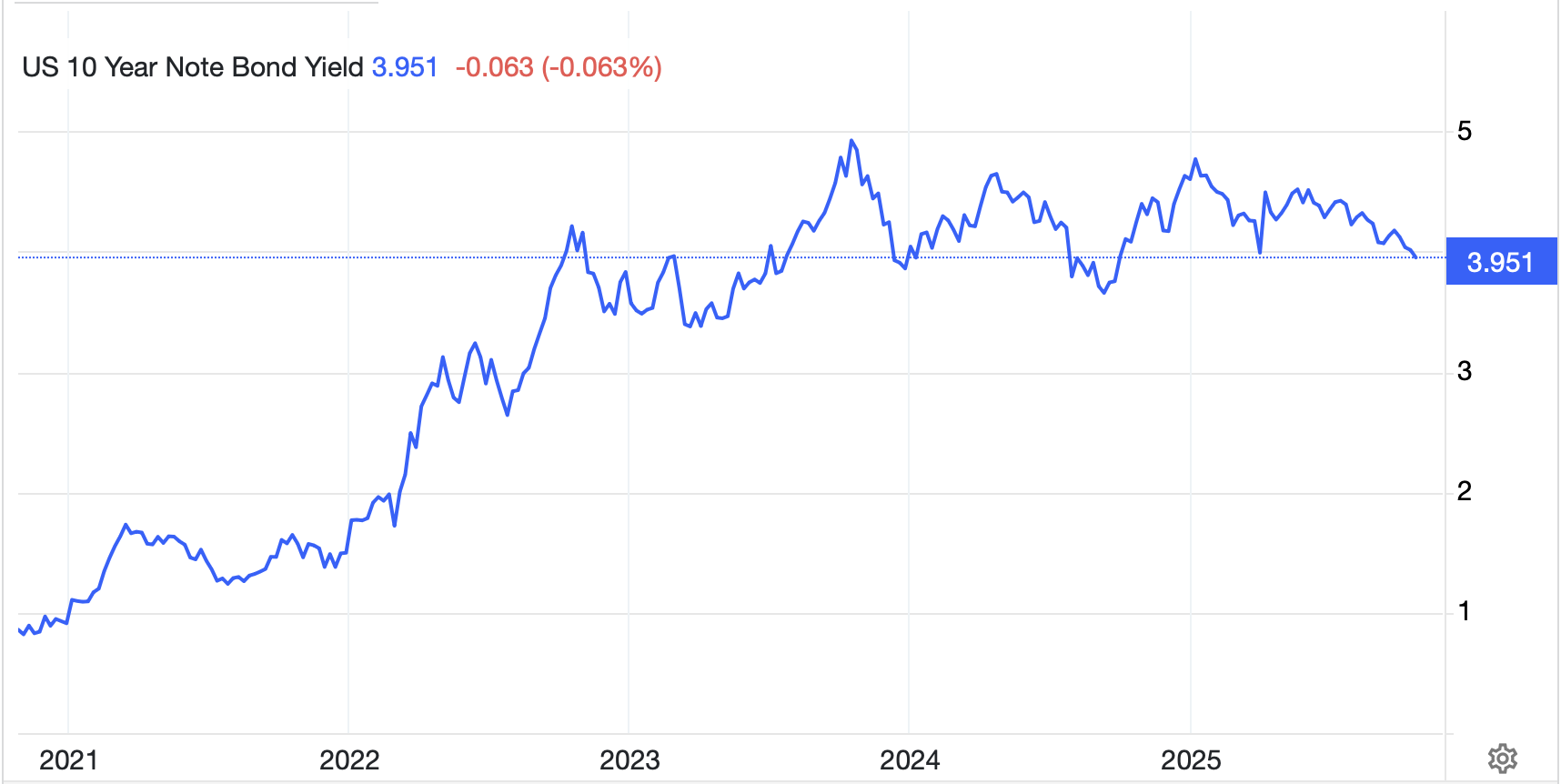
Source: tradingeconomics.com

European sovereign yields have seen similar movement, edging lower by -1bp except for UK gilts, which have fallen -10bps this morning after that inflation report.  Perhaps more interesting is the fact that despite Takaichi-san becoming PM, with her platform of increased fiscal spending, JGB yields are 2bps lower this morning.

Turning to the rest of the commodity space, oil (+2.1%) is rising on the news that the US has started to refill the SPR.  While the initial bid is only for 1 million barrels, this is seen as the beginning of the process with the administration taking advantage of the recent low prices.  Arguably, given they want to see more drilling as well, it is very possible that $55/bbl is as low as they really want it to go.  As to the metals beyond gold (-2.4% this morning), silver (-1.6%) is still getting dragged along but copper (+0.6%) and platinum (+0.9%) seem to be consolidating after sharp declines in both.  My sense is gold remains the liquidity asset of choice given its far larger market value.  (One other thing to note is that there was much discussion how gold has replaced Treasuries as the most widely held central bank reserve asset.  That was entirely a valuation story, not a purchase story.  In other words, the dramatic rise in the price of gold increased the value of its holdings relative to other assets on central bank balance sheets.)  

Finally, the dollar is doing just fine.  It continues within its recent trading range and basically hasn’t gone anywhere in the past six months.  In fact, of you look at the DXY chart below from Yahoo Finance, it is arguably in the upper quintiles of its long-term price action.  It is very difficult for me to listen to all the reasons that the dollar is going to be replaced by some other reserve currency and take it very seriously.

As to specific currency moves today, the pound (-0.3%) is slipping on the increased belief in a rate cut coming soon and ZAR (-0.5%) is suffering on the ongoing gold price decline but away from those two, +/-0.1% is the story of the day.

EIA Crude Oil inventories are the only data of the day with a modest build expected.  Yesterday, Governor Waller discussed payment systems and cryptocurrencies never straying into monetary policy so we will need to wait for CPI on Friday, the FOMC next Wednesday and whenever the government reopens, which I sense is coming sooner rather than later as the Democrats have been completely unsuccessful in making the case this is President Trump’s fault.  

It appears the cracks in the leverage that has accompanied the recent rally in asset prices are beginning to appear.  If things get worse, and they probably will, look for the Fed to respond and haven assets to be in demand.  Amongst those will be the dollar.

Good luck

Adf
Price Rise Regimes

Ahead of today’s CPI
Investors would not really buy
But neither would they
Sell short, as they weigh
If Jay is a foe or ally

Meanwhile, amongst pundits it seems
The world is split into extremes
Some see prices falling
And for cuts, are calling
While others fear price rise regimes

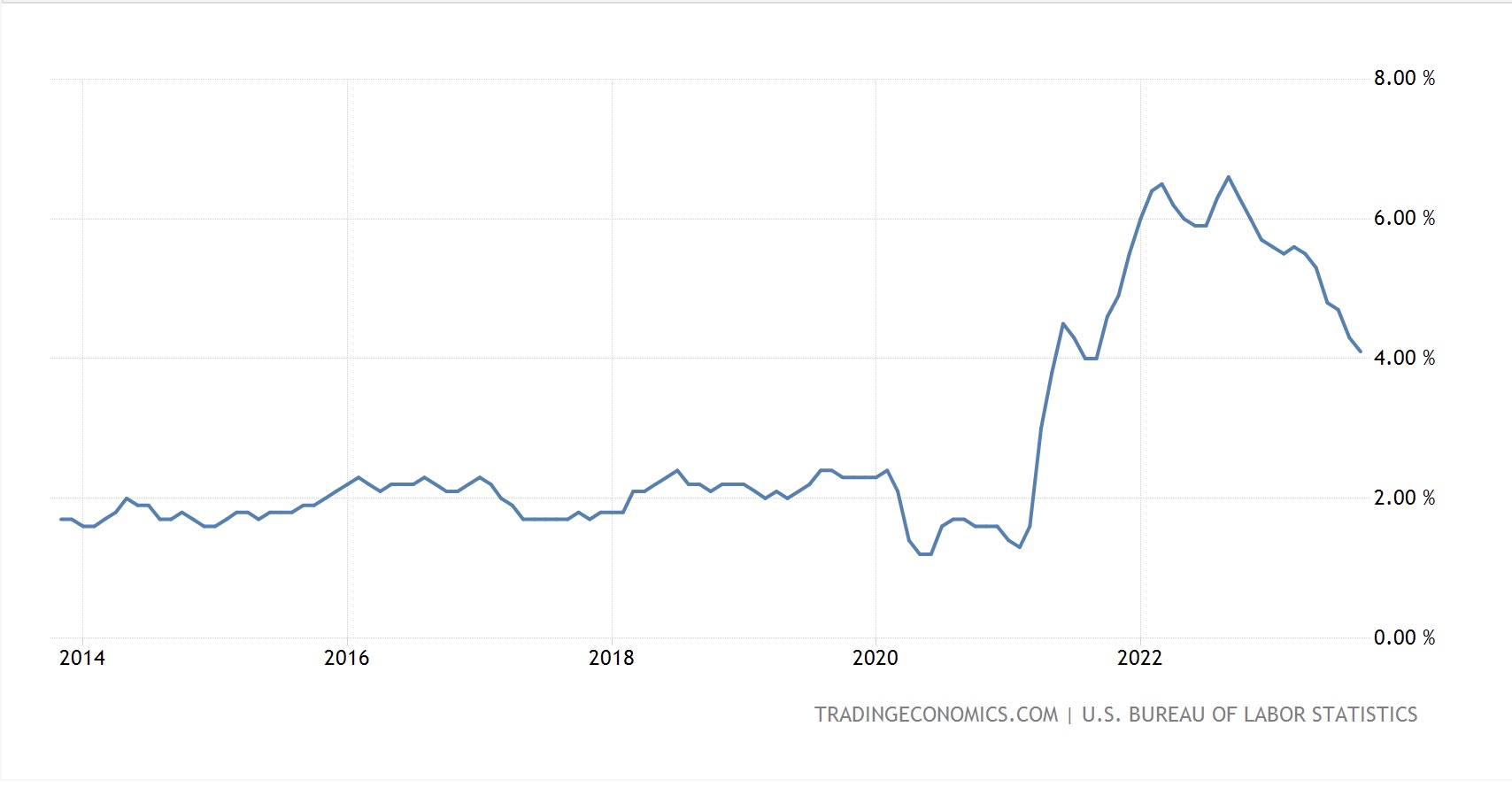
Market activity has been subdued overnight as we all await this morning’s big CPI report.  Currently the consensus views are for a 0.1% rise in the headline, leading to a 3.3% Y/Y number, down substantially from last month’s 3.7% reading, and a 0.3% rise in the core, leading to an unchanged Y/Y reading of 4.1%.  Here’s the thing, as can be seen in the below chart of core CPI, although it is clear inflation appears to be trending lower, it is still a LONG way from where anybody is comfortable.

Something else to remember is the different ways in which we all experience, and think about, inflation.  When writing about inflation, all analysts look at the rate of change of a percentage move as an indicator of what is happening.  But when you go to the grocery store, or your favorite restaurant, or when you order stuff on-line, especially things that you regularly buy, the price changes over the past two years have been so substantial, and taken place in such a short time, that we all remember the pre-covid prices.  The fact that prices may not be rising as fast as they did last year does not make the stuff any cheaper this year.  I would contend that is why virtually all of us consider the inflation data to be suspect, because the package of toilet paper that used to cost $4.99 now costs $8.99, and while it may not go higher anytime soon, it is still nearly double what we remember.  This perception is critical, in my mind, to understanding the national mood, and it is one that nobody in the Fed, or likely the administration, considers.  We know this because there are so many articles in the mainstream media about how things are really great, and people just don’t understand how good a job those two groups are doing.  

At any rate, if pressed, I would say that there are more deflationistas these days, who believe that inflation is going to quickly head back to 2% and that the Fed is going to be cutting rates early next year to prevent overtightening of policy.  The crux of their argument is that M2 is declining at a record pace (as can be seen in the below chart), and therefore is highly deflationary.  

I would counter that argument, though, with the fact that the velocity of money (see chart below) is rising at a record pace, offsetting those declines, and supporting ongoing inflationary tendencies.  

As some of us may remember from our macroeconomics classes, the identity to describe growth and inflation is:

                                                MV = PQ

The argument that a decline in M2 money supply (the “M”) will lead to lower prices assumes the velocity of money (the “V”) remains stable.  But as you can clearly see from the second chart, the velocity of money is rising sharply.  I would contend there is little chance that deflation is coming to a screen near you at any point in the next several years absent a depression brought on by a collapse in the bond market.  And ultimately, that means that the price of all those things we buy regularly is not going to retreat to pre-covid levels.

Away from the CPI drama, there were two things of note overnight.  First, Japanese FinMin Suzuki was on the tape explaining the government would take all possible steps necessary to respond to currency moves.  The market response was a very short-term rise in the yen, with the currency popping 0.35%, but giving back most of those gains within the hour and currently, it sits largely unchanged on the session.  There has been no evidence that the BOJ has intervened since October 2022, but it appears that 152.00 may be a sensitive spot right now.  The other thing he said was they were preparing a package to help citizens cope with the weakening yen which is driving inflation there.  That said, there is no indication yet they are going to raise the deposit rate from its current -0.10% level.  Net, I still think the yen has further to decline, at least until policy changes in Tokyo.

The other noteworthy occurrence was word from China that they were considering an additional CNY 1 trillion of support for the housing market as things on the mainland continue to slow despite Xi’s best efforts.  It seems when you blow a 20-year property bubble of such enormous proportions, such that the property sector consumes > 25% of your growing economy, slowing that down without collapsing the economy is a tough job.  I continue to think of King Canute and his command that the tide recedes every time I think about KingPresident Xi trying to stop the property market collapse.  At any rate, as can be seen by the fact that equity markets in China and Hong Kong did virtually nothing last night, the market is not excited by the prospects of more Chinese money sloshing around.

As to the rest of the equity markets, yesterday’s trading in the US was pretty limited with modest gains and losses in the indices while the Nikkei managed to gain 0.3% overnight.  European bourses are also mixed, with the continent a bit firmer while the UK is under some pressure.  Perhaps the marginally better than forecast German ZEW reading of 9.8 vs 5.0 expected and -1.1 last month is the driver on the continent, while UK employment data was arguably a bit better than forecast, with the Unemployment Rate remaining unchanged at 4.2% rather than ticking higher as expected, and so hopes for a quick BOE rate cut have faded a bit.

Too, in the bond market, activity has been extremely subdued with Treasury yields 2bps softer this morning while European sovereign yields are essentially unchanged across the board.  Last night in Asia, we saw little movement as well, with JGB yields slipping just 1bp and hanging around their new home at 0.85%.

While commodity prices managed to rally a bit yesterday, this morning, what little movement there is across energy and metals markets is ever so slightly lower.  Yesterday saw the EIA raise its forecast for oil demand slightly, and there is word that the administration is bidding for 1.2 million barrels of oil to start to refill the SPR, but sentiment in this space is clearly negative with the recession fears the driving force across all these markets.

Finally, the dollar, too, is very little changed this morning which should be no surprise given the lack of movement elsewhere.  If anything, it is trending a bit softer, but only just, as the deflationistas seem to be preparing themselves for a soft CPI print and want to get on board for that first Fed rate cut.  As we currently stand, at least according to the Fed funds futures market, the first cut is priced in for the June meeting, although the first hints of a cut show up in March.  That said, the probability of a rate hike in December has edged higher to 15% from below 10% last week.  There is still a great deal of confusion as to how market participants believe this is going to play out over time.

Aside from the CPI data, we hear from 3 more Fed speakers today, Barr, Mester and Goolsbee, while Governor Jefferson, in a speech in Zurich early this morning, didn’t really touch on current monetary policy, rather he was discussing uncertainty in a broad manner.  I suspect that the 3 speakers will generally reiterate Powell’s message from last week that the future is uncertain but higher for longer is the way forward.  As such, it is all about the data.  A hot print, certainly a M/M of 0.2% headline or 0.4% core will likely see bonds sell off along with stocks while the dollar rallies.  However, anything else, meaning a soft print or even an as expected print, will likely encourage risk buying and dollar selling.  We shall see,

Good luck

Adf

No Longer a Threat

Opinions are already set
The Fed is no longer a threat
Today’s NFP
Will help all to see
That buying stocks is the best bet

At least that’s the narrative tale
The talking heads want to prevail
The question’s, will Jay
Have something to say
If finance conditions, up, scale

To conclude what has already been a tumultuous week, this morning brings the monthly payroll report, a key piece of evidence for the Fed to determine the health of the economy.  Expectations for the readings are as follows:

Nonfarm Payrolls180K
Private Payrolls158K
Manufacturing Payrolls-10K
Unemployment Rate3.8%
Average Hourly Earnings0.3% (4.0% Y/Y)
Average Weekly Hours34.4
ISM Services53.0

Source: tradingeconomics.com

Apparently, the whisper number is a bit above 200K, but we also must pay close attention to the revisions.  Recall last month had a blowout 336K result, which was much larger than expected.  If that number retains its strength, it would certainly be indicative of a still healthy labor market.  This matters a great deal as after Powell’s press conference on Wednesday and the surprising QRA that shortened the duration of upcoming Treasury bond issuance, the market is all in on the goldilocks story, solid growth with low inflation.  The corollary to this is that the market is looking for the Fed to back off the current rate policy and begin to reduce the Fed funds rate, thus helping all the DCF models pump up the value of equities.

But even though I have been highlighting the importance of the NFP number for the past two years as a key for the FOMC, it is not clear to me that today’s is so important.  I only say this because the Fed just met two days ago, and we will see another NFP before they meet again.  Arguably, this one will get lost in the fog of memory.  

If that is the case, then it is probably a good time to recap what we have seen this week and how it has affected market sentiment.  The bulls are on a roll right now as we have seen a significant pullback in Treasury yields with 10yr down to 4.66%, down 36bps from their peak back on October 23rd.  While that is certainly a large move in a short period of time, it is in line with the types of movement we have been seeing all year, so hardly unprecedented.  But Powell’s comments, which have been read as dovish despite his best efforts to prevent that view, and the bond market movement have many market participants licking their chops for a massive equity rally going forward.

Interestingly, one of the things the talking heads have been using to pump their story has been the tightening in financial conditions that were a result of declining stock and bond prices.  The whole issue of tighter financial conditions doing the Fed’s work for them has been a key story for the past several weeks since it was first mentioned by Dallas Fed President Lorrie Logan.  However, the big rally in both stocks and bonds, as well as the decline in the dollar, are all critical features in the calculation of those financial conditions, and they are all pointing to easier conditions.  The point is, if tighter conditions was a reason for the Fed to have stopped tightening further, the fact that they are now easing implies the Fed may feel the need to raise rates again in December, although that is clearly not the consensus view.

At any rate, right now, momentum is on the bulls’ side, and it is tough to overcome.  Certainly, the economic data continues to point to a resilient economy which implies, to me at least, that the Fed will not feel any urgency to cut rates soon.  There has also been a great deal of discussion regarding the fact that the average time the Fed has held rates at a peak before cutting is just 7 months.  We are now three months into the most recent hold, and, by definition, since the next meeting is not until December, we will be at 5 months then.  My observation about Chairman Powell, though, is at this point he is unconcerned with statistics of that nature and is far more focused on achieving their objective of 2% inflation.  

One last thing about inflation before we touch on markets.  There has been a growing chorus that deflation is on its way because M2 money supply growth is currently declining.  However, for the economics majors out there, recall that the key monetary equation is M*V = P*Q.  P = prices, and Q = quantity of goods, or, combined economic output.  M = Money supply and V = Velocity of money.  It is the last piece that is often ignored but remains quite important.  My good friend @inflation_guy, has just published a piece which is well worth reading.  The essence is that while M2 may be declining, V is rising rapidly, offsetting that impact and creating conditions for much stickier inflation than many believe.  I have a feeling the Fed is going to stay on hold, if not tighten further, for a much longer time than currently anticipated.  While this week’s news has clearly been seen as bullish, the long-term trends have not yet changed in my view.

Ok, so a quick look at markets shows that after another gangbusters day in the US, where all three major indices were higher by 1.7% or more, Asian markets followed suit, with virtually every index there higher by at least 1.0%.  Europe, however, has been more circumspect with markets essentially unchanged this morning, just +/- 0.1% on the day.  US futures are ever so slightly softer at this hour (7:30) down about -0.15% on average, as investors and traders await this morning’s data.

At this point, bonds seem to be taking a rest after a huge price rally / yield decline over the past several sessions and we are seeing very little movement on the day with Treasuries and European sovereigns all within 1 basis point of yesterday’s closing.  Even JGB yields slid a bit yesterday but remain above 0.90% as of now.  As to the shape of the yield curve, that inversion is starting to show its head again, with the current 2yr-10yr spread back to -32bps.  Remember, two days ago that was at -18bps.  Broadly speaking, yield curve inversions are not signs of economic strength.

In the commodity space, oil is creeping back higher, up 0.4% this morning although still lower on the week.  Gold is basically unchanged this morning, continuing to hang out just below $2000/oz, which continues to surprise me given the sharp decline in yields, at least nominal yields.  As to the rest of the space, base metals are mixed amid small changes this morning and foodstuffs, something I have not mentioned in a while, have actually been declining with the FAO’s world food price index falling to its lowest level in more than 2 years last month.  It may not seem that way in the grocery store, but perhaps future price rises will be more muted.

Finally, the dollar is generally biding its time ahead of the data, although leaning lower overall.  In the G10, the average gain of a currency is about 0.2% while in the EMG bloc we have seen a few outliers, notably KRW (+1.2%) but a more general rise of 0.4% or so.  You already know that my view has changed given the seeming change in the underlying drivers.  For now, and likely through the end of the year at least, I think the dollar will be under pressure.

Aside from the data this morning, we get our first Fed speaker, Supervision Vice-Chair Michael Barr, this afternoon, but the topic is the Community Reinvestment Act, which makes it unlikely he will swerve into monetary policy.  So, as is often the case, the data will see a flurry of activity at 8:30 and then I suspect the recent trends will reassert themselves in a slower session overall.  We will need to see an extraordinarily strong NFP print to help reverse the dollar’s current malaise.

Good luck and good weekend

Adf

Worse Than Just Sloth

With payrolls on everyone’s mind
The overnight range was confined
The bulls live in fear
That job growth’s still clear
While bears worry payrolls declined

But, looking beyond NFP
There’s something the bulls fail to see
Liquidity’s growth
Is worse than just sloth
It’s shrinking to quite a degree

Before I start this morning, please know I will be on vacation next week so there will be no poetry again until the 16th.

Now, to start this morning, all eyes are on the payroll report where the market is definitely in the ‘bad is good’ frame of mind.  Median analyst expectations are as follows:

Nonfarm Payrolls170K
Private Payrolls160K
Manufacturing Payrolls5K
Unemployment Rate3.7%
Average Hourly Earnings0.3% (4.3% Y/Y)
Average Weekly Hours34.4
Participation Rate62.9%

Source: tradingeconomics.com

We know that Wednesday’s ADP number was quite weak, and we know that Tuesday’s JOLTS number was quite strong.  Yesterday’s Initial Claims data was also a harbinger of strength with the weekly number falling to 207K.  If we look at the ISM employment sub-indices, both showed relative strength with the Manufacturing number rising above 50 for the first time in 5 months while the Services employment index remains at a healthy 53.4 level.  Much of what I have read over the past several weeks has focused on the idea that companies are still reluctant to lose employees as they remember how difficult it was to hire post the Covid fiasco.   I have a funny feeling we are going to see a better than expected number this morning, as between the JOLTS and Claims data it feels like we’re due for a pop.  However, I believe we need to see a print above 200K to have a meaningful impact on the markets.

To be clear, if I am correct, I would look for bond yields to retest their recent highs, equities to fall and the dollar to rebound from its recent consolidation/correction.

But let’s discuss the dollar for a moment and a data point that gets short shrift these days, the Trade Balance.  A brief history lesson shows that once upon a time, the Trade Balance was the most important monthly release for the FX market.  This was during the Reagan years when US policy was highly focused on the trade deficit with Japan and concerns over whether Japan was going to replace the US as the preeminent global economy.  (We know how that worked out!). But the point is trade data used to matter.  One of the things that gets little attention these days but is directly impacted by the trade data is the amount of global USD liquidity that exists. Despite all the hyperventilation over the concept of dedollarization, the reality is that the dollar has never been a more integral part of the global financial system than now.  The reason for this is the fact that there is somewhere north of $275 trillion of USD debt outstanding around the world, according to the IMF, and the US portion is only on the order of $95 trillion.  This means the rest of the world needs to service $180 trillion of debt, paying USD interest.   

How, you may ask, does everybody get those dollars to pay the interest on that debt?  Well, one of the keys had been the US running a massive trade deficit, buying stuff and sending dollars all over the world.  Those dollars were used to service the debt.  But lately, the US trade deficit has been declining pretty steadily, with yesterday’s better than expected reading of -$58.3 billion a continuation of the last two years’ trend from the worst print of -$105B in March 2022.   The thing is, if the US trade deficit is shrinking, we are not sending as many dollars out into the world for everyone else to use.  There has also been a great deal of discussion lately about how M2 money supply has been shrinking at an unprecedentedly fast rate, yet another sign that liquidity is drying up.  One consequence of these two factors, shrinking M2 and a shrinking trade deficit, is that foreigners need to bid more aggressively for the dollars they need to service and repay their USD notional debt.  This has been a key driver in the dollar’s recent strength and there is no sign this is going to change in the near future.

But shrinking liquidity also weighs on other things, notably risk assets.  Again, think about the post GFC era when QE’s 1 through infinity were ongoing and all the calls for inflation to ramp up never materialized.  Well, as I wrote during that time and is becoming clearer today, there was plenty of inflation, it was just concentrated in asset prices like stocks, bonds and real estate, as opposed to everyday items like groceries, clothing and dining out.  At this point, we realize that the Covid fiscal stimulus around the world is what unleashed the recent bout of inflation, and that central banks are working feverishly to halt this trend.  Combine the Fed leading the way, having raised rates the furthest of the major central banks, and the fact that there are less dollars around due to shrinking money supply and trade deficits, and you come up with a good understanding of why the dollar remains well bid.  Regardless of the short-term impact of numbers like today’s NFP, the underlying structural effects continue to point to dollar strength.

With that structural backdrop in mind, a look at today’s price activity shows modest net activity ahead of the data.  Asian equity markets that were open had a mixed session with the Nikkei sliding while the Hang Seng managed some solid gains (+1.6%) and mainland Chinese markets remained closed, set to reopen on Monday.  European bourses, though, are having an ok day, with gains on the order of 0.5% or so after better than expected Factory Orders data from Germany.  As to US futures, they are currently (7:30) higher by 0.1% and trading in a tight range.

Bond yields are backing up again with Treasuries and most of Europe higher by 3bps or so.  One move that has been growing lately is the Bund-BTP spread, which is now 202bps, right at the level where the ECB has historically started to get a bit nervous.  If this spread continues to widen look for more ECB talk about, first, how the market is wrong, and then second, how the TPI, their program to buy BTPs and sell Bunds, is likely to be appropriate.  At 250bps, their hair will be on fire, but that still feels pretty far off.

Oil prices, which are unchanged today, appear to be consolidating after a hellacious week where they fell >$10/bbl.  The thing is demand data continues to point to growth and supply data continues to point to limits.  The recent price action has all the earmarks of Russian disinformation a trading response to the massive run higher through the summer where a lot of trend followers got into the market too late.  Longer term, the direction here remains higher in my view.  As to the metals markets, they also are consolidating after a rough period with gold unchanged though silver, copper and aluminum are all higher between 0.3% and 0.9% this morning.  Again, we have seen a pretty sharp decline here, so this feels like a trading reaction, not a fundamental thing.

Finally, the dollar is a bit firmer this morning as we await the data.  USDJPY continues to hold the 149 level and it looks to be merely a matter of time before we test 150 again.  According to the flow data from the BOJ, there was no indication that they intervened earlier this week which implies there was some rate checking.  However, it is very clear they remain quite concerned over the movement.  One currency that has really seen some movement lately is MXN, which after a long period of strength on the back of a very stout monetary policy by Banxico, has given back 10% in the past 5 weeks.  Interestingly, the US is running a growing trade deficit with Mexico, which should help alleviate some pressure on the peso, but right now, the difference in tone between the Fed’s higher for longer and Banxico’s we are done is the driver.

Aside from payrolls this morning we see consumer Credit (exp $11.7B) and hear from Governor Waller at noon.  Yesterday’s Fed speak was much of a muchness with no changes in tone overall.  At this point, all we can do is wait.

Good luck, good weekend and until Monday October 16th

Adf