
Voters Have Doubt

In France, Monsiuer Bayrou is out
In Norway, though, Labor held stout
Japan’s been discussed
And Starmer’s soon Trussed
In governments, voters have doubt
 
Investors, though, see all this news
And none of them have changed their views
Just one thing they heed
And that’s market greed
At some point they’ll all sing the blues


Here we are on Wednesday and already we have seen two major (Japan and France) and one minor (Nepal) nations make governmental changes.  Actually, they haven’t really changed yet, they just defenestrated the PM and now need to figure out what to do next.  In Japan, it appears there are two key candidates vying to lead a minority LDP government, Sanae Takaichi and Shinjiro Koizumi, although at this point it appears too close to call.  Regardless, it will be rough sledding for whoever wins the seat as the underlying problems that undermined Ishiba-san remain.  

In France, President Macron has, so far, said he will not call for new elections, nor will he resign despite increasing pressure from both the left and the right for both measures.  He will appoint a new PM this week and they will go through this process yet again as the underlying issue, how to rein in spending and reduce the budget deficit, remains with nobody willing to make the hard decisions.  A side note here is that French 10-year OATs now trade at the same level as Italian 10-year BTPs, a catastrophic decline over the past 15 years as per the below chart. 
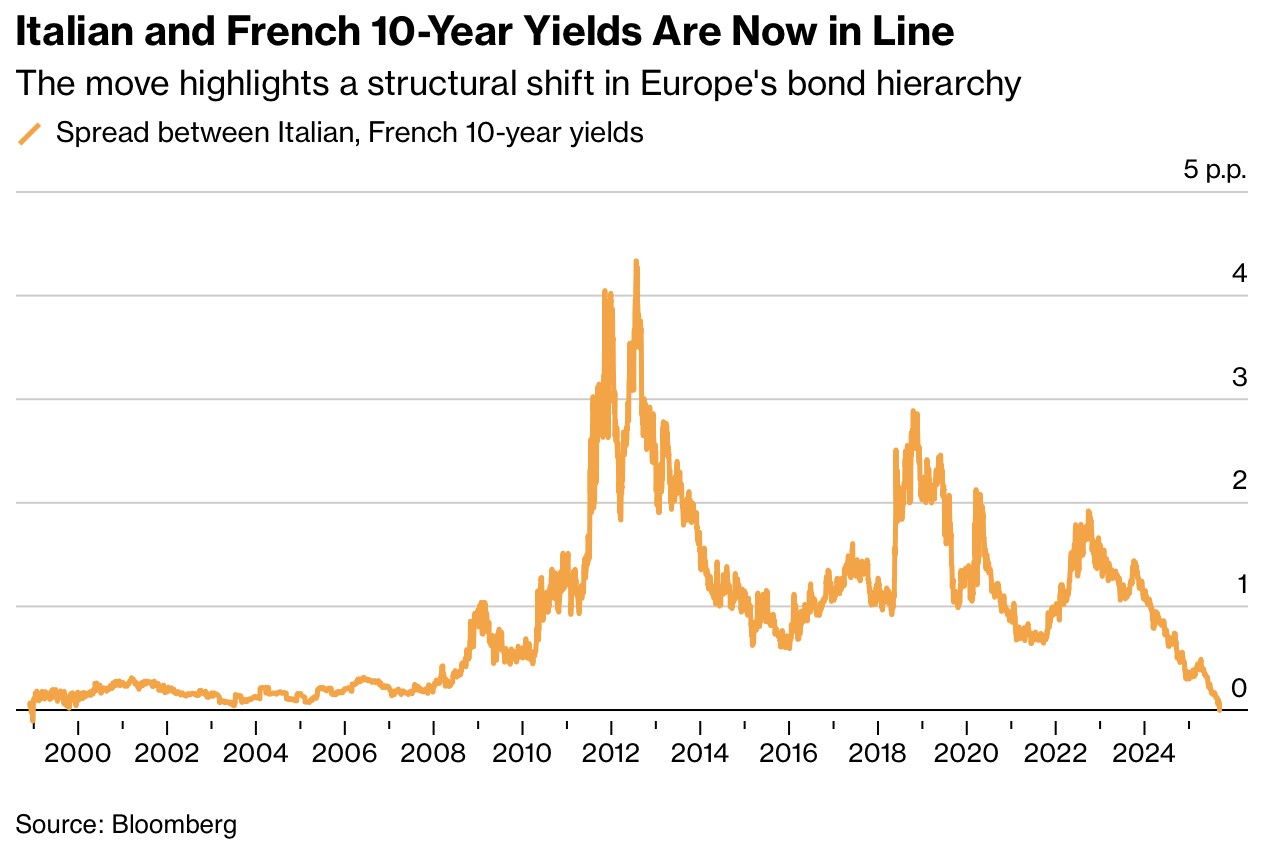
Recall, during the Eurozone crisis in 2011, Italy was perceived as the second worst situation after Greece in the PIGS, while France was grouped with Germany as hale and hearty.  Oh, how the mighty have fallen.

Nepal is clearly too insignificant from a global macroeconomic perspective to matter, but it strikes me that the fall of the PM there is merely in line with the growing unhappiness of populations around the world with their respective governments.

A friend of mine, Josh Myers, who writes a very thoughtful Substack published last night and it is well worth the read.  He makes the point that the Washington Consensus, which has since the 1980’s, underpinned essentially all G10 activity and focused on privatization of assets, free trade and liberalized financial systems, appears to have come to the end of the road.  I think this is an excellent observation and fits well with my thesis that the consensus views of appropriate policies are falling apart.  Too many people have been left behind as both income and wealth inequality in the G10 is rampant, and those who have fallen behind are now angry enough to make themselves heard.  

This is why we see governments fall.  It is why nationalist parties are gaining strength around the world as they focus on their own citizens rather than a global concept.  And it is why those governments still in power are desperately struggling to prevent their opponents from being able to speak.  This is the genesis of the restrictions on speech that are now rampant in Germany and the UK, two nations whose governments are under extreme pressure because of policy failures, but don’t want to give up the reins of power and are trying to prevent anybody from saying anything bad about them, thus literally jailing those who do!

And yet…investors are sanguine about it all!  At least that seems to be the case on the surface as equity indices around the world continue to trade higher with most major equity markets at or within a few percent of all-time highs.  This seems like misplaced confidence to me as the one thing I consistently read is that markets are performing well in anticipation of the FOMC cutting Fed funds next week, with hopes growing that it will be a 50bp cut.  

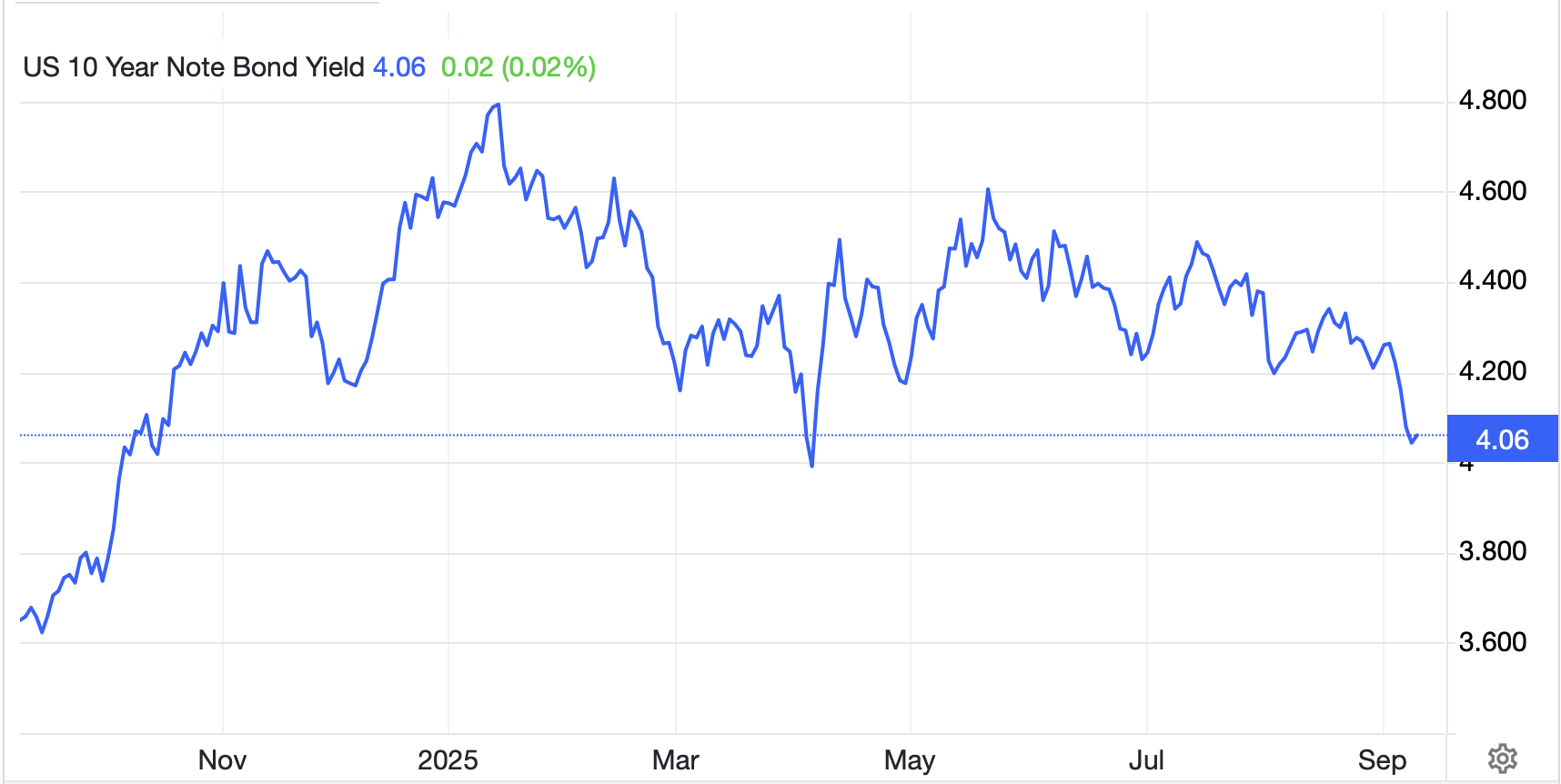
But if we look at the Treasury market, which has seen yields slide steadily since the beginning of the year, with 10-year yields now lower by 75bps since President Trump’s inauguration, it is difficult to square that circle.  
Source: tradingeconomics.com

Bond yields typically rise and fall based on two things, expected inflation and expected growth as those two have been conflated in investor (and economist) minds for a while.  The upshot is if yields are declining steadily, as they have been, it implies investors see slowing economic activity which will lead to lower inflation.  Now, if economic activity is set to slow, it strikes me that will not help corporate profitability, and in fact, has the potential to exacerbate the situation by forcing layoffs, reducing economic activity further.  Alas, it is not clear if that will drive inflation lower in any meaningful way.  The point is the bond market and the stock market are looking at the same data and seeing very different future outcomes.

Is there a tiebreaker we can use here?  The FX market might be one place, but the weakness in this idea is that FX rates are relative rates, not descriptive of the global economy.  Sure, historically the dollar has been the ultimate safe haven with funds flowing there when things got rough economically, but its recent weakness does not foretell that particular story.  Which brings us to the only other asset class around, commodities.  And the one thing we have seen lately is commodity prices continuously rising, or at least metals prices doing so, specifically gold.  Several millennia of history showing gold to be the one true store of value is not easily forgotten, and that is why the barbarous relic has rallied 39% so far in 2025.  

A number of analysts have likened the current situation to that of Wile E Coyote and I understand the idea.  It certainly is a potential outcome so beware.

Well, once again I have taken much time so this will be the lightning round.  Starting with bonds, this morning, yields in the US and Europe are higher by 2bps across the board, with one exception, France which has seen yields rise 6bps as discussed above.  JGB yields are unchanged as it appears investors there don’t know what to think yet and are awaiting the new PM decision.

In equities, yesterday’s very modest late rallies in the US were followed by a mixed session in Asia (Japan -0.4%, China -0.7%, HK +1.2%) although there were more winners (Korea, India, Taiwan, Thailand) than laggards (Australia, New Zealand, Indonesia) elsewhere in the region.  In Europe, mixed is also the proper adjective with the CAC (+0.4%) remarkably leading the way higher despite lousy IP data (-1.1%) while Germany (-0.4%) and Spain (-0.4%) both lag.  As to US futures, at this hour (7:20) they are marginally higher, 0.15% or so.

Oil (+0.8%) continues to trade back and forth each day with no direction for now.  I’m sure something will change the situation here, but I have no idea what it will be.  Gold (+0.5%) meanwhile goes from strength to strength and is sitting at yet another new all-time high, above $3600/oz.  While silver and copper are little changed this morning, the one thing that seems clear is there is no shortage of demand for gold.

Finally, the dollar is arguably slightly lower this morning, although mixed may be a better description.  The euro (-0.15%) is lagging but JPY (+0.6%) is the strongest currency across both G10 and EMG blocs.  Otherwise, it is largely +/-0.2% or less as traders ponder the data.

While CPI is released on Thursday, I think this morning’s NFP revision is likely to be the most impactful number we see this week, and truly, ahead of the FOMC next week.

TodayNFP Revision-500K to -950K
WednesdayPPI0.3% (3.3% Y/Y)
 -ex food & energy0.3% (3.5% Y/Y)
ThursdayECB Rate Decision2.0% (unchanged)
 CPI0.3% (2.9% Y/Y)
 -ex food & energy0.3% (3.1% Y/Y)
 Initial Claims235K
 Continuing Claims1950K
FridayMichigan Sentiment58.0

Source: tradingeconomics.com

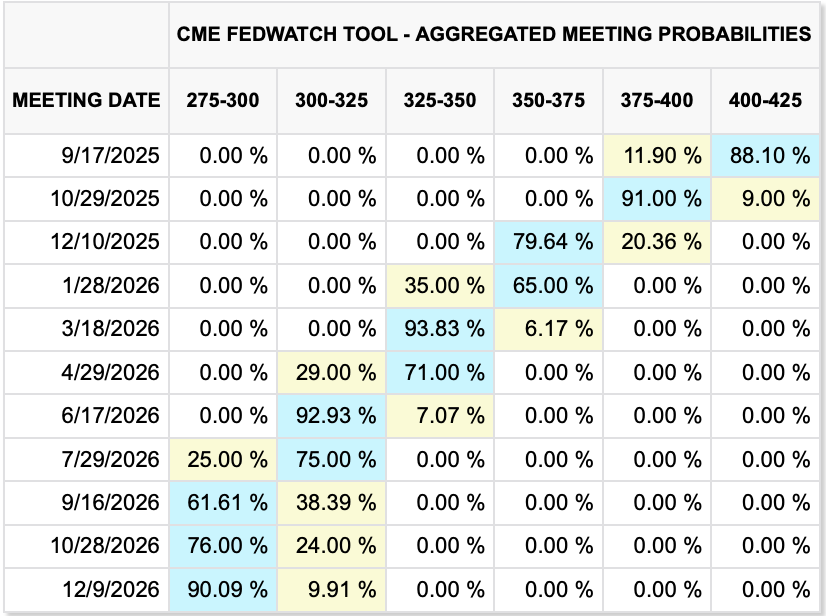
As I type, the Fed funds futures market is pricing a 12% probability of a 50bp cut next week and an 80% chance of 75bps this year.
Source: cmegroup.com

If the NFP revisions are more than -500K, I suspect that rate cut probabilities will rise sharply with the dollar falling, gold rising, and bond yields heading lower as well.  Equity markets will probably rally initially, although it strikes me that this type of bad news will not help corporate earnings.  So, buckle up for the fun this morning on a release that has historically been ignored but is now clearly center stage.

Good luck

Adf

Unnerved

The Claims data last week preserved
The markets, which had been unnerved
By thoughts that Japan
Did not have a plan
To exit QE unobserved
 
Now yesterday’s data revisions
To Payrolls cemented decisions
That when Powell speaks
He’ll say, “in four weeks
Rate cuts are quite clear in my visions”


Well, the big news was that the BLS revised down the number of new jobs created between April 2023 and March 2024 by 818K, not far from the extreme calls of 1MM.  Alas, this has become more of a political talking point than an economic one with claims of subterfuge on the part of the current administration in an effort to flatter their record.  From an economic perspective, however, to the extent that we believe this data is accurate, it offers a far greater case for the Fed to cut rates next month.  After all, the strong labor market had been one of the key rationales for the Fed to maintain higher for longer, so if that market is not as strong as previously believed, lower rates would be appropriate.

In addition to the NFP revisions, which had gotten virtually all the press, the FOMC Minutes of the July 31stmeeting were also released.  It turns out that according to those Minutes, the discussions in the room included several members calling for a cut at that meeting, and unanimity in a cut by September.  That feels a bit more dovish than the post-meeting press conference where Powell wouldn’t commit to a September cut, seemingly trying to retain some optionality.  Now, the market has been pricing in a full 25bp cut since a week before the last meeting, so it’s not as though people have been fooled.  And we are still looking at a 30% probability of a 50bp cut in September, but to this poet, absent a negative NFP reading in two weeks’ time, September is going to bring a 25bp cut.

Here’s the thing, though, will it matter?  It certainly won’t have any impact on the economy for any appreciable time (remember those long and variable lags) although it could be a signaling event.  But exactly what does it signal?  If the economy is truly robust, why cut?  If the economy is weakening quickly, or not as strong as previously thought, then why just 25bps?  In the big scheme of things, 25bps has exactly zero marginal impact on economic activity.  If they were to explain they are entering a series of more aggressive rate cuts to accommodate weakening growth, well that seems like a signal they don’t want to send either, especially politically.  One final thought, when things are going well in the economy, nobody is talking about any kind of ‘landing’, whether soft or hard.  The very fact people are discussing a ‘soft-landing’ is recognition that the economy is slowing down.  I believe that most of us understand that is the case, but for the media to inadvertently admit that is the case in this manner speaks either to their stupidity or their cupidity.

Ok, so how did markets respond to these two stories?  The first thing to note is that while the NFP revisions were scheduled to be released at 10:00, they were a bit late.  As you can see in the chart below, there was an immediate jump in the equity market, which slowly retraced until the Minutes were released and then the dovishness was complete, and we saw a steadier appreciation.  

A green line graph with numbers and a black dot

Description automatically generated

Source: Bloomberg.com

Net, the clear belief from the investment community was that the Fed is more dovish than they have been letting on, and so equity markets in the US rallied on the day.  Once again, that followed through in Asia, where pretty much all markets except mainland China (CSI 300 -0.25%) followed suit with the Hang Seng (+1.45%) the leader, but strength throughout the region overall.  In Europe, Flash PMI data was released this morning showing that Germany continues to stumble, especially in the manufacturing sector, and that the whole of Europe is lackluster at best.  While the Olympics seemed to help French services output, net, there is not much excitement.  The upshot is that ECB members are talking up further rate cuts and the result is European bourses are gaining some ground this morning, but only on the order of 0.2%.  As to US futures, they are little changed at this hour (7:15).

In the bond market, yields are edging higher with Treasury yields up by 2bps and similar gains across Europe and the UK.  In truth, I would have expected European yields to slide a bit on the PMI data, but clearly that is not the case.  Interestingly, 10yr JGB yields slipped lower by another 1bp as the market there prepares for testimony by BOJ Governor Ueda tonight.  In a truly unusual event, the Diet (Japan’s congress) called him in to testify before both the Lower and Upper houses even though it is technically not in session.  It seems they are very concerned about his hawkishness and how it impacted Japanese stock markets and the yen two weeks ago.  (As an aside, I cannot imagine something like that happening in the US, it would be extraordinary given the ostensible independence of the Fed.)

Turning to commodity markets, after falling 1% further yesterday, oil (+0.5%) is bouncing slightly, although it remains far closer to the lower end of its trading range than even the center.  Gold (-0.3%) continues to hang around just above $2500/oz but has not made any real headway above since it first broke through that level last Friday.  A very interesting X thread on this subject by Jesse Colombo (@TheBubbleBubble), a pretty well-known commentator on markets (167K followers on X),  highlighted that while gold has made new all-time highs vs. the dollar, it has not done so vs. other currencies and that process needs to be completed to see a more significant move.  I raise this idea because if/when it occurs, it is likely to be a signal of far more distress in the economy and markets than we are currently seeing.  As to the rest of the metals complex, they are having lackluster sessions as well, with copper ceding -1.0% and silver (-0.15%) a touch softer.

Finally, the dollar refuses to collapse completely despite the growing view that the Fed is getting set to embark on a series of rate cuts.  While both the euro (-0.2%) and pound (+0.1%) are little changed this morning, both sit near 1-year highs vs. the dollar.  The thing about both these currencies that has me concerned is that energy policies currently being implemented in both Germany and the UK, with many other continental countries going down the same path, are almost guaranteed to destroy all manufacturing capability and force it to leave for somewhere with lower energy prices.  While both of those economies are clearly services driven, I assure you that the destruction of manufacturing capacity is going to have long-term devastating impacts on those nations, and by extension their currencies.  Just something to keep in mind.  Elsewhere, the yen (-0.6%) is slipping today and has been in a fairly tight range since the pyrotechnics from two weeks ago.  But we are also seeing weakness in ZAR (-0.75%), NOK (-0.5%) and SEK (-0.4%) to name a few, and general weakness, albeit in the -0.2% to -0.3% range across the rest of the G10 and EMG blocs.  The dollar is not dead yet.

On the data front, this morning brings Initial (exp 230K) and Continuing (1870K) Claims as well as the Chicago fed National Activity Index (.03) at 8:30.  Later this morning, Flash PMIs (manufacturing 49.6, services 53.5) are due and then Existing Home Sales (3.93M) finishes things off.  There are no scheduled Fed speakers but then all eyes are on Jackson Hole tomorrow when Chairman Powell speaks.

Given what we learned yesterday regarding both the labor market and the last FOMC meeting, it seems clear the Fed is going to cut 25bps next month.  Of more interest, I believe, will be the way Powell lays out his vision for what needs to occur for the Fed to continue the process and his guideposts.  Remember, they are still shrinking the balance sheet, albeit slowly, but cutting rates and reducing liquidity simultaneously may have unintended consequences.  If they stop shrinking the balance sheet, though, I believe the market will view that as a very dovish signal, and the dollar would fall sharply.  I’m not saying that’s what I expect, just that would be the result.  But for today, it is hard to believe we see a large move ahead of tomorrow’s speech.

Good luck

add