
The Perfect Riposte

Attention right now’s being paid
To Congress on taxes and trade
The One BBB
Is seen as the key
To growth in the coming decade
 
Meanwhile, Sintra right now’s the host
To Powell, Lagarde and almost
All central bankers
Each one of whom hankers
To nurture the perfect riposte


The headlines this morning highlight that Congress put in an all-nighter last night as they try to get the BBB over the line and on the president’s desk by Friday.  My take is they were seeking sympathy for all the hard work they must do and trying to make it seem like they are slaving away on their constituents’ behalf.  Yet it appears that since the president’s inauguration on January 20, 161 days ago, Congress has been in session for somewhere between 40 and 50 days (according to Grok), about one-quarter of the time.  I have seen these estimates elsewhere as well, and quite frankly, it doesn’t speak well of Congressional leadership.  

In the end, though, I continue to expect the BBB to get passed by both houses and sent to the president.  I’m certain there are still a lot of things in the bill that many fiscal conservatives will not like, but I’m also confident that the fact that not a single Democratic representative or senator is going to vote for the bill is likely a sign that it does more good than harm.  I am completely aware of the debt and deficit issues and questions of their long-term sustainability, and I am not ignoring that.  But politics is the art of the possible, not the perfect, and my take is this is possible.  Consider for a moment the Orwellian-named Inflation Reduction Act from 2022, which passed the Senate on a tiebreaker vote by VP Harris.  That was a much more harmful piece of legislation from a fiscal perspective than this.  In fact, I would say this is the very definition of politics.

Through a market lens, if (when) this is passed, while there may be an initial ‘sell the news’ move, I suspect that the stimulus it entails will be a net benefit for risk assets overall.  And the only reason there would be a sell the news event is that the market is already pricing in a great future as evidenced by yesterday’s quarterly close at new all-time highs for the S&P 500, above 6200.

Turning to the other noteworthy news, the ECB is holding their faux Jackson Hole event this week in Sintra, Portugal where all the heads of major central banks are currently gathered along with academics and journalists who are there to spread the good word.  Chairman Powell speaks today, but this is the Powell story of the day.  Apparently, President Trump had this hand-written note delivered to the Fed Chair.  Are we not entertained?

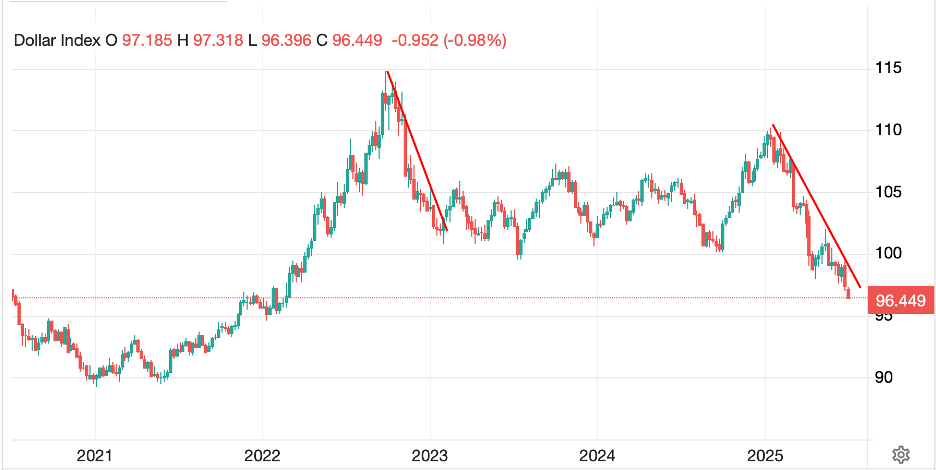
But ignoring for a moment the president’s desires, let us consider the dollar and its potential future direction.  The predominant current thinking is that it has further to slide as the trend is clearly lower and the rising anticipation of a recession in the US forcing the Fed to cut rates further will undermine the greenback.  Let’s break that down for a moment.  There is no question the dollar is currently in a downtrend as evidenced by the chart below.  A look at the red line on the right shows the slope of the decline thus far this year, which totals about 11%.
Source: tradingeconomics.com

In fact, much has been made of the decline thus far this year as to its speed and how it is a harbinger of both a recession and the end of the dollar’s hegemony.  Yet, we don’t have to go very far back in time, late 2022-early 2023 to see a virtually identical decline in the dollar over a slightly shorter period, hence the steeper slope of the line in the center of the chart, and I cannot find a single descrying of the end of the dollar at that time. Too, I remember being certain a recession was on the way then, when it never arrived.  According to JPMorgan, it seems the recession probability for 2025 is now 40%.  I have seen estimates ranging from 25% to 80% over the past few months which mostly tells me nobody has any idea.

We also don’t have to go very far back in time to see when the dollar was substantially weaker than its current levels.  I’m not sure why this time the dollar’s recent trend means the world is ending when that was not the case back in 2023 or any of the myriad times we have seen movement like this in the past.

But one other thing to consider regarding the dollar is that the BBB is going to provide significant stimulus to the economy.  Combining this with President Trump’s trade policies which are designed to draw investment into the US, and seemingly are working, and I think that despite his desire for lower interest rates, the Fed will have little reason to cut amid stronger growth in the economy.  I do not believe you can rule out a turn in the dollar higher once the legislation is passed as it is going to matter a great deal.  While spending priorities are going to change, it appears that investment is going to rise and that will help the buck.  Be wary of the dollar is dying thesis.

Ok, yesterday’s market activity, while reaching record highs in the equity markets, was actually incredibly slow with volumes shrinking.  My sense is folks are on holiday this week and those who aren’t are waiting for Thursday’s NFP data, so they can then run out of the office and go for their long weekend.  But the rest of the world doesn’t have the holiday Friday and are all trying to solve their trade situation with the US.  That led the Nikkei (-1.25%) lower yesterday as there appears to be a timing mismatch from a political perspective.  Ishiba doesn’t want to agree to open Japan’s market to US rice ahead of the election on July 20th as that will be a major political problem, but July 9th is approaching quickly, and Trump has said that is the date.  But aside from Japan and Hong Kong (-0.9%) the rest of the region had a pretty solid session led by Thailand (+2.1%) and Taiwan (+1.3%).  In Europe, though, PMI data was less than stellar, and bourses are modestly softer (DAX -0.5%, CAC -0.4%, FTSE 100 -0.3%) although Spain’s IBEX (+0.2%) has managed a gain as they had the best PMI outcome of the lot.  

In the bond market, yields continue to slide everywhere with Treasuries (-4bps) actually lagging the Eurozone which has seen declines of -6bps virtually across the board.  Madame Lagarde, in her Sintra opening speech, explained that the ECB would be altering their communication strategy to try to take account of the uncertainty in their forecasts, so not promise as much, but I have a feeling the movement is more a result of the softer PMI data as well as the Eurozone inflation release at 2.0% which has ECB members explaining things are under control.  Japan is a bit more confusing as JGB yields (-4bps) slipped despite what I would consider a strong Tankan report and a rise in their PMI data.  However, the newest BOJ board member did explain there was no reason to raise rates anytime soon, so perhaps that is the driver.

In the commodity markets, oil (+0.8%) continues to creep higher, perhaps a harbinger of stronger future economic activity around the world, or perhaps more short covering.  Gold (+1.4%) has completely erased the dip at the end of last week and is back at its recent pivot point of $3350 or so.  This has brought silver (+1.1%) and copper (+0.7%) along for the ride.

Finally, the dollar is clearly softer this morning with JPY (+0.6%) the leader in the G10 while ZAR (+0.9%) is the leading gainer in the EMG bloc as it follows precious metals prices higher.  Net, I would suggest that the average move here is about 0.25% strength in currencies.

On the data front, we get ISM Manufacturing (exp 48.8) and Prices Paid (69.0) and we get the JOLTs Job openings (7.3M) this morning.  Too, at 9:30, Chairman Powell speaks so it will be interesting to see if there is any change in his tune.

I see no reason for the dollar to turn higher right now but watch for the BBB.  Its passage could well change the dollar’s direction.

Good luck

Adf

Double Secret Inflation

In Sintra, each central bank head
From Europe, Japan and the Fed
Explained all was well
Amongst their cartel
So, ideas of changing were dead

However, in Asia it seems
The PBOC’s latest schemes
To strengthen the yuan
Have failed to catch on
Look, now, for a change in regimes

The panel in Sintra that mattered had the three key central bank heads on the dais, Powell, Lagarde and Ueda, and each one held true to their recent word.  Both Powell and Lagarde insisted that inflation remains too high and that the surprising resilience in both the US and European (?) economies means that they would both be continuing their policy tightening going forward.  Powell hinted at a July hike and Lagarde promised one a few weeks ago.  At the same time, Ueda-san explained that while headline inflation was higher than their target, given the lack of wage growth, the BOJ’s ‘double-secret’ core inflation reading was still below 2% and so there would be no policy changes anytime soon.  He did explain that if this key reading moved sustainably above 2%, it would be appropriate to tighten monetary policy, but quite frankly, my take (and I’m not alone) is that all three of these central bank heads are very happy with the current situation.


Why, you may ask, are they happy?  Well, politically, inflation remains the biggest headache for both Powell and Lagarde, and quite frankly most of the rest of the world, while in Japan, recent rises in inflation have not raised the same political ire.  At the same time, as long as the BOJ continues YCC and QE with negative rates, the flood of liquidity into the market there helps offset the liquidity withdrawn by the Fed and ECB.  The result of this policy mix is a very gradual reduction in total global liquidity along with an ongoing demand for US and European sovereign issuance.  It should be no surprise that Japan is now the largest holder of US Treasuries outside the Fed.  As well, the policy dichotomy has resulted in a continued depreciation of the yen which supports the mercantilist aspects of the Japanese economy.  And finally, higher inflation in Japan helps erode the real value of the 250% of GDP worth of JGBs outstanding, allowing eventual repayment of that debt to proceed more smoothly.  Talk about a win, win, win!  Until we see a material change in the macroeconomic statistics in one of these three areas, it would be a huge surprise if policies changed.


The upshot of this analysis is that it seems unlikely that we are going to see any substantive movement in yields, either up or down, given the relative offsets in policy, and that the yen is likely to continue to erode in value.  Last autumn, the yen fell very sharply, breaching 150 for a short time and generating serous angst at the BOJ and MOF.  We saw intervention and the idea was there was a line in the sand at that level.  However, my take is that as long as the move remains gradual, and it has been gradual as the yen has steadily, but slowly depreciated for the past 5 months, about 2%/month, we are likely to see more verbal intervention, but not so much in the way of actual activity.  In the end, unless policies change, actual intervention simply serves to moderate the move.


Speaking of failed intervention, we can turn to China which has a similar problem to Japan, weakening growth and low inflation.  As I have written before, a weak renminbi is the best outlet valve they have, and the market has been doing the job.  However, here the movement has been a bit faster than the PBOC would like thus resulting in more overt and covert intervention.  On the overt side, we continue to see the PBOC try to fix the onshore currency strong (dollar lower) than the market would indicate as they try to get the message across that they don’t want the currency to collapse.  On the covert side, there has been an increase in the number of stories regarding Chinese banks, like China Construction Bank and Bank of China, actively selling USDCNH, the offshore renminbi in an effort to slow the currency’s depreciation.  But the story that is circulating is that all throughout Africa and Asia, nations that were encouraged to accept CNY for sales of commodities are now quite unhappy with the CNY’s weakness and are quickly selling as much as they can in order to preserve their reserve’s value.  My sense is this process will continue as the dichotomy between a stronger than expected US economy and a weaker than expected Chinese one continues to push the renminbi lower.  PS, for everyone who was concerned about the dollar losing its reserve currency status to the renminbi or some theoretical BRICS backed currency, this should help remind you of why any change to the dollar’s global status is very far in the future.


And those are today’s stories.  Yesterday’s mixed US risk picture has been followed overnight with Chinese shares, both Mainland and Hong Kong, suffering but the Nikkei eking out a gain.  In Europe, the FTSE 100 is under pressure, but we are seeing strength on the continent despite what I would consider slightly worse than expected data prints in German State CPIs as well as Eurozone Confidence measures.  However, the one place where inflation slowed sharply was Spain, where headline fell to 1.9%!  While that was a touch higher than forecast, it is the first reading of any country in the Eurozone below the 2% level since early 2021.  Alas, what is not getting much press is the fact that core CPI there fell far less than expected to 5.9% and remains well above targets.  The ECB has a long way to go.


Bonds are under pressure across the board today, with yields higher by about 3bps-4bps in Treasuries and across Europe.  This seems to be a response to the idea that a) neither the Fed nor ECB is going to stop raising rates and b) inflation is not falling as quickly as hoped.  JGB yields, though, remain well below the YCC cap at 0.38% so there is no pressure on Ueda-san to change his tune.


Oil prices are creeping higher this morning but remain below $70/bbl and in truth have not done very much lately.  The big picture of structural supply deficits vs. concerns over shorter term demand deficits due to the coming recession continue to play out as choppy markets but no direction.  Copper has fallen sharply this morning and is down more than 5% in the past week.  Its recent rally appears to have been a short squeeze more than a fundamental view.  Gold, meanwhile, continues to consolidate just above $1900/oz.


Finally, the dollar is mixed on the day, with both gainers and losers across the EMG space although it is broadly lower vs the G10.  AUD (+0.5%) is the leading major currency after better-than-expected Retail Sales data was released overnight but the rest of the bloc, while higher, is just barely so.  In the EMG, PLN (+0.75%) is the best performer, but that is very clearly a position rebalancing after a week of structural weakness.  On the downside, KRW (-0.75%) is the worst performer after weaker Chinese data impacted the view of Korea’s future.  Otherwise, most currencies are relatively unchanged on the day.


We get some important data today starting with Initial Claims (exp 265K) and Continuing Claims (1765K) as well as Q1 GDP (1.4%).  Frankly, since this is the third look at GDP, I expect that the Claims data, which has been trending higher lately, is the most critical piece.  If we see another strong print, be prepared for the recession narrative to come back with a vengeance, but if it is soft, then there will be nothing stopping the Fed going forward.


Powell made some comments this morning in Madrid, but they were about bank stability not economic policy, and we hear from Bostic this afternoon.  But frankly, I see little reason for a change in sentiment anywhere on the Fed given the data continues to show surprising economic strength.  As such, I still like the dollar medium term.


Good luck

Adf

Havoc We’ll Wreak

Said Christine, we’ve not reached the peak
Of rate hikes, more pain we still seek
So, come this July
A hike we’ll apply
To see how much havoc we’ll wreak

The ECB summer retreat began this morning and ECB President Lagarde kicked things off with the following comments, “It is unlikely that in the near future the central bank will be able to state with full confidence that the peak rates have been reached.  Barring a material change to the outlook, we will continue to increase rates in July.”  That seems like a pretty clear signal that there is no pause on the horizon.  Remarkably, the OIS market in Europe is only pricing in a 90% probability of a hike, despite a virtual guarantee from Lagarde.  Overall, the market has two more hikes total priced in, with a terminal rate of ~3.90%.  If you think about it, that is remarkable considering that core CPI in the Eurozone currently sits at 5.3%!  There is an awful lot of belief that despite both lower interest rates and higher inflation readings compared to the US, the ECB is nearly done.


Working in Lagarde’s favor is the fact that Europe appears to be slipping into a recession with Germany already there and the overall data output of late consistently underperforming rapidly declining expectations.  In fact, a look at the Citi Surprise Index for the Eurozone shows a reading of -140.20, lower than anytime other than the Covid collapse and the GFC.  This is even lower than during the Eurozone bond crisis in 2011-12, which given the dire straits at the time, is really impressive.  So, maybe Lagarde and the ECB anticipate a deep recession that will help crush demand and price pressures as well.  Of course, she can never actually say that, but who knows what she actually believes.  Or…perhaps the ECB have become closet monetarists and are relying on the fact that, unlike the Fed, their balance sheet has actually fallen substantially in size this year, > €1.1 trillion and is tracking lower still.  Compare this to the Fed where the balance sheet has only fallen by half as much and perhaps there is hope yet for the ECB. 


At any rate, the overall market response to these comments has been nonplussed.  It has certainly not engendered concerns in the equity market as European bourses are essentially unchanged on the day.  It has not engendered concerns in the bond market as European sovereigns are less than one basis point different than yesterday’s closes, and as far as the currency markets, the euro has edged higher by 0.3%, continuing its recent trend of bouncing off its lows ever so slowly.  For the rest of the day, we hear from various ECB speakers and several BOE members, but Powell doesn’t speak until tomorrow, and as we can see from today’s price action, he remains THE man when it comes to moving markets.

In China, they’re getting annoyed
That analysts there have employed
Some logic and said
When looking ahead
That stock value will be destroyed

If you want to understand the dangers of recent efforts to censor mis- or disinformation, look no further than China, where last night, three prominent finance writers were banned suspended from their Weibo accounts (China’s version of Twitter) for spreading “negative and harmful information” about the stock market.  In other words, after a 20% decline since the beginning of the year and no indication that the government was going to do anything substantive to try to address a clearly slowing economy, they didn’t exhort the public to buy stocks, but rather seemingly indicated they could fall further.  Apparently, that analysis is not appropriate hence the banning.  At the same time, the PBOC fixed the onshore renminbi much higher (dollar lower) than expected in an effort to slow the ongoing decline in the currency.  Since January 16th, prior to last night, CNY had declined more than 8%, pretty much in a straight line.  As I have written consistently, with inflation remaining quite low on the mainland, the PBOC seemed fairly relaxed about the currency’s weakness, but I guess that started to get a little out of hand.  It remains to be seen if they are going to intervene more aggressively, but the pressures clearly remain for a weaker renminbi.  The interest rate differential significantly favors the dollar and that is not going to change anytime soon.  As such, given the significant carry advantage for the dollar, I continue to expect USDCNY to rally to 7.50 and beyond as the year progresses.


Otherwise, it’s been a fairly dull session with no other noteworthy news and no critical data.  Risk has had a mixed picture with China and Hong Kong rebounding from recent lows on rumors that China was going to add some support, but Japan is continuing its recent correction from a massive run up this year.  European bourses are edging a bit lower at this hour (8:00) while US futures are mixed, albeit not really having moved very much. 


Bond yields, as mentioned above, are little changed with Gilts (+2.2bps) the only outlier of note.  There has been no data from the UK, so I expect this movement is position related more than anything else.


In the commodity space, oil (-1.6%) is once again under pressure as it remains the only market that truly is pricing for declining growth, although most base metals are under pressure today as well.  Gold, however, seems to be forming a new bottoming pattern above the $1900/oz level, although given reduced geopolitical fears and, more importantly, still high and rising interest rates, it will be tough for the yellow metal to rise in the current environment.


Finally, the dollar is under pressure again with a bit more universal negativity today.  The euro, now +0.45%, leads the way with the rest of the G10 showing far less impetus higher and NOK (-0.1%) unable to shake oil’s weakness.  As to the EMG space, ZAR (+1.2%) is the leading gainer followed by PLN (+0.7%) and PHP (+0.7%) showing that the gains are widespread.  LATAM currencies are also firmer, but by much smaller amounts.  As to the drivers, some hawkish talk from the SARB has traders looking for higher rates for longer, with similar commentary from the Polish Central Bank a key support there.  Completing this trio, a change at Bangko Sentral Pilipinas has been coming but the outgoing governor expressed his view that policy would not change, thus keeping relative tightness there as well.  I sense a theme.  Higher for longer is the central bank mantra virtually everywhere in the world with just China and Japan not playing along.


On the data front, Durable Goods just printed at a much better than expected 1.7% with the ex Transport reading at 0.6%, also firmer than expected.  That is certainly a different story than the survey data we have been seeing for the past several months, but it is also going to be confirmation for the Fed that they need to continue to raise rates.  Later this morning we will see Case Shiller House Prices (exp -2.40%), New Home Sales (675K), Consumer Confidence (104.0) and Richmond Fed (-12).  There are no Fed speakers on the calendar, so I expect that we will take our cues from equities and anything surprising out of Sintra.  Right now, the dollar is under gradual pressure, but over time, I continue to believe it will find support on the back of a Fed which is likely to be the most hawkish of all.


Good luck

Adf