
A Major Mistake

There once was a pundit named Fately
Who asked, is Fed policy lately
A major mistake
Or did Yellen break
The mold? If she did t’was sedately

Please sanction my poetic license by listing Janet Yellen as the primary suspect in my inquiry; it was simply that her name fit within the rhyme scheme better than her fellow central bankers, all of whom acted in the same manner. Of course, I am really discussing the group of Bernanke, Draghi, Kuroda and Carney as well as Yellen, the cabal that decided ZIRP (zero interest rate policy), NIRP (negative interest rate policy) and QE (quantitative easing) made sense.

Recently, there has been a decided uptick in warnings from pundits about how current Fed Chair, Jay Powell, is on the verge of a catastrophic policy mistake by raising interest rates consistently. There are complaints about his plainspoken manner lacking the subtleties necessary to ‘guide’ the market to the correct outcome. In this case, the correct outcome does not mean sustainable economic growth and valuation but rather ever higher equity prices. There are complaints that his autonomic methodology (which if you recall was actually instituted by Yellen herself and simply has been followed by Powell), does not take into account other key issues such as wiggles in the data, or more importantly the ongoing rout in non-US equity markets. And of course, there is the constant complaint from the current denizen of the White House that Powell is undermining the economy, and by extension the stock market, by raising rates. You may have noticed a pattern about all the complaints coming back to the fact that Powell’s policy actions are no longer supporting the stock markets around the world. Curious, no?

But I think it is fair to ask if Powell’s policies are the mistake, or if perhaps, those policies he is unwinding, namely QE and ZIRP, were the mistakes. After all, in the scope of history, today’s interest rates remain exceedingly low, somewhere in the bottom decile of all time as can be seen in Chart 1 below.
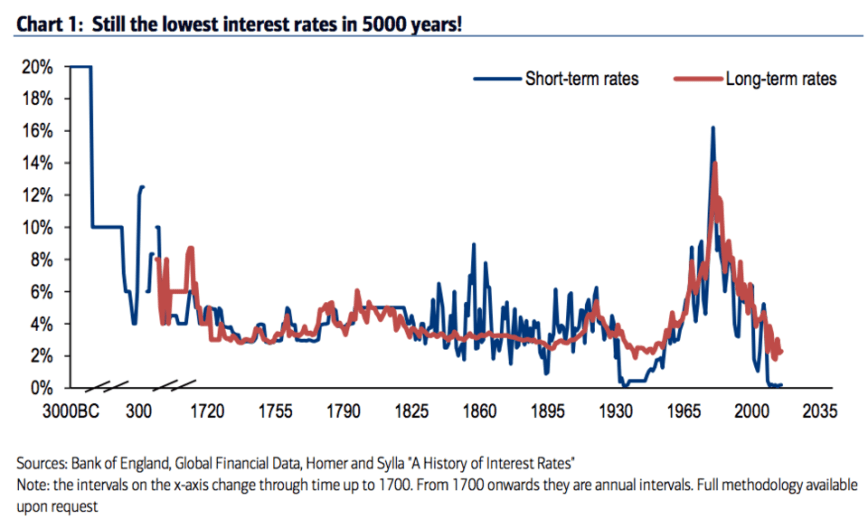
5000 yr interest rate chart

So maybe the mistake was that the illustrious group of central bankers mentioned above chose to maintain these extraordinary monetary policies for nearly a decade, rather than begin the unwinding process when growth had recovered several years after the recession ended. As the second chart shows, the Fed waited seven years into a recovery before beginning the process of slowly unwinding what had been declared emergency policy measures. Was it really still an emergency in 2015, six years after the end of the recession amid 2.0% GDP growth, which caused the Fed to maintain a policy stance designed to address a severe recession?

Chart 2
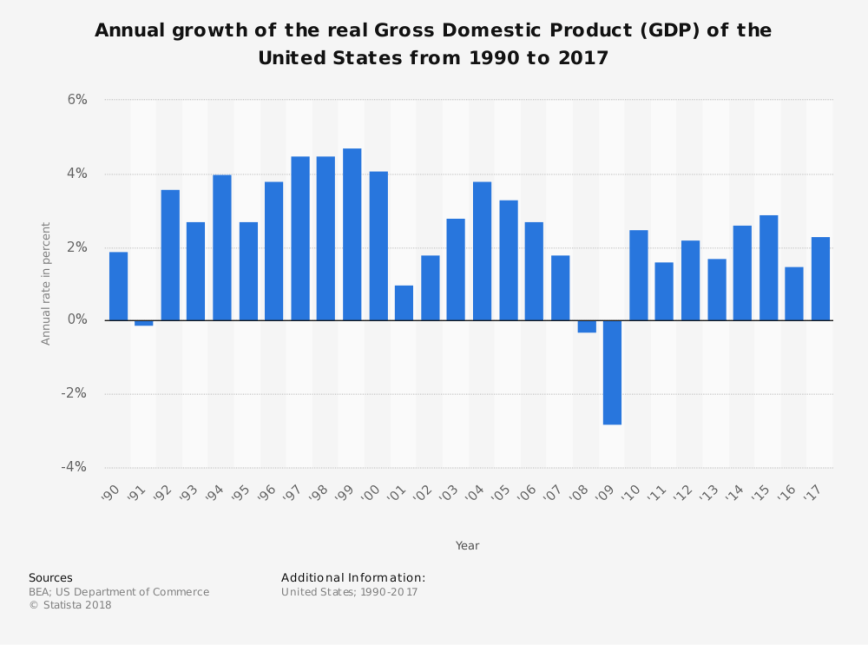
real gdp growth

My point is simply that any analysis of the current stance of the Federal Reserve and its current policy trajectory must be seen in the broader context of not only where it is heading, but from whence it came. Ten years of extraordinarily easy monetary policy has served to build up significant imbalances and excesses throughout financial markets. Consider the growth in leveraged loans, especially covenant lite ones, corporate debt or government debt, all of which are now at record levels, as key indicators of the current excesses. The history of economics is replete with examples of excesses leading to shakeouts throughout the world. The boom and bust cycle is the very essence of Schumpeterian capitalism, and as long as we maintain a capitalist economy, those cycles will be with us.

The simple fact is that every central bank is ‘owned’ by its government, and has been for the past thirty years at least. (Paul Volcker is likely the last truly independent Fed Chair we have had, although Chairman Powell is starting to make a name for himself.) And because of that ownership, every central bank has sought to keep rates as low as possible for as long as possible to goose growth above trend. In the past, although that led to excesses, the downturns tended to be fairly short, and the rebounds quite robust. However, the advent of financial engineering has resulted in greater and greater leverage throughout the economy and correspondingly bigger potential problems in the next downturn. The financial crisis was a doozy, but I fear the next one, given the massive growth in debt outstanding, will be much worse.

At that point, I assure you that the first person who will be named as the culprit for ‘causing’ the recession will be Jay Powell. My point here is that, those fingers need to be pointed at Bernanke, Yellen, Draghi, Carney and Kuroda, as it was their actions that led to the current significantly imbalanced economy. The next recession will have us longing for the good old days of 2008 right after Lehman Brothers went bankrupt, and the political upheaval that will accompany it, or perhaps follow immediately afterwards, is likely to make what we are seeing now seem mild. While my crystal ball does not give me a date, it is becoming abundantly clear that the date is approaching far faster than most appreciate.

Be careful out there. Markets and politics are going to become much more volatile over the next several years.

One poet’s view!

Powell’s Fixation

Though spending by business has slowed
(And debt from the government growed)
There’s no indication
That Powell’s fixation
On raising rates soon will erode

The Fed left rates on hold yesterday, as universally expected. The policy statement was largely unchanged although it did tweak the wording regarding business investment, which previously had been quite strong but is now slowing somewhat. That said, there is absolutely no indication that the Fed is going to slow its trajectory of rate increases anytime soon. With the meeting now out of the way, I expect that the Fedspeak we hear going forward will reinforce that view, with only Kashkari and Bullard seeking to slow the pace, and neither of them is yet a voting member. The market response was actually mildly surprising in that equities sold off somewhat after the news (and have fallen sharply in Asia and Europe) despite the fact that this was the expected outcome. Meanwhile the dollar has continued to rebound from its recent lows touched on Wednesday, with the euro having declined 0.2% further this morning and 1.4% from its peak.

As an aside, I am constantly amazed at the idea that the Fed, especially as overseen by Jay Powell, is more than mildly interested in the happenings in the stock market. The Fed mandate is clear, maximum employment and stable prices, notably lacking any discussion of rising equity markets. Alas, ever since the Maestro himself, Alan Greenspan, was Fed Chair, it seems that the default reaction has been to instantly add liquidity to the market if there was any stock market decline. The result is we have seen three massive bubbles blown in markets, two of which have burst (tech stocks and real estate) with the third ongoing as we speak. If you understand nothing else about the current Fed chairman, it is abundantly clear that he is unconcerned with the day-to-day wobbles in financial markets. I am confident that if there is a significant change in the economic situation, and markets respond by declining sharply, the current Fed will address the economic situation, not the markets, and that, in my view, is the way policy should be handled.

But back to today’s discussion. I fully admit that I did not understand the market response to the election results, specifically why the dollar would have declined on the news. After all, a split Congress is not going to suddenly change policies that are already in place, especially since the Republican majority in the Senate expanded. And as the Fed made clear yesterday, they don’t care about the politics and are going to continue to raise rates for quite a while yet. Certainly, we haven’t seen data elsewhere in the world which is indicative of a significant uptick in growth that would draw investment away from the US, and so the dollar story will continue to be the tension between the short-term cyclical factors (faster US growth and tighter monetary policy) vs. the long-term structural factors (rising budget deficits and questionable fiscal sustainability). Cyclical data points to a stronger dollar; structural data to a weaker one, and for now, the cyclical story is still the market driver. I think it is worth keeping that in mind as one observes the market.

Regarding other FX related stories, the Brexit situation is coming to a head in the UK as PM May is trying to get her cabinet to sign off on what appears to be quite a bad deal, where the Irish border situation results in the UK being forced to abide by EU rules without being part of the EU and thus having no input to their formation. This is exactly what the Brexiteers wanted to avoid, and would seemingly be the type of thing that could result in a leadership challenge to May, and perhaps even new elections, scant months before Brexit. While I have assumed a fudge deal would be agreed, I am losing confidence in that outcome, and see an increasing chance that the pound falls sharply. Its recent rally has been based entirely on the idea that a deal would get done. For the pound, it is still a binary outcome.

The Italian budget story continues to play out with not only Brussels upset but actually the backers of the League as well. While I am no expert on Italian politics, it looks increasingly likely that there could be yet another election soon, with the League coming out on top, five star relegated to the backbenches, and more turmoil within the Eurozone. However, in that event, I think it highly improbable that the League is interested in leaving the euro, so it might well end up being a euro positive net.

So the week is ending on a positive note for the dollar, and I expect to see that continue throughout the session. This morning’s PPI data was much firmer than expected with the headline print at 2.9% and the core at 2.6%, indicating that there is no real moderation in the US inflation story. This data is likely tariff related, but that is no comfort given that there is no indication that the tariff situation is going to change soon. And if it does, it will only get worse. So look for the dollar to continue its rebound as the weekend approaches.

Good luck and good weekend
Adf


Brexit Doomsday

In London, Prime Minister May
Has started revealing, some say
Details of the deal
Which optimists feel
Could postpone the Brexit doomsday

With the elections now past, market participants are looking for the next potential catalysts for movement and Brexit regularly leads the list. According to the British government, the deal is 95% complete, although the Irish border issue remains unsolved. The essence of this issue is as follows: ever since the Good Friday Agreement in 1998, Northern Ireland has been part of the UK, but has had no hard border between itself and the Republic of Ireland. As both Ireland and the UK were members of the EU, there were no issues regarding tariffs or trade, and so the process worked effectively. However, now that the UK is leaving the EU, as well as the customs union, suddenly there are likely to be tariffs on goods that cross that border. The problem stems from the fact that neither side wants a ‘hard’ border between the two nations, meaning no customs checking there. Therein lies the problem. How can Northern Ireland remain in the customs union but not England, Wales and Scotland? It would mean a border of some type between Northern Ireland and the rest of the UK. Of course, that doesn’t go over very well either. Hence the stalemate. The EU is willing to allow Northern Ireland to maintain its current stance with Ireland, but not the rest of the UK. The UK doesn’t want Northern Ireland to have a different status than itself with the EU. Those are exactly opposite positions and there is no obvious middle ground.

The risk becomes that PM May negotiates a deal, which will by definition be imperfect, and that said deal gets defeated in a Parliamentary vote, thus leaving nothing completed. Given the shrinking timeline available to come up with a deal, less than five months at this point, it seems pretty clear that this is the last opportunity to get something done. The market, at least based on the recent performance of the pound, has become increasingly optimistic that a solution will be found. While the pound has edged slightly lower overnight, it is up by more than 3% since Halloween with the entire movement based on the idea that a deal will be done. In addition, this morning there have been several comments by investors that a Brexit deal will result in a powerful rally in the pound, up to 1.50 or beyond. While I disagree with that assessment, it is important that everyone understands the different viewpoints in the market. The idea is that a Brexit deal will end uncertainty, spur investment and allow the BOE to become more aggressive raising interest rates. And while some of that is certainly true, for the pound to reach 1.50, the dollar will need to be much lower against all its counterparties, and I just don’t see that outcome.

The other key story today is the FOMC meeting, where no change in policy is anticipated, although there are some analysts looking for a tweak to the policy statement. At this point, it seems abundantly clear that the Fed is unconcerned with the level of the stock market, and that last month’s decline will have no bearing on their policy decision. There is talk of a tweak to IOER, where the Fed may reduce that rate relative to the current Fed Funds corridor of 2.00% – 2.25%, but I agree with the analysts who say that it makes limited sense for the Fed to do something this month, and they will be better off waiting until December when they raise rates again.

Beyond that, the data overnight showed a modest slowdown in Chinese exports with a reduction in their trade surplus, both globally and with the US. We also saw that German exports decline 0.8%, a surprisingly weak outcome attributed to ongoing issues with the German diesel auto sales. While yesterday morning saw the dollar under significant pressure across the board, the reality is that it reversed many of those losses during the session. This morning the dollar is marginally higher across the board, but the movements have not been significant. For example, the euro is lower by 0.15% and the pound by 0.3%. We have seen similar magnitude moves by the commodity bloc, and the yen has softened by 0.2%. As you can see, it has been a dull market.

In the EMG space, the dollar is generally, though not universally, stronger but here, too, the magnitude of movement has been modest, on the order of 0.2%-0.4% overall.

The only piece of data aside from the FOMC meeting is Initial Claims (exp 214K) this morning, and aside from the fact that this data continues to show a robust labor market, it has not been a market catalyst for a long time. After a big equity rally yesterday, futures are pointing slightly softer to open, and Treasury yields, after rallying sharply at the beginning of the month, remain near their multiyear highs with this morning’s level at 3.23%.

In sum, it is hard to get excited about large upcoming movement in the market today, and so a modest further dollar rally seems about right. Removing some more of the recent excesses would make sense in the context of the still uncertain outcomes from key issues like Brexit and the Italian budget quesoins.

Good luck
Adf

Good Times Will Endure

Elections are out of the way
The outcome caused little dismay
Investors seem sure
Good times will endure
With stocks set to rally today

The dollar, however, is weak
Some pundits claim we’ve seen the peak
Still folks at the Fed
See rate hikes ahead
Which could, on those views, havoc wreak

The midterm elections are now past, with expectations largely fulfilled. The Democrats will run the House, while the Senate’s Republican majority has actually grown by four seats to a 53-47 count. At least that’s what appears to be the case at this time, although there are some runoff elections that need yet to be completed in the next weeks. The traditional view of a political split is that gridlock will ensue and very little in the way of new policy will come out of the next Congress. However, in this case, things may not actually work out that way. Consider the fact that President Trump’s populist leanings may well dovetail with Democratic priorities, especially on spending. It wouldn’t be that surprising if the next budget is even more stimulative than the last, especially as by next summer it is highly likely that the US growth impulse will be slowing down somewhat as the effects of the last stimulus fade away. And through it all, there is no indication that the Fed is going to stop raising interest rates, so I might argue that things haven’t changed all that much.

The risks to this view are if the new Democratic majority in the House chooses to use their power to rehash the battles from 2016 or, more disconcertingly for markets, decide that they want to proceed with an Impeachment process against the President. Two things about this issue are that, first, with the Republicans in control of the Senate, there is essentially zero probability that the President would be removed from office, so it would all be for show. But second, as I mentioned yesterday, the last time we saw this movie, in the autumn of 1998, the dollar fell sharply during the proceedings. This is just something to keep in mind as headlines start to flow going forward.

Enough about the elections. The market response overnight showed equity markets feeling a little better, with Europe higher and US futures pointing in the same direction, although APAC markets were largely flat. Meanwhile, the dollar has come under pressure across the board. The latter seems a little counterintuitive, although I guess it is simply a result of the embrasure of risk by investors. There is no need to flock to dollars, or yen for that matter, if expectations turn positive. And that’s what we seem to have seen.

Focusing on the FX market, the dollar is down pretty sharply across the board. Both the euro and the pound are higher by more than 0.5% despite what I would argue was some mildly negative news. In the Eurozone, while German IP was a touch firmer than expected at +0.2%, Retail Sales data throughout the Eurozone was actually quite weak, with both Italian and Austrian data showing contraction while the French managed to just hold on to an unchanged result, and all three coming well short of expectations.

Meanwhile, the pound continues to trade on hopes that a Brexit breakthrough is coming, despite the fact that yesterday’s widely publicized cabinet meeting produced exactly nothing. PM May has two potential problems here; first is the question of actually coming up with a deal that her cabinet can agree to support that also has EU support, a task that has thus far been out of reach. Second, remember that May has a coalition partner, not a majority in Parliament, and the Labor Party is now coming on record that they will vote against any deal. If that is the case, it is entirely possible that it all falls apart and the UK leaves the EU with no deal in place. While the pound has rallied nicely over the past week, up more than 3.5%, I continue to see the downside risks being significantly greater than the upside. Certainly the rally on a deal announcement would be much smaller in magnitude than the decline in the event of a hard Brexit. Hedgers must keep this in mind as they manage their risks.

As to the rest of the G10, the dollar has fallen even further than the euro and pound, with 0.7% pretty common across virtually the entire bloc. The only two exceptions are JPY, with a more modest 0.3% rally and CAD with a similar gain. My sense is the former is all about risk reduction mitigating some of the dollar weakness, while the latter is related to the fact that oil prices continue to fall, having come down nearly 20% from their highs reached in early October.

In the EMG bloc, there is broad dollar weakness as well with IDR leading the way (+1.5%) and ZAR jumping a solid 1.25%. We discussed the IDR story yesterday as investment flows continue to find their way back to the country given its continued strong growth and low inflation. ZAR, on the other hand, has benefitted from the combination of broad dollar weakness and gold’s recent strength, with the “barbarous relic” having rallied more than 4% in the past month. But it is not just those two currencies showing strength this morning; it is a universal dollar down day, with most freely traded currencies rising more than 0.5%.

And that’s really the day overall. There is no US data to be released today, and the Fed is just starting its two-day meeting, although there is no expectation that there will be any policy change regardless of the fact that it has been pushed back a day in deference to Election day yesterday. There is certainly no reason to believe that the dollar will reverse course in the near term, unless we see a significant uptick in US data that might cause the Fed to step up their pace of activity. However, that is not going to happen today, no matter what, and so I would look for the dollar to continue the overnight move and sell off modestly from this morning’s levels. Although I do not believe that the big picture has changed, any dollar strength is likely to be fleeting in the near future.

Good luck
Adf


No Real Direction

Ahead of the midterm election
The dollar’s had no real direction
Once ballots are tallied
The dollar, which rallied
Before, may be due for rejection

It’s Election Day here in the US, as I’m sure everyone is already aware. The current expectations are for the Democrats to capture the House while the Republicans maintain the Senate, with perhaps a larger majority. Of course, many of you may remember the 2016 Presidential election when expectations proved misguided. My point is, nothing is clear to me at this point, and I will not pontificate on any particular outcome. Rather the question at hand is, what will happen to the dollar once the ballots are counted.

If expectations are borne out, a gridlocked government is likely to put forth significantly less in the way of economic policy initiatives. Given the lack of fiscal policy changes, monetary policy will gain in importance. If there is no additional fiscal stimulus, will the Fed feel compelled to continue tightening as quickly as they have been doing? Will the US economy slow more rapidly than currently projected (remember we are already growing well above most economists’ forecasts for sustainability which hover between 2.0% and 2.5%)? If this is the case, then it would be reasonable to expect the dollar to soften going forward since right now, the dollar’s strength can be largely attributed to a Fed that is tightening faster than most of the market had assumed would be the case.

On the other hand, either of the other two scenarios, the Democrats sweep or the Republicans sweep have much clearer implications for the dollar, at least to my mind. In the event of the former, I would expect the dollar to come under immediate pressure. The probability of impeachment proceedings would rise significantly and with that, the chaos that would occur would almost certainly undermine the dollar. One need only look back twenty years, when a Republican House of Representatives sought to impeach Bill Clinton. From September 1998 through the actual vote in December 1998, the dollar declined roughly 10%. Something like that is entirely realistic.

And if the Republicans were to hold the House and grow their Senate majority, the probability of even more fiscal stimulus would simply force the Fed’s hand further, and may see an even tighter policy response, as their fear of inflation would grow commensurately. A more hawkish Fed, especially in the context of what is a clearly slowing global economic picture, should further support the dollar, with a move toward 1.05 in the euro very viable. Not tomorrow mind you, but over time.

At any rate, for today, there is very little else we can do than wait. So looking at the rest of the world, we see that growth in the Eurozone may not have been quite as bad as feared. The flash PMI numbers reported two weeks ago were worse than the finalized ones reported this morning, but they are still the softest readings in more than two years. Yesterday saw the euro edge slightly higher by the end of the day, but in reality, it has done virtually nothing since November 1st. This is the picture of a market biding its time, with the election clearly the event of note.

Meanwhile, the pound continues to creep higher as there seems to be a growing belief that PM May will be able to convince her cabinet to support her with regard to the Brexit deal she is proposing. Having read about the proposed solution, it appears to me that pro-Brexit cabinet members will have a difficult time supporting anything that allows the EU to have a role in future UK decisions. After all, the idea behind Brexit was to end that process. But politics makes strange bedfellows, as they say, and so I wouldn’t rule out anything. In the end, the pound remains hostage to the Brexit outcome, and nothing has changed in that regard overnight.

As to the rest of the G10, we have seen a mixed picture with AUD and NZD both having a nice day (both higher by ~0.3%) on the back of the RBA’s upgraded forecast for economic growth Down Under. Just like in the US, wages continue to lag what historic models would indicate, but the RBA is further behind the cycle than the US, and so expectations are growing that the next move there will be for higher interest rates. At the same time, CAD and the Skandies have softened a bit this morning, but in reality, overall movement has been modest at best.

In the EMG bloc, the dollar is actually rising pretty uniformly, with ZAR (-0.65%), MXN (-0.25%), KRW (-0.25%) and TRY (-0.9%) leading the way. CNY has edged slightly lower but remains well within recent trading bounds. The exception to the rule is IDR, which has rallied 1.2% after data showed that foreign inflows into both the stock and government bond market had increased significantly in the past several weeks, prompted by an economy growing more than 5.0% with inflation remaining moderate around 3.0%. And remember, the rupiah had fallen as much as 12% from the beginning of the year before the recent little rally, so many investors see a real opportunity.

And that is really all there is. Both equity and bond markets are biding their time as well, as everybody awaits the outcome of the US elections. There is no reason to believe that the market will move much ahead of that outcome this evening, so hedgers might want to take advantage of quiet markets to top up hedges in the event of a surprise tonight.

Good luck
Adf

Hardliners Abhorred

According to sources, it seems
That Minister May and her teams
Have neared the accord
Hardliners abhorred
As they’ll need to give up their dreams

While there is much in store for markets this week from the US, between the midterm elections tomorrow and the FOMC meeting on Thursday, today’s biggest headline is really about the UK and Brexit. Allegedly, albeit with no corroboration from either side, the entire UK will remain in the customs union, not just Northern Ireland, in the immediate aftermath of Brexit as the two sides continue to work out the eventual solution. May’s idea is that she will present this to her cabinet with an ultimatum to approve it and send it to Parliament in order to get the process completed before the end of the year. And while the other 27 members of the EU must also ratify the deal, the current belief is that there will be limited problems doing that. However, this all remains speculation at this point, except for the fact that May and her cabinet have a meeting scheduled for tomorrow where more details should become available.

It cannot be surprising that the pound has rallied on the news, jumping 60 pips on the open although since giving back about half that original gain. The broad consensus in the market is that any deal will result in the pound trading sharply higher, although I am skeptical that it can stay much above 1.35 for any meaningful amount of time. Even if the Brexit monkey climbs off the pound’s back, the market will still have to account for the fact that UK growth is slowing more sharply than its peers and that the pressure for the BOE to raise rates will likely ebb accordingly. But for now it remains speculation as to whether a deal is imminent or not. And as long as that uncertainty remains, the pound will be beholden to the latest story or headline on the subject.

Away from the pound though, the dollar is starting to show some life at this stage of the morning. Friday’s employment report, with NFP printing at 250K and AHE at 3.1%, confirmed that growth in the US continues to outperform virtually every other region in the world, and will have done nothing to dissuade the Fed from continuing its rate hiking strategy. While there is no expectation of any activity by the Fed on Thursday, the market probability for a rate hike in December remains above 80%. As long as US data continues to outpace that of the rest of the world, it seems unlikely that the Fed is going to stop.

Regarding the US midterm elections, clearly there is the potential for a market reaction depending on the results and whether the Republican party maintains its hold on the House of Representatives. If not, a split government (it is assumed that they will retain the Senate) will clearly impede the president’s plans for further economic stimulus programs and reintroduce brinksmanship to things like budget discussions. Net, given the current economic situation, I expect that after a kneejerk response, it is unlikely to have a significant impact for a while. However, it does open the possibility of more inflammatory rhetoric, including the threat of impeachment hearings, which may well detract from the dollar’s performance going forward. As we learned following President Trump’s election, markets pay close attention to significant electoral changes. With this in mind, it is important to remember that many pundits have been forecasting the Democrats will retake the House, so if the Republicans hold on, even with a much smaller majority, that may be an outcome not currently priced into the market. My point is that there is still great uncertainty to the outcome, and it is not entirely clear the FX impact that will result.

Away from those stories, the biggest news we saw was the weaker than expected Caixin PMI data from China. The Services print was 50.8 with the Composite number at just 50.5. The latter was at its weakest in more than two years and is an indication that the trade conflict with the US is continuing to take a toll on the Chinese economy. In addition, there were several articles in the press this weekend explaining that despite President Trump’s tweets last week, the meeting between Xi and Trump is really just going to get the trade negotiations restarted. There is no deal imminent. It should be no surprise that the renminbi has weakened during the session, especially after last week’s remarkable rally. So the 0.3% decline this morning needs to be kept in context, and simply represents a move back toward its previous trend.

Broadly speaking, the dollar is performing well against the EMG bloc today with MXN (-0.4%), INR (-0.9%) and KRW (-0.5%) indicative of the type of market activity ongoing.

Looking ahead to the upcoming data, we see that beyond the Fed and election, there is precious little that we will learn.

Today ISM Non-Manufacturing 59.3
Tuesday JOLT’s Jobs Report 7.1M
Thursday Initial Claims 214K
  FOMC Rate Decision 2.25%
Friday PPI 0.3% (2.5% Y/Y)
  -ex food & energy 0.2% (2.3% Y/Y)
  Michigan Sentiment 98.0
  Wholesale Inventories 0.3%

So between the US elections and PM May’s cabinet meeting with its chance to make real Brexit headway, there is much to look for this week. But the data will not be the story. As to today’s session, APAC equity markets have reversed some of last week’s gains after it became clear that trade situation wasn’t going to improve in the very short term. US equity futures are pointing lower, although Europe is modestly higher. It all strikes me as though traders are biding their time awaiting the big news, which makes sense. Look for a dull session today, but with the chance for some fireworks tomorrow, at least in the pound if something happens in the cabinet meeting.

Good luck
Adf

So Ended the Equity Slump

There once was a president, Trump
Who sought a great stock market jump
He reached out to Xi
Who seemed to agree
So ended the equity slump

The story of a single phone call between Presidents Trump and Xi was all it took to change global investor sentiment. Last evening it was reported that Trump and Xi spoke at length over the phone, discussing the trade situation and North Korea. According to the Trump, things went very well, so much so that he requested several cabinet departments to start putting together a draft trade agreement with the idea that something could be signed at the G20 meeting later this month in Buenos Aires. (As an aside, if something is agreed there it will be the first time something useful ever came out of a G20 meeting!) The market response was swift and sure; buy everything. Equity markets exploded in Asia, with Shanghai rallying 2.7% and the Hang Seng up over 4%. In Europe the rally is not quite as robust, but still a bit more than 1% on average across the board, and US futures are pointing higher as well, with both S&P and Dow futures higher by just under 1% as I type.

I guess this answers the question about what was driving the malaise in equity markets seen throughout October. Apparently it was all about trade. And yet, there are still many other things that might be of concern. For example, amid a slowdown in global growth, which has become more evident every day, we continue to see increases in debt outstanding. So more leverage driving less growth is a major long-term concern. In addition, the rise of populist leadership throughout the world is another concern as historically, populists don’t make the best long-term economic decisions, rather they are focused on the here and now. Just take a look at Venezuela if you want to get an idea of what the end game may look like. My point is that while a resolution of the US-China trade dispute would be an unalloyed positive, it is not the only thing that matters when it comes to the global economy and the value of currencies.

Speaking of currencies lets take a look at just how well they have performed vs. the dollar in the past twenty-four hours. Starting with the euro, since the market close on October 31, it has rallied 1.2% despite the fact that the data released in the interim has all been weaker than expected. Today’s Manufacturing PMI data showed that Germany and France both slowed more than expected while Italy actually contracted. And yet the euro is higher by 0.45% this morning. It strikes me that Signor Draghi will have an increasingly difficult time describing the risks to the Eurozone economy as “balanced” if the data continues to print like today’s PMI data. I would argue the risks are clearly to the downside. But none of that was enough to stop the euro bulls.

Meanwhile, the pound has rallied more than 2% over the same timeline, although here the story is quite clear. As hopes for a Brexit deal increase, the pound will continue to outperform its G10 brethren, and there was nothing today to offset those hopes.

Highlighting the breadth of the sentiment change, AUD is higher by more than 2.5% since the close on Halloween as a combination of rebounding base metal prices and the trade story have been more than sufficient to get the bulls running. If the US and China do bury the hatchet on trade, then Australia may well be the country set to benefit most. Reduced trade tensions should help the Chinese economy find its footing again and given Australia’s economy is so dependent on exports to China, it stands to reason that Australia will see a positive response as well.

But the story is far more than a G10 story, EMG currencies have exploded higher as well. CNY, for example is higher by 0.85% this morning and more than 1.6% in the new month. Certainly discussion of breeching 7.00 has been set to the back burner for now, although I continue to believe it will be the eventual outcome. We’ve also seen impressive response in Mexico, where the peso has rallied 1.2% overnight and more than 2% this month. And this is despite AMLO’s decision to cancel the biggest infrastructure project in the country, the new Mexico City airport.

Other big EMG winners overnight include INR (+1.3%), KRW (+1.1%), IDR (+1.1%), TRY (+0.8%) and ZAR (+0.5%). The point is that the dollar is under universal pressure this morning as we await today’s payroll report. Now arguably, this pressure is simply a partial retracement of what has been very steady dollar strength that we’ve seen over the past several months.

Turning to the data, here are current expectations for today:

Nonfarm Payrolls 190K
Private Payrolls 183K
Manufacturing Payrolls 15K
Unemployment Rate 3.7%
Average Hourly Earnings (AHE) 0.2% (3.1% Y/Y)
Average Weekly Hours 34.5
Trade Balance -$53.6B
Factory Orders 0.5%

I continue to expect that the AHE number is the one that will gain the most scrutiny, as it will be seen as the best indicator of the ongoing inflation debate. A strong print there could easily derail the equity rally as traders increase expectations that the Fed will tighten even faster, or at least for a longer time. But absent that type of result, I expect that the market’s euphoria is pretty clear today, so further USD weakness will accompany equity strength and bond market declines.

Good luck and good weekend
Adf

Real Strides

In Twenty-sixteen when we learned
That Britain, the EU, had spurned
The pound took a fall
While casting a pall
On how future growth might be earned

For nearly two years chaos reigned
While Brexiteers strongly maintained
A deal will be made
With no one betrayed
And there is still much to be gained

Well last night it seems that both sides
Have finally made some real strides
It’s no real surprise
To see the pound rise
As delegates closed the divides

The big story this morning is that there seemed to be real movement in the Brexit negotiations with an agreement “95% complete” according to the UK government. The key was an agreement regarding financial services, obviously an enormous issue for the UK, whereby UK financial firms would still be given access to the EU based on the “equivalence” of regulations. While this is not quite as robust as the current situation, being within the bloc, it is seen as sufficient to allow continued cross border access in both directions. Of course, the Irish border situation remains outstanding, but there is talk that progress has been made there and that the benefit of a finance deal will be sufficient to offset hard-line concerns over Ireland.

The market response was immediate with the pound jumping more than 1.0% when the headlines hit. If a Brexit deal is reached, the pound likely has further to rise as there is no question it has suffered based on the increasing likelihood of a no-deal situation. That said, a full-throated rally seems unlikely. There are still many other issues that are going to weigh on the pound, notably the dollar’s underlying strength as well as UK economic malaise. In fact, data early this morning showed that the UK manufacturing PMI fell much more than expected to a reading of just 51.1, its lowest reading since the month after the Brexit vote. Obviously, this data did not include the positive news from today, but it is indicative of how the UK economy continues to slow along with the rest of the world. If a deal is signed, I expect the pound could rally another few percent, but anything more than 1.35 would seem to be a stretch based on the economic fundamentals.

But the Brexit story set the tone for the FX market as the dollar is softer across the board, in many other cases having fallen by more than 1% as well. For example, the euro has rallied by 0.6% amid general enthusiasm generated by yesterday’s global stock rebound. We have also seen both Aussie (+1.1%) and Kiwi (+1.4%) jump sharply, as commodity prices stabilize and risk appetite improves.

This theme was also made evident by movements in government bonds around the world, where, for example, Treasury yields are 10bps higher over the last two sessions. In addition, EMG currencies, which had a terrible month in October, have shown some life this morning. Today we see the Mexican peso has rallied 0.8%, while South Africa’s rand is up 1.5%. Even the Chinese yuan, which has been closely scrutinized due to its approaching the critical 7.00 level, has rallied today by 0.4%, its largest gain in more than three weeks. In fact, most EMG currencies are higher, with many gaining more than 0.5%. In other words, it has been a broad-based USD decline. After a strong multi-week run in the dollar, it can be no surprise that a correction has occurred.

Turning to the data situation, yesterday’s ADP number was quite strong, 227K, and the Employment Cost Index (ECI) showed that wages are rising at a 3.1% clip Y/Y, the fastest in several years. While yesterday’s Chicago PMI disappointed slightly at 58.4, that remains a very firm reading historically. Looking forward to today’s session, we hear from the BOE, where policy is forecast to be unchanged, and we will get updated economic forecasts. If a Brexit deal is signed, look for the UK to raise rates several more times next year as there should be a positive growth impact. Then from the US we see Initial Claims (exp 213K), Nonfarm Productivity (2.2%), Unit Labor Costs (1.0%) and ISM Manufacturing (59.0). While these will be seen as important, tomorrow’s payroll data is still going to be the focus, especially the Average Hourly Earnings (AHE) number. With the ECI pointing higher, if AHE shows the same thing, watch for more talk of the Fed becoming even more aggressive.

Ultimately, the US data picture continues to point to strength in the US economy, especially relative to what we are seeing throughout the rest of the world. The EU is slowing, the UK is slowing, China is slowing and so are most other places. As long as this remains the situation, it is hard to expect the dollar to retreat in any meaningful way. While no market moves in a straight line, the dollar’s trend remains higher.

Good luck
Adf