
The blood on exchanges is real
As traders and markets now feel
The future may not
Be all that they thought
When Trump wrote “The Art of the Deal”

It’s clear there was leverage, excess,
And that’s what has driven this stress
So, when might it end
This big new down trend?
An answer’d be naught but a guess
It was certainly ugly if you owned stocks yesterday, that’s for sure. Ironically, while I had bought portfolio protection for an event of this nature post-election, Wednesday’s rally convinced me that the Democratic sweep had been priced into the markets already, and following my trading rules, I sold out the puts at a small loss. Oops! The lesson is that sometimes, trading discipline can result in decisions that don’t work out the way you expect, but that doesn’t mean trading discipline is a mistake.
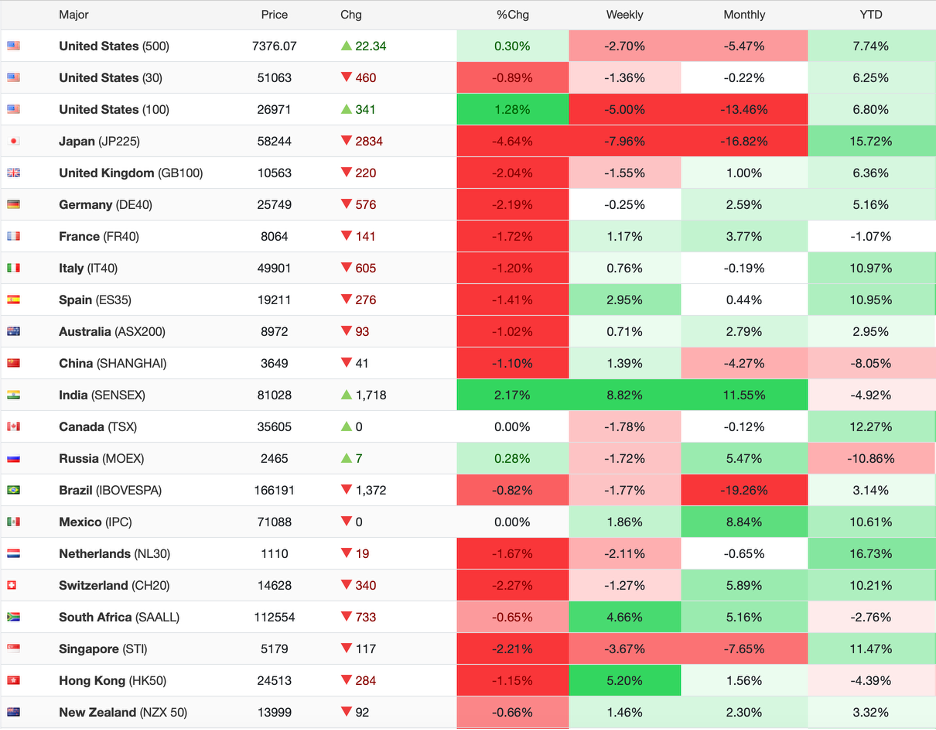
As of 6:15 this morning, this is how futures markets around the world were behaving, and you can already see that there is a bounce in the NASDAQ as some dip buyers are jumping back into the market.
Source: tradingeconomics.com
The real outlier is India, where equities rose 2.2% overnight on the back of somewhat lower oil prices and, I think more realistically, a place where international fund managers believe the AI fallout is not going to be as significant. But it is also worth noticing the YTD performances, where despite the angst generated by yesterday’s price action, long-term holders of equities remain in the green everywhere except China (and Russia, but that doesn’t count as a real market). And you wonder why the Chinese National Team, as they call it, or the plunge protection team, as it is more colloquially known, is on the case. In fact, Bloomberg had an interesting article on the subject this morning.
So, is the world ending? That feels like an aggressive statement at this point. Were some market excesses washed out yesterday? That seems very clear. Is the US economy going to fall into a recession? That is a much harder question to answer, and the answer depends on your timeline. Eventually, I suspect that will be the case, but it certainly doesn’t appear to be a near-term probability. After all, look at the data we saw yesterday, where Initial Claims fell to 189K, a 57-year low while Continuing Claims have also been trending steadily lower since the middle of last year. Something else to consider on the Initial Claims result is 57 years ago, the US population was 203 million or so, compared to today’s 340 million.
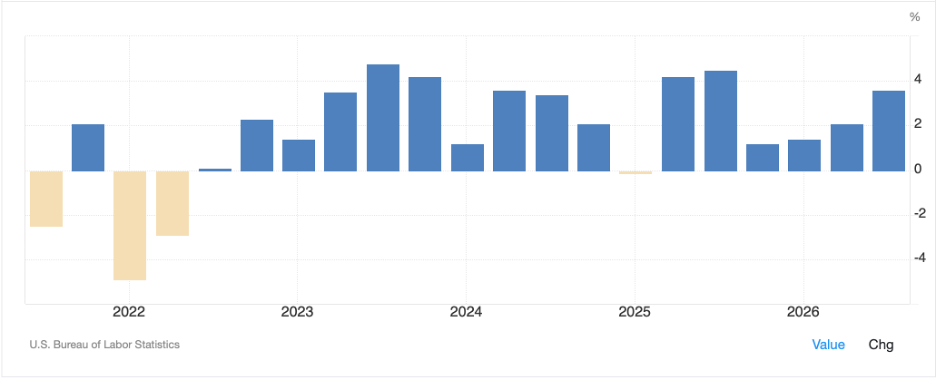
Perhaps just as importantly, the productivity data yesterday rose to 3.6% Q/Q in Q3, and as you can see below, continues to point to positive economic outcomes going forward. After all, productivity growth is the key to economic growth, especially given the slowdown in population growth. Maybe AI’s benefits are starting to show up after all.
Source: tradingeconomics.com
All this is a way of saying that yesterday was not, in my opinion, the beginning of the end of the equity market’s long-term rally. I remain of the opinion that the upcoming gridlock between Congress and the Administration is going to prevent very much from happening at all, and generally, that is a net benefit to the economy and markets.
Attention now turns to the tape
And whether employment’s shipshape
The trend has been lower
Which could mean growth’s slower
But many misread that landscape
To finish off a week full of significant news, we get the payroll report this morning with the following expectations:
| Nonfarm Payrolls | 65K |
| Private Payrolls | 64K |
| Manufacturing Payrolls | 5K |
| Unemployment Rate | 4.2% |
| Average Hourly Earnings | 0.3% (2.9% Y/Y) |
| Average Weekly Hours | 34.4 |
| Participation Rate | 61.9% |
| Michigan Sentiment | 48.0 |
Source: tradingeconomics.com
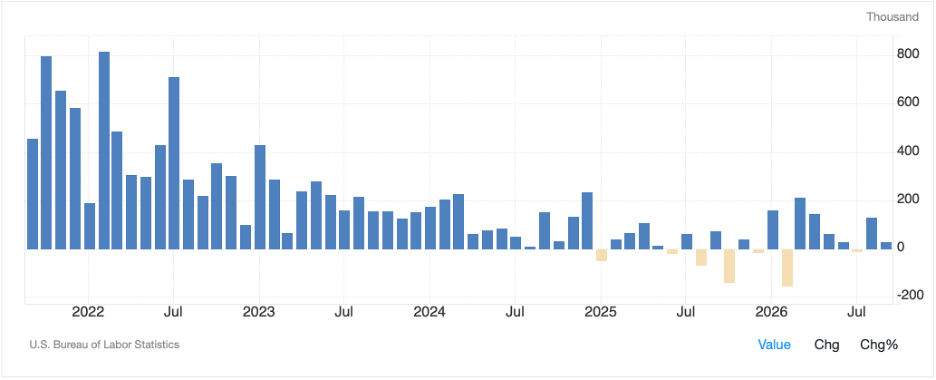
For those of us who have been following markets for a long time, an NFP number of 65K would be considered near recessionary, which makes the Unemployment Rate at 4.2% that much harder to understand. But as has been identified over the past two years, the Trump administration’s crackdown on illegal immigration has dramatically changed the nature of this data, as confirmed by several Fed working papers on the subject. The result is that previous estimates of the need for between 150K and 200K new jobs every month to prevent the Unemployment Rate from rising have been whittled down to between 0 and 50K. With that in mind, the recent NFP trend may not seem as concerning.
Source: tradingeconomics.com
In fact, it is this dichotomy, the fact that the labor market seems to be in very good shape according to the data, and the overall economic angst that clearly exists across the nation, which remains difficult for many to understand. But that is where we are.
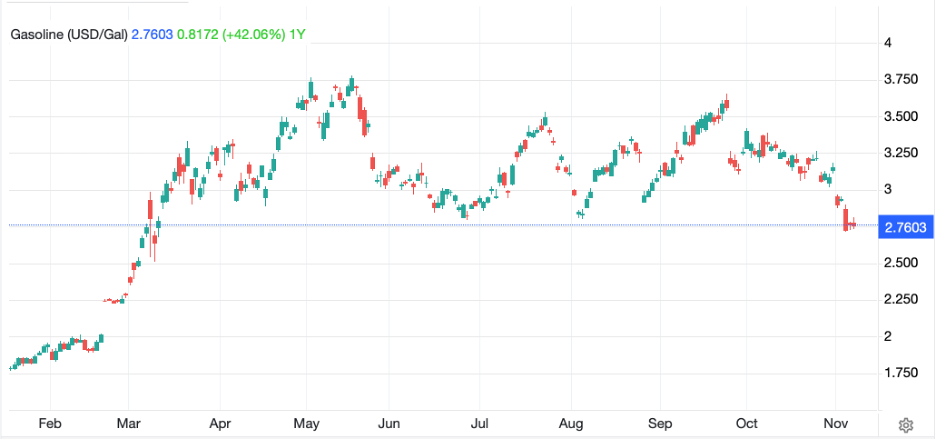
With all the other things ongoing, we have not heard anything about the Fed lately, and I must imagine Chairman Warsh is thrilled with that. Are they still going to hike rates next month? The UK just hiked, as did Australia, the ECB and the BOJ while the Fed paused last week although markets are pricing a 70% probability of a December hike. But with oil starting to retreat, and more importantly gasoline prices retreating as per the below chart, are inflationary pressures really extant?
Source: tradingeconomics.com
Thinking through the Fed’s Keynesian framework, I would expect they could well see a change on the horizon. Of course, the fact that this framework has been wrong for decades will not dissuade them from believing it. Alas, as long as they continue to increase the size of their balance sheet, which they have been doing despite talking up rate hikes, I fear they will not arrive at their desired 2.0% PCE outcome anytime soon.
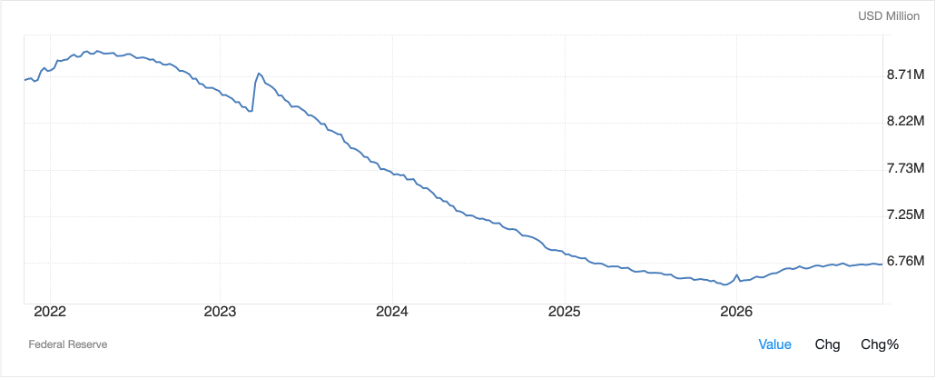
Source: tradingeconomics.com
A resumption of the previous downtrend would be a far more effective methodology for them to rein in inflation. Maybe Chairman Warsh will get his way one day.
As to other markets, bond yields saw another sharp decline yesterday but this morning, they are bouncing a bit, (US +3bps, Germany +2bps, UK +5bps, France +4bps) ahead of the NFP data. However, over the past month, Treasury yields are now lower by 50bps in pretty much a straight line as per the below chart. For now, at least, Treasuries remain a place to hang your hat if you are an investor.
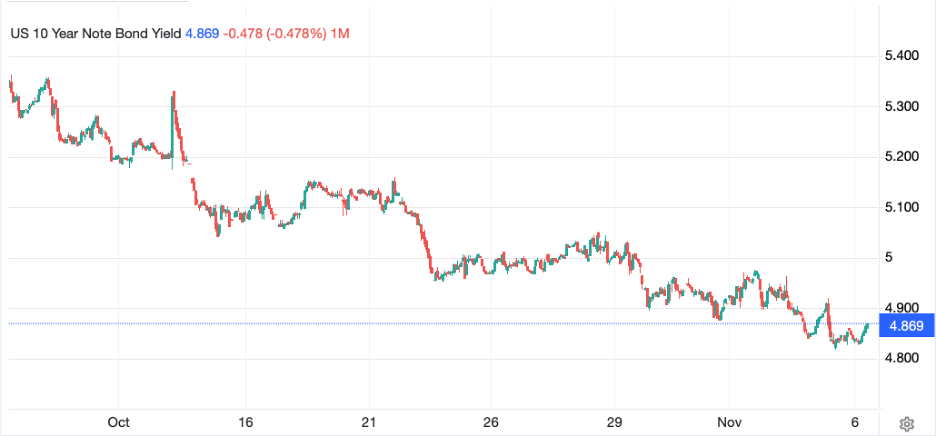
Source: tradingeconomics.com
Perhaps more interestingly, despite the decline in yields, the dollar is firmer across the board this morning, with the euro (-0.4%) under pressure, albeit not as much as the Antipodeans (AUD -0.7%, NZD -0.8%). As yields everywhere are following the US lead, this must be something else. It is entirely possible that this short-term move is the embodiment of the haven trade as investors bought dollars to buy Treasuries, but if they were liquidating their US equities, they already had those dollars. One cannot rule out the idea that the relative macroeconomic stories between the US and the rest of the world remain heavily in favor of the US. Certainly, this is not indicative of an immediate slowdown of the inward investment to the US in the wake of the election, but it is early days.
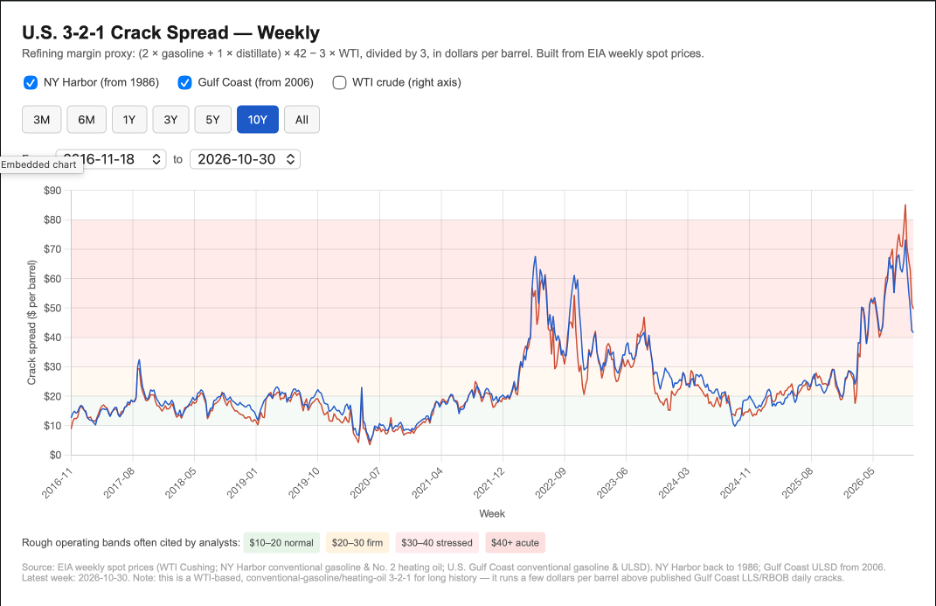
Lastly, if we look at commodity markets, oil (0.0%) has been chopping back and forth during the session as everybody is trying to figure out whether Mr Trump is going to resume attacks on Iran or if a deal is coming soon. Crack spreads, (the value able to be retrieved from a barrel of oil), have fallen substantially from where they were just a month ago as per the below chart from data4thepeople.com, although they remain elevated in the long-term scheme of things.
In the metals markets, gold (-0.4%) has regained the $4000/oz level after significant month end selling last week and seems to be stabilizing here. Silver (+0.6%) is in the same boat, having weathered the sub-$50/oz storm. Until we see changes in fiscal policies and the ensuing monetary profligacy that always follows, I believe that these metals will retain their value. But commodities have always been extremely volatile, after all, they are the very epitome of the boom-bust cycle. Yet over time, inflation has eroded fiat currencies universally.
And that’s all I’ve got. I’m happy it is the end of the week, as it has been more than enough to think about. My sense is that with the election now behind us, focus will return to more market internals and the Fed, but for now, I expect that most folks just want to get to the weekend!
Good luck and good weekend
Adf

