More Fun Than Blondes

In just the past week we have seen
That traders have changed their routine
They’re confident bonds
Have more fun than blondes
‘Cause rate cuts are what they now glean

Despite this, most central bank threads
Explain rate cuts ain’t in their heads
They all still maintain
Inflation’s not slain
And so now, they’re at loggerheads

There is only one story that continues to drive market activity lately, and that is bond yields.  They have become the best barometer of market sentiment we’ve seen in quite a while and the reaction function is quite clear; lower yields mean a soft landing, is coming and with it, central bank rate cuts to prevent a hard one.  While the US continues to lead the way, we are seeing yields decline around the world.  In essence, the bond markets worldwide have declared victory on behalf of the central banks.  In fact, as I look at my screen this morning, of the major economies in the world, only two, Mexico and South Africa, have seen 10yr yields climb today and that has been by 1.5bps and 0.5bps respectively.  In other words, virtually unchanged, while the rest of the world has seen declines of between 3bps and 7bps with even JGB yields lower by 5bps.

There are more and more adherents to the soft landing story as recent inflation readings have been declining steadily while economic activity is not slipping nearly as quickly.  Of course, this view is not universal as there remains a camp that points to underlying pieces of the economic puzzle like slowing bank lending growth or sliding manufacturing and are still looking for a more dramatic downturn in economic activity.  But generally, between the cheerleaders in finance ministries around the world and CNBC talking heads, all is right with the world.

Of course, if you are a central banker right now, all this positivity is working at cross purposes to your view that inflation is not actually dead and there is still further to go.  This is why we continue to hear that although progress has been made, it’s too early to take the victory lap.  We heard it from Cleveland Fed President Loretta Mester yesterday and from Austrian Central Bank chief and ECB Council Member Robert Holzmann this morning.  And we have been hearing it consistently for the past week, policy is somewhat restrictive, but we need to stay here until we are sure inflation is heading back to target.

Now, I am old enough to remember when the idea of tighter financial conditions doing the Fed’s job for them was a thing.  But in the month that has passed since that was first mooted, financial conditions are actually looser now than then.  The point is that the feedback loop between the data and the market response is now so dramatic, and occurring so rapidly, that the central bank reaction function is falling further behind the curve.  I have neither heard nor read a single thing in the past several days that implies there is a possibility the central banks are not done.  

But whether more rate hikes will do anything for inflation is no longer the issue, my sense is central banks want to make sure they are seen as in control.  I know things have been great lately with equities and bonds on fire and everybody’s 401Ks growing, but Jay doesn’t really care about your portfolio, and absent a complete collapse in economic activity in the next month, I would not be surprised by a December rate hike.  There is clearly no certainty on this, and the Fed funds futures market is currently pricing in just a 0.3% chance of it occurring.  I also know the Fed does not like to surprise markets, but I think the Fed fears the appearance of losing control more than anything else.  

However, until such time as they sound increasingly forceful, or the data starts to show inflation is not collapsing, it is hard to fight this move.  We have come a very long way in a very short period of time with respect to 10-year Treasury yields, a 60 basis point decline in slightly less than a month.  Be careful in assuming this will continue in a straight line.  As well, the fact that the yield curve’s inversion remains at -40bps is quite interesting.  Given the market is pricing 100bps of rate cuts by the end of 2024, I would have expected the front end of the curve to have fallen further in yield.

But that is where things stand as we get ready for another weekend and then, next week’s Thanksgiving holiday.  So, a quick tour of the overnight session shows that Chinese equities remain under pressure, especially in Hong Kong (-2.1%) as whatever they are doing over there is not solving their problems.  However, Japan is benefitting with modest gains and Europe is higher this morning across the board, about +0.8%.  As well, after a mixed day yesterday, US futures are pointing slightly higher, +0.2% or so at this hour (8:30).

We know the bond story so a look at commodities shows oil bouncing a bit, +1.3%, although it has been a horrific week and month for the black sticky stuff, down -15% in the past month.  Gold and silver, however, are huge beneficiaries of the decline in yields as they continue to rally and base metals are holding their own as well on the softer yield story.

Finally, it should be no surprise that the dollar remains under pressure, down 0.2% broadly (the DXY).  In the G10, JPY (+0.85%) is the leader followed by AUD (+0.5%) but all of them are firmer.  While there is a little more divergence in the EMG bloc, the broad trend remains for a softer dollar and as long as US yields remain under pressure, the dollar is likely to do so as well.  The one place I would watch carefully is the yen, as there is a growing belief it is set to rebound sharply.  On the plus side is the fact that US yields are falling, and the rate narrative is changing rapidly.  But remember, Japanese yields are also declining, and their recent GDP data was terrible, -2.1% in Q3, so the idea that the BOJ is going to tighten policy soon seems shaky at best.  There are many technical support levels on the way down, but do not be surprised of a test of 142.00 in the coming weeks if the current zeitgeist continues.

On the data front, Housing Starts (1.372M) and Building Permits (1.487M) were both released this morning pretty much on target and put paid to the idea that the housing market is collapsing. For the rest of the day, we have 5 more Fed speakers, but I doubt we hear anything new.  One other thing to remember is that Sunday, Argentina goes to the polls and the chances for the upstart candidate, Javier Milei, seem pretty good as the people there are fed up with the current government.  That could have some repercussions both financially and politically around the world, especially the latter, as it would be another step away from the current ruling class.  The point is, I do not believe that everything is better, and while right now things look good, there is more volatility in store.  Be careful and stay hedged, it is your best protection.

Good luck and good weekend

Adf
Inflation is Dead

For anyone who’s ever doubted
Inflation is falling and touted
The price of their food
Or Natgas and crude
The market has recently shouted

Inflation is dead, can’t you see?
The CPI’s back down to three
Soon Jay and the Fed
Will clearly have said
It’s time to cut rates, we agree

Another day, another soft inflation reading, two of them, actually.  First, the UK reported that CPI there fell to 4.6% in October, its lowest point in two years and a bit below expectations.  While that was quite a sharp decline from the September print of 6.7%, things there are still a bit problematic as the core rate remains much higher, at 5.7%, and is not declining at anywhere near the same rate as the headline.  What this tells us is that the energy component is a big driver as the price of oil is down about 10% in the past month.

Then, US PPI printed with the M/M number at -0.5%, much softer than expected which took the Y/Y down to 1.3%.  Core PPI is a bit higher, 2.4% Y/Y, but obviously, at a level that is not seen as a major problem.  Meanwhile, Retail Sales was released at a slightly less negative than expected -0.1% and last month’s print was revised up to 0.9%, the indication being that economic activity is not collapsing yet.  For the optimists, this has all the earmarks of a soft landing, declining inflation, modest growth, and still relatively strong employment.  As well for the optimists, they are all in on the idea that not only has the Fed, and every other central bank, finished their rate hiking cycle, but that rate cuts are coming soon!

In fact, that is the clear narrative this morning, rate hikes are dead, long live rate cuts.  There are numerous takes on this particular subject, but the general view is that now that inflation is finally heading back toward target, the central bank community will need to cut rates to prevent destruction in economic activity.  Europe is already teetering on the edge, if not currently in recession, and though GDP in Q3 here in the US printed at a robust 4.7%, Q4 appears to be slowing down somewhat with the latest GDPNow estimate at 2.2%.  However, given that growth in the US remains far better than many anticipated considering the speed and magnitude of the Fed’s rate hikes, my question is, why would the Fed cut?  At this point, there is limited evidence in the data that the economy is going to fall into recession, and based on their models, strong growth is likely to be inflationary, so maintaining the current levels should be fine.

At any rate, that is the crux of the bull/bear argument these days, and for now, the bulls are leading the dialog.  Equity markets continue to buy into that narrative as evidenced not just by Tuesday’s powerful rally, but the fact that yesterday saw a continuation of those gains, albeit at a much more muted pace.  Now, Asian markets didn’t really participate last night, with Japanese shares modestly lower but Chinese shares, especially the Hang Seng (-1.4%) suffering more broadly.  The data from China continues to show that the property market is crumbling, with home prices reported declining further last month despite Xi’s government pumping more money into the sector.  That is a bubble that is going to haunt President Xi for a very long time.  As to European bourses, they are mixed this morning with some (Germany and Spain) modestly firmer while others (UK and France) are modestly softer.  It is hard to get a read from this, especially given there has been no data released this morning.  Finally, US futures are ever so slightly softer at this hour (7:10), maybe on the order of -0.2%.  However, this seems a lot like a consolidation rather than a major retracement.

The bond market story, though, is probably more inciteful with regard to the overall narrative.  Given the softer inflation data, and the fact that futures and swaps markets are now pricing in the first interest rate cuts by May and 100bps of cuts over 2024, interest rates are still the key focus.  You will remember that in the wake of the CPI number, 10yr yields crashed 20bps.  Yesterday they did rebound a bit, rising 10bps at one point in the day before closing higher by about 7bp at 4.54%.  this morning, though, they are slipping back again, lower by 5bps as that 4.50% level remains the market’s trading pivot.  We are seeing similar yield declines throughout Europe as well, with investors there embracing the slowing inflation story.  In fact, UK yields are down 8bps this morning continuing the positive inflation story there.

Interestingly, the oil market is not embracing the goldilocks narrative as oil prices are softer again this morning, -0.75%, and have no real life in them.  Yesterday we did see EIA data describe a much larger than expected inventory build, and the US continues to pump out record amounts of oil, 13mm bbl/day, so in the short run, there is clearly ample supply.  Do not be surprised to see other OPEC members discuss voluntary production cuts in the near future.  On the other hand, gold and silver continue to rally, taking their cue from lower interest rates and the weaker dollar while this morning, the base metals are little changed.  One thing to remember is that if we truly are in a new, declining interest rate regime, look for the dollar to fall, and all the metals to rally.

Speaking of the dollar, it is very slightly firmer overall this morning, but remains well below levels seen prior to the CPI print on Tuesday.  In the G10, AUD (-0.4%) and NZD (-0.8%) are the laggards with the rest of the bloc seeing much smaller price action.  But, to demonstrate that things seem to be heading back to pre-CPI levels, USDJPY is back firmly above 151, although has not yet threatened the apparent line in the sand at 152.  In the EMG bloc, the story is far more mixed with KRW (+0.7%) seemingly benefitting from the warmer tone between Presidents Biden and Xi at yesterday’s APEC meeting, while ZAR (-0.7%) is suffering on the back of signs the economy there is slowing more rapidly based on construction activity reports.  The big picture remains that the dollar should continue to follow US yields broadly.  This means that if the Fed really is done and that cuts are coming, the dollar is going to fall further.  This is especially true if they start cutting before inflation is truly under control.  This is the key risk which we will need to watch going forward.

On the data front, today brings the weekly Initial (exp 220K) and Continuing (1847K) Claims data as well as the Philly Fed Manufacturing Index (-9.0).  Later we will see IP (-0.3%) and Capacity Utilization (79.4%) and we hear from four more Fed speakers before the day is through.  So far, the cacophony of Fedspeak has not wavered from the Powell idea that higher for longer is the game plan and that they will not hesitate to raise rates if they feel it is necessary.  Not one of them has cracked and acknowledged that rate cuts may happen next year, so keep an eye for that.

However, absent a Fed slip of the tongue, I suspect that today will be relatively quiet although this bullish equity/bullish bond/bearish dollar move does seem to have legs.  With the big data now behind us, until GDP and PCE at the end of the month, my take is the bulls are going to push as hard as they can.  Be prepared.

Good luck

Adf

Markets No Longer Have Fear

The CPI data made clear
That markets no longer have fear
But Jay and his team
Will still push the theme
That cuts in Fed funds just ain’t near

As such markets have been persuaded
It’s time for the Fed to be faded
The bulls are on top
And they just won’t stop
Til new record highs have been traded

By now, you are all well aware that yesterday’s CPI data came in a bit softer than the forecasts with the headline printing at 3.2% Y/Y while the core printed at 4.0% Y/Y.  Both of these were 0.1% lower which doesn’t seem to be that big a difference.  But the bulls are stampeding on the idea that if you look at the recent trend, the annualized rate for the past 6 months is lower still (3.0% and 3.1% respectively) and the implication is that inflation is dead and the Fed has achieved the impossible, reducing inflation without causing a recession.  And maybe they have, but boy, that is a lot to take away from a single data point that printed a smidge lower than expectations.

Two weeks ago, in the wake of the last FOMC meeting, I wrote (Bulls’ Fondest Dreams) that the Fed changed their tune and despite all the pushback we have received from Fed speakers in the interim, they definitely saw the end of the hiking path coming into view.  Yesterday’s data seemed to confirm this view, at least in the markets’ eyes.  As such, we saw a massive rally in both stocks and bonds, with 10-year yields falling 20 basis points at one point in the day before closing lower by about 17bps.  They are 2bps higher this morning on the bounce.  Interestingly, European sovereign yields also fell quite sharply despite the lack of local news as the price action once again proved that the 10yr Treasury yield is the only bond price that really matters in the world.

So, to me the question is now, is this view correct?  Has the Fed actually threaded the needle and successfully reduced inflationary pressures without causing a meaningful economic slowdown?  If so, Chairman Powell will rightly be hailed as a brilliant central banker, even if there was some luck involved.  How can we know, and more importantly, when will we be certain this is the case?

I think it is important to try to separate the markets and the economy as the two are really quite different.  The economy is where we all live.  From an individual perspective, I would contend it is a combination of one’s employment situation(and whether there is concern over losing one’s job or finding a new one), the true cost of living, meaning the ability to afford the mortgage/rent as well as put food on the table, and then to see if there is any additional money left to either save or spend on desires rather than necessities.  It seems abundantly clear that from this perspective, there is a large segment of the population that doesn’t feel great about things.  This was made clear in an FT survey that showed just 14% of those surveyed thought things had gotten better economically under the Biden Administration’s policies.

However, if this poet has learned nothing else in his time trading in, and observing, financial markets, it is that policymakers do not care one whit about those issues.  Despite periodic attempts to seem down-to-earth, the reality is they all exist within a policy bubble with no concerns about the rent or their next meal.  In this bubble exist only numbers like yesterday’s CPI or today’s Retail Sales (exp -0.3% headline, 0.0% ex autos).  GDP, to them, is not a measure of people’s confidence or belief in the state of the current world, it is a policy variable that they are trying to manage or manipulate so they can make positive pronouncements.

There is obviously quite a gulf between those two views of the world and the markets are the connection, trying to interpret the reality on the ground through the lens of the data.  Well, the policymakers must be thrilled today because the extraordinary bullishness that is now evident across all risk markets, in their minds, means that their jobs are secure.  When things are going well, reelection/reappointment are the expected outcomes.  However, that FT survey was clearly a warning shot across the bow of their Good Ship Lollipop that everything was going to be great going forward.

So, what’s it going to be?  As I wrote after the FOMC meeting, I believe the market is prepped to rally through the rest of the year.  After yesterday’s data, that seems even clearer.  But do not forget that one of the key rationales for the Fed’s change of heart was that the market was doing the Fed’s work for them, tightening policy by raising rates and watching risk assets drift lower, thus tightening financial conditions.  Let me tell you, financial conditions loosened a lot yesterday, and if this rally continues, you can be certain that Powell and friends will grow more concerned about a rebound in inflation.  The market has completely removed any probability of a December rate hike, or any further rate hikes by the Fed as of yesterday with the first cut now priced for May 2024.  At this stage, it seems probable that the October PCE data will be on the soft side so much will depend on the next NFP and CPI readings, both of which are released before the next FOMC meeting.

And there is one more thing that must be remembered when it comes to the bond market.  The US is still going to issue an enormous amount of debt going forward between refinancing ($8.3 trillion though 2024) the current debt and the new $2 trillion budget deficit that needs to be funded for next year.  Can bonds continue to rally in the face of that much supply?  Maybe they can, but it would seem to require a reengagement of foreign buyers rather than relying entirely on domestic savers.  Either that or the Fed will need to end QT and possibly even restart QE.  In the latter case, inflation would almost certainly become a major issue again.  The point is, while everyone is feeling great this morning, there are still numerous perils to be navigated in order to maintain economic growth with a low inflation regime.  I hope Jay and all the central bankers are up to the task, but a little skepticism seems in order.

Ok, the overnight session can be summed up in one word: BUY!  Equity markets everywhere rallied with strong gains in Asia (Hang Seng +3.9%) and Europe, after rallying yesterday, continuing higher by nearly 1% this morning.  US futures are also all green this morning, generally +0.5% at this hour (7:30).

Bond markets have mostly held onto yesterday’s impressive gains with some trading activity, but movements all within a basis point or two from yesterday’s close.  The exception was Asian government bond markets, where prices rallied sharply, and yields tumbled there as well, following the US lead.

Metals prices are ripping higher again this morning, with gold, silver, and copper all up nicely after strong gains yesterday.  The outlier here is oil, which is a touch lower (-0.4%) this morning after a very lackluster session yesterday.  Now, in fairness, it has been creeping higher for the past several sessions, but compared to other markets, oil is remarkably quiet right now.

Finally, the dollar got smoked yesterday, with the euro rallying 1.5% and similar moves across the other European currencies.  Meanwhile, AUD rallied more than 2% yesterday as the combination of rocketing metals prices and a broadly weaker dollar were just the ticket for the currency.  In the EMG bloc, ZAR (+3.0%) and MXN (+1.5%) were the big winners yesterday although, interestingly, most of the APAC currencies had much more muted runs, on the order of 0.5%-1.0% gains.  This morning, price activity is much more subdued as FX traders are trying to get their bearings again.  It was, however, a 3-sigma day, a rare occurrence.

On the data front, as well as Retail Sales, we also see PPI (exp 2.2% headline, 2.7% ex food & energy) and the Empire Manufacturing Survey (-2.8) along with EIA oil information where inventory builds are forecast.  There is only one Fed speaker, vice chairman of supervision Michael Barr, and I don’t expect he will be able to sway any views today.

For now, the die is cast, and the bulls are in the ascendancy.  We will need to see some very big changes in the data trajectory for the current momentum to stall, and quite frankly, I don’t see what that will be for now.  So, go with the flow here, higher stocks, lower yields and a softer dollar seem to be the trend for now.  There will be some trading back and forth, but you can’t fight City Hall.

Good luck

Adf

Price Rise Regimes

Ahead of today’s CPI
Investors would not really buy
But neither would they
Sell short, as they weigh
If Jay is a foe or ally

Meanwhile, amongst pundits it seems
The world is split into extremes
Some see prices falling
And for cuts, are calling
While others fear price rise regimes

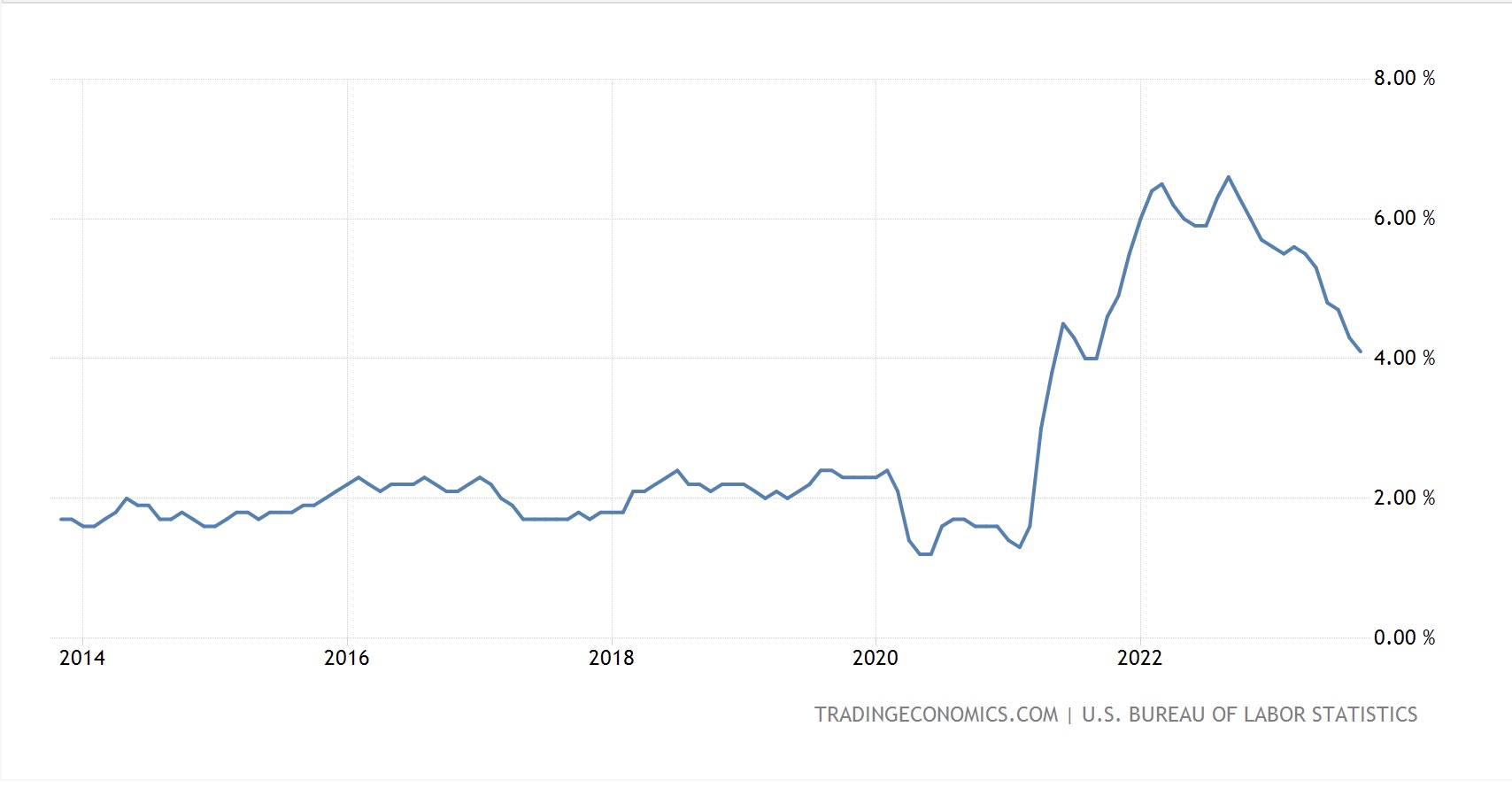
Market activity has been subdued overnight as we all await this morning’s big CPI report.  Currently the consensus views are for a 0.1% rise in the headline, leading to a 3.3% Y/Y number, down substantially from last month’s 3.7% reading, and a 0.3% rise in the core, leading to an unchanged Y/Y reading of 4.1%.  Here’s the thing, as can be seen in the below chart of core CPI, although it is clear inflation appears to be trending lower, it is still a LONG way from where anybody is comfortable.

Something else to remember is the different ways in which we all experience, and think about, inflation.  When writing about inflation, all analysts look at the rate of change of a percentage move as an indicator of what is happening.  But when you go to the grocery store, or your favorite restaurant, or when you order stuff on-line, especially things that you regularly buy, the price changes over the past two years have been so substantial, and taken place in such a short time, that we all remember the pre-covid prices.  The fact that prices may not be rising as fast as they did last year does not make the stuff any cheaper this year.  I would contend that is why virtually all of us consider the inflation data to be suspect, because the package of toilet paper that used to cost $4.99 now costs $8.99, and while it may not go higher anytime soon, it is still nearly double what we remember.  This perception is critical, in my mind, to understanding the national mood, and it is one that nobody in the Fed, or likely the administration, considers.  We know this because there are so many articles in the mainstream media about how things are really great, and people just don’t understand how good a job those two groups are doing.  

At any rate, if pressed, I would say that there are more deflationistas these days, who believe that inflation is going to quickly head back to 2% and that the Fed is going to be cutting rates early next year to prevent overtightening of policy.  The crux of their argument is that M2 is declining at a record pace (as can be seen in the below chart), and therefore is highly deflationary.  

I would counter that argument, though, with the fact that the velocity of money (see chart below) is rising at a record pace, offsetting those declines, and supporting ongoing inflationary tendencies.  

As some of us may remember from our macroeconomics classes, the identity to describe growth and inflation is:

                                                MV = PQ

The argument that a decline in M2 money supply (the “M”) will lead to lower prices assumes the velocity of money (the “V”) remains stable.  But as you can clearly see from the second chart, the velocity of money is rising sharply.  I would contend there is little chance that deflation is coming to a screen near you at any point in the next several years absent a depression brought on by a collapse in the bond market.  And ultimately, that means that the price of all those things we buy regularly is not going to retreat to pre-covid levels.

Away from the CPI drama, there were two things of note overnight.  First, Japanese FinMin Suzuki was on the tape explaining the government would take all possible steps necessary to respond to currency moves.  The market response was a very short-term rise in the yen, with the currency popping 0.35%, but giving back most of those gains within the hour and currently, it sits largely unchanged on the session.  There has been no evidence that the BOJ has intervened since October 2022, but it appears that 152.00 may be a sensitive spot right now.  The other thing he said was they were preparing a package to help citizens cope with the weakening yen which is driving inflation there.  That said, there is no indication yet they are going to raise the deposit rate from its current -0.10% level.  Net, I still think the yen has further to decline, at least until policy changes in Tokyo.

The other noteworthy occurrence was word from China that they were considering an additional CNY 1 trillion of support for the housing market as things on the mainland continue to slow despite Xi’s best efforts.  It seems when you blow a 20-year property bubble of such enormous proportions, such that the property sector consumes > 25% of your growing economy, slowing that down without collapsing the economy is a tough job.  I continue to think of King Canute and his command that the tide recedes every time I think about KingPresident Xi trying to stop the property market collapse.  At any rate, as can be seen by the fact that equity markets in China and Hong Kong did virtually nothing last night, the market is not excited by the prospects of more Chinese money sloshing around.

As to the rest of the equity markets, yesterday’s trading in the US was pretty limited with modest gains and losses in the indices while the Nikkei managed to gain 0.3% overnight.  European bourses are also mixed, with the continent a bit firmer while the UK is under some pressure.  Perhaps the marginally better than forecast German ZEW reading of 9.8 vs 5.0 expected and -1.1 last month is the driver on the continent, while UK employment data was arguably a bit better than forecast, with the Unemployment Rate remaining unchanged at 4.2% rather than ticking higher as expected, and so hopes for a quick BOE rate cut have faded a bit.

Too, in the bond market, activity has been extremely subdued with Treasury yields 2bps softer this morning while European sovereign yields are essentially unchanged across the board.  Last night in Asia, we saw little movement as well, with JGB yields slipping just 1bp and hanging around their new home at 0.85%.

While commodity prices managed to rally a bit yesterday, this morning, what little movement there is across energy and metals markets is ever so slightly lower.  Yesterday saw the EIA raise its forecast for oil demand slightly, and there is word that the administration is bidding for 1.2 million barrels of oil to start to refill the SPR, but sentiment in this space is clearly negative with the recession fears the driving force across all these markets.

Finally, the dollar, too, is very little changed this morning which should be no surprise given the lack of movement elsewhere.  If anything, it is trending a bit softer, but only just, as the deflationistas seem to be preparing themselves for a soft CPI print and want to get on board for that first Fed rate cut.  As we currently stand, at least according to the Fed funds futures market, the first cut is priced in for the June meeting, although the first hints of a cut show up in March.  That said, the probability of a rate hike in December has edged higher to 15% from below 10% last week.  There is still a great deal of confusion as to how market participants believe this is going to play out over time.

Aside from the CPI data, we hear from 3 more Fed speakers today, Barr, Mester and Goolsbee, while Governor Jefferson, in a speech in Zurich early this morning, didn’t really touch on current monetary policy, rather he was discussing uncertainty in a broad manner.  I suspect that the 3 speakers will generally reiterate Powell’s message from last week that the future is uncertain but higher for longer is the way forward.  As such, it is all about the data.  A hot print, certainly a M/M of 0.2% headline or 0.4% core will likely see bonds sell off along with stocks while the dollar rallies.  However, anything else, meaning a soft print or even an as expected print, will likely encourage risk buying and dollar selling.  We shall see,

Good luck

Adf

Somewhat Queasy

Though markets appeared somewhat queasy
Said Janet, it’s really quite easy
To fund wars times two
But Moody’s said ooh
Your credit is now a bit wheezy

The combo of deficit growth
As well as a Congress that’s loath
To pass any bills
Has given us chills
So downgrading debt’s due to both

Under cover of night last Friday, Moody’s put US Treasury debt on Negative watch, citing, “…the risk that successive governments will not be able to reach consensus on a fiscal plan to slow the decline in debt affordability.”  Ultimately, they criticized the combination of rising interest rates and a concern that the current polarization in Congress will prevent anything from being done about constantly growing deficits and calls into question the ultimate value of the debt.  Moody’s is the last ratings agency to maintain the Aaa rating for the world’s risk-free asset, so this is quite a blow.  

Not surprisingly, the administration disagreed with the decision as Deputy Treasury Secretary Wally Adeyemo explained,” we disagree with the shift to a negative outlook.  The American economy remains strong, and Treasury securities are the world’s preeminent safe and liquid asset.”  I don’t believe anyone is concerned that repayment in full is in question, this is simply another shot across the bow of the idea that the value of the nominal dollars that are repaid will be anywhere near what they were when originally invested.

But that was just one of the many crosscurrents that have been afflicting the macro scene and markets of late.  For instance, in the past month, we have seen better than expected data from Retail Sales, IP, Capacity Utilization, New Home Sales, GDP, Durable Goods, Personal Spending, Nonfarm Productivity and Unit Labor Costs.  That’s quite an impressive listing of reports, and the characteristic they all share is they are ‘hard’ data.  In other words, this is not survey data, but rather these are measured statistics.

Meanwhile, the prognosis for the future continues to be far less optimistic with worse than expected outcomes in Empire State Manufacturing, ISM Manufacturing and Services, Leading Indicators and Michigan Sentiment.  The common thread here is these are all surveys and subject to the whims of the person answering the question.  In fact, the only ‘hard’ data points that were worse than expected were the Nonfarm Payrolls and Unemployment Rate.  I guess we can add the Moody’s downgrade to the list of worse than expected data, but it too is subjective rather than a hard data point.

Given the widely diverging data story, it should be no surprise that there are widely divergent views on how things are going to progress from here.  In fact, I read this morning that the two best known Investment Banks, Goldman Sachs and Morgan Stanley, have pretty divergent views on what the future holds.

The bullish argument remains that despite the gnashing of teeth and clutching of pearls by the faint-hearted, the data continues to perform well and that is the best measurement of the economy.  Certainly, the Fed is using this as their crutch to maintain their higher for longer stance and fight back against anyone who claims they have overtightened policy and need to cut rates.

However, all the hard data is backward looking, so describing what has already passed.  The bulls claim that there is autocorrelation in the data, so the past is prolog.  My observation is this is generally true in a trending market, but at inflection points, things become much murkier.

Meanwhile, the bears point to the ongoing weakness in all the survey data, which shows a dour view of the future with ISM in contraction, Michigan Sentiment falling to levels only surpassed during Covid, and inflation expectations continuing to rise.  

Another perfect analogy of this dichotomy is the S&P 500, where the median stock is -36% this year while the index is +14% given the extreme narrowness of breadth.  Absent the so-called Magnificent 7*, the index is actually lower on the year.  Now, those seven stocks are part of the index and so the reality is the S&P remains higher, but if looking for a signal on the economy, the case can certainly be made that broadly speaking, things are not great.

There is one potential reason for this dichotomy of survey vs. hard data, and that is the outside world.  After all, through the lens of the ordinary American, we see two hot wars ongoing, both of which we are spending money in supporting as well as a growing divide in the country along political party lines and sides in each conflict.  Perhaps Moody’s is onto something after all.  But with all that negativity in the press, it is easy to understand why surveys look so dismal.  However, people continue to spend money for things they need and want and given there is still so much money floating around in the wake of the pandemic stimulus efforts, business continues to get done.

There is, of course, one other thing that is part of the equation and that is the presidential election that is coming in one year’s time.  If history is a guide, you can be sure that the administration will be seeking to spend as much money as possible to support reelection, although with the House in opposition, it won’t be as much as they would like.  Nonetheless, at the margin, I expect that it will be substantial enough to continue to pressure yields higher which ought to weigh on equities and support the dollar, at least ceteris paribus.

Ok, so let’s look at how markets have behaved overnight as we start the week.  In the equity space, after a massive rebound rally on Friday in the US, only the Hang Seng in Hong Kong managed any love, rising 1.3%, but the rest of the space was flat to marginally lower on the day.  However, European bourses are all firmer this morning, about 0.5% or so.  As to US futures, they are pointing slightly lower, -0.25%, at this hour (7:20).

Turning to the bond market, Treasury yields are softer by 2bps this morning, but still well off the lows seen last week ahead of the lousy 30-year auction.  I still see higher yields in the future, but I am increasingly in the minority on this view.  European sovereigns are all bid today with yields declining between -3bps and -6bps despite a dearth of new data.  In fact, if anything, from the periphery we have seen firmer inflation data from Sweden and Norway and the market is now looking for both those central banks to hike again later this month.  That does not sound like a reason to buy bonds but it’s all I’ve seen.

Turning to the commodity markets, oil (+0.3%) is edging higher this morning but is just consolidating after a terrible week last week.  Gold, too, is in consolidation, unchanged this morning but having lost some of its recent luster.  Interestingly, both copper and aluminum are firmer this morning, arguably on discussion of further Chinese stimulus that may be coming soon.

Finally, the dollar is little changed this morning, with G10 currencies all within +/-0.2% of Friday’s levels while EMG currencies are showing a similar mixed picture, although with slightly wider ranges of +/-0.4%.  It appears traders are awaiting the next key piece of information, perhaps tomorrow’s CPI.

Speaking of which, after a week that was dominated by Fed speeches (18 of them I think), we are back to some hard data with CPI tomorrow and Retail Sales on Wednesday.  

TuesdayNFIB Small Biz Optimism89.8
 CPI0.1% (3.3% Y/Y)
 -ex food & energy0.3% (4.1% Y/Y)
WednesdayPPI0.1% (1.9% Y/Y)
 -ex food & energy0.3% (2.7% Y/Y)
 Retail Sales-0.3%
 -ex autos-0.1%
ThursdayInitial Claims220K
 Continuing Claims1848K
 Philly Fed-10
 IP-0.3%
 Capacity Utilization79.4%
FridayHousing Starts1.347M
 Building Permits1.45M

Source: tradingeconomics.com

As well as all the data, we hear from eight more Fed speakers across 14 different speeches, and that doesn’t include any off-the-cuff interviews.  Waller and Williams arguably highlight the schedule, and it will be quite interesting to see if anyone is going to try to adjust Powell’s themes from last week.  I kind of doubt it.

Putting it all together tells me that today is likely to see limited activity as everyone awaits both the CPI and Retail Sales data to see if the hard data is going to start to follow the surveys or not.  As such, I see little reason for the dollar to decline very far absent a big surprise lower in the data.

Good luck

Adf

*Magnificent 7 stocks = Apple, Amazon, Alphabet, Meta, Microsoft, Nvidia, Tesla,

Singin’ the Blues

Before Powell stepped to the mike
The buyers of bonds went on strike
Then Jay warned again
Inflation is when
Both prices and yields tend to spike

Investors absorbed this new news,
(The bond market fail and Jay’s cues)
And offloaded risk
In manner quite brisk
So, that’s why we’re singin’ the blues

Remember when I explained that some weeks are just really slow?  Just kidding!  The remarkable thing about financial markets is one most always be alert to a shift in sentiment, even if it doesn’t make that much sense.  However, yesterday’s shift made sense.

Last week when the QRA was published, the market took the news that a much larger percentage of issuance in the coming two quarters would be T-bills and not notes or bonds as a huge positive.  We saw a significant rally in the bond market with 10-year Treasury yields falling nearly 50bps and we saw a corresponding rally in the equity markets as the major indices rose nearly 5%.  Everybody was happy and the narrative was the worst was over for the risk asset correction.  Oops!

This week has been the Treasury auction week, when they issue the newest tranches of 3yr, 10yr and 30yr notes and bonds.  On Tuesday, the 3yr went fine.  On Wednesday, the 10yr was acceptable, if a little weak, but given the broader narrative of positivity, it had limited impact.  Alas, yesterday, the 30yr was an unmitigated disaster.  

The two key statistics that are followed in this relatively arcane part of the markets are the tail (the difference between the final yield and the lowest bid accepted) and the bid-to-cover (BTC) ratio which describes the total amount of bids compared to the issue on offer.  Typical tails are in the 0.5bp – 1.5bp range.  Yesterday saw a 5.3bp tail, the largest ever, with the implication that they had to go through many bids to fill in the auction.  The BTC yesterday was 2.24, far below the 2.38 average of the past ten auctions, and another indication that investors are not that interested in owning long duration Treasury paper.  In fact, dealers (mostly banks) had to absorb almost 40% of the issue, double the usual amount.  This is another indication that there aren’t many natural buyers of this paper right now.

In the wake of this auction, we saw bond yields rise sharply, up 11bps from the open, through the auction and then afterwards until the time that Chairman Powell spoke.  Now, while Powell didn’t actually throw more gasoline on this fire, he certainly stoked it.  Speaking at an IMF conference, he opened his comments with the following (emphasis added), “The Federal Open Market Committee (FOMC) is committed to achieving a stance of monetary policy that is sufficiently restrictive to bring inflation down to 2 percent over time; we are not confident that we have achieved such a stance.”  A bit later he made sure to remind us, “If it becomes appropriate to tighten policy further, we will not hesitate to do so.  We will keep at it until the job is done.”  

Needless to say, risk assets did not perform well yesterday or overnight (US indices fell between -0.65% and -0.95%, Asian indices fell as much as -1.75% and European bourses are all lower by about -1.0% this morning) as investors dreams of rainbows and unicorns came crashing into the reality of the idea that interest rates are not going to be declining anytime soon.  Not only is it unlikely that the Fed is going to reverse course, but yesterday was the first concrete indication that the cost of funding the US budget deficit may be starting to become a problem.  (In fairness, it has been a problem all year and pointed out as such by numerous pundits, but yesterday the market, as a whole, seemed to get the message.)  This is a major crimp in the narrative that just got developed last week.  

Recall, the view that had come out of the Fed’s allegedly dovish stance and the weaker than expected NFP report was the Fed was done, inflation was going to fall, and yields would be heading lower across the curve. The unspoken part of that narrative was that there would be plenty of demand for Treasury paper because both investors and traders would be jumping in to get ahead of the decline in yields.  Apparently, this feature of the narrative will need to be restructured, and with it, potentially, the entire narrative.  This process is going to be the major market driver over the coming months and quarters.  If the Fed maintains its higher for longer stance, and more importantly, continues along the QT path, shrinking its balance sheet, they will achieve the reduction in demand they currently seek to bring things into balance.  Unfortunately, given the Fed’s inability to fine-tune this process, things have the chance to get very messy on the downside.

Summing up, the bullish narrative took a major hit yesterday and we will need to see a perfect combination of gently slowing economic data alongside quickly slowing inflation data to resurrect it.  Personally, I would take the under on that bet.  In fact, I fear that we could well see a much more rapid decline in economic data, with a recession on tap for early 2024 along with still sticky inflation keeping the Fed firmly wedged between that rock and that hard place.  In this scenario, risk assets are very likely to underperform substantially.  A key to watch will be the shape of the US yield curve.  If (when) the bear steepening reasserts itself and long-term yields rise above the front end of the curve, you can be sure that a recession will be right around the corner.  Sic semper erat, et sic semper erit.  (Look it up)

Ok, well after that distressing discussion, a quick look at how other markets have behaved shows the following.  Treasuries have edged lower by 2bps this morning, but that was after yesterday’s 14bp rally.  European sovereigns, though, were closed when all the fun happened and so are catching up with yields higher by 6bps-7bps across the board.  Not surprisingly, JGBs are little changed, but then there is no indication that the BOJ is going to stop QE anytime soon.

On the commodity front, oil (+1.5%) seems like it is finding a floor after its recent sharp decline, although given its inherent volatility (both literal and financial) I’m not confident the bottom is in.  There has been much talk of significant speculative selling as a key driver of this move, but regardless of why, I would be wary of much signal from its price movement right now.  Meanwhile, gold (-0.6%) which rallied sharply yesterday is in the process of giving it all back and base metals remain under general pressure. 

Finally, the dollar is mixed this morning with both gainers and losers across the G10 and EMG blocs.  In truth, the G10 movement has been quite limited, +/- 0.2% or less with one exception, NOK (+0.8%) which is benefitting from higher-than-expected CPI data and the belief that Norgesbank is going to be tighter going forward.  In the EMG bloc, the movements have been a bit larger, 0.3% – 0.5%, but we are also seeing a mix of directions with, for example, MXN weaker while PLN is stronger.  Net, I would say there is not much new here (the dollar did rally yesterday in the wake of the higher US yields) and I expect that traders will be happy to go home square this weekend.

On the data front, this morning brings the Michigan Consumer Sentiment (exp 63.7) and, remarkably, even more Fed speakers with Logan and Bostic on the calendar.  At this point in time, I suspect that both traders and investors are going to be re-evaluating their medium- and long-term views on the progression of both economic activity and inflation.  The bullishness of last week’s narrative has clearly been called into question.  Arguably, we are going to need to see a lot more data to help convince market participants of the next trend.  Next Tuesday starts with CPI data where a hot print will likely be seen quite negatively as it will push any Fed ease further into the future.  But today does not seem like a session where much more will happen.  In the end, as long as the Fed remains the most hawkish, and after yesterday I think that was reinforced, the dollar should find support.

Good luck and good weekend

Adf

Damp Squib

While everyone waited for Jay
To blind us with brilliant wordplay
Seems he only said
The quants at the Fed
Try hard and their work is okay

This damp squib forced traders to seek
An alternate reason to tweak
Positions and views
But there’s just no news
At least not the rest of the week

The tedium continues another day.   There have always been periods in the markets when there is very little of note ongoing and so pundits work hard to pump one story or another in order to generate enthusiasm, and on Wall Street, more trading activity.  But sometimes, like right now, one is better off paying attention to something else more important (for instance, college football).  With that in mind, this morning’s note will be brief.

There was a great deal of anticipation ahead of Chairman Powell’s comments yesterday morning, but he gave no satisfaction by simply lauding the folks who work at the Fed’s Research and Statistics group.  That is the group that prepares the official Fed forecasts, and he was quite complementary of their effort.  The fact that they are often completely wrong is incidental.  Perhaps the most interesting thing he said was an oblique suggestion that they consider different models of the economy at times as things do change over time.  I heartily agree with that sentiment, but sincerely doubt that PhD economists who have made their entire reputation based on their pet models are going to change anything given it might imply their previous efforts fell short.  The upshot of the Powell speech was it had no impact on anything.

As to the rest of the Fed speakers, they simply repeated that inflation is still too high and that they will continue to do whatever they think is necessary to push it lower.  There was some caution about having gone too far from Chicago Fed President Goolsbee, but even he explained that it will take time before they can be certain they have achieved their goal.

Away from Fedspeak, there was no US data and this morning’s discussion has centered on Chinese CPI data which showed the M/M reading fell to -0.1% while the Y/Y reading fell to -0.2%.  Now, these are headline numbers, not core, and the fact that energy prices have been declining for the past month is likely a big part of this movement.  But the outcome has tongues wagging about the coming deflationary wave that will soon hit the world.  Don’t believe it.  If ever there was a good time to use the term transitory regarding inflation, this seems to be it.  Chinese deflation is transitory.

And that was literally the most impactful piece of data we have seen in the past 24 hours, if not the past 3 days.  One other thing to note was that Ueda-san spoke at a conference in London and explained, “When we normalize short-term interest rates, we will have to be careful about what will happen to financial institutions, what will happen to borrowers of money in general and what will happen to aggregate demand.  It is going to be a serious challenge for us.”  I think he is absolutely correct; it will be very difficult to change that policy without a few things breaking.  Good luck Ueda-san!

So, how have markets responded to this virtual lack of information?  Pretty much as you might expect, with minimal movement.  After a very quiet session in the US yesterday, where the major indices all closed withing 0.1% of Tuesday’s closes, Asia saw gains in Japan with the Nikkei higher by 1.5%, but Chinese shares did not respond well to the CPI data, sliding a bit.  Europe, this morning is modestly firmer, on the order of 0.4% as the many ECB speakers are unable to convince investors that they will remain hawkish going forward, while US futures are still within 0.1% of Tuesday’s closes, i.e., unchanged.

Bond yields continue to be the driving force in markets and after a small decline in 10-year yields yesterday, they have bounced 3bps this morning.  We have seen similar moves throughout Europe, 2bp – 3bp rises which seem to simply be following the Treasury market.  Meanwhile, JGB yields have edged lower by 2bps overnight, although it will be interesting to see how the local market responds to the Ueda comments above when they open tomorrow.  I would expect that we are still a long way from 1.00%.  One other thing to note is that the 2yr-10yr curve inversion is growing still larger, with this morning’s level up to -42bps.  This tells me that there is still a great deal of volatility to come in the bond market, and by extension across all financial markets.

Oil prices, which have been getting decimated lately, have settled for the moment and are higher by 0.5%, but now hovering around $75/bbl.  It is abundantly clear that the market is far more concerned with the demand destruction story than the supply constraint story.  This seems at odds with the soft-landing / no-landing crowd that is continuing to drive the equity markets, although I suspect the commodity folks have it right.  Metals markets, both precious and base, also remain under pressure on the weak economic story being driven by high real yields.

Finally, the dollar continues to range trade with the most noteworthy movement being USDJPY pushing toward new highs for the move above 151.00.  Until such time as the BOJ really changes policy, and based on Ueda-san’s comments, I think that is still some ways off, it is hard to get excited about owning the yen.  As to the rest of the market, the EMG bloc is suffering more than the G10 bloc, and if I had to describe a direction, I would say the dollar is modestly firmer overall.

We finally have some data this morning, with Initial (exp 218K) and Continuing (1820K) Claims hitting the tape at 8:30.  We have a bunch more Fed speakers, including Chairman Powell again at 3:00 this afternoon.  We shall see if he veers closer to monetary policy today than yesterday’s nothing burger.  And one last thing, Banxico meets today and is expected to leave their base rate unchanged at 11.25%.

It is difficult to get excited about this market and it beggars’ belief that Powell is going to change his tune given the lack of new information.  As such, look for another quiet session across the board.  The next shoe to drop is CPI, but that is not until next Tuesday.  Til then, there is little reason to expect any significant movement in either direction.

Good luck

Adf

The Bond, or Not the Bond

The bond, or not the bond, that is the question:
Whether ‘tis nobler for the Fed to consider
That long-term yields have offered outrageous fortune,
Or to take Arms against a Sea of inflation
And in opposing it: hike rates yet again

(with deepest apologies to William Shakespeare)

For some reason, the ongoing cacophony of Fedspeak regarding whether the rise in long-term yields is helping the Fed in their efforts, or whether it is merely incidental, brought this famous soliloquy to mind.  We have had no less than eight different Fed speakers from the time Dallas Fed president Logan first mentioned the idea several weeks ago through yesterday discuss the subject with the majority continuing to latch on to the benefits for the Fed, although some dismiss the issue.  Now, in any definition of financial conditions I have ever seen, long-term yields are part of the construction, so it is perfectly reasonable to take them into account.  Clearly, the Fed is aware of this as QE was created entirely to ease financial conditions and consisted of simply buying bonds to lower long-term yields.  However, now that the Fed is in QT mode, their ability to control the long end of the curve has vanished.  In fact, if anything it is simply pushing those yields higher by removing themselves, a price-insensitive buyer, from the mix.

The problem for Chairman Powell is that whatever the Fed’s reaction function is with respect to data, the market’s reaction function to any hint that the Fed has finished tightening policy is well understood by one and all; BUY STONKS!!  The reason I believe this is a concern for Powell and co. is that they fear a rally in equities will signal an all-clear on the inflation front.  And it is abundantly clear that there is nobody on the FOMC who is prepared to claim victory over inflation.  That is exclusively the stance of the CNBC bulls and the administration sycophants who are paid to make that case specifically.  Reality, however, continues to demonstrate that inflation remains a feature of our everyday lives and I suspect that the FOMC mostly understands that.  Remember, too, that the Fed is data dependent, or so they say, which implies that they are not in a position to anticipate the death of inflation, rather they will only accept that premise when they see the body.

Where does this leave us now?  I suspect that the ongoing dance between the Fed and the markets with respect to the future of inflation will continue to play out for at least another year.  In fact, nothing has changed my view that inflation will remain well above their 2.0% target for the foreseeable future, likely finding a new home in the 3.5% +/- range.  And as long as Powell is Fed Chair, I see no indication he is willing to reverse course.  While the Fed may not hike rates again, certainly the market does not believe that is going to be the case with just a 9.6% probability of a hike in December now priced, I find it extremely difficult to believe they will cut rates anytime soon absent clear signs that we are already in a recession.

Though soft-landing bulls have all scoffed
The fact that the data was soft
In China implies
It cannot surprise
If growth worldwide can’t stay aloft

So, is a recession coming soon to an economy near you?  That is the $64 trillion question and one where there are myriad views expressed daily.  The most recent inkling that economic activity is slowing more sharply than had previously been thought was the surprisingly weak Chinese trade data, where not only did their trade surplus decline substantially (to a still robust $56.5B) but exports fell in absolute terms, they did not merely rise more slowly than imports.  The implication is that global growth is slowing more rapidly than the narrative explains.  

We already know that Europe is in a world of trouble with Germany the current sick man of the continent, but we also have seen the latest Atlanta Fed GDPNow data showing that growth in the US is slowing as well with the latest reading at 1.2%.  The UK is struggling as are many Asian nations, notably South Korea and Taiwan, or at least their export industries which are the key economic drivers there.

Another clue is the recent sharp decline in the price of oil, which has fallen -5.0% this week and ~-10% in the past month.  Clearly, a part of this price decline is based on the growing belief (hope?) that the Israeli-Palestinian conflict will not spread into a wider Middle East conflagration that affects oil production.  But part of this is the fact that oil inventories are building as are gasoline and diesel inventories with the result that prices are falling sharply.  Given it wasn’t that long ago when there were shortages in these products, it appears that demand is falling sharply as well.  Remember, diesel fuel is what drives the world as essentially no industry or commerce could continue without its use.  The fact that less is being used is a clear signal of slowing activity.

Putting it all together shows that amidst what appears to be a slowing global growth impulse, markets are pricing out further central bank monetary policy tightening.  Equity markets have been looking at the second part of that equation, less tightening and potential easing, while ignoring the first part, slower growth leading to lower profits.  It is very easy, at least for me, to accept the idea that markets have not yet understood that slower economic activity will lead to lower profits and subsequently, lower equity prices.  Alas, I understand that sequence so remain quite cautious overall.

Ok, how has this translated overnight?  Well, after a modest rally in the US yesterday, equity markets in Asia were a bit softer, declining on the order of -0.35% while European bourses are edging slightly higher this morning, maybe +0.1%.  US futures at this hour (7:45) are basically unchanged as we all await Chairman Powell’s dulcet tones at 10:15 this morning.

Bond yields are also quiet this morning with Treasuries (+2bps) one of the larger movers as European sovereigns are almost all unchanged right now.  It seems that the market has found a new temporary home around the 4.60% level and the yield curve inversion continues to deepen, now at -36bps.  JGB yields, which have fallen from their recent YCC-tweak induced highs, have edged up overnight by 3bps, but are at 0.85%, still far from the 1.00% target or cap or concept, whatever they are calling it now.

We already know that oil is under pressure, having fallen sharply yesterday and another -1.2% this morning.  In fact, at $76.35/bbl, it is trading at its lowest level since mid-July.  Gold, too, has been suffering, down -0.3% this morning and drifting further away from the $2000/oz level as those Middle East fears seem to dissipate.  Copper and aluminum are also under pressure on the slowing growth story worldwide.  Foodstuffs, however, are generally bid lately, as we can all discern every time we go grocery shopping.

Finally, the dollar is back to its dominant ways again, rallying vs. almost all its counterparts in both the G10 and EMG blocs.  USDJPY is marching back toward 151 this morning, the euro is back below 1.07 and the pound back below 1.23.  Meanwhile, in the EMG space, ZAR (-1.1%) is the laggard although it has competition from CLP (-0.9%), KRW (-0.7%) and HUF (-0.7%) as virtually the entire bloc is under pressure.  In fact, CNY (-0.15%) is about the best performer as the PBOC continues to prevent any significant further declines.

Aside from Powell’s speech this morning, we hear from Williams, Barr and Jefferson, but there is absolutely no data to be released.  Given the dearth of new data on the calendar, this week is going to continue to be all about the Fedspeak.  In fact, Powell speaks again tomorrow and there are 5 more speakers as well by Friday, so rather than data, this week is about parsing language.  Of course, Powell will set the tone today, and I am confident he will continue to push back on the idea the Fed is done.  But we shall see.

In the end, it still seems to me that a higher dollar is the path of least resistance.  Manage accordingly.

Good luck

Adf

Bad News is Good

It seems that when bad news is good
Some things are not well understood
So, risk assets rally
And traders who dally
Miss out making gains that they could

But that was the story last week
And looking ahead we shall seek
The narrative changes
That altered the ranges
Of assets that used to look bleak

It has been a pretty quiet session overall and, in truth, the upcoming week does not look all that interesting from a market perspective.  While we do get the RBA policy announcement tonight (exp 25bp hike to 4.35%), and a great deal of Fedspeak including Powell on both Wednesday and Thursday, from a data perspective, there is nothing of note on the horizon.

As such, I feel like it is a good time to review the recent data and policy decisions that have led to the market gyrations through which we have been living.  If you recall, heading into last week, the narrative had been focused on the continued bear steepening of the yield curve as bond yields were rising on the anticipation of a significant increase in supply.  This movement was weighing on equity markets, which had just finished an awful week.  While risk was under pressure, we saw dollar strength although oil markets were in the midst of pricing out an expansion of the Israeli-Hamas conflict into a wider Middle East war impacting oil production or shipments.  Generally, the mood was bearish and there were many questions as to the timing of the much-anticipated recession.

And then last week turned almost everything on its head.  Starting with the BOJ, which adjusted its YCC policy again, although in a more flexible manner, removing the hard cap on yields at 1.00% and instead calling that a goal, rather than a cap.  Not surprisingly, the first move was for JGB yields to rise sharply, although they have not yet touched 1.00%, and, also, not surprisingly, the BOJ was in the market with an unscheduled round of JGB purchases the next day.  In the end, I think it is fair to say that while the BOJ is still running the easiest monetary policy in the world, it is somewhat tighter at the margin.

Meanwhile, the Fed’s reaction function seems to have been adjusted by the bond market’s bear steepening price action.  Several weeks prior to the FOMC meeting last week, Dallas Fed President Lorrie Logan was the first to mention that higher long-dated yields were tightening financial conditions and doing some of the Fed’s work for them.  Subsequently, we heard several other Fed speakers reiterate that idea, with some going as far as saying they thought it was worth between 50bps and 75bps of tightening.  At the FOMC press conference last Wednesday, Chairman Powell jumped on that bandwagon, and though he attempted to sound somewhat hawkish, claiming that they remained data dependent and if inflation remained hot, they would hike again, nobody really believes him anymore.  According to the Fed funds futures market, the current probability of a rate hike in December is down to 9.8%.  That was nearly 30% just before the FOMC meeting and has been sliding ever since.

It seems fair to ask, what has changed all these attitudes?  I would argue that the Treasury’s Quarterly Refunding Announcement (QRA) which is generally completely under the radar, was the big news that altered the narrative.  Then, adding to the new momentum, we got clearly weaker than expected employment data, implying that the Fed’s data dependence was going to be heading toward rate cuts sooner rather than rate hikes at all.

Briefly, the QRA is, as its name suggests, the document the Treasury issues each quarter to inform the market of how much new Treasury debt will be issued for the next two quarters, as well as the anticipated mix of issuance between T-bills and longer dated coupons.  In the most recent version, Secretary Yellen indicated that the Q4 issuance would be lower than had previously been expected, and she also indicated that a greater proportion would be in T-bills than expected.  The combination of these two features cut the legs out from under the oversupply issue, at least temporarily (there is still an enormous amount of debt coming) and combined with what had clearly been developing short bond positions by the hedge fund and CTA communities, saw a major reversal in bond prices with yields declining > 40bps last week.

It should be no surprise that stock markets took that news and ran with it.  Part of the previous narrative was the continuous rise in yields was devaluing future earnings in the equity market.  As well, earnings season saw decent numbers, but lots of lower guidance by company management downgrading future assessments.  While Q3 GDP was a hot, hot, hot 4.9%, the Atlanta Fed’s first look at Q4 GDP is for a much more sedate 1.2%.  If that is what Q4 is going to look like, it is hard to get excited about earnings growth.  So, prior to last week, equity markets had declined ~10% from their recent highs, a very normal correction, and the big question was, is this the beginning of the next leg lower in a longer-term bear market, or was this just a correction?

Taken together, and adding in a much weaker than forecast NFP report on Friday, where the headline number fell to 150K, and there were revisions lower for the previous two months by an additional 40K while the Unemployment Rate ticked up to 3.9%, its highest print since January 2022 and 0.5% higher than the cycle lows, the new market narrative seems to be as follows: the Fed is done hiking and the only question is when they will start to cut rates.  The high in longer-term yields has been seen as well since the data is starting to roll over.  This will lead to further downward pressure on inflation and the soft landing will be completed.  The upshot of this narrative is, of course, BUY STONKS!!!

And that was the outcome from Wednesday on last week, a major reversal in equity market weakness, a huge rally in bond prices and decline in yields and a general warm and fuzzy feeling.  And who knows, maybe they will be correct.  But…

  1. The combination of higher stocks and lower bond yields has eased financial conditions considerably in just the past week.  This implies the Fed may be forced to act to continue their program lest inflation reasserts itself.
  2. The idea that slowing growth is a positive for equity prices seems a bit skewed as slowing growth typically leads to weaker profits.
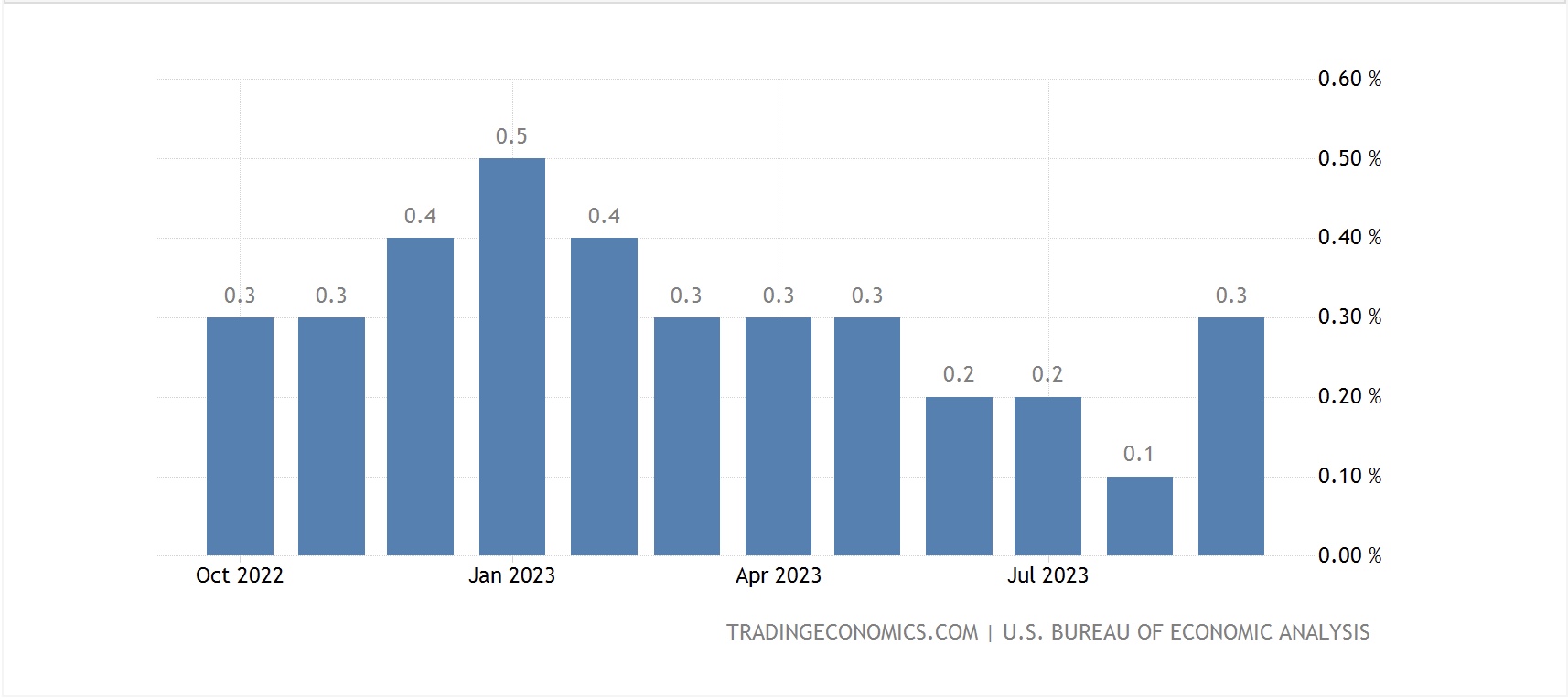
  3. Inflation is not dead yet, and the most recent Core PCE reading did not indicate that it is slowing that rapidly.  As can be seen from the chart below, 0.3% M/M PCE equates to 3.6% annual, well above the Fed’s target.

While I believe that the market is going to run with this narrative for a while, and we could easily see stocks continue to rebound and yields grind a touch lower, I fear that reality will set in soon enough and these moves will prove ephemeral.

Tying this up with a bow on the dollar leaves me with the following view; as long as this current narrative holds, the dollar will remain under pressure.  I suspect this can last through the end of the year, although much beyond that I am far less certain.  I would contend there are two ways things can evolve from here:

  1. This relaxation in financial conditions forces the Fed to reassert themselves and they start hiking rates again.  In this case, the dollar will once again rise as no other central banks will have the ability to keep up with a newly hawkish Fed, or
  2. The much-anticipated recession finally shows up, perhaps in Q1 2024, and the Fed, after a little hesitation starts to ease policy.  However, by that time, I suspect that the rest of the world will also be in recession and central banks elsewhere will be cutting rates even more quickly.  While the dollar is likely to slide initially, I don’t think it will decline very far as in that situation, it seems likely that the US will remain the proverbial ‘cleanest shirt in the dirty laundry.’

As for today, it is hard to get excited about anything really, at least with respect to the FX market.

There will be no poetry tomorrow, but I will return on Wednesday.

Good luck

Adf

No Longer a Threat

Opinions are already set
The Fed is no longer a threat
Today’s NFP
Will help all to see
That buying stocks is the best bet

At least that’s the narrative tale
The talking heads want to prevail
The question’s, will Jay
Have something to say
If finance conditions, up, scale

To conclude what has already been a tumultuous week, this morning brings the monthly payroll report, a key piece of evidence for the Fed to determine the health of the economy.  Expectations for the readings are as follows:

Nonfarm Payrolls180K
Private Payrolls158K
Manufacturing Payrolls-10K
Unemployment Rate3.8%
Average Hourly Earnings0.3% (4.0% Y/Y)
Average Weekly Hours34.4
ISM Services53.0

Source: tradingeconomics.com

Apparently, the whisper number is a bit above 200K, but we also must pay close attention to the revisions.  Recall last month had a blowout 336K result, which was much larger than expected.  If that number retains its strength, it would certainly be indicative of a still healthy labor market.  This matters a great deal as after Powell’s press conference on Wednesday and the surprising QRA that shortened the duration of upcoming Treasury bond issuance, the market is all in on the goldilocks story, solid growth with low inflation.  The corollary to this is that the market is looking for the Fed to back off the current rate policy and begin to reduce the Fed funds rate, thus helping all the DCF models pump up the value of equities.

But even though I have been highlighting the importance of the NFP number for the past two years as a key for the FOMC, it is not clear to me that today’s is so important.  I only say this because the Fed just met two days ago, and we will see another NFP before they meet again.  Arguably, this one will get lost in the fog of memory.  

If that is the case, then it is probably a good time to recap what we have seen this week and how it has affected market sentiment.  The bulls are on a roll right now as we have seen a significant pullback in Treasury yields with 10yr down to 4.66%, down 36bps from their peak back on October 23rd.  While that is certainly a large move in a short period of time, it is in line with the types of movement we have been seeing all year, so hardly unprecedented.  But Powell’s comments, which have been read as dovish despite his best efforts to prevent that view, and the bond market movement have many market participants licking their chops for a massive equity rally going forward.

Interestingly, one of the things the talking heads have been using to pump their story has been the tightening in financial conditions that were a result of declining stock and bond prices.  The whole issue of tighter financial conditions doing the Fed’s work for them has been a key story for the past several weeks since it was first mentioned by Dallas Fed President Lorrie Logan.  However, the big rally in both stocks and bonds, as well as the decline in the dollar, are all critical features in the calculation of those financial conditions, and they are all pointing to easier conditions.  The point is, if tighter conditions was a reason for the Fed to have stopped tightening further, the fact that they are now easing implies the Fed may feel the need to raise rates again in December, although that is clearly not the consensus view.

At any rate, right now, momentum is on the bulls’ side, and it is tough to overcome.  Certainly, the economic data continues to point to a resilient economy which implies, to me at least, that the Fed will not feel any urgency to cut rates soon.  There has also been a great deal of discussion regarding the fact that the average time the Fed has held rates at a peak before cutting is just 7 months.  We are now three months into the most recent hold, and, by definition, since the next meeting is not until December, we will be at 5 months then.  My observation about Chairman Powell, though, is at this point he is unconcerned with statistics of that nature and is far more focused on achieving their objective of 2% inflation.  

One last thing about inflation before we touch on markets.  There has been a growing chorus that deflation is on its way because M2 money supply growth is currently declining.  However, for the economics majors out there, recall that the key monetary equation is M*V = P*Q.  P = prices, and Q = quantity of goods, or, combined economic output.  M = Money supply and V = Velocity of money.  It is the last piece that is often ignored but remains quite important.  My good friend @inflation_guy, has just published a piece which is well worth reading.  The essence is that while M2 may be declining, V is rising rapidly, offsetting that impact and creating conditions for much stickier inflation than many believe.  I have a feeling the Fed is going to stay on hold, if not tighten further, for a much longer time than currently anticipated.  While this week’s news has clearly been seen as bullish, the long-term trends have not yet changed in my view.

Ok, so a quick look at markets shows that after another gangbusters day in the US, where all three major indices were higher by 1.7% or more, Asian markets followed suit, with virtually every index there higher by at least 1.0%.  Europe, however, has been more circumspect with markets essentially unchanged this morning, just +/- 0.1% on the day.  US futures are ever so slightly softer at this hour (7:30) down about -0.15% on average, as investors and traders await this morning’s data.

At this point, bonds seem to be taking a rest after a huge price rally / yield decline over the past several sessions and we are seeing very little movement on the day with Treasuries and European sovereigns all within 1 basis point of yesterday’s closing.  Even JGB yields slid a bit yesterday but remain above 0.90% as of now.  As to the shape of the yield curve, that inversion is starting to show its head again, with the current 2yr-10yr spread back to -32bps.  Remember, two days ago that was at -18bps.  Broadly speaking, yield curve inversions are not signs of economic strength.

In the commodity space, oil is creeping back higher, up 0.4% this morning although still lower on the week.  Gold is basically unchanged this morning, continuing to hang out just below $2000/oz, which continues to surprise me given the sharp decline in yields, at least nominal yields.  As to the rest of the space, base metals are mixed amid small changes this morning and foodstuffs, something I have not mentioned in a while, have actually been declining with the FAO’s world food price index falling to its lowest level in more than 2 years last month.  It may not seem that way in the grocery store, but perhaps future price rises will be more muted.

Finally, the dollar is generally biding its time ahead of the data, although leaning lower overall.  In the G10, the average gain of a currency is about 0.2% while in the EMG bloc we have seen a few outliers, notably KRW (+1.2%) but a more general rise of 0.4% or so.  You already know that my view has changed given the seeming change in the underlying drivers.  For now, and likely through the end of the year at least, I think the dollar will be under pressure.

Aside from the data this morning, we get our first Fed speaker, Supervision Vice-Chair Michael Barr, this afternoon, but the topic is the Community Reinvestment Act, which makes it unlikely he will swerve into monetary policy.  So, as is often the case, the data will see a flurry of activity at 8:30 and then I suspect the recent trends will reassert themselves in a slower session overall.  We will need to see an extraordinarily strong NFP print to help reverse the dollar’s current malaise.

Good luck and good weekend

Adf