A Financial Home Run

Seems President Xi isn’t done
And last night he added a ton
Of new stimuli
In order to try
To hit a financial home run
 
The market response has been clear
Forget anything that’s austere
It’s buy with both hands
Ere Powell rebrands
QE as just more Christmas Cheer

Things are obviously worse in China than President Xi had been willing to let on for the past several months/years, as after two straight days of monetary policy stimulus announcements, they pulled out the big guns and got the fiscal side of the process involved.  Last night the Politburo pledged further support after a surprise meeting to discuss economic policies.  Their economic discussions have historically only occurred in April, July and December, so this was the latest indication that Xi is really concerned. 

Some of the actions include an (unspecified) effort to make the real estate market “stop declining”, limiting construction of new home projects, issuing CNY 2 trillion of special sovereign bonds to disburse funds to help fund financial assistance for low-income workers, shore up bank capital to encourage more lending and support further investment in productive capacity as well as to potentially buy up unfinished homes.  

Obviously, Xi was quite concerned that the country would not achieve his 5% GDP growth target for 2024 as an increasing number of analysts around the world were penciling in slower growth, and he decided he could not wait until December for the next policy adjustments.  Remember, too, that next week is a week-long Chinese holiday, so part of the impetus was to give cash to people to encourage more spending/activity.  While it is far too early to determine how effective these new policies will be at supporting real, organic economic activity, they did wonders for equity markets and risk assets around the world.

And really, that continues to be the main story.  With the Fed now having confirmed that lower rates are appropriate, I would look for almost every nation to boost stimulus, both monetary and fiscal, especially in the wake of recent election results which have seen incumbent after incumbent tossed from office.  After all, what good is being in power if you cannot buy your way to re-election?

So, how has all this impacted financial markets this morning?  You will not be surprised to see that risky assets are in huge demand with equity markets rallying everywhere along with metals, while haven assets see much more modest demand, with bond yields having slipped just a bit lower.

Yesterday’s mixed US market performance is but a distant memory this morning with Asian shares roaring higher (Nikkei +2.8%, Hang Seng +4.2%, CSI 300 +4.2%) and gains virtually across the region, albeit not quite as robust as those.  But after the Fed cut, this fiscal stimulus from China is seen as helping everybody.  Europe, too, is rocking this morning with gains well above 1.0% everywhere (DAX +1.2%, CAC +1.6%, IBEX +1.1%) except the UK (FTSE 100 +0.2%) which continues to struggle as the Labour government is shown to be further and further out of its depth with respect to actually running things rather than carping about how the Tories did it.  And not to worry, US futures are all racing higher as well this morning, higher by between 0.3% (DJIA) and 1.5% (NASDAQ) at this hour (7:15).

In the bond market, Treasury yields have edged lower by 2bps and remain far below the Fed funds rate.  It is not clear if this is the market anticipating a more significant economic slowdown or simply a continued manifestation of the fact that the Fed still owns a significant portion of the debt outstanding and so has restricted supply at the margin.  In Europe, yields are also lower, with the riskiest nations seeing the biggest declines as risk assets are in vogue this morning.  Thus, Italy (-7bps) and Greece (-6bps) have moved the farthest, but otherwise we are seeing movement on the order of -3bps elsewhere.  In another quirk, and a telling comment on the state of France’s finances, Spanish 10yr bonos now yield less than French 10yr OATs for the first time in more than 15 years.

Turning to commodities, oil (-2.8%) didn’t get the China rebound memo and has tumbled nearly $2/bbl falling well below the $70/bbl level.  It seems that Saudi Arabia is dropping its price target and preparing to increase production, something the market has been fearing.  As well, in Libya, which had not been producing lately due to political issues, it appears a tentative agreement is in place that will allow for more supply on the market.

But you know what really benefits from a lot of deficit spending and the effective abandonment of inflation targets?  That’s right, precious metals as gold (+0.8%) continues its steady move higher to new all-time highs and quickly approaches $2700/oz.  This has taken both silver (+2.2%) and copper (+2.2%) along for the ride and there is currently no end in sight.

Finally, the dollar is under pressure this morning in a classic risk-on reaction.  AUD (+0.9%) is the leading G10 gainer on the back of its strong metals exposure while NZD (+0.8%) is right behind.  But the dollar’s weakness is manifest in Europe (EUR +0.2%, GBP +0.5%, SEK +0.5%) as well as against most EMG currencies.  In fact, CNY (+0.55% and below 7.00) is one of the biggest movers today although we are seeing strength in KRW (+0.7%), MXN (+0.5%) and ZAR (+0.4%), an indication that this move is widespread.  As long as the perception remains that the Fed is going to lead the way to lower interest rates, I can see the dollar underperforming.  However, as soon as we see other nations become more aggressive, this move will abate.

On the data front, there is much on the calendar this morning starting with the weekly Initial (exp 225K) and Continuing (1832K) Claims data as well as the 3rd look at Q2 GDP (3.0%).  We also see Durable Goods (-2.6%, +0.1% ex-Transports) and then the ancillary data that comes with the GDP report including Real Consumer Spending (2.9%), Final Sales (2.2%) and the GDP PCE indicator (2.5% headline, 2.8% core).  But perhaps of far more importance, we hear from a host of Fed speakers this morning.  Governor Kugler and Boston Fed president Collins speak about financial inclusion, Governor Bowman discusses the economy and monetary policy, Governor Cook discusses AI and workforce development, Vice-chair Barr discusses regulation and Chairman Powell gives the opening remarks at the US Treasury Market Conference in NY. 

Yesterday, Governor Kugler added to the ‘mission accomplished’ view on inflation at the Fed and lauded the move to focus on Unemployment.  I would contend this is the key issue right now, the fact that central banks around the world, but particularly the Fed, have determined that the inflation fight is over.  While we may very well touch 2.0% core PCE in the next months, it strikes me as highly unlikely that level will be maintained.  Rather, 2.0% is now the floor and if the Unemployment Rate behaves in its historic manner, accelerating higher now that it has started to move in that direction, look for much sharper interest rate cuts, much higher inflation and a much weaker dollar.  To me, that is the biggest risk.  However, if Unemployment follows the Fed’s projected path, and stays quiescent, then the current slow decline in rates and a very gradual decline in the dollar seems more likely.

Good luck

Adf

The Hits Keep on Coming

In China, the hits keep on coming
As Gongsheng adjusts China’s plumbing
Last night he cut rates
As he navigates
A way to help growth there keep humming
 
Combined with the Fed’s latest act
Worldwide it is clearly a fact
Liquidity’s growing
With stock markets showing
Why traders just love the impact


As virtually promised the other night, PBOC Governor Pan Gongsheng cut the medium-term lending facility rate to 2.0% from its previous level of 2.3% last night, the largest single cut in the history of this rate’s existence.  Of course, that only takes us back to 2016 when the PBOC rolled out this concept, but nonetheless, it is a clear expression of an aggressive easing policy by the central bank.  In fact, pundits are calling for further rate cuts this year as Xi’s government struggles with rekindling the animal spirits in China.  For equity investors there, this continues to be good news as the CSI 300 rallied another 1.5% and is now within spitting distance of being flat for the year.  As well, the renminbi rallied further, briefly trading through the 7.00 level and currently about 0.35% stronger than yesterday’s close.

Alas for President Xi, while all these measures are likely to have positive short-term impacts on economic statistics, especially the way they report them over there, it is unclear if they will help restart truly organic domestic economic activity.  Ultimately, that is a direct product of the level of confidence people have in their current employment situation as well as their perception of the prospects for better opportunities going forward.  Having the government pay you back for things that were supposed to rise in price forever is welcome, but not sufficient to do the trick, I think.  Clearly the current situation is that Chinese assets are going to perform in the short run, and it is very likely commodity prices will rise as well given the perception that Chinese demand will now increase, but personally, I suspect that the longevity of this price action, at least for the Chinese assets, may be limited.

Commodity prices, on the other hand, are getting boosts from all over the place, notably from the fact that virtually every country on earth, except perhaps Japan, has entered a monetary easing cycle.  Now that the Fed has begun, and gone big to start, other central banks will feel empowered to ease policy further with the confidence that their own currencies will not collapse amid a US rate cutting cycle.  And let’s face it, so far, everything we have heard in the wake of the FOMC move last week is that they are not afraid to cut rates a lot more.

Under the guise, actions speak louder than words, even though Powell explicitly said they had not declared victory over high inflation, listening to the four speakers since the meeting, it actually appears they have done just that.  Now, there is one market that seems to disagree with them, at least so far, and that is the 30-year Treasury bond. As you can see in the chart below, the yield there is now higher by 20bps since the first stories about the Fed cutting 50bps made their way into the press.  Whatever PCE holds in store for us later this week, the combination of commodity price rises and the yield on the long bond offer strong hints that inflation is going to make an inglorious return.

Source: tradingeconomics.com

But for now, be joyful because stock markets are continuing to rally.  This economic cycle is clearly unlike any others given the still subtle ripples from Covid policies and the fact that the housing market remains stuck with so many homeowners locked into their homes due to the exceptionally low mortgage rates they hold.  The result has been two very opposite views of how things are evolving, with one camp still celebrating the fact there has been no appreciable slowdown and all-in on the soft-landing while the other digs under the headlines and finds numerous issues with hiring and debt.  Perhaps next week’s NFP print will bring clarity although I doubt that will be the case.  In the meantime, we need to observe and react as it is all we have.  It is times like these that define why hedging is so important.

Ok, let’s look at the overnight activity.  After yesterday’s modest US rally, aside from China, the picture was far more mixed in Asia with the Nikkei (-0.2%) slipping slightly while the Hang Seng (+0.7%) continued its rally on the back of the China news.  But Singapore, Korea and the Antipodes all suffered although Taiwan (+1.5%) took heart in the Chinese news.  In Europe, the picture is also mixed with both the DAX (-0.4%) and CAC (-0.3%) slipping while the FTSE 100 (+0.4%) is higher despite a complete lack of data.  Well, that’s not completely true as French Consumer Confidence rose to 95, its highest level since February 2022, but apparently that is not so important.  Meanwhile, US futures are essentially unchanged at this hour (7:30).

In the bond market, Treasury yields are leading the way higher with 10-year yields higher by 3bps and pretty much all European sovereign yields higher by either 1bp or 2bps.  Bond investors are very clearly concerned over inflation’s prospects given the wholesale turn to monetary ease seen worldwide.  The outlier here was JGB yields (-1bp) as the market there continues to respond to Ueda-san’s comments from yesterday regarding the lack of urgency to tighten further, especially given the yen’s recent rebound.

In the commodity markets, oil (-1.3%) is fading this morning, perhaps because there has been no further escalation of hostilities in the middle east, they remain at a steady level, or perhaps because we have seen a 9% rally in the past two weeks, so traders are simply taking a rest.  Metals markets, too, are softer this morning, but that is also after a very strong rally and gold (-0.1%) continues to maintain the bulk of its daily new all-time high prints.  But both silver and copper have had very strong weeks as well.  One other thing to note is that NatGas is higher by 13% this week, perhaps an indication that supply concerns are growing.

As to the dollar, after several soft sessions, it is rallying this morning.  Weakness in currencies is broad-based with the pound (-0.4%), Aussie (-0.5%), yen (-1.0%) and Swiss franc (-0.9%) all retracing some of their recent gains.  We are seeing similar price action in the EMG bloc with MXN (-0.6%), KRW (-0.5%) and PLN (-0.3%) all under pressure but with one exception, ZAR (+0.4%) which continues to benefit from the combination of still high interest rates, so the carry trade, as well as a growing belief that the new government is going to be quite business, and by extension market, friendly.

On the data front, only New Home Sales (exp 700K) is on the docket although we also see the weekly EIA oil inventory data with further drawdowns forecast.  There are no scheduled Fed speakers, but I expect we will hear from one or two anyway.  While the dollar is bouncing today, I believe the current mindset is the Fed is going to lead the way lower in this rate cycle and that the dollar will suffer accordingly.  Just be careful as with everyone cutting rates, expecting a sharp dollar decline from here seems suspect.

Good luck

Adf

Juiced

No doubt it was President Xi
Who leaned on the PBOC
To cut rates at last
And try to recast
The tone of its cash policy
 
So, mortgage rates will be reduced
While bank reserves, too, will be juiced
But will cutting rates
Be what motivates
The people and give growth a boost?


It’s almost as though Pan Gongsheng, head of the PBOC, read my note yesterday morning and decided that it was time to really do something big!  While obviously, we know that is not the case (at least I don’t see his name on my subscriber list), the PBOC definitely painted the tape last night with their actions.  Fortunately, Bloomberg listed them for us as per the below:

  1. The seven-day reverse repurchase rate will be lowered to 1.5% from 1.7%
  2. RRR lowered by 0.5 percentage points, unleashing 1 trillion yuan in liquidity
  3. PBOC didn’t specify when RRR cut takes effect
  4. MLF expected to be cut by 0.3 percentage points
  5. Minimum down-payment ratio cut to 15% for second-home buyers, from 25%
  6. China may cut the RRR further this year by another 0.25 to 0.5 percentage points
  7. RRR cut won’t apply to small banks
  8. LPR and deposit rates to fall by 0.2 to 0.25 percentage points
  9. The PBOC to cover 100% of loans for local governments buying unsold homes with cheap funding, up from 60%

A glossary of terms is as follows:

  • RRR is the reserve ratio requirement which describes how much leverage banks may take, with the lower the number equating to more leverage (need to hold fewer reserves).
  • MLF is the medium-term lending facility which is the program that the PBOC uses to lend money to banks in China, and the rate had been the key interest rate for policy. 
  • LPR is the loan prime rate, the rate at which banks lend to their best clients
  • Seven-day reverse repurchase rate is a relatively new rate that the PBOC uses for its monetary policy efforts, similar to the Fed funds rate, and is now deemed the PBOC’s key interest rate.

Now, that’s a lot of activity for a central bank in one day.  Consider how long it takes the Fed to decide to raise or cut the Fed funds rate and compare that to just how much was done.  

And that’s just the rate moves.  In addition, they indicated they would lend up to CNY 500 billion for funds, brokers and insurers to buy Chinese shares and another CNY 300 billion for companies to buy back their own shares.  Again, I find the irony of a strictly communist nation worrying about their stock market unbelievably delicious.  So, the government is willing to roll out significant monetary stimulus, but as yet, has not been willing to inject fiscal stimulus.  Arguably the biggest economic problem in China right now is that sentiment is weak as people are concerned over both their jobs and the value of their property, hence consumption remains weak overall.  It is not clear what Xi can do to fix that problem, but cheap money is only effective if people and companies want to borrow and spend it.  That remains to be seen, although the odds of China achieving its 5.0% GDP growth target for 2024 have improved now.

One other thought is that this likely would not have been possible for the Chinese had the Fed not cut 50bps last week.  As I have consistently explained, once the Fed gets going, central banks everywhere will feel more comfortable cutting their own rates and easing policy further.  At least in China, inflation is not a problem, so they have plenty of room to cut.  However, elsewhere inflation has proven stickier than most central bankers would like to see.  Nothing is yet carved in stone as to just how many rate cuts are in the offing.

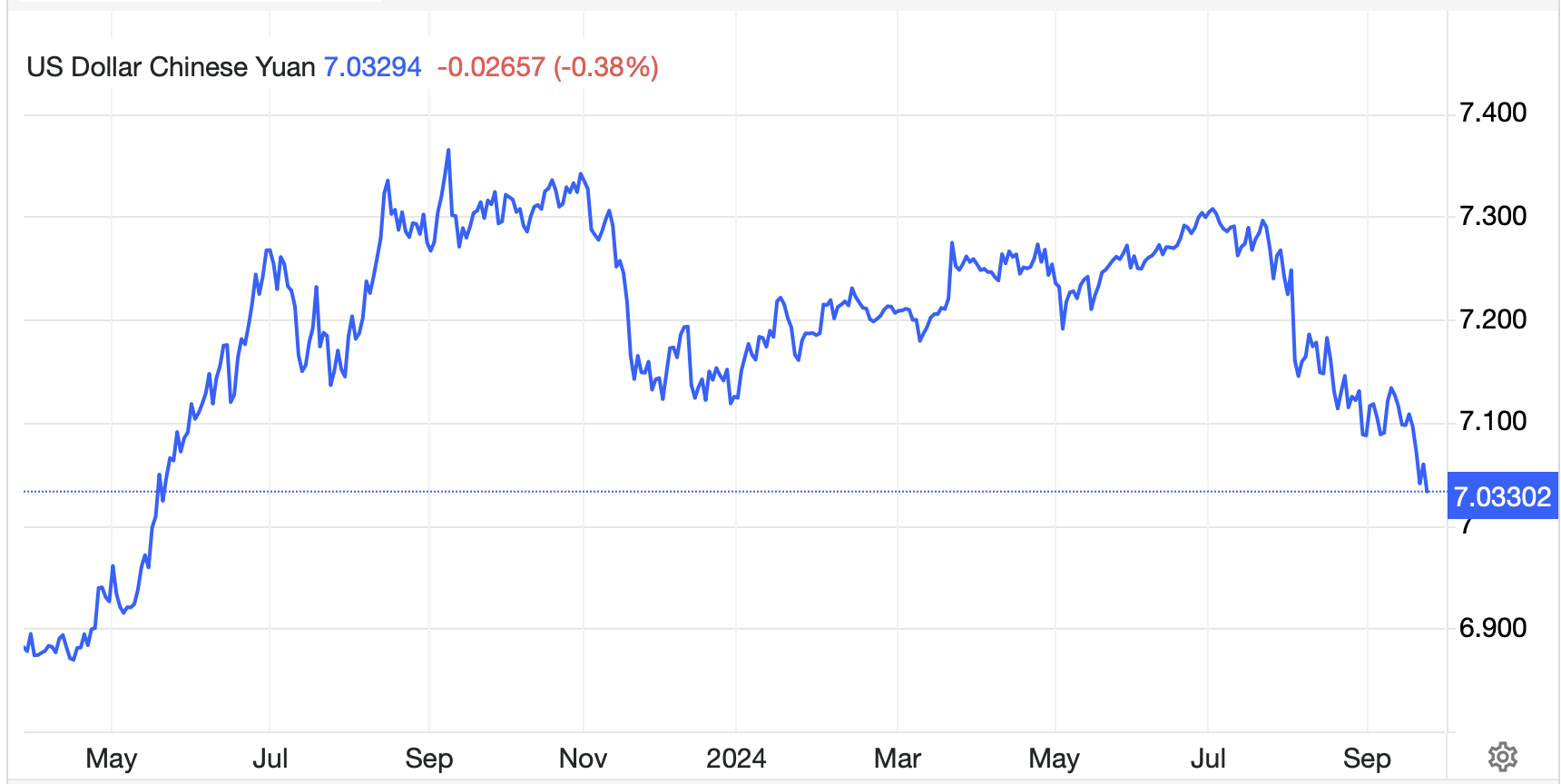
As this was the only noteworthy story, let’s look at how it impacted markets everywhere.  It can be no surprise that shares in China exploded higher given the explicit PBOC support with both the CSI 300 and Hang Seng rallying more than 4.1% on the session.  As well, Chinese yields backed up a bit, off the lows I described yesterday, but only by a few basis points.  As seen below, CNY (+0.4%) rallied nicely, trading to its strongest level since May 2023 and commodities rallied across the board with oil (+2.1%) and copper (+2.4%) the leaders although precious metals (Au +0.3%, Ag +0.8%) are also rising.

Source: tradingeconomics.com

Perhaps the most interesting thing about this story is just how little it impacted non-Chinese markets. Japanese shares (Nikkei +0.6%) rallied but given the yen’s decline (-0.3%) overnight, that likely had a bigger impact on those shares.  And the rest of Asia saw a mix of modest gains and losses, with Taiwan (+0.6%) and Korea (+1.1%) the next best performers although India, Australia and Singapore saw no benefit whatsoever.  It appears they are awaiting the fiscal boost.

In Europe, though, shares are definitely feeling the love led by the CAC (+1.6%) although even the DAX (+0.75%) is rallying despite another series of lousy data, this time the Ifo surveys all printing weaker than last month and weaker than expectations.  I guess given the importance of China as an export market for Germany, the PBOC news trumps the Ifo surveys from earlier this month.  As to US futures, after very modest gains yesterday, although some more record highs, they are essentially unchanged at this hour (7:00).

In the bond market, Treasury yields continue to back up, higher by 3bps this morning and now 15bps off the lows pre-FOMC meeting.  European sovereign yields are higher by 1bp across the board except for UK gilts (+4bps) as concerns grow that the fiscal situation in the UK may deteriorate more rapidly given the apparent confusion in the Starmer government about what to do to pay its bills.  It is also worth noting that JGB yields have slipped 3bps this morning and are now back to levels last seen back in April before the BOJ’s policy tightening got somewhat serious. 

As to the dollar, overall, it is on its back foot this morning although other than the renminbi, most of the moves have been 0.2% or less.  Today’s story is CNY for sure.

On the data front, this morning brings Case-Shiller Home Prices (exp 5.8%) and Consumer Confidence (103.8).  While there are no Fed speakers today, yesterday we heard from three (Goolsbee, Bostic and Kashkari) all of whom agreed with the 50bp cut last week and were mostly pushing for another one before the end of the year.  It seems Goolsbee has taken the mantle of chief dove on the committee, explaining there are “hundreds” of basis points left to cut before they achieve the neutral rate, however neither of the other two indicated any hesitation to cut further.  As of this morning, it is basically a 50:50 proposition as to 25bps or 50bps at the November 7th meeting according to the Fed funds futures market.

And that’s where we stand this morning.  China has opened their coffers and are adding yet more liquidity to the global system.  This should continue to help risk assets everywhere, and ultimately feed into inflation readings, although in China that is not a problem.  But what about elsewhere?  For now, it feels like the dollar is more likely to suffer given the dovish enthusiasm from the Fed speakers, but Thursday will bring 4 more speakers, including Chairman Powell, so perhaps we need to hear that before getting too excited.

Good luck

Adf

Juxtapose

In Europe, the ‘conomy’s woes
Continue while some juxtapose
Their weak PMIs
With US’s rise
Expecting the buck, higher, goes
 
Meanwhile, out of China we learned
The government there is concerned
Again, they cut rates
Which just illustrates
Their efforts, thus far, have been spurned


As we start a new week leading into month and quarter end, the market dialog continues to be about whether a recession is imminent or has been avoided completely.  As we have seen during the past months, it remains easy to choose the data that supports your view, in either direction, and make your case.  Ultimately, my take on that is very few opinions have been changed because as soon as one positive (negative) data point is printed, the opposite arrives within 24 hours.

However, let’s look at what we learned overnight.  The first story is that the PBOC cut their 14-day reverse repo rate by 10bps, another sign that the government there recognizes things are not really up to snuff.  In fact, most pundits were surprised that they didn’t cut the loan prime rates in the wake of the Fed’s rate cut last week.  Overall, this action is not that surprising, and most analysts are anticipating further rate cuts going forward, likely following the Fed lower every step of the way.  Perhaps the best indicator that more policy ease is coming is the fact that the yield on longer-term Chinese government debt has fallen to record lows (30-year at 2.15%, 10-year at 2.045%).

While the CSI 300 (+0.35%) did finally manage a bounce in the wake of the rate cut, perhaps there is no better picture of the situation in China than the chart of that stock index, which has been falling steadily since 2021.  I realize that the stock market is not the economy, especially in a command economy like China’s, but it appears quite clear that the many problems that have manifest themselves in China as the property bubble continues to unwind have been reflected in investor appetite, or lack thereof, to own potential future growth on the mainland.  The below chart speaks volumes I believe.  It ought to be no surprise that the renminbi (-0.25%) suffered a bit after the rate cut as well.

Source: tradingeconomics.com

As to the other noteworthy story, the Flash PMI data out of Europe was, in a word, dreadful.  Both manufacturing and services readings were below last month’s readings and below forecasts as the European growth story continues to suffer.  Given Europe’s reliance on imported energy overall, the recent rebound in oil and product prices are clearly impacting the economies there.  As well, there appears to be a growing divergence of opinion as to how different nations in the Eurozone want to move forward.  

For instance, this weekend’s elections in the German state of Brandenburg once again saw AfD make huge strides and massively complicate the coalition math, the third state to have that outcome this month.  As well, one of the keys to European convergence is the Schengen Agreement which allows for open borders within the EU.  However, the immigration situation there has now resulted in several nations closing their borders, not merely with the outside world, but internally as well as they try to cope with the massive influx of immigrants and asylum seekers that have been coming to the continent.  My point is if nations cannot agree on critical policies of this nature, it will become that much more difficult to arrive at common economic policies that are universally accepted.

Remember, last week Mario “whatever it takes” Draghi released his report on how the Eurozone could improve things with suggestions including more Eurozone debt (as opposed to individual national debt) and more government focused investment in areas where Europe lags, notably technology.  I guess the first step to correcting a problem is recognizing it exists, so credit is due that the Eurozone leadership has figured out things aren’t great for their citizens.  Alas, I fear Signor Draghi’s prescriptions, if enacted, are unlikely to solve many problems.

But that’s really all we have from the weekend, so let’s see how markets fared ahead of the US open.  Japan was closed for Vernal Equinox Day, a delightfully quaint holiday, while we’ve already discussed the mainland. The rest of Asia was generally positive, although Australian shares slid from recent all-time highs as investors await the RBA rate tonight with no change expected.  In Europe, it is a mixed picture, which given the PMI data, is better than I would have expected.  In fact, Germany (+0.5%) is the leading gainer there, although I cannot figure out any sensible catalyst driving that move.  The rest of the continent is +/-0.2%, so nothing really to note.  As to US futures, overall, they are slightly firmer at this hour (7:00), maybe 0.15%.

In the bond market, Treasury yields have edged higher by 1bp, continuing their rise from last week just ahead of the FOMC decision and now 13bps off the lows.  My sense is that yields will continue to slowly grind higher as a more aggressive Fed will open the door for a rebound in inflation.  As to European sovereigns, all are seeing yields slide between 2bps and 4bps this morning as it becomes clearer that the growth situation there is fading.

Oil prices (+0.3%) continue their slow rebound from the lows seen two weeks ago, although this looks much more like market internals and positioning than fundamental news.  Some claim that the escalation between Israel and Hezbollah is behind this, but given how little the market has seemed to care about the entire situation there for the past year, virtually, that doesn’t make much sense to me.  As to the metals markets, gold is unchanged this morning, sitting on its new all-time high although we have seen a retracement in both silver (-1.7%) and copper (-0.7%), though both remain in uptrends for now.

Finally, the dollar is mixed this morning with the euro (-0.4%) feeling the weight of the lousy PMI data but the commodity bloc mostly performing well (AUD +0.3%, NZD +0.25%, CAD +0.2%).  One exception here is NOK (-0.3%) and we are seeing far more weakness in EMG currencies as well (PLN -0.6%, HUF -0.9%, MXN -0.4%, KRW -0.5%).  The outlier here is ZAR (+0.25%) where investors are becoming increasingly comfortable with the pro-business attitude of the recently elected government and inward investment continues to grow.

On the data front this week, there is plenty as well as a number of Fed speakers

TodayChicago Fed Nat’l Activity-0.6
 Flash Manufacturing PMI48.5
 Flash Services PMI55.3
TuesdayCase-Shiller Home Prices5.8%
 Consumer Confidence103.8
WednesdayNew Home Sales700K
ThursdayInitial Claims225K
 Continuing Claims1832K
 Durable Goods-2.6%
 -ex Transport0.1%
 Q2 GDP3.0%
 GDP Final Sales2.2%
FridayPersonal Income0.4%
 Personal Spending0.3%
 PCE0.1% (2.3% Y/Y)
 Core PCE0.2% (2.7% Y/Y)
 Michigan Sentiment69.3

Source: tradingeconomics.com

Given the Fed’s pivot to employment from inflation, I suspect there will be a lot of scrutiny on the Claims data, especially since last week’s numbers were so surprisingly low.  If the labor market is behaving better, the need for rate cuts diminishes.  In addition to the data, we also hear from 7 Fed speakers including Chairman Powell Thursday morning.  As well, Treasury Secretary Yellen speaks on Thursday, no doubt to explain how great a job she has done.

Summing it all up, we continue to see signs of weakness elsewhere in the world while thus far, the headline data in the US continues to hold up reasonably well.  While I have consistently explained that as the Fed starts cutting rates, the dollar would suffer, the decline may be quite gradual if the rest of the world is in worse shape than the US.

Good luck

Adf

Sayonara Yen

Ueda did not
Accept the challenge and hike
Sayonara yen


Market excitement has ebbed after yesterday’s massive risk rally around the world, especially with limited new information released.  The one place where there was a chance for excitement was Tokyo, where the BOJ was meeting.  Heading into the meeting, the analyst community anticipated no policy changes although it seems clear that there were at least some market participants who thought Ueda-san would take this opportunity to surprise markets once more.  However, in this case, the analysts were correct.  Policy was left as is, with the overnight rate remaining at 0.25%, and there was no discussion regarding the reduction of QE at all, in fact, the most noteworthy thing about the policy statement was the frequency with which they used the term ‘moderate’ or variations thereof.  

They explained that the Japanese economy’s recovery, overseas economies’ growth, corporate profits, private consumption, business fixed investment, and inflation expectations have all been increasing moderately.  As such, the unanimous decision was that policy was just fine already with no imminent concern over rising inflation and no need to do anything.  The upshot is that the Nikkei (+1.5%) continues its recent rebound rally, JGB yields didn’t budge and the yen (-0.9%) fell sharply, proving to be the worst performing currency in the session.  See if you can figure out when the BOJ news was released based on the chart below.  This is what I meant when I said while analysts weren’t looking for any policy changes, clearly FX traders were.

Source: tradingeconomics.com

However, beyond the BOJ nonevent, there has been very little to discuss overall.  There is still a sense of euphoria around equity markets as congratulations abound for Chairman Powell and his bold action on Wednesday, at least from the Keynesian audience.  The one other thing to mention is that the barbarous relic (+1.0%) has absorbed all this information and traded to yet another new all-time high, well above $2600/oz, dragging the rest of the metals complex along for the ride.

Some days, there is just not much to discuss, so I will recap markets and let us all start the weekend early.

Following the big rally in the US yesterday, alongside Japan, Hong Kong (+1.35%) stocks rallied as did most of Asia (Korea, India, Australia, Malaysia) although there were a few laggards (Indonesia and New Zealand stick out).  As to mainland Chinese shares (+0.15%), they did edge higher, which given their performance of late is clearly a positive, but the news from China continues to disappoint.  Last night, the PBOC left their 1yr and 5yr loan rates unchanged, unwilling to take advantage of the Fed’s rate cut to help try to boost the domestic economy.  There is talk that the government there is going to ease the Hukuo restrictions, a type of internal passport that restricts what citizens there can do, to try to goose the property market, but no confirmation of that.  

But there was also news that the youth unemployment rate rose again, up to 18.8%.  You may recall that last summer, when the numbers started to really get bad, rising above 25%, they simply stopped publishing them.  Well, they rejiggered the data and brought them back at the beginning of the year, and now they are rising once again.  China still has many intractable problems and the equity market there seems likely to remain under pressure for a while yet.  As to US futures, at this hour (7:00) they are backing off a bit from recent highs, down -0.25% or so.

In the bond market, it is an extremely quiet session everywhere, with Treasury yields edging higher by 1bp and similar moves in some European sovereign markets while others remain unchanged.  It seems that with central bank meetings now behind us, there is no reason to anticipate the next move yet, so no reason to rock the boat.  I assume that as more data shows up, NFP, inflation, etc., we will see more movement, but for now, likely very little activity.

As mentioned above, the metals markets are rocketing this morning but the same is not true in energy with oil (-0.3%) and NatGas (-0.6%) both slipping a bit.  However, both have had strong weekly rallies, so this feels much more like a profit taking response as traders head into the weekend than anything fundamental.  After all, escalation in the Middle East doesn’t seem to faze traders, nor in Russia/Ukraine. 

Finally, the dollar is a touch higher overall, but really, in the G10 other than the yen, most currency movements have been very modest.  In the emerging markets, CNY (+0.25%) is the outlier, with those looking for a cut unwinding their short positions, but we have seen weakness elsewhere (KRW -0.65%, MXN -0.25%, ZAR -0.25%) all of which seem to be a reaction to the dollar’s sharp decline of the past two sessions.  Again, profit-taking on a Friday with no data is pretty common.

And that’s really it.  There is no data and only one Fed speaker, Philly Fed president Harker, who will be the first post-FOMC speaker we hear.  It is hard to get excited about anything in the markets today.  I expect that we will see more profit taking in those markets which moved significantly, like equities and eventually metals by the close.  In fact, if the metals markets don’t retrace, I think that could be a signal that there is a larger move in that space coming our way.

Good luck and good weekend

Adf

Recalibration


All week we had heard many clues
That fifty is what Jay would choose
And that’s what he cut
With only one but
From Bowman, who shuns interviews
 
The key is now recalibration
In order to tackle inflation
Without driving higher
The joblessness spire
So, trust us, it’s all celebration


Recent indicators suggest that economic activity has continued to expand at a solid pace. Job gains have slowed, and the unemployment rate has moved up but remains lowInflation has made further progress toward the Committee’s 2 percent objective but remains somewhat elevated.” [emphasis added]

Reading the opening paragraph of the FOMC Statement, it might be confusing as to why they needed to cut rates 50bps.  After all, the economy is expanding at a solid pace (In fact, after the Retail Sales data on Tuesday, the Atlanta Fed’s GDPNow reading for Q3 is up to 3.0%!)  unemployment remains low and inflation is still somewhat elevated.  I know I am a simple poet, but the plain meaning of those words just doesn’t lead my thinking to, damn, we better cut 50 to get started.  But I guess that is just another reason I am not a member of the FOMC.

Perhaps the more interesting thing was the Summary of Economic Projections and the dot plot which showed that while expectations were for rates to fall far more dramatically than in June, the longer run expectations continue to rise.  In fact, Chairman Powell specifically addressed the SEP in the press conference, “If you look at the SEP you’ll see that it’s a process of recalibrating our policy stance away from where we had it a year ago when inflation was high and unemployment low to a place that’s more appropriate, given where we are now and where we expect to be, and that process will take place over time.” [emphasis added] In fact, there was a lot of recalibrating going on as that appears to be the Chairman’s new favorite word, using it 8 times in the press conference.

Source: federalreserve.cgov

Notice that their current forecasts are for GDP to slow to 2.0% with Unemployment edging only slightly higher while PCE inflation magically returns to their 2.0% target.  And take a look at the last two lines, with the Fed funds rate projections falling substantially for the next three years, far more quickly than their previous views, although they think the long-run level will be higher.  

I wonder about that last issue.  Historically, the thought was that the long run Fed funds rate would be inflation (2.0%) + real interest rate (0.5%) and they pegged it at 2.5% for years.  Now that they see it at 2.9%, is that because they think inflation is going to be higher (not according to their projections) which means that for some reason they think real interest rates are going to be higher.  However, when asked, Chairman Powell and every member of the board has been unable to explain this change.

But what really matters is how have markets responded to this earth-shattering news?  The initial movement was as expected, with stocks rallying sharply (see chart below) and yields sliding along with the dollar while commodities rallied.

Source: Bloomberg.com

But a funny thing happened on the way to the close, as can be seen in the chart.  Stocks gave back all their gains and then some, with all three major indices lower on the session while 10yr Treasury yields backed up 7bps and the dollar rebounded.  Arguably, this was a sell the news response, but we need to be careful.  Remember, there are many analysts who believe the economy is in deep trouble already and by starting off with a big cut, those with paranoia may be wondering what the Fed knows that the data, at least the headline data, is not really showing.

So much for yesterday, now let’s look at markets this morning beyond the initial knee-jerk responses.  Absent any other major news or data (Norgesbank leaving rates on hold doesn’t count as major), markets have played out far more along the lines of what would have been expected in the wake of a 50bp cut.  In other words, the dollar has fallen sharply against almost all its counterparts, equity markets have rallied around the world, commodity prices have rallied sharply, and bond yields are…unchanged? 

Which brings us to the question that has yet to be answered.  Which market is right, stocks or bonds?  They appear to be telling us different stories with stocks pushing to new highs amid rising multiples and rising profit growth expectations while bonds are pricing in another 200bps of rate cuts by the end of 2025, an outcome that would only seem to make sense in the event the economy fell into a recession.  But if we are in a recession, corporate earnings seem highly unlikely to rise as much as currently forecast and typically, P/E multiples contract.  Meanwhile, if the economy is humming along such that current equity pricing is warranted, what will be the driver for the Fed to cut rates as that will almost certainly reignite inflation.  

History has shown that the bond market tends to get these big questions right when they are pointing in different directions, but that doesn’t mean that risk assets will stop rallying right away.  In fact, this will likely take quite a while to play out.

Ok, so let’s put a little more detail on the market activity overnight.  Tokyo rocked (+2.0%) as did Hong Kong (+2.0%), Taiwan (+1.7%), Singapore (+1.1%) and even mainland China (+0.8%) managed to rally some.  It appears that investors around the world believe the Fed has opened the floodgates for a much lower interest rate environment everywhere.  European bourses, too, are sharply higher led by the CAC (+2.1%) but with strength across the board (DAX +1.5%, FTSE 100 +1.3%).  And US futures have shaken off the late selloff yesterday and are firmly higher this morning led by the NASDAQ (+2.2%).

Bond yields, though, are largely unchanged on the day, with yesterday’s backup in Treasury yields maintained and European sovereigns all within 1bp of yesterday’s close.  It appears that bond investors are less confident in a soft landing than equity investors.  Interestingly, JGB yields rose 2bps last night as Japanese markets prepare for the BOJ meeting tonight.

In the commodity markets, oil (0.75%) is continuing its recent rebound after another massive inventory draw was revealed by the EIA yesterday prior to the Fed meeting.  There is a growing concern that inventories in Cushing, Oklahoma are falling to a point where products like gasoline and diesel will not be able to be produced.  As an example, gasoline futures have risen far more than crude futures this week on that fear.  As to the metals markets, gold briefly touched $2600/oz yesterday immediately in the wake of the FOMC but sold off hard afterwards.  This morning, however, it is back pushing up to that level again and the entire metals complex is rising nicely.

Finally, the dollar, has been a whipsaw of late.  Post the FOMC, it fell sharply across the board, and then into yesterday’s close it rebounded to close higher on the day.  However, this morning it has given back all those late gains and then some, and is now sitting at its lowest level, at least per the DXY, since April 2022.  This morning, in the G10, we are seeing many currencies rally between 0.5% (EUR) and 1.3% (NOK) vs the dollar and everywhere in between.  The one exception to that is the yen (-0.2%) which is biding its time ahead of the BOJ meeting.  The working assumption is that the BOJ will do nothing tonight, but now that the Fed has cut 50bps, and given Ueda-san’s history of actively trying to surprise markets to achieve outcomes he wants, we cannot rule out another rate hike in Japan.  Monday morning, USDJPY fell below 140 for the first time in 18 months.  My take is Ueda-san is quite comfortable with it heading back to the 130 level, if not the 120 level.  If he were to surprise markets and raise the base rate by even 10bps tonight, I think we would see a sea change in sentiment and a much lower dollar.  And given inflation in Japan seems to have stalled at 2.8%, well above their 2.0% target, he has a built-in excuse.

Too, watch the CNY (+0.45%) as it is now trading at its highest level (weakest dollar) in more than a year, and is approaching the big, round number of 7.00.  the linkage between JPY and CNY is tight as they constantly compete in markets, especially now in autos and electronics.  If the Fed is really going to cut as much as markets are pricing, both these currencies should strengthen much further.

It is almost anticlimactic to discuss the data today but here goes.  First, the BOE left rates on hold, as expected and the market impact was limited.  Expectations are they will cut next in November.  As to data, we see Initial (exp 230K) and Continuing (1850K) Claims, Philly Fed (-1.0) and Existing Home Sales (3.90M).  None of that is likely to change any views.  Prior to the BOJ meeting, at 7:30 this evening we see Japanese CPI, which may change views there.

For now, the dollar is very likely to remain on its back foot as enthusiasm builds for multiple rate cuts by the Fed going forward.  However, if the data continues to impress like it has lately, that enthusiasm will need to be tempered.

Good luck

Adf

Fednesday

Well, Fednesday is finally here
And traders, for fifty, still cheer
But arguably
The prices we see
Account for a half-point rate shear
 
So, if they just cut twenty-five
Prepare for a market nosedive
The doves will all scream
Jay’s killing the dream
While hawks everywhere all will thrive


First, I did not create the term Fednesday, I saw it on Twitter but thought it quite appropriate.  In fact, looking, I cannot determine who did create it but kudos to them.

As I have already written twice on the subject of today’s meeting, I will be brief this morning, especially because not much has changed.  Yesterday’s stronger than expected Retail Sales data resulted in Fed funds futures reducing the probability of a 50bp hike during the session, but overnight, we have returned to the 65%/35% probability spectrum for a 50bp cut.  I continue to believe that will be the case based on the number of articles we have seen in the mainstream media about the merits of a 50bp cut, mostly centering on the idea that rates are “too” high despite the fact that growth continues apace, the employment situation remains solid, if cooling somewhat, and inflation remains well above target.  Perhaps the big surprise will be that there will be a dissent on the vote, something we have not seen in two years.  (In fact, the last time a governor dissented was 2006 I believe).  

But something I have not touched on is the dot plot which will give us an idea as to the members’ collective belief for the rest of the year.  For instance, if the dot plot indicates Fed funds will be at 4.5% by year end, then 25bps today will be followed by at least one 50bp cut.  That should be net equity bullish and bearish for the dollar.  If the dot plot indicates only 75bps of cuts, so 4.75% at year end, my take is that will be seen as somewhat hawkish overall, and we should see risk assets decline while the dollar rallies.  Finally, if it is more than 100bps expected, I think that could be a situation of the market asking, what does the Fed know that we don’t?  That would not be a positive for risk assets but would also hammer the dollar.  Bonds would rally as would gold.  At least those are my views.

Moving on, tomorrow brings a BOE meeting where the current expectation is for no cut, although one is priced for the next meeting in the beginning of November.  Early this morning, the UK released its inflation report which showed headline CPI at 2.2%, as expected while the core rate rose to 3.6%, a tick more than expectations and up 0.3% from the July reading.  Arguably, that is what has the BOE concerned, the fact that despite the decline in energy prices which has taken headline CPI lower, the underlying stickiness of inflation remains extant within the UK.  As well, the UK also released its PPI data, all of which showed declines greater than expected, if nothing else implying that UK corporate margins should be healthy.  The pound (+0.35%) has rallied on the news, although the dollar is weaker overall, so just how much of this move is UK related is open to debate.  I guess we can say that the short-term differences in central bank stance is likely to continue to help the pound for a while.  In fact, the pound is back to levels last seen in summer 2022 and there is a growing bullish sentiment for the currency based on current perceptions of the divergence between the Fed and BOE.  My view is the BOE will fall in line pretty quickly so this will change, but for now, especially with the dollar under broad pressure, the pound has further to go.

On Friday we’ll learn
If Ueda can once more
Surprise one and all

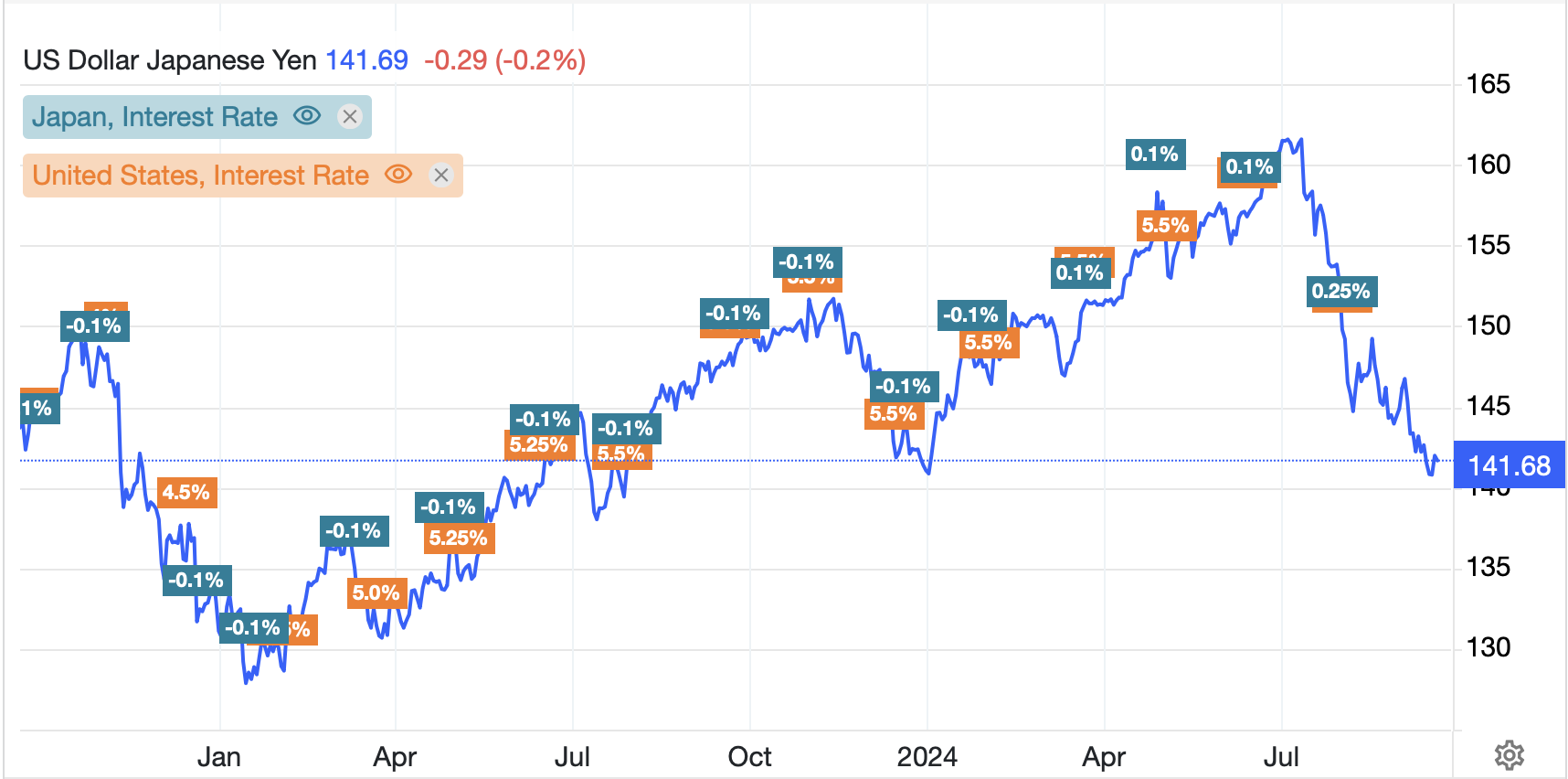
The other central bank meeting this week is the BOJ early Friday morning.  Currently, there is no expectation of a BOJ policy change although many analysts are looking for a rate hike by December.  However, I think it is worth looking at USDJPY in relation to the policy adjustments we have seen by both central banks over the past several years.  Hopefully you can see in the chart below that the exchange rate here has returned to the level when the Fed last raised rates in July 2023.  

Source: tradineconomics.com

Since then, after a dramatic further decline in the yen, with both policy rates on hold, the BOJ first adjusted the cap on YCC higher (from 0.50% to 1.0%) then eventually raised the policy rate from -0.1% to +0.25% where it is today.  During that time, Ueda-san has surprised markets several times, and has had help from the MOF regarding intervention, taking a completely different approach to the process than the Fed, who never wants to surprise markets. With this in mind, we must be prepared for another surprise on Friday.  One thing to remember is that the BOJ meeting announcement occurs after the market in Tokyo closes, so even though other markets, and of course the FX market will be able to respond, the Tokyo equity and JGB markets won’t be able to move until Monday.  The point is the reaction may take time to play out.  In this situation, I don’t have enough information to take a view, but I will say that if he tightens policy in any manner, USDJPY is likely to fall much further.

One other thing I realize is that I have not discussed QT/QE.  If the Fed changes that process, the current $25 billion/month of balance sheet runoff, that will be extremely dovish and be quite a boost for stocks, bonds and commodities while the dollar will get run over.

Ok, heading into this morning, and after a mixed and lackluster session yesterday in the US, Asian equity market all rallied with Japan (+0.5%) continuing its recent rally, while even mainland Chinese shares (CSI 300 +0.4%) managed a gain today.  However, European bourses are all softer this morning with the FTSE 100 (-0.6%) lagging after the higher-than-expected inflation data driving concerns the BOE won’t cut rates much.  But screens everywhere are red, albeit only modestly so.  US futures are currently (7:45) edging slightly higher as I continue to believe traders and investors are looking for a 50bp cut.

In the bond market, yields are higher across the board as the euphoria we have seen lately seems to be running into a bit of profit taking with Treasury yields higher by 3bps and European sovereign yields all higher by between 4bps and 6bps.  Perhaps the one surprise is that JGB yields are unchanged this morning as there seems to be no anticipation of a BOJ move, at least not yet.

In the commodity markets, oil (-1.0%) is giving back some of its recent gains but remains above $70/bbl.  It seems that the stories of a massive military strike by Ukraine deep in Russia have raised concerns amongst the punditry of an escalation of the war there, but it has not concerned energy markets, at least not yet.  In the metals markets, gold (+0.2%), which sold off yesterday, continues to find support while copper has been on a roll and has risen once again.  

Finally, as mentioned above, the dollar is softer overall against all its G10 counterparts and most EMG currencies as well. The one outlier here was KRW (-0.35%) where traders are starting to price in rate cuts by the BOK after yet another mild inflation report earlier this week.

Ahead of the Fed we see Housing Starts (exp 1.31M) and Building Permits (1.41M) as well as the EIA oil inventory data where expectations are for no real changes.  Until the FOMC release, look for quiet markets. Afterwards, I’ve given my views above.

Good luck

Adf

Lately Downturned

The story is still ‘bout the Fed
And whether, when looking ahead
They see skies are blue
And so, they eschew
A rate cut the bears will all dread
 
But if they are growing concerned
The ‘conomy’s lately downturned
Then fifty will be
What we all will see
And bears, once again, will be spurned


As we move closer to the FOMC announcement and Powell press conference, the nature of the discussion has focused entirely on the size of the rate cut that will be announced tomorrow.  Yet again this morning, the Fed whisperer, Nick Timiraos at the WSJpublished an article on the subject, once again making the case for 50 basis points.  The money quote is below:

“Fed officials aren’t likely to regret a larger rate cut this week if the economy chugs along between now and their next meeting, in early November, because rates will still be at a relatively high level, he said. But if the Fed makes a smaller move and the labor market deteriorates more rapidly, officials will feel greater regret.”

As well, the futures market is growing more and more certain 50bps is coming as evidenced by the pricing this morning as per the below chart from the CME:

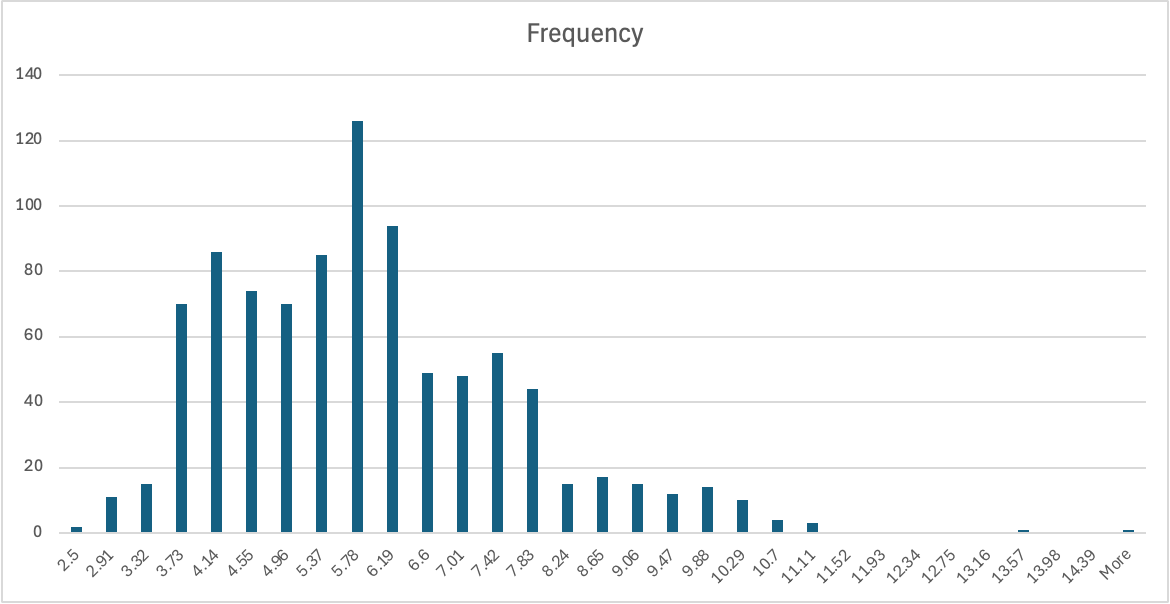
The interesting thing is that an unbiased (if such a thing exists) look at the data does not scream out to me that the economy is collapsing such that an aggressive start to an easing cycle is necessary.  Unemployment remains in the lowest quintile of outcomes over the past 76 years.  For reference, the median reading since January 1948 has been 5.5%, the average has been 5.7% and today it is at 4.2%.  The chart below shows the distribution of outcomes over the entire data series from the FRED database.

Data source: FRED database; calculation: fx_poetry.com

It is difficult to look at this chart and think the economy is imploding.  And let us consider another thing, the widely mentioned long and variable lags by which monetary policy impacts the economy.  Whatever the Fed does tomorrow, the impact on almost the entire economy will not be felt for at least a year, if not much longer than that.  After all, do companies really make a borrowing decision based on the marginal 25bps of interest cost per annum?  I would argue that most corporate borrowing is based entirely on their current schedule of maturing debt and any forecast needs for capex or other funding.  It strikes me that whether the Fed funds rate is 5.25% or 5.00% is not going to change much in the real economy.

Markets, of course, are a different kettle of fish in this discussion, but let’s face it, the bond market has already priced in 250 basis points of cuts in the next twelve months, so whether they start with 25 or 50 seems less relevant than the destination.  Certainly, the equity market will try to goose things on a 50bp cut, and will almost certainly fall if the cut is only 25bps, at least initially, but again, will corporate profits change that much in the short-run because of this move?

In the end, I fear we make far too much of the outcome, at least in this case.  Now, if Powell and the Fed were to decide that the recent call for a 75bp cut by three senators was an eloquent argument and did that, the market surprise would be substantial and the initial move in risky assets would be higher.  But something like that would also engender fears that the Fed knows something bad about the economy that the rest of us have missed, and that would result in its own negative consequences. I guess the good news is we only have another 30 hours or so before we find out.

As to the market activity overnight, yesterday’s mixed US equity performance, with the DJIA making new all-time highs while the NASDAQ fell -0.5%, led to weakness in Tokyo (Nikkei -1.0%) as tech shares underperformed, but strength in HK (+1.4%) and much of the rest of Asia that was open.  Both China and South Korea remained closed for holidays.  In Europe, though, given the virtual lack of technology shares available, the DJIA was the template with all markets higher this morning led by Spain’s IBEX (+1.25%)), but with robust gains elsewhere on the order of +0.6% to +0.8%.  As to US futures, at this hour (7:30), they are higher by about 0.25%.

In the bond market, yields continue to edge lower overall.  While Treasuries are unchanged this morning, that follows another 2bp decline yesterday afternoon.  In Europe this morning, sovereign yields are all lower by between -1bp and -3bps, catching up (down?) to the Treasury market as well as responding to pretty awful German ZEW numbers (Sentiment 3.6 vs. 17.0 expected and 19.2 last month; Current Conditions -84.5 vs. -80.0 expected and -77.3 last month).  Germany remains the sick man of Europe and there is no doubt that they need to see the ECB start to cut rates more aggressively to help support their withering manufacturing sector.  And one more thing, JGB yields fell -2bps last night and are now at 0.81% in the 10yr.  While the focus will turn to the BOJ at the end of the week after the FOMC announcement tomorrow, the market does not appear to be particularly concerned over aggressive tightening there.

In the commodity markets, WTI (+0.15%) has crept back above $70/bbl for the first time in nearly two weeks as the big story in the market revolves around the net speculative Comex positioning which has turned negative for the first time ever.  That means that hedge funds and speculators are net short oil futures.  While they may have a negative outlook, the positioning does indicate there is an opportunity for a massive short-squeeze sometime going forward.  As to the metals markets, they are little changed this morning, broadly holding their recent gains with both precious and industrial metals all showing healthy gains in the past week.  A 50bp cut should support prices across the board here.

Finally, the dollar is softer again this morning, but by a modest amount, about -0.1% across the board.  Those are the types of gains we have seen across the G10 and most of the EMG currencies with one outlier, MXN (-0.9%).  However, the peso, which had strengthened nearly one full peso in the past four trading sessions looks more like it is responding to that movement than to any fundamental changes.  The judicial review story is now old news although there may be some concerns that Banxico will cut more aggressively next week if the Fed does so tomorrow.

On the data front, this morning brings Retail Sales (exp -0.2%, ex autos +0.2%) as well as IP (0.2%) and Capacity Utilization (77.9%).  We also hear from Dallas Fed president Logan this morning.  It’s funny, a strong Retail Sales number could well weigh on the chances for a 50bp cut as further evidence that things continue to be moving along fine.  Remember, even though inflation has been trending lower, it is not yet nearly at its target.  Retail Sales strength would indicate that employment remains robust as people spend money more readily when they have a paycheck, so the need for more stimulus may just not be that critical.

In the end, my best take is the Fed is going to cut 50bps tomorrow and the market is going to increasingly price that in as the session unfolds.  This will be especially true if Retail Sales is weaker than forecast, but even if it surprises on the upside, I remain convinced Powell wants to cut 50bps based on the number of articles discussing the idea in the mainstream press.  Ultimately, I think the dollar will suffer a bit further on that move and commodities will be the big winners.

Good luck

Adf

More Than a Pen

Twas just about two months ago
When President Trump was laid low
As bullets were flying
With somebody trying
To end his campaign in one blow
 
And now, yesterday, once again
A shooter used more than a pen
To try to rewrite
The vote that’s so tight
Enthused to act by CNN
 
By now, you are all aware of the second assassination attempt on former president Donald Trump’s life, this time while he was playing golf at his course in Palm Beach.  The difference, this time, is the alleged shooter was caught alive, so it will be very interesting to hear what he says under questioning and as this situation progresses.  While this is obviously newsworthy, it did not have a major market impact as investors are far more focused on the Fed coming Wednesday and then the BOJ on Friday.  As such, as I write (6:20) US equity futures are mixed with modest movements of +/-0.2%.
 
In China, poor President Xi
Is finding that his ‘conomy
Is not really growing
In fact, it is slowing
Much faster than he’d like to see

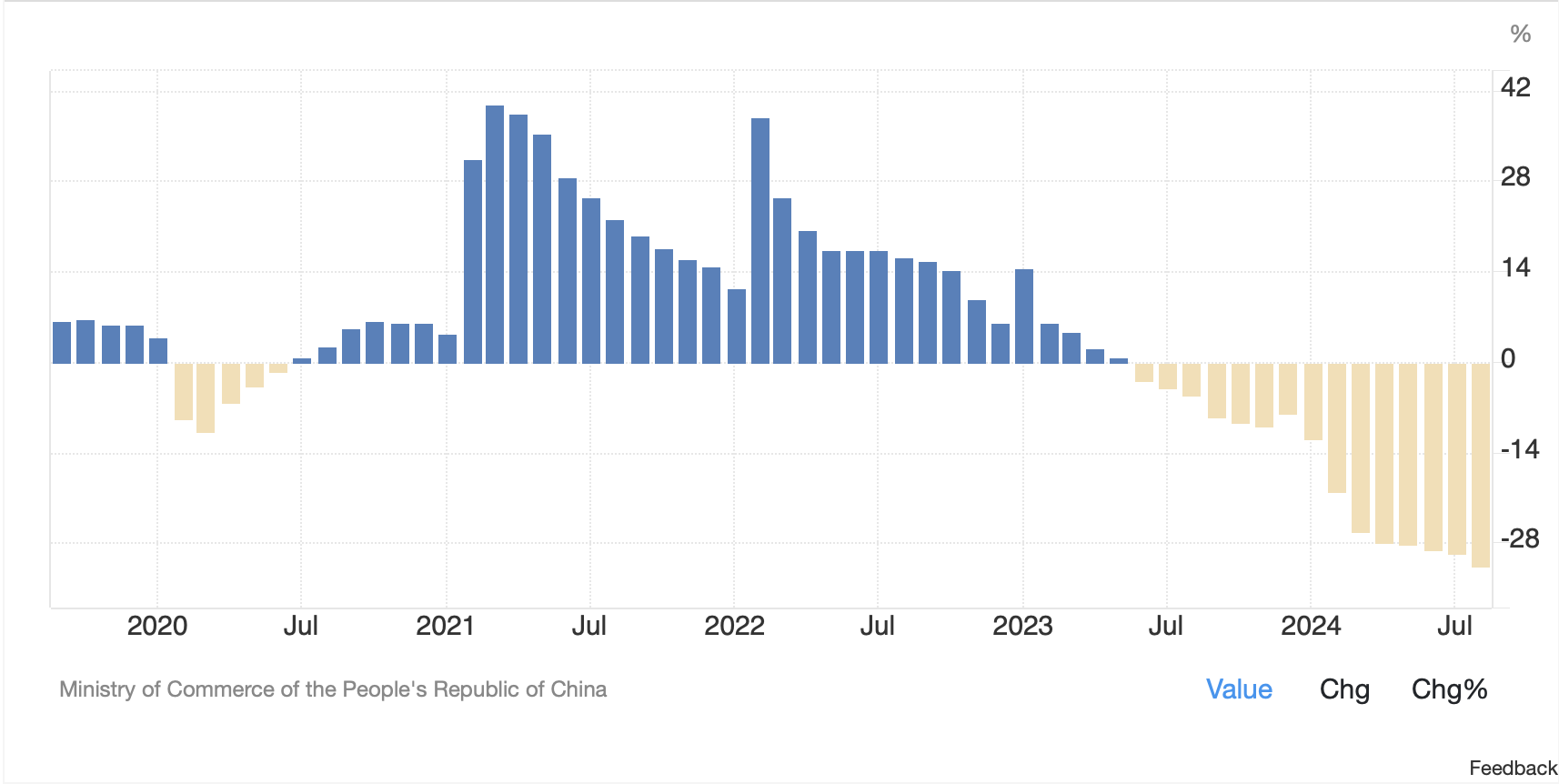
While last night there were different holidays in China, Japan and South Korea, causing all three markets to be closed, Saturday morning, the Chinese released their monthly data drop regarding IP (4.5%), Retail Sales (2.1%) and Fixed Asset Investment (3.4%) along with the Unemployment Rate (5.3%).  Then on Saturday evening here, they released their Foreign Direct Investment (-31.5%) with every one of those figures worse than the previous reading and worse than forecasts.  The evidence continues to show that the Chinese economy is slowing and seems to be slowing more quickly than previously anticipated.  In truth, from my perspective, the biggest concern Xi has is the FDI decline, which as can be seen below, has been falling (net, foreign investors are exiting China) for the past 15 months, and at an accelerating rate. 

Source: tradingeconomics.com

This bodes ill for President Xi’s 5.0% GDP growth target for 2024 and the working assumption amongst the market punditry is that he will soon announce fiscal stimulus in order to get things back on track.  Of course, one of the key problems is that not only are economies elsewhere in the world slowing down, thus reducing demand for Chinese exports, but as well, the expansion of tariffs on Chinese goods by the West continues apace, slowing that data even further.  I saw an estimate this morning that Chinese families have seen $18 trillion of wealth evaporate as the property market in China continues to decline which undoubtedly weighs on consumer sentiment and activity.  But Xi is going to have to do something to prevent a revolution, because remember, the basic Chinese Communist Party contract with the people is we will bring you economic betterment and you let us rule.  If they don’t achieve better economic growth, the population, especially the millions of unemployed young men, may get restless.  While I am not forecasting a revolution, this is typically a precursor to the process.

On Wednesday, the time will arrive
When Jay and his minions contrive
To try to explain
Their easing campaign
And hope stocks don’t take a swan dive

Now to the most important market story this week, will the Fed cut rates by 25bps or 50bps?  It’s funny, if you read independent economic analysis, both sides make their case, and not surprisingly, given the mixed data we have received over the past several months, each case makes some sense.  But…that is not the information you get when reading the press.  The WSJ, inparticular, is really banging the drum for a 50bp cut and many more to follow.  You will recall that Friday, the Fed whisperer was out with his latest piece discussing the merits of a 50bp cut.  Well, this morning there are two more articles, one by pundit Greg Ip basically begging for a 50bp cut, and one by a trio of authors laying out the case and coming down strongly on the side of 50bps.  

All this has helped push Fed funds futures to a 59% probability of a 50bp cut as of this morning.  As some have pointed out on X(fka Twitter), in the past, when there was uncertainty about a Fed move, they managed to get the word out as to what they wanted to do during the quiet period via articles like the ones above and sway markets to their preferred outcome.  As such, at this point I assume we are going to see a 50bp cut on Wednesday.

I guess the real question is what will the impact on markets be?  This morning, we are already seeing the impact in the FX market, with the dollar under pressure across the board.  Versus its G10 counterparts, it has declined by between 0.4% and 0.6% against all except CAD, which remains very tightly linked to the dollar and has gained just 0.1% this morning.  But this movement seems entirely a result of the belief that 50bps is coming.  In the EMG bloc, though, the picture is more mixed with some significant gainers (KRW +0.8%, CE4 +0.5%, ZAR +0.6%) but most other currencies little changed overall.  Nevertheless, the market is clearly pricing for 50bps across the board now and I expect that by Wednesday morning, the Fed funds futures market will reflect that as well.

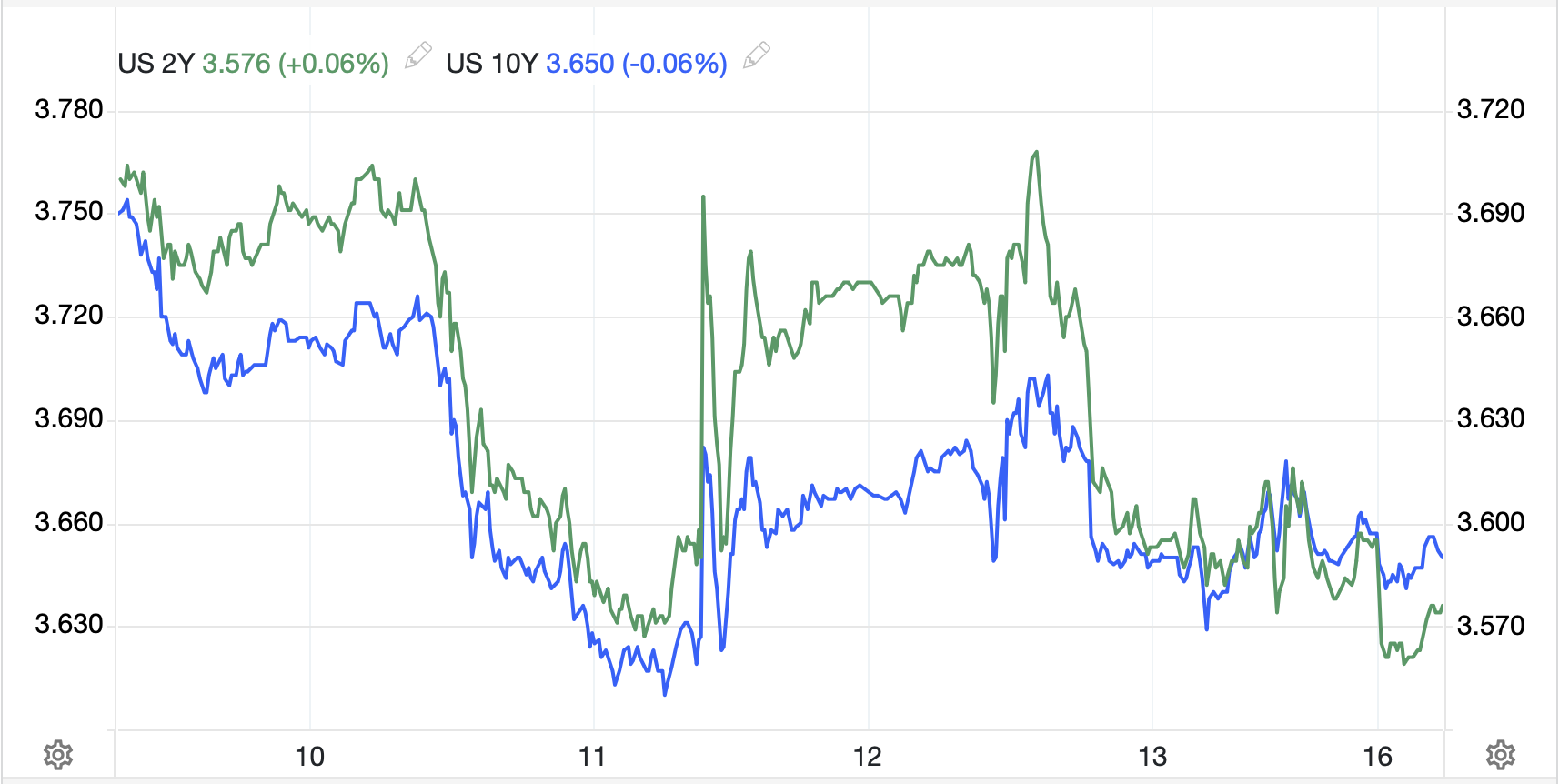
But a weaker dollar is probably not the Fed’s goal.  After all, dollar weakness can help reignite inflation, so they will be wary.  Of more interest to them is the bond market which also appears to be in agreement as the 2yr yield has now fallen to 3.56%, 10bps below the 10yr yield and a clearer sign that the two plus year inversion is behind us.  Of course, as I pointed out Friday, with 2yr yields nearly 200bps below Fed funds, it can be interpreted that the market is anticipating a recession, something I’m pretty sure the Fed wants to avoid if it can.  Perhaps you can see in the chart below how the 2yr yield (in green) fell sharply this morning, almost exactly when those WSJ articles were published.  Go figure!

Source: tradingeconomics.com

At any rate, that is the current zeitgeist, the Fed has leaked they want 50bps and are pushing the levers so when they cut 50bps on Wednesday afternoon, nobody is surprised.  The Fed hates surprises.  It will, however, be very interesting to hear Chairman Powell’s comments given that economic data remains pretty strong overall.

As to the other markets beyond bonds and FX, equity markets, after Friday’s US strength, were generally positive in those countries in Asia not celebrating a holiday (Hong Kong +0.3%, Australia +0.3%, Taiwan +0.4%).  In Europe, though, the picture is more mixed with the DAX (-0.3%) lagging while Spain’s IBEX (+0.3%) is higher although other major markets are virtually unchanged on the session.

Finally, in the commodity markets, oil prices (+0.4%) are edging higher this morning as Libya’s production has been completely shut in due to ongoing internal military conflict.  In the metals markets, gold (+0.2%) remains the biggest beneficiary of the global central bank rate cutting theme as it continues to trade at new all-time highs virtually every day.  Silver (+0.7%) is getting dragged along for the ride with many pundits calling for a much more substantial rally there and copper (+0.4%) is responding to a combination of lower rates and lower inventories in exchange warehouses raising the specter of supply shortages.

On the data front, this week is mostly about central banks, but we do get some other important numbers.

TodayEmpire State Manufacturing-3.9
TuesdayRetail Sales0.2%
 -ex autos0.3%
 IP0.0%
 Capacity Utilization77.9%
WednesdayHousing Starts1.25M
 Building Permits1.41M
 FOMC rate decision5.25% (-0.25% still median)
 Brazil interest rate decision10.75% (+0.25%!)
ThursdayBOE rate decision5.0% (no change)
 Initial Claims230K
 Continuing Claims1851K
 Philly Fed2.4
 Existing Home Sales3.85M
FridayBOJ rate decision0.25% (unchanged)

Source: tradingeconomics.com

Clearly Retail Sales will be closely scrutinized as evidence that the economy is still growing.  I would estimate that a weak number there would insure a 50bp cut, while a strong number may give some pause to those on the fence.  The other very interesting aspect of this week will be the BOJ’s communication in the wake of their meeting Friday.  They went from tough talk to just kidding in less than a week back in August.  What will Ueda-san try this time?  Japanese inflation data is released just hours before their announcement, and it remains well above the 2% target.  My sense here is they want to raise rates, they just need to prepare the market more effectively before doing so.

The dollar is already pricing a bunch of cuts as is the bond market.  If the Fed truly gets aggressive, I believe it can fall further, but if the Fed gets aggressive, you can be certain that so will the BOE, ECB and BOC at the very least.  When they start to catch up, the dollar’s decline will slow to a crawl at most.

Good luck

Adf

Powell’s Dream Team

The punditry’s dominant theme
Is whether Chair Powell’s dream team
Will cut twenty-five
And try to contrive
A reason a half’s a pipe dream
 
But there’s something getting no press
The balance sheet shrinking process
They’re still in QT
But what if QE
Is something they’ll now reassess?


With all the data of note now passed (PPI was largely in line although tending a bit higher than forecast) and the ECB having cut their deposit facility rate by 25bps, as widely expected, the market discussion is now on whether the Fed will cut by one-quarter or one-half percent next week.  The Fed funds futures market, which you may recall had been pricing as little as a 15% probability for that 50bp cut earlier this week, is currently a coin toss between the two outcomes.  In addition, the Fed whisperer, Nick Timiraos of the WSJ, had a front page article on the subject this morning, although he drew no conclusions.

But something that is getting virtually no airtime is the Fed’s balance sheet and its ongoing shrinkage.  You may recall that the current level of QT is $25 billion/month, which was reduced from the original amount of $60 billion/month back in June as the FOMC started to grow cautious regarding the appropriate amount of reserves and liquidity in the system.  

The issue is nobody knows what number constitutes the right amount of reserves.  Fed research is of the belief that somewhere between 10% and 12% of GDP (currently about $2.7 trillion to $3.3 trillion) should be sufficient to ensure that economic activity does not grind lower due to a lack of liquidity.  This has been the rationale behind the slow reduction in balance sheet assets.  But that research may not be accurate, and the underlying assumption was that the economy continued to grow at its trend rate.  In the event of a slowdown or recession, you can be sure that the Fed will add liquidity back as well as cut rates.

Now, working against my thesis is the Fed has not discussed this idea at all, at least publicly, and so a complete surprise is not their typical MO.  However, they have found themselves in a place where the market is pricing in more than 100 basis points of cuts over the next three meetings, including next week’s, which if they stick to their 25bp increments, means that one of these meetings needs a 50bp cut.  As I have written before, the bond market is pricing nearly 200bps of cuts in the next two years (see chart below), which would indicate that the likelihood of an economic slowdown is high.  

Source: tradingeconomics.com

At the same time, equity markets are trading near all-time highs with earnings estimates indicating that economic growth expectations remain quite robust.  Both of those scenarios cannot be true at the same time.

Source: LSEG

This is the landscape through which Chairman Powell must navigate the Fed’s policies as well as his communication of those policies.  In Jackson Hole, he virtually promised a rate cut was coming next week, and one is certainly on its way.  The magnitude of that cut, though, will offer the best clues as to the Fed’s thinking with respect to the future trajectory of the economy and which market, stocks or bonds, is right. 

There is one other thing to consider, though, as an investor. Given the bond market is pricing a significant slowdown, if that is your view, bonds will not offer much return if you are correct.  And if you are wrong, and growth is strong, it will be ugly.  Similarly, if you are of the view that there is no recession, but rather a soft- or no-landing is the likely outcome, then being long stocks, which have already priced for that outcome will likely have only a modest benefit.  However, in the event that the economy does fold and recession arrives, stocks are likely to sell-off sharply.  Arguably, the best positioning for a trader is to be short both stocks and bonds, as whichever outcome prevails, one asset will fall substantially while the other has limited upside, at least for a while.  For a hedger, this is the time that options make a lot of sense as the asymmetry they provide is what allows a hedger to prevent locking in the worst outcomes.

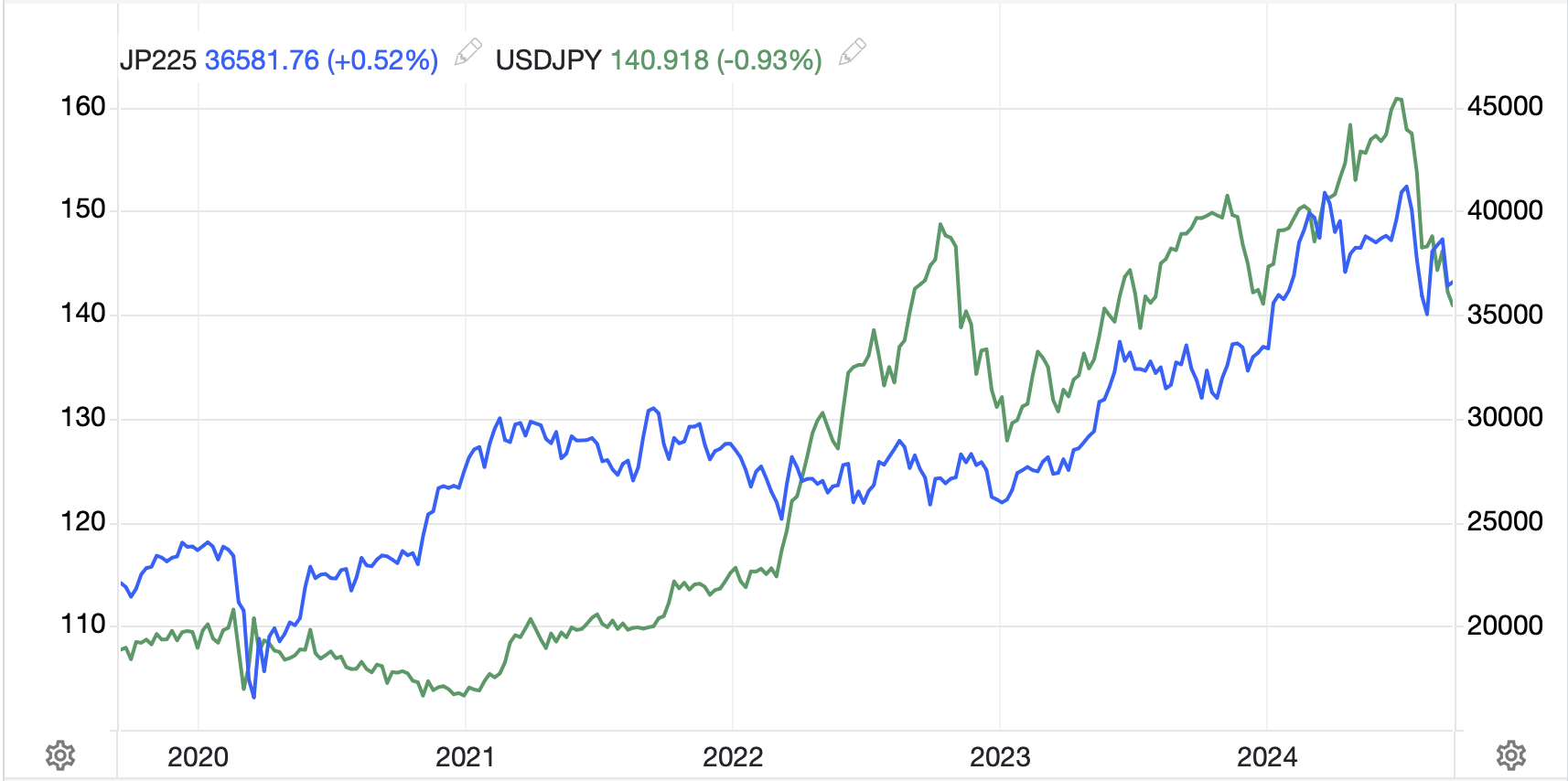
Ok, with that behind us, let’s look at the overnight session to see how things followed yesterday’s risk rally in the US.  In Asia, the Nikkei (-0.7%) has been struggling lately on the back of continued JPY strength.  As you can see from the below chart, that relationship has been pretty strong for a while, and last night, USDJPY traded to new lows for the year, erasing the entire gain (yen decline) that peaked at the end of June.

Source: tradingeconomics.com

As to the rest of Asia, mainland Chinese shares (CSI 300 -0.4%) continue to underperform although HK shares managed a rally (+0.75%) while most of the rest of the region showed very modest strength, certainly nothing like the US performance, but at least in the green.  In Europe, equity markets are all higher this morning with Spain’s IBEX (+0.8%) leading the way although solid gains of 0.3% – 0.5% prevalent elsewhere.  As to US futures, at this hour (7:45) they are creeping higher by about 0.1%.

In the bond market, Treasury yields are lower by 2bps this morning and European sovereign yields are generally little changed to lower by 2bps across the continent.  Yesterday’s ECB outcome was universally expected, and Madame Lagarde explained they remain data dependent and promised no timeline for potential further rate cuts, if they are even to come (they will).  As to JGB yields, they too fell 2bps last night, once again confusing those who are looking for policy tightening in Tokyo.

In the commodity markets, oil (+1.4%) is rallying for the third consecutive day as Hurricane Francine shut in about 40% of gulf production and the timing of its return is still uncertain.  Despite the US equity markets’ clear economic bullishness, the weak growth/demand story is still a major part of this discussion.  In the metals markets, gold (+0.3% overnight, +3.2% in the past week) continues to set new price records daily with a story making the rounds that SAMA, Saudi Arabia’s central bank, secretly bought 160 tons of gold last quarter, soaking up much supply.  This has helped drag silver back above $30/oz although copper (-0.5%) is stumbling a bit this morning.

Finally, it should be no surprise that the dollar is under some pressure this morning as the talk of more aggressive Fed easing grows.  While the euro and pound are little changed, JPY (+0.5%) is leading the way in the G10 with AUD (+0.45%), NZD (+0.4%), NOK (+0.2%) and SEK (+0.3%) all firmer on the back of commodity strength.  In the EMG bloc, the story is a bit more nuanced with ZAR (-0.15%) bucking the trend on domestic political concerns, although we saw strength in KRW (+0.5%) overnight and MXN (+0.35%) as the Fed rate cut story plays out across most currencies.

On the data front, only Michigan Sentiment (exp 68.0) is on the docket so once again, the dollar will be subject to the equity market behavior and the strength of narrative regarding just how dovish the Fed will wind up behaving next week.  I will say that a 50bp cut is likely to see some short-term dollar weakness, probably enough for it to fall to multi-year lows vs. its major counterparts.  But remember, if the Fed starts getting aggressive, other central banks will feel comfortable following that lead, so the dollar’s weakness may not be that long-lived.

Good luck and good weekend

Adf