Confusion

Confusion continues to reign
O’er markets though pundits will feign
That they understand
The movements at hand
Despite a quite rocky terrain
 
The speed with which Trump changes views
Can even, the algos, confuse
The pluses, I think
Are traders must shrink
Positions, elsewise pay high dues


For the longest time I believed that the algos were going to usurp all trading activity as their ability to respond to news was so much faster than any human.  Certainly, this has been the key to success for major trading firms like Citadel and Virtu Financial.  And they have been very successful.  I think part of their success has been that we have been in an environment where both implied and actual volatility has declined in a secular manner, so not only could they respond quickly, but they could lever up their positions with impunity as the probability of a large reversal was relatively less.

However, I believe that the algos and their owners may have met their match in Donald Trump.  Never before has someone been so powerful and yet so chaotic in his approach to very important things.  Many pundits complain that even he doesn’t have a plan when he announces a new policy.  But I think that’s his secret, keep everyone else off balance and then he has free reign.  Chaos is the goal.

The market impact of this is that basically, for the past three months since shortly after his election, the major asset classes of stocks, bonds and the dollar, have chopped around a lot, but not moved anywhere at all.  How can they as nobody seems willing to believe that the end game he has explained; reduced deficits, reduced trade balance, lower inflation and a strong military presence throughout the Western Hemisphere, is going to result from his actions.  And in fairness, some of the actions do have a random quality to them.  But if we have learned nothing from President Trump’s time in office, including his first term, it is that he is very willing to tell us what he is going to do.  It just seems that most folks don’t believe he can do it so don’t take it seriously.

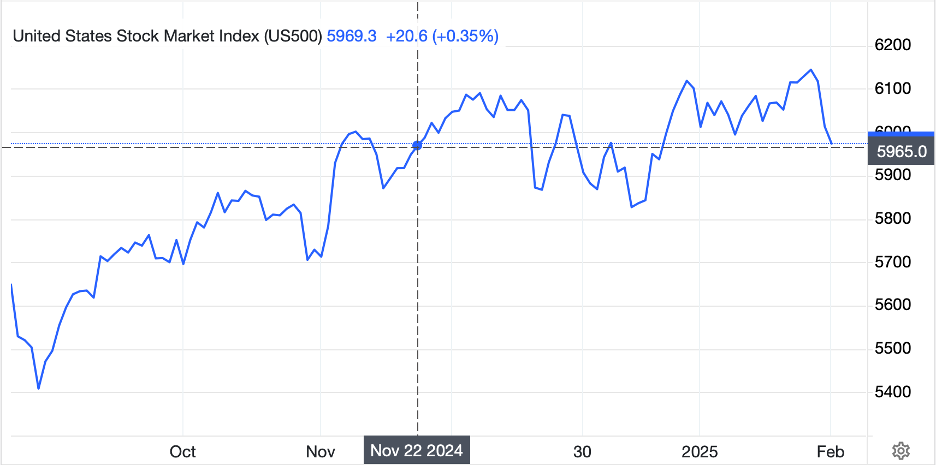
So, let’s look at how markets have behaved in the past three months.  The noteworthy result is that the net movement over that period has been virtually nil.  Look at the charts below from tradingeconomics.com:

S&P 500
10-Year Treasury

EUR/USD
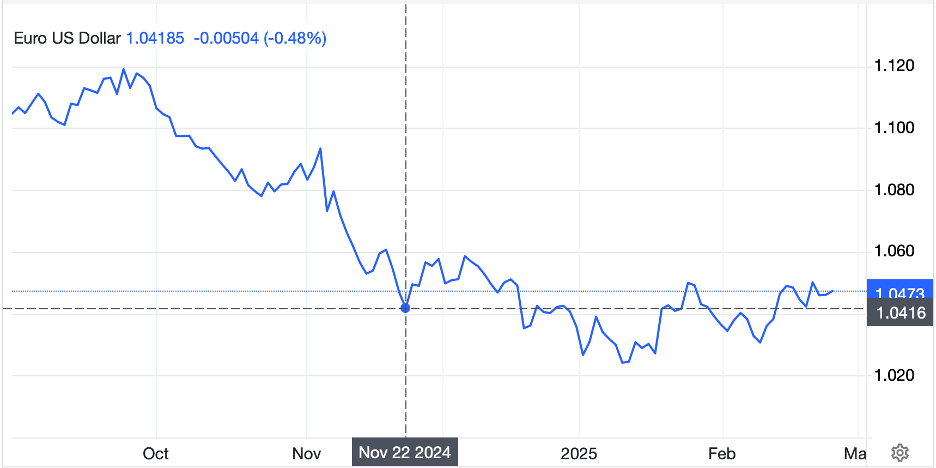
While all these markets have moved higher and lower in the intervening period, they have not gone anywhere at all.  The biggest mover over this time is the euro, which has rallied 0.54% with the other major markets showing far less movement than that.

One interesting phenomenon of this price action is that despite significant uncertainty over policy actions by the President and the implications they may have on markets, and even though recent price action can best be described as choppy rather than trend like, the VIX Index remains in the lowest quartile of its long-term range. Certainly, it has risen slightly over the past few weeks, but to my eye, it looks like it is underpricing the chaos yet to come.  

Source Bloomberg.com

While I have no clearer idea how things will unfold than anyone else, other than I have a certain amount of faith that the President will achieve many of his goals in one way or another, I am definitely of the belief that volatility is going to be the coin of the realm for quite a while going forward.  We have spent the past many years with numerous strategies created to enhance returns via selling volatility, either shorting options or levering up, and that is the trend that seems likely to change going forward.  The implication for hedgers is that maintaining hedge ratios while having a plan in place is going to be more important than any time in the past decade or more.

Ok, let’s take a look at how markets did move overnight.  Yesterday’s net negative session in the US was followed by similar price action in Asia.  Tokyo (-1.4%), Hong Kong (-1.35) and China (-1.1%) all suffered on stories about tariffs and extra efforts by the Trump administration to tighten up export controls on semiconductors.  It should be no surprise that virtually every index in Asia followed suit with losses between -0.3% (Singapore) and -2.4% (Indonesia) and everywhere in between.  Meanwhile, in Europe, the picture is not as dour as there are a few winners (Spain +0.9% and Italy +0.5%) although the rest of the continent is struggling to break even.  The data point that is receiving the most press is Eurozone Negotiated Wage Growth (+4.12%) which rose less than in Q3 and has encouraged many to believe the ECB will be cutting rates next week.  Interestingly, Joachim Nagel, Bundesbank president was on the tape telling the rest of the ECB to shut up about their expectations of future rate moves as there is still far too much uncertainty and decisions need to be made on a meeting-by-meeting basis.  Apparently, oversharing is a general central bank affliction, not merely a Fed problem.  As to US stocks, at this hour (6:50) they are little changed.

In the bond market, yields continue to slide, at least in the US, with Treasury yields down -6bps this morning and back to levels last seen in December.  Apparently, some investors are beginning to believe Secretary Bessent regarding his goal to drive yields lower.  As well, he has reconfirmed that there will be no major increase in the issuance of long-dated paper for now.  European sovereigns, though, are little changed this morning with only UK gilts (-3bps) showing any movement after the CBI Trades report printed at -23, a bit less bad than expected.

In the commodity markets, oil (-0.15%) is little changed this morning after a very modest rally yesterday.  But the reality here is that oil, like other markets, has been in a trading range rather than trending, although my take is that the longer-term view could be a bit lower.  Gold (-0.35%), though lower this morning, is the one market that has shown a trend since Trump’s election, and truthfully since well before that as you can see in the chart below.

Source: tradingeconomics.com

Finally, the dollar is a touch softer this morning, with both the euro and pound rising 0.3% alongside the CHF (+0.3%) and JPY (+0.2%). Commodity currencies, though, are less robust with very minor losses seen in MXN, ZAR and CLP.  Given the decline in 10-year yields, I am not that surprised at the dollar’s weakness although it is in opposition to the gut reaction that tariffs mean a higher dollar.  This is of interest because yesterday President Trump confirmed that the 25% tariffs on Canada and Mexico were going into effect next week.  As I explained above, it is very difficult to get a sense of short-term price action here although given the clear intent of the president to improve the competitiveness of US exporters, he would certainly like to see the dollar decline further.  

It is very interesting to watch this president reduce the power of the Fed with words and not even have to attack the Chairman like he did in his first term.  It will be very interesting to see how Chair Powell responds to the ongoing machinations.

On the data front, this morning brings only the Case-Shiller Home Price Index (exp +4.4%) and Consumer Confidence (102.5).  We do hear from two Fed speakers, Barr and Barkin, but as I keep explaining, their words matter less each day. (It must be driving them crazy!)

It is hard to get excited about markets here.  There is no directional bias right now and the lack of critical data adds to the lack of information.  As well, given the mercurial nature of President Trump’s activities, we are always one tape bomb away from a complete reversal.  While I don’t see the dollar collapsing, perhaps the next short-term wave is for further dollar weakness.  

Good luck

Adf

Three-Three-Three

Said Bessent, when speaking of rates
The 10-year yield’s what dominates
Our focus and goals
As that’s what controls
Most mortgages here in the States
 
Remember, our goal’s three-three-three
With job one on deficits key
So, that’s why we’ll slash
The wasting of cash
With tax cuts set permanently


There is a new voice in Washington that matters to Wall Street, that of the new Treasury Secretary Scott Bessent.  Yesterday in his first significant comments since his swearing-in, he made very clear that he and the president were far more focused on the 10-year Treasury yield, and driving that lower, than they were concerned over the Fed funds rate.  Talk about a different focus than the last administration!  At any rate, he expounded on his views as to how that can be achieved, namely lower energy prices and a reduced budget deficit alongside deregulation.  Recall, his three-three-three plan is 3% budget deficit, 3mm barrels of oil/day additional supply and 3% GDP growth.  Clearly, this is a tall order given the starting point, but he has not shied away from these goals and insists they are achievable.

Yesterday also brought the Quarterly Refunding Announcement, the Treasury’s announced borrowing schedule for the current quarter.  Under then-Secretary Yellen, the US shifted its borrowing to a much greater percentage of short-term T-bills (<1-year maturity) while avoiding the sale of longer date notes and bonds.  This is something which Bessent has consistently explained his predecessor screwed up given her unwillingness to term out more debt when the entire interest rate structure was much lower.  After all, homeowners were smart enough to refinance down to 3% fixed rate mortgages, but the Treasury secretary thought it was a better idea to stay short.  

Of course, changing the current treasury mix is one of the impediments to lower 10-year yields because changing it would require an increase in the sale of longer dated paper which would depress the price and raise those yields.  Bessent has his work cut out for him.  However, my take is this is a goal, but one that will be achieved gradually.  He even commented that until the debt ceiling is raised, there will be no changes in the debt mix.  Arguably, if the administration can make real progress on reducing the budget deficit, that is what will allow for the gradual adjustment of the debt mix without a dramatic rise in long-term yields.

Perhaps it is still the honeymoon period, but the market is showing some deference to Mr Bessent as 10-year yields have fallen steadily in the past two weeks, dropping from a high of 4.81% the week before the inauguration to their current level at 4.44%.  

Source: tradingeconomics.com

While we cannot attribute the entire move to Bessent, certainly investors are showing at least a little love at this stage.  I believe the 10-year yield will grow in importance for all markets as movement there will be seen as the report card for Bessent and this administration’s goals.

Meanwhile, in the UK, stagflation
Is now the Old Lady’s vexation
But cut rates, they will
Lest growth they do kill
As prices continue dilation

The BOE is currently meeting, and expectations are nearly universal that they will cut their base rate by 25bps to 4.50% with 8 of the 9 MPC members set to vote that way.  The only hawk on the committee, Catherine Mann, is expected to vote for no change.  The problem they have (well the problem regarding monetary policy, there are many problems extant in the UK right now) is that core inflation continues to run above 3.0% while GDP is growing at approximately 0.0% in recent quarters and at 1.0% in the past year.  A quick look at the monthly GDP readings below shows that things have not been moving along very well, certainly not since PM Starmer’s election in July.

Source: tradingeconomics.com

In stagflationary environments, the most successful central bank responses have been to kill the inflation and suffer the consequences of the inevitable recession first, allowing growth to resume under better circumstances.  Of course, Paul Volcker is most famous for this model, which he derived after numerous other countries, notably the UK, failed to effectively solve the problem in the mid 1970’s in the wake of the first oil price shocks.  Now, the UK has created its own energy price supply shock via its insane efforts to wean itself from fossil fuels without adequate alternate supplies of energy, and stagflation is the natural result.  However, addressing inflation does not appear to be the primary focus of the Bank of England right now.  I am skeptical that they will be successful in achieving their goals which is one of the key reasons I dislike the pound over time.

Ok, let’s turn to market activity overnight.  The party continues on Wall Street with yesterday’s equity gains attributed to many things, perhaps Bessent’s comments being amongst the drivers.  Certainly, a reduced budget deficit and reduced 10-year yields are likely to help the market overall.  That attitude has been uniform overnight and through the morning session with every major Asian market (Japan, +0.6%, Hong Kong +1.4%, China +1.3%) and European market (Germany +0.8%, France +0.8%, UK +1.45%) higher on the session.  As it happens, the BOE did cut rates by 25bps as expected and now we await Governor Bailey’s comments.  As to US futures, at this hour (7:25) they are little changed on the session.

In the bond market, the ongoing rally has stalled for now with Treasury yields higher by 2bps this morning while most European sovereign yields are little changed on the day.  A key piece of information that is set to be released tomorrow comes from the ECB as their economists are going to report the ECB’s estimate of where the neutral rate lies in Europe.  With the deposit rate there down to 2.75%, many pundits, and ECB speakers, are targeting 2.0% as the proper level implying more rate cuts to come.

In the commodity markets, oil (+0.65%) is bouncing off its recent trading lows but in truth, a look at the chart and one is hard-pressed to discern an overall direction.  More choppiness seems likely as the market tries to absorb the latest information from the Trump administration and its plans.

Source: tradingeconomics.com

As to the metals markets, gold, which had a strong rally yesterday and made further new all-time highs, is unchanged this morning while silver (-0.75%) consolidates its recent gains and copper (+0.6%) adds to its gains.  The thing about copper is it is, allegedly, a good prognosticator of economic activity as it is so widely used in industry and construction, and it has been rallying sharply for the past month.  That does seem to bode well for future activity.

Finally, the dollar is firmer this morning, recouping some of its recent losses although I would contend we have merely been consolidating after a sharp move higher during the past three months.  The pound (-1.0%) is today’s laggard after the rate cut but we are seeing weakness almost everywhere in both G10 and EMG currencies.  One exception is the yen (+0.2%) which seems to be benefitting from comments by former BOJ Governor Kuroda that the BOJ is likely to raise rates above 1.0% during the coming year.  Interestingly, he explained that given the recent economic trajectory, it was only natural that the BOJ would seek to normalize rates.  However, given that interest rates in Japan have been 0.5% or below for the past 30 years, wouldn’t that be considered normal these days?  Just sayin’!

On the data front, with the BOE out of the way, we now get the weekly Initial (exp 213K) and Continuing (1870K) Claims data as well as Nonfarm Productivity (1.4%) and Unit Labor Costs (3.4%).  Yesterday’s ADP Employment data was much stronger than expected with a revision higher to last month as well, certainly a positive for the job outlook.  As well, this afternoon we hear from three more Fed speakers, but so far this week, the word caution has been the most frequently used noun in their vocabulary.  Of course, with Mr Bessent now starting to make his views known, perhaps more focus will turn there and away from the Fed for a while.

Market participants are clearly feeling pretty good right now, especially about the recent activity in the US.  I think you have to like US assets, both stocks and bonds, while expecting the dollar to continue to hold its ground.  This sounds like a recipe for weaker commodity prices, notably gold, but so far, that has not been the case.

Good luck

Adf

Wrecked

There once was a Treasury note
Whose yield every trader could quote
Of late, its price dive
To yields above five
Has tongues wagging while bond bears gloat

Now, looking ahead I expect
This rise in yields could architect
More problems worldwide
As risk assets slide
And equity markets get wrecked

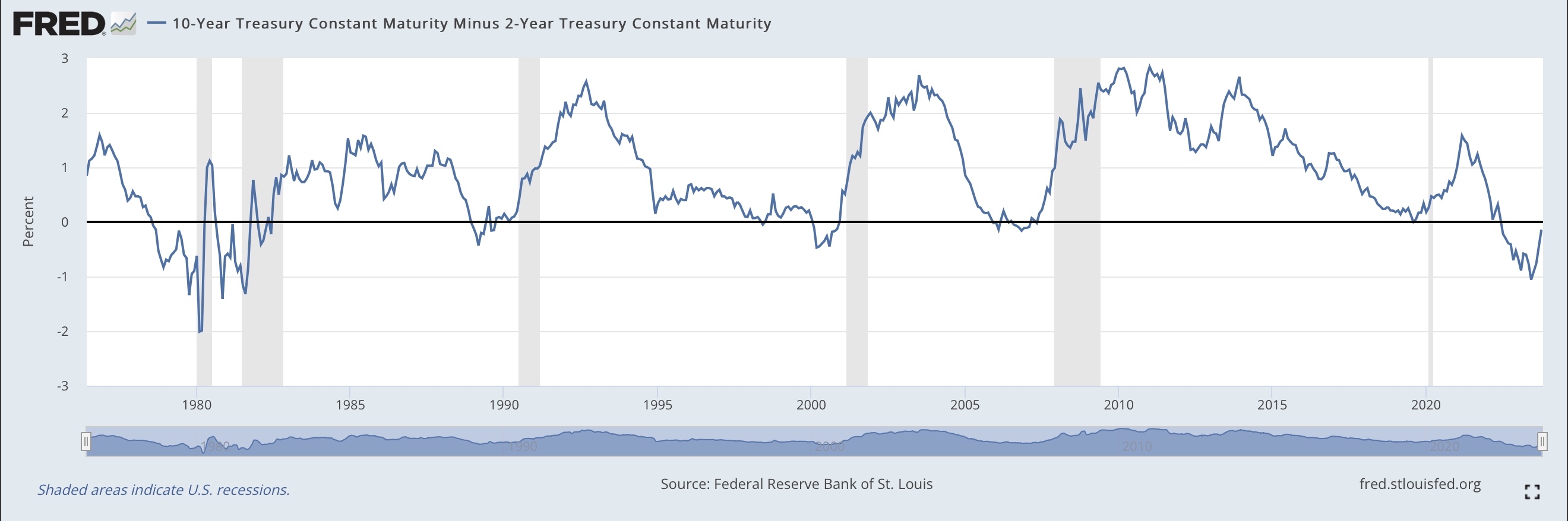
There is only one story in financial markets today, and that is the fact that the 10-year US Treasury note is now yielding above 5.0%.  We briefly touched that level last Thursday, and then saw a pullback in yields on Friday, but today there is no question about a breach of that key psychological level.  As a corollary to that price action, the 2yr-10yr spread is down to -12bps and looks quite clearly as though it is going to complete the normalization process this week.  The real question is, how much further will it steepen?  A quick look at the chart below from the St Louis Fed’s FRED database shows that the average steepness of this spread is somewhere around +100bps.  The implication is that if the Fed continues to hold Fed funds at their current level, and higher for longer is the way forward, then 10-year Treasury yields could easily head to 6.00% and simply be back to their long-term relationship with the 2-year Treasury.

The other thing to note is why there is so much focus on the shape of the yield curve.  As you can see from the shaded gray areas on this chart, every recession was preceded by a curve inversion (negative 2yr-10yr spread) but then when the recession was in process, the curve was steepening dramatically.  It is this history that has economists and analysts concerned given the speed with which the curve is steepening of late.

And yet…two headlines in the WSJ this morning show a completely opposite expectation.   A Recession is no Longer the Consensus is one of them, explaining a survey of economists now shows that fewer than half anticipate a recession will arrive at all, let alone soon.  In addition, we have The Economy was Supposed to Slow by Now.  Instead it’s Revving Up” which describes the fact that recent data has been firmer than expected (see Retail Sales and NFP earlier this month) and now the proverbial soft landing is the new consensus call.  

Now, maybe this time really will be different, but that is always a hard pill to swallow.  There are many things that continue to haunt the economy with respect to things like bank lending standards tightening and consumer debt and delinquencies rising, neither a sign of economic strength.  In fact, there was a terrific note published this weekend on Substack by GrahamsBenjamins going into more detail.  The point is that there is a significant amount of economic stress in the economy and that combined with the rapid steepening of the yield curve has always been a sign of a looming recession.  And folks, if (when?) that recession arrives, you can be confident that risk assets are going to decline sharply in value.  Just sayin!

Ok, with that cheery opening, let’s see how markets have behaved overnight.  Following last week’s lousy price action in the US, Asian shares were lower across the board, somewhere between -0.75% and -1.0% while European bourses are also lower, perhaps a little less dramatically, with an average decline on the order of -0.5%.  US futures, too, are in the red, -0.6% or so at this hour (7:15), and not feeling very good.

Meanwhile, we already know the Treasury story, but it is important to understand that European sovereign yields are also rising rapidly, with most of them higher between 4bps and 6bps this morning.  That critical Bund-BTP spread continues to trade just north of 200bps and holds the potential to be quite destabilizing if it widens much further.  As well, we saw JGB yields creep up 2bps and are now at 0.85%. Inflation in Japan has been above 3.0% for the past 14 months,  and more and more analysts are concluding the BOJ is going to have to tweak their policy yet again.  There is far more to the bond market than just Treasuries, although Treasuries are clearly still story number one.

On the commodity front, oil (-0.6%) is a bit softer this morning although this seems a consolidation of last week’s strength.  The biggest question in this market is the tension between the possible recession and a corresponding reduction in demand, and the structural supply shortages that are currently being exacerbated by the Saudi and Russian production cuts.  My money is still on higher prices over time.  Meanwhile, gold is little changed this morning, holding up quite well in the face of rising yields and seeming to be showcasing its haven status of late.  As to the base metals, both copper and aluminum continue to grind lower with copper having fallen to its lowest level in a year and seemingly an indication of economic weakness to come.

Finally, the dollar is mixed to slightly softer this morning although slightly is the operative word.  Looking across the G10 currencies, the Skandies are under a bit of pressure, but the majors are essentially unchanged.  The real news is that the correlation between the dollar and Treasury yields seems to be disintegrating.  If that is changing, then there are certainly many reasons to believe the dollar can decline given the US fiscal situation and the continuous growth in the US debt portfolio.  As is often said, nothing matters until it matters.  Throughout my entire career, spanning > 40 years, there has been a constant drumbeat of how the dollar should decline because of the massive budget and trade deficits that the US has run consistently.  And that drumbeat has been studiously ignored for all that time.  But perhaps, it will soon matter.  While that is not my base forecast, one has to assign that outcome some real probability.

On the data front this week, this is what we see:

TodayChicago Fed National Activity-0.16
TuesdayFlash PMI Manufacturing49.5
 Flash PMI Services49.9
WednesdayNew Home Sales680K
ThursdayInitial Claims209K
 Continuing Claims1720K
 Durable Goods1.5%
 -ex Transport0.2%
 GDP Q34.2%
FridayPersonal income0.4%
 Personal Spending0.5%
 Core PCE0.3% (3.7% Y/Y)
 Michigan Sentiment63.0

Source: Tradingeconomics.com

Weirdly, while the Fed is supposed to be in its quiet period, I see three speeches scheduled, with Chairman Powell ostensibly speaking Wednesday afternoon.  I will need to confirm that as it would be highly unusual at this time.

It seems to me the big question is whether the dollar – rates correlation is breaking down.  If that is the case, then I will need to rethink, and likely adjust, my views of a stronger dollar over time, at least vs. the majors.  But tick by tick price action is not necessary for the relationship to generally hold.  I still like the dollar over time but am certainly going to review the situation more closely to see if something truly has changed.

Good luck

Adf