Remarkable Fragility

JGB yields have
Risen to multi-year heights
Is this why stocks fell?


Yesterday I highlighted that 10-year JGB yields had risen to their highest level since 2008.  As you can see below, the same is true for 30-year JGBs and essentially the entire curve there.

Source: tradingeconomics.com

Ostensibly, this move was triggered by comments from BOJ Governor Ueda indicating that a rate hike was coming this month.  However, the thing I find more interesting is that this move in JGB yields has become the bête noire of markets, now being blamed for every negative thing that happened yesterday.  

For instance, Treasury yields yesterday rose 7bps despite ISM data indicating that manufacturing activity remains sluggish at best.  In fact, the initial response to that data was that it confirmed the Fed will be cutting rates next week.  But the narrative seems to be that Japanese investors are now willing to repatriate funds, selling Treasuries to buy JGBs, in order to invest locally because they are finally getting paid to do so.  Certainly, looking at the chart above shows that Japanese yields had been tantamount to zero for a long time prior to 2024, and even then, have only started to show any real value in the most recent few months.  Of course, real 10-year yields in Japan remain significantly negative based on the latest inflation reading of 3.0%.  The upshot is, rising JGB yields are deemed the cause of Treasury market weakness.

Turning to risk assets, the story is the same for both stocks (which saw US equities decline across the board yesterday) and cryptocurrencies, notably Bitcoin.  Ostensibly, the rise in yields, and the prospect of a rate hike by the BOJ (to just 0.75% mind you) has been cited as the driver of an unwinding in leveraged trades as hedge funds seek to get ahead of having their funding costs rise thus crimping their margins.  

There is no doubt in my mind that the yen has been a critical funding currency for a wide array of carry trades, that is true.  In fact, that has been the case for several decades.  But is 25 basis points really enough to destroy all the strategies that rely on that process?  If so, it demonstrates a remarkable fragility in markets, and one that portends much worse outcomes going forward.  

If we look at the relationship between Bitcoin and 10-year JGBs, it appears that there has been a significant change in tone.  For the past two months, while JGB yields have continued to climb, BTC has broken its correlation with JGBs and has fallen dramatically instead. (see below chart from tradingeconomics.com). When it comes to crypto, I am confident that leverage levels are higher than anywhere else, in fact that seems part of the attraction, so it should not be as surprising to see something of this nature.  But again, it speaks to a very fragile market situation given there was no discernible change in the Japanese yield trend to drive a Bitcoin adjustment.
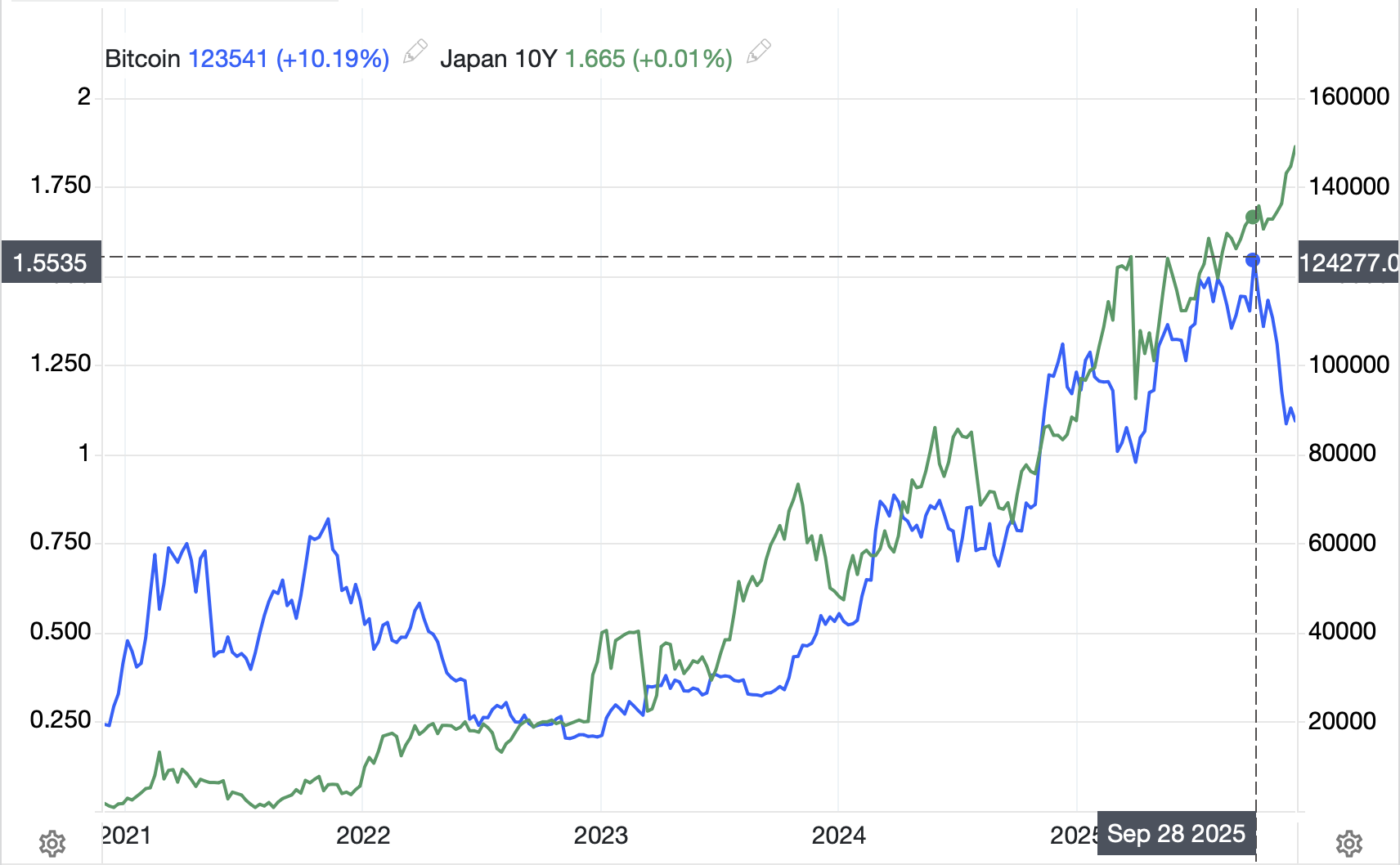
The upshot here, too, is that rising JGB yields are claimed to be the reason Bitcoin is declining.  In fact, nearly all the commentary of late seems to be focusing on JGBs as the driver of everything.  While I concede that Japanese yields are an important part of the USDJPY discussion, it is difficult for me to assign them blame for everything else.  I have seen numerous commentators explaining that the Japanese have been selling Treasuries because they don’t trust the US, and this has been ongoing for years.  I have also seen commentators explain that because Japanese surpluses had been invested internationally for years and funding so much of the world’s activity, now that they can invest at home, liquidity everywhere will dry up, and asset prices will fall.  

Responding to the first issue, especially with new PM Sanae Takaichi, I do not believe that is a concern at all.  If anything, I expect that the relationship between the US and Japan will deepen.  As to the second issue, that may have more import but the one thing of which we can be sure is that central banks around the world will not allow liquidity to dry up in any meaningful fashion.  Remember, the Fed ended QT yesterday and it won’t be long before the balance sheet starts to grow again, adding liquidity to the system.  One thing I have learned in my many years observing and trading in markets is, there doesn’t need to be a catalyst for markets to move in an unexpected direction.  Certainly not a big picture catalyst.

And with that, let’s look at how markets responded overnight to yesterday’s risk-off session in the US.  Looking at the bond market first, yesterday’s rise in yields was nearly universal with European sovereigns all following the Treasury market’s lead.  And this morning, across the board sovereigns are higher by 1bp, the same as Treasury yields.  While JGB yields didn’t budge overnight, we did see Australia and other regional yields catch up to yesterday’s rise.  I fear bond investors are stuck as they see the potential for inflation, but they also see weakening economic activity as a moderator there.  As an example, the OECD just reduced its US GDP forecast for 2026 to 2.9% this morning, from 3.2%.  Personally, I don’t think anything has changed the run it hot scenario.

In the equity markets, Asian bourses were mixed with Korea (+1.9%) and Taiwan (+0.8%) the notable gainers while elsewhere movement was much less substantial (Japan 0.0%, HK +0.2%, China -0.4%).  There was no single story driving things there.  As to Europe, things are brighter this morning led by Spain (+1.0%) and Italy (+0.5%) although there is no single driving issue here either.  US futures are edging higher at this hour as well, +0.2%, so perhaps yesterday was more like a little profit taking after last week’s strong rally, than anything else.

In the commodity sector, oil (-0.3%) is slipping after yesterday’s rally.  I suppose the potential peace in Ukraine is bearish, but that story has been dragging on for a while so I’m not sure when it will come to fruition.  In the metals markets, after a gangbusters rally yesterday, with silver trading to $59/oz, we are seeing a modest retracement this morning across the board (Au -0.6%, Ag -1.2%, Pt -2.0%) although copper (+0.4%) is holding its gains.  Nothing indicates that these metals have topped.

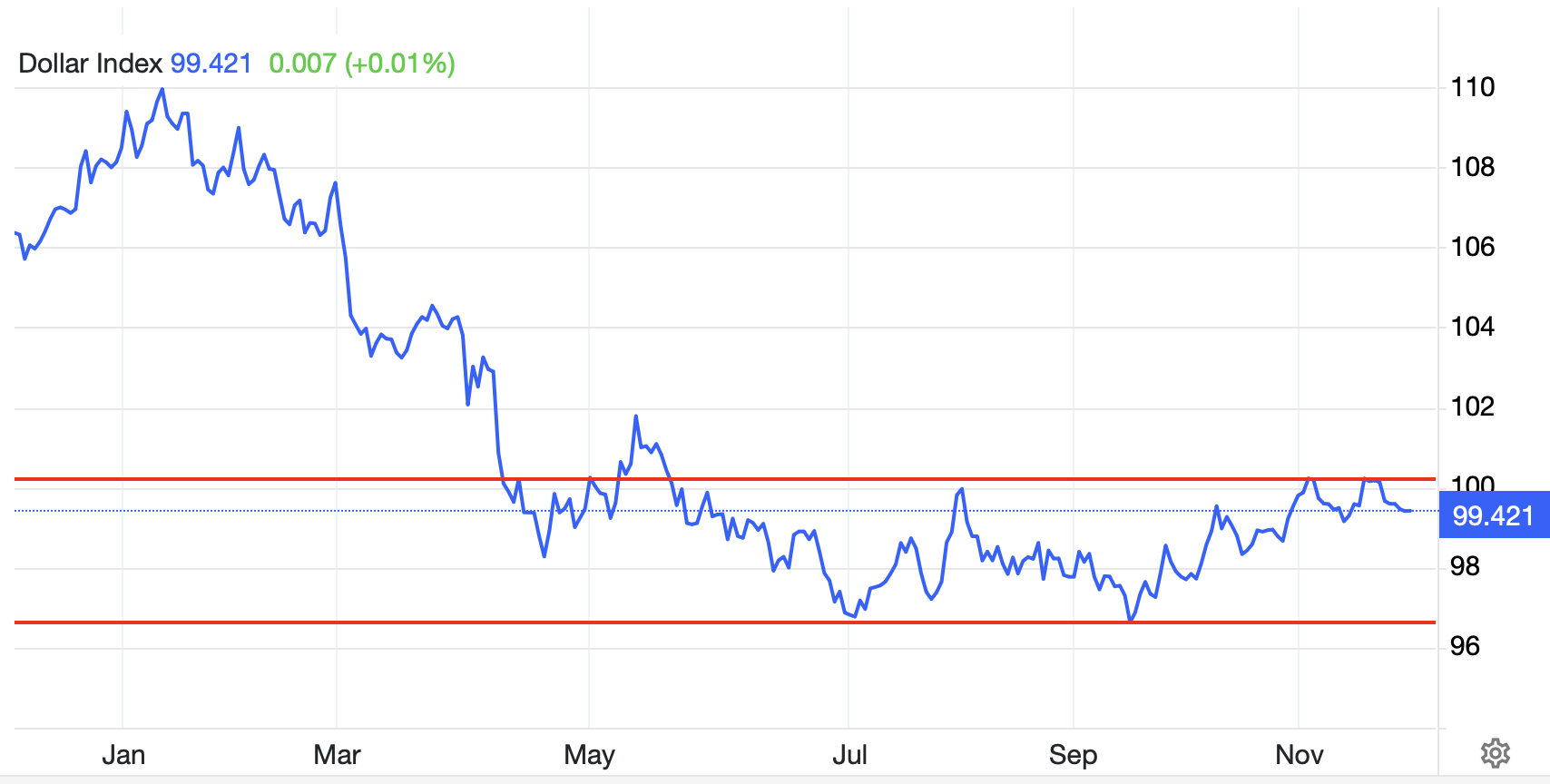
Finally, the dollar is little changed as I write, giving back some early modest strength.  JPY (-0.3%) continues to be amongst the worst performers, and although it has bounced from its recent lows, remains within a few percent of those levels.  My take here is we will need to see both a more aggressive Fed and a more aggressive BOJ to get USDJPY back to 150 even, let alone further than that.  If we look at the DXY, it is sitting at 99.45, and still well within its trading range for the past 6+ months as per the below.  For now, the dollar remains a secondary story.
Source: tradingeconomics.com

On the data front, here’s what comes the rest of this week:

WednesdayADP Employment 10K
 IP0.1%
 Capacity Utilization77.3%
 ISM Services52.1
ThursdayInitial Claims220K
 Continuing Claims1960K
 Trade Balance -$65.5B
FridayPersonal Income (Sep)0.4%
 Personal Spending (Sep)0.4%
 PCE (Sep)0.3% (2.8% Y/Y)
 -ex food & energy0.2% (2.9% Y/Y)
 Michigan Expectations51.2
 Consumer Credit$10.5B

Source: tradingeconomics.com

As the Fed is in its quiet period, there are no Fed speakers until Powell at the presser next week.  Given the age of the PCE data, I don’t see it having much impact.  Rather, ADP and ISM are likely the things that matter most for now.

Ultimately, I believe more liquidity is going to come to the market via central banks around the world, and that will support risk assets, as well as prices for the things we buy.  Nothing has changed in my view of the dollar either.

Good luck

Adf

Markets Ain’t Fair

The pundits, when looking ahead
All fear that their theses are dead
‘Cause bitcoin’s imploding
And that is corroding
The views they have tried to embed
 
The thing is, it’s simply not clear
What caused this excessive new fear
But those with gray hair
Know markets ain’t fair
And force us to all persevere


It all came undone yesterday around 10:45 in the morning for no obvious reason.  There was no data released then to drive trader reaction nor any commentary of note.  In fact, most of the punditry was still reveling in the higher Nvidia earnings and planning which Birkin bag they were going to buy for their girlfriends wives.  But as you can see from the NASDAQ chart below, in the ensuing two hours, the index fell by 4% and then slipped another 1% or so from there into the close, the level that is still trading at 6:30 this morning

Source: tradingeconomics.com

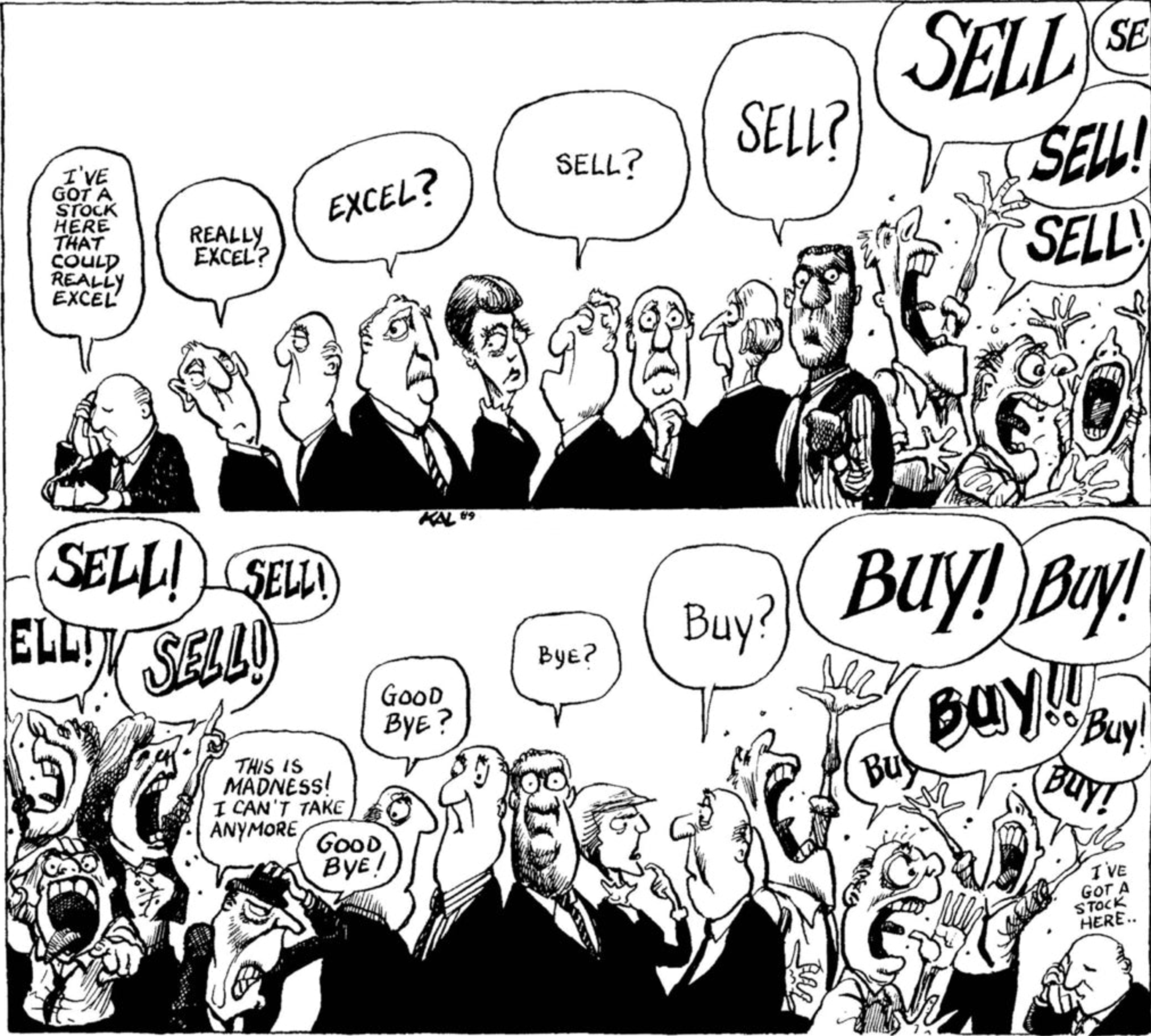
As a member in good standing of the gray hair club, I have seen this movie before, and I have always admired the following image as a perfect example of the way things work in markets.  

And arguably, this is all you need to know about how things work.  Sure, there are times when a specific data release or Fed comment is a very clear driver of market activity, but I would contend that is the exception rather than the rule.  The day following Black Monday in 1987, the WSJ asked noted Wall Street managers what caused the huge decline.  Former Bear Stearns Chairman, Ace Greenberg said it best when he replied, “markets move, next question.”  And that is the reality.  While I believe that macroeconomics offers important information for long-term investing theses, on any given day, anything can happen.  Yesterday is a perfect example of that reality.

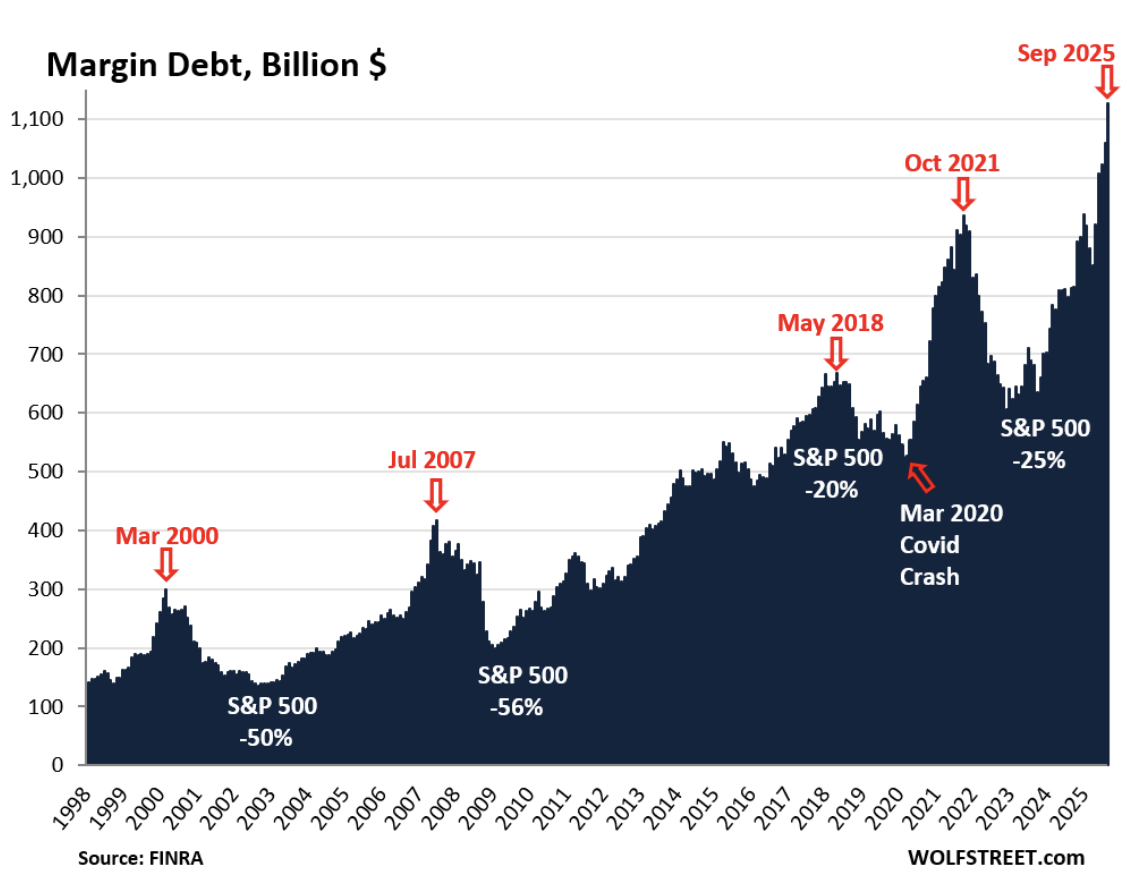
But let us consider what we know about the overall financial situation.  The Damoclesian Sword hanging over everything is excessive leverage across the board.  I have often discussed the idea that global debt is more than 3X global GDP, a clear an indication that there will be repayment problems going forward.  And something that seems to have been driving recent equity market gains has been an increase in margin buying of stocks and leverage in general.  After all, the fact that there are ETFs that offer 3X leverage on a particular stock or strategy is remarkable.  But a look at the broad levels of leverage, as shown by the increase in margin debt in the chart below from Wolfstreet.com (a very worthwhile follow for free) tells me, at least, that when things turn, there is going to be an awful lot of selling that has nothing to do with value and everything to do with getting cash for margin calls.

It is this process that drives down the good with the bad and as you can see in the chart, happens regularly.  I’m not saying that we are looking at a major reversal ahead, but as I wrote earlier this week, a correction seems long overdue.  Perhaps yesterday was the first step.

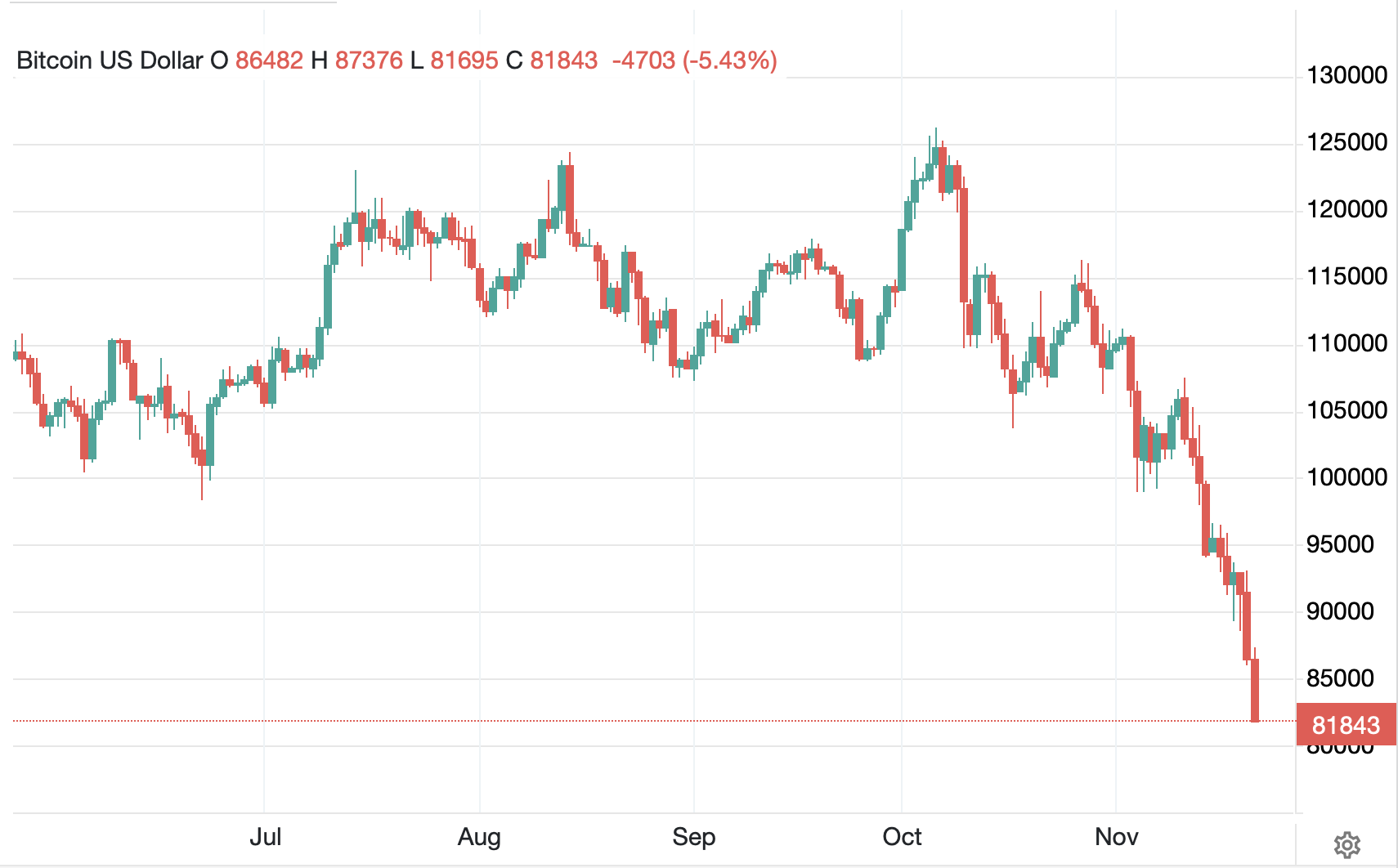
One last thing.  I mentioned Bitcoin at the top and I think it is worthwhile to look at the chart there to get a sense of just how speculative assets behave when times are tough.  Since its peak on October 6th, 46 days ago, it has declined ~45% as of this morning.  That, my friends, is a serious price adjustment!

Source: tradingeconomics.com

Ok, let’s see how other markets are behaving in the wake of this, as well as the recent news.  Remember, yesterday we saw a slew of old US data on employment, but it is all we have, so probably has more importance than it deserves.  After all, it is pre-shutdown and things have clearly changed since then.

Starting in Asia, it wasn’t pretty with the three main markets (Nikkei, Hang Seng, CSI 300) all declining by -2.40%.  Korea (-3.8%) and Taiwan (-3.6%) fared even worse but the entire region was under pressure.  The narrative that is forming as an explanation is that there is trouble in tech land, despite the Nvidia earnings, and since Asia is all about tech, you can see why it fell.

Meanwhile, the antithesis of tech, aka Europe, is also lower across the board this morning, albeit not as dramatically.  Spain’s IBEX (-1.3%) is leading the way down but weakness is pervasive; DAX (-0.8%), CAC (-0.4%), FTSE 100 (-0.4%), as all these nations also released their Flash PMI data which came in generally softer across the board.  But there is one other thing weighing on Europe and that is the publication of a 28-point peace plan designed to end the Russia/Ukraine war.  The plan comes from the US and essentially ignored Europe’s views as it is patently clear they are not interested in peace.  In fact, it appears peace will be quite the negative for Europe as it will undermine their rearmament drive and likely force governments there to focus on domestic issues, something which, to date, they have proven singularly incompetent to address.  In fact, if the war really ends, I suspect there are going to be several governments to fall in Europe with ensuing uncertainty in their economies and markets.  As to the US futures markets, at this hour (7:30) they are basically unchanged to leaning slightly higher.  Perhaps the worst is past.

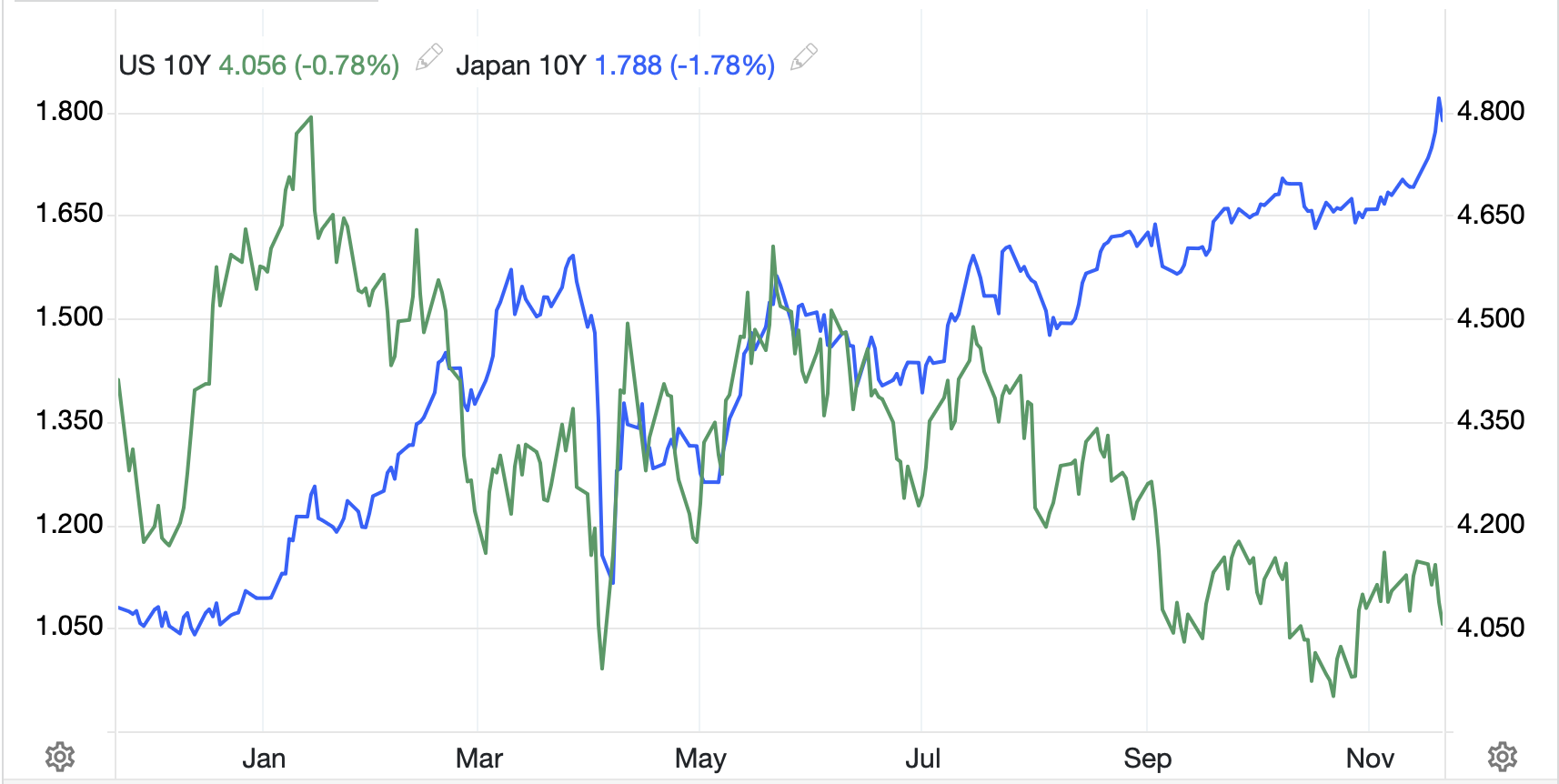
In the bond market, yields are lower across the board led by Treasuries (-4bps) while European sovereign yields have slipped -2bps to -3bps.  Certainly, the European data does not scream inflationary growth, but I have a feeling this is more about tracking Treasuries than anything else.  I say that because JGB yields also fell -4bps despite the passage of an even larger supplementary budget than expected, ¥21.7 trillion, which is still going to be paid for with more borrowing.  That is hardly the news to get investors to buy JGBs and I suspect yields will climb higher again going forward.  I think it is worth looking at the trend in US vs. Japanese 10-year yields to get a fuller picture of just how different things are in the two nations.  Of course, there is one thing that is similar, inflation continues to remain above their respective 2.0% targets and is showing no signs of returning anytime soon.

Source: tradingeconomics.com

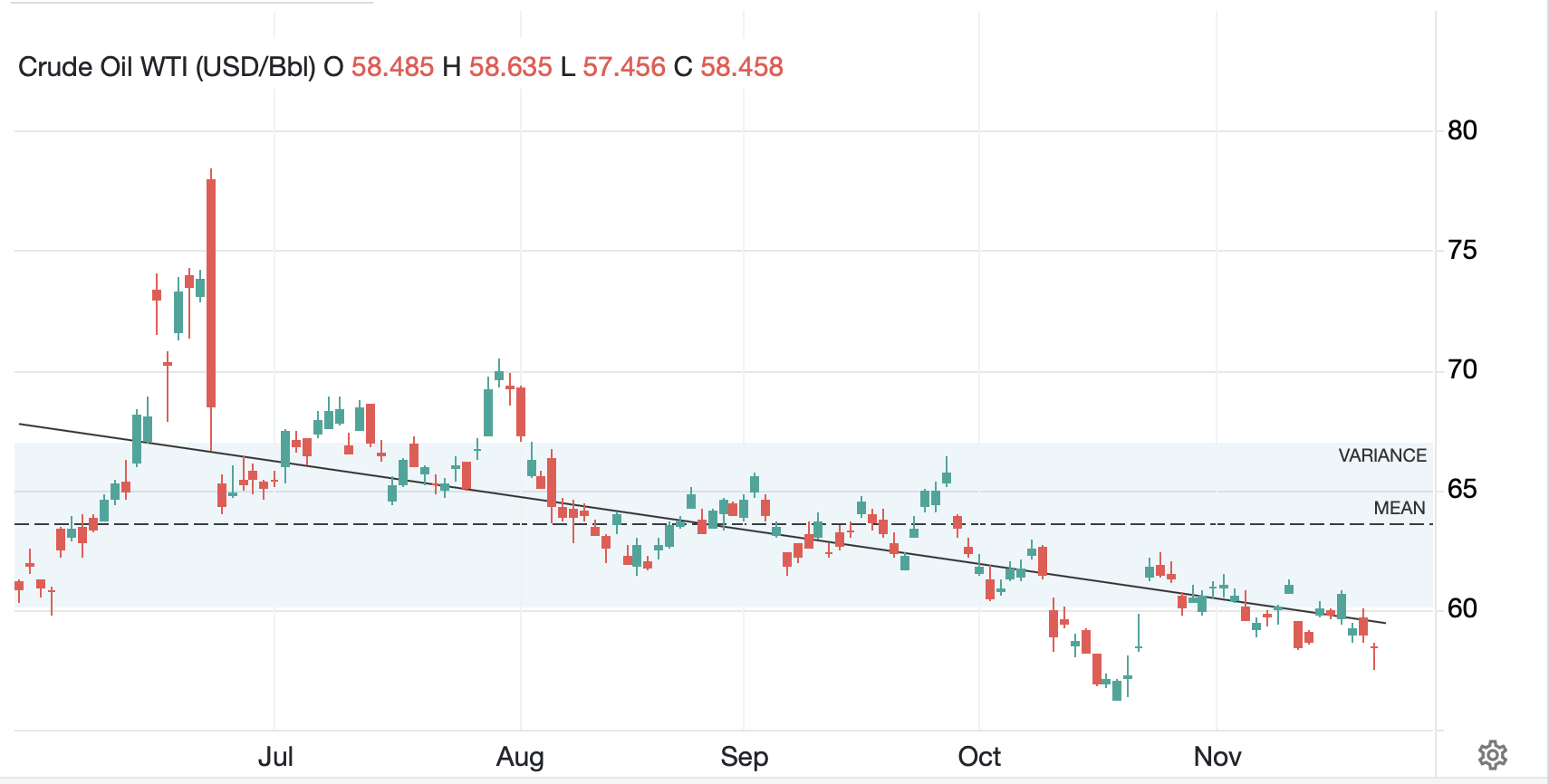
You will not be surprised to know that commodity prices remain extremely volatile.  Oil (-1.0%) had a bad day yesterday and is continuing lower this morning although as you can see from the chart below, it is off its worst levels of the session.  But the one thing that remains true despite the volatility is the trend remains lower.

Source: tradingeconomics.com

Metals markets also suffered yesterday and are under pressure this morning with gold (-0.4%) and silver (-2.5%) sliding.  One thing to remember is that when margin calls come, traders/investors sell what they can, not what they want, and given the liquidity that remains in both gold and silver, they tend to get sold to cover margin calls.  Too, today is the weekly option expiry in the SLV ETF and as my friend JJ (writes at Market Vibes) regularly explains, there is a huge amount of silver activity driven by the maturing positions.

Finally, the dollar continues to remain solidly bid, although is merely consolidating recent gains as it trades just above the key 100 level in the DXY.  Two things of note today are JPY (+0.5%) which responded to comments from not only the FInMin, but also Ueda-san explaining that a weak yen is driving inflation higher and might need to be addressed.  Step 4 of the dance toward intervention?  As to the rest of the G10, movement has been minimal.  But in the EMG bloc, INR (-1.1%) fell to record lows (dollar highs) after the RBI stepped away from its market support.  It sure seems like it is going to break through 90 soon and I imagine 100 is viable.  As well, ZAR (-0.7%) is suffering on the weaker metals prices, along with CLP (-0.5%) while BRL (-0.5%) slipped as talk of a more dovish central bank stance started percolating in markets.

Today’s data brings US Flash PMI (exp 52.0 Manufacturing, 54.6 Services) and Michigan Sentiment (50.5).  We hear from five more Fed speakers, with a mix of hawks and doves.  It will be interesting to see how the doves frame yesterday’s better than expected September NFP report as their entire thesis is softening labor growth is going to be the bigger problem than rising prices.

I, for one, am glad the weekend is upon us.  For today, I am at a loss for risk assets.  The case can be made either way and I have no strong insight.  However, the one thing that I continue to believe is the dollar is going to find support.  Remember, when things get really bad (and they haven’t yet) people still run to T-bills to hide, and that requires buying dollars.

Good luck and good weekend

Adf

Never Sold

The news of the day is that gold
Is actively bought, never sold
The Four Thousand level
Led some folks to revel
And drew many more to the fold
 
But weirdly, the dollar keeps rising
Which based on the past is surprising
The problems in France
And Sanae’s stance
Have been, for the buck, energizing


A month ago, many Wall Street analysts came out with forecasts that gold could trade as high as $4000/oz by mid 2026 as they reluctantly jumped on the bandwagon.  But, by many accounts, although my charts don’t show it, the barbarous relic’s futures contract traded a bit more than 120 lots at $4000.10 last night, nine months earlier than those forecasts.

Source: Bloomberg.com

Right now (6:20), the cash market is trading at $3957 (-0.1%) but there is absolutely no indication that the top is in.  Rather, I have been reading about the new GenZ BOLD investment strategy, which is buying a combination of Bitcoin and gold.  Mohammed El-Arian nicknamed this the debasement trade, which is a fair assessment and a number of banks have been jumping on this theme.

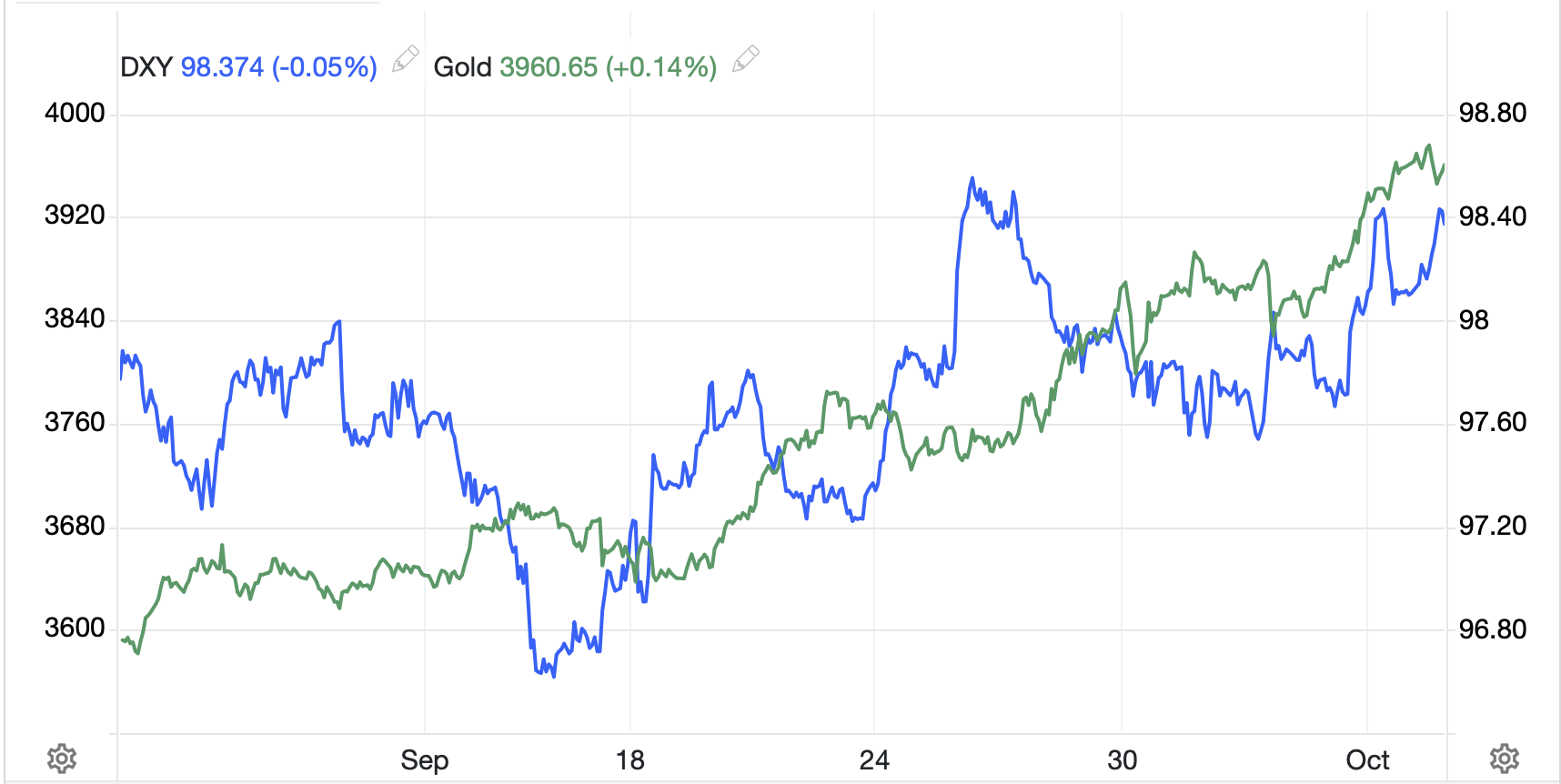
Perhaps more interesting than this story, which after all is simply rehashing the fact that gold is seen as a long-term hedge against inflation, is the fact that the dollar is trading higher alongside gold, which is typically not the case.  In fact, for the bulk of my career, gold was effectively just another currency to trade against the dollar, and when the dollar was weak, foreign currencies and gold would rise and vice versa.  But look at these next two charts from tradingeconomics.com, the first a longer term view of the relationship between gold and DXY and the second a much shorter-term view.

The one-year history:

Compared to the one-month history:

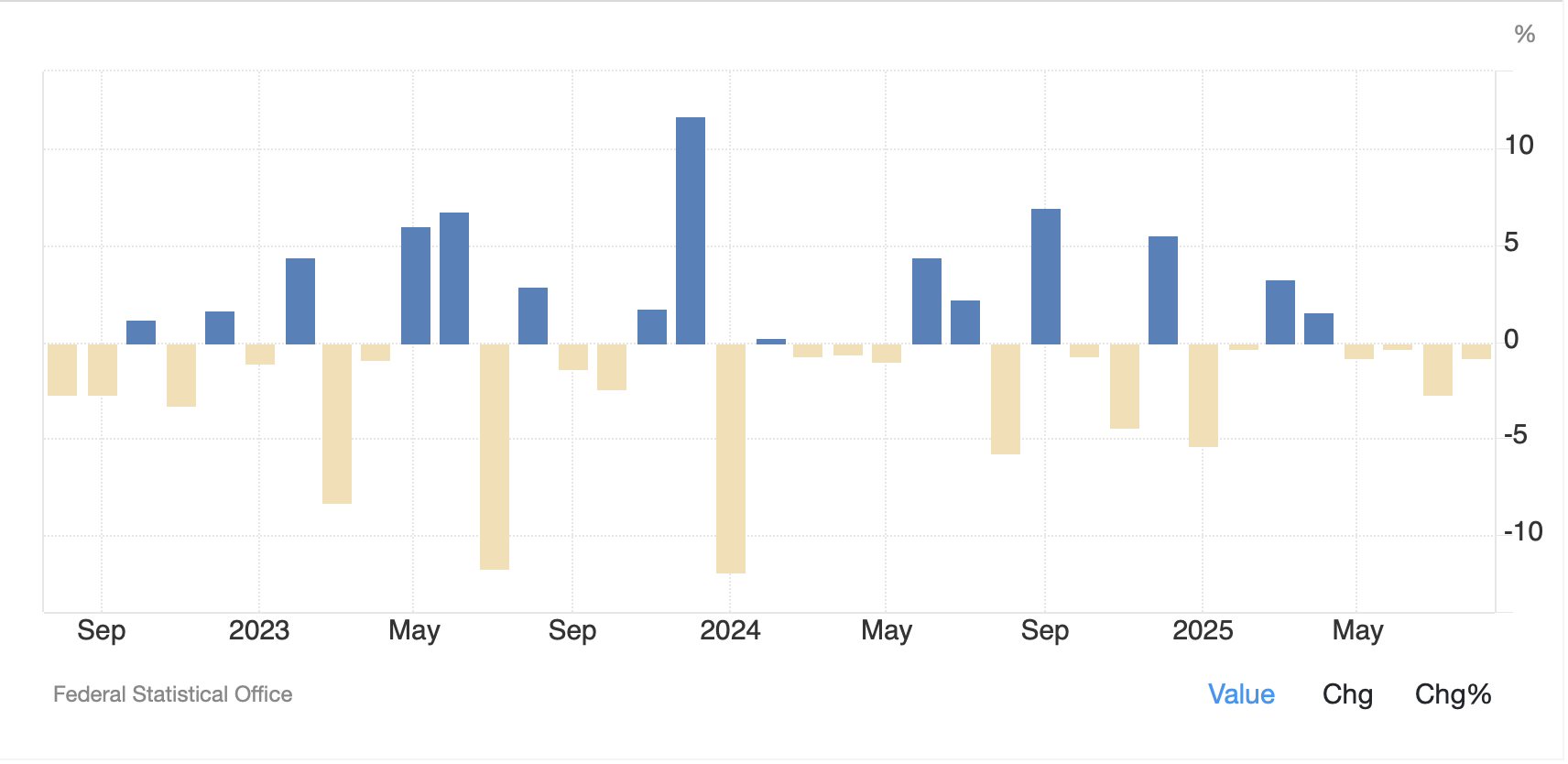
I believe it is fair to say that while there is a clear concern about, and flight from, fiat currencies, hence the strength of precious metals as well as bitcoin, in the fiat universe, the dollar remains the best of a bad lot.  Yesterday I described the problems in France and how the second largest nation in the Eurozone was leaderless while trying to cope with a significant spending problem amid broad-based political turmoil.  We have discussed the problems in Germany in the past, and early this morning, the fruits of their insane energy policies were shown by another decline in Factory Orders, this time -0.8%, far less than the 1.7% gain anticipated by economists.  I don’t know about you, but it is difficult for me to look at the below chart of the last three years of Germany’s Factory Orders and see a positive future.  Twenty-two of the thirty-six months were negative, arguably the driving force behind the fact that Germany’s economy has seen zero growth in that period.

Source: tradingeconomics.com

Meanwhile, the yen continues to weaken, pushing toward 151 now and quite frankly, showing limited reason to rebound anytime soon.  Takaichi-san appears to be on board with the “run it hot” thesis, looking for both monetary and fiscal stimulus to help Japan grow itself out of its problems.  The JGB market has sussed out there will be plenty more unfunded spending coming down the pike if she has her way as evidenced by the ongoing rise in the long end of the curve there.  While the 30-year bond did touch slight new highs yesterday, the 40-year is still a few basis points below its worst level (highest yield) seen back in mid-May as you can see in the chart below.  Regardless, the chart of JGB yields looks decidedly like the chart of gold!

Source: tradingeconomics.com

In a nutshell, there is no indication the fiscal/financial problems around the world have been addressed in any meaningful manner and the upshot is that more and more investors are seeking safety in assets that are not the responsibility of governments, but either private companies or have inherent intrinsic value.  This is the story we are going to see play out for a while yet in my view.

Ok, so, let’s look at how markets overall behaved in the overnight session.  China remains on holiday, but it will be interesting to see how things open there on Thursday morning local time.  Japan, was unchanged overnight, holding onto its extraordinary post-election gains.  As to the other bourses there, holidays abound with both Hong Kong and Korea closed last night and the rest of the region net doing very little.  Clearly the holiday spirit has infected all of Asia!  In Europe, though, we are seeing very modest gains across the board despite the weak German data.  The DAX (+0.2%) has managed a gain and we are seeing slightly better performance in France (+0.4%) and Spain (+0.4%) with the UK (+0.1%) lagging slightly.  On the one hand, these are pretty benign moves so probably don’t mean much, but it is surprising there are rallies here given the ongoing lousy data coming from Europe.  As to US futures, at this hour (7:20), they are all pointing higher by just 0.1%.

In the bond market, yields are continuing to edge higher with Treasuries (+2bps) leading the way and European sovereigns following along with yield there higher by between 2bps and 3bps.  There continues to be a disconnect between what appear to be government policies of “run it hot” and bond investors, at least at the 10-year maturity.  Either that or there is some surreptitious yield curve control ongoing to prevent some potentially really bad optics.

In the commodity markets, oil (+0.1%) is still firmly ensconced in its recent range with no signs of a breakout.  I read a remarkably interesting article from Doomberg (if you do not already get this, it is incredibly worthwhile) this morning describing the methods that the Mexican drug cartels have been heavily involved in the oil business in Mexico, siphoning billions of dollars from Pemex and funding themselves, and more importantly, how the US was now addressing this situation.  This is all of a piece with the administration’s view that the Americas are its key allies and its playground, and it will not tolerate the lawlessness that has heretofore been rampant.  It also implies that if successful, much more oil will be coming to market from Mexico, and you know what that means for prices.  As to the metals markets, they are taking a breather this morning with gold (-0.1%) and sliver (-0.3%) consolidating after yesterday’s rally.  We discussed gold above, but silver is about $1.50 from the big round number of $50/oz, something that I am confident will trade sooner rather than later.

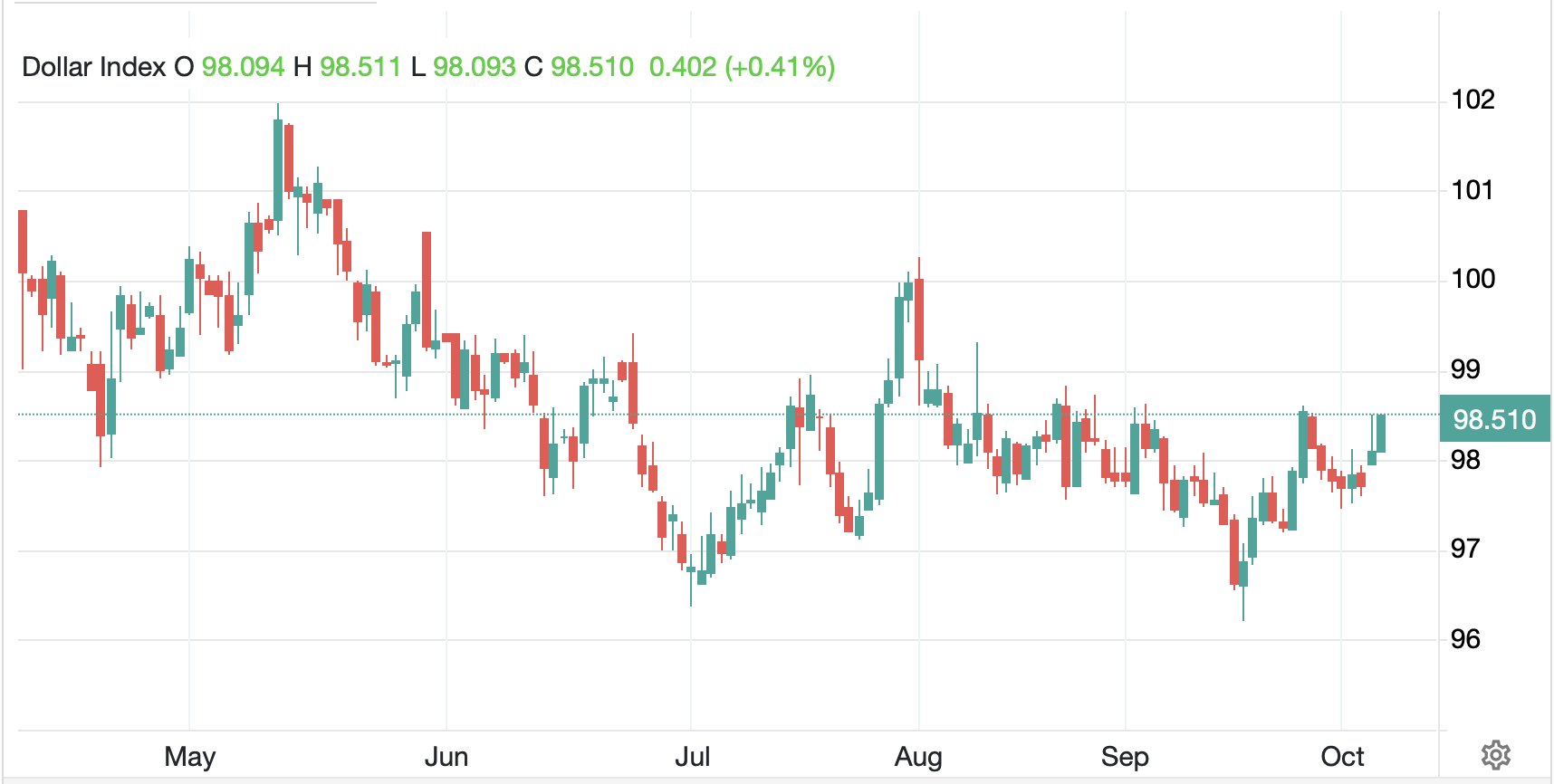
Finally, the dollar is rallying again with the euro (-0.5%) and pound (-0.6%) both under pressure and dragging the rest of the G10 with them.  If the DXY is your favorite proxy, as you can see from the chart below, this is the 4th time since the failed breakout in late July that the index is testing 98.50 from below.  It seems there is some underlying demand, and I would not be surprised to see another test of 100 in the coming days.

Source: tradingeconomics.com

It should be no surprise that the CE4 currencies are all under pressure this morning and we have also seen weakness in MXN (-0.3%) and ZAR (-0.3%) although given the holidays in Asia, it is hard to make a claim there other than that INR (-0.1%) continues to steadily weaken and make new historic lows on a regular basis.

With the government shutdown continuing, there is still no official data although there is a story that President Trump is willing to have more talks with the Democrats.  We shall see.  I think the biggest problem for the Democrats in this situation is that according to many polls, nobody really cares about the shutdown, with only 6% registering any concern.  It is a Washington problem, not a national problem.  Of course, FOMC members will continue to speak regardless of the shutdown and today we hear from four more.  Interestingly, nothing any of them said yesterday was worthy of a headline in either the WSJ or Bloomberg which tells me that there is nothing coming from the Fed that matters.

Running it hot means that we will continue to see asset prices rise, bond prices suffer, and the dollar likely maintain its current level if not rally a bit.  We need a policy change somewhere to change that, and I don’t see any nation willing to make the changes necessary.  I have no idea how long this can continue, but as Keynes said, markets can remain irrational longer than you can remain solvent.  Be careful betting against this.

Good luck

Adf