Walk the Walk

The Chinese are starting to feel
Recession could really be real
With PMI falling
Most pundits are calling
For policy help with more zeal

But so far, despite lots of talk
The Chinese will not walk the walk
One wonders how long
That they’ll sing this song
And when they’ll stop acting the hawk

Right now, the face of ‘all talk, no action’ is Chinese President Xi Jinping.  China’s economy has been slowing, or perhaps a better description is that the post-covid performance has been much less dynamic than had been widely anticipated.  Amongst the more concerning lowlights is the incredibly high youth unemployment rate there, with >21% of the population aged 18-24 unable to find work.  That is not the sign of economic dynamism.  You may recall the enthusiasm that greeted the news that the Covid lockdowns had ended suddenly in January and there was a widespread call for a rally in commodity prices in anticipation of the great reopening.  It never really happened.  Since then, things have been lackluster at best and the Chinese government has grown increasingly concerned.  However, they have not yet grown concerned enough to act in any significant way with fiscal policy support extremely narrow and inconsistent.

Last night simply reinforced these themes as the Caixin PMI Manufacturing data was released at 49.2, a full point below expectations and, of course, below the key 50 level indicating growth.  This was the lowest print since December, but a quick look at the numbers since then shows a very limited growth impulse in China.  The average reading in 2023 has been 50.1, hardly a sign of a rebound.  Now, the Chinese government did come out and say they are going to increase credit to private companies, focusing on small firms and the central government called on cities and provinces to do more to support the property markets.  But talk is cheap and until we see real money getting spent, it is hard to get excited about the Chinese economy.  Ultimately, while the PBOC is very concerned that the renminbi could fall sharply if they loosened their grip on the currency, I expect that a weaker CNY is going to be a theme for the rest of this year, and probably most of next year, as it offers the one release valve that they have available.  7.50 is still in the cards.

Away from the China story, the market’s focus on central banks intensified as the RBA left rates on hold at 4.10% despite market expectations of a 25bp rate hike.  The first casualty of this surprise was the AUD (-1.3%) which is the worst performing currency across the board today.  Apparently, their concern is that growth is faltering, and given the lack of growth in their largest export market, China, they believe that inflation pressures are ebbing and they have achieved their objectives.  Like all central banks these days, they claim to be data dependent and right now the data are telling them not to worry.  I guess that means when if inflation starts to reaccelerate, they will be back at the hiking game.  But for now, like central bankers all over the world, they are eager to claim victory over inflation.  

We heard this from the ECB last week, and it is quite possible that the BOE hints at that on Thursday as well, although inflation is much stickier in the UK than elsewhere.  My point is that the one central bank that is not satisfied is the Fed, where there is still a very wide consensus that the job is not done.  As long as US economic activity remains the best around, and that seems highly likely for another few months at least, it is hard to see any other central bank maintaining a more hawkish stance than the Fed.  Again, the underlying thesis of dollar strength is the Fed will be the most hawkish of all, and nothing we have seen today would contradict that theory.

How have markets responded to this news?  Well, yesterday saw a very late rally to take the US indices higher on the day, but only just, and while the Nikkei (+0.9%) had a good session, continuing its recent run, Chinese stocks, not surprisingly, were weighed down by the baggage of the PMI data.  Europe is also feeling the brunt of weak PMI data as the Manufacturing prints there were all in the low 40’s, except for Germany which managed to remain unchanged at 38.8!  Virtually all the markets on the continent are down by around 1% this morning in response to the data.  In fact, it is data like this that helped inform Madame Lagarde’s belief that the ECB is done, and who can blame her.  While inflation may be a problem, and the ECB’s only mandate, given she is a politician first and central banker second, the optics of tightening policy into a rapidly declining economy would be very difficult to explain.  Again, this bodes well for the dollar overall.  As to the US futures market, they are a bit softer this morning, not dramatically so, but it seems that there is some response to a generally softer tone in the earnings numbers released to date.

Interestingly, despite equity weakness, bond yields are higher in the US and across Europe by a few basis points.  For some reason, the bond market does not seem to agree with stocks, nor it seems, with most central bankers.  Inflation concerns remain top of the list for bond investors, and other than Down Under, where AGBs fell 8.6bps after the RBA left rates on hold, there seems to be a growing worry that the central banks are ending their fight too soon.  As to the US, once again the 10-year yield is approaching 4.0%, clearly a level of great import to the market.  I would also note that JGB yields edged ever so slightly lower overnight and remain below 0.60%.  However, it is still early days with respect to the policy changes there, so the eventual outcomes are still unclear.

Oil prices are very little changed today, consolidating their recent gains.  This must be a concern for the central banks as evidence of slowing economic activity is not leading to slowing demand for oil.  That is a key tenet of their policy structure.  The belief is weaker growth and recession will reduce demand for energy first, and then other things thus reducing inflationary pressures.  But if growth weakens and oil stays firm or rallies, they have a big problem.  Now, the metals complex is all softer this morning, behaving as would be expected in a weakening growth scenario, so it is oil that is the current outlier.

As to the dollar, it is king of the hill this morning.  While Aussie is the weak link, all the commodity currencies are under pressure, down between -0.6% and -0.9%.  But the yen (-0.5%) is also failing to find support on a risk-off day, which comes as a bit of a surprise to all those who continue to believe the BOJ is going to alter policy further.  Here, too, I see further weakness vs. the dollar as time progresses.  Just wait until the Fed hikes again and sounds hawkish as CPI data rebounds.

In the emerging markets, ZAR (-1.4%) has now edged ahead of the Aussie for title of worst of the day, as a response to the Chinese data, its own weak PMI reading and declining metals prices.  But virtually the entire bloc is weaker today with all three geographic areas feeling the pain.  

Yesterday’s US data was definitely soft with Chicago PMI at 42.8 and Dallas Fed at -20.0.  As well, the Senior Loan Officer Opinion Survey indicated that credit conditions for commercial and industrial loans had tightened further with reduced demand to boot.  In fact, the tightening is reaching levels last seen during the covid recession and the GFC.  This is not indicative of a soft landing, rather of a much harder one.  This morning we see Construction Spending (exp 0.6%), JOLTS Job Openings (9600K) and ISM Manufacturing (46.9) all at 10:00am.

And yet, despite the data and SLOOS, we heard from Goolsbee and Kashkari that they continue to believe a recession will be avoided.  This morning, Goolsbee is back on the tape, but we already know his view.  However, I do not believe he is in the majority at this point, though he is a voter, so come September, if they hike, perhaps we will have a dissent.

If the data is terrible, perhaps we will see the dollar cede some of this morning’s gains, but absent that outcome, let alone surprising strength, it feels like the dollar has further to rally.

Good luck

Adf

Just Kidding

Remember Friday
When one percent was declared
The top?  Just kidding

Much has been written about the BOJ’s surprising change in policy at their meeting last Friday, when they ostensibly widened the cap on their Yield Curve Control to 1.00% while explaining that flexibility in operations was the watchword.  They did not touch their overnight rate, which remains at -0.10% and there is no apparent belief that they are going to adjust that anytime soon. 

Neither market pricing in the OIS market nor any commentary from any BOJ official has hinted at such a move.  So, the question is, did they really change their policy?

This matters a great deal for those amongst us who care about USDJPY and its potential future direction.  The prevailing narrative has been that once the BOJ altered policy and allowed Japanese interest rates to rise to a more normal setting, investment would flow into JGBs, and the yen would strengthen rapidly.  Remember, a big part of this process is that since the yen is the last remaining currency with negative interest rates in the front end of the curve, it remains the financing currency of choice amongst the speculative and hedge fund set.  Adding to this discussion was the fact that back in December of last year, when Kuroda-san truly surprised the market by raising the YCC cap from 0.25% to 0.50%, it took less than one day for the 10-year JGB yield to test the new cap.  Expectations recently had been that a similar move was likely to be seen this time around as well.

Alas, it is Monday, so some thirty-six market hours into the new policy and already the BOJ has stepped into the market to prevent a further rise in the 10-year yield once it touched 0.60%.  Last night they stepped in with a ¥300 billion program of additional QE.  One cannot be surprised that USDJPY (+0.9%) is higher on this news as it undermines the entire thesis about imminent JPY strength once they changed policy.  And if they didn’t really change policy, as evidenced by the fact that they have already stepped into the market, then THE key pillar of the stronger yen thesis has just been removed.  The other problem for the yen bulls is that the US data last week, especially the GDP and IP data, indicate that the Fed will be under no duress if they continue to tighten policy beyond current levels.  Despite all the arguments about the Fed making another policy error, and there are sound arguments there, in Jay Powell’s eyes, until NFP starts to fall sharply, or Unemployment starts to rise sharply, or both, there are no impediments to a continuation of the current tightening policy.

It is with this in mind that I foresee continued strength in USDJPY, and while it seems likely that a very rapid move higher will see further intervention by the BOJ/MOF like we saw last autumn, another test of 150 is in the cards.  A quick look at the chart below (from tradingeconomics.com) shows that the trend higher in the dollar remains intact with the decline in the first part of July already mostly undone.  For those of you who were looking for a reversion to the 120 or 130 level, I fear that is just not in the cards for a long time to come.

Last Thursday the ECB said
That policy, looking ahead
Need not be so tight
And so, they just might
Stop raising rates, pausing instead

Though their only mandate is prices
They’ve come to a bit of a crisis
Seems growth’s really weak
And so, they will seek
A policy, sans sacrifices

The good news in Europe is that Q2 GDP was positive, which followed a negative Q4 and a flat Q1.  Hooray! The bad news about the data, which showed a 0.3% rise, is that fully half that number comes from Ireland! Now, Ireland’s weight in the Eurozone economy is tiny, about 4%, so the fact that growth there represented half the entire EZ’s growth is remarkable.  However, if you consider that this growth is more illusion than economic activity, it is easier to understand.  The growth is a result of the large profitability of US tech companies that generate their profits, from an accounting perspective, in Ireland to take advantage of the extremely low Irish corporate tax rate of 12.5%.  So, US tech companies had a good quarter driving Irish GDP higher, and by extension Eurozone GDP higher.  But they didn’t really produce that much stuff.

At the same time, Core CPI in the Eurozone printed at 5.5% this morning in July’s preliminary reading, hardly indicative of a collapse and calling into question Lagarde’s seeming dovishness last week.  In the end, the dichotomy between the US economy, where the latest data continues to show a robust outcome, and Europe, where the only thing rising is prices with economic activity lackluster at best, remains the key reason why the dollar’s demise is still a theory and not reality.  

To summarize the information that we have received from around the world in the past several days, Japan is unwilling to allow interest rates to rise very far, European growth is staggering, US growth is accelerating, the ECB is inclined to stop hiking rates and the Fed continues with ‘higher for longer’.  All of this points to the dollar maintaining its value and likely rising further.  I have yet to see anything persuasive in the dollar bear case to address all these issues. 

Now, those are the big picture views, but let’s take a quick tour of the overnight session.  Equities rallied in Asia following the US performance on Friday, but Europe has been a bit more circumspect with a couple of markets showing gains, notably France and Italy, but the rest doing nothing at all.  At the same time, US futures are little changed at this hour (7:30).

Arguably, though, it is the bond market where things are really interesting as yields continue to rebound.  US Treasuries are higher by 1.5bps and pushing back to that all important 4.00% level this morning.  There is a growing belief that if 10-year yields push above 4.10%, that may signal a new framework, a breakout in technical terms, and we could see much higher yields from there.  The Fed is likely to welcome such an event as it will help tighten financial conditions, something that they have been unable to achieve thus far.  However, I do not believe the equity markets would take kindly to that type of movement, so beware.  As to European sovereigns, they are mostly higher by about 1bp-2bps this morning and of course, JGBs saw yields finish higher by 6bps, just below 0.60%.

Oil prices (+1.0%) continue to rise on an organic basis.  By this I mean there have been no announcements, no disruptions and no news of any sort that might indicate a change in the current situation.  In other words, there is just a lot of buying going on.  WTI is well above $81/bbl and we have seen a gain of more than 16% in the past month.  Headline inflation will not be sinking on this news.  We are also seeing a little strength in the metals space this morning with gold, copper and aluminum all firmer as the week begins.  The base metals are responding to continued indications that China is going to support their economy, although direct fiscal payments don’t yet seem likely.  Just wait a few months.

Finally, the dollar is net, little changed, although we have a wide array of gainers and losers today.  In the G10, AUD (+0.9%) and NZD (+0.75%) are the leaders, rallying alongside the commodity rally, while JPY (-0.8% now), is the laggard based on the discussion above.  As to the rest of the bloc, there are more gainers than losers, but the movement has been far less impactful.  In the EMG space, MYR (+1.1%) has been the leading gainer on significant (for Malaysia) equity market inflows of ~$40mm -$50mm last night.  After that, though, the gainers have mostly been EEMEA currencies, and they have not moved that much.  On the downside, ZAR (-0.7%) is the laggard on limited news, implying more of a trading action rather than a fundamental shift.  But on this side of the ledger as well, things haven’t moved that far and net, the space is little changed.

It is an important week for data in the US culminating in the payroll report on Friday.

TodayChicago PMI43.4
 Dallas Fed Mfg-22.5
TuesdayJOLTS Job Openings9600K
 ISM Manufacturing46.9
WednesdayADP Employment183K
ThursdayInitial Claims227K
 Continuing Claims1723K
 Unit Labor Costs2.5%
 Nonfarm Productivity2.2%
 Factory Orders2.1%
 ISM Services53.0
FridayNonfarm Payrolls200K
 Private Payrolls175K
 Manufacturing Payrolls5K
 Unemployment Rate3.6%
 Average Hourly Earnings0.3% (4.2% Y/Y)
 Average Weekly Hours34.4
 Participation Rate62.6%
Source: Bloomberg

In addition to this, we get the first post-FOMC Fedspeak with just two speakers, Goolsbee and Barkin, on the calendar this week although the pace picks up next week.  As long as the data remains strong, I see no reason for the Fed to change its tune nor any reason for the dollar to back off its recent net strength.

Good luck

Adf

A Bad Dream

The narrative’s gaining more steam
With landings, so soft, the new theme
In England today
They’re trying to say
Inflation was just a bad dream

The problem is that on the ground,
In Scotland and Wales and around,
Is incomes keep lagging
With purchases sagging
Which pressures the Great British pound

The biggest story of the morning has clearly been the UK inflation data which saw CPI fall back below 8.0% Y/Y for the first time in more than a year.  Granted, 7.9% is not that far below 8% and certainly still miles above the BOE target, but the decline was substantially more than had been expected by the analyst community as well as the market.  For instance, 10-year Gilt yields have tumbled -17.5bps and are now lower by 50bps since the peak two weeks’ ago and back to their lowest level since early June.  2-year Gilt yields have fallen even further, -25bps, so the market is really quite positive on this outcome.

It should be no surprise that UK equity markets have rallied as well, with the FTSE 100 the leading gainer in Europe, up 1.5%, nor should it be a surprise that the pound has fallen sharply, -1.0%, as traders re-evaluate the idea about just how much the BOE is going to raise rates going forward.  Prior to this release, the OIS market had been pricing in a terminal interest rate at 6.1%, implying at least 4 more rate hikes by the BOE.  But this morning, traders have removed one of those hikes from the curve and the excitement over further potential declines is palpable.

Now, the inflation news in Europe is not all rosy as the final release on the continent showed that core CPI turned out to be a tick higher at 5.5% in June, clearly an unwelcome result.  And remember, it was just yesterday that we heard from Klaas Knot implying that while a hike next week is a given, nothing is certain past that.  So, the question, currently, is will the ECB look through a revision to continue their more dovish stance?  I guess we’ll find out next week.  

But here’s an interesting tidbit regarding Europe, and something you need to consider when it comes to both investments and market outcomes there, electricity demand is falling there amid deindustrialization on the continent.  The IEA just issued their latest Electricity Market Report and the reading was not pleasant for Europe.  Consider that in the US, the combination of reshoring and the impact of the (ironically named) Inflation Reduction Act, as well as the CHIPS Act, has driven a marked increase in industrialization in the US.  Meanwhile, in Europe, the loss of their cheap energy from Russia combined with their climate goals has resulted in industry fleeing the continent.  For everyone who is long-term bearish the dollar, you better be far more bearish the euro given this new reality.  Remember, energy consumption is the mark of a growing and healthy economy.  When it is declining, absent extraordinary productivity/efficiency gains, it bodes ill.  If anything, the increasing reliance on less dense energy sources like wind and solar just reduces energy efficiency.  Be wary.

But, away from that news, things are a bit more confusing.  For instance, virtually all European bourses are higher this morning, albeit not as much as the FTSE 100, but in Asia, while the Nikkei (+1.25%) had a good session, Chinese equities were under pressure.  Yes, US markets yesterday continued their rally as earnings data has been able to beat the much-reduced estimates although futures this morning are essentially unchanged.  But arguably, we can describe the equity picture as risk-on.  

The same cannot be said for the bond market though, where yields have fallen everywhere, again, just not as much as in the UK.  Treasury yields are down another 2bps, and most European sovereigns are also seeing modest yield declines, not the typical risk-on behavior.  In fact, given the Eurozone CPI release, it would not have been surprising to see yields climb a bit.

As to the commodity space, oil is essentially unchanged on the day, but WTI is back above $75/bbl with Brent right at $80/bbl after several strong sessions.  There has definitely been a renewed focus on the bullish supply story in oil as opposed to the recession discussion of late.  At the same time, gold (-0.3%) which has rallied nicely during the past week, up nearly 2%, is holding the bulk of its gains.  Alas, the base metals continue to lag, with both copper and aluminum softer on the day.  Perhaps they didn’t get the bullish memo!

Finally, the dollar is quite robust this morning, which is not what one might expect given the equity and bond moves.  In fact, it is firmer vs. the entire G10, with the pound the laggard, as would be expected given the inflation data and falling UK rates.  But as well, the yen (-0.8%) is under pressure along with AUD (-0.7%) and the whole lot.  Regarding the yen, it has been rallying sharply of late, up more than 5% during July until yesterday.  That seems to be on an increasing belief that the BOJ, which meets next Friday, is going to tweak its policy in a tighter fashion, whether that involves YCC or rates or QE.  Now, these stories have not disappeared, I just think that we are seeing a bit of a breather for this move.  Remember, the yen has been the funding currency of choice for every asset all year as the BOJ remains the only central bank that hasn’t tightened policy at all.  This month appeared to be profit-taking ahead of potential BOJ activity, and last night appears to be a simple trading bounce.  FWIW, I do not believe the BOJ is ready to adjust its policy yet as the big review has just begun.  And as I have written before, it doesn’t appear that the rising inflation pressures in Japan have yet become a major political liability for PM Kishida, so there is only limited pressure to make a change.  For now, I would rather be short than long the yen.

Turning to the EMG bloc, only THB (+0.5%) is firmer this morning as the political machinations continue there in the wake of the recent election. In a nutshell, the winner of the election to replace the military junta is clearly not favored by the powers-that-be, and is being disqualified on a technicality, but another member of the coalition seems to be getting closer to taking the reins, with optimism building.  But aside from that story, the dollar is firmer vs. the entire bloc as we are seeing a solid trading bounce in the greenback after several days/weeks of weakness.

On the data front, yesterday’s Retail Sales data was disappointing, and the IP and Capacity Utilization data were awful.  Obviously, that didn’t hurt equities which remain disconnected from any macro data at this point.  This morning brings the Housing Starts (exp 1480K) and Building Permits (1500K) data, although if Retail Sales didn’t have an impact, it is hard to believe the housing data will.  

I remain uncomfortable with the equity market’s ongoing rally as I fail to see the underlying strength in the economy or earnings.  Certainly, recent dollar weakness has helped goose the stock market a bit, but I would not be surprised to see things start to turn around in the near term, meaning the dollar rebounding after its recent sell-off and the equity market seeing some profit-taking.

Good luck
Adf

Inflation’s at Bay

While waiting to hear more from Jay
Investors keep socking away
More assets that need
Low rates to succeed
With clues, now, inflation’s at bay

In Europe, the money supply
Although really still very high
Is starting to fall
As well, there’s a call
To start waving PEPP bonds bye-bye

Overall, it has been an uneventful session in the markets with risk assets generally performing well amid clues that all the central bank efforts to tame inflation may be starting to work.  The first sign was the release of lower-than-expected Italian CPI data at 6.7%, down sharply from last month’s 8.0% reading.  As well, Italian PPI continues its recent negative trend, printing at -6.8% Y/Y, widely seen as a harbinger of future CPI activity.  In addition, money supply data has continued to fall rapidly as per the below chart from the ECB, with M1 growth falling to -6.4%, its lowest reading ever.

Yesterday I mentioned the idea that the ECB was turning into a closet monetarist institution as they continue to see their balance sheet shrink and today’s data helps bolster that view.  In addition, there is increasing discussion at Sintra that the ECB should consider actually selling some of the bonds from their QE programs, APP and PEPP, rather than simply let them roll off without reinvesting.  Recall, that while the Fed is allowing $95 billion / month to mature without reinvestment, the ECB’s pace is a mere €15 billion / month.  Granted, the ECB also has the benefit of having a large slug of TLTRO loans maturing this week (approximately €500 billion) which has been the driving force behind their balance sheet’s decline, but whatever is driving the process, it seems like the ECB is tightening monetary policy more aggressively than the Fed. 


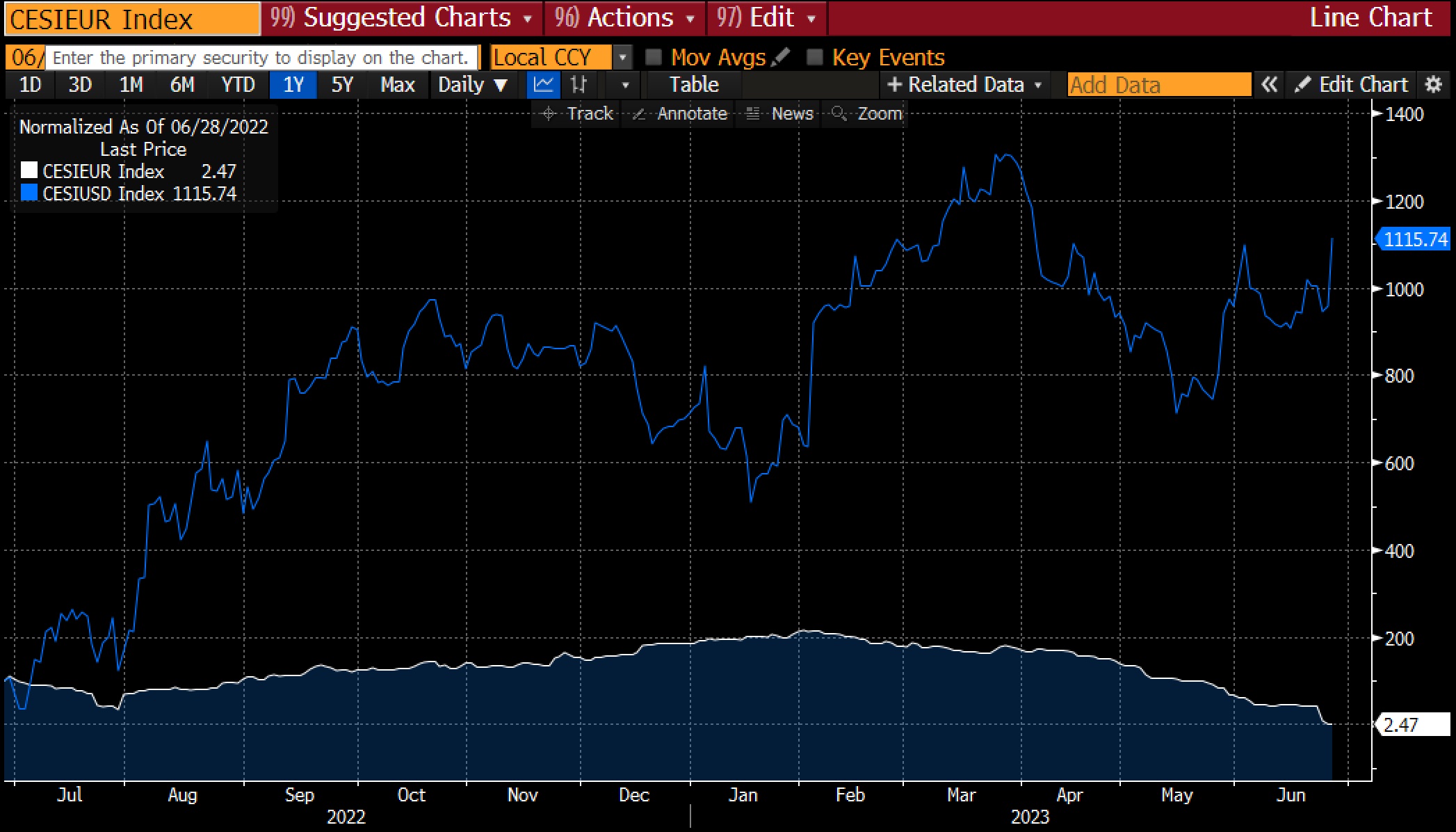
The big difference between the US and Europe, though, is that Europe is already clearly in a recession while the US, despite a widely anticipated slowdown, continues to perform quite well.  For instance, yesterday’s data releases were uniformly better than expected.  Durable Goods, Home Prices, New Home Sales, Consumer Confidence and the Richmond Fed Manufacturing Index all printed at better levels than expected.  This goes back to the Citi Surprise Index, which jumped nearly 17 points yesterday after the releases and sits firmly in positive territory in an uptrend.  Meanwhile, the same measure in the Eurozone is collapsing, deep in negative territory.  The below Bloomberg chart is normalized at 100 from one year ago.  It is quite easy to see the remarkable gap between the US (blue line) and Eurozone (white line) with respect to relative economic performance.

Arguably, one would expect that given the US economy’s seeming resilience, the Fed would be the more aggressive of the two central banks, but that is just not the case, at least based on the behavior of their respective balance sheets.


The big question is, can this dichotomy continue?  With the Eurozone already in a recession and showing no signs of coming out of it, can the ECB continue to tighten policy in the same manner they have to date?  As well, can the US equity market continue to perform well despite no indication that the Fed has any reason to pivot to easier money in the near future?  Logically, at least based on previous logic, one would have thought these conditions could not continue very long.  And yet, here we are with no obvious end in sight. 


My sense, and my fear, is that the ‘long and variable lags’ with which monetary policy impacts economic activity have not yet been felt in the US economy and that much more stress is still in the not-too-distant future.  If I had to select a particular weak spot it would be commercial real estate, especially the office sector, as already we have seen a number of high-profile mortgage defaults, and given the change in working conditions for so many people and companies, are likely to see many more.  The GFC was driven by the retail mortgage sector imploding.  It is not hard to imagine the next financial downturn being driven by the inability of commercial mortgage holders to refinance over the next year or two as they are currently upside down on their properties and cash flows are suffering dramatically to boot.  If this sector is the genesis of the problems, then given local and community banks are quite exposed to the sector all over the country, we are likely to be in for a rough ride, both in the economy and the stock market.  Be wary.


As to the overnight session, generally speaking, equity markets followed yesterday’s US rally with gains.  Japan was the leader with the Nikkei rallying 2% and only mainland China suffered as there was less clarity that the Chinese government was going to support the economy, and the currency.  European bourses are all nicely higher although US futures, especially the NASDAQ, are a bit softer after the Biden administration indicated further restrictions on semiconductor sales to China.


Bond yields are sliding a bit this morning but not too much, 2bp-3bp and quite frankly, all remain in a fairly narrow trading range.  Despite the Treasury issuance onslaught that has been proceeding since the debt ceiling was eliminated, yields have not moved very far at all.  It would seem that as issuance is pushed further out the maturity ladder, we would see higher yields, but that has not been evident yet.  Meanwhile, the yield curve remains massively inverted, right at -100bps this morning.


Oil prices are stabilizing this morning but have fallen more than 6% in the past week as this is the one market that truly believes the recession story.  Gold is also under pressure, falling further and pushing toward $1900/oz.  Higher yields continue to undermine the barbarous relic.  As to base metals, copper is under pressure, but aluminum is holding in reasonably well. 


Finally, the dollar is rebounding from a few days of softness with strength virtually across the board this morning.  Every G10 currency is weaker led by NZD (-1.3%) and AUD (-0.95%) as concerns over Chinese economic activity weigh on the antipodeans.  But the whole bloc is under pressure.  Meanwhile, in the EMG space, the picture is the same, virtual unanimity in currency weakness led by ZAR (-1.0%) and THB (-0.95%) with CNY (-0.3%) reversing course after the PBOC was absent from the market last night.  Despite hawkish comments from the SARB, the rand continues to suffer over concerns about the broader economy while the baht is suffering from political concerns.  This is an interesting story as Pita Limjaroenat was the surprise victor in recent elections but was not backed by the military.  Not surprisingly they are not happy, and he is having trouble putting a government together.


There is no major data today, so we are all awaiting Chairman Powell’s comments at 9:30 to see if he has any further nuance to impart.  At this point, I have to believe he will continue to push the higher for longer mantra as the data has certainly done nothing to dissuade him.  As such, I still like the dollar over time.


Good luck

Adf

Firmly On Hold

For now the Fed’s firmly on hold
While Powell made statements quite bold
It’s time to assess
How great is the mess
Created by stories we’ve told

This morning then, Christine is live
With certainty that twenty-five
Is how much she’ll hike
As she tries to spike
Inflation while growth she’ll still drive

To virtually nobody’s surprise, the Fed left policy rates on hold yesterday after what has been characterized by many as a hawkish pause.  This seems a fair assessment given the effort by Chairman Powell to stress that inflation remains too high and has not been falling as rapidly as they would like to see.  For instance, comments like the following during the press conference were quite clear:


“If you look at core PCE inflation over the last six months, you’re not seeing a lot of progress. It’s running at a level over 4.5%, far above our target and not really moving down. We want to see it moving down decisively, that’s all.”

“We’re two-and-a-quarter years into this, and forecasters, including Fed forecasters, have consistently thought inflation was about to turn down and typically forecasted that it would, and been wrong.”

“What we’d like to see is credible evidence that inflation is topping out and then getting it to come down.”


These were just some of the comments but give a flavor for what the mindset appears to be in the Eccles Building.  Looking at the dot plot, the median expectation is for two more rate hikes in 2023 and there were zero expectations of a rate cut.  The point is that higher for longer, which is what they have been preaching for upwards of a year, remains the mantra and given how robust the employment situation remains, they do not seem likely to change that view in the near term.  A quick look at the Fed funds futures market shows a market probability of 71% for a rate hike in July where things peak, and then pricing for a cut in January.  However, as I have maintained, I see inflation remaining quite sticky and the probability of a rate cut as far lower than that.


The market response was perfectly sensible in the bond market, where yields continue to climb, and the yield curve inversion increased to -91bps.  2-Year yields are now back to 4.73% as traders and investors price in a much higher probability that even if rates don’t rise much further, they are unlikely to fall back.  In fact, 10-Year yields around the world have all risen further as the global tightening cycle seems set to continue.  Recall, we saw Canada, Australia and now the Fed come out hawkishly and this morning the ECB is set to follow suit with a 25bp rate hike.  At this stage, there are no G10 central banks that believe they have solved the inflation problem…and they are right.


A quick look at European sovereign yields ahead of the ECB announcement shows they have risen between 5bps and 10bps this morning as there is clearly an expectation that after the extremely hawkish commentary from Powell yesterday, Madame Lagarde will be forced to follow suit.  In truth, that seems a reasonable expectation and when looking at the OIS market in Europe, expectations appear to be for another one or two hikes after today’s move.  Given that inflation remains sticky there too, that doesn’t seem far-fetched.


On last thing regarding central bank hikes is the Bank of England next week, where a 25bp hike is fully priced, but more impressively, an additional 4 hikes are priced in by the end of the year.  Inflation in the UK has clearly been even more problematic than in the Eurozone or the US, while the Old Lady has been lagging lately so this does make sense as well.


There are, though several places where tighter policy is not on the cards, namely China and Japan.  Starting with Japan first, YCC remains the current policy framework and there is no indication they are going to change things anytime soon.  10-year yields there remain well below the YCC cap and there is much more discussion regarding the potential for a snap election in Japan than about monetary policy.  The yen (-0.8%) is weakening further today as the more hawkish Fed combined with the continued dovishness of the BOJ weigh on the currency.  We’ve seen this movie before when the dollar ran up above 150 in October, and while that is still a long way from today’s price, the trend since March has been very clear.  Absent a major policy change from either the Fed or the BOJ, look for a weaker yen over time.


As to China, they did cut their Medium-Term Lending Facility rate by 10bps last night as widely expected although the currency did not really move as it was fully priced already.  However, the Chinese government is clearly flailing about for ways to support the economy without increasing the leverage that already exists.  The problem is that the PBOC toolkit, as well as the CCP toolkit, relies on centralized direction not market activity, and it appears that the limits of those policies are starting to be reached.  There is little reason to believe the renminbi is going to rebound in the short-term as a weaker currency is the only outlet valve they have.  Given measured inflation in China has been so low, I expect we can see a continued grind lower (dollar higher) in the second half of the year.  Think 7.50 by Christmas.


With all that news, US equity markets had a mixed picture yesterday with the NASDAQ continuing its run higher with a small (0.4%) gain, but the rest of the market under more pressure.  Chinese equities responded quite positively to the rate cut there with substantial gains, but the Nikkei was simply flat on the day.  And now, European bourses are in the red by about -0.7% with US futures also pointing lower.


Oil prices (+0.75%) are edging higher but that is after a reversal yesterday brought them back below $70/bbl.  There remains a great deal of controversy over just how badly demand is going to be hit given the lackluster Chinese economy and the huge split on views regarding the US and Europe with a recession call still quite popular although there are those who are now calling for a successful soft landing by the Fed.  Precious metals are a little less precious this morning as are base metals which are indicative of dollar strength I believe.  However, net, I would say the commodity space is more in the recession camp than not.


Finally, the dollar is stronger vs virtually all its EMG counterparts with HUF (-1.25%) the laggard as market participants take profits in anticipation of a rate cut from Hungary vs. the Fed’s tough talk.  But the bulk of the bloc is weaker across all three regions.  In the G10, while the yen is worst off, we are seeing weakness almost everywhere except NOK (+0.3%) which is clearly benefitting from oil’s modest rally.  Given the Fed’s unambiguous hawkishness, I suspect the dollar will remain better bid than not for a while yet.


On the data front, there is a lot coming today as follows:  Retail Sales (exp -0.2%, +0.1% ex autos); Initial Claims (245K); Continuing Claims (1768K); Empire Manufacturing (-15.1); Philly Fed (-14.0); IP (0.1%); and Capacity Utilization (79.7%).  At this point, the Retail Sales data is likely the most important as the discussion regarding a recession will hinge on whether or not economic activity is still improving.  Remember, though, this data is nominal, not inflation adjusted.  On a real basis, Retail Sales have been falling for 6 months straight, not a good sign.  As to the Fed speaking slate, nobody is on the calendar today, but we will hear from three (Bullard, Waller and Barkin) tomorrow, with all likely to be focused on reiterating the hawkish message.


A hawkish Fed bodes well for the dollar going forward, so unless (until?) something in the US economy breaks, my money is on higher rates and a stronger dollar.


Good luck

Adf

The Issuance Tap

The Saudis thought oil was cheap

So, figured that they’d rather keep

More stuff in the ground

And in a profound

Move, cut back production quite steep


Meanwhile now the debt ceiling’s gone

The Treasury’s set to turn on

The issuance tap

To refill the gap

In finance that started to yawn


The biggest story over the weekend was the Saudi’s decision to cut oil production by 1 million barrels per day as they are concerned the pending recession is going to further destroy demand and so are aiming to keep prices supported.  No other OPEC+ members joined with the Saudis as it seems they all want the money.  And who can blame them?  Not surprisingly, oil prices are firmer this morning, up nearly 2%, but remain far below levels seen prior to the last OPEC+ production cut when WTI was pushing $80/bbl.   However, if we look back to pre-covid times, oil was trading a full $10/bbl lower than the current level of ~$73/bbl.  In the interim, we have seen significant structural changes in the oil market, and I continue to expect these changes to force prices higher over time.


First, the election of President Joe Biden led to an immediate change in US energy policy with a destruction in production capabilities in the name of global warming.  Second, the Russian invasion of Ukraine and the ensuing sanctions on Russian oil (and NatGas) exports have helped reduce the amount of energy molecules available to be used worldwide.  Add to this the longer-term lack of energy infrastructure investment given the ESG push for the past decade, and the supply side of the equation does not look robust. 


On the demand side, however, things are likely to continue to trend higher for the foreseeable future.  Despite trillions of dollars of investment in alternative sources of energy, namely wind and solar, fossil fuels continue to represent more than 80% of total energy usage worldwide.  As well, every advancement in civilization throughout history has been driven by access to cheaper energy, and all those nations that we currently call emerging markets are quite keen to continue to advance their economies to the benefit of their populations.  They are far less concerned about global warming than they are about better living standards.  According to the IEA’s most recent forecasts, 2023 will set yet another record for oil demand regardless of the recession calls and the war in Ukraine.  Ultimately, this supply/demand imbalance is going to resolve toward higher prices still.  Mark my words.


As to the other discussion making the rounds in markets this morning, the upcoming deluge of Treasury security issuance, there are many claiming that this may have a significant impact on risk asset pricing, notably equities.  The idea is that as the Treasury refills its TGA (checking account) with up to $500 billion to get it back to its more normal balance, it will draw liquidity from potential equity investors who decide that earning a risk-free 5+% on their money is quite attractive, thus reducing demand for stocks.  However, this is a more nuanced discussion as there are other features in the money markets that will be impacted as well, and that are likely to offset a significant portion of that impact.


On the surface, that argument has validity, but digging a bit deeper is worthwhile to get a better understanding here.  The Fed runs a Reverse Repo program (RRP), where they essentially pay a small subset of investors to hold their securities at the Fed funds rate.  This program currently has about $2.2 trillion in it and is widely used by Money Market funds as an investment.  And that money in the RRP program is stuck at the Fed and not available for other investment.  However, T-bills have been yielding higher than Fed funds, and it is expected that those same Money Market funds will be snapping up the newly issued T-bills while running down their RRP balances, thus absorbing a great deal of the new issuance.  If this is the case, it will reduce the amount of available risk-free assets to which the equity investors described above will have access.  In other words, the feared demand drain is likely to be far smaller than the $1 trillion that has been bandied about lately.  Do not count on this as a rationale for equity weakness, although that doesn’t mean there are no problems ahead.


And, as we begin another week, those are really the noteworthy stories around.  After Friday’s blowout NFP number of 339K new jobs with a revision higher in the previous months, US equities took off and had a big day.  That has mostly been followed by Asia, which saw strength almost everywhere (mainland China being the most prominent exception) although Europe has had a less robust session today.  Arguably, that is because the Services PMI data in Europe released this morning was softer than expected across the board, and they had already reacted to the US payroll data on Friday as those markets were open during the release.  Meanwhile, US futures are either side of unchanged this morning, clearly not feeling any additional love from the payroll story.


Of more interest is the fact that bond yields are higher around the world this morning, with Treasuries (+5.4bps) seeing selling pressure along with all of Europe (Bunds +7.2bps, OATs +7.0bps, Gilts +5.8bps, BTPs +8.1bps) as it seems the flood of issuance due from the US is being felt everywhere.  After all, given the dollar’s recent trend higher, which is very evident today, for non-USD investors, higher yielding Treasury securities are likely to be very attractive. As to domestic investors, selling ahead of significant issuance is a time-honored tradition.


Aside from oil, metals markets are under very modest pressure this morning, which has more to do with the rising dollar than anything specific to those markets.


And speaking of the dollar, it is on top of the world yet again this morning, rising against all its G10 counterparts and almost all its EMG counterparts.  SEK (-1.1%) is the worst G10 performer, after its PMI data was substantially worse than forecast with the Composite index tumbling to 47.6, a level only ever achieved during Covid, the GFC and the Eurozone banking/bond crisis.  In other words, things don’t look too good there.  But even NOK (-0.55%) is under pressure despite the strong rally in oil.  This is unadulterated USD strength.  Similarly, EMG currencies are all under pressure save ZAR (+0.6%), which seems to have responded positively to news that there would be reduced blackouts going forward. 


On the data front, there is not very much this week, so activity is likely to be driven by other markets given the FOMC is in their quiet period.


Today

Factory Orders

0.8%


-ex Transport

0.2%


ISM Services

52.4

Wednesday

Trade Balance

-$75.5B

Thursday

Initial Claims

237K


Continuing Claims

1802K

Source: Bloomberg


And that’s really all we’ve got for today.  To me, the biggest risk to markets is the fact that US equity performance is entirely reliant on 7 companies, all of which are very good companies, but whose performance has been extraordinarily outsized and does not seem representative of the economy or market as a whole.  At some point, those stocks are likely to come back to earth and that will result in a very large adjustment to views about the Fed, the economy, and the stock market.  But for now, it is hard to fight the trend, and that includes the dollar higher trend.


Good luck

Adf


Far From a Floor

As energy prices decline

Inflation, at least the headline,

Continues to shrink

As central banks think

Their actions have been quite benign


The problem is that at its core

Inflation is far from a floor

So, Christine and Jay

Ain’t ready to say

They’re done and won’t hike anymore


European inflation readings continue to fall alongside the ongoing decline in energy prices.  Headline numbers in France, Italy and Germany, as well as Spain and most of the Eurozone, have fallen sharply in the past month and seem likely to continue to do so.  Core inflation readings, however, for those countries that measure such things, and for the Eurozone as a whole, are demonstrating the same stickiness that we have seen here in the US.  Ultimately, the problem is that an inflationary mindset has begun to take hold in many people’s view.  While there is a great deal of complaining about rising prices, people continue to pay them, and the hangover of fiscal stimulus that was seen everywhere and continues to be pumped into economies around the world has allowed companies to raise prices while maintaining sales. 


There continues to be a strong disagreement within the analyst community regarding the future of inflation as there are many who have watched the trajectory of energy price declines and anticipate a return to 0%-2% inflation by the end of the year.  At the same time, there is another camp, in which the Fxpoet falls, that expects inflation to remain sticky in the 4% range for the foreseeable future.  Arguably, until such time as the massive amount of liquidity that was injected into the economy in response to Covid (and the GFC) is removed, I fear prices will err on the side of rising faster than we had become used to for so long.


Taking this one step further, the central bank playbook on inflation, as written by Paul Volcker in the 1980’s, was to tighten monetary policy enough to cause a severe recession and break demand.  We all know that Chairman Powell has read that book and is following it as best he can these days.  And, he has most of his team on board with that view.  Just this morning, Cleveland Fed President, and known hawk, Loretta Mester explained to the FT, “I don’t really see a compelling reason to pause – meaning wait until you get more evidence to decide what to do.  I would see more of a compelling case for bringing rates up…and then holding for a while until you get less uncertain about where the economy is going.”  These are not the words of someone who is concerned that rising interest rates are going to derail the US economy.  It is sentiment like this that has the Fed funds futures market pricing in a 64% probability of a rate hike in two weeks’ time.  It is also sentiment like this that is supporting the dollar, which has traded to its highest level in more than two months and is crushing the large, vocal contingent of dollar short positions around.


But, heading back to the recession argument, the data that we continue to receive shows no clear signs in either direction, rather it shows lots of conflict.  Yesterday I mentioned the decline in GDI, a seeming harbinger of weaker growth.  Meanwhile, yesterday’s data releases perfectly encapsulated the issue, with Consumer Confidence printing at a higher than expected 102.3, while the Dallas Fed Manufacturing Index fell to a wretched -29.1, far worse than expected and a level only reached during recessions in the past.  And there’s more to this story as last night China’s PMI data was all released at worse than expected levels (Manufacturing 48.8, Non-manufacturing 54.5, Composite 52.9) with all 3 readings slowing compared to April and an indication that the Chinese reopening story seems well and truly dead. 


This poses a sticky problem for President Xi as the clearly slowing Chinese economy seems likely to require further stimulus, whether fiscal, monetary, or both, with the ‘smart money ‘betting on monetary easing.  However, the renminbi (-0.4%) fell again last night and has been sliding pretty steadily since January.  Now, firmly above 7.10, it is fast approaching levels that the PBOC has previously indicated are inappropriate.  The question is, what will they do?  Easing monetary policy opens the door to rising prices, a potentially severe problem in China, while standing pat will likely result in further economic decline, not exactly what Xi is seeking.  My money is on easier policy and if necessary, price controls, something at which the Chinese government excels.


One cannot be surprised that with news like this, risk is taking a breather today, despite the ongoing euphoria over NVDA and AI.  Yesterday’s mixed performance in the US led to substantial weakness overnight in Asia, with all main indices falling by at least -1.0%.  Meanwhile, Europe this morning is also largely in the red, albeit only to the tune of -0.5%, and at this hour (8:00) US futures are pointing lower by -0.3% across the board. 


At the same time, the combination of falling inflation rates in Europe and the fact that a debt ceiling deal appears to be coming together has yields continuing to slide with Treasuries (-4.4bps) actually underperforming European sovereign yields which are all lower by between 7bps and 8bps.  The other thing to note here is that the yield curve inversion in the US, currently back to -78bps, is showing no signs of righting itself soon.  It has been nearly one year since the curve inverted, and recession alarms have been ringing everywhere, although one has not yet been sighted.  I expect continued volatility in this market as the debt ceiling bill will allow for a significant uptick in issuance right away and the question is, who will buy all this debt? 


Oil prices (-2.8%) continue to point to slowing economic activity and that is confirmed by weakness in the base metals as well.  While the Fed sees no signs of a recession, it seems pretty clear that some markets disagree.  Do not be surprised to see another production cut by OPEC+ as the summer progresses.


Finally, the dollar is king again, rising against virtually all its G10 and EMG counterparts, with the G10, sans JPY, all falling between -0.4% and -0.6%.  This is a broadscale risk-off move and one which is likely to continue as long as we see the combination of tough talk from the Fed and slowing economic data.


Speaking of economic data, today brings Chicago PMI (exp 47.2), JOLTS Job Openings (9.4M) and the Fed’s Beige Book this afternoon.  It is pretty clear that manufacturing activity remains in the doldrums here but pay close attention to the JOLTS data as the Fed is watching it closely for clues as to labor market tightness.  A weak number there is likely to have a bigger market impact than anything else today.


Net, I see no reason to dispute the dollar’s strength at the current time.  Talk to me when the Fed changes its tune, and we can see a dollar reversal.  Until then, higher for longer is both the interest rate and USD mantra.


Good luck

Adf


Much Pain

There once was a nation quite strong

Whose policies worked for so long

But war in Ukraine

Inflicted much pain

And now it seems they were all wrong

Relying on, energy, cheap

They rose to the top of the heap

But when prices rose

They’d naught to propose

‘Bout how to, advantages, keep

It turns out that Germany has fallen into a recession after all.  The German Statistics office revised down their Q4 2022 GDP reading from stagnation at 0.0%, to a -0.5% reading after adjusting for a substantial decline in government spending.  Meanwhile, Q1 GDP growth fell -0.3%, so Germany is solidly in a recession, at least based on the traditional definition of two consecutive quarters of negative GDP growth.  It certainly is remarkable that an economy that predicated itself on levering cheap, imported energy into the manufacture of steel, chemicals and machinery would encounter any problems simply because it became totally reliant on raw materials from a communist regime…NOT!  But in fairness, the Germans have hamstrung themselves by spending hundreds of billions of euros in their Energiewende program to reduce greenhouse gas emissions.  Unfortunately, this included shuttering their entire nuclear power fleet, which had produced upwards of 25% of their electricity with zero emissions and replacing it with heavily subsidized solar and wind power generation.  (By the way, whoever thought that solar power was a good idea in Northern Europe?  Arizona I get, Germany not so much.)

Granted, prior to Vladimir Putin invading Ukraine, things were going along swimmingly.  China was soaking up so much of what Germany was producing, and of course the rest of Europe were huge customers as well.  But it turns out risk management is a real thing, and not just when it comes to your foreign exchange or interest rate risks.  If we learned nothing else from the Covid pandemic it is that surety of supply of critical products or inputs is worth a lot, perhaps just as much as the price of that supply.  

Once Russia invaded, though, the world changed dramatically, and a critical flaw in the German economy was exposed.  Prior to the invasion, because of Energiewende, German electricity prices were the highest in Europe and approaching the highest in the world.  And that included cheap Russian gas as a source.  Now those prices are higher still and major manufacturers are picking up stakes and moving their facilities to places where they can get reliable, and relatively inexpensive, energy.  BASF moving key production to both China and Saudi Arabia is merely indicative of the problems Germany will have going forward.  It strikes me that Germany has a long road to hoe in order to get their economy back working as effectively as it had in the past.  This does not bode well for the euro (-0.2%) which is continuing its slow grind lower this morning, as the dollar continues to buck the majority analyst view of USD weakness.

The future belongs to AI

At least that’s what bulls glorify

So, last night we learned

Nvidia earned

A ton helping futures to fly

Obviously, this is not an equity piece and so I rarely cover specific names, but the buzz on Nvidia’s earnings is having a significant impact on markets overall.  The most instructive thing is to look at the performance of the NASDAQ vs. that of the Dow, at least in the pre-market futures trading.  At this hour (7:30), NASDAQ futures are higher by 2.0% while Dow futures are lower by -0.4%.  This dichotomy continues to grow on a daily basis, with the tech megacaps generating virtually all of the equity market performance seen this year, hence the relative outperformance of the NASDAQ vs. both the S&P 500 and the Dow.  The narrowing breadth of the market’s performance, with 7 names accounting for more than the entire S&P 500 gains this year means the other 493 names are actually lower.  From a more macro point of view, historically, price action of this nature has preceded significant bear markets every time it has occurred.  It is very easy to look at the totality of information including still high US inflation, softening growth metrics and a stock market that is reliant on just 7 names for its performance, and conclude a reckoning is coming.  Oh yeah, did I mention that the Fed remains committed to keeping its policy at current, relatively tight levels?  It is no wonder that the recession that is forecast to come soon is so widely forecast.

Quickly, the FOMC Minutes yesterday indicated that while there was a lot of discussion as to whether or not rates needed to go higher, there was zero discussion that rates would need to decline anytime soon.  The commentary we have heard since the last meeting has certainly had a less conclusive tone regarding further hikes, with several members indicating they thought a pause for observation was worthwhile.  But unless the economy craters, and Unemployment spikes much higher, there is no reason  to believe the Fed is going to change course.  And that, my friends, will continue to support the greenback for quite a while.

As to the overnight session, after a weak US equity performance yesterday, Asia was mixed and most European bourses are edging lower on the order of -0.2%.  It is certainly no surprise that the DAX is falling, and we have also seen lackluster data from France weighing on the CAC.  The problem for Europe is they don’t have any megacap tech stocks to support the indices.

Bond yields continue to mostly edge higher with gains on the order of 1bp this morning although there was a standout here, Gilt yields have risen by 9bps, still feeling the hangover from yesterday’s inflation data.

Meanwhile, in commodities, recession is the watchword as oil prices (-1.2%) are giving back some of their recent gains, although copper has seen a trading bounce.  

And finally, in the FX markets, the dollar continues to perform well, rising against all its G10 and most EMG counterparts.  Remarkably, the debt ceiling concerns seem to be the driver as the dollar is still considered the safest of havens despite the issues here.  There have been no outstanding stories to note other than the risk-off nature of things.

On the data front, we see Initial (exp 245K) and Continuing (1800K) Claims as well as the second look at Q! GDP (1.1%).  Also, Chicago Fed  National Activity (-0.2) is released, which has been pointing to slowing economic growth for a while now.   Two Fed speakers, Barkin and Collins are on the slate today, but I feel that mixed message continues unabated and won’t be changed here.

Ultimately, until the Fed backs off, the dollar is going to continue to perform well, keep that in mind.

Good luck

Adf

Ready to Pop

Investors are having some trouble
Determining if the stock bubble
Is ready to pop
Or if Jay will prop
It up, ere it all turns to rubble

So, volatile markets are here
Most likely the rest of this year
Then, add to this fact
A Russian attack
On Ukraine.  I’d forecast more fear

One has to be impressed with yesterday’s equity markets in the US, where the morning appeared to be Armageddon, while the afternoon evolved into euphoria.  Did anything actually change with respect to information during the day?  I would argue, no, there was nothing new of note.  The proximate cause of the stock market’s decline appeared to be fear over escalating tensions in the Ukraine.  Certainly, that has not changed.  Russia continues to mass troops on its border and is proceeding with live fire drills off the coast of Ireland.  The Pentagon issued an order for troops to be ready for rapid deployment, which Russia claimed was fanning the flames of this issue.  While the key protagonists continue to talk, as of yet, there has been no indication that a negotiated solution is imminent.  With that in mind, though, today’s market reactions indicate somewhat less concern over a kinetic war.  European equity markets are all nicely higher (DAX +0.6%, CAC +0.8%, FTSE 100 +0.75%) and NatGas in Europe (-2.4%) has retraced a bit of yesterday’s surge.  Granted, these reversals are only a fraction of yesterday’s movement, but at least markets are calmer this morning.

However, one day of calm is not nearly enough to claim that the worst is behind us.  And, of course, none of this even considers the FOMC meeting which begins this morning and from which we will learn the Fed’s latest views tomorrow afternoon.  The punditry is virtually unanimous in their view that the first Fed funds hike will come in March and there will be one each quarter thereafter.  In fact, if there are any outliers, they expect a faster pace of rate hikes with five or more this year as the Fed makes a more concerted effort to temper rising prices.

Now, we have not heard from a Fed speaker since January 13th, nearly two weeks ago, although at that time there was a growing consensus that tighter policy needed to come sooner and via both rate hikes and balance sheet reduction.  But let’s take a look at the data we have seen since then.  Retail Sales were awful, -1.9%; IP -0.1% and Capacity Utilization (76.5%) both disappointed as did the Michigan Sentiment indicator at 68.8, its lowest print since 2011.  While the housing market continues to perform well, Claims data was much higher than anticipated and the Chicago Fed Activity Index fell sharply to -0.15, where any negative reading is seen as a harbinger of future economic weakness.  Finally, the Atlanta Fed’s GDPNow indicator has fallen to 5.14%, down from nearly 10% in December.  The point is, the data story is not one of unadulterated growth, but rather of an economy that is struggling somewhat.  It is this issue that informs my decision that the Fed is likely to sound far more dovish than market expectations tomorrow,  The policy error that has been discussed by the punditry is the Fed tightening policy into an economic slowdown and exacerbating the situation.  I think they are keenly aware of this and will move far more slowly to tackle inflation, especially given their underlying view that inflation is going to return to its previous trend on its own once supply chains are rebuilt.

For now, barring live fire in Ukraine, it seems the market is quite likely to remain rangebound until we hear from Mr Powell tomorrow afternoon.  As such, it is reasonable to expect a bit less market volatility than we saw yesterday.  But, do not discount the fact that markets remain highly leveraged in all spaces and that the reduction of high leverage has been a key driver of every market correction in history.  Add that to the fact that a Fed that is tightening policy may push rates to a point where levered accounts are forced to respond, and you have the makings of increased market volatility going forward.  While greed remains a powerful emotion, nothing trumps fear as a driver of market activity.  Yesterday was just an inkling of how things may play out.  Keep that in mind as we go forward.

Touring the markets this morning, while Europe is bouncing from yesterday’s movement as mentioned above, Asia saw no respite with sharp declines across the board (Nikkei -1.7%, Hang Seng -1.7%, Shanghai -2.6%).  US futures, too, are under pressure at this hour with NASDAQ (-1.7%) leading the way, but the other main indices much lower as well.

Looking at bond markets, European sovereigns are all softer with yields backing up as risk is re-embraced (Bunds +2.1bps, OATs +1.4bps, Gilts +4.4bps) as are Treasury markets (+0.7bps), despite the weakness in equity futures.  Bond investors are having a hard time determining if they should respond to ongoing high inflation prints or risk reduction metrics.  In the end, I continue to believe the latter will be the driving force and yields will not rise very high despite rising inflation.  The Fed, and most central banks, are willing to live with rising prices if it means they can stabilize bond yields at relatively low levels.

In the commodity markets, oil (+0.1%), after falling sharply from its recent highs yesterday has rebounded slightly.  NatGas (-1.4%) in the US is also dipping although remains right around $4/mmBTU in the US and $30/mmBTU in Europe.  Gold (-0.25%) and Copper (-0.3%) continue to consolidate as prospects for weaker growth hamper gains of the latter while uncertainty over inflation continue to bedevil the former.

As to the dollar, it is stronger for a second day in a row today, with substantial gains against both G10 (NOK -0.7%, CHF -0.7%, SEK -0.6%) and EMG (PLN -0.75%, RON -0.5%, MXN -0.45%) currencies.  Clearly, the Ukraine situation remains a problem for those countries in proximity to the geography, while Mexico responds to slightly disappointing GDP growth data just released.  But in the end, the dollar remains the haven of choice during this crisis and is likely to remain well bid for now.  However, if, as I suspect, the Fed comes across as less hawkish tomorrow, look for the greenback to give up some of its recent gains.

This morning brings only second tier data; Case Shiller Home Prices (exp 18.0%) and Consumer Confidence (111.1).  So, odds are that the FX market will continue to take its cues from equities, and if the sell-off resumes in stocks, I would expect the dollar to remain firm.  For payables hedgers, consider taking advantage of this strong dollar as I foresee weakness in its future as the year progresses.

Good luck and stay safe
Adf

Becoming a Bane

Twixt Europe and Russia, Ukraine
Is feeling incredible strain
As diplomats leave
The markets perceive
That risk is becoming a bane

The fear is that war is in view
At which time the best thing to do
Is buy francs and yen
And Treasuries, then
Be ready for stocks to eschew

While it is true that the Fed meeting on Wednesday is of significant importance to market participants, there is another, much greater concern that has risen to the top of the list today, the growing sound of war drums in the Ukraine.  Both sides seem to be increasing both their activities and their rhetoric, and financial markets are really starting to take notice.  The immediate losers have been on the Russian side as the MOEX (Russian stock market index) is down 6.1% so far this morning and 15% YTD.  In addition, RUB (-1.5%) is the worst performing EMG currency today and this year, having fallen -5.0% so far.  The implication is that international investors are fleeing given the threats of retaliation by the EU and NATO in the event Russia actually does invade.

The latest headline from the EU is, FURTHER MILITARY AGGRESSION TO COME AT SEVERE COST.  You can see why owning Russian assets seems quite risky here as on a military basis, there is probably very little the EU or NATO can do in response to an invasion.  But they can certainly impose much more severe economic sanctions and even boot Russia from the SWIFT system, removing the nation’s access to dollars for any transactions.  Of course, given the fact that Germany is so reliant on Russia for its natural gas supply, which by the way has seen prices explode higher this morning in Europe by 12.3%, it does seem unlikely that the most severe sanctions will be imposed.

Will this devolve into war?  There is no way to know at this time.  My take is neither side wants a hot war as those are extremely expensive and difficult to prosecute, but President Putin has an agenda with respect to the West’s attitude toward the Ukraine and what constitutes the Russian sphere of influence.  Arguably, one of the big concerns is that leadership in the West lacks both real world experience and any mandate to “protect” the Ukraine.  However, they also don’t want to look either foolish or weak to their own constituents.  I fear that pride and hubris on both sides could result in a much worse outcome than needs to occur.  For a long time, I read the Ukraine tensions as a negotiating tactic by Putin to achieve a greater buffer zone around Russia.  Alas, the situation seems to have deteriorated pretty severely and pretty quickly.  At this time, one must be prepared for a more dramatic and negative outcome, one which is likely to see traditional havens like yen, Swiss francs, the dollar, and Treasuries rise dramatically.

Apparently, President Xi
Does not like the FOMC
As Jay keeps implying
That rates will be flying
And Xi can’t force growth by decree

While Covid has been an extraordinary burden on the world in so many different ways, as with all things, there has been a modicum of good as a result as well.  For instance, the WEF has been downgraded to a bunch of Zoom calls with no elite hobnobbing and very little press overall.  However, that elite cadre persist in their efforts to rule the world by decree and I thought it worth highlighting something that didn’t get much press last week when it occurred but offers an indication of China’s current economic thinking.  President Xi’s speech included the following, (emphasis added) “Second, we need to resolve various risks and promote steady recovery of the world economy. The world economy is emerging from the depths, yet it still faces many constraints. The global industrial and supply chains have been disrupted. Commodity prices continue to rise. Energy supply remains tight. These risks compound one another and heighten the uncertainty about economic recovery. The global low inflation environment has notably changed, and the risks of inflation driven by multiple factors are surfacing. If major economies slam on the brakes or take a U-turn in their monetary policies, there would be serious negative spillovers. They would present challenges to global economic and financial stability and developing countries would bear the brunt of it.”

Boiled down, this comes to Xi Jinping basically asking (telling?) Jay Powell to avoid raising rates as that would be a problem for China, as well as other EMG economies.  Now, I don’t believe that Chairman Powell is overly concerned about China, but I do believe that while the tightening of policy is very likely to start, it will be short-lived as the economic situation proves to be less robust than currently thought.  However, I thought it instructive as backdrop for recent actions by the PBOC and as a harbinger of the future, where interest rates there are likely to continue declining.  However, nothing has changed my view that the renminbi (+0.2%) is going to continue to strengthen this year.

Ok, so a tour of markets makes for some pretty sad reading this morning.  While the Nikkei (+0.25%) managed to eke out a gain, the Hang Seng (-1.25%) could not despite ostensible positive news regarding Chinese property developers being able to sell some properties.  Europe, though, is bleeding badly on the Russia/Ukraine story (DAX -1.8%, CAC -1.7%, FTSE 100 -1.2%) with the UK clearly the least impacted for now.  Meanwhile, US futures, which had spent the bulk of the evening in the green, are now lower by -0.25% across the board.

Treasuries are playing their haven role like Olivier, rallying further with yields declining another 2.5bps, taking them 15bps from recent highs.  Bunds (-2.4bps), OATs (-1.9bps) and Gilts (-3.3bps) are all seeing strong demand as well as investors flee to the relative safety of fixed income.

Turning to commodities, oil (-0.2%) is in consolidation mode, although the uptrend remains strong.  NatGas in the US (-1.0%) is clearly dislocated from that in Europe but feels very much like it is developing a base around $4/mmBTU.  Gold (+0.4%) is proving more of a haven these days despite the dollar’s strength, although industrial metals (Cu -1.8%, Al -0.85%) are under pressure today.

And finally, the dollar is showing its traditional haven characteristics as well, rallying against all its G10 counterparts and most EMG currencies.  SEK (-0.8%) and NOK (-0.75%) are leading the way lower, arguably because of the proximity of those nations to the Ukraine and the escalation of military and naval activity in the Baltic and North Seas with both Russian and NATO ships and submarines seen.  AUD (-0.7%) is obviously feeling the impact of weakening commodity prices as well as the general dollar strength.  The rest of the bloc is all weaker, just not quite to this extent.

Aside from the RUB (now -2.0%), PLN (-0.9%), ZAR (-0.9%) and CZK (-0.85%) are the worst performers this morning in the EMG bloc.  The zloty story is interesting given central bank comments that “Polish rates should rise more than the market expects”, which would ordinarily be seen as currency bullish, however, given Poland’s proximity to the Ukraine, one cannot be surprised to see investors selling the currency.  The same is true of CZK, although frankly, other than a pure risk-off play, I can see no news from South Africa.

This is a big data week with far more than the Fed on tap.

Today PMI Manufacturing 56.7
PMI Services 54.8
Tuesday Case Shiller Home Prices 18.2%
Consumer Confidence 111.8
Wednesday New Home Sales 765K
FOMC Decision 0.00% – 0.25%
Thursday Initial Claims 260K
Continuing Claims 1650K
Durable Goods -0.5%
-ex Transport 0.3%
Q4 GDP 5.3%
Q4 Personal Consumption 2.9%
Friday Employment Cost Index 1.2%
Personal Income 0.5%
Personal Spending -0.6%
PCE Deflator 0.4% (5.8% Y/Y)
Core PCE Deflator 0.5% (4.8% Y/Y)
Michigan Sentiment 68.8

Source: Bloomberg

So, while of course the FOMC meeting is the primary piece of data, both the Claims and PCE data is going to be carefully scrutinized as well for indicators of the current economic situation and the Fed’s likely reaction function.  As of now, no Fed speakers are scheduled after the meeting for the rest of the week, although I imagine we will hear from several by the end of the week.

As to the dollar, right now, its haven status is all that matters.   Look for it to continue to perform will unless there is a real de-escalation of the Ukraine situation.

Good luck and stay safe
Adf