Finally Dead

It’s been, now, two weeks since the Fed
Said rate cuts were not straight ahead
Their confidence lacked
Support to abstract
Inflation was finally dead
 
Which brings us now to CPI
Where analysts identify
Used cars and soft gas
As just ‘nuff to pass
The test and wave ‘flation bye-bye


Finally, the CPI report will be released this morning so we will be able to collectively exhale!  The current consensus forecasts are for a 0.2% M/M rise in the headline, leading to a 2.9% Y/Y outcome and a 0.3% M/M rise in the ex-food & energy reading leading to a 3.7% Y/Y increase.  Those annual numbers would be down from 3.4% and 3.9% respectively.

A key part of the thesis for the ongoing decline is that Used Car prices will continue to fall as well as gasoline prices, which fell about 30 cents/gallon on the NYMEX exchange.  However, rent increases remain stubbornly high and any declines in foodstuffs seem to have ended.  There was a ‘brilliant’ article by a UC Berkeley economist, Ulrike Malmendier, that determined most people’s view of inflation was skewed by the prices of things they bought most frequently, rather than the ‘proper’ economists’ view of the totality of prices.  Who would have thunk it?  Honestly, it is hard to believe that some of these people have degrees at all.

At any rate, the market is highly fixated on the number and there is no doubt that many are looking for a soft outcome and, perhaps, sufficient proof for the Fed to gain enough confidence to cut rates in March.  As it stands, right now the Fed funds futures market is pricing a 15.5% probability of a March cut and a 57.5% probability of a May cut.  But the pining for this cut is palpable.  I will reiterate my view that based on the current trajectory of economic data, there is no reason for the Fed to cut at all absent a major downturn.  Clearly, given the government’s ongoing fiscal largesse, economic activity continues to move along.  While price rises have been slowing over time, I would contend there is no risk of a major deflationary event.  

The flip side of this argument is that the Federal government cannot afford to continue with interest rates this high.  Much has been made of the fact that interest payments on the Federal debt are now in excess of $1 trillion per annum, more than either defense spending or Medicare, and trending inexorably higher.  While they remain <5% of GDP, the fact that the government is running a budget deficit of >7% of GDP and slated to do so for the foreseeable future, there will come a time when this process will be unsustainable.  However, as Japan has proven over the past twenty years, things previously thought impossible are not necessarily so if the population tolerates them.  Right now, the major financial problem for the government is not the deficit, but inflation.  So that is where the attention is focused.  Eventually, something will have to give, but it is not clear that will occur within the next several political cycles, and ultimately, that’s the only time things like this will be addressed.  So, look for more of the same for now.

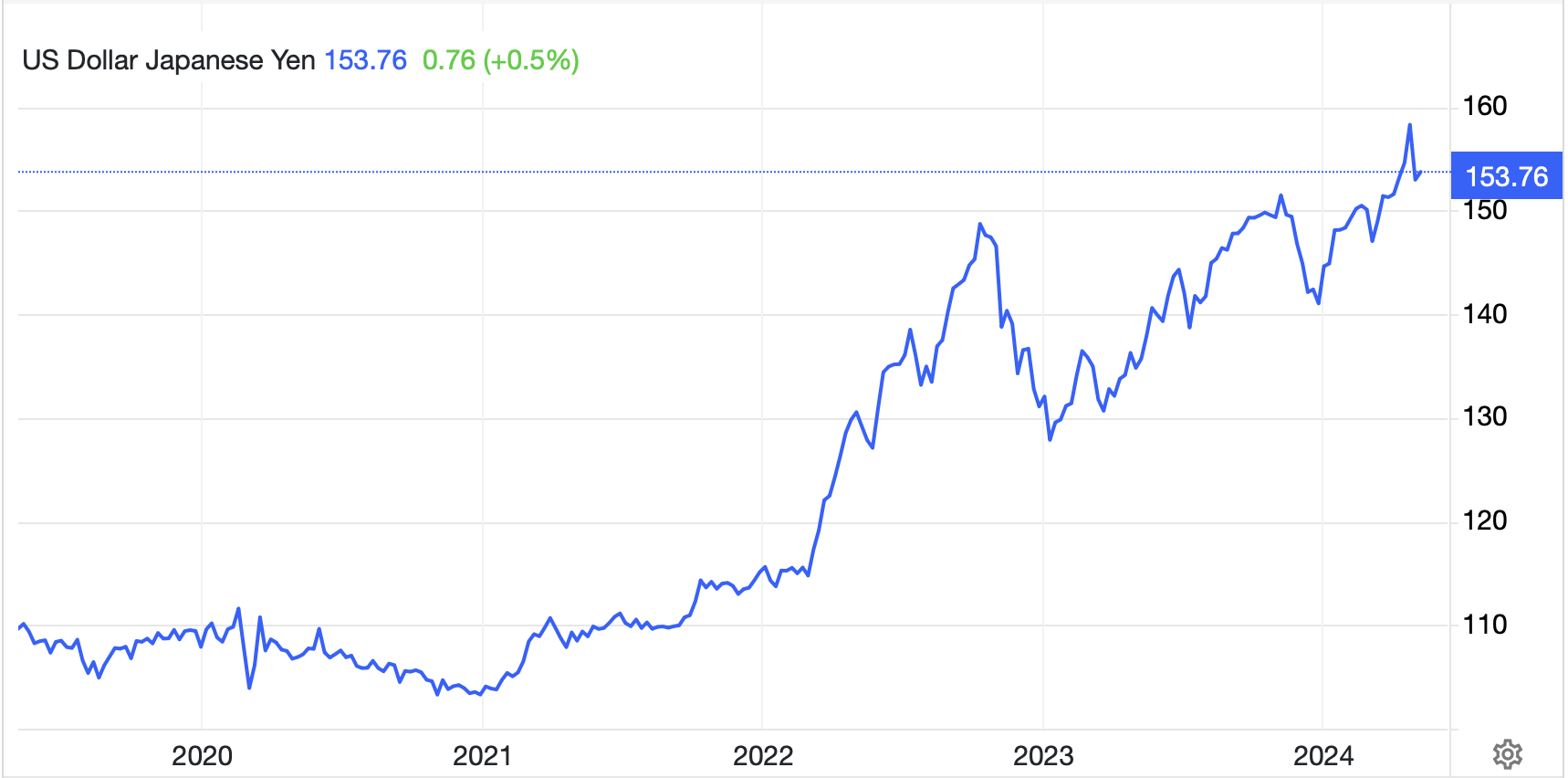
Turning back to markets, ahead of the CPI report, most markets around the world have remained quiet, with one notable exception, Japanese equities which have continued their impressive rally.  After a mixed and lackluster session yesterday in the US, the Nikkei rose nearly 3.0% overnight as the ongoing yen weakness and a growing suspicion that the BOJ is not going to act anytime soon continues to support things there. Chinese markets remain closed all week for the New Year holiday but the rest of the APAC markets had solid sessions.  European bourses, however, are under some pressure this morning with all of them lower by between -0.3% and -0.6%.  The data from the UK showed that the employment situation was better than expected, with lower Unemployment and firmer wage growth.  This will not encourage the BOE to consider cutting rates anytime soon.  As to US futures, at this hour (7:45) they are somewhat lower with the NASDAQ (-0.75%) leading the way down.

Meanwhile, in the bond market, yields have edged lower everywhere except the UK (+2bps and see employment data for explanation) as Treasuries (-2bps) show the way and most of Europe has followed directly in its footsteps with similar yield declines.  Interestingly, JGB yields were unchanged overnight despite the equity rally and yen weakness.

Oil prices (+0.75%) are bouncing this morning as any hopes of a ceasefire in the Middle East have faded for now but we are also seeing broad-based strength across the metals markets with gold (+0.4%), copper (+0.75%) and aluminum (+0.3%) all finding support this morning.  Perhaps this is on the back of dollar weakness in anticipation of a cool CPI print.

Speaking of the dollar, it is broadly softer, albeit not dramatically so.  GBP (+0.4%) is the leading G10 currency although CHF (-0.4%) has fallen on the back of a much lower than expected CPI reading there, just 1.3% Y/Y, with market participants now looking for rate cuts sooner rather than later.  In the EMG bloc, things are mixed although there are more gainers than laggards with ZAR (+0.5%) the leader of the pack on those strong metals prices.

Looking at this week’s data beyond today shows the following:

ThursdayInitial Claims220K
 Continuing Claims1880K
 Retail Sales-0.1%
 -ex autos0.2%
 Empire State Manufacturing-15
 Philly Fed-8
 IP0.3%
 Capacity Utilization78.8%
 Business Inventories0.4%
FridayPPI0.1% (0.6% Y/Y)
 Ex Food & energy0.1% (1.6% Y/Y)
 Housing Starts1.46M
 Building Permits1.509M
 Michigan Sentiment80.0

Source: tradingeconomics.com

As well, today we already saw the NFIB Small Business Optimism Index show a little less optimism printing at 89.9, down 2 points from last month.  Of course, things would not be complete without a bit more Fedspeak, with 6 more on the calendar including Governor Waller, perhaps the 3rd most important voice there.

Overall, while I don’t think the rate of inflation has much further to fall, and in fact, I expect it to rise again as the spring and summer progress, today’s number feels like it could be soft.  Here’s the thing, the market is anticipating that soft number so it is not clear to me how much further they can drive risk assets higher on this news.  They need something new.  However, if it is hot, look for a sharp down day in risk assets and higher yields and a higher dollar.

Good luck

Adf

Turns to Sh*t

The FOMC’s out in force
Explaining the still likely course
Of rates is to stay
Where they are today
Unless there’s some hidden dark horse
 
Investors, though, don’t give a whit
As Spooz seem quite likely to hit
Five thousand quite soon
Then onto the moon
Take care lest this view turns to sh*t


The WSJ led with an interesting article today with the below graphic as the teaser.  This is called a hair chart, for obvious reasons, with those light blue lines describing Fed funds futures curves and comparing them to the subsequent actual Fed funds rate over time.  The article’s point, which is important to understand, is that the futures market tends not to get things right very often.  In other words, just because the market is pricing in 5 or 6 rate cuts today does not mean that is what will occur over time.  In fact, looking at the chart, it almost seems that 5 or 6 cuts is the least likely outcome.  One need only look at the past several years to see that while they were pricing cuts, the Fed was still hiking.

Of course, this fits with my thesis that the Fed funds futures market is actually reflecting a bimodal outcome of either zero cuts or 10.  But regardless of my view, the equity market is all-in on the idea that the Fed is going to be cutting rates soon as evidenced by the fact that the S&P 500 is now trading just a hair below 5000 after yesterday’s 0.8% gain.  

In the meantime, yesterday we heard from four more Fed speakers and to a wo(man) they all said effectively the same thing; progress has been made on the inflation front but they still don’t have confidence that 2% inflation on a sustainable basis has been achieved.  In fact, several mentioned that the recent hot GDP and NFP data indicated more caution is warranted.  By the way, if we look at the Atlanta Fed’s GDPNow forecast, it currently sits at 3.4%, hardly a level of concern, while their Wage Growth Tracker remains at 5.0%.  Again, that is not data that indicates inflation is collapsing.  It remains very difficult for me to expect inflation to fall given the recent totality of the data.  In other words, nothing has changed my view that inflation will remain stickier than currently priced and very likely start to creep higher again, and that will ultimately have a negative impact on risk assets.  But not today!

The other news overnight was that Chinese CPI rose less than expected in January, just 0.3%, which took the annual change to -0.8%.  As China heads into their two-week Lunar New Year holiday, welcoming the Year of the Dragon, the question for investors around the world is, will Xi do anything to halt the decline?  Thus far, his efforts have been weak and insufficient as evidenced by the equity markets in Hong Kong and on the mainland both having fallen sharply over the past year with little net movement this year despite several efforts at support and stimulus.  Now, Xi has nearly two weeks to come up with a new plan to get things going when markets return on February 20th, but for the past several years he has been unwilling to fire a big fiscal bazooka.  Will it be different this time?  Remember, they still have a catastrophic mess in the property market there which will impinge on anything they do.  I expect there will be some more half-hearted measures, but nothing sufficient to turn things around.  Ultimately, while they don’t want to see the renminbi fall sharply, I suspect it may have a bit more weakness in it before things are done, especially if the Fed really does stay higher for longer.

Ok, let’s look at markets elsewhere overnight.  The Nikkei (+2.0%) rallied sharply after comments by a BOJ member indicating that even when rates get back above zero, they will not move very much higher, and it will take time.  This saw the yen weaken further while stocks benefitted.  Meanwhile, the only loser in Asia overnight was India, where investors were disappointed that the RBI left rates on hold rather than cutting them (see a pattern here?).  Otherwise, everything followed the US rally yesterday.  The same is broadly true in Europe with decent gains, about 0.5%, almost everywhere except the UK, which is flat on the day after comments by a BOE official that cuts may not come as soon as hoped.  As to the US, at this hour (7:30) futures are basically unchanged.

In the bond market, after a generally quiet session yesterday, yields are starting to creep higher again with Treasuries +2bps and European sovereign yields rising a similar amount across the board.  Once again, the global bond markets revolve around Treasury yields with the only exception being JGB’s which saw the yield decline 1bp after those BOJ comments.

In the commodity markets, oil (+0.9%) is higher once again with Brent trading back above $80/bbl, as Secretary of State Blinken returned to the US with no real improvement in the Israeli-Hamas war and no prospects for a cease-fire.  Meanwhile, the US was able to kill the Iranian commander who allegedly led the attack on a US base that killed three soldiers, certainly not the type of thing to cool down tensions in the region.  Between the rise in cost of shipping oil from the Mideast to the rest of the world because of the Red Sea situation, and the lack of hope for an end to the fighting, it seems oil may have some legs here.  As to the metals markets, there is a split with both gold and copper under some pressure but aluminum seeing a bid this morning.  Quite frankly, I understand the former two rather than the gains in aluminum, but in the end, none of these metals has moved very much over the past months and remain trendless for now.

Finally, the dollar is starting to assert itself this morning as though the yen (-0.75%) is leading the way lower, pretty much every G10 and EMG currency is weaker vs. the greenback at this time.  Again, I would contend this is all about the ongoing Fed message of caution and confidence regarding inflation’s disposition, and the prospects of higher for longer.  FWIW, the current probability of a March cut is 18.5%.  barring a collapse in the CPI data next week, I expect that to head toward zero over time.

As to the data situation, we only see the weekly Initial (exp 220K) and Continuing (1878K) Claims data first thing and then it is Fedspeak for the rest of the day.  I expect that traders are going to push the S&P 500 over 5000 early this morning, if for no other reason than to say it was done, but what happens after is far less certain.  Earnings data has been generally ok, but some pretty bad misses have had quite negative impacts on individual names.  As to the dollar, the more I hear Fed speakers urge caution in the idea for rate cuts soon, the better its prospects.

Good luck

Adf

Now Estranged

“Something appears to be giving”
Said Waller, the true cost of living
So, bonds rallied hard
The dollar was scarred
But stocks were quite unreactive-ing

The narrative clearly has changed
With hawks on the Fed now estranged
Is everything better?
As world’s largest debtor
We need low rates to be arranged

Fed Governor Chris Waller, one of the erstwhile hawks on the FOMC was covered in white feathers yesterday as he explained his latest perception that the Fed was on a path to achieving their 2% inflation goal as Q3’s expansive GDP was clearly an outlier and the data he cited showed economic growth slowing toward trend just below 2%.  The other Fed speakers on the day did not back him up specifically, and in fact, Governor Bowman explained her base case was the Fed needed to hike still further to be certain inflation was under control.  However, the market only had eyes for Waller and has heard the following message from the Fed, ‘we have finished hiking, and the next move will be a cut.’  Although this had been a building narrative, until yesterday there had been consistent pushback from virtually every Fed speaker with the higher for longer mantra.  However, the current belief set is that higher for longer has just been buried and that lower rates are in our future.  Let the celebrations begin because the Fed has achieved the much discussed, though rarely achieved, soft-landing.

However…it is still a bit premature, to my mind, to celebrate accordingly.  In fact, just yesterday the Case Shiller Home Price Index showed an annual rise of 3.9%, which although 0.1% less than forecast, also shows that the widely claimed decline in house prices due to higher yields, has not materialized.  And consider, if yields are set to go lower, the idea that house prices are going to fall and feed into lower inflation seems absurd unlikely.

But logic has never been an important part of any market narrative, and this time is no different.  The fact that declining bond yields (Treasuries fell 6bps yesterday and a further 5bps in the aftermarket) and the fact that the dollar, as measured by the DX, fell 0.5% led by USDJPY falling nearly 1.5% to its lowest level since September, has eased financial conditions thus supporting economic activity and inflation, is of no importance to the narrative.  Once again, we have heard from some big-name traders, Bill Ackman in this case, claiming that the Fed is now going to cut well before the market is pricing, predicting the first cut in March 2024. The market response to this has been for Fed funds futures to price a 40% chance of a March cut and a 75% chance of one at the May meeting.

And maybe all this is correct.  However, as I wrote yesterday, I believe that we are going to see a significant additional amount of federal government largesse to help prop up the economy, and that is not going to push inflationary pressures lower, the opposite in fact.  As is always the case, nothing matters until it matters, and right now, the only thing that matters is that the narrative is all-in on rate cuts coming soon to a screen near you.  While we could easily see further short-term weakness in equity markets as portfolios rebalance after a huge equity rally this month, it certainly seems like a push higher in risk assets is on the cards into Christmas.

As we consider the price action from yesterday and overnight, the thing that really stands out is that the US equity markets did so little on this very clear change in tone from a key Fed speaker.  Had you told me this was going to be Waller’s attitude prior to the session, I would have expected US equity markets to rally by 1+% each, with the NASDAQ really embracing the idea of lower rates.  But while the three major indices all closed in the green, it was only at the margin, +0.1% – +0.3% with a very late day rally.  Yes, futures are pointing higher this morning, up about 0.3% across the board, but again, this is somewhat unimpressive.  Perhaps the market has already priced in this idea, hence the 10% rally in November.

There is another wrinkle in this narrative as well, and that is that APAC shares are underperforming in both China and Japan.  Regarding the former, the Hang Seng (-2.0%) fell again as continuing concerns over Chinese corporate growth and profitability weigh on the index with Meituan reporting poor results.  On the mainland, despite hopes that the government was going to do more to support the property market, thus far it has been all talk, and no action and investors are getting tired of waiting.  Europe, however, is having a better go of it this morning, excluding the UK, where continental indices are all nicely higher, at least 0.5% with some as much as 0.9%.  

Not surprisingly, European debt markets are rallying as European sovereigns are following the US lead, ignoring the pleas from ECB speakers that higher for longer remains the path forward.  As such, we are seeing further declines on the order of 4bps – 6bps across the continent, matching US yield declines for the past two days.  Yields in Asia, though, are quite interesting with some very different narratives playing out there.  Starting with Japan, which saw yields fall 9bps last night, back to their lowest level since September, we heard from BOJ member Seiji Adachi that it was premature to consider exiting ultra-loose monetary policy amid global economic uncertainties and the end of the aggressive rate hikes in the US.  That seems counter to what had been the building narrative regarding Ueda-san’s next move.  Australia saw yields decline 14bps but in New Zealand, the decline was much more muted, just 2bps, after the RBNZ left rates on hold, as expected, but was far more hawkish in their statement than expected and hinted at potential further rate hikes.  

Turning to the commodity markets, oil continues to rebound, rallying another 1.8% this morning and recouping all its recent losses as confusion still reigns over the OPEC+ meeting tomorrow, or perhaps to be delayed again.  As well, it seems that a massive early winter storm closed ports in the Baltic and so oil shipments have been interrupted there for the time being.  Gold, though, has been the big story in commodity markets as it exploded higher yesterday after the Waller comments, jumping $30/0z (1.5%) to levels last seen in May and once again approaching its all-time highs of $2085/oz.  The market technicians are getting quite excited as they see a break there as having potential for a much larger run higher.  A case can be made that this is not a vote of confidence in the Fed’s anticipated future handling of inflation, but for now, we can simply attribute it to lower interest rates around the world.

Finally, the dollar has taken a straight-right to the chin and is reeling against virtually all its counterparts, both G10 and EMG. While we have seen a bit of a rebound this morning, since Monday’s close, EUR (+0.3%), GBP (+0.5%) and JPY (0.65%) have all rallied nicely, and that is after giving up some of those gains overnight.  We saw similar movement in the EMG bloc with CNY (+0.3%), PLN (+0.3%) and BRL (+0.8%) all responding positively to the Waller comments.  As I have been saying recently, if the Fed is truly done, then the dollar is likely to suffer, at least until such time as the other central banks fall in line.

On the data front, in addition to the Case Shiller Home Prices yesterday, we saw Richmond Fed Manufacturing which disappointed at -5.0 (exp 1.0), yet another sign that growth is waning.  It is data like this that has Waller in the mindset that slowing growth will lead to lower inflation.  Of course, rising home prices would certainly be a crimp in that theory.  Today we see the second look at Q3 GDP (exp 5.0%) with Real Consumer Spending expected at +4.0%.  We also get the Fed’s Beige Bok at 2:00pm and Cleveland Fed president Mester speaks at that time.  It will be interesting to hear if Mester, a very clear hawk, confirms the Waller thoughts or tries to push back alongside Governor Bowman.

For now, while the dollar has bounced slightly this morning, as long as the narrative remains the Fed is done and that cuts are coming soon, you have to believe the dollar is going to fall further from here.  If pressed, I would suggest USDJPY has the furthest to decline, but the fact that we have already had pushback from the BOJ implies that they are not that unhappy it remains weak.  After all, it supports their corporate sector and helps keep inflation higher, which remains one of their goals.

Good luck

Adf

Not Preordained

The first cracks have started to show
In Jay’s, up til now, status quo
When Harker explained,
Though not preordained,
That rate cuts, next year, they’d bestow

While he is the first of the Fed
To claim that rate cuts are ahead
Do not be surprised
When views are revised
By others now this road’s been tread

While things looked dire yesterday morning with respect to risk assets, along around lunchtime there was a reversal of attitudes and while equity markets did finish in the red, they were all well off their lows by the close. So, the question is, what could have caused that reversal?  Interestingly, an argument can be made that Philadelphia Fed President Patrick Harker’s comments may well have been the catalyst.  

After explaining, “I think there is a path to an economic soft landing,” Harker went on to the money quote, “Sometime, probably next year, we’ll start cutting rates.”  While the first comment was a nice sentiment, the second comment was the first time we have heard any Fed speaker consider that rate cuts would be appropriate in 2024.  Remember, the entire mantra has been, ‘higher for longer’ with no indication that the FOMC was even close to considering rate cuts.  Importantly, Mr Harker is a current voting member, so his views carry a touch more weight than the non-voters.

Of course, the Fed funds futures market has been pricing in that exact scenario for months, with the current expectation that by the end of 2024, Fed funds will be back to 4.0%.  The conundrum here, though, is that if the economy comes in for a soft landing, meaning we do not have a recession while inflation falls back to their target, why would they adjust rates at all?  It would seem under that scenario that interest rates could be termed ‘appropriate’, neither too high nor too low.  I get why equity investors want lower rates, but then seemingly, rate cuts could well bring on another bout of inflation as an already growing economy overheats with extra monetary stimulus.

Yesterday’s other Fed speaker, Richmond’s Thomas Barkin (a non-voter this year) had a less dovish message.  He was unwilling to ‘predeclare’ where rates are going, explaining they have time before the next FOMC meeting to monitor the data.  He also explained that there are competing outlooks for the economy, “one where inflation will glide down to 2%, another where it remains persistent.”  But that message is far more in line with what we have been hearing.  It was the Harker comments that got things rolling.

And so, as we walk in this morning, there is a lot of green on the screen in the equity markets as risk is once again in favor.  Not surprisingly, this has pushed commodity prices higher, especially oil, which while higher by 1.3% this morning, and back over $83/bbl, is more than 5% above the lows seen yesterday morning.  That is a big reversal!  Metals markets, too, are firmer this morning with gold, copper and aluminum all benefitting from this change in sentiment.

In the equity space, Asian markets were more mixed with the Nikkei (-0.5%) which had been holding its own giving back a bit, but the Hang Seng managed to reverse a small portion of yesterday’s losses.  The real story, though, is in Europe, where all the markets are higher, mostly by 1% or more, notably Italy’s FTSE MIB (+1.75%) which has benefitted from both the overall risk sentiment as well as a change in plans by the Italian government regarding the bank windfall profit tax mooted yesterday.  It seems that they got a little nervous over the market’s reaction, which wiped out more than €10 billion in market cap from the banking sector, and so reversed course a bit.  As to US futures, they are modestly firmer (+0.3%) at this hour (7:45).

In the bond market, after sharp declines in yields yesterday, we are seeing a bit of a reversal with 10yr Treasury yields up 1bp this morning.  While early yesterday that yield had fallen below 4.0%, it was a short-lived move, and we are back above that key level today.  The easy part of the quarterly refunding was well received yesterday with the 3yr note clearing at 4.398% and a 2.90 bid/cover ratio.  In other words, there were plenty of buyers for that $42 billion tranche.  Today could be a bit trickier as the Treasury seeks to sell $38 billion of 10yr notes.  We shall see where bonds trade as the auctions progress.  And tomorrow comes the 30yr, with $23 billion set to be auctioned, so there is still plenty of new supply coming.  Meanwhile, European sovereign bonds are all seeing yields higher as well this morning, mostly on the order of 1bp to 2.5 bps, after yesterday’s sharp yield declines.

Finally, the dollar is under a bit of pressure this morning, as would be expected given the change in risk attitude.  NOK (+0.5%) leads the way in the G10 on the back of oil’s performance, but in truth, the rest of this bloc has not moved very far at all, although I would argue that gainers mean more than laggards.  In the EMG space, the situation is similar with quite a few more currencies gaining ground, albeit not too much, while only a few are under pressure.  ZAR (-0.5%) is the laggard although there is no obvious catalyst for the movement, especially given the commodity rebound.

There is no data of note today and no Fed speakers are on the docket either.  With this in mind, and as we all await tomorrow’s CPI data, I suspect that risk will remain in favor today.  That means that commodities should continue to perform well along with equities, while the dollar remains under pressure.

Good luck

Adf