What We’ve Learned

It wasn’t but three weeks ago
That pundits who felt in the know
Were sure the attack
On Vene would crack
The world, and more chaos bestow
 
But that news, so quickly, has faded
While Greenland fears have been upgraded
The pundits were sure
That war was the cure
And Europe would soon be invaded
 
Now as it turns out, what we’ve learned
Is NATO, which had been concerned
Has ‘greed to a deal
Which stopped Denmark’s squeal
As Trump, to the US, returned


It is certainly difficult to keep up with current events these days, especially for the punditry who feel it is critical they demonstrate expertise on every issue, given the speed with which the issues change.  All that effort to understand the geopolitics behind ousting Nicholas Maduro has been forgotten in less than 2 weeks as they needed to pontificate on Greenland and its importance.  If, as the president’s TruthSocial post below is the current lay of the land, by Monday, Greenland will return to its historic obscurity as President Trump will move on to the next issue of his choosing.  In fact, this morning, the WSJ is claiming Cuba is next on the list, which, while it wouldn’t be that surprising, has to date only been mentioned in passing by Mr Trump.
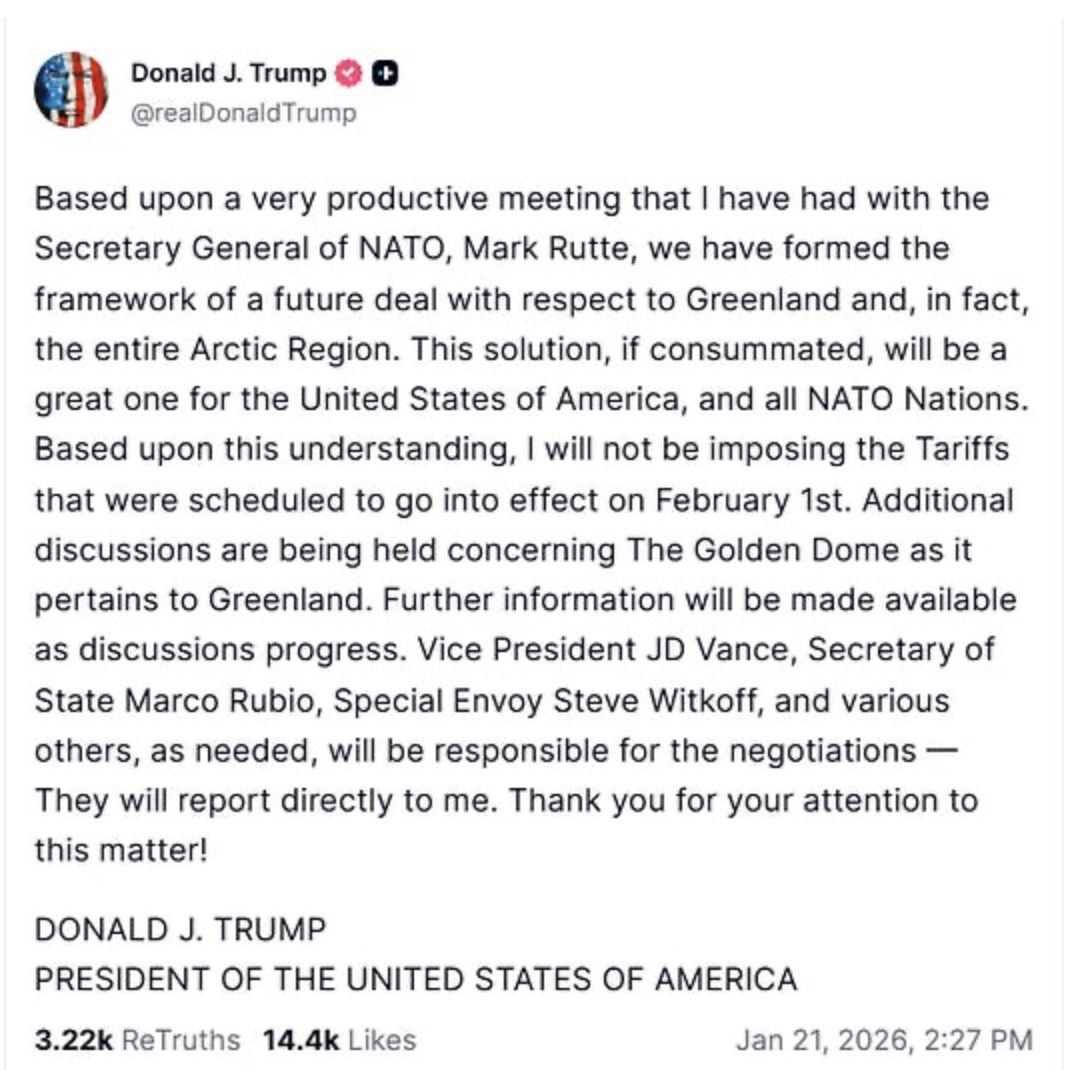
Here’s the thing about all the pontification regarding President Trump, nearly, if not all of it, is simply that, pontification by outsiders who have no idea about what is really happening.  These folks are not sitting in the Oval Office when the President is meeting with his advisors discussing strategy and are generally wishcasting their views and creating a narrative around that.  As I am also an outsider, all I can do is observe and try to ascertain how things might impact markets, but if you are not hearing it from the president or Secretary Rubio or someone like that, it is all speculation.  However, one must admit, it is entertaining!

As I don’t know what the next ‘global crisis’ is going to be ahead of time, let’s turn our attention to markets and how they responded to the president’s speech in Davos as well as the news of the deal framework.

Equities were quite happy.  After the sharp decline seen Sunday night, when the tariff threats were made, the S&P 500 has recouped nearly all of the losses as per the below chart.  Yesterday saw US market gains of 1.2% across the board and futures, this morning, continue to rally, up about 0.5% across the board.
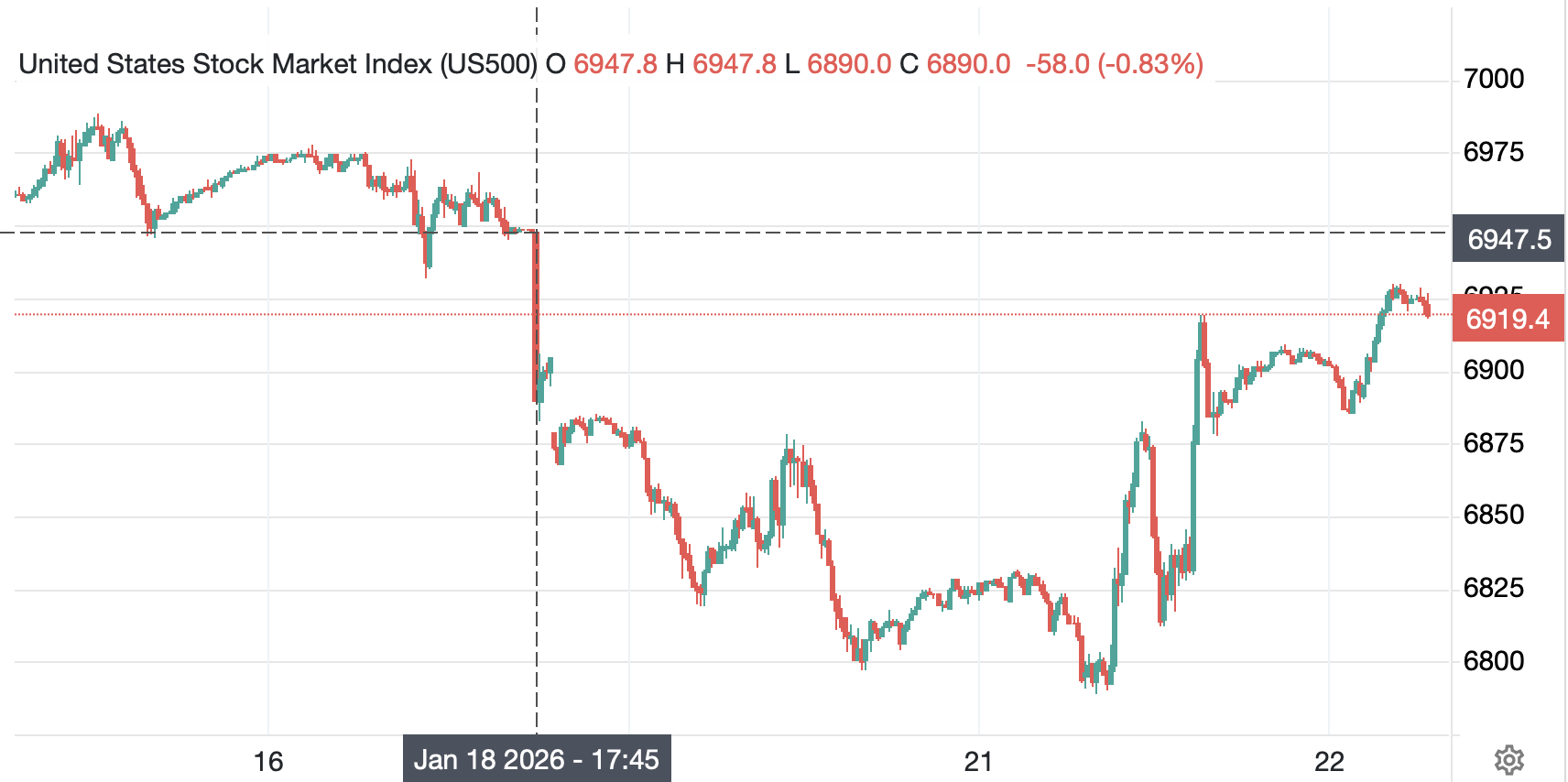
Source: tradingeconomics.com

It should be no surprise that things were bright in Asia as well, with Tokyo (+1.75%) leading the way as almost every exchange in the region was higher by a decent amount (Korea +0.9%, India +0.5%, Taiwan +1.6%, Australia +0.75%) but interestingly, China (0.0%) and HK (+0.2%) were the laggards.  Perhaps good news for the West is not seen that positively there, although the story of regulators in China cracking down on possible stock manipulation by social media influencers has raised some concerns.  After all, one of the biggest issues with investing in China by outsiders is the capriciousness of President Xi and the CCP as they decide what they don’t like that particular day.  

As to Europe, it should be no surprise that there has been a collective sigh of relief from investors there given the removal of the threat of more tariffs and the promises of more defense spending by European nations.  So, gains across the board with the DAX (+1.2%) leading the way although the CAC (+1.1%) is right there as well with most of the rest of the nations seeing gains on the order of 0.5% to 0.75%.

In the bond markets, apparently the end of the world has also been postponed.  Yields declined yesterday and this morning, Treasury yields are unchanged at 4.24%.  In Europe, yields have slipped -2bps to -4bps on the continent although UK gilts (+2bps) are bucking the trend, which appears to be an ongoing impact from yesterday’s higher than expected inflation data which continues to point toward stagflation in the UK.  Interestingly, JGB yields (-4bps) have also fallen again, although they certainly remain near recent highs.  PM Takaichi is going to formally dissolve the Diet tonight and the election is slated for February 8th (wouldn’t it be wonderful if US election campaigns were just 2 weeks long!).  While nothing has changed in her fiscal planning, it seems that investors are awaiting the BOJ announcement tonight (no change expected) and have been modestly appeased by a substantial increase in exports although the trade surplus declined slightly.  

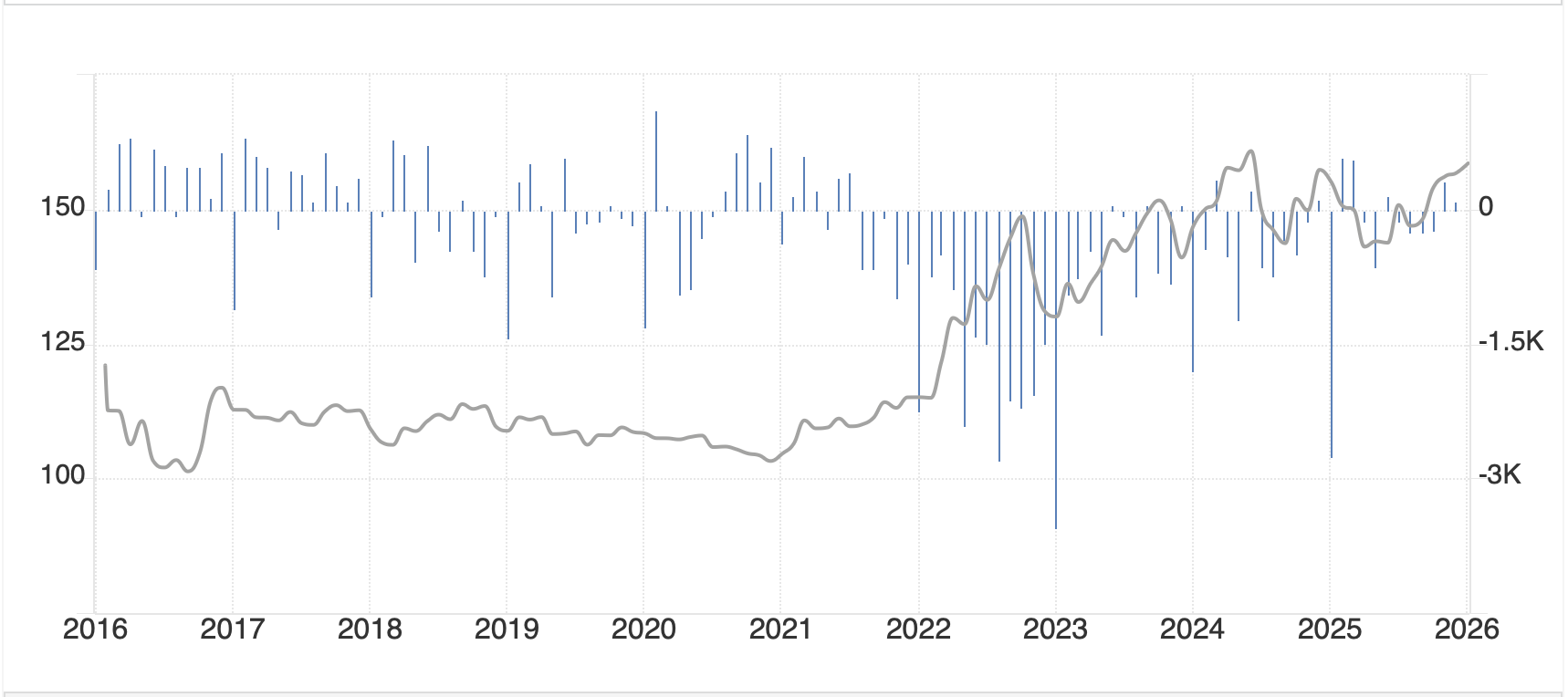
I think it is worth looking at the trade balance relative to the yen (-0.2%) as per the below chart.  Recall, historically, Japan ran major trade surpluses, which was always one of the tensions between the US and Japan dating back to President Reagan.  But as you can see below, the blue bars are the monthly trade numbers and since Covid, that situation changed dramatically.
Source: tradingeconomics.com

However, once the yen started to weaken substantially, the lagged effect showed up in trade data as can readily be seen above.  In fact, this is the real tension in Japan, I believe, that the weak yen helps exports significantly, but has become an inflation problem and the government is caught between the two issues.  This is why I believe we will see a weaker yen over time, especially if Takaichi-san comes out of the election with a solid majority.

As I’m on currencies, if we look elsewhere, the dollar, although we have been constantly assured it was collapsing, remains in its trading range.  This morning, the DXY (-0.1%) has edged lower after yesterday’s rebound.  As it happens, yen weakness has been offset by modest euro strength, but the real strength is in the commodity space with NOK (+0.8%), SEK (+0.36%), AUD (+0.6%) and NZD (+0.6%) all having solid sessions.  Now, my take is that the first two are more likely responses to the Greenland issue’s apparent resolution as NOK is rallying despite oil’s (-1.7%) sharp decline.  Remember, both those nations were in the crosshairs of Trump’s mooted tariffs.  On the other hand, last night, the employment situation in Australia perked up nicely which has helped raise market pricing for a rate hike by the RBA and given the strength in commodity prices and the apparent end of another global crisis, has helped support the currency.  Ironically, as I scan the EMG space, movements there have been much smaller overall.

Finally, turning to the rest of the commodity space, for the first time in a week, gold is not higher this morning, but rather essentially unchanged.  Silver (+0.25%) has bounced a tiny bit after selling off somewhat yesterday in NY.  I have maintained that trees don’t grow to the sky, and frankly, the price action here appears tired regarding ever larger gains.  I believe the fundamental story remains in place, but that doesn’t mean silver won’t chop around for a few weeks or months before starting higher again.   Copper (-0.6%) is also under modest pressure this morning and has retreated much further, about -6.3%, from its recent highs at $6.10/lb than the precious metals.  However, the red metal remains much in demand given the underlying electrification story. 

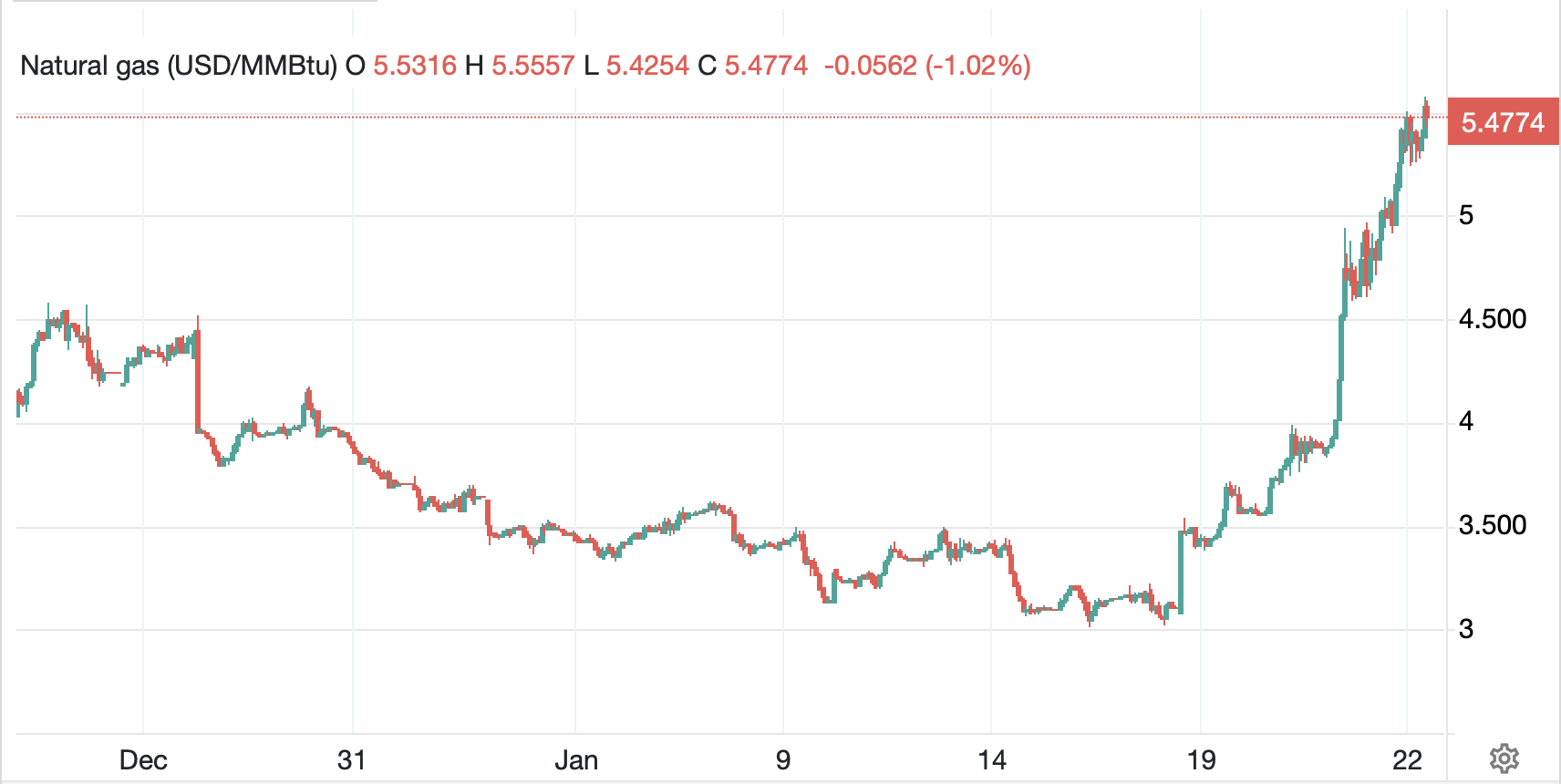
And lastly, a quick look at NatGas (+12%) shows what happens to commodity markets when there is the perception of insufficient supply for the current demand.  This is higher by 75% this week!  And while today in NJ, the temperature is a relatively balmy 34°, the forecast for the coming weekend is much colder and a huge snowfall.  It’s not often you see a movement of this magnitude so here is the chart for the past month.
Source: tradingeconomics.com

On the data front, today brings the final look at Q3 GDP (exp 4.3%) as well as Initial (212K) and Continuing (1880K) Claims.  Too, we get Personal Income (0.4%) and Spending (0.5%) for November and PCE (0.2%, 2.8% Y/Y) for both headline and core.  The EIA releases its weekly oil inventory data today, a day later than usual because of the holiday Monday, with a modest build expected.

Market participants in all markets appear to have found a comfort zone and are taking risk positions again, at least for now.  All the apocalyptic stories about the world rejecting the dollar and the rise of the BRICS will have to wait for another day.  While I don’t know what the next situation is going to be, I am highly confident we are going to have another geopolitical scenario that is going to result in more screaming, teeth gnashing and pearl clutching by those who continue to believe the rules-based order is the way things should be.  Alas for them, economic power and statecraft is the new world order, and my take is ultimately, the dollar benefits from this pivot.

Good luck

Adf
Most Enthralling

Some fractures are starting to show
In markets, as Trump’s blow by blow
Attack on the Danes
And friends, really strains
The view ‘Twenty-Six will lack woe
 
So, equities worldwide are falling
While bond yields, much higher, are crawling
The buck’s in a rut
While oil’s a glut
Thus, gold is the thing, most enthralling


Something is rotten in the state of Denmark.”  So said Marcellus, when Shakespeare introduced him to the world in 1603(ish) in one of his most brilliant works, Hamlet, and it seems true today, 423 years later.  By now, you are likely aware that President Trump has imposed 10% tariffs, to begin on February 1st, on Denmark, Norway, Sweden, France, Germany, Finland, the Netherlands and the UK as he presses his case for US ownership of Greenland.  This is not the venue to discuss the relative merits or pitfalls of the strategy, so I won’t bore you with my views on the subject.  

Rather, this is a venue to discuss the market impacts and how they may evolve, in one poet’s eyes, going forward given the new starting condition.  As I type this morning, investors around the world are extremely unhappy, at least holding paper claims on either assets or governments.  However, holding real assets, notably gold (+1.15% and at new all-time highs), silver (+0.9% and at new all-time highs) and platinum (+1.45%, not quite at new highs yet) are feeling much better.

It is interesting to me that the WEF is meeting this week, and likely no coincidence that President Trump escalated things ahead of the meeting where he is scheduled to speak tomorrow.  It seems that the protagonists in this latest drama are set to meet while in Davos as well, so all these views are subject to change at a moment’s notice.  But for now, since there really is no other story that matters, let’s look at how markets have (mis)behaved since we last saw them here in the US on Friday.

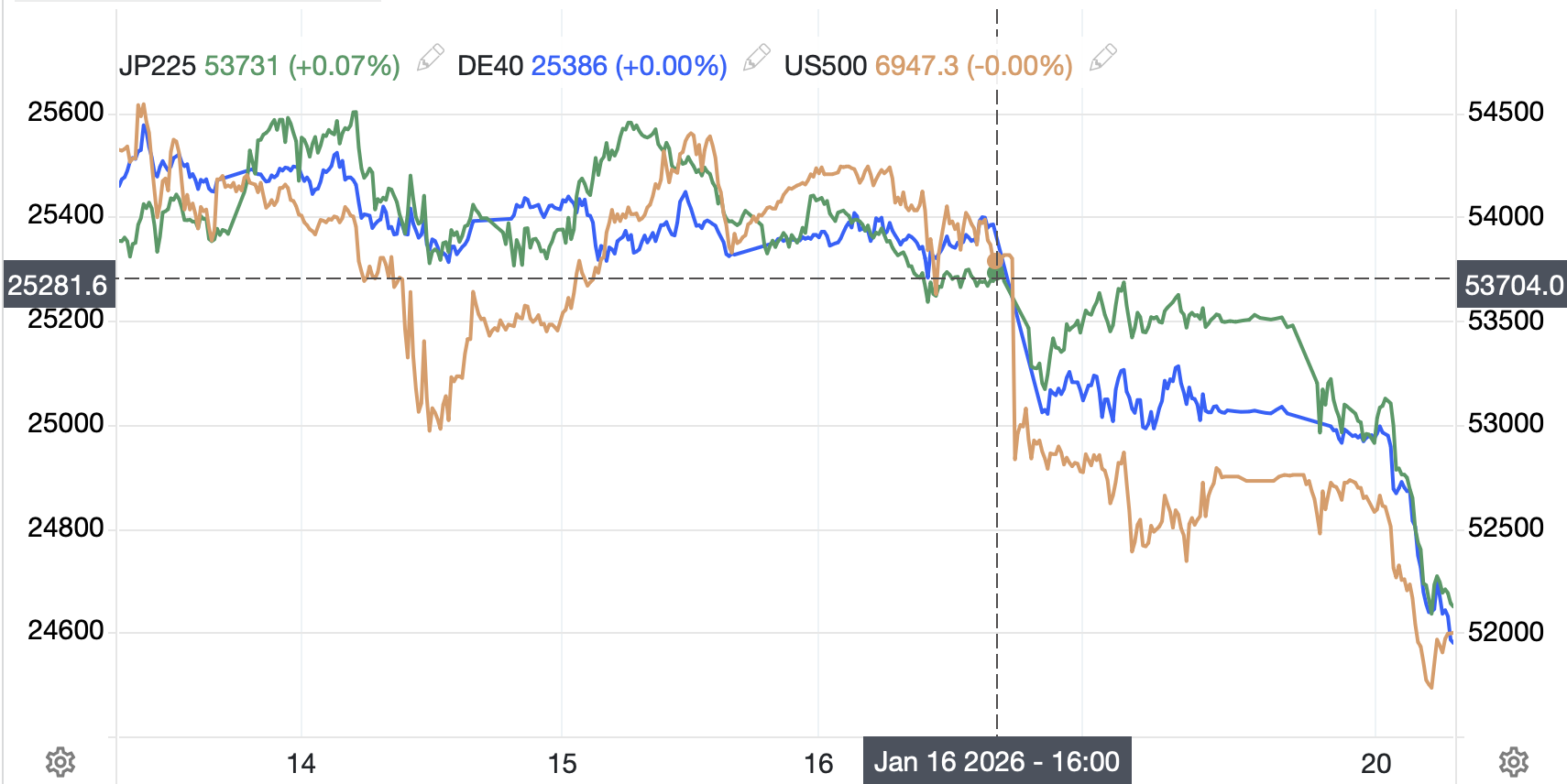
As you can see from the chart below combining the Nikkei 225, the DAX and the S&P 500 futures, the move has been consistent since the close in NY on Friday, with all three main indices lower by between -1.75% (Japan) and -3.1% (Germany), with the US (-2.1%) in the middle.  

Source: tradingeconomics.com

In fact, that price action has been widespread across the rest of the G10 markets and many EMG markets as well. Only China (-0.2% since Friday) has bucked the trend and remains little changed.  Of course, that makes sense given this spat has nothing to do with China, on the surface.  At this point, I expect that all equity markets are going to remain under pressure until there is some resolution.  While Europe has threatened to invoke its Anti-Coercion Instrument on the US if those tariffs come into being, one must wonder will that do more damage to the US or Europe?  FWIW, I expect some type of resolution to be achieved before the Feb 1 deadline but could easily be wrong about that.  One last thing about tariffs; remember last week when expectations were high that the Supreme Court was going to rule on the legality of the ones already imposed?  That has suddenly gone very quiet.  My take there is the longer we don’t hear anything, the more likely they are not going to stop them.

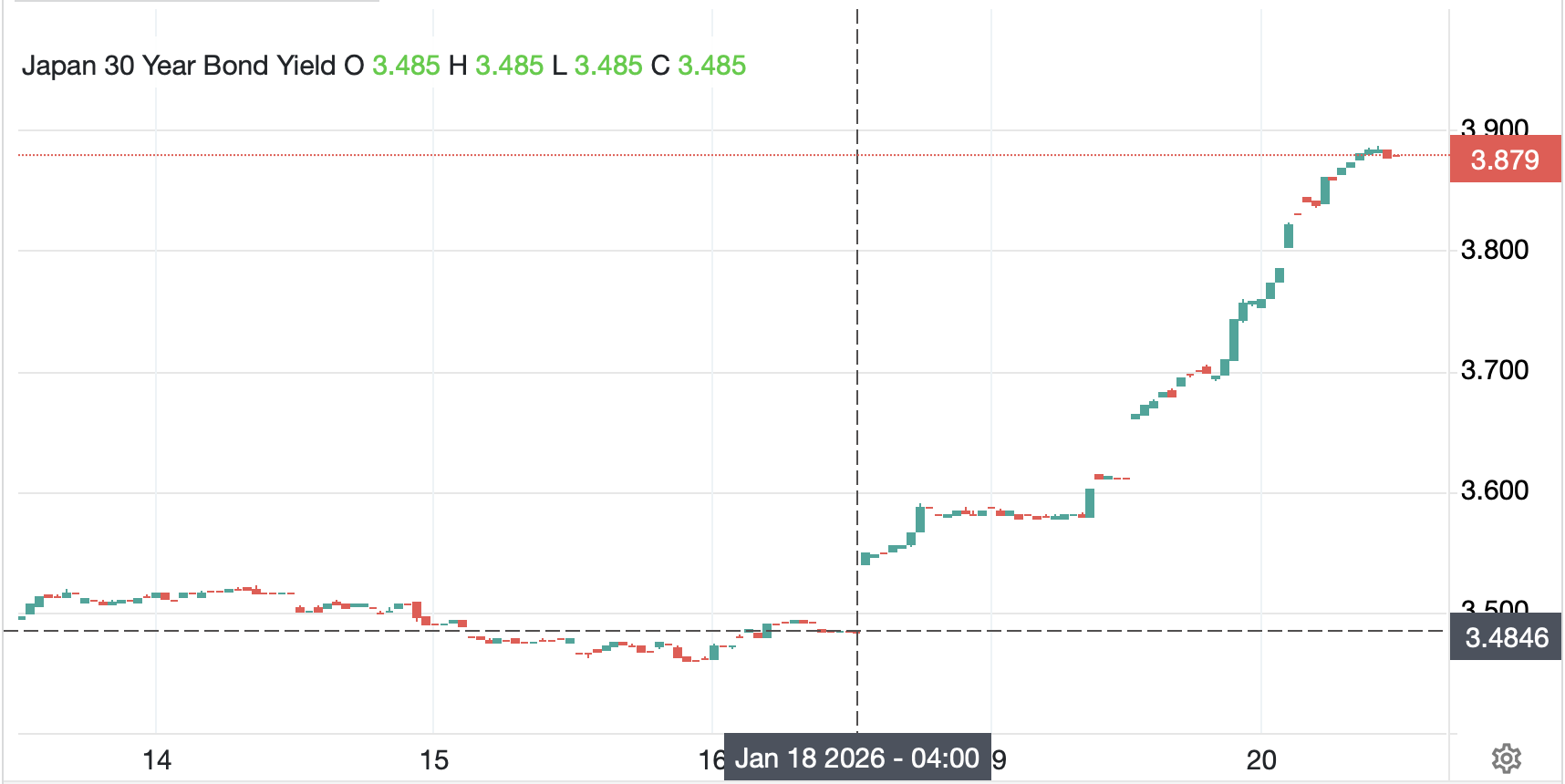
Perhaps, though, the bond market is the more interesting place to look this morning with government bonds around the world getting sold aggressively.  While all eyes have been focused on the US (+6bps and well above the top of the previous range) and Europe (Germany +5bps, UK +7bps, France +6bps) perhaps the real activity is happening in Japan (+9bps).  In fact, Japanese 30yr yields have exploded higher by 40 basis points since Friday’s close, and I’m confident that has nothing to do with Greenland!

Source: tradingeconomics.com

In fact, it appears that JGB holders are getting increasingly concerned that PM Takaichi is going to really run it hot, with more unfunded fiscal stimulus and are responding accordingly.  The latest Takaichi proposal for the upcoming election is that they are going to remove the GST (VAT tax) on food for 2 years to help alleviate inflation problems.  I certainly like that better than capping prices, but fiscally, it’s a tough road to follow.  

One other bond market story that is making the rounds is the idea that Europeans would attack the US by simultaneously unloading their US Treasury holdings.  We have heard this story before with respect to China, and if you look across all of Europe, between central banks and private investors, there are likely upwards of $2 trillion held there.  But the question I ask every time I hear something of this nature is…what will they do with the proceeds if they were somehow able to coordinate the sales?  First, in the worst case, the Fed would buy them to prevent the market from collapsing.  And second, now they would have a whole lot of dollars that need to be invested elsewhere.  Which markets can absorb that amount of flow?  US equities?  Sure, but would that achieve their goals?  I think not.  If they converted them into euros, a one-way flow of $2 trillion into euros in short order would pretty much render all European manufacturing uncompetitive right away as the euro rose to 1.50 or 1.60 or higher.  Gold?  Think $10k/oz or higher.  Ain’t gonna happen.

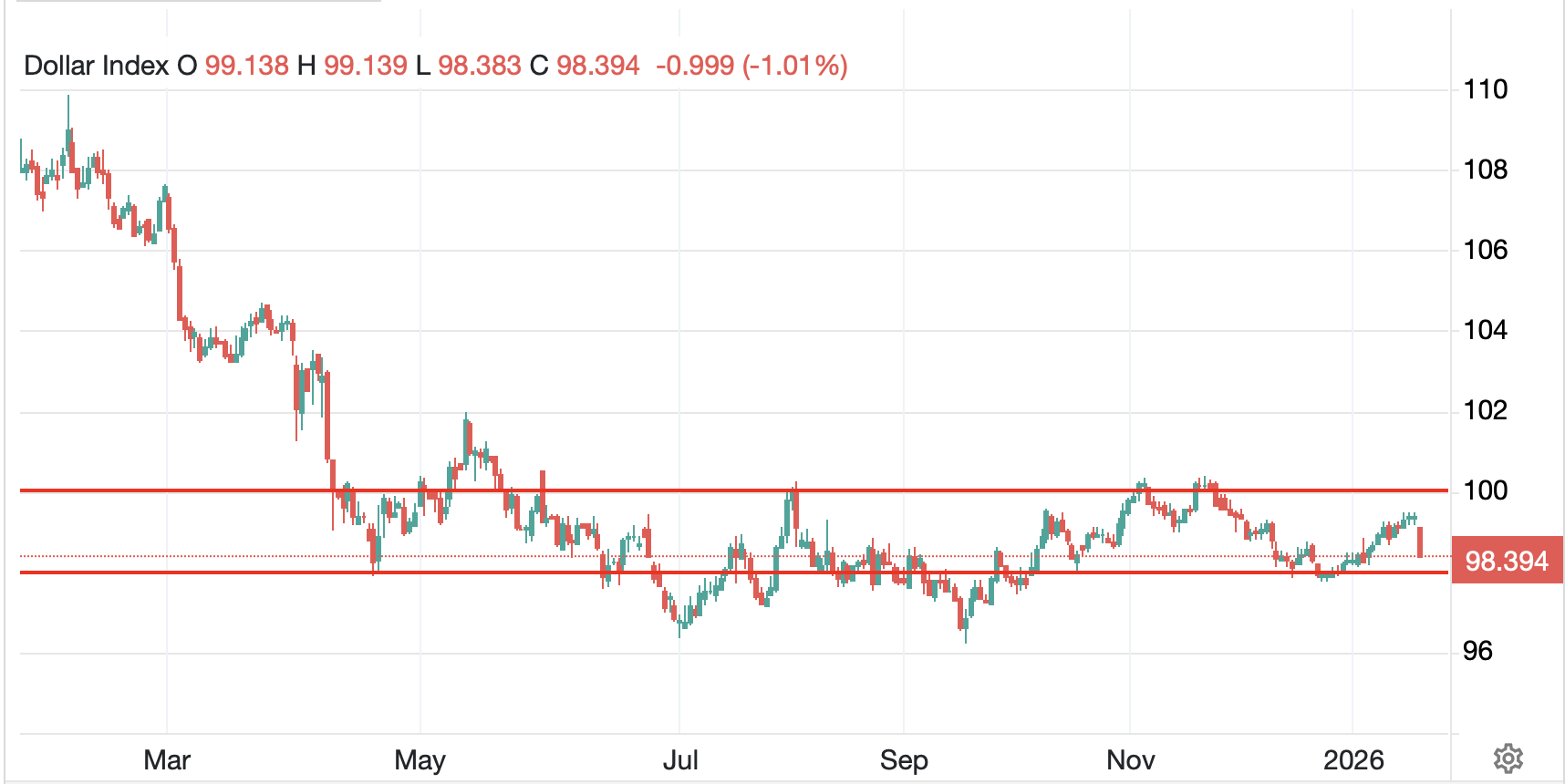
Let’s hit the dollar next, which is under pressure across the board.  As I type (7:20), the DXY has fallen -1.0% this morning, a very large move for that index, but remains within the trading range that we have seen since October.

Source: tradingeconomics.com

The sell-off in the dollar is almost universal, although interestingly, ZAR (-0.5%), MXN (-0.3%) and CLP (-0.3%) are all bucking that trend.  I understand the nervousness, but it strikes me that none of this conversation is a positive for Europe, excepting the idea they sell all their Treasuries and convert the dollars into euros and pounds, an idea I tried to squash above.  

Finally, let’s look at commodities where the metals, as discussed above are soaring while oil (+0.8%) is picking back up off its end of week lows and currently sits just below $60/bbl.  The Iran situation remains murky, at best, and my sense is we have not heard the last of the situation there, although from what I have seen on X, the rioting has been quelled to some extent.  However, I think there is still enormous pressure on the government there and would not be surprised to see some type of US intrusion. 

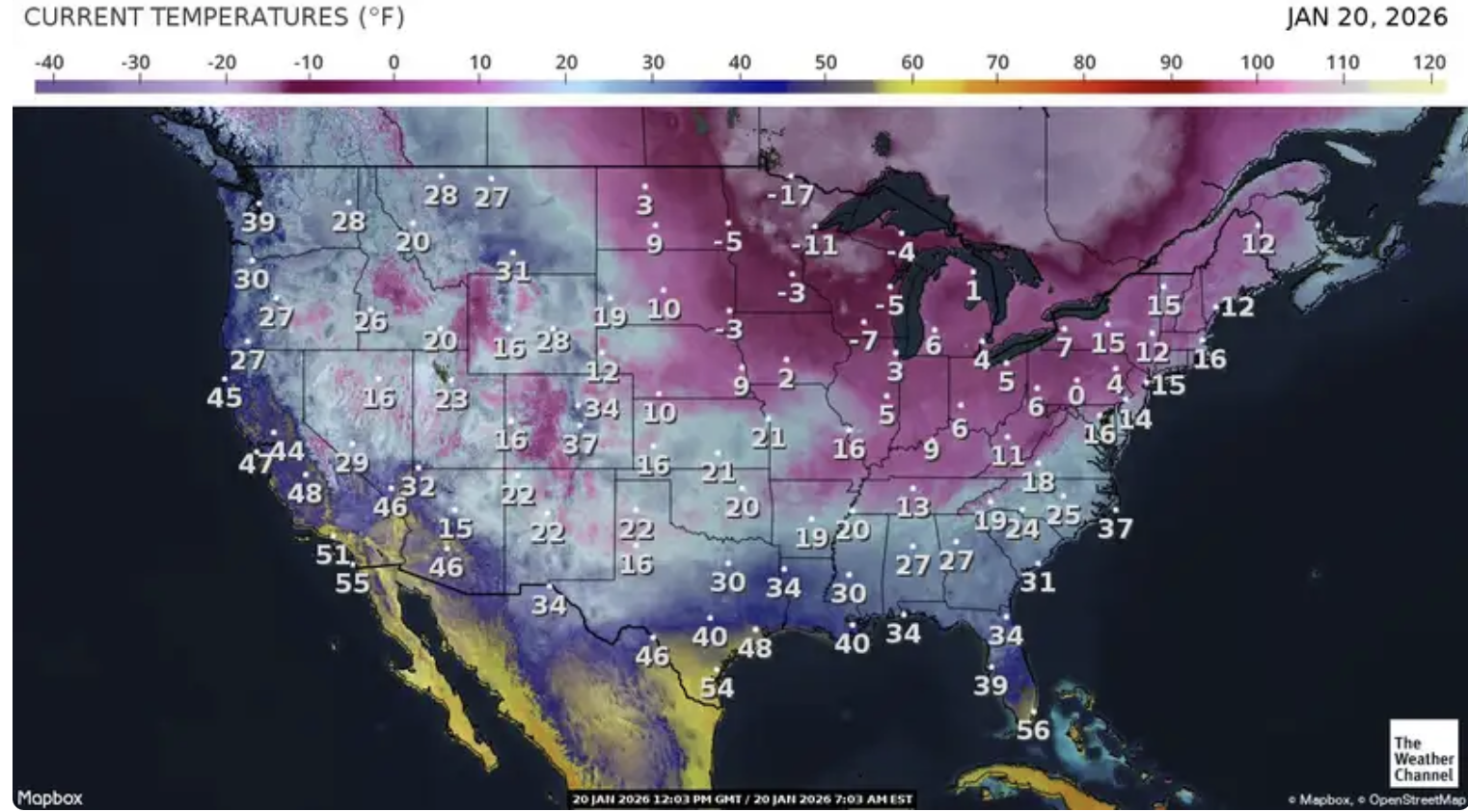
But I’m confident the one thing almost all of you are feeling this morning is the bitter cold that has enveloped most of the US as per the weather.com map below.

Given natural gas is the most common fuel for heating homes, we cannot be surprised that its price has skyrocketed today, jumping 24% in the session so far, although it is now simply back to where it was this time last year.  however, a key issue in this market is Europe, which since they virtually shut off Russian gas, is now highly reliant on US LNG to heat their homes.  It turns out that their storage has fallen to slightly less than 50% of capacity, well below their average storage level for this date of 60% – 65%.  European TTF gas, on a like for like basis, currently costs ~$12.25/MMBtu compared to $3.85/MMBtu in the US, even after the massive jump.  Again, Europe has some issues going forward.

On the data front, there is really nothing today or tomorrow of note although Thursday brings GDP amongst other things.  I will review them tomorrow because, after all, markets right now are far more beholden to President Trump and Europe than to data.

Fear is growing more widespread and will likely continue to do so until there is some type of resolution over Greenland.  But then, it will dissipate quickly as consider, two weeks ago we were all Venezuela experts and today, nobody even cares about that nation anymore!

As to the dollar, I expect that when the resolution arrives, the dollar will make up lost ground, but given we are in the midst of a White House bingo game, one needs to play things close to the vest.  Hedges are crucial here.

Good luck

Adf

The Doctrine, Donroe

There once was a time in the past
When Vene-zu-ela was cast
As queen of the ball
With Maduro’s fall
But life around Trump moves so fast
 
He’s already moved to expand
His target to Denmark’s Greenland
The EU’s gone crazy
And called Trump fugazy
While claiming that they’ll take a stand
 
But really, the Doctrine, Donroe
Explains that the US most grow
Its regional strength
And keep at arm’s length
It’s foes from Beijing to Moscow


It is truly difficult to keep up with all the things that are ongoing in the world these days as so much is happening so quickly.  It is very easy to understand Lenin’s quote, “there are decades where nothing happens; and there are weeks where decades happen” given recent events.  This is clearly one of the latter weeks.

So, Trump, after successfully taking down Maduro has turned his sights on Greenland, something he has discussed from Day 1 of this administration, but apparently now, there seems to be a willingness to discuss things on the other side.  At the same time, from what I read on X, the city of Abadan in Iran has basically ‘fallen’, at least with respect to the Iranian regime’s control as the police are marching with the protestors now.  The rumors are that the Ayatollah has already made escape plans to Moscow.

From a geopolitical perspective, if Iran sees a regime change, which appears increasingly likely, and if the US throws its support behind the replacement regime, it would appear to be a significant power play against China.  After all, if sanctioned Iranian and Venezuelan oil was no longer being sold on the cheap to China, two places where they receive a significant amount of their daily requirements, (between 20% – 25% according to Grok) it would be a major blow.  

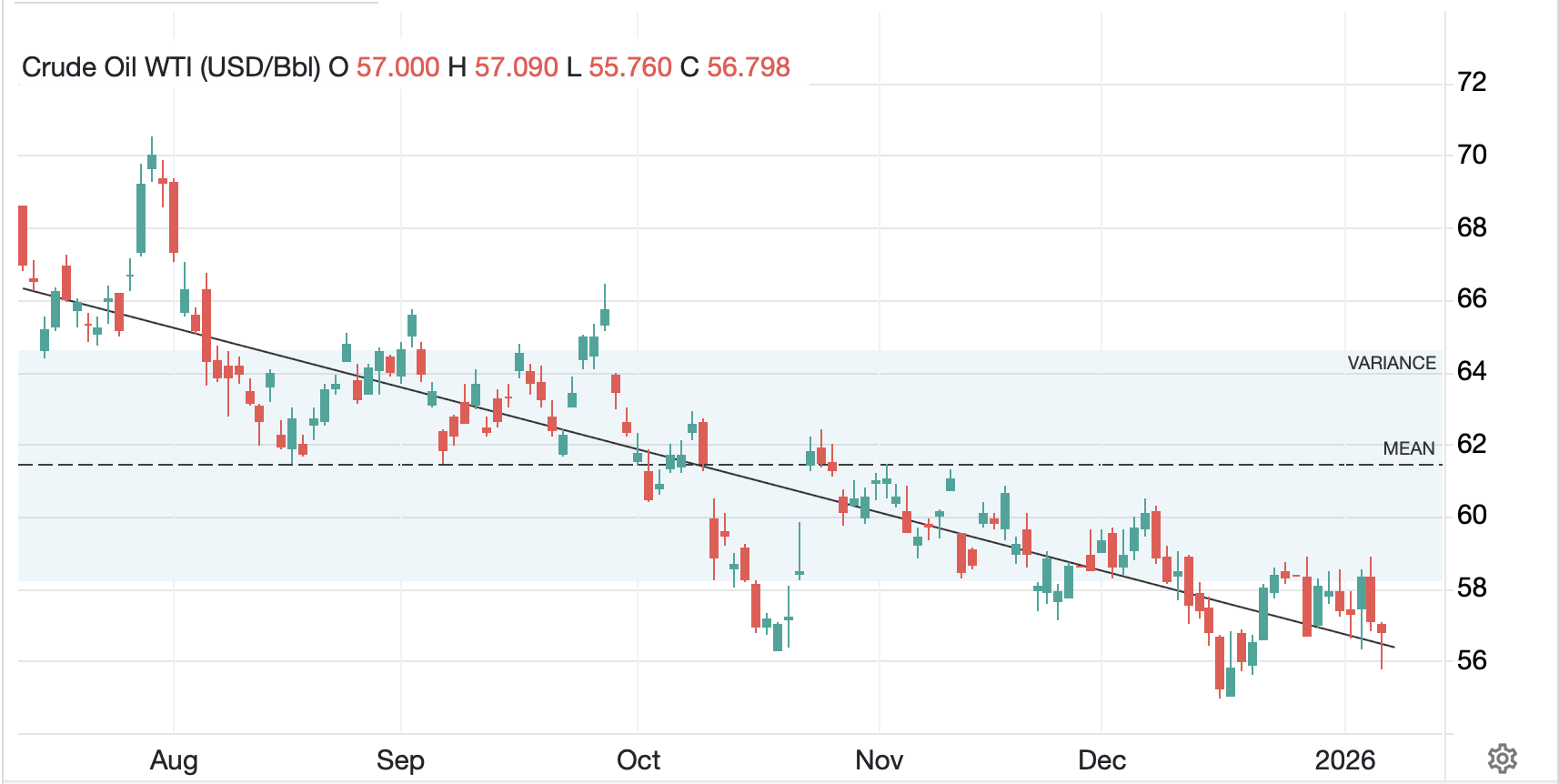
But from our lens in markets, if the Iranian regime falls and sanctions are lifted, suddenly there is much more unsanctioned oil available, and its price is likely to decline further.  This morning, oil (-0.6%) is slipping further after a sharp decline yesterday with Monday’s rally a wispy memory.  I have maintained the trend here remains lower, and that was without government changes in sanctioned nations.  As you can see from the chart below, nothing about this story has changed.

Source: tradingeconomics.com

In the meantime, be prepared for all those who had just shown their new bona fides about Venezuela to be explaining the Greenland story from their newly acquired “deep” knowledge.  This poet certainly doesn’t know enough about Greenland to make any prognostications, but it would not surprise me if within a matter of weeks, we reach an accord with the territory where the US plays a much greater role in its activities while increasing its military presence on the island.  

And to think, we are just finishing the first week of 2026.  Do not be surprised if, as the year progresses, there are more government changes in Europe as the current leadership there has been shown to be weak and ineffective, and an increasing number of people are unhappy with the situation.  While fears over the fall of NATO are rife now, if Germany, France and the UK wind up having snap elections, a distinct possibility at this point, and the new regimes are AfD, RN and Reform UK led, there could well be much greater agreement on the way forward for the alliance.

However, like most of you, I am neither a politician nor geopolitical analyst, I’m just a poet who watches the world and tries to make sense of how it impacts markets.  So, let’s go down that road.

After another strong equity session in the US, where both the DJIA and S&P 500 made new all-time highs, the story in Asia seemed to be one of some early profit-taking after strong rallies.  So, Japan (-1.1%), China (-0.3%) and HK (-0.9%) all slipped during the session with generally less excitement seen overnight than earlier in the week.  India (-0.1%) continues to lag, and while Korea (+0.6%) managed to maintain its upward momentum, the rest of the region was relegated to +/- 0.4% or less in their movement.  

As to Europe, only the DAX (+0.6%) is showing any positivity this morning, mostly on defense names still performing well, while the UK (-0.6%) is lagging after weaker than expected Construction PMI data (40.1 vs. 42.5 exp) and the rest of the continental bourses are little changed overall.  Eurozone inflation was confirmed at 2.0%, cementing the idea that the ECB will remain on hold, so I suspect opportunities here will rely on global trends.  As to US futures, at this hour (7:10) they are mixed, but with movement less than 0.2% in either direction.

In the bond market, yields are sliding around the world, perhaps on the understanding that oil prices are likely to slide given the potential for new, unsanctioned supply hitting the market.  Certainly, there is no indication that government spending anywhere in the world is going to slow down, so that avenue is still closed.  But, recapping, Treasury yields (-3bps) are not declining as much as most of Europe (-4bps to -5bps) or the UK (-8bps after the weak data).  I continue to believe that this year is going to be extremely dull in bond land as central bank support is going to offset additional issuance.

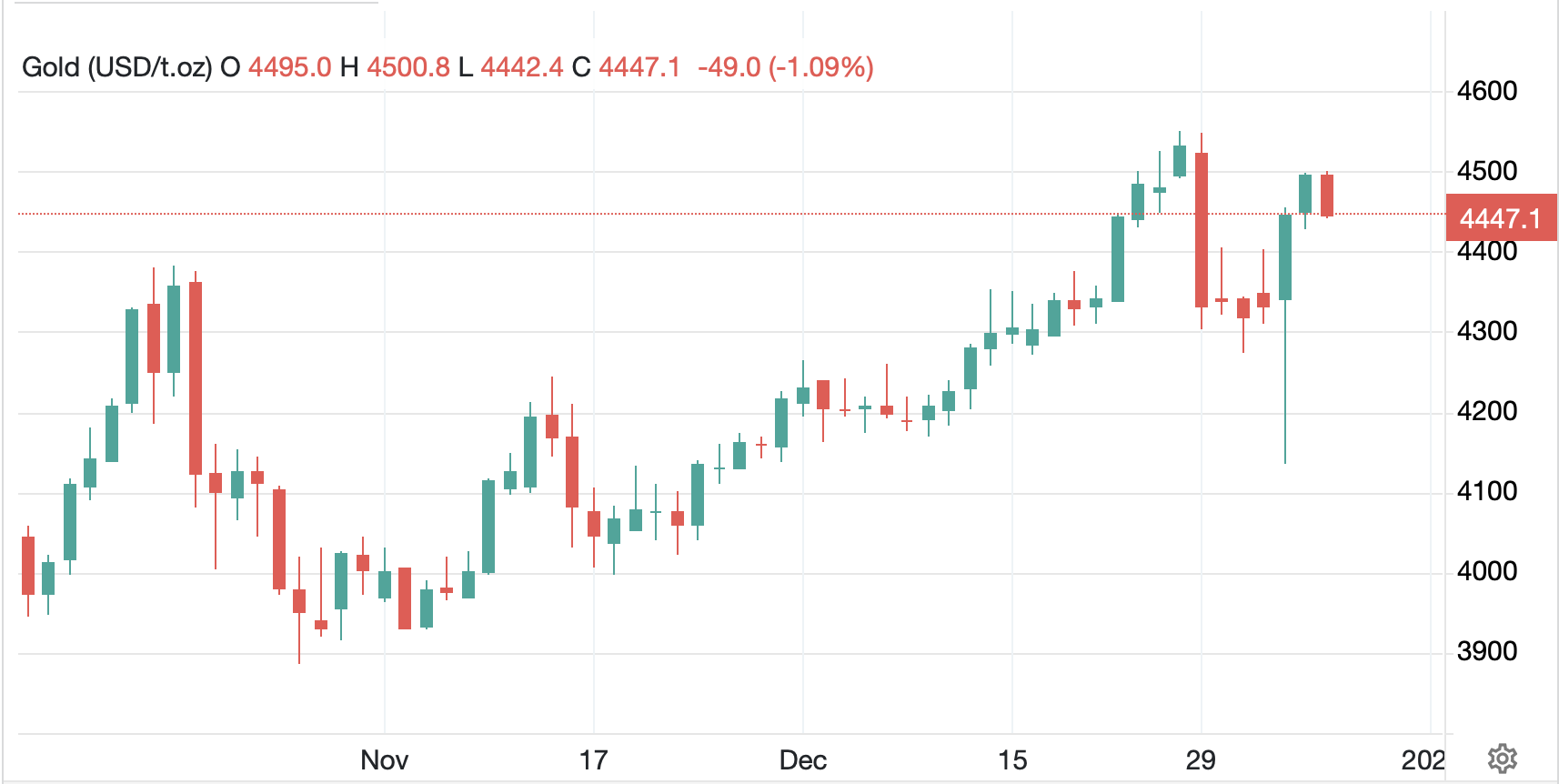
We’ve already discussed oil, but metals, which is where the real action has been, are all lower this morning, very clearly on profit taking activity.  Consider that gold (chart below from tradingeconomics.com) has been the least remarkable and still rallied 4% since the beginning of the year, so slipping -1.2% this morning can be no surprise.

Meanwhile platinum (-6.1%) which is the least liquid of all the precious metals, saw a nearly 20% gain this week prior to today’s decline.  The chart below is not for the faint of heart!

Source: tradingeconmics.com

Silver (-3.1%) is somewhere in between these two, but the story has not changed at all.  There continues to be significant demand for physical metals with paper futures no longer able to control the price action.  One way to follow this is to look at the price on the Shanghai Futures Exchange where it is all delivery settlement and where the price trades at a substantial premium to the COMEX, on the order of $3-$4/oz.

Finally, the dollar is still there, and vs. most of its counterparts, doing very little this morning.  the outlier today is ZAR (-0.5%) which is obviously hurting on the back of gold and platinum’s weakness.  In fact, it is worth looking at the relationship between ZAR and gold, as per the below chart, to help you understand just how closely tied is the price action between the two.

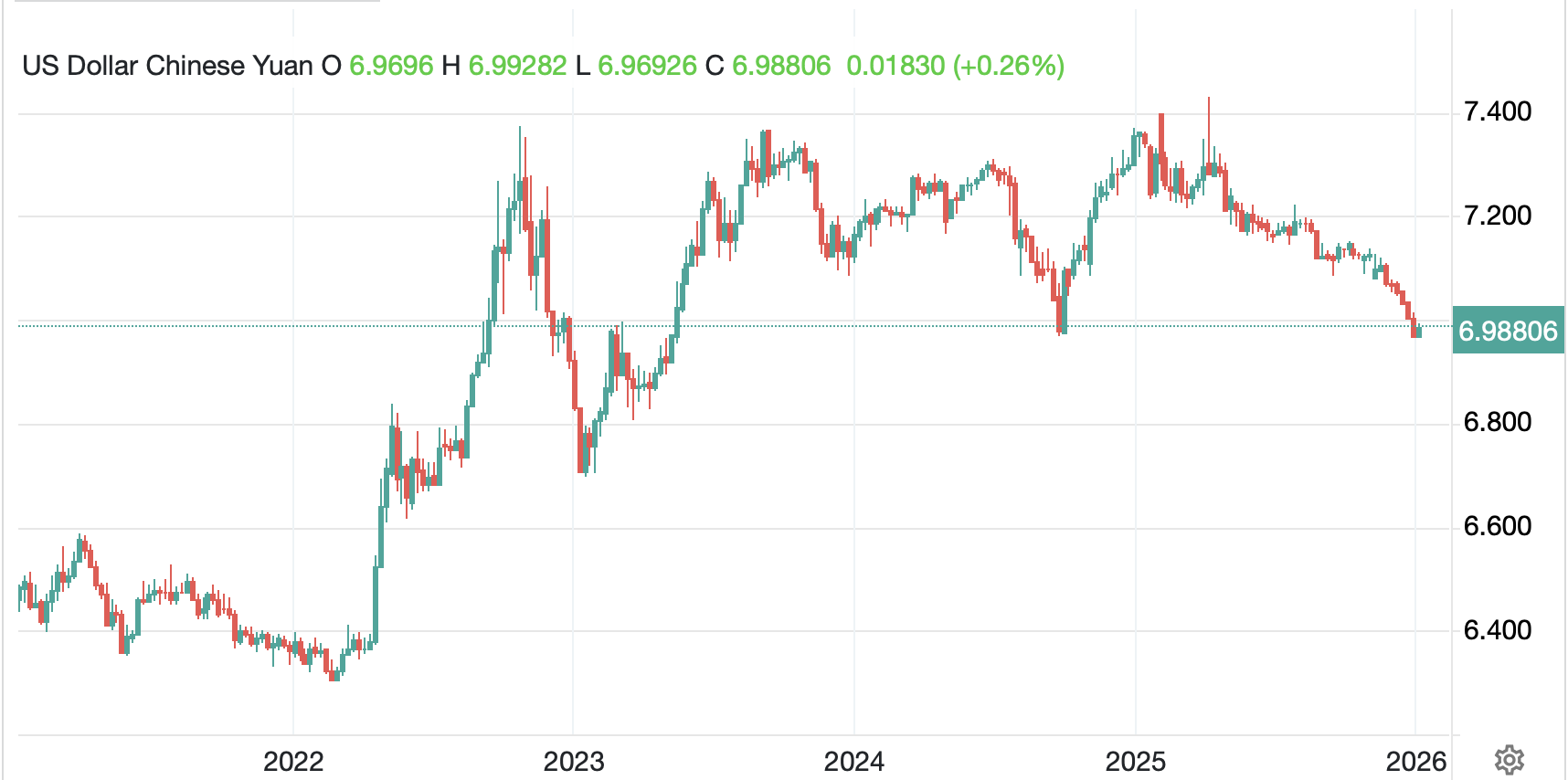
The other currency that has been trending steadily is CNY, with it breaching the 7.00 level at the end of 2025 for the first time since September 2024.  While this trend has been steady for the past year, a look at the longer-term chart shows the renminbi is nowhere near an extreme in either direction. 

Source: tradingeconomics.com

I maintain my view that if China really does create domestic demand for its products, the renminbi will continue this rally and strengthen further.  But we have heard this same story of Chinese government support for the domestic economy for at least a decade, and it hasn’t shown up yet.

On the data front, ADP Employment (exp 47K), JOLTs Job Openings (7.6M), ISM Services (52.3) and Factory Orders (-1.2%, -0.3% ex Transport) are the key releases this morning.  we also get EIA oil inventory data with expectations for a decent build.  There is only one Fed speaker, Governor Bowman, but the Fed just doesn’t seem as important this year as last.

The dollar is not the focus right now, neither are bonds.  Metals remain top of mind with oil a close second.  While recent price action in the former has been extremely volatile, nothing has changed my view that the long-term trend remains higher there.  Similarly for oil, the long-term trend remains lower with recent events simply adding to the weight.

Good luck

Adf