Little Enjoyment

The Beige Book reported inflation
Was modest across the whole nation
And growth and employment
Found little enjoyment
While JOLTs data showed retardation
 
The upshot is traders were caught
Offsides, which is why bonds were bought
But so too was gold
And as things unfold
Be nimble or you’ll be distraught


Bonds rallied on both soft data, Factory Orders falling and JOLTs Job openings declining as well as a Beige Book that described modest economic activity across the nation.  Some cherry-picked quotes are as follows:

  • Most of the twelve Federal Reserve Districts reported little or no change in economic activity since the prior Beige Book period.
  • Eleven Districts described little or no net change in overall employment levels, while one District described a modest decline.
  • Ten Districts characterized price growth as moderate or modest. The other two Districts described strong input price growth that outpaced moderate or modest selling price growth.

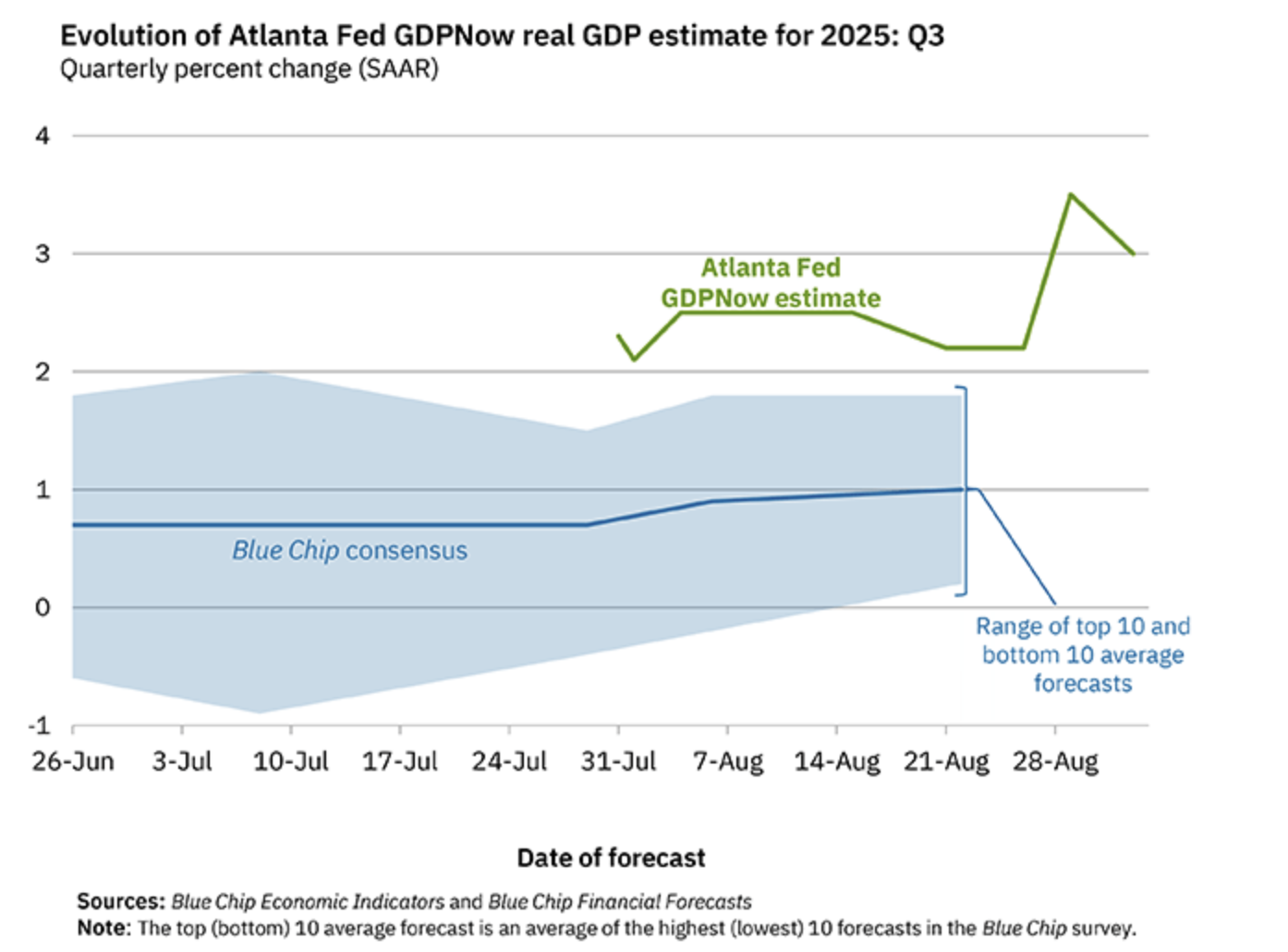
Actually, these were the first lines from each of the key segments, Overall Economic Activity, Labor Markets and Prices.  But if you read them, it is hard to get excited about either growth or inflation as both seem pretty lackluster.  This is at odds with the Q2 GDP results as well as the early Q3 estimates from the Atlanta Fed’s GDPNow forecast as per the below showing 3.0% growth.
While the JOLTS data has always been confusing, and I think is even less reliable these days given the number of phantom job openings (just ask anybody looking for a job using LinkedIn), the Factory Orders data seems to have lost some of its information content given current tariff policies, and their substantive changes on short notice, have upset a lot of apple carts.  I had the system draw a trend line in the below data because it was difficult for me to eyeball it, but FWIW this does not seem a positive result.  Arguably, this is exactly why President Trump is seeking to bring manufacturing back to the US.

Source: tradingeconomics.com

Meanwhile, with ADP jobs this morning (exp 65K) and NFP tomorrow (exp 75K), it is difficult to get too excited about the JOLTS data.  One interesting thing about this data is how it is undermining the higher bond yield narrative that has been rampant (I wrote about it on Tuesday) with yields around the world slipping yesterday in the US and then everywhere else overnight.  For instance, 10-year Treasury yields are lower by -9bps since yesterday morning with virtually all European sovereign yields having fallen about -5bps over the same period.  This is true even in France which auctioned €11 billions of 10yr through 30yr debt this morning.   Compared to their last auction, yields are 30bps to 40bps higher, a strong indication that investors are concerned over the French fiscal situation.

Of course, these two narratives can be simultaneously correct with timing the key difference.  While the short-term view is weaker economic activity will dampen demand and reduce yields, the long-term trajectory of government spending and debt issuance almost ensures that yields will go higher.  Corroborating the long-term story is gold (-0.6% this morning, +3.6% this week) as though some profit taking is evident right now, the barbarous relic has managed to trade to new all-time highs yet again.  That is not a sign of confidence in government finances.

And truthfully, that last sentence continues to be the overriding issue to my mind.  No matter what we hear from any government (perhaps Switzerland should be excluded here), spending is on a sharp upward trajectory, and no government wants to slow it down.  What they want to do is sound like they are doing things to slow it down, but politicians see too much personal benefit from increased government spending to ever stop.  And so, this will continue until such time as it no longer can.  Yesterday I mentioned YCC and I remain convinced that is coming to every major economy over time.  But different nations will respond on different timelines and that is what will drive FX rates given they are the ultimate relative relationship asset class.  I wish I could paint a cheerier picture, but I just don’t see it at this point.

So, let’s see how other markets behaved overnight.  Yesterday’s US equity rally (mostly anyway) seemed entirely on the back of Google’s legal victory allowing it to keep Chrome, where spinning it off was one of the proposed penalties in the anti-trust case, and which saw the share price rally more than 9% in the session.  That move helped Japan (+1.5%) and Australia (+1.0%) but China (-2.1%) and Hong Kong (-1.1%) both suffered on rumors that the government was growing concerned with excess speculation and would soon be implementing rules to prevent further inflating the stock market.  These two markets have had a very nice run since April, rising on the order of 25% each as per the below.

Source: tradingeconomics.com

As to the rest of the region, Korea (+0.5%) was the next best performer with lots of nothing elsewhere, +/-0.3% or so.  In Europe, the DAX (+0.7%) and IBEX (+0.6%) are having solid sessions although the CAC (-0.2%) seems to be feeling pressure from the bond auctions and concerns over the future government situation.  European data was largely in line with expectations and secondary in nature at best.  Meanwhile, at this hour (7:20) US futures are little changed to slightly higher.

We’ve already discussed bonds, but I should mention that even JGB yields slid -4bps overnight as the status of the Ishiba government remains unclear as well.

In the commodity space, oil (-1.3%) continues to chop around in its recent trading range as yesterday’s concerns over OPEC increasing production seem to be giving way to today’s story about weaker demand and growing inventories available in the US.  It’s tough to keep up without a scorecard, that’s for sure.  It should not be surprising that the other metals (Ag -0.75%, Cu -1.2%) are also slipping this morning after they also rallied sharply along with gold yesterday.  In fact, as is often the case, silver’s recent moves have been much more aggressive than gold’s, although in the same direction.

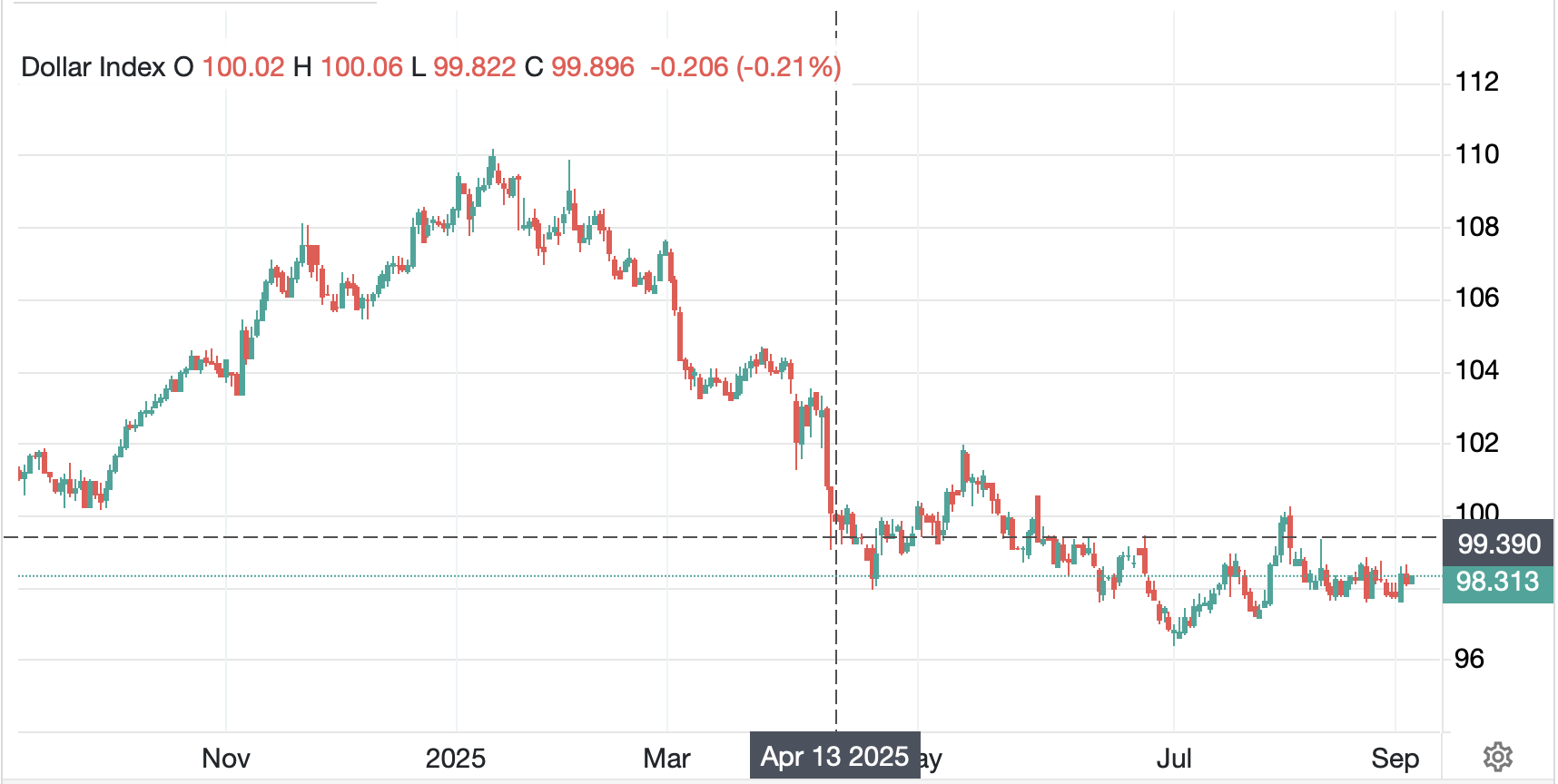
Finally, the dollar is a bit firmer this morning after a modest decline yesterday.  If we use the DXY as our proxy, while there is no doubt the dollar fell sharply during the first half of the year, arguably, since just past Liberation Day in early April, it has gone nowhere.  
Source: tradingeconomics.com

The short-term story for the dollar revolves around the Fed and its behavior.  After yesterday’s data, Fed funds futures increased the probability of a cut on the 17th to 97.6% with a one-third probability of a total of 75bps by year end.  If the Fed were to become more aggressive, perhaps after a much weaker than expected NFP number on Friday, then the dollar would have room to fall.  But you cannot show me the combined fiscal and economic situations elsewhere in the world and explain those are better places to hold assets at this time.

As to today’s movements, the laggards are ZAR (-0.9%) following the precious metals complex lower, and NOK (-0.6%) suffering on the back of oil’s decline.  Otherwise, there is a lot of -0.2% across the board with no terribly interesting stories.

This morning’s data brings Initial (exp 230K) and Continuing (1960K) Claims along with ADP as well as the Trade Balance (-$75.7B), Nonfarm Productivity (2.7%), Unit Labor Costs (1.2%) and finally ISM Services (51.0).  Two more Fed speakers are on the docket, Williams and Goolsbee, but the Fed story is much more about President Trump’s ability to fire Governor Cook than about the nuances these speakers are trying to get across.

Weak data should reflect as a weaker dollar in the near term, and the opposite is true as well.  My sense is a very weak number on Friday will result in the market starting to ramp up the odds of a 50bp cut later this month and that will undermine the buck.  But if that number is solid, I need another reason to sell dollars and I just don’t have it yet.

Good luck

Adf

JOLTed

The market, on Wednesday, was JOLTed
By data, and traders revolted
The jobs situation
Has changed the narration
And helped Jay, his door be unbolted


What door you may ask?  Why, the door that leads to a 50bp rate cut at the FOMC meeting in two weeks.  Already, the Fed funds futures market is pricing in a 43% probability of a 50bp cut, up from a one-third probability on Tuesday morning.  Remember, everything now revolves around the labor market, and yesterday’s JOLTs data was not only worse than forecast, at 7.67M (forecast 8.1M), but last month’s was revised lower by nearly 200K jobs as well.  Remember, too, that tomorrow the NFP report is released with current forecasts centering on 160K, higher than last month but well down on what we have been seeing all year prior to the August report.

There are many analysts who have been calling out Powell and the Fed for making a policy error and holding rates too high for too long.  Perhaps they are correct.  But so much of the decision to cut rates relies on the idea that inflation is well and truly dead, or at least terminal, and if that assumption is incorrect, there will be hell to pay.  The last time the US saw inflation of the same magnitude that we have seen in the past two years, then Fed Chair, Arthur Burns, cut rates too early and inflation exploded higher, peaking at a higher rate than the first rise.  In fact, he did that twice, with inflation spiking three times throughout the 1970’s and early 1980’s.  

Source: FRED database

Powell has been very clear that he is trying to channel Paul Volcker and not Arthur Burns, but if he cuts rates, he opens himself up to a much less satisfactory outcome.  There have been many charts of the following nature showing the parallels of the 1970’s to recent price levels and it is entirely possible we see another wave higher if the Fed cuts.

Source: Real Investment Advice

As things currently stand, I would contend that the Fed’s focus is almost entirely on employment, hence the market response to yesterday’s weaker than forecast JOLTs data.  This implies that this morning’s ADP and Initial Claims data have the chance to really move things.  It also means that tomorrow’s NFP data remains a critical focus for all markets.

In the meantime, market activity overall could well be described as choppy.  While US equity markets opened lower yesterday, following the sharp declines on Tuesday, they closed mixed with limited overall movement. The fears in the semiconductor sector, which were fanned by a, since denied, report that Nvidia had been subpoenaed in an anti-trust investigation, has stopped falling and there are still numerous stories about how much Capex the big 4 tech companies are going to invest this year in all things AI.  Traders and investors are looking for the next big clue which is why I expect limited activity until tomorrow morning’s data release.

Asian equity markets were similarly mixed overnight with some gainers (Australia +0.4%, Taiwan +0.45%, CSI 300 +0.2%) and some laggards (Nikkei -1.05%, KOSPI -0.2%, Hang Seng -0.1%), as no clear direction presently exists.  Late last week, BOJ Governor Ueda sent a letter to the Diet explaining he still expected to raise interest rates if the economy progressed as expected, and that has a number of analysts calling for another leg down in USDJPY and further Nikkei weakness.  But it seems that is a big IF.  With economic activity clearly slowing around the world, it is not hard to believe that the same will be true in Japan and conditions for further rate hikes may not develop.  As to European bourses, the picture here is mixed as well with the CAC (-0.5%) lagging while Spain’s IBEX (+0.7%) is having a pretty good day.  Both the DAX (+0.2%) and FTSE 100 (+0.1%) are modestly higher despite weak Construction PMI data, perhaps both anticipating further policy ease.

In the bond markets, though, the direction of travel is clear for now with yields everywhere having fallen sharply yesterday and simply consolidating today.  After the JOLTs data, Treasury yields fell 9bps (2yr yields fell 12bps and the 2yr-10yr spread is now flat), although this morning it has bounced by a single basis point.  European sovereign yields slipped yesterday as well, between -3bps and -5bps, after the JOLTs data and this morning have backed up by 1bp across the board.  As to JGB yields, they edged lower by -1bp last night and remain a good distance from the 1.00% level despite the recirculated Ueda comments.

In the commodity markets, oil (+0.2%) which had bounced a bit yesterday morning, ceded those gains as the session wore on and is currently below $70/bbl.  While talk of OPEC+ starting up more production has faded, the weak economy / slowing demand story, especially the weak Chinese economy story, remains front and center and continues to weigh on the price.  Meanwhile, in the metals markets, gold (+0.7%) continues to shine overall as the growing sentiment for a 50bp Fed funds cut helps all commodities, but especially this one as concerns over the dollar’s ability to maintain its purchasing power remain rife.  But this morning we are seeing silver (+1.4%) and copper (+0.2%) higher as well, although the latter seem more trading than fundamentally based.

Finally, the dollar is under some modest pressure this morning, which given the movement in yields and rate cut expectations, should be no surprise.  In the G10, virtually all the movement has been less than 0.2% with CAD (-0.1%) the laggard after the BOC cut rates by 25bps yesterday as widely expected.  This morning the yen is also a touch softer, but that is after a sharp rally yesterday of more than 1%, so this morning feels like a trading bounce.  In the EMG bloc, the picture is a bit more mixed with ZAR (+0.5%) the leader this morning on both the gold price as well as economic data showing the Current Account deficit shrank dramatically in Q2 in a pleasant surprise.  On the flipside, MXN (-0.3%) is lagging as the market absorbs recent modestly weaker than expected economic data on Unemployment and Fixed Investment.

Which brings us to today’s data releases.  We start with ADP Employment (exp 145K), then Initial (229K) and Continuing (1870K) Claims.  As well, at 8:30 we see Nonfarm Productivity (2.4%) and Unit Labor Costs (0.8%).  Then, at 10:00 comes ISM Services (51.1) with the final set of data the EIA oil inventories at 11:00 with net further drawdowns forecast.  There are no Fed speakers on the docket today, but we are supposed to hear from two tomorrow after the NFP data.

Absent a big surprise in either ADP or Initial Claims, with the former more likely than the latter, I suspect that it will be another choppy day as all eyes focus on NFP tomorrow.  However, the one thing that seems likely is the dollar has further to decline within the current market narrative of more rate cuts sooner by Powell and the Fed.

Good luck

Adf

Already Wary

In China, the news wasn’t great

As Moody’s no longer could wait
Because of a glut
Of debt, they did cut
The outlook for China’s whole state

Investors were already wary
And as such, since last January,
Afraid of more shocks
Have been selling stocks
In quantities not arbitrary

The biggest news overnight was Moody’s downgrading their outlook for Chinese debt to negative from its previous stable view.  Moody’s currently rates the nation at A1, 4 notches below the best available of Aaa, but still a solid investment grade rating.  However, citing the property downturn in the country and the concomitant fiscal pressures that are building on local governments’ balance sheets, it appears there is a growing concern that national debt will be issued to cover the local failures.  

It must be very difficult to be a local government financial official in China as the competing pressures of ever faster growth and maintaining sound finances have become impossible to attain simultaneously.  The real question is, will President Xi determine that fiscal stability is more important than economic growth?  While that appeared to be his view last year, this year he seems to have changed his focus to growth.  Perhaps the fact that the US economy seems to be maintaining very solid growth while China is stumbling has become too much of a bad look for him to tolerate further.  (And that’s not to say things are fantastic here.) 

At any rate, his efforts to encourage more widespread economic activity while simultaneously deflating the immense property bubble there is starting to run into trouble.  As the pace of growth slows in the country, exacerbated by the demographic decline of the population (it is getting old and the population is shrinking), Xi appears to have thrown fiscal caution to the wind.  Once again, my concern is that if the domestic economy continues to deteriorate, Xi will determine that it is time for some international adventures to shore up his support at home.  I would contend that is not on anyone’s bingo card right now, but it is something to watch.

The market response to the news was to further sell Chinese equities with both onshore and Hong Kong markets suffering, each declining nearly 2%.  This weighed on Japanese markets (Nikkei -1.4%) as well as Taiwan, South Korea, and Australia, with only India ignoring the story.  It makes some sense that the China and India stories are uncorrelated given India is one of the few nations not reliant on China for much with respect to trade.  

Away from that story, however, things have been remarkably quiet on the economic front.  We saw Services PMI data from around the world with China, interestingly, one of the few nations printing above 50 (Caixin Services PMI 51.5), while all the continent remains firmly below the 50 boom-bust line save the UK which printed a much better than expected 50.9 reading.  While the market is waiting for US ISM Services data (exp 52.0) as well as JOLTS Job Openings data (9.3M), there is scant little else to discuss this morning.  Recall, though, as the week progresses, we will be receiving much more important data, notably the payroll report, which may help clarify the state of things now.

But, lacking anything else to discuss, let’s run down markets.  Away from Asia, equity markets are mixed with continental bourses all modestly firmer, on the order of 0.3%, although the FTSE 100 is lower by -0.5% despite the better than expected PMI data.  US futures are also pointing lower this morning, about -0.5% after a desultory day yesterday on Wall Street.

In the bond markets, Treasury yields have edged a bit lower this morning, -3bps, resuming what has been a powerful downtrend in yields.  In Europe, though, yields have really taken a dive, with sovereign bonds there all seeing declines of between 7bps and 9bps.  The weak PMI data has investors now bringing forward EB rate cuts to June.  Adding to this story were comments from the ECB’s Schnabel, historically one of the more hawkish members, describing the possibility of rate cuts next year as appropriate.  This seems quite similar to the Waller comments last week given Schnabel’s presumed importance on the ECB.  Finally, JGB yields are 2bps softer after slightly softer than expected Tokyo CPI data was seen as a harbinger for slowing inflation across Japan.  Once again, the idea that interest rate policy in Japan is due to normalize soon is being challenged by the facts on the ground.

Turning to commodities, oil (-0.3%) is slipping again as the weak PMI data encourages worries of an impending recession and the OPEC+ meeting was not taken seriously by the market as an effective manner to reduce supply.  Inventories have been building lately, so further pressure seems viable.  Meanwhile, metals markets are under further pressure with both copper and aluminum falling by more than -1.0% and gold, which had a remarkable session yesterday with a greater than $100 trading range, edging down a few bucks, but still well above the $2000/oz level.

Finally, the dollar refuses to obey the narrative and die.  Instead, it is higher again this morning vs. almost all its counterparts, both G10 and EMG.  The laggard today is AUD (-0.9%) which fell after the RBA left rates on hold, as expected, but apparently was not seen as hawkish as traders anticipated and the market has removed the pricing for any further rate hikes there.  The only exception to this movement has been the yen, which is now 0.1% firmer although in the wake of the Tokyo CPI data, it fell sharply.  USDJPY remains beholden to the twin narratives of declining US interest rates and normalizing monetary policy in Japan.  Right now, those stories are not working in concert, so until they do so, in either direction, I expect the yen will be choppy but not really make much headway in either direction.

Aside from the ISM and JOLTS data, we only see the API Crude Oil inventory data with a draw of 2.2 million barrels expected.  As there are no Fed speakers, it is shaping up to be a quiet day overall.  With that in mind, look for limited activity until 10:00 when the data is released and then I suspect that we remain in a ‘bad news is good’ regime.  So, weak ISM is likely to encourage risk taking on the belief the Fed will cut more aggressively and vice versa.  The same is true with the JOLTS data.  As to the dollar, I suspect it will follow the rate story, so strong data will help the buck and weak will see a bit of selling.

Good luck

Adf

Two-Faced

On Tuesday the market was JOLTed
And buyers of assets revolted
But then ADP
Said, no, look at me
And bulls, toward risk assets, all bolted

Now those numbers offer a foretaste
Of how market prices are two-faced
But really the key
Is Sep’s NFP
Ahead of which, traders will stay chaste

Remember all the carnage on Tuesday?  Never mind!  In truth, it is remarkable that the market response to the Tuesday JOLTS data was so strong, given the number has historically not been a key market driver. At the same time, yesterday’s weaker than expected ADP Employment data, just 89K new jobs, had the exact opposite impact on the market.  So, bonds rallied, and yields declined sharply, with 10-yr Treasury yields lower by 14bps from the highs seen yesterday pre-data, while stocks rallied nicely, led by the NASDAQ’s 1.4% gains although the other two indices lagged that badly.

My first thought was to determine what type of relationship both numbers have with the NFP data which is set for release tomorrow morning.  I ran some simple regressions for the past year and as it happens, the Rbetween NFP and ADP is 0.5 while between NFP and JOLTS it is 0.65.  I do find it interesting that the JOLTS data, which has a bigger lag built in, has the stronger relationship, but I also remember that ADP changed its model and formulation and since they have done that, the fit to NFP is far less impressive.

It is anyone’s guess as to what tomorrow’s data is actually going to be like, but it is clearly instructive that the market was so keen to react to both of these data points so dramatically ahead of the release.  Ostensibly, the market has come around to my view that NFP is the data point on which the Fed is relying to continue their higher for longer mantra.  As such, a weak number (something like 100K or lower) seems very likely to soften the tone of Fedspeak and result in an immediate rip-roaring rally in the stock market.  Correspondingly, a strong number (200K or higher) seems more likely to bring out the hawkishness that remains widely evident on the FOMC.  The consensus view appears to be 160K, but then consensus for ADP was 150K and that missed badly.

The point is, for now, the market is hyper focused on the NFP number, and I suspect that between now and then, we are unlikely to see too much movement.  As an aside, one of the best indicators of the employment situation is Initial Claims, which is more frequent and thus timelier, and that number, which is expected at 210K this morning, has clearly been trending lower, a sign of a strong jobs market.  I believe we will need to see a lot of convincing evidence for the Fed to alter their current stance, but tomorrow’s NFP will certainly be important.

Away from that, right now other fundamentals just don’t seem to matter very much.  The dysfunction in Washington is a big issue in Washington, but not in financial markets, at least not yet.  I guess if we wind up in a situation where there is a government shutdown it may wind up mattering, but we know there is six weeks before that will come up again.  Next week is the Treasury refunding auction with $102 billion of notes and bonds coming to market.  I believe a key part of the bond market’s recent downward trend is the concern over the massive supply that is coming to market.  Next week’s realization, plus the fact that there is no end in sight should continue to weigh on bond prices and support yields.  And as long as US yields are forced higher, so too will be European sovereign, and truthfully, global yields.

On the oil front, the OPEC+ meeting came and went without incident as the production cuts that the Saudis initiated back in June are to remain in place through December, at least, with the group set to revisit the issue later in the year.  While oil (-2.0%) has been slumping badly during the past week, falling $10/bbl in that short time frame, I would contend the trend remains higher.  Remember, oil is a highly volatile commodity, both in reality and from a market price perspective.  We have heard nothing to alter my long-term conclusion that oil demand is going to continue to grow and oil supply remains constricted.  In truth, if I were a hedger, I would be looking to take advantage of the current price action, especially since the market is in backwardation (future prices are lower than current spot prices) so hedging is quite cost effective.  It’s kind of like earning the points in FX.

At the same time, metals prices remain under pressure with gold suffering from the combination of still high US yields and a strong dollar, while industrial metals like copper and aluminum are both pointing to weaker economic activity.  I continue to believe this is a short-term fluctuation in a broader long-term move higher in commodities in general, but again, if I were a hedger, current prices would be interesting.

A look at equity markets overnight showed that the Nikkei (+1.8%) approved of the US price action and that dragged much of the rest of Asia along for the ride although, recall, mainland China remains closed for their Golden Week holidays.  In Europe, today has been far less impressive with very modest gains across the continent averaging about 0.2% while US futures are little changed at this hour (7:30).  As I said before, I anticipate a slow day ahead of tomorrow’s NFP report.

Turning to the dollar, it, too, is little changed this morning after a bit of a sell-off yesterday.  For instance, the euro, which has rebounded from its recent lows, is still just barely above 1.05 and higher by just 0.1% this morning.  And those gains are similar across all the major currencies.  Now, if we look at the EMG bloc, despite the dollar’s pullback against some G10 counterparts, we see MXN (-1.0%) and ZAR (-1.25%) leading the way lower as both of those nations have large commodity sectors and the decline in prices there is more than sufficient to offset any benefit of a little bit of dollar weakness broadly.  Here, too, I see no reason to change my view on the dollar following yields higher, and the fact that yields have backed off for a day does not change the underlying reality.

In addition to the Initial Claims data, we see the Trade data (exp -$62.3B) and we hear from three more Fed speakers, Mester, Daly and Barr.  ADP did not change the world.  We will need to see more data demonstrating that growth, at least as defined by the Fed, is slowing before they are going to change their tune.  Today is shaping up as quite dull, but tomorrow, at least immediately after the 8:30 data print, could be interesting.  Remember, too, that Monday is Columbus Day, so markets will have less liquidity and be susceptible to larger movements.

Good luck

Adf

Towel Throwing

Did they sell?  Or not?
The new Mr Yen, Kanda
Explained, “No comment”

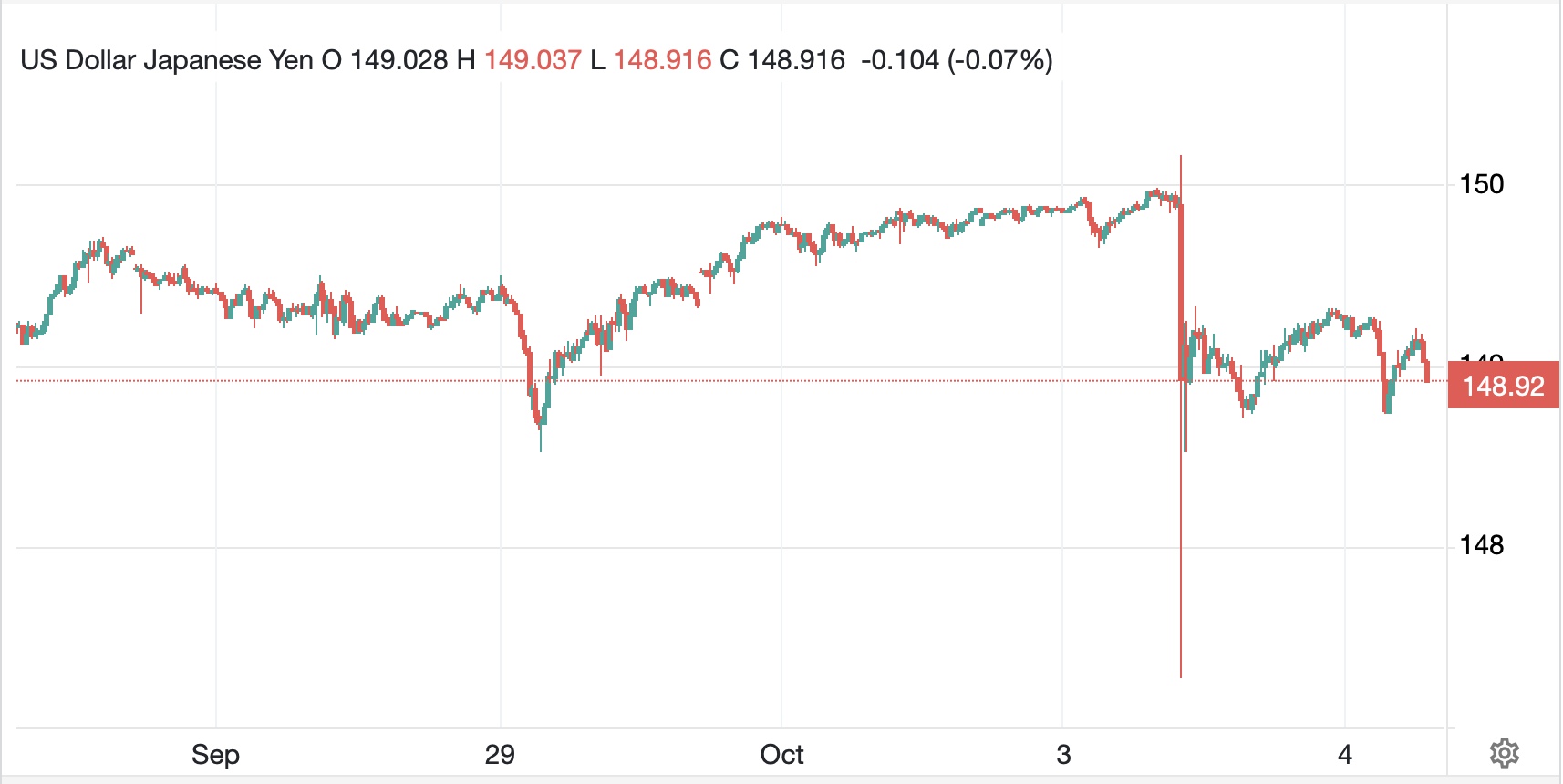
As is clear from the chart below (source tradingeconomics.com), there was a bit of movement in the USDJPY market yesterday morning.  The price action certainly had the feel of intervention, with a nearly 2% decline that occurred in seconds, but there has been neither confirmation nor denial of any BOJ trading activity.  Kanda-san, who is vice minister of international affairs which is the MOF role that deals with the currency, is the current Mr Yen.  His comments were certainly cryptic and as such, not very informative.  “We will continue with the existing stance on our response to excessive currency moves,” said Kanda. “While we are basically like a Gulliver in the market, we’re also coming and going as a market player, so usually we won’t say whether or not we’ve intervened each time,” Kanda said.  

The story that makes the most sense is that the BOJ reached out to the major Japanese banks in NY and London and checked rates.  The fact that the move happened minutes after the spot rate finally breeched the 150 level certainly was suspicious and indicated that contrary to yesterday’s comments by Watanabe-san, a former Mr Yen, the level really does matter, not just the speed of the move.  Others have tried to explain that breeching 150 triggered selling levels, but if there were exotic option barriers at 150, and I’m sure there were, the more typical move would be an acceleration higher as stop-loss orders by dealers were triggered.  The spike down, at least in my experience, is a sign of exogenous activity, not market internals.

Looking ahead, are we likely to see more of this type of activity?  You can never rule out currency support from any nation whose currency is weakening sharply, but there are G7 and G20 constructs that are supposed to limit these, and are designed to focus on volatility of movement, not levels.  This appeared contrary to those concepts, so we have much yet to learn.  At the end of the month, the BOJ will publish any intervention activity as part of their transparency initiative, but that might as well be next year for all the information it will provide.  Be wary of further movements like this, but the fundamentals continue to point to a higher USDJPY, especially given the accelerating rise in US Treasury yields.

The bond market rout keeps on going
As we see more folks towel throwing
The question at hand
Is can Powell stand
The pressure that’s certainly growing

Thus far, there’s no sign that the Fed
Is worried when looking ahead
More speakers were heard
To follow the word
That higher for longer’s not dead

Of course, away from the FX market, where the dollar has continued to show remarkable strength overall, the big story is the Treasury market.  After yesterday’s sharp move, the 10-year yield is higher by 23bps so far in October and it is only the morning of the third session of the month!  The yield curve inversion is down to -32bps and 30-year Treasury yields are pressing 5% now, a level not seen since summer 2007.  This sharp move has been the true driver of almost all markets and as long as it continues, there is going to be more pain for risk assets.  There has been no change in the fundamentals and yesterday’s move was ascribed to a much higher than expected JOLTS Job Openings number, which printed at 9.61M, far above the forecast 8.8M and a huge jump from last month’s outcome.  This seemed to encourage the Fed speakers to maintain their higher for longer attitude with a number still looking for one more rate hike this year.  Once again, I will point to Friday’s NFP number and its importance as a key driver of Fed policy.  If that number remains strong, and Unemployment remains low, the Fed can maintain this policy stance with limited fallout politically.

The rise in Treasury yields is being copied elsewhere around the world with yields following the US higher.  While today is seeing a bit of consolidation, with European sovereign and Treasury yields currently softer by 1bp-2bps, this is a trading effect, not a change of heart.  Interestingly, even JGB yields are getting dragged along higher as they closed last night at 0.80%, their highest level since 2012, the beginning of Abenomics.  But in the end, this is all about US yields with the rest of the world continuing to follow their lead.  I heard some analysts claiming this was a blow-off top in yields and we have seen the end.  Alas, I don’t believe that as history shows the yield curve will move back to a normal stance and with the Fed firmly in the higher for longer camp, 10-year yields have further to rise.  Yes, something is likely to break at some point, but so far, the few hiccups have been contained.

Not surprisingly, risk assets had a tough time in yesterday’s session with US indices all falling sharply, by -1.3% or more.  Yesterday’s European bourses were also under significant pressure and the Asian markets open overnight got hit hard as well with the Nikkei (-2.3%) and Hang Seng (-0.8%) the biggest movers.  However, this morning, Europe has a touch of green on the screen, with small gains on the order of 0.3% and US futures are also edging higher, +0.15% at this hour (7:45).  I wouldn’t read too much into this modest bounce and fear that there is further, and potentially much further, to go.  One of the remarkable things about the equity market is that earnings estimates for 2024 are for a rise of 12% on 2023 earnings.  Given the ongoing rise in energy costs and the increasing probability of a recession, those seem quite optimistic.  As they are revised lower, that, too, will weigh on equities, and by extension all risk assets.

Lastly, in the energy space, oil (-1.7%) is under further pressure this morning, although the fundamentals wouldn’t indicate that is the right move.  Not only did we see a further draw in inventories in the US, notably at the key Cushing, OK storage depot, but we heard from Russia that they are going to continue to restrict production by 300K bbl/day through the end of the year.  Meanwhile, the law in the US is set that the government cannot sell oil from the SPR when the inventory level falls below 330 million barrels.  Currently, it sits at 327 million, so that supply has ended.  Nothing has changed my view that oil has much higher to go, albeit not in a straight line.

Metals prices remain generally under pressure although gold (+0.2%) seems to be bouncing with other risk assets this morning on a technical trading basis.  However, both copper and aluminum are still sliding, typically a harbinger of weaker economic activity to come.

As to the dollar broadly, it, too, is a touch softer this morning, pulling back from highs seen yesterday in sync with all the markets.  But the same fundamentals driving the bond and stock markets are in play here, higher yields leading to more demand and a higher dollar.  Yes, this will end at some point, but we need to see a change in policy for that to happen.  The next real chance we have for something like that is on Friday with the payroll report.  A weak report, which seems unlikely at this time given the other employment indicators, would almost certainly change the market’s tone.  However, until then, look for positioning to continue to favor a stronger dollar, and for more and more dollar short sellers to get stopped out.

On the data front, this morning brings ADP Employment (exp 153K) as well as Factory Orders (-2.1%) and ISM Services (54.5).  the PMI Services data from Europe indicated that the worst may be over, but that there is, as yet, no real rebound.  We hear from a few more Fed speakers, but thus far they remain consistent, higher for longer is appropriate.

Today could see more consolidation of the recent moves across the board, but I do not believe that we have come to the end.  Calling a top or bottom is always impossible but remembering that the trend is your friend is likely to keep your activities in good shape.

Good luck

Adf

Singing the Blues

For Jay and his friends at the Fed
What they’ve overwhelmingly said
Is weakened employment
Will give them enjoyment
While helping inflation get dead

So, yesterday’s JOLTS data news
Which fell more than ‘conomists’ views
Was warmly received,
Though bears were aggrieved,
By bulls who’d been singing the blues

In fairness, Chairman Powell never actually said he would revel in a weaker employment picture, but he did discuss it regularly as a critical part of the Fed’s effort to drive inflation back to their 2% target.  And, in this case, more importantly, he had specifically mentioned the JOLTS data as a key indicator as an indication of the still very tight labor market.  With this in mind, it should be no surprise that when yesterday’s number came in much lower than expected, at ~8.8 million, down from a revised 9.2 million (the original print last month had been ~9.6 million), risk assets embraced the news as evidence that the Fed is, in fact, done raising rates.  Now, tomorrow and Friday’s data releases are still critical with both PCE and NFP on the calendar, so there is still plenty of opportunity for changes in opinions.  However, there is no question that the risk bulls have made up their minds and decided the Fed is done.

There is, however, a seeming inconsistency in this bullish thesis.  If the US economy is set to weaken, or perhaps is already weakening, with the jobs data starting to roll over, exactly what is there to be bullish about?  After all, China is clearly in the dumps, as is most of Europe.  While short-term interest rates are certainly likely to fall amid a recession, so too are earnings.  And if earnings are falling, explain to me again why one needs to be bullish on stocks.  I assume that the goldilocks scenario of the soft landing is the current driving force in markets, but that still remains a very low probability in my mind.  

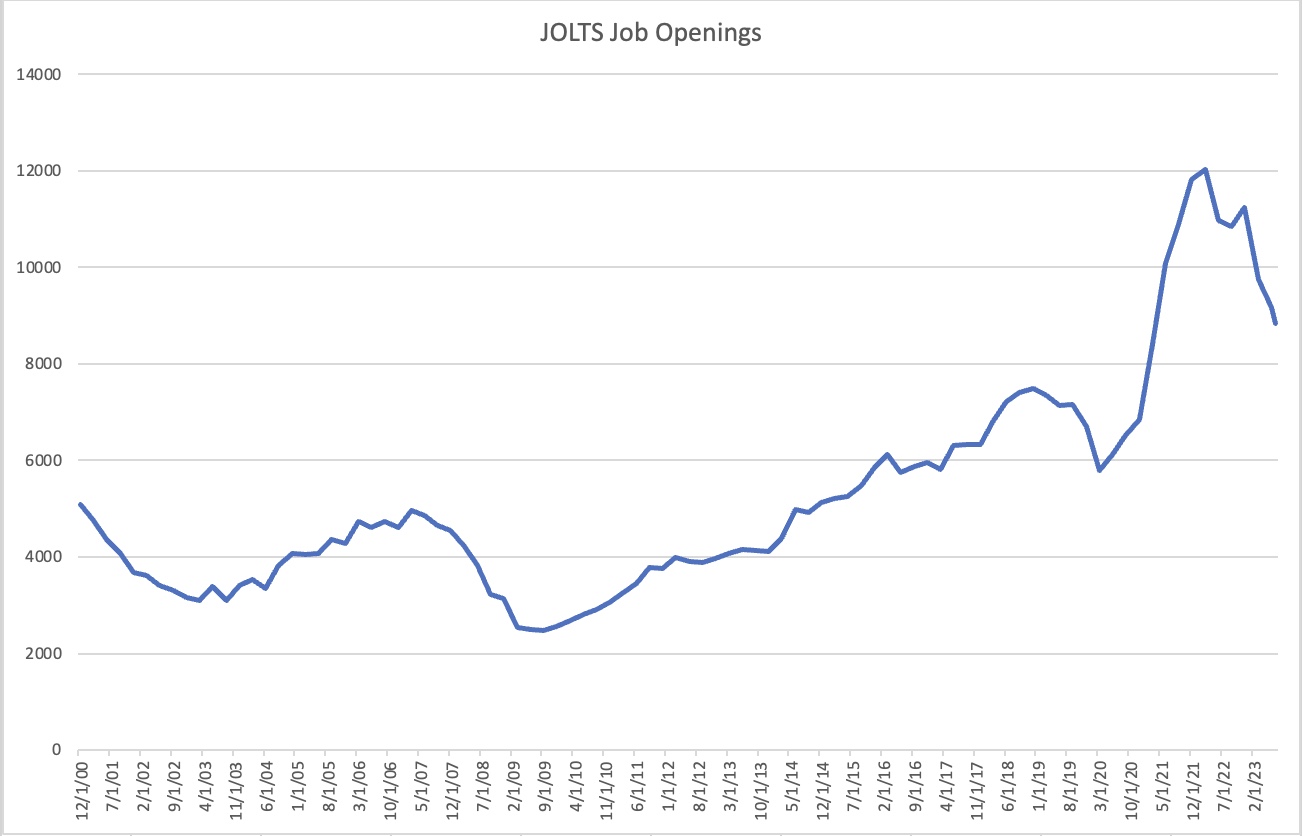
History has shown that since they started compiling this particular labor market indicator in December 2000, peak-to-trough decline, has occurred leading directly to a recession.  This was true in 2001-02 (39% decline), 2008-09 (49% decline), 2020 (23% decline) as can be seen in the chart below, and now we are at the next sharp decline.  Thus far, the decline from the peak in March 2022 has been 27%, so there is ample room for it to fall further.  I merely suggest that if that is the case, things are probably not that great in the US economy, and therefore, are likely to have a negative impact on risk assets.  Keep that in mind as you consider potential future outcomes.

Source data: Bloomberg

The other data yesterday, Case Shiller House Prices and Consumer Confidence did little to enhance a bullish view.  Confidence fell sharply, by nearly 11 points and is not showing any trend higher.  Meanwhile, house prices fell less than expected, only about -1.2%, which has implications for the inflation picture.  After all, housing remains more than one-third of the CPI calculation, and if the widely assumed decline in house prices has ended, that doesn’t bode well for the idea inflation is going to fall further.  

Remember, Chairman Powell was quite clear that one data point would not be enough to change the Fed’s views, and while he is no doubt relieved that some of the job market pressure seems to be receding, he was also quite clear in his belief that rates needed to remain at least at current levels for quite some time to ensure success in their goal to reduce inflation.  The futures markets have reduced the probability of a September rate hike to 13% this morning, from nearly 25% before the data.  There is about a 50% chance of a hike at the November meeting.  It seems premature to determine that inflation is dead, and the Fed is getting set to cut soon, at least to my eyes.  Beware the hype.

As to the overnight session, after a strong US equity day, which saw the NASDAQ rally nearly 2% and the Dow nearly 1%, Asia had trouble following through. At least China had trouble, with virtually no movement there.  Australia rallied nicely, 1.2%, but otherwise, not much action in APAC.  In Europe this morning, there are far more losers than gainers, but the losses are on the order of -0.2%, so not substantial, but certainly not bullish.  The data out of Europe today showed inflation in Germany remains higher than desired, and confidence across the continent, whether consumer, economic or industrial, is sliding.  Not exactly bullish news.  As to US futures, they are ever so slightly softer this morning, down about -0.1% across the board.

In the bond market, it should be no surprise that bonds rallied and yields fell yesterday after the JOLTS data, with the 10yr yield falling 8bps.  However, this morning, it has bounced 3bps and European sovereign yields are higher by between 6bps and 7bps on the back of that higher than expected German inflation data.  The market is still pricing about a 50% probability of an ECB hike in September, but whether it happens in September or October, it is seen as the last one coming.

In the commodity space, oil (+0.5%) continues to hold its own, perhaps seeing support after OPEC member Gabon saw a coup yesterday, potentially reducing supply.  At the same time, we have seen several large drawdowns in inventories as well, so there seem to be some fundamentals at play.  Now, a recession is likely to dampen demand, but right now, the technicals seem to be winning out.  As to the metals markets, gold had a big rally yesterday on the back of declining real interest rates and is retaining those gains this morning.  The base metals are mixed this morning, but essentially unchanged over the past two sessions as the questions about growth vs. supply continue to be probed.

Finally, the dollar is modestly stronger this morning, but that is after a sharp decline yesterday.  With yields falling in the US it was no surprise to see the dollar under pressure.  With yields backing up, so is the dollar.  USDJPY is back above 146 again, having fallen below yesterday, but today’s movements are far more muted than yesterday’s.  As to the EMG bloc, the picture today is mixed with some gainers and some laggards, but aside from TRY and RUB, which are hyper volatile and illiquid, the gains and losses have been smaller.  One exception is ZAR (-0.5%), which fell after news the government ran a record budget deficit in July was released.

ADP Employment (exp 195K) headlines the data today, although we also see a revision of Q2 GDP (2.4%, unchanged) and the Advanced Goods Trade Balance (-$90.0B).  There are no Fed speakers on the calendar, so that ADP data will likely be the key for the day.  A weak print there will reinvigorate the Fed has finished debate, while a stronger than expected print may well see much of yesterday’s movement reversed.  With that in mind, remember that the past two months have seen very strong ADP numbers that were not matched by the NFP data, so this is likely to be taken with a little dash of salt.

We are clearly in a data dependent market right now as all eyes focus on this week’s news.  I need to see consistently weak data to alter my view that the Fed is going to step off the brakes, and it just has not yet appeared.  Until then, I still like the dollar.  

***Flash, ADP just released at 177K, with revision higher to last month’s number.  Initial move in equity futures is +0.2%, but there is a long time between now and the close.

Good luck

Adf

No Certitude

The efforts from Xi haven’t yet
For locals, their appetites whet
So, more were announced
And equities bounced
But still there is just too much debt

Meanwhile, elsewhere things are subdued
As traders have no certitude
‘Bout data this week
And if it will wreak
More havoc on everyone’s mood

As the week progresses, we will get a raft of data culminating in Friday’s payroll report.  But for now, the market is looking elsewhere for its catalysts and China continues to provide fodder for the trading community.  Last night, the news hit that Chinese banks were going to be reducing their mortgage rates for mortgages on first homes by up to 60 basis points in order to help support domestic consumption.  At the same time, they are also likely to reduce deposit rates by between 5bps and 20bps as they try to maintain their lending margins, but net, it appears the move should free up some cash for the Chinese consumer.

This should certainly be a positive for the nation’s economy and the equity market in China responded accordingly, with the CSI 300 rallying 1.0% while the Hang Seng jumped nearly 2.0%.  However, Xi’s actions continue to be small beer, tweaking policies at the margin, while he apparently remains adamantly opposed to any broad fiscal stimulus.  Now, in the long-term, this is probably a pretty sensible move for China as they already have a massive amount of debt outstanding, especially in the property market, and if national debt were piled on top, it could lead to much worse long-term outcomes.  However, in the short run, a 50bp cut in mortgage rates is unlikely to change consumption patterns by very much, and more domestic consumption is what they need.  This is especially true given the ongoing economic weakness in Europe, which has become their largest trading partner.

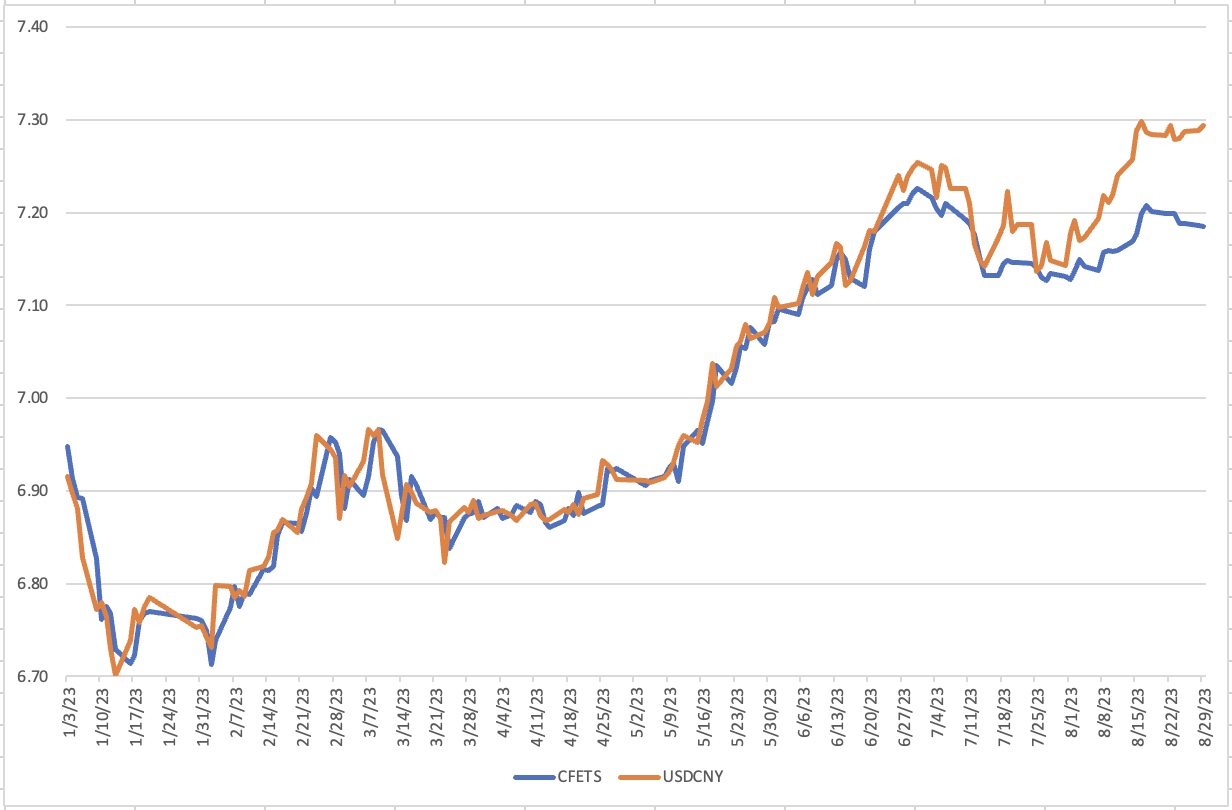
While Xi continues to fiddle with minor policy adjustments, the PBOC is desperately trying to prevent more severe weakness in the renminbi.  Last night, for instance, they fixed USDCNY at 7.1851, far below the market’s calculated expectations and 1.65% lower than the market is actually trading.  Remember, the onshore rules are that spot can only trade within a +/- 2.0% band compared to that CFETS fix, and it has been pushing that boundary for a while now as can be seen in the chart below (source Bloomberg):

The spread between the blue and orange lines continues to increase, but more importantly, the trends are moving in opposite directions.  Given how close the spread already is to the 2% limit, it appears that there is the potential for some fireworks in the future.  At this point, I cannot see how the PBOC will not ultimately allow a weaker CNY.  This is especially true if (when?) the Fed raises the Fed funds rate again.  Nothing has changed my view of 7.50 and beyond.

But, away from the ongoing recalibrations in the Chinese financial systems, there is precious little else on which to focus.  Generally, markets seem to have absorbed the idea that the Fed may continue to tighten further and remain resolutely bullish on risk.  It seems that the no-landing scenario is the current market fave.  And so, last night aside from the Chinese share gains, we saw green everywhere else as well, just not nearly as excited with rises on the order of 0.2% to 0.5%.  In Europe, it is also a positive morning with most gains relatively modest, of the 0.3% variety, with only the FTSE 100 (+1.45%) showing more substantial gains as the UK catches up with yesterday’s rally after their bank holiday.  Alas, US futures are actually leaning slightly negative this morning, but only just, as traders await the first pieces of data this week.  I would contend that the JOLTS data (exp 9.5M) is the most important as a key jobs indicator frequently mentioned by Powell, but we also see Case Shiller Home Prices (-1.60%) and Consumer Confidence (116.0).  Things pick up a bit tomorrow with ADP and then GDP on Thursday ahead of NFP on Friday.

In the bond market, lackluster describes things quite well with Treasury yields higher by 1 basis point and even lesser moves across the European sovereign space.  JGB’s, meanwhile are starting to drive a bit lower, but continue to hang around near 0.6%.  Traders and investors are awaiting this week’s data now that they have absorbed the Fed commentary.  If we see a surprisingly strong NFP print, do not be surprised to see yields back up toward their recent highs of 4.35% as many will assume at least one more hike is coming soon.  Correspondingly, a soft print will likely see a test of 4.00%, at least initially.

Oil prices continue to hold their own, perhaps getting a boost from the China story as any stimulus there is welcome and seen as a fillip for demand.  Metals prices, which had been a touch firmer earlier in the session, have given up those modest gains and at this hour (8:00), are basically flat on the day.

Finally, the dollar is mixed to slightly stronger this morning, but overall movement has been muted, like all the other markets.  While NOK (+0.15%) is managing some gains on oil’s strength, the rest of the G10 bloc is a touch softer, although other than JPY (-0.3%), which has managed to trade above 147 this morning, the movement is tiny.  In the EMG bloc, there is a more mixed view, but none of the movement is very large in either direction, with the biggest gainers and losers at +/- 0.3% on the day, effectively nothing in this space. Here, too, all eyes are on the data this week.

The only Fed speaker today is Michael Barr, and he is talking about banking services, with no policy discussions expected. Adding it all up leads to a conclusion of a pretty quiet session overall unless today’s data is dramatically surprising.  Remember, though, quiet sessions are good days to hedge.

Good luck

Adf