We All Will Be Fucted

The Fed PhD’s have constructed
Their models, from which they’ve deducted
The future will be
Like post-GFC
In which case, we all will be fucted
 
Instead, perhaps what’s really needed
And for which Steve Miran has pleaded
Is changing impressions
In future Fed sessions
Accepting the past has receded


While we all know that things change over time, human nature tends to drive most of us, when facing a new situation, to call on our experience and analogize the new situation to what we have experienced in the past.  But sometimes, the differences are so great that there are no viable analogies.  For the past several years I have made the point in this commentary that the Fed’s models are broken.  Consider, as an example, how wrong they were regarding the alleged transitory nature of inflation in 2022 which led to policy adjustments that not only were far too late to address the issue, but in reality, only had a marginal impact anyway.

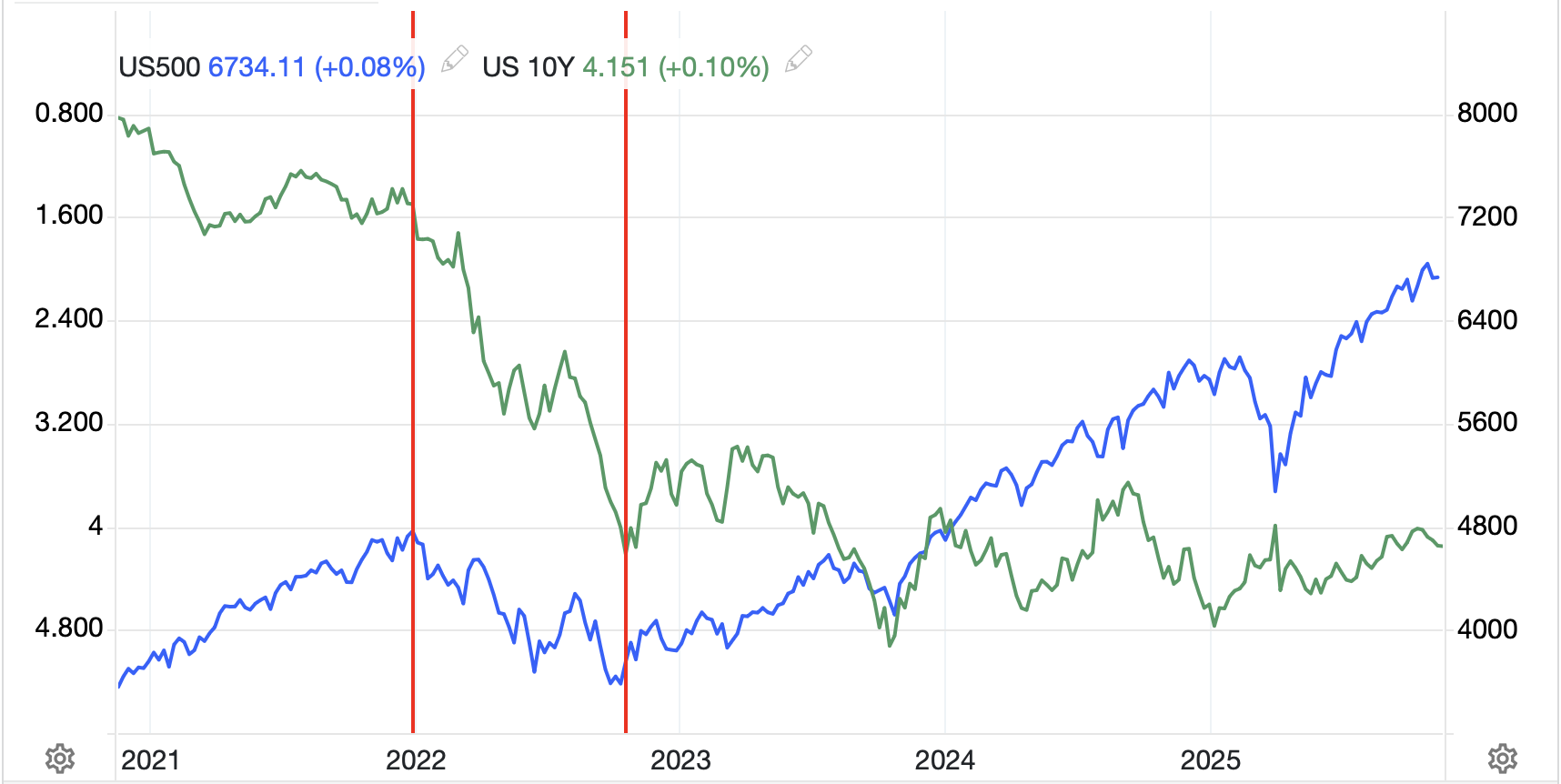
On a different, and topical subject, consider the issue with tariffs.  Economists explained that the imposition of tariffs would be devastating to the US consumer, raise prices dramatically and strengthen the dollar as FX markets adjusted to reflect the new trade policy.  But none of that happened, at least not yet.  In fact, the dollar continued to fall in the wake of the Liberation Day tariff announcements, while CPI since then has, granted, edged higher, but remains in its recent range for now and well below the 2022 levels (see below chart from tradingeconomics.com).

And a more important question regarding inflation is, have the tariffs been the driver, or has it been other parts of the price index, housing and core services for instance, that have been the key issue, neither of which would be directly impacted by tariffs.

All of this is to highlight the fact that the world has changed and that the evidence of the past several years, at least, is that the Fed’s econometric models are no longer fit for purpose.  I raise this issue because a look at so many previous market relationships show that many are breaking down.  We have seen gold rise alongside rising real interest rates and the dollar rise alongside gold, two things that are 180o from previous history.  Too, think back to 2022 when both stocks and bonds fell sharply at the same time, breaking the decades-long history of bonds behaving in a manner to offset declines in equity markets.
Source: tradingeconomics.com

This contemplation was brought on by a tweet which led me to a very interesting article (just a 5 minute read) by DL Jacobs of the Platypus Affiliated Society, regarding Fed Governor Miran and his recognition that the world has changed and that the Fed needs to change too.  Here is the second paragraph, and I think it explains the issue beautifully [emphasis added]:

He [Miran] used the moment to challenge the foundations of United States monetary policy. “I think it’s important to take these models seriously, not literally,” he said. He warned that models do not take into account the scale and speed of policy changes in light of the Trump administration’s re-election. The problem with the Fed isn’t wrong technique or bad data, he suggested, but rather that the very structure of its models is embedded in the economic and political assumptions of a bygone era. The world the forecasts are trying to measure no longer exists.

(At this point, I have to explain that the Platypus Society is a left-wing organization trying to explain why Marxism failed and recreate it, but that doesn’t make this article any less worthwhile.  I believe they see it as a step in the destruction of capitalism, which appears to be their goal.)

To me, this is just another point indicating that we’re not in Kansas anymore.  Policies need to change, and the Trump administration is working hard to do so.  One of the key points Miran makes is that the Fed and Treasury ought to be considered as a single entity, with the idea of Fed independence an anachronism from a bygone age.  The upshot is the Trump administration is going to continue to run things hot, or as macro analyst Lynn Alden has been saying, “Nothing stops this train”.  

This means that the Fed is going to run relatively easy monetary policy while the government, via the Treasury, is going to ensure there is ample liquidity available for everything, real economic activity and market activity.  The downside of these policies, alas, is that the idea inflation is going to decline in any meaningful way is simply wrong. It’s not.  Keep this in mind as we go forward.

As it happens, there was very little news of note overnight, at least market news, so let’s see how things behaved.  Friday’s mixed session in the US was followed by Chinese weakness with HK (-0.7%) and China (-0.7%) both under pressure.  Tokyo (-0.1%) was not nearly as impacted and the regional exchanges were actually broadly higher (Korea, India, Taiwan, Indonesia, Thailand).  The big news in Asia is the increasing verbal jousting by China and Japan at each other after PM Takaichi said, out loud, that if China attacked Taiwan, it would impact Japan.  Given the proximity, that is, of course, true, but apparently it was a taboo item in the diplomatic dance in the past.  I don’t see this having a long-term impact on anything.

In Europe, though, bourses are lower this morning led by Spain (-0.8%) although weakness is widespread (Germany -0.5%, France -0.4%. UK -0.1%).  There has been no data of note to drive this movement and it seems as though we are seeing the beginning of some longer-term profit taking after strong YTD gains by most bourses on the continent.  US futures at this hour (6:45) are pointing a bit higher, 0.43% or so.

In the bond market, Treasury yields have slipped -3bps this morning despite (because of?) the market pricing a December rate cut as a virtual coin toss.  This is a huge change over the past month as can be seen at the bottom of the chart below from cmegroup.com

Recent Fedspeak has highlighted the Fed’s uncertainty, especially absent data, and the belief that waiting is a better choice than acting incorrectly (what if waiting is the incorrect move?).  At any rate, we are going to be inundated with both Fedspeak (14 speeches this week!) as well as the beginnings of the delayed data so there will be lots of headlines.  Right now, I think it is fair to say that nobody is confident in the current direction of travel in the economy.  But perhaps, a more hawkish tone at the front of the curve has investors believing that inflation will, once again, become the Fed’s focus.  Alas, I don’t think so.  Looking elsewhere, European sovereign yields have followed Treasury yields lower, slipping between -2bps and -3bps this morning.  Perhaps more interesting is Japan, where JGB yields (+3bps) have risen to a new 17-year high as a prominent LDP member put forth a massive new spending bill to be passed.

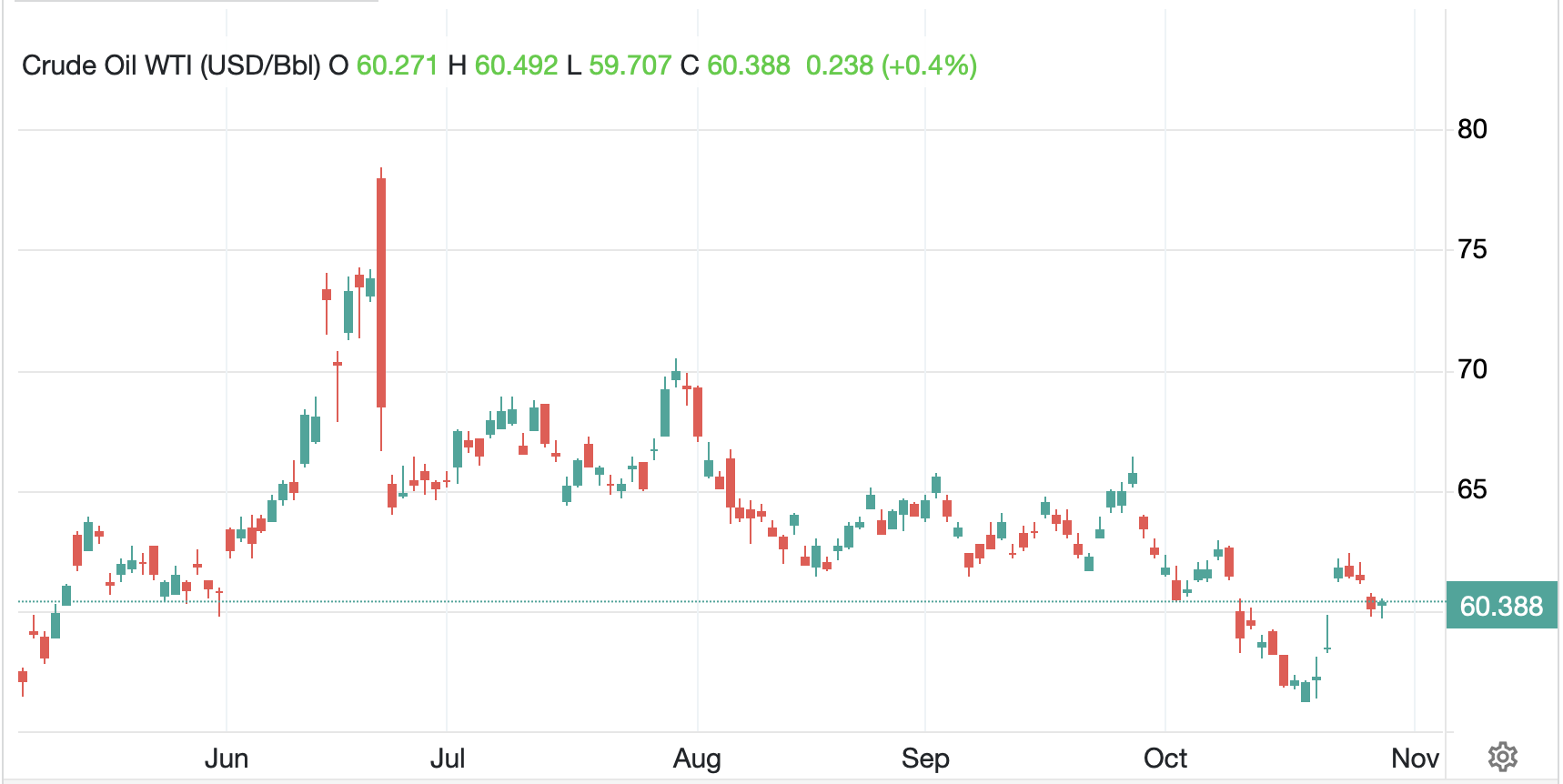
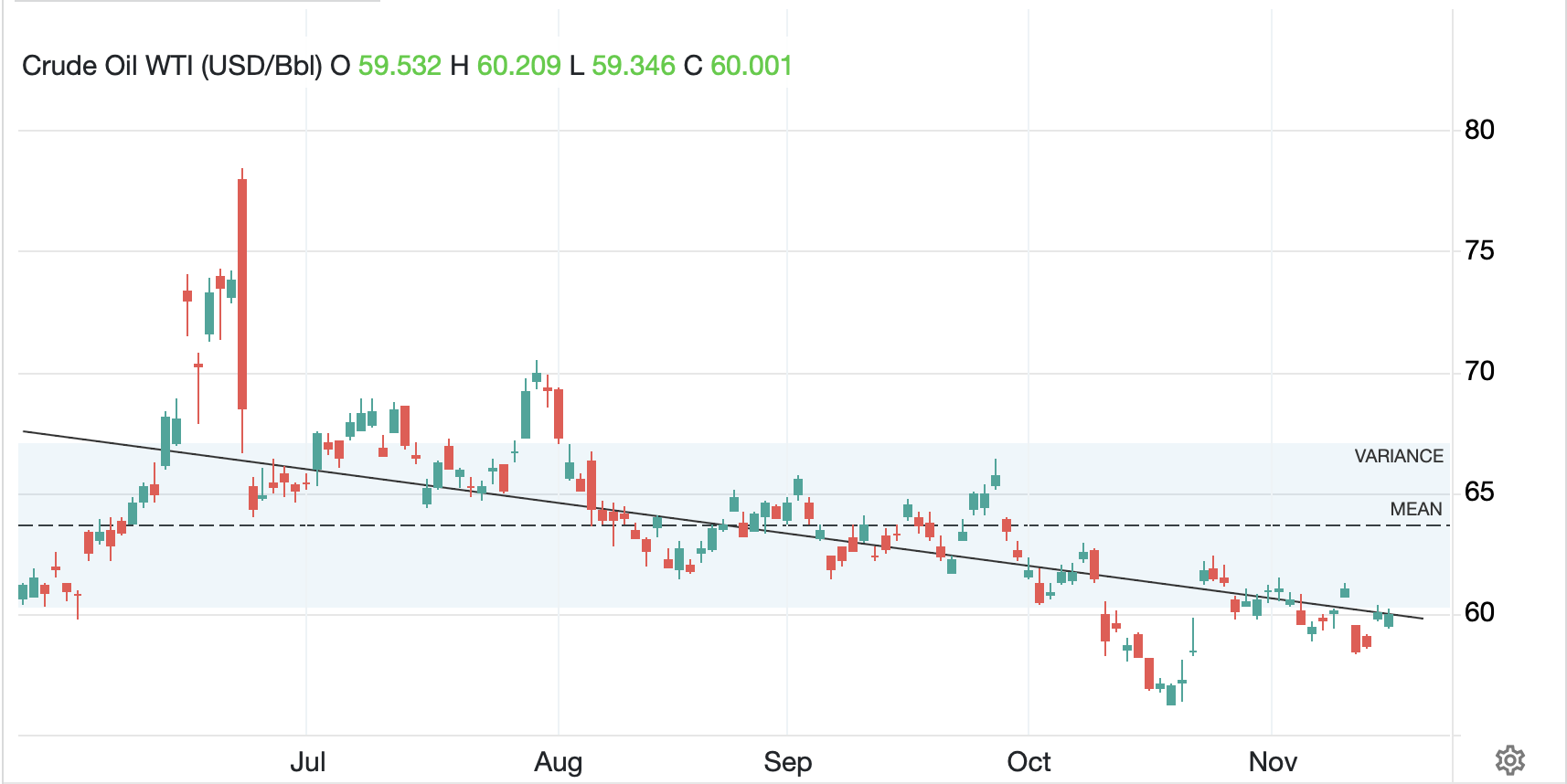
In the commodity space, oil remains pinned to the $60/bbl level with lots of huffing and puffing about Russian sanctions and oil gluts and IEA changes of opinion but in the end, WTI has been either side of $60 for the past month+ and continues to trend slowly lower.  
Source: tradingeconomics.com

Metals remain the most volatile segment of the entire market complex although this morning, movement has not been so dramatic (Au -0.1%, Ag +0.9%, Cu -0.4%, Pt -0.1%).  All the metals remain substantially higher than where they began the year and all have seemingly run into levels at which more consolidation is needed before any further substantial gains can be made.  I don’t think the supply/demand story has changed here, just the price action.

Finally, the dollar is a touch firmer this morning, with the DXY (+0.1%) a good representation of the entire space.  The only two currencies that have moved more than 0.2% today are KRW (-0.9%) which reversed Friday’s price action and is explained as continued capital outflows to the US for investment.  On the flip side, CLP (+1.1%) is benefitting from the first round of Presidential elections in Chile, where the right-wing candidate came out ahead and is expected to consolidate the vote and win an absolute majority in the second round.  Jose Antonio Kast, if he wins, is expected to proffer more market-friendly policies than the current socialist president, Gabriel Boric.  It seems the people in Chile have had enough of socialism for now.  But other than those two currencies, this market remains quiet.

On the data front, there is so much data to be released, but the calendar for much of it has not yet been finalized.  One thing that is finalized is the September employment situation which is due for release Thursday morning at 8:30. This morning we see Empire State Manufacturing (exp 6.0) and Construction Spending (-0.1%) and hopefully, the calendar will fill in as the week passes.

While equity markets remain very near their all-time highs, the Fear and Greed Index is firmly in Fear territory as per the below from cnn.com.

Historically, this has been seen as an inverse indicator for stock markets although it has been down here for more than a month.  Uncertainty breeds fear and the lack of data has many people uncertain about the current state of the US economy since the only information they get is either from the cacophony of social media, the bias of mainstream media or their own two eyes.  But even if you trust your own eyes, they just don’t see that much, likely not enough to come to a broad conclusion. 

FWIW, which is probably not much, my take is things are slower than they have been earlier in the year, but nowhere near recession.  I think it is the correct decision for the Fed to hold next month rather than cut because the drivers of inflation remain extant.  But Jay doesn’t ask me.  Whether Miran is correct in his prescriptions for the economy, I am gratified that he is questioning the underlying structure.  In the meantime, run it hot remains the name of the game and that means any risk-off period is likely to be short.

Good luck

Adf
Curses and Squeals

Though data is scarce on the ground
This week has the chance to astound
Four central banks meet
And when it’s complete
Two cuts and two stays ought abound
 
Meanwhile, Mr Trump’s signing deals
In Asia, an act that reveals
His fervent desire
To drive markets higher
As foes let out curses and squeals


Some days, there’s very little to note, with the news cycle a rehash of stories that have been festering for weeks.  This is especially true in the political sphere, but also on the economic front.  As well, given the ongoing government shutdown and the lack of government data being released, a key market focus is missing.  But not today!

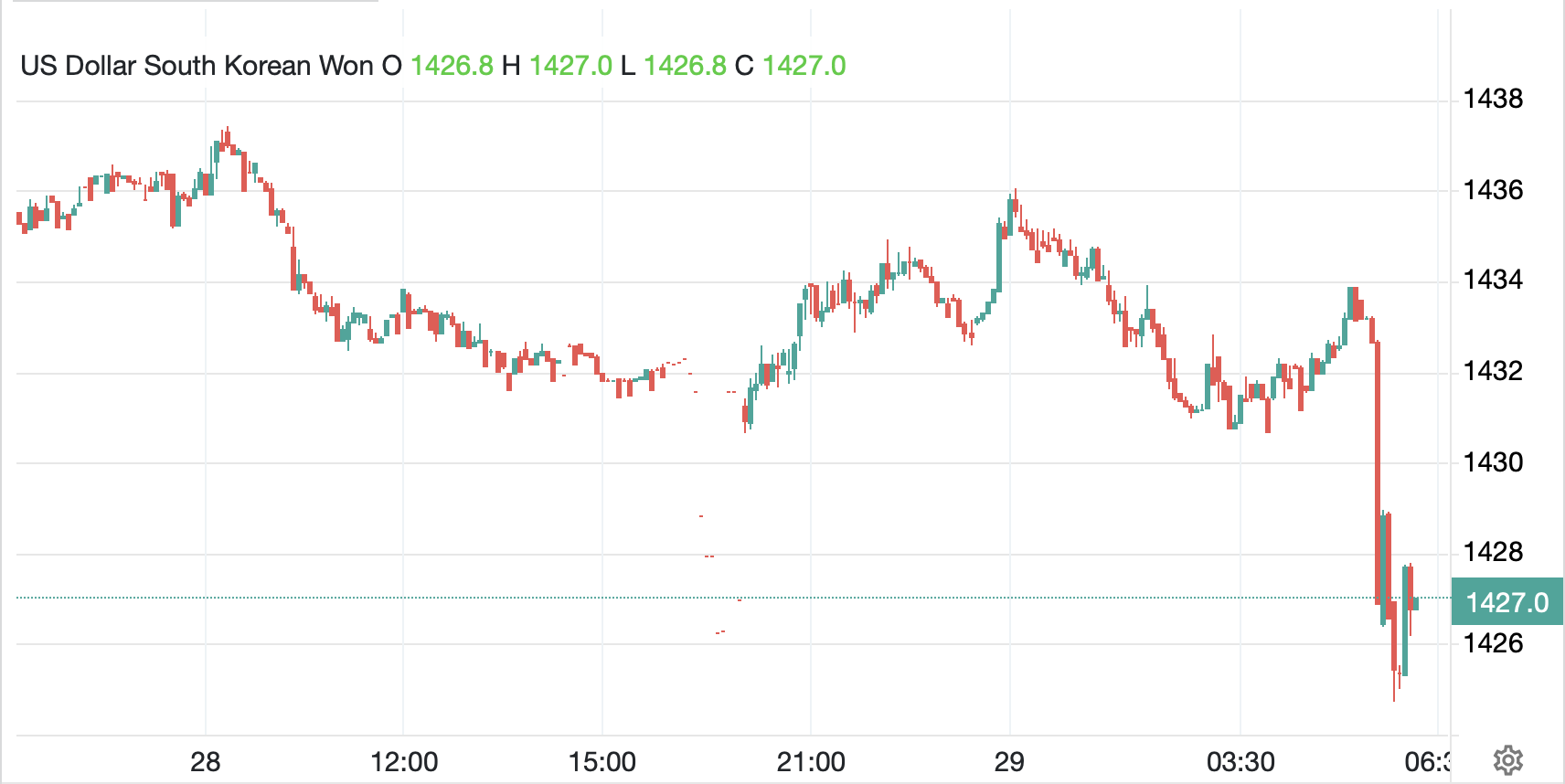
News across the tape moments ago is that President Trump has agreed a trade deal with South Korea, although the details of the deal are yet to be revealed.  When it comes to Trump and trade deals, it is always difficult to get through the hype to determine if things will actually improve, but if we use the KRW as a proxy for market sentiment, as you can see in the chart below, the announcement was seen as a benefit to the won.

Source: tradingeconomics.com

This is hardly definitive, and the nature of a trade deal is that it takes time to be able to determine its benefits for both sides, but for now, it appears markets are giving it the benefit of the doubt.  As well, it continues to be reported that Presidents Trump and Xi will be sitting down tomorrow (tonight actually) and that a trade framework has been agreed by Secretary Bessent and Chinese Vice Commerce Minister Li Chenggang which includes reduced tariffs, fentanyl, soybeans, semiconductors and rare earth minerals as key pieces of the puzzle.  

The ongoing competition between the US and China is not about to end with this deal, but perhaps it will be able to revert to a background issue rather than a headline one, and that is likely a positive for all.  Certainly, equity markets continue to believe that this dialog is a benefit as evidenced by their daily trips to new highs.

Which takes us to the other key discussion point in markets, central banks.  Over the next twenty-seven hours (it is 6:30am as I type) we are going to hear four major central banks explain their latest policy steps starting with the Bank of Canada (expected 25bps cut) at 9:45 this morning, then the FOMC at 2:00 this afternoon with their 25bps cut.  This evening at 11:00, NY time, the BOJ is expected to leave rates on hold, although there are those who believe a 25bps hike is possible, and then tomorrow morning at 9:15 EDT, the ECB will also leave rates on hold.  

While this is certainly a lot of new information, the question is, will it have any market impact?  Given the market pricing of these events, if any of the central banks do something different, you can be sure its markets will respond.  If I had to assess what might be different, both the BOC and FOMC could cut more than 25bps, and the ECB could cut 25bps rather than standing pat.  In all those cases, the currency would likely weaken sharply at first, although if all those things happened, I suppose it would simply create a new equilibrium.  But understand, I don’t think any of that WILL happen.

Regarding the Fed, though, there is another question and that is, what is going to happen to QT and the balance sheet.  Lately, there has been a great deal of discussion regarding how much longer the Fed will allow the balance sheet to shrink.  Last week I discussed the difference between ample and abundant reserves, but in numeric terms, the signals are coming from the SOFR (Secure Overnight Financing Rate) market, the one that replaced LIBOR.  It seems that there is increasing concern over the recent rise in the rate.  This is seen by numerous pundits, as well as by some in the Fed, as a signal that the reserve situation is getting tighter, thus offsetting the Fed’s attempts at ease. 

The below chart from the NY Fed shows the daily wiggles, but also, it is pretty clear that the recent trend has been higher.  You can see the September Fed funds cut in the sharp drop, and the first peak after that was September 30th, the quarter-end when banks typically look to spruce up their balance sheets, so borrow more aggressively.  But since then, this rate has been edging higher, an indication that there may not be sufficient reserves available for the banking system.

This begs the question; will the Fed end QT today?  Or wait until December?  My money is on today as they are growing concerned about the employment situation with the uptick in recent layoff announcements, and the pressure on SOFR is the best indicator they have that things have reached the point where their balance sheet no longer needs to shrink.  One other thing to keep in mind, at some point, it seems likely that the Fed is going to need to find more buyers of Treasuries as the market may develop indigestion given the amount being issued.  That pivot back to QE, whatever it is called, is easier if they are not simultaneously reducing their own balance sheet.

And one final point on the Fed.  Apparently, when they cut today, it will be the twenty-second time the Fed will have cut with stock indices at all-time highs, and of those previous twenty-one, twenty-one times equity markets were higher one year later.  Let’s keep that party rolling!

Ok, let’s look at how things have gone overnight.  Tokyo (+2.2%) was basking in the glow of all the love between President Trump and PM Takaichi, as it, too, traded to new all-time highs.  China (+1.2%) gained on the news of the trade framework, but interestingly, HK (-0.3%) did not follow suit.  And it should be no surprise that Korea (+2.1%) rallied on that trade news with India and Taiwan rising as well.  Australia (-1.0%) though, had a rougher go after a higher than forecast inflation print (3.5%) put paid to the idea that the RBA would be cutting rates again soon.

In Europe, Spain (+0.65%) is rallying on solid GDP data (1.1% Q/Q) although the rest of the continent is doing very little with virtually no change there.  In the UK, the FTSE 100 (+0.6%) is rallying on stronger corporate earnings from miners (metals are higher) and pharma companies.  As to US futures, at this hour (7:30) they are all nicely in the green, about 0.35% or so.

In the bond market, Treasury yields have backed up 2bps, but are still just below the 4.00% level, hardly signaling major concern right now.  European sovereign yields are all essentially unchanged this morning and overnight, only Australia (+5bps) moved after that CPI data Down Under.

Turning to commodities, oil (+0.5%) is bouncing after a couple of weak sessions, but net, we are right back to the $60 level which appears to be a comfortable level for both buyers and sellers.  It is also a high enough price to encourage continued exploration, so my take is we are likely to trade either side of this level for quite a while going forward.  My previous bearish views are being somewhat tempered, although I don’t foresee a major rally of any note.  

Source: tradingeconomics.com

In the metals markets, gold (+1.7%) is bouncing off its recent trading low and currently back above $4000/oz.  A look at the chart for the past month shows just how large the movements have been as the parabolic blow-off to near $4400 was seen through the middle of the month, and after a second try, the rejection was severe.  I don’t believe the long-term story in the precious metals has changed at all, the idea that fiat currencies are going to maintain their current status as reserve assets is going to be more and more difficult to defend with gold the natural replacement.  But in a market with a history of manipulation, don’t be surprised to see many more sharp moves ahead.

Source: tradingeconomics.com

As to the rest of the metals, they are all higher this morning with silver (+2.1%) leading the way and copper (+0.6%) and platinum (+1.6%) following in its wake.

Turning to those fiat currencies, the dollar is broadly firmer this morning, with only AUD (+0.15%) managing any gains against the greenback after that inflation print got traders thinking about higher rates Down Under.  But otherwise, in the G10, the dollar is ascendant.  In the EMG bloc, we already discussed KRW, but ZAR (+0.2%) is also gaining today on the back of the metals bounce.  Elsewhere, though, modest dollar strength is the rule.  What makes this interesting is the dollar is back to rallying alongside precious metals.

Ahead of the Fed, we only see EIA oil inventories with a small draw expected.  In theory, with President Trump in South Korea, one would expect him to be sleeping throughout most of today’s session, but apparently the man rarely sleeps.

The big picture is that run it hot remains the play, and that means equities should benefit, bonds should have a bit more trouble, but the dollar and commodities should do well.  I see no reason for that to change soon.

Good luck

Adf

They Cannot Wait

While Jay and the FOMC
Are certain it’s transitory
Inflation elsewhere
Has forced some to pare
Their policy stance by degree

Thus none of us ought be amazed
That yesterday Banxico raised
Its overnight rate
As they cannot wait
Til prices (and people) get crazed

Last week the central bank of Brazil raised its overnight rate by 1.0%, taking it back to 5.25%, and promised to continue raising rates until they get inflation back under control.  This seems pretty reasonable since the latest inflation reading there was 8.99%.  Currently, the market is pricing in a 1.25% rate hike next month.  Yesterday afternoon, Mexico’s central bank raised the overnight rate by 25 basis points for the second consecutive meeting, taking it up to 4.50%.  Given that the latest reading on inflation there is 5.81%, it seems they, too, have further to raise rates in order to tame rising prices.

In fact, this is a scenario we are witnessing around the world in emerging markets, where inflation has been rising quite rapidly and the monetary authorities, recognizing that they don’t have infinite capacity to borrow in either their local currency or in dollars, find themselves in a very uncomfortable position.  Either attack inflation now by raising rates and earning the wrath of their government, or let it rip and watch the country descend into more dire straits, akin to Argentina, Turkey, or worst of all, Venezuela.

But that the Fed would respond to inflation in the same manner.  Instead, we continue to get high inflation readings (yesterday’s PPI jumped to 7.8%, 6.2% ex food & energy) and a steady stream of pablum about the transitory nature of inflation in the US.  While only time will actually tell if higher inflation is truly here to stay, there certainly seems to be a lot of evidence that is the case.  One cannot open a newspaper (or perhaps scroll a newsfeed) without immediately seeing a story about how fast food restaurants, or food manufacturers or…fill in the blank, are raising prices because of a combination of higher input and shipping costs.  Perhaps, what is more surprising is that these companies have gained confidence that higher prices will not scare off their customers, meaning these price rises will stick.

On the wage front, this morning’s story of how newly minted college graduates taking (getting?) a job at Evercore Securities will now be paid a starting salary of $120,000 per year seems a pretty good indication that wages are rising.  Given the JOLTS data showing there are over 10 million open positions in the country, it is not surprising that ‘finding qualified people to hire’ remains the top problem of small businesses according to the NFIB survey.  The implication is wages are going to continue to rise and prices alongside them.

Speaking of shipping costs, we continue to see record rises in shipping rates as well as huge delays in timing.  China closed one-quarter of its Ningbo port, the third largest in China, because of concerns over the spread of the delta variant of Covid.  While US ports have not yet closed because of this, the backlog of ships waiting to unload continues to run near record high levels, and now delays from China will result in even bigger logistical and supply chain problems.  All in all, it remains difficult for this author to see a future, at least a near future, where prices do anything but go much higher.

Into that environment we continue to see the key Fed leadership remain sanguine over the prospects of inflation, maintaining the narrative that any price rises are transitory.  Apparently, this has come to mean prices will stop going up so rapidly but are unlikely to come back down.  While there is a growing chorus of FOMC members, mostly regional presidents, that believe it is coming time to taper QE purchases, until we hear that from Powell or Williams or Brainerd, I think it remains a 50:50 proposition at best.    But even if they do start to taper, given their history of responding to asset valuations, any stock market decline, which would seem likely given the current valuations are entirely built on the ‘lower forever’ interest rate scenario, would almost certainly see them stop quickly.  Painting a picture where real yields do anything but fall deeper into negative territory continues to be a difficult thing.  And that, ultimately, is going to be a negative for the dollar.

But when is ultimately?  It is still a little ways off.  Until then, it appears that the market is set up for the dollar to strengthen somewhat further.  The dollar’s relationship with 10-year yields, which had been strong in Q1 and broke in Q2, seems to be back on track.  All the taper talk has bond traders looking for a further backup in yields, and correspondingly, a further rise in the dollar.  While today it is drifting lower vs. most of its counterparts, this can easily be explained by the fact that it is a summer Friday and traders are paring positions going into the weekend.  But the medium-term view needs to be that higher US yields will support the dollar.

As to the rest of the markets, Asian equity markets continue to struggle as the spread of the delta variant accelerates and more countries in the region consider more drastic responses.  Last night saw losses in all the major markets (Nikkei -0.15%, Hang Seng -0.5%, Shanghai -0.25%) and as long as these nations have difficulty managing the resurgence of infections, investors seem to believe that the growth story will be negatively impacted.  Europe, on the other hand, is all green this morning (DAX +0.4%, CAC +0.35%, FTSE 100 +0.35%) as there is a greater belief that Covid issues are under better control.  Vaccination rates have risen quite rapidly and so while infection rates may be rising, hospitalizations are not, just like in the US.  Many analysts continue to believe European equity markets, writ large, are undervalued vs. their US counterparts, and while there is tapering talk here, there is absolutely no indication whatsoever that the ECB is going to do anything but continue to print money.

Treasury yields have drifted lower by 1.3bps this morning, which helps explain the dollar’s modest decline, but they remain right at 1.35% and show no signs of retracing last week’s sharp move higher.  European sovereigns, on the other hand, are a bit softer this morning, classic risk-on behavior, with Bunds (+0.9bps) and OATs (+1.4bps) slipping into the weekend.  Gilts are essentially unchanged, as it happens.

The commodity market is showing no clear directional bias of late, with both oil (-0.35%) and gold (+0.4%) having retraced a portion of major price declines over the past two weeks, but neither showing signs of either a break higher or the next leg down.  Rather, they are both a bit choppy right now.

Finally, the dollar is mostly softer against its G10 counterparts, with NOK (+0.3%) the leader and the euro pushing up 0.25%.  Frankly, both of these appear to be trading moves, as both had shown weakness all week, so positions are likely being pared into the weekend.

In the emerging market space, KRW (-0.65%) continues to be the bloc’s biggest laggard, falling for the fifth consecutive day as the combination of the record level of Covid infections, and concerns over the semiconductor space in the KOSPI have seen sellers come out of the woodwork for both stocks and the currency.  Away from the won, weakness was evident throughout the APAC currencies, albeit to a much lesser extent, as the Covid spread story is regionwide.  On the plus side, both CE4 and LATAM currencies are performing well, with MXN (+0.4%) the leader on the back of Banxico’s rate hike, and RUB (+0.4%) seeing position unwinding after a particularly weak trading period this week.

Data this morning brings Michigan Sentiment (exp 81.2) as well as some further secondary price indices, Import and Export prices, which have been running well above 10% each.  The point is there is inflationary pressure everywhere.

It is not surprising that after a week where the dollar was broadly stronger, it softens on Friday, but nothing has changed the short-term view that modestly higher US yields will lead to further dollar strength.  Keep an eye on the 1.1704 level in EURUSD, which I believe can be a catalyst for a much larger move higher in the dollar if it breaks.

Good luck, good weekend and stay safe
Adf