We All Will Be Fucted

The Fed PhD’s have constructed
Their models, from which they’ve deducted
The future will be
Like post-GFC
In which case, we all will be fucted
 
Instead, perhaps what’s really needed
And for which Steve Miran has pleaded
Is changing impressions
In future Fed sessions
Accepting the past has receded


While we all know that things change over time, human nature tends to drive most of us, when facing a new situation, to call on our experience and analogize the new situation to what we have experienced in the past.  But sometimes, the differences are so great that there are no viable analogies.  For the past several years I have made the point in this commentary that the Fed’s models are broken.  Consider, as an example, how wrong they were regarding the alleged transitory nature of inflation in 2022 which led to policy adjustments that not only were far too late to address the issue, but in reality, only had a marginal impact anyway.

On a different, and topical subject, consider the issue with tariffs.  Economists explained that the imposition of tariffs would be devastating to the US consumer, raise prices dramatically and strengthen the dollar as FX markets adjusted to reflect the new trade policy.  But none of that happened, at least not yet.  In fact, the dollar continued to fall in the wake of the Liberation Day tariff announcements, while CPI since then has, granted, edged higher, but remains in its recent range for now and well below the 2022 levels (see below chart from tradingeconomics.com).

And a more important question regarding inflation is, have the tariffs been the driver, or has it been other parts of the price index, housing and core services for instance, that have been the key issue, neither of which would be directly impacted by tariffs.

All of this is to highlight the fact that the world has changed and that the evidence of the past several years, at least, is that the Fed’s econometric models are no longer fit for purpose.  I raise this issue because a look at so many previous market relationships show that many are breaking down.  We have seen gold rise alongside rising real interest rates and the dollar rise alongside gold, two things that are 180o from previous history.  Too, think back to 2022 when both stocks and bonds fell sharply at the same time, breaking the decades-long history of bonds behaving in a manner to offset declines in equity markets.
Source: tradingeconomics.com

This contemplation was brought on by a tweet which led me to a very interesting article (just a 5 minute read) by DL Jacobs of the Platypus Affiliated Society, regarding Fed Governor Miran and his recognition that the world has changed and that the Fed needs to change too.  Here is the second paragraph, and I think it explains the issue beautifully [emphasis added]:

He [Miran] used the moment to challenge the foundations of United States monetary policy. “I think it’s important to take these models seriously, not literally,” he said. He warned that models do not take into account the scale and speed of policy changes in light of the Trump administration’s re-election. The problem with the Fed isn’t wrong technique or bad data, he suggested, but rather that the very structure of its models is embedded in the economic and political assumptions of a bygone era. The world the forecasts are trying to measure no longer exists.

(At this point, I have to explain that the Platypus Society is a left-wing organization trying to explain why Marxism failed and recreate it, but that doesn’t make this article any less worthwhile.  I believe they see it as a step in the destruction of capitalism, which appears to be their goal.)

To me, this is just another point indicating that we’re not in Kansas anymore.  Policies need to change, and the Trump administration is working hard to do so.  One of the key points Miran makes is that the Fed and Treasury ought to be considered as a single entity, with the idea of Fed independence an anachronism from a bygone age.  The upshot is the Trump administration is going to continue to run things hot, or as macro analyst Lynn Alden has been saying, “Nothing stops this train”.  

This means that the Fed is going to run relatively easy monetary policy while the government, via the Treasury, is going to ensure there is ample liquidity available for everything, real economic activity and market activity.  The downside of these policies, alas, is that the idea inflation is going to decline in any meaningful way is simply wrong. It’s not.  Keep this in mind as we go forward.

As it happens, there was very little news of note overnight, at least market news, so let’s see how things behaved.  Friday’s mixed session in the US was followed by Chinese weakness with HK (-0.7%) and China (-0.7%) both under pressure.  Tokyo (-0.1%) was not nearly as impacted and the regional exchanges were actually broadly higher (Korea, India, Taiwan, Indonesia, Thailand).  The big news in Asia is the increasing verbal jousting by China and Japan at each other after PM Takaichi said, out loud, that if China attacked Taiwan, it would impact Japan.  Given the proximity, that is, of course, true, but apparently it was a taboo item in the diplomatic dance in the past.  I don’t see this having a long-term impact on anything.

In Europe, though, bourses are lower this morning led by Spain (-0.8%) although weakness is widespread (Germany -0.5%, France -0.4%. UK -0.1%).  There has been no data of note to drive this movement and it seems as though we are seeing the beginning of some longer-term profit taking after strong YTD gains by most bourses on the continent.  US futures at this hour (6:45) are pointing a bit higher, 0.43% or so.

In the bond market, Treasury yields have slipped -3bps this morning despite (because of?) the market pricing a December rate cut as a virtual coin toss.  This is a huge change over the past month as can be seen at the bottom of the chart below from cmegroup.com

Recent Fedspeak has highlighted the Fed’s uncertainty, especially absent data, and the belief that waiting is a better choice than acting incorrectly (what if waiting is the incorrect move?).  At any rate, we are going to be inundated with both Fedspeak (14 speeches this week!) as well as the beginnings of the delayed data so there will be lots of headlines.  Right now, I think it is fair to say that nobody is confident in the current direction of travel in the economy.  But perhaps, a more hawkish tone at the front of the curve has investors believing that inflation will, once again, become the Fed’s focus.  Alas, I don’t think so.  Looking elsewhere, European sovereign yields have followed Treasury yields lower, slipping between -2bps and -3bps this morning.  Perhaps more interesting is Japan, where JGB yields (+3bps) have risen to a new 17-year high as a prominent LDP member put forth a massive new spending bill to be passed.

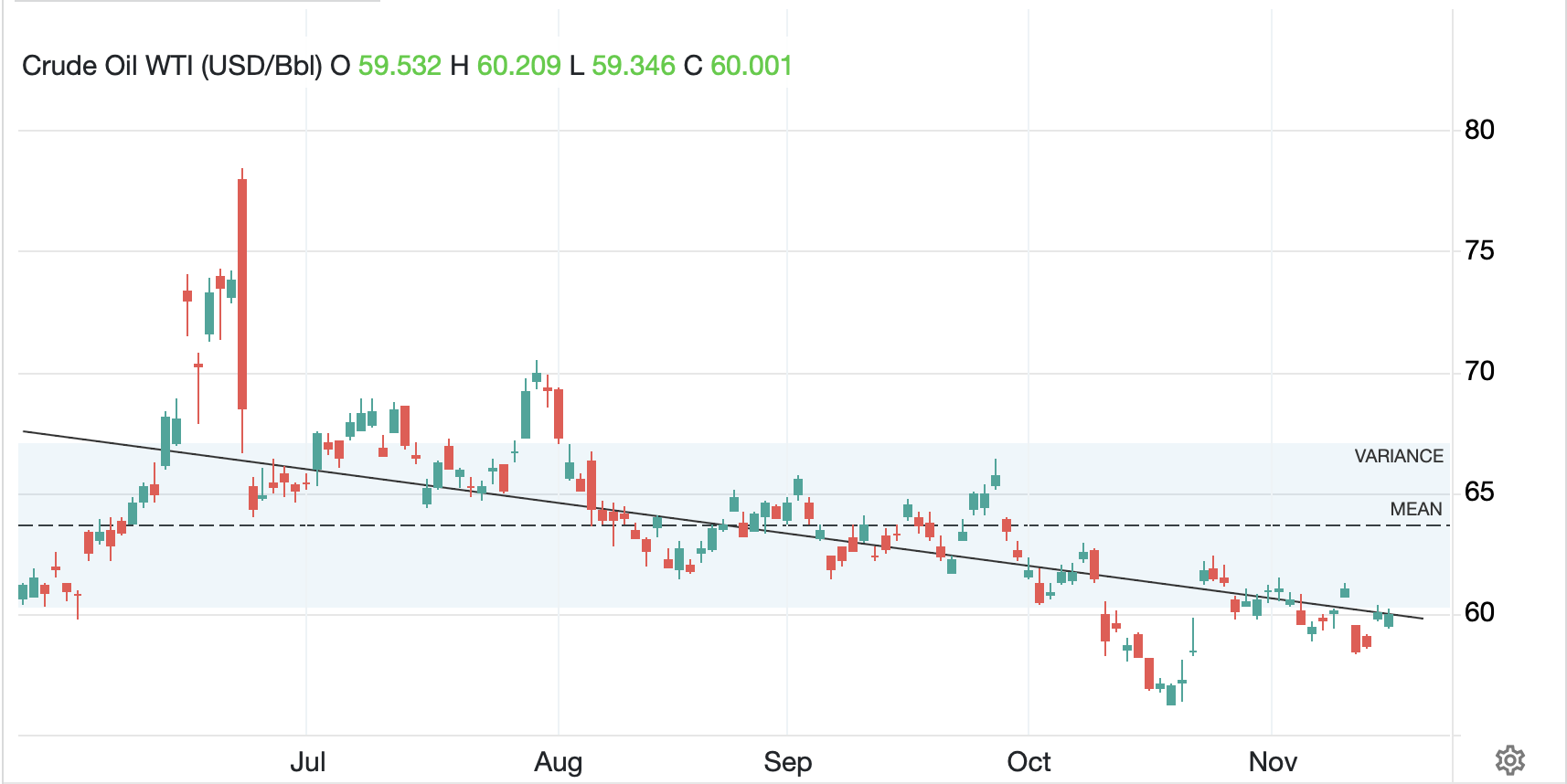
In the commodity space, oil remains pinned to the $60/bbl level with lots of huffing and puffing about Russian sanctions and oil gluts and IEA changes of opinion but in the end, WTI has been either side of $60 for the past month+ and continues to trend slowly lower.  
Source: tradingeconomics.com

Metals remain the most volatile segment of the entire market complex although this morning, movement has not been so dramatic (Au -0.1%, Ag +0.9%, Cu -0.4%, Pt -0.1%).  All the metals remain substantially higher than where they began the year and all have seemingly run into levels at which more consolidation is needed before any further substantial gains can be made.  I don’t think the supply/demand story has changed here, just the price action.

Finally, the dollar is a touch firmer this morning, with the DXY (+0.1%) a good representation of the entire space.  The only two currencies that have moved more than 0.2% today are KRW (-0.9%) which reversed Friday’s price action and is explained as continued capital outflows to the US for investment.  On the flip side, CLP (+1.1%) is benefitting from the first round of Presidential elections in Chile, where the right-wing candidate came out ahead and is expected to consolidate the vote and win an absolute majority in the second round.  Jose Antonio Kast, if he wins, is expected to proffer more market-friendly policies than the current socialist president, Gabriel Boric.  It seems the people in Chile have had enough of socialism for now.  But other than those two currencies, this market remains quiet.

On the data front, there is so much data to be released, but the calendar for much of it has not yet been finalized.  One thing that is finalized is the September employment situation which is due for release Thursday morning at 8:30. This morning we see Empire State Manufacturing (exp 6.0) and Construction Spending (-0.1%) and hopefully, the calendar will fill in as the week passes.

While equity markets remain very near their all-time highs, the Fear and Greed Index is firmly in Fear territory as per the below from cnn.com.

Historically, this has been seen as an inverse indicator for stock markets although it has been down here for more than a month.  Uncertainty breeds fear and the lack of data has many people uncertain about the current state of the US economy since the only information they get is either from the cacophony of social media, the bias of mainstream media or their own two eyes.  But even if you trust your own eyes, they just don’t see that much, likely not enough to come to a broad conclusion. 

FWIW, which is probably not much, my take is things are slower than they have been earlier in the year, but nowhere near recession.  I think it is the correct decision for the Fed to hold next month rather than cut because the drivers of inflation remain extant.  But Jay doesn’t ask me.  Whether Miran is correct in his prescriptions for the economy, I am gratified that he is questioning the underlying structure.  In the meantime, run it hot remains the name of the game and that means any risk-off period is likely to be short.

Good luck

Adf
No Reprieve

The barbarous relic is soaring
As Stephen Miran is imploring
That Fed funds should be
At 2, don’t you see
An idea that Trump is adoring
 
But what else would happen if Steve
Is Fed Chair, when Powell does leave?
At first stocks would rally
Though bonds well could valley
And ‘flation? There’d be no reprieve


Arguably, the most interesting news in the past twenty-four hours has been the speech given by the newest FOMC member, Stephen Miran, where he explained his rationale for interest rates going forward.  There is no point going into the details of the argument here, but the upshot is he believes that 2.0% is the proper current setting for Fed funds based on his interpretation of the Taylor Rule.  That number is significantly lower than any other estimate I have seen from other economists, but then, the track record of most economists hasn’t been that stellar either.  Who am I to say he is right or wrong?

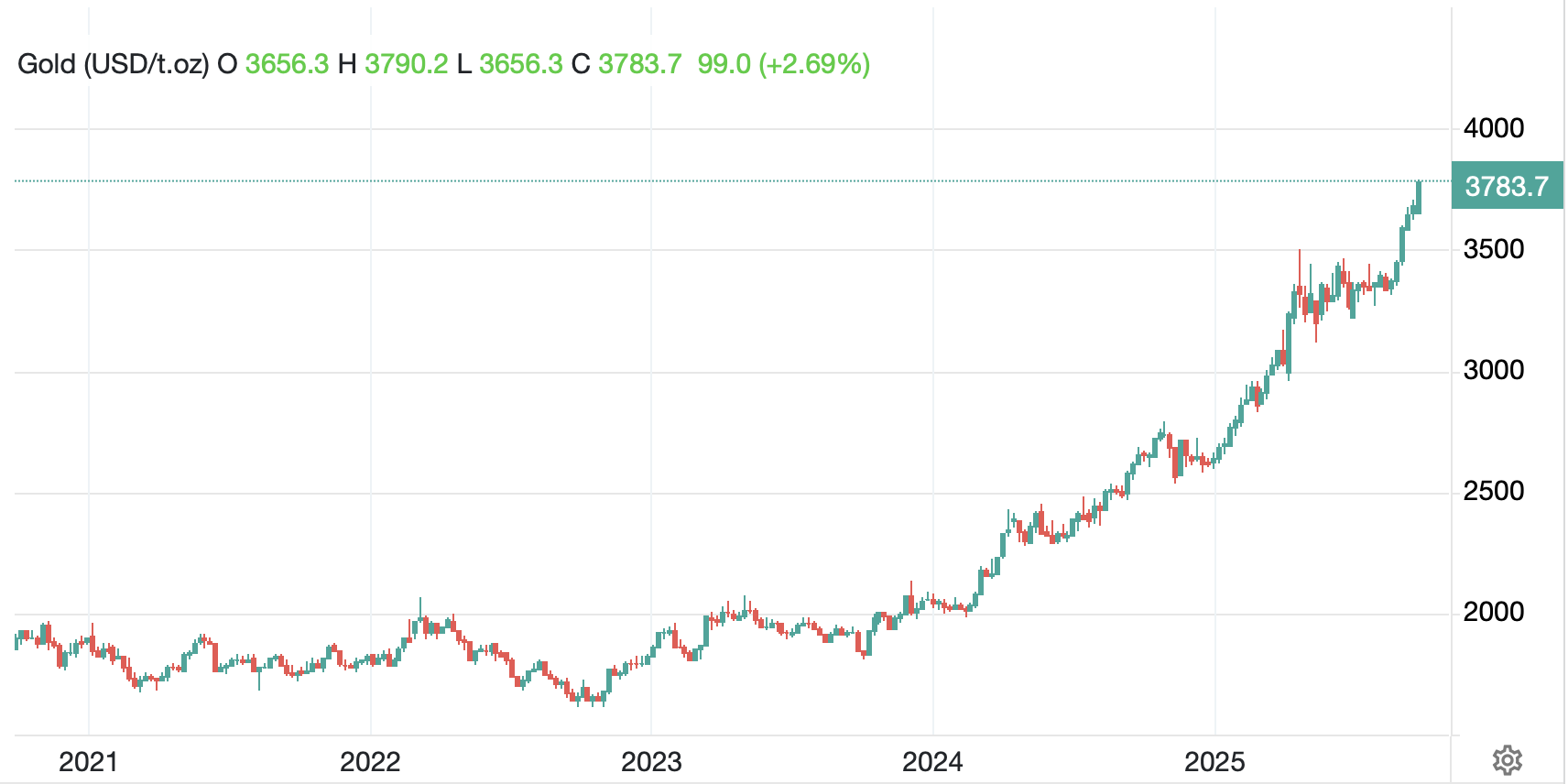
Well, actually, I guess that’s what I do, comment from the cheap seats, and FWIW, I suspect that number is far too low.  But forgetting economists’ views, perhaps the best arbiter of those views is the market, and in this case, the gold market.  With that in mind, I offer the following chart from tradingeconomics.com:

Those are weekly bars in the chart which shows us that the price of gold has risen for the past five weeks consecutively, during which time it has gained more than 14% on an already elevated price given the rally that began back in the beginning of 2024. Today’s 1% rise is just another step toward what appears to be much higher levels going forward.  

Why, you may ask, is gold rallying like this?  The thought process, which Miran defined for us all yesterday, is that he is in line to be the next Fed chair when Powell leaves, and so his effort will be to cut rates as quickly as possible to that 2% level.  Of course, the risk is inflation readings will continue to rise while the Fed is cutting.  If that occurs, and I suspect it is quite likely, then fears about a weaker dollar are well founded (that has been my view all along, aggressive rate cuts by the Fed will undermine the dollar in the short-run, longer term is different) and gold and other commodities will benefit greatly.  As to bonds…well here the picture is likely to be pretty ugly, with yields rising.  In fact, I wouldn’t be surprised to see 10-year Treasury yields head back toward 5.0% at which point the Treasury and the Fed, working hand in hand, will cap them via some combination of QE and YCC.

Of course, this is just one hypothesis based on what we know today and won’t happen until Q2 or Q3 next year.  Gold is merely sniffing out the probability of this outcome.  Remember, too, that the Trump administration has been quite unpredictable in its policy moves, and so none of this is a sure thing.

As an aside, given the inherent dovishness of the current make up of Fed governors, it would seem that a Miran chairmanship with a distinctly dovish bent will not have much problem getting the rest of the FOMC to go along, except perhaps for a few regional presidents.  And that doesn’t even assume that Governor Cook is forced out.  After all, she is a raging dove, just a political one that doesn’t want to give President Trump what he wants.

And before I start in on the overnight activity, here is another question I have.  Generally, economists are much more in favor of consumption taxes (that’s why they love a VAT) rather than income taxes and it makes sense, in that consumption taxes offer folks the choice to pay the tax by consuming or not.  If that is the case, why are these same economists’ hair all on fire about the tariffs, which they plainly argue is a consumption tax?  I read that the US is set to generate $400 billion in tariff revenue this year which would seem to go a long way to offsetting no tax on tips and other tax cuts from the OBBB.  I would expect that if starting from scratch, an honest economist, with no political bias (if such a person were to exist) would much rather see lower income tax rates and higher consumption tax rates.  Alas, that feels like a conversation we will never be able to have.

Anyway, on to markets where yesterday saw yet another set of new all-time highs in the US across all the major indices with futures this morning slightly higher yet again.  Japan was closed for Autumnal Equinox Day, while the rest of the region had a mixed performance.  China (-0.1%) and HK (-0.7%) suffered on continuing concerns over the Chinese economy with news that banks which are still dealing with property loan problems are now beginning to see consumer loan defaults as well.  Elsewhere Korea and Taiwan both rallied nicely, following the tech-led US while India suffered a bit on the H1-B visa story with the rupee falling to yet another historic low (dollar high) now pushing 89.00.  There were some other laggards as well (Thailand, Philippines) but most of the rest were modestly higher.  

In Europe, green is the theme with the CAC (+0.7%) leading the way while the DAX (+0.2%) and IBEX (+0.3%) are not as positive.  Ironically, Flash PMI data showed that French activity was lagging the most, with both manufacturing (48.1) and services (48.9) below the 50.0 breakeven level and much worse than expected.  It seems the fiscal issues in France are starting to feed into the private sector.  As to the UK, weaker Flash PMI data there has resulted in no change in the FTSE 100 as it appears caught between inflation worries and growth worries.

In the bond market, Treasury yields which rose 2bps yesterday have slipped by -1bp this morning while continental sovereigns are all essentially unchanged.  The one outlier here is the UK where gilts (-3bps) are rallying on hopes that the PMI data will lead to easier monetary policy.

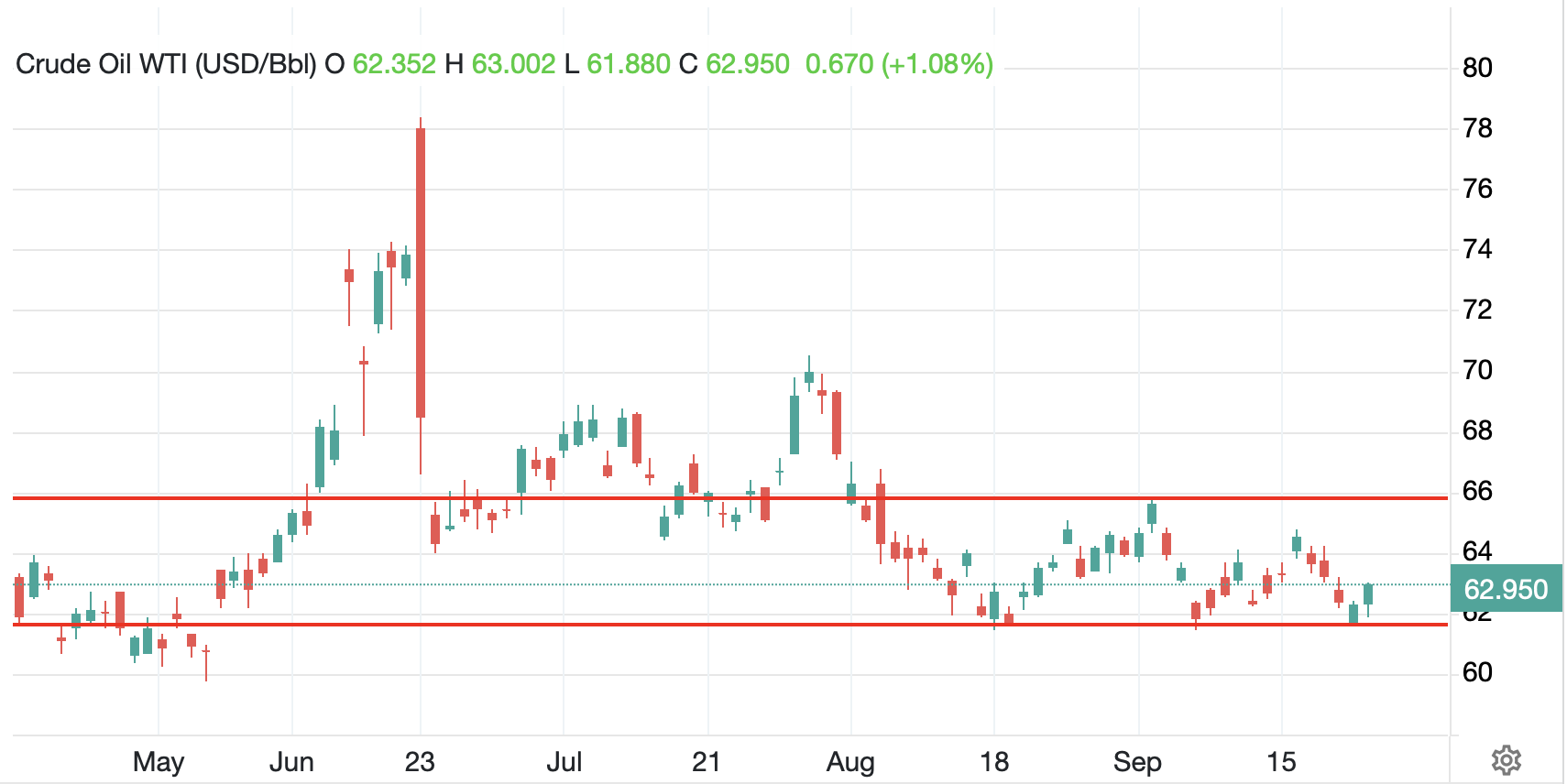
Elsewhere in the commodity markets, oil (+1.1%) is bouncing from its recent lows but has not made much of a case to breech its recent $61.50/$65.50 trading range as per the below.

Source: tradingeconomics.com

The other precious metals are rocking alongside gold (Ag +0.7%, Pt +2.6%) with silver having outperformed gold since the beginning of the year by nearly 10 percentage points.  Oh, and platinum has risen even more, more than 63% YTD!

Finally, the dollar is basically unchanged this morning, with marginal movement against most of its counterparties.  There are only two outliers, SEK (+0.5%) which rallied despite (because of?) the Riksbank cutting their base rate by 25bps in a surprise move.  However, the commentary indicated they are done cutting for this cycle, so perhaps that is the support.  On the other side of the coin, INR (-0.5%) has been weakening steadily with the H1-B visa story just the latest chink in the armor there.  PM Modi is walking a very narrow tight rope to appease President Trump while not upsetting Presidents Putin and Xi.  His problem is that he needs both cheap oil and the US market for the economy to continue its growth, and there is a great deal of tension in his access to both simultaneously.  But away from those currencies, +/- 0.1% describes the session.

On the data front, today brings the Flash PMI data (exp 52.0 Manufacturing, 54.0 Services) and the Richmond Fed Manufacturing Index (-5.0).  remember, the Philly Fed Index registered a much higher than expected 23.2 last week, so the manufacturing story is clearly not dead yet.

Arguably, though, of far more importance than those numbers will be Chairman Powell’s speech at 12:35 this afternoon on the Economic Outlook in Providence, RI.  All eyes and ears will be on his current views regarding the employment situation and inflation, especially in light of Miran’s speech yesterday.

While the gold market is implying our future is inflationary and fiat currencies will weaken, the FX market has not yet taken that idea to extremes.  Any dovishness by Powell, which given the lack of data since we heard from him last week would be a surprise, will have an immediate impact.  However, I suspect he will maintain the relatively hawkish tone of the press conference and not impact markets much at all.

Good luck

Adf

A Third Fed Mandate

As Jay and his minions convene
A new man is making the scene
Now, Stephen Miran
A man with a plan
Will help restart Jay’s cash machine
 
But something that’s happened of late
Is talk of a third Fed mandate
Yes, jobs and inflation
Have been the fixation
But long-term yields need be sedate


As the FOMC begins their six-weekly meeting this morning, most market participants focus on the so-called ‘dual mandate’ of promoting the goals maximum employment and stable prices.  This, of course, is why everybody focuses on the tension between the inflation and unemployment rates and why the recent revisions to the NFP numbers have convinced one and all that a rate cut is coming tomorrow with the only question being its size.  But there is a third mandate as is clear from the below text of the Federal Reserve Act, which I have copied directly from federalreserve.gov [emphasis added]:

“Section 2A. Monetary policy objectives

The Board of Governors of the Federal Reserve System and the Federal Open Market Committee shall maintain long run growth of the monetary and credit aggregates commensurate with the economy’s long run potential to increase production, so as to promote effectively the goals of maximum employment, stable prices, and moderate long-term interest rates.

[12 USC 225a. As added by act of November 16, 1977 (91 Stat. 1387) and amended by acts of October 27, 1978 (92 Stat. 1897); Aug. 23, 1988 (102 Stat. 1375); and Dec. 27, 2000 (114 Stat. 3028).]”

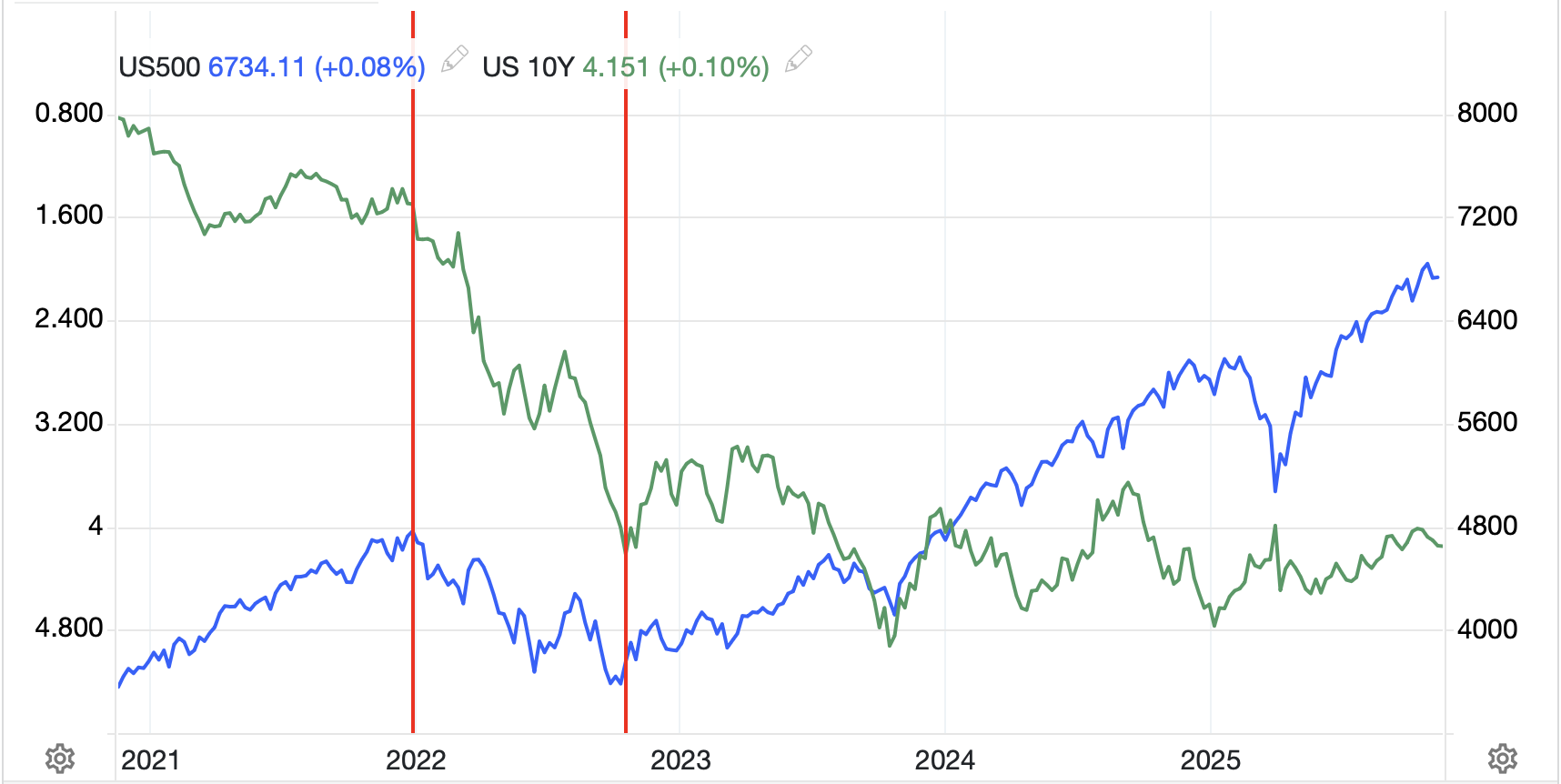
One of the things we have heard consistently from Treasury Secretary Bessent is that he is highly focused on ensuring that longer-term yields do not get too high.  Lately, the market has been working to his advantage with both 10-year, and 30-year yields having declined by more than 25bps in the past month.  And more than 40bps since mid-July.  (Look at the yields listed on the top of the chart below to see their recent peaks, not just the line.)

Source: tradingeconomics.com

Now, with President Trump’s head of the CEA, Stephen Miran getting voted onto the board to fill the seat that had been held by Governor Adriana Kugler, but heretofore vacant, one would think that the tone of the conversation is going to turn more dovish.  What makes this so odd is that, by their nature, central bankers are doves and seemingly love to print money, so there should be no hesitation to cut rates further.  But…that third mandate opens an entirely different can of worms and brings into play the idea of yield curve control as a way to ensure the Fed “promote(s)…moderate long-term interest rates.”

It was Ben Bernanke, as Chair, who instigated QE during the GFC although he indicated it was an emergency measure.  It was Janet Yellen, as Chair, who normalized QE as one of the tools in the toolbox for the Fed to address its dual mandate.  I believe the case can be made that newly appointed Governor Miran will begin to bang the drum for the Fed to act to ensure moderate long-term interest rates, and there is no better policy to do that than QE/YCC.  Actually, there is a better policy, reduced government spending and less regulation that allows productivity to increase and balances the production-consumption equation, but that is out of the Fed’s hands.

At any rate, we cannot ignore that there could be a subtle change in focus to the statement and perhaps Chairman Powell will discuss this at the press conference.  If this has any validity, a big IF, the market impacts would be significant.  The dollar would start another leg lower, equities would rise sharply, and commodity prices would rise as well.  Bonds, of course, would be held in check regardless of the inflationary consequences.  Just something to keep on your bingo card!

Ok, let’s check out the overnight activity.  While it was quiet in the US yesterday, we did manage to make more new highs in the S&P 500 as all three major indices were higher.  As to Asia, Tokyo (+0.3%) had the same type of session, with modest gains as it takes aim at a new big, round number of 45,000.  China (-0.2%) and HK (0.0%) did little although there was a lot of positivity elsewhere in the region with Korea (+1.2%), India, (+0.7%) and Taiwan (+1.1%) leading the way amidst almost all markets, large and small, showing gains.  Europe, though, is a different story with red today’s color of the day, as Spain (-0.8%) and Germany (-0.6%) leading the down move despite better-than-expected German ZEW data (37.3 vs. 26.3 expected).  One of the things I read this morning was that German auto manufacturers have laid off 125,000 workers in the past 6 weeks.  That is a devastating number and bodes ill for German economic activity in the future.  As to other European bourses, -0.1% to -0.4% covers the lot.  US futures, though, continue to point higher, up 0.3% at this hour (7:30).

In the bond market, Treasury yields are unchanged this morning while European sovereign yields have edged higher by between 1bp and 2bps.  It doesn’t feel like investors there are thinking of better growth, but we did hear from several ECB members that while cuts are not impossible during the rest of the year, they are not certain.

In the commodity space, oil (+0.7%) is back in a modest upswing but still has shown no inclination to move outside that trading range of $60/$65.  It has been more than a month since that range has been broken and absent a major change in the Russia sanctions situation, where Europe actually stops buying Russian oil (as if!) I see no short-term catalyst on the horizon to change this situation.  Clearly, producers are happy enough to produce and sell at this level and demand remains robust.

Turning to the metals markets, I discuss gold (+0.4%) a lot, and given it is making historic highs, that makes sense, but silver (+0.4%) has been outperforming gold for the past month and looks ever more like it is going to make a run for its all-time highs of $49.95 set back in January 1980.  The more recent peak, set in 2011, of $48.50 looks like it is just days away based on the recent rate of climb.

Source: finance.yahoo.com

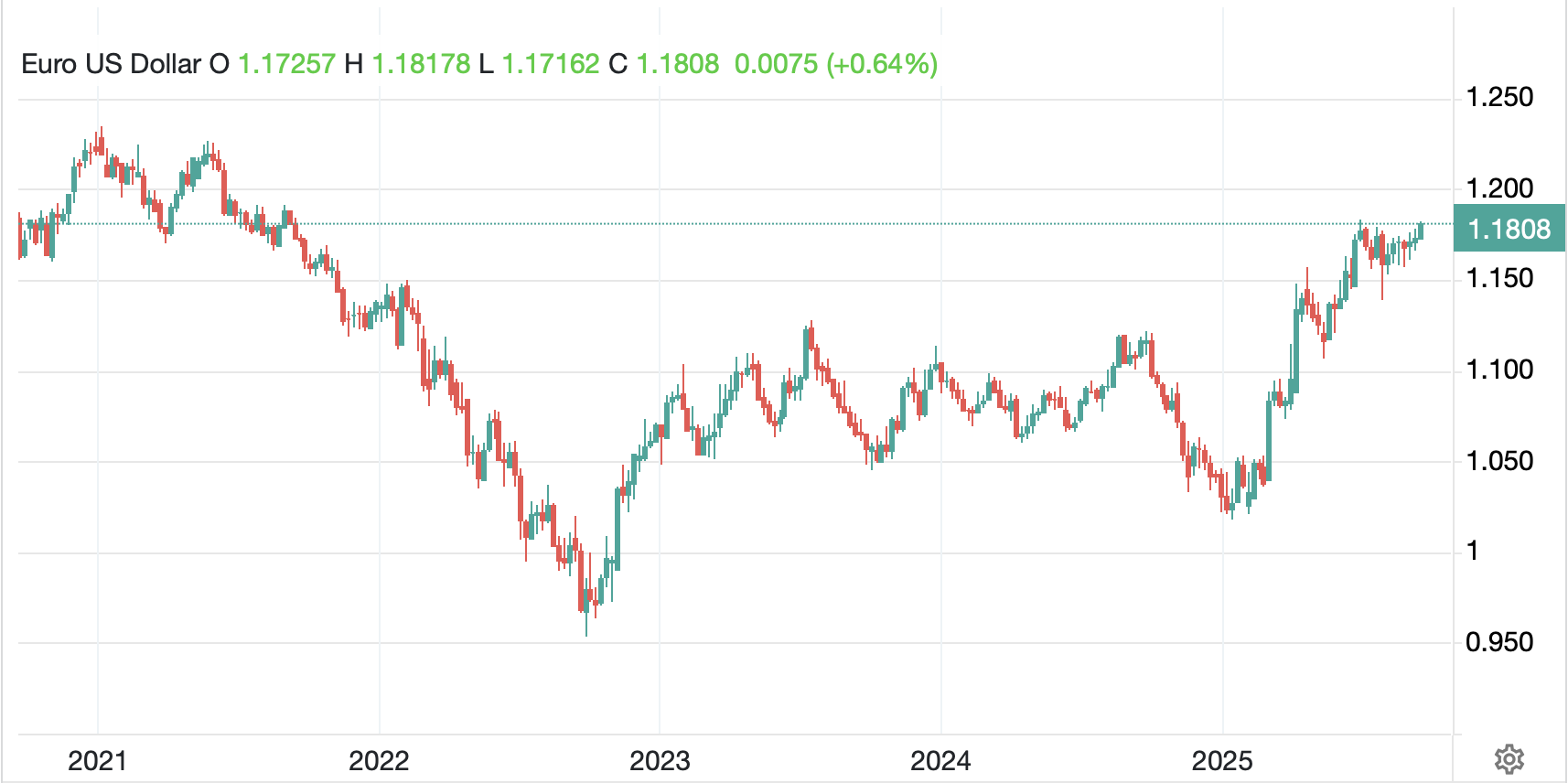
Finally, the dollar is under pressure this morning, with the euro (+0.4%) trading above 1.18 again for the first time since July 1st and there is a great deal of discussion as to how it is going to trade back to, and through, 1.20 soon, a level not seen since 2021.  

Source: tradingeconomics.com

The narrative is now that the Fed is set to begin cutting rates and the ECB is going to stand pat, the euro will rise.  This is true for GBP (+0.3%) as wel, with the Sterling chart largely the same as the euro one above.  Here’s the thing.  I understand the weak dollar thesis if the Fed gets aggressive, I discussed it above. However, if German manufacturing is contracting that aggressively, and the layoffs numbers are eye opening, can the ECB really stand pat?  Similarly, PM Starmer is under enormous, and growing, pressure to resign with the Labour party in the throes of looking to oust him for numerous reasons, not least of which is the economy is struggling.  So, please tell me why investors will flock to those currencies.  I see the dollar declining, just not as far as most.

Data this morning brings Retail Sales (exp 0.2%, 0.4% -ex autos) along with IP (-0.1%) and Capacity Utilization (77.4%).  However, it is not clear to me that markets will give this data much consideration given the imminence of the FOMC outcome tomorrow.  The current futures pricing has just a 4% probability of a 50bp cut.  I am waiting for the Timiraos article to see if that changes.  Look for it this afternoon.

Good luck

Adf