
A Brand New Zeitgeist

Although it’s the number two nation
Of late its shown real desperation
Seems Xi did appraise
The recent malaise
And ordered growth maximization
 
So, mortgage rates there have been sliced
And refi’s are now getting priced
It’s different this time
The bulls, in sync, chime
As Xi seeks a brand new zeitgeist


As China gets set to head off for a week-long holiday, President Xi wanted to make sure everybody there felt great and would start to spend money again.  His latest move came via the PBOC where they loosened the regulations regarding refinancing of home mortgages, now allowing them for everybody starting November 1st.  The key housing rate in China is the 5-year Loan Prime Rate, and while that has fallen steadily over the past two years, down nearly 1%, all the people who were swept up in the property bubble that began to burst three years ago have not been able to take advantage of the lower rates.  This is what is changing, and I presume there will be quite a bit of refi activity for the rest of the year.

So, to recap what China has done in the past week, they have cut interest rates across the board, guaranteed loans to be used for stock repurchases, changed regulations to allow lower down payments on mortgages for first and second homes and now allowed more aggressive refinancing of existing mortgages.  As well, they reduced the RRR, freeing up capital for banks, and relaxed rules for regional governments to be able to spend more.  Now matter how this ultimately ends up, you must give Xi full marks for finally figuring out that in a command economy, he needed to command some more stimulus.  The latest mortgage news has simply excited the equity market even more and there was another huge rally last night (CSI 300 +8.5%), which when looking at a chart of that index shows an impressive rally in the past two weeks, slightly more than 27%!
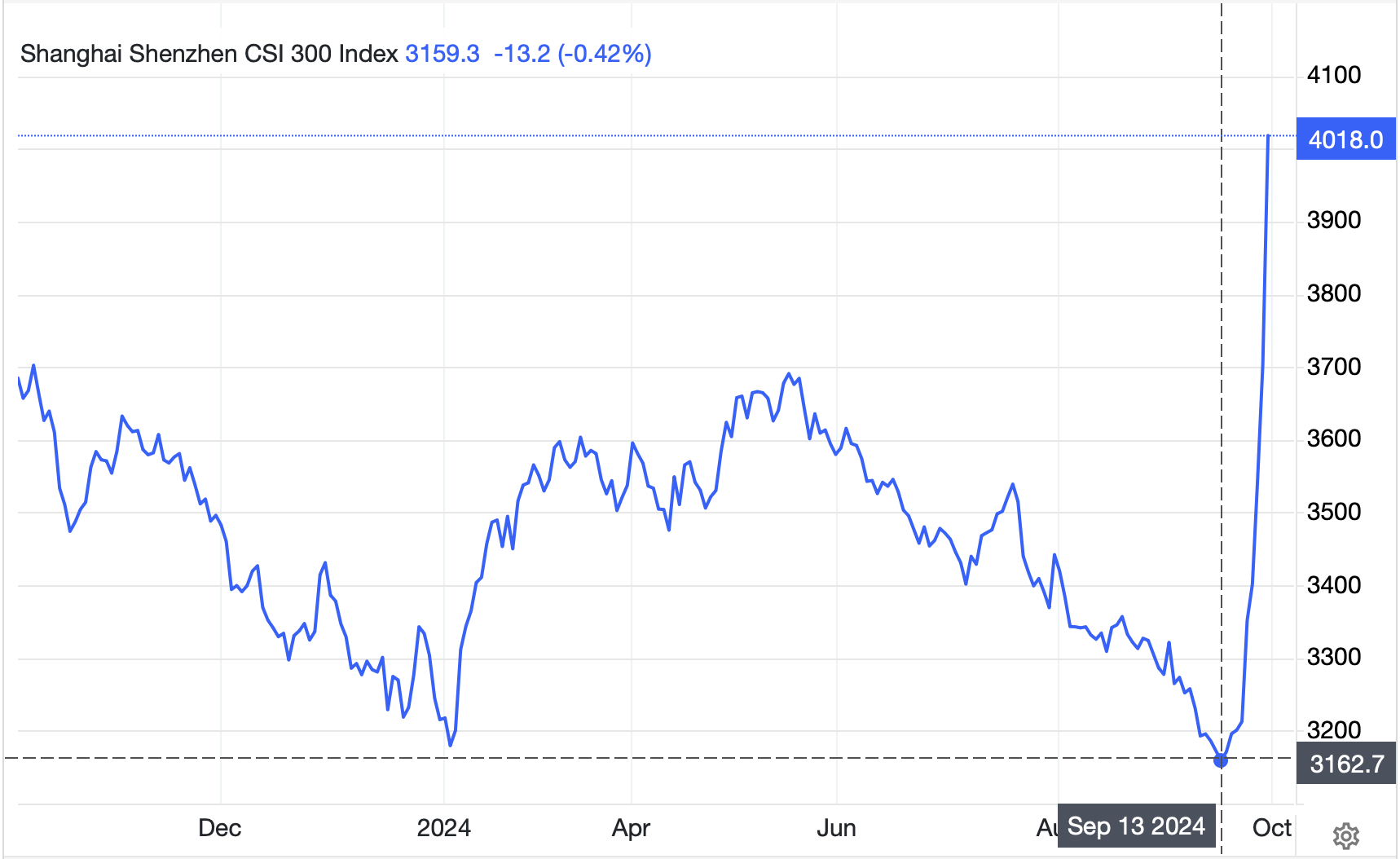
Source: tradingeconomics.com

However, before we get too carried away, a little perspective may be in order.  The below chart is the 5-year view, and while the recent rebound is quite impressive, it simply takes us back to the level from July 2023 and remains more than 30% below the highs seen in February 2021.  I might argue that even if all of these policies work out as planned, something which rarely ever happens, until the economic data start to prove it out, things here feel a bit overbought for now.  Putting an exclamation on the last point, last night China released its monthly PMI data which showed just why Xi has become so aggressive.  Every reading, from both Caixin and the National Bureau of Statistics, was weaker than last month and weaker than expected.  Xi certainly needed to do something.

Source: tradingeconomics.com

Gravity remains
An unyielding force, even
For Japanese stocks

Now, a quick mea culpa from Friday’s note as I was in error on my analysis of the Japanese stock market in the wake of the election of Ishiba-san.  It seems that the announcement of his victory was not made until after the cash equity market was closed for the day. At that time, Sanae Takaichi remained the odds-on favorite to win the vote, and the market was anticipating a more dovish approach to things. Hence, the idea of the return to Abenomics and a much slower policy tightening was welcomed by the equity market at the same time the yen weakened.  But with Ishiba-san’s surprise victory, all of that got tossed out the window.  

Of course, USDJPY was able to respond instantly, hence the sharp reversal in the market I showed in a chart on Friday.  However, the futures market sold off sharply on the election news and now that has been reflected in the overnight session with the Nikkei (-4.8%) giving back all the gains it had made in the previous two sessions in anticipation of a dovish turn.  So, as you can see in the below chart for the Nikkei 225 over the past week, we are basically exactly where things started before the Takaichi expectations built.  Truly much ado about nothing.
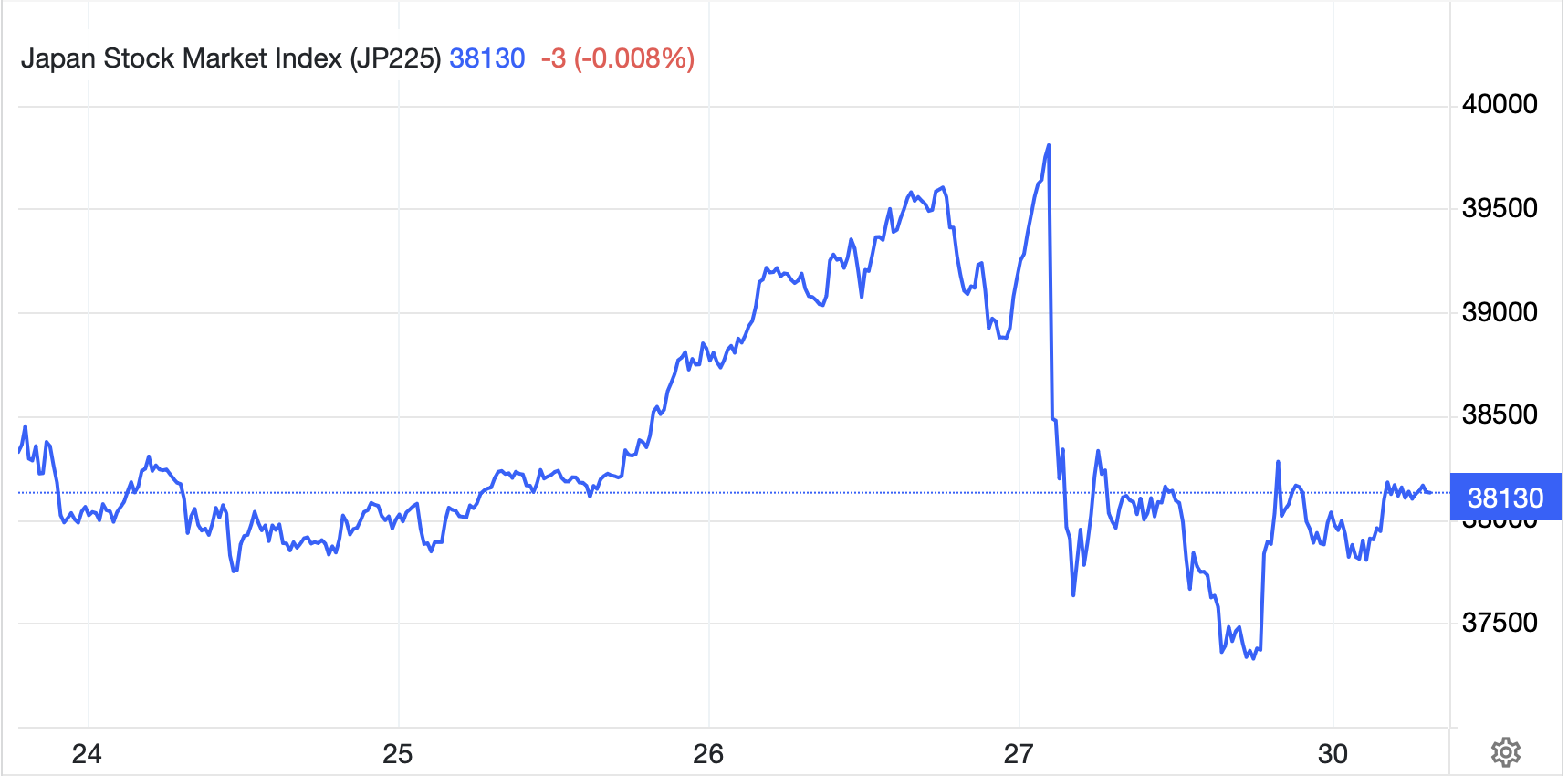
Source: tradingeconomics.com

As to the rest of the overnight session, beyond the Chinese data, we saw German state CPI readings which continue to fall as the German economy continues to slow appreciably.  We also saw UK GDP data, which was slightly softer than forecast, although at 0.9% Y/Y, still well ahead of Germany’s pace.  But otherwise, not very much else.  Last Friday’s PCE data was largely in line and quite frankly, most of the market seems to be focused on China right now, not the US, as that has become the newest idea on how to get rich quick.

So, here’s a quick recap of the session thus far.  Away from China and Japan, we saw more weakness than strength in Asia with both Korea and India falling more than -1.0%, although the rest of the region was mixed with much smaller moves.  Australia (+0.8%), though, benefitted from the China story as the price of iron ore, one of its major exports, rose 11% overnight on the idea that Chinese construction was coming back.  However, European bourses are under pressure this morning led by the CAC (-1.6%) with the rest of the continent also soft on the back of weaker earnings forecasts and announcements from European companies.  As to US futures, at this hour (7:20), they are pointing lower by -0.25%.

In the bond market, with all the excitement over renewed growth in China and continued tightening in Japan, yields are backing up slightly with virtually every G10 government seeing yields higher by 2bps this morning.  Ultimately, for Treasuries my fear is with the Fed cutting rates now and no real sign that the economy is slowing rapidly, we are going to see a quicker rebound in inflation than they are anticipating and that will not help the long end of the curve at all.

In the commodity markets, we are following Friday’s declines with further moves lower this morning as oil (-0.55%) continues to struggle on the weak demand story (this time from Europe, not China) while metals markets are also under pressure with all three biggies down (Au -0.75%, Ag -1.4%, Cu -0.7%).  This is a bit confusing for two reasons.  First, with the euphoria that the Chinese reflation story has generated, I would have expected copper to continue to rally alongside iron ore, but second, the dollar is softer today, and that generally supports the metals markets.

So, a quick look at the dollar shows the DXY is looking to test 100.00, a level it last briefly touched in July 2023 but spend most of 2020 and 2021 below.  This is concurrent with the euro (+0.3%) testing 1.12 and the pound (+0.3%) testing 1.35, with the former showing virtually the same pattern as the DXY and the latter making new highs for the past two years.  But there is some schizophrenia in the G10 with JPY (-0.2%), CHF (-0.3%), NOK (-0.35%) and SEK (-0.2%) all under pressure today.  While NOK and SEK make sense given the commodity moves, that doesn’t explain gains in AUD and NZD.  Some days are just like that.  In the EMG bloc, in truth, the dollar is showing more strength than weakness with ZAR (-0.35%), CNY (-0.2%) and KRW (-0.15%) although MXN (+0.3%) is bucking that trend.  On the one hand, it is quite confusing to see so many contrary moves amongst the currencies that typically track closely together.  On the other, though, none of the moves are very large, so there can be idiosyncratic explanations for all of this without changing the big picture story.

On the data front, we get a bunch of stuff culminating in NFP on Friday.

TodayChicago PMI46.2
 Dallas Fed Manufacturing-4.5
TuesdayISM Manufacturing47.5
 ISM Prices Paid53.7
 JOLTS Job Openings7.67M
WednesdayADP Employment120K
ThursdayInitial Claims220K
 Continuing Claims1837K
 ISM Services51.6
 Factory Orders0.1%
FridayNonfarm Payrolls140K
 Private Payrolls120K
 Manufacturing Payrolls-5K
 Unemployment Rate4.2%
 Average Hourly Earnings0.3% (3.8% Y/Y)
 Average Weekly Hours34.3
 Participation Rate62.9%

Source: tradingeconomics.com

As well as all that, we hear from nine different Fed speakers over 13 different speeches this week, including Chairman Powell this afternoon at 2:00pm.  It’s not clear that we have learned enough new information for Powell to change his tune although given all of China’s moves there could be some belief that the Fed doesn’t need to be so aggressive.  Now, as of this morning, the Fed funds futures market is pricing a 41% probability of a 50bp cut in November and a 50:50 chance of a total of 100bps by the end of the year.  but, if China is easing so aggressively, does the Fed need to as well?

Right now, the story is all China.  However, I still detect a lot of positive sentiment in the US and expectations that the Fed is going to continue to ease and boost growth, inflation be damned.  It still strikes me that you cannot be bullish both stocks and bonds here as they are going to respond quite differently to the future.  As to the dollar, it is clearly on its back foot as the pricing of further Fed ease undermines it for now, but remember, as other central banks follow the Fed more aggressively, any dollar declines will be muted.

Good luck

Adf

Bears’ Great Dismay

Their confidence clearly was lacking
So, now on rate cuts they’re backtracking
As well, they’re concerned
Some banks have not learned
To manage their risk and need smacking
 
But really the news of the day
Is AI remains the key play
NVIDIA beat
And all of Wall Street
Is buying to bears’ great dismay
 
Starting with the FOMC Minutes, the two things that stood out to me were these two lines, “The staff provided an update on its assessment of the stability of the U.S. financial system and, on balance, characterized the system’s financial vulnerabilities as notable. The staff judged that asset valuation pressures remained notable, as valuations across a range of markets appeared high relative to fundamentals.”  Arguably, this was why the Fed removed the line from the statement about “The U.S. banking system is sound and resilient,” which had been included since the Silicon Valley Bank debacle.  Perhaps they see something amiss.  As well, there was discussion regarding the timing of the end of QT with July seeming to be the latest thinking for its initial reduction.  But otherwise, as evidenced by the fact that virtually every Fed speaker has indicated they lack confidence inflation is dead, and that while policy is currently restrictive, it is still too soon to think about cutting rates, was clearly the broad theme of the meeting.  Next week we see the PCE data so perhaps that can change some opinions, but right now, given what we have just seen from CPI/PPI, they cannot have gained confidence it is time to cut.
 
As to NVIDIA, huge results, beating expectations and the word from the CEO is that demand will outstrip supply at least through the end of the year.  The market response here has been as one would expect; a big rally in stocks, especially tech.  ‘Nuff said.
 
Nikkei all-time high
Thirty-four years in waiting
Has finally come

Under the heading a picture is worth 1000 words, behold the relationship between NVIDIA and Nikkei 225 (chart from Weston Nakamura’s Across the Spread substack):

Pretty tight correlation, no?  Arguably, the question is which is driving which?  Does a stronger Nikkei drive NVIDIA’s performance or the other way around?  The first thing to note is that breaking down the Nikkei’s performance, similar to the NASDAQ, there are a handful of AI related stocks that have been the drivers of the move.  If you read Nakamura-san’s take, he believes that it is the Nikkei which is driving things, but I would argue while the Nikkei’s move happens earlier in the global day, the reality is that everything is an echo of the current AI craze which NVIDIA started.  

The next question is, just how long can this continue?  Remember two things here; first, trees don’t grow to the sky, and neither will NVIDIA’s stock; and second, new technologies take MUCH longer to assimilate than the initial hype would have you believe.  We are already seeing issues with Google’s Gemini AI with respect to drawing remotely accurate historical images of US presidents, as an example.  We are still in the very early innings of the AI phenomenon and there will be more hiccups along the way.  One last thing regarding AI is its power consumption, which is off the charts high.  If the world is going to be run by AI, we need a lot more electricity than is currently being produced and that alone will slow its incorporation into things.

Ok, on to more macro views, last night and this morning saw the release of the Flash PMI data all around the world.  Of the seven major releases thus far, only India is in expansion with it continuing to motor along in the low 60’s.  Otherwise, everything else (Australia, Japan, Germany, France, the Eurozone and the UK) are all in contraction in manufacturing.  Services is more mixed with several slightly above the 50 boom/bust line, but overall, while things might be seen as slightly improving, they are still pointing to recessions in Europe, Japan and the UK.

Despite this weakening data, virtually every one of these nations’ currencies is stronger vs. the dollar this morning.  In fact, the dollar is having a pretty rough session, down between 0.3% and 0.5% against most G10 counterparts with a slightly smaller decline vs. its EMG counterparts.  One of the odd things about this is that US yields have not really fallen much (Treasuries -1bp) which is right in line with the price action in European sovereigns and what we saw overnight in Asia across the board.

Add to the bond story the message from the Fed of higher for longer and it doesn’t appear that interest rates are today’s driver of the markets.  We already have seen that equity markets are rocking with the Nikkei (+2.2%), Hang Seng (+1.5%), CSI 300 (+0.9%), and most of Europe higher by 0.9% or more.  US futures, of course, are really flying with the NASDAQ (+2.2%) leading the way, but everything in the green.  I grant that a typical risk-on reaction is a weaker dollar but given the amount of funds that are flowing into the US equity markets, it is very hard to understand why the dollar is under pressure.  Something seems amiss.

If we look at the commodity markets, energy is softer across the board with oil (-0.2%) edging lower and basically unchanged on the week, while NatGas (-2.7%) is suffering as well.  As to the metals markets, gold (+0.2%) is edging higher on the back of the weaker dollar but both copper and aluminum are little changed on the day, less than 0.1% different from yesterday’s closing levels.  

Perhaps this is the new risk-on look, strong equity markets, a weak dollar and nobody cares about bonds.  But bonds have been far too important a driver of market activity to suddenly be ignored.  Now, yesterday, the Treasury auctioned some 20-year bonds and it did not go well, with a tail of 3.3bps, implying demand for the long-end remains tepid.  Given my personal view on inflation, that makes perfect sense, but arguably, the longest duration assets around are tech stocks and the divergence between bonds and those stocks is hard to reconcile.  I guess we will learn more as time progresses, but for now, I would be at least a little wary.  Absent a change in the inflation narrative back to the Fed has won, it does feel like there is still some risk to be seen.

On the data front, this morning brings the Chicago Fed National Activity Index (exp -0.15) which is a comprehensive view of financial conditions around the country and closely followed by the Fed.  As well we get Initial (218K) and Continuing (1885K) Claims and the Flash PMI’s (50.5 Manufacturing, 52.0 Services).  We close with Existing Home Sales (3.97M) and the oil inventory data and throughout the day we hear from four different Fed speakers, Jefferson, Harker, Cook and Kashkari.  Will any of this data matter?  I doubt it.  Can we expect anything new from the Fed speakers?  I kind of doubt that as well as there has been exactly zero evidence that the economy is slowing and dragging inflation lower since last week’s CPI and PPI data.   So, look for that lack of confidence in the demise of inflation to be widespread.

As to the dollar, something doesn’t smell right today.  I feel like it should be better bid and expect that by the end of the day, it will see that type of movement.

Good luck

Adf

Markets Are Waiting

The macro event of the day
Is actually micro I’d say
The markets are waiting
For all the debating
‘Bout Bitcoin to end in OK
 
The irony here is too great
As TradFi, the Bitcoin bros, hate
But they’re still a buyer
If number goes higher
‘Cause really, it’s all ‘bout the rate

It is a very slow day in the markets as evidenced by the fact that the biggest story is whether or not the SEC is going to approve a cash Bitcoin ETF.  Today is the deadline for the first application to be approved, or not, and the working belief is that if they are going to approve one, they will approve all 13 that have applied in order to prevent any concerns over favoritism to a particular manager.  Yesterday afternoon, there was a tweet from the SEC that indicated approvals had been made, but then within 10 minutes, the SEC denied that was the case and explained their X (Twitter) account had been hacked.

One of the interesting things of late in this space is that there has been a 20% rally in Bitcoin since the beginning of December, seemingly in anticipation of this event.  This price action has many believing we are looking at a ‘buy the rumor, sell the news’ type story with expectations that a short-term sell-off is coming after the announcement.  However, last night, after the erroneous Tweet, Bitcoin rallied more than 2% before turning back around on the retraction.

With that in mind, the more ironic issue, at least to me, is that there is so much excitement in the Bitcoin community for a traditional finance product like an ETF.  Institutionalizing Bitcoin and creating all the same structure and regulation as any other trading vehicle seems at odds with the entire concept of a new digital transaction medium that does not require a centralized system and is free to one and all.  Arguably, what it highlights is that the entire appeal of Bitcoin is that it is a highly speculative and volatile trading vehicle and is appreciated solely because its number can go up really fast!

In the end, just as the odds of a BRICS currency coming along and usurping the dollar’s throne as top currency in the world (at least when it comes to utilization) are close to zero, the same holds true here.  Bitcoin is never going to replace any fiat currency in the role of money.  Just as with every other asset, its value is entirely dependent on what someone will pay for it.  While an ETF will widen the population that is involved in the space, and perhaps ensure that the government never makes any effort to cut it off from the banking world, it will not change the world in any way, shape or form.

Away from this, the market is turning its focus toward tomorrow’s CPI report in the US as the next critical piece of information for the macro story.  Recent data elsewhere in the world has continued to show a cooling rate of inflation, with Australia’s overnight print at 4.3% a tick lower than expected while Norway’s 5.5% Core rate was also a tick lower than expected.  This follows yesterday’s Tokyo CPI which came in soft and is continuing the theme that the Fed, and central banks around the world, have successfully put the inflation genie back into the bottle.  Personally, I think it is premature to make that claim as I have seen very limited evidence that prices for rent are falling and based on the wage data we saw last week in the NFP report, wage rises, at 4.1%, remain well above the rate necessary to see a stable 2% inflation outcome.  But that is the narrative and it is being pushed hard by Yellen and the mainstream media.

As to today, yesterday’s directionless session in the US led to a mixed performance in Asia where the Nikkei continued its recent rally, up another 2% and back to levels last seen in February 1990 as the Japanese bubble was deflating.  However, Chinese shares remain under pressure with the Hang Seng (-0.6%) continuing its recent slide and mainland shares faring no better.  In Europe, the screens are a pale red, with losses on the order of -0.2% or so across the board and US futures are essentially unchanged at this hour (7:15).

In the bond market, 10-year Treasury yields have edged down 2bps this morning and are trading right on 4.00%.  European sovereign yields are little changed on the day.  After a bond sell-off (yield rally) for the past several weeks, it seems that a bit of dovish commentary from some ECB members, notably de Guindos and Centeno has calmed things down a bit.  And you will not be surprised that JGB yields have slipped another 1bp lower this morning as inflation concerns subside everywhere.

Oil prices are little changed today, holding onto yesterday’s gains but not really responding to a new wave of missile and drone attacks by the Houthis in the Red Sea against some tankers.  Too, gold prices are only edging a bit higher, 0.25%, and essentially have remained in a very narrow range for the past six weeks.  As to the base metals, copper has rallied nicely this morning, up 1% but aluminum is unchanged on the session.

Finally, the dollar is under modest pressure this morning against most currencies, but the yen is the exception, falling -0.4% with the dollar back above 145.00.  I believe you cannot separate the Nikkei rally from the yen decline and the ongoing interest rate story in Japan.  With softer inflation readings leading traders and investors to reduce the likelihood of any monetary policy change by the BOJ, those are exactly the moves that would be expected.  In the meantime, the market is staring to price in a slightly higher probability of a March rate cut by the Fed, up to 67.6% despite no indication from any Fed speaker that is on the table.  However, while this is the narrative, I expect the dollar will have a little trouble going forward against both G10 and EMG currencies.

There is no noteworthy economic data today, but we do hear from NY Fed President Williams at 3:15 this afternoon.  Yesterday’s comments by Michael Barr were interesting in that he was adamant that the BTFP (the lending facility put into place in the wake of last year’s Silicon Valley Bank collapse) was going to be wound down when its term of 1 year comes up in March.  Personally, I am skeptical that will be the case, but at the very least, we can expect it to make a quick appearance as soon as there is any other banking trouble.

And that’s really it for today.  Until tomorrow’s CPI, there is very little about which to get excited.  I don’t believe the Bitcoin story, while mildly interesting, is going to have any impact on other markets for any length of time.  So, we shall be biding our time for another twenty-four hours at least.

Good luck

Adf