No Cash Left in the Fisc

Right now, markets keep taking risk
And lately, the pace has been brisk
But coming next week
We could see a peak
If there’s no cash left in the fisc
 
A government shutdown would raise
Concerns about ‘nomic malaise
As well, what I see
Is Trump’s OMB
Is planning a RIF anyways


Volatility remains absent from most markets these days, metals excepted, and given the dearth of data until tomorrow’s PCE report, the focus is beginning to turn elsewhere.  Perhaps the biggest story developing right now is the potential US government shutdown if no continuing resolution is passed by Congress.  The government’s fiscal year runs from October 1 through September 30, and the rules are if Congress hasn’t passed appropriations bills by the end of the fiscal year, nonessential services are ended, and government employees are furloughed until that process is completed.  As of right now, the House of Representatives has passed a clean bill, meaning it continues spending at the current rate, and we are all awaiting on the Senate.  However, the Senate needs 60 votes to pass it to overcome the filibuster and right now, the Democratic Minority Leader, Chuck Schumer, claims they will not support the bill.

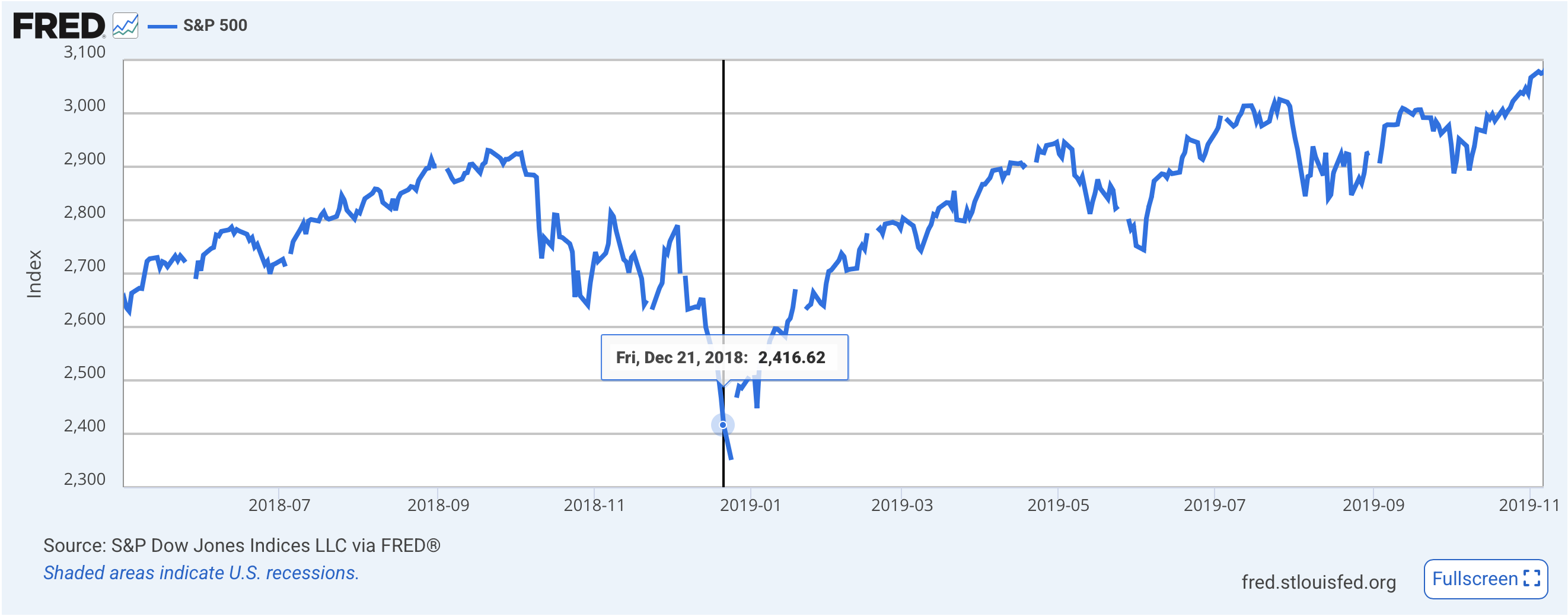
First, understand this is not unprecedented.  In fact, according to Grok, it has happened 21 times since 1980 with the longest being 35 days in 2018-19 over funding for the border wall.  Now, I ask you, can anyone remember the impact of any of those shutdowns, which in fairness typically last less than a week?  

Next, it is worth understanding what actually happens during a shutdown.  National Parks are closed, while passport services, HUD services, SBA services, scientific research and EPA inspections are the type of things that are put on hold.  Also, the BLS will pause data collection and calculations, although given their recent track record, that may be seen as a benefit!  But things like Social Security, Medicare, Medicaid and the Military are all unaffected.

Naturally, there is a lot of politicking ongoing with this process and apparently, President Trump has given marching orders for departments to begin a RIF if the government is shut down.  So, when things reopen, there will be fewer federal employees, one of the goals of this administration, and something that is anathema to his opponents.

From a market perspective, the impact on equity markets during the December 2018 – January 2019 shutdown was actually a rally of just over 10%, although the market did decline in the month leading up to the shutdown.  My point is, there is a lot more politics than economics in this process.
But away from that story, commodities remain the market with the most interest as oil (-0.5%) continues to trade within the range I highlighted earlier this week with a top at $65.50, but has made a technical break above its 50-day moving average, which has the bulls starting to get excited.  As well, the backwardation of the curve is increasing, another bullish sign and much of this is being laid at the feet of President Trump’s seeming turn on the Russia/Ukraine war, where he is quite tired of President Putin’s dissembling.  Certainly, a break above that range top would be at least short term bullish for crude.

Source: tradingeconomics.com

As to the precious metals, while gold continues to trade well, silver has taken the mantle and as you can see from the chart below, is accelerating higher at an even more impressive clip than the yellow metal.  This is a common occurrence as silver historically outperforms gold, on a percentage basis, when both are in bull markets like this.  Just wait until it reaches $50/oz, and makes new all-time highs, and you will see even more discussion of the metals and why they are rallying with inflation concerns a major part of that discussion.

Source: tradingeconomics.com

Meanwhile, financial instruments are far less exciting lately with equity markets stabilizing after their recent run and bond markets also doing little.  Granted, we have seen two consecutive down days in US equity markets, but the magnitude of the decline was de minimis, so it is not really telling us very much.  European markets appear more closely linked to the US, with all bourses there lower by between -0.1% and -0.5% this morning although we did see some modest gains in Asia (China +0.6%, Japan +0.3%).  Net, it seems investors are not certain where to turn right now and are waiting for more clarity from the Fed as to whether more rate cuts are on the way.

The same is true of bond investors who apparently are unconcerned over the shutdown threats, with yields unchanged despite the increasingly combative rhetoric.  We did hear from SF Fed president Daly yesterday, a known dove, who explained that she is coming around to the idea that more cuts are necessary, and they were simply waiting to see how tariffs were going to impact things.  I might argue that she is anxious to cut rates but also doesn’t want to seem to support President Trump’s demands.

Finally, the dollar, after a pretty solid rally yesterday, is essentially unchanged this morning as well.  (That seems to be the theme today, no change.). As I look across my screen, the largest move I see is 0.15%, which is how far CHF has declined on the session, otherwise things have been completely dead.

On the data front, this morning brings the weekly Initial (exp 235K) and Continuing (1930K) Claims data as well as Durable Goods (-0.5%, 0.0% ex-Transport) and the final Q2 GDP reading (3.3%) all at 8:30 with Existing Home Sales (3.96M) at 10:00.  Yesterday saw New Home Sales rise dramatically more than expected at 800K although most analysts expect that number to be revised lower as the Census Bureau gets more information.  Nonetheless, it is a sign that the economy is not collapsing, that’s for sure.  

We also hear from four more Fed speakers today, Williams, Bowman, Barr and Daly again, and we will need to see how they all interpret the current situation.  We learned from the dot plot that there are a lot of different opinions at the Fed right now, and personally, I am very glad to see that.  Given the overall confusion, and the asynchronous nature of the economy right now, it would be more concerning if everyone was on the same page.

As far as the shutdown is concerned, you can be sure that this process will continue until next Tuesday night, at the earliest, if the Democrats cave, and if not, we will then be bombarded by both sides claiming it is the other side’s fault.  Eventually a spending bill will be passed, and as we saw back in 2019, markets pretty much look through this stuff.  Meanwhile, unless the data starts to really deteriorate and brings Fed comments along for that ride, I think the dollar is probably in a rough equilibrium space for now.

Good luck

Adf

A Third Fed Mandate

As Jay and his minions convene
A new man is making the scene
Now, Stephen Miran
A man with a plan
Will help restart Jay’s cash machine
 
But something that’s happened of late
Is talk of a third Fed mandate
Yes, jobs and inflation
Have been the fixation
But long-term yields need be sedate


As the FOMC begins their six-weekly meeting this morning, most market participants focus on the so-called ‘dual mandate’ of promoting the goals maximum employment and stable prices.  This, of course, is why everybody focuses on the tension between the inflation and unemployment rates and why the recent revisions to the NFP numbers have convinced one and all that a rate cut is coming tomorrow with the only question being its size.  But there is a third mandate as is clear from the below text of the Federal Reserve Act, which I have copied directly from federalreserve.gov [emphasis added]:

“Section 2A. Monetary policy objectives

The Board of Governors of the Federal Reserve System and the Federal Open Market Committee shall maintain long run growth of the monetary and credit aggregates commensurate with the economy’s long run potential to increase production, so as to promote effectively the goals of maximum employment, stable prices, and moderate long-term interest rates.

[12 USC 225a. As added by act of November 16, 1977 (91 Stat. 1387) and amended by acts of October 27, 1978 (92 Stat. 1897); Aug. 23, 1988 (102 Stat. 1375); and Dec. 27, 2000 (114 Stat. 3028).]”

One of the things we have heard consistently from Treasury Secretary Bessent is that he is highly focused on ensuring that longer-term yields do not get too high.  Lately, the market has been working to his advantage with both 10-year, and 30-year yields having declined by more than 25bps in the past month.  And more than 40bps since mid-July.  (Look at the yields listed on the top of the chart below to see their recent peaks, not just the line.)

Source: tradingeconomics.com

Now, with President Trump’s head of the CEA, Stephen Miran getting voted onto the board to fill the seat that had been held by Governor Adriana Kugler, but heretofore vacant, one would think that the tone of the conversation is going to turn more dovish.  What makes this so odd is that, by their nature, central bankers are doves and seemingly love to print money, so there should be no hesitation to cut rates further.  But…that third mandate opens an entirely different can of worms and brings into play the idea of yield curve control as a way to ensure the Fed “promote(s)…moderate long-term interest rates.”

It was Ben Bernanke, as Chair, who instigated QE during the GFC although he indicated it was an emergency measure.  It was Janet Yellen, as Chair, who normalized QE as one of the tools in the toolbox for the Fed to address its dual mandate.  I believe the case can be made that newly appointed Governor Miran will begin to bang the drum for the Fed to act to ensure moderate long-term interest rates, and there is no better policy to do that than QE/YCC.  Actually, there is a better policy, reduced government spending and less regulation that allows productivity to increase and balances the production-consumption equation, but that is out of the Fed’s hands.

At any rate, we cannot ignore that there could be a subtle change in focus to the statement and perhaps Chairman Powell will discuss this at the press conference.  If this has any validity, a big IF, the market impacts would be significant.  The dollar would start another leg lower, equities would rise sharply, and commodity prices would rise as well.  Bonds, of course, would be held in check regardless of the inflationary consequences.  Just something to keep on your bingo card!

Ok, let’s check out the overnight activity.  While it was quiet in the US yesterday, we did manage to make more new highs in the S&P 500 as all three major indices were higher.  As to Asia, Tokyo (+0.3%) had the same type of session, with modest gains as it takes aim at a new big, round number of 45,000.  China (-0.2%) and HK (0.0%) did little although there was a lot of positivity elsewhere in the region with Korea (+1.2%), India, (+0.7%) and Taiwan (+1.1%) leading the way amidst almost all markets, large and small, showing gains.  Europe, though, is a different story with red today’s color of the day, as Spain (-0.8%) and Germany (-0.6%) leading the down move despite better-than-expected German ZEW data (37.3 vs. 26.3 expected).  One of the things I read this morning was that German auto manufacturers have laid off 125,000 workers in the past 6 weeks.  That is a devastating number and bodes ill for German economic activity in the future.  As to other European bourses, -0.1% to -0.4% covers the lot.  US futures, though, continue to point higher, up 0.3% at this hour (7:30).

In the bond market, Treasury yields are unchanged this morning while European sovereign yields have edged higher by between 1bp and 2bps.  It doesn’t feel like investors there are thinking of better growth, but we did hear from several ECB members that while cuts are not impossible during the rest of the year, they are not certain.

In the commodity space, oil (+0.7%) is back in a modest upswing but still has shown no inclination to move outside that trading range of $60/$65.  It has been more than a month since that range has been broken and absent a major change in the Russia sanctions situation, where Europe actually stops buying Russian oil (as if!) I see no short-term catalyst on the horizon to change this situation.  Clearly, producers are happy enough to produce and sell at this level and demand remains robust.

Turning to the metals markets, I discuss gold (+0.4%) a lot, and given it is making historic highs, that makes sense, but silver (+0.4%) has been outperforming gold for the past month and looks ever more like it is going to make a run for its all-time highs of $49.95 set back in January 1980.  The more recent peak, set in 2011, of $48.50 looks like it is just days away based on the recent rate of climb.

Source: finance.yahoo.com

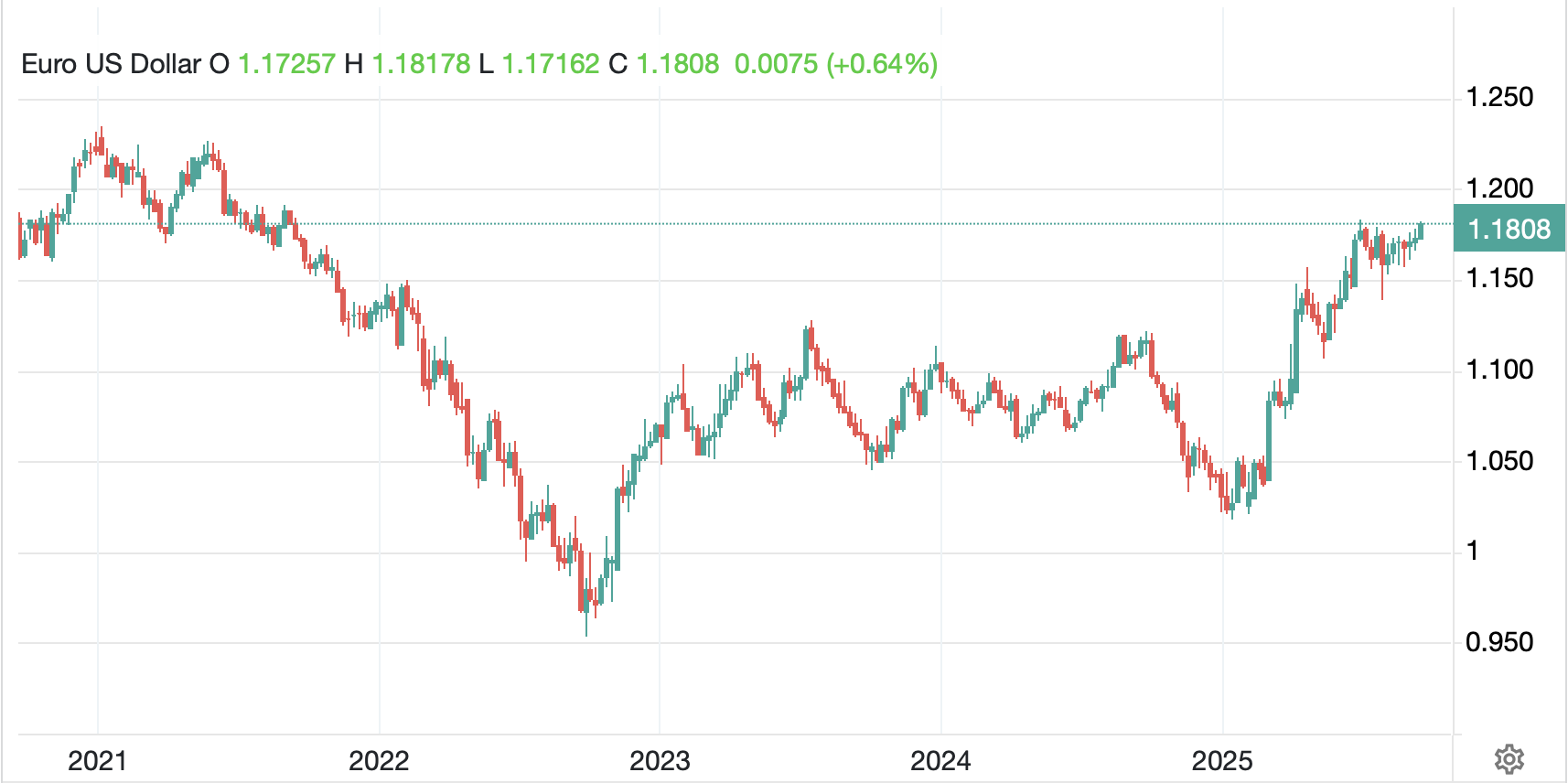
Finally, the dollar is under pressure this morning, with the euro (+0.4%) trading above 1.18 again for the first time since July 1st and there is a great deal of discussion as to how it is going to trade back to, and through, 1.20 soon, a level not seen since 2021.  

Source: tradingeconomics.com

The narrative is now that the Fed is set to begin cutting rates and the ECB is going to stand pat, the euro will rise.  This is true for GBP (+0.3%) as wel, with the Sterling chart largely the same as the euro one above.  Here’s the thing.  I understand the weak dollar thesis if the Fed gets aggressive, I discussed it above. However, if German manufacturing is contracting that aggressively, and the layoffs numbers are eye opening, can the ECB really stand pat?  Similarly, PM Starmer is under enormous, and growing, pressure to resign with the Labour party in the throes of looking to oust him for numerous reasons, not least of which is the economy is struggling.  So, please tell me why investors will flock to those currencies.  I see the dollar declining, just not as far as most.

Data this morning brings Retail Sales (exp 0.2%, 0.4% -ex autos) along with IP (-0.1%) and Capacity Utilization (77.4%).  However, it is not clear to me that markets will give this data much consideration given the imminence of the FOMC outcome tomorrow.  The current futures pricing has just a 4% probability of a 50bp cut.  I am waiting for the Timiraos article to see if that changes.  Look for it this afternoon.

Good luck

Adf

Both Need Downgrading

Excitement in markets is fading
With GameStop and silver both trading
Much lower today
As sellers convey
The message that both need downgrading

Well, it appears that the GameStop bubble is deflating rapidly this morning, which is only to be expected.  Short interest in the stock has fallen from 140% of market cap to just 39% as of yesterday’s close.  This means that there is precious little reason for it to rally again, as, if you recall, the company’s business model remains a bad fit for the times.  The top tick, last Thursday, was $483 per share.  In the pre-market this morning it is trading at $172, and I anticipate that before the end of the month, it will be trading back to its pre-hype $17-$18 level.  But it was fun while it lasted!

Meanwhile silver, yesterday’s story, has also fallen sharply, -4.7% as I type, as the mania there seems to have been more readily absorbed by a much larger market.  The conspiracy theory that the central banks and JP Morgan have been manipulating the price lower for the past several decades has always been hard to understand but was certainly more widespread than I expected.  The major difference between silver and GME though, is that silver has a real raison d’etre as an industrial metal, as well as a traditional store of wealth and monetary metal.  Last year silver’s price rose 46.5%, leading all precious metals higher.  And, in the event that inflation does begin to show itself again, something I believe is coming soon to a screen near you, there is a strong case to be made for it to rally further.  This is especially so given the ongoing debasement of all fiat currencies by central banks around the world as they print more and more each day.

Down Under the RBA stunned
The market and every hedge fund
Increasing QE
As they want to see
The Aussie increasingly shunned

While other major central banks stood pat in their recent policy meetings, the RBA last night surprised one and all by increasing the amount of QE by A$100 billion, at A$5 billion / month, meaning they will continue the program well into 2022.  As well, they explained that they would not consider raising rates until 2024 at the earliest as they work to push unemployment lower.  This means, the overnight rate will remain at 0.1% and YCC for the 3-year bond will also remain at that level.  Interestingly, the market had tapering on its mind, as ahead of the meeting AUD had rallied nearly 0.6%, with analyst discussions of tapering rampant.  As such, it is no surprise that the currency gave up those gains immediately upon the release of the statement, and has now fallen 0.25% on the day, the worst laggard in the G10.

With the FOMC meeting behind us, Fed speakers are going to be inundating us with their views for the next month, so be prepared for a lot more discussion on this topic.  Remember, before the quiet period ahead of the January meeting, four regional presidents were talking taper, with two seeing the possibility of that occurring late in 2021.  Chairman Powell, however, tried to squelch that theory in the statement and press conference.   Yesterday, uber-dove Neel Kashkari expressed his view that it is “..key for Fed to keep foot on monetary policy gas.”  Meanwhile, Raphael Bostic and Eric Rosengren both harped on the need for additional fiscal stimulus to revive the economy, with Bostic once again explaining that tapering when economic growth picks up will be appropriate, although giving no timeline.  (He was one of the four discussing a taper ahead of the meeting.)  We have seven more speakers this week, some of them multiple times, so there will certainly be headline risk as this debate plays out in public.

But for now, markets are sanguine about the possibility of central bank tightening in any way, shape or form, as once again, risk is being embraced across the board.  Starting in Asia, we saw green results everywhere (Nikkei +1.0%, Hang Seng +1.2%, Shanghai +0.8%), with the same being true in Europe (DAX +1.1%, CAC +1.6%, FTSE 100 +0.5%).  US futures are pointing in the same direction with gains on the order of 0.75% at 7:00am.

Bond markets are also on board the risk train, with yields rising in Treasuries (+2.9 bps) and throughout Europe (Bunds +2.7bps, OATs +2.2bps, Gilts +3.1bps).  Part of this positivity seems to be coming from the release of Eurozone Q4 GDP data, which was not quite as bad, at -0.7% Q/Q (-5.1% Y/Y) as forecast.  That outcome, though, was reasonably well known ahead of time as both Germany and Spain printed Q4 GDP at +0.1% in a surprise last week.  Unfortunately, the ongoing lockdowns throughout Europe, which have been extended into March in some cases, point to another quarter of economic contraction in Q1, thus resulting in a second recession in short order on the continent.  With that in mind, while we have not heard much from ECB speakers lately, it is certainly clear that there is no taper talk in Frankfurt at this time.

Which takes us to the currency markets.  The G10 bloc is split with EUR (-0.25%) matching AUD’s futility, while the rest of the European currencies are all modestly lower.  Commodity currencies, however, are holding their own led by CAD (+0.35%) which is benefitting from oil’s rally (+1.3%), although NOK (+0.1%) has seen less benefit.  EMG currencies, however, lean toward gains this morning, with MXN (+0.8%), BRL (+0.6%) and RUB (+0.6%) leading the way, each benefitting from higher commodity prices.  Even ZAR (+0.5%) is higher despite the lagging in precious metals.  But that story is far more focused on ZAR interest rates, which are an attractive carry play in a risk on scenario.  The laggards in this bloc are basically the CE4, tracking the euro, and even those losses are minimal.

While there is no data this morning in the US, we do have important statistics coming up later in the week as follows:

Wednesday ADP Employment 50K
ISM Services 56.7
Thursday Initial Claims 830K
Continuing Claims 4.7M
Nonfarm Productivity 4.0%
Unit Labor Costs -3.0%
Factory Orders 0.7%
Friday Non Farm Payrolls 60K
Private Payrolls 100K
Manufacturing Payrolls 31K
Unemployment Rate 6.7%
Average Hourly Earnings 0.3% (5.0% Y/Y)
Average Weekly Hours 34.7
Participation Rate 61.5%
Trade Balance -$65.7B
Consumer Credit $12.0B

Source: Bloomberg

So, plenty to see, but will we learn that much?  Obviously, all eyes will be on the payroll data, which given the rise in Initial Claims we have seen during the past month seems unlikely to surprise on the high side.  As such, anticipating sufficient data exuberance to get the Fed doves to talk about tapering seems remote.

Adding it all up leaves the current short dollar squeeze in place, with an opportunity, I think, for the euro to trade back below 1.20 for a time, but nothing we have seen or heard has changed my view that the dollar will fall in the second half of the year.  For those of you with payables, hedging sooner rather than later should be rewarded over time.

Good luck and stay safe
Adf