More Drear

While many, last night, were dismayed
By Jensens’s results as displayed
Most markets worldwide
Absorbed them in stride
As buyers keep up their crusade
 
Meanwhile, Europeans still fear
That things won’t get better this year
The war in Ukraine
Is at it again
While sentiment points to more drear


Please understand, I only write about Nvidia because it is topic number one in the markets overall, albeit not very important in FX for now.  So, briefly, despite record revenues and earnings, the numbers were slightly below expectations, and the immediate result was for the share price to decline about 3% or so.  As I type this morning, though, it has already begun to recoup some of those losses and while there are many commentators claiming this was a disaster and forecasts are unrealistic, my sense is the company is going to continue to churn out chips and profits.  I read that their gross margins are 72%, a remarkably high number.  In the end, it is hard for me to look at these results and think the end is nigh.  So, let’s move on.

A moment, first, to remember the tragedy in Minneapolis where two children were killed in a church shooting on the first day of school there as well as the increase in hostilities in Ukraine where last night Russia launched a massive aerial attack on Kyiv, sending 629 missiles and drones of which 40 got through and 14 were killed along with 38 injured.  At this time, it certainly doesn’t look like hostilities in Ukraine are about to end and I think it is fair to say that the only one seeking that result is President Trump.  Clearly Putin is determined to conquer Ukraine, clearly Zelenskiy is determined to resist and apparently the entire EU wants to continue the fight regardless of the costs.

My sense is the problem for Europe is that it is a theoretical construct, not a nation.  As such, it cannot make decisions on a timely basis as a group.  So, while some want to rearm and fight, others are reluctant to do so and would rather free ride.  This lack of cohesion makes the EU a very unstable partner and will hinder their efforts to do more than continue to shovel money to Zelenskiy and Ukraine.  The war has been ongoing for more than three years and I have become of the opinion that it will not end until one side runs out of resources.  Ukraine’s attacks on Russia’s oil infrastructure are starting to have an impact, but it remains to be seen if they can keep those up while Russia continues to bombard population centers.

With that as backdrop, perhaps we should not be surprised that the data released this morning from the Eurozone showed Confidence and Sentiment indicators for both businesses and consumers falling compared to last month and relative to expectations.  Looking at the data from tradingeconomics.com, you can see that the August results were worse for everything with confidence falling but concerns over inflation rising.

                                                                                                             Actual          Previous            Estimate

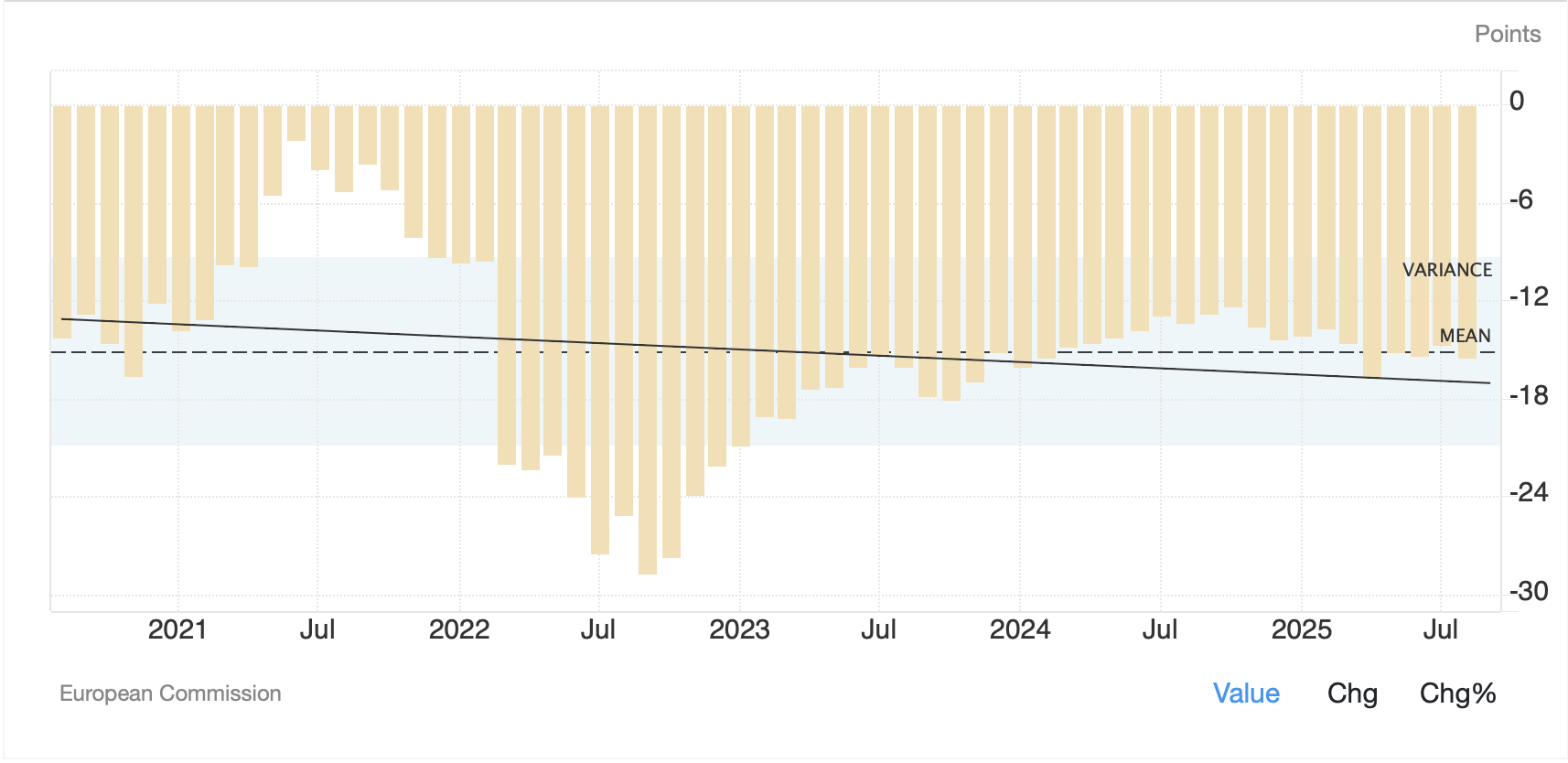
While these numbers are not devastating in themselves, the trend is not positive.  Selecting just one, Consumer Confidence in this case, you can see that while not the worst it has been over the past 5 years (the initial invasion of Ukraine marked the nadir), the trend is not very friendly.  And pretty much all the charts are the same, not the worst but trending the wrong way.
Source: tradingeconomics.com

I make these points because I continue to read about negative sentiment regarding US assets and the dollar, and yet I cannot help but look at the Eurozone and see a negative situation.  I agree that if the Fed starts to get aggressive cutting rates, which seems unlikely as long as Powell remains Chair, the dollar will fall, but is Europe really where you want to be?  I’m not convinced.

Away from that, not much else has been happening (it is the last week of August, and it appears almost everyone is on holiday) so let’s look at overnight price action.  Leading up to the Nvidia earnings, equities in the US rallied, and despite the Nvidia disappointment, futures are currently (7:15) unchanged across the board.  Last night in Asia, China (+1.8%) was the leader, reversing yesterday’s declines with the talk of the town still AI and China’s new AI Plus strategy.  Meanwhile, the Hang Seng (-0.8%) disagreed with the mainland although there was no separate news.  Tokyo (+0.7%) was solid, but elsewhere in the region there were more laggards (India, Taiwan, Philippines) than winners (Korea, Australia) with the winners just barely so.

With that Eurozone data, you will not be surprised that European shares are generally softer, with the major bourses lower by between -0.2% and -0.4% and only the CAC (+0.1%) bucking the trend.  Perhaps this is because the French FinMin, Eric Lombard, claimed France would be able to pay its bills although it seems clear the current government is going to fall when the confidence vote is held on September 8th.

In the bond market, 10-year Treasury yields are unchanged this morning and edging toward the lower end of their recent trading range, with no indication that there is a funding problem for the US.  However, it is worth noting that the yield curve is steepening in the US (and everywhere else) as the 2yr-30yr spread is now 128bps and as you can see from the chart below, that spread has been widening all since July. (30yr yields are in green and the LHS Y-axis).

Source: tradingeconomics.com

When the yield curve inverted back in 2020, there was much talk of its prowess as a prognosticator of coming recessions.  However, we are still awaiting that recession.  In fact, I believe history shows it is when the curve steepens sharply that more problems occur.  It is easy to look at this and see the market is expecting inflation to continue to rise especially given the Fed seems to have put inflation in the back seat of their mandate.  Beware!

In commodities, oil (-0.1%) is stabilizing after a solid rally yesterday as the EIA data was a somewhat larger draw on inventories than expected and perhaps Ukraine’s recent successes regarding attacks on Russian oil infrastructure has some folks concerned.  However, as my friend JJ who writes Market Vibes notes, open interest is declining fast, and activity remains very slow in the space.  At the same time, gold (+0.3%) rallied all day yesterday and is continuing this morning and dragging silver (+1.1%) along for the ride.  Spot gold is back above $3400/oz, a level that had seemed toppish for quite a while.  Perhaps this is the long-awaited break higher the gold bugs have been talking about, but I think we need to see another $100/oz to make that commitment and that likely would entail a much weaker dollar, something that has not yet been happening.

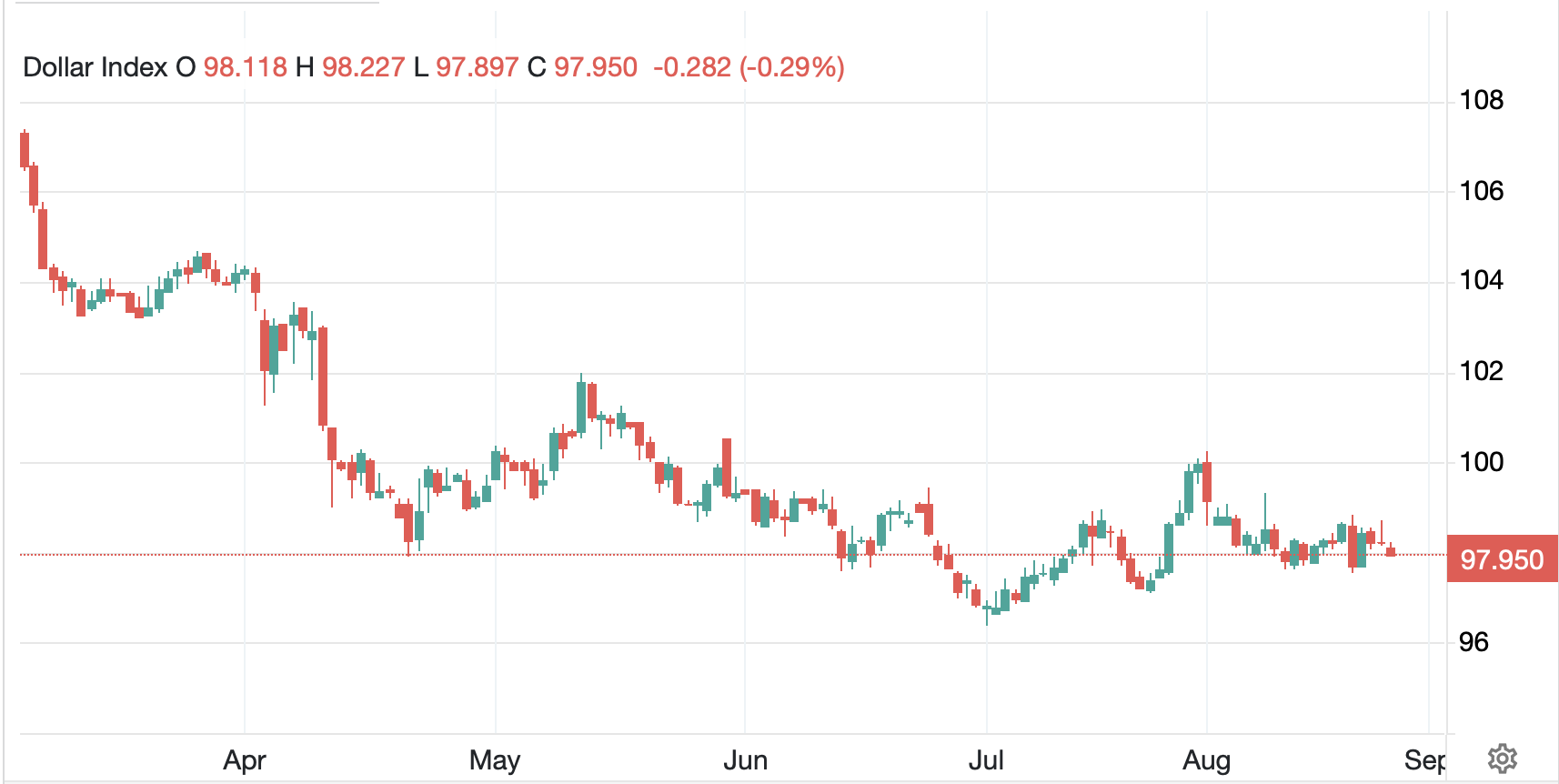
Turning to the dollar, while it is a touch softer this morning, -0.3% as per the DXY, if you look at the chart below (which resembles so many charts these days) since the post-Liberation Day volatility, it is hard to get excited about a move in either direction.  We will need a new out of the box catalyst and I just don’t know what that will be.
Source: tradingeconomics.com

While the dollar’s weakness this morning is universal, the biggest mover overnight was KRW (+0.6%) which rallied after BOK governor Rhee defended their intervention, even indicating it is part of the trade deal with the US.  Otherwise, 0.1% to 0.3% describes the entire slate of currency gains vs. the greenback.

We get some real data this morning as follows: Initial (exp 230K) and Continuing (1970K) Claims; Q2 GDP (3.1%); Q2 Real Consumer Spending (1.4%); and Q2 GDP Sales (6.3%), although this is the second look at all these numbers.  Tomorrow’s Personal Income and Spending as well as PCE data will be far more interesting.  We hear from Governor Waller as well, but we already know his views are to cut right away.

It is difficult to get too excited about much these days and there are valid arguments for movement in most markets in both directions (remember the idea that the goods and services economies are out of sync).  Net, until it is clear the Fed is going to cut aggressively, assuming that happens, the dollar is likely to drift.

Good luck

Adf
What Would You Choose?

As summer meanders along
No market is weak, nor’s it strong
But traders keep trading
With hope masquerading
As knowledge, though they know they’re wrong
 
The question is what sort of news
Can catalyze changes in views?
Seems rate cuts will not
And peace had its shot
Dear readers, just what would you choose?


My friend JJ (he writes the Market Vibes note) made a profound comment that described the current situation so well, I think it is worth repeating: 

It is not that the news and fundamentals are uninteresting or unimportant. They are. But vol control has anesthetized every future, ETF, equity, and FX market, and the managers of it are making trillions on it. Therefore, it is likely this narcolepsy won’t end for a while.”

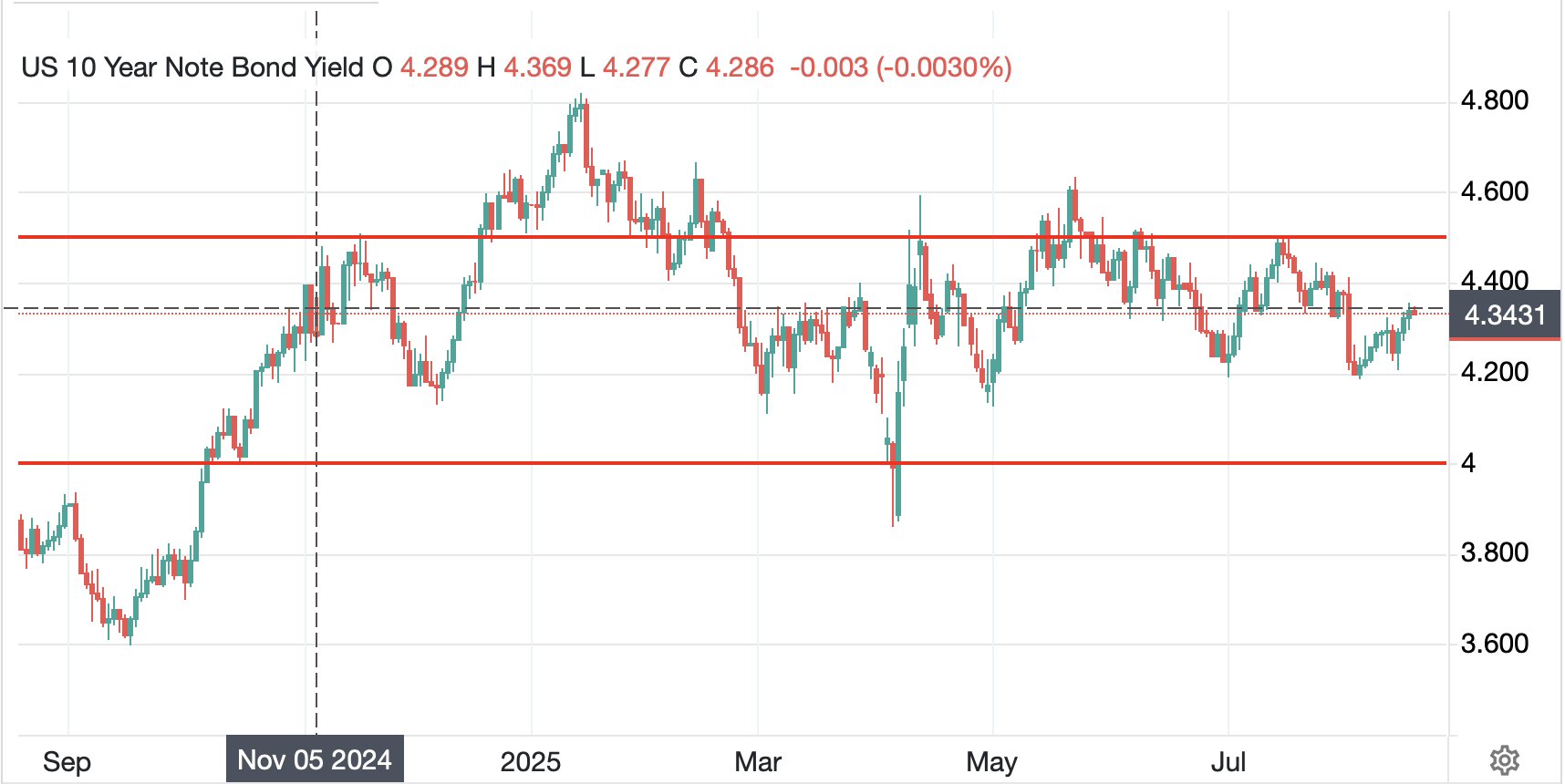
A point he has been making of late, and one with which I cannot argue, is that everything that is not algorithmic is dumb money as the algos drive it all.  And it is a fair point.  Market activity has ground to a halt, and while I have no proof, I would estimate it is even quieter than the typical year’s summer doldrums.  That seems remarkable given the panoply of news stories that exist and in other times would have had a major market impact.  Consider, war and peace in Ukraine, massive changes in federal regulations and administration priorities, and remarkable electoral shifts around the world, yet none of it matters.  Consider this chart of the US 10-year Treasury:

Source: tradingeconomics.com

The yield, which most afficionados agree is critical to not just US, but global, financial markets and activity, has largely traded between 4.0% and 4.5% since well before Mr Trump was elected.  The one thing that cannot be said is that the Trump administration has been boring.  More has happened on the fiscal front in the past six months than in entire presidential terms and yet yields are essentially unchanged since November 5th when Trump was elected.

JJ’s view is the massive increase in the use of options by retail traders has become the driving force.  Retail buys options, paying premium which decays away and that value accrues to the market making algorithms. The amounts of premium are huge, in the $trillions, and it is a straightforward business model that reaps huge rewards, so a lack of movement is the goal.  I cannot argue with that either.

However, the one thing I have learned over my too many years in the market is that no matter how smart you are, no matter how well you have considered the potential outcomes, reality will be different, and at some point, there will be a tipping point to change the market dynamic.  After all, Covid was not expected, nor even more importantly, the government responses to it which is what drove the market volatility.  I am pretty sure there is another true black swan out there, something nobody is discussing as it currently seems irrelevant or impossible, but which will alter the game.

I spent my trading career learning to manage risks while running a global FX options business, trying to profit, but more importantly preventing the huge drawdowns that end careers.  I spent my sales career trying to help my clients understand their FX risks and learn to mitigate them in the most cost-effective manner possible.  What I learned over that 40+ years is that while risks sometimes seem unimportant, or unimaginable, they exist.  Do not mistake the current state for the future state.  Things will change, although how I cannot currently imagine.

With that as preamble, let’s look at just how little things are moving.  Stocks did nothing in the US yesterday and movement overnight in Asia was lackluster as well (Nikkei -0.4%, Hang Seng -0.2%, CSI 300 -0.4%).  As I wrote above, there is just not that much that is exciting investors right now.  Europe, however, seems to be taking a positive stance on the Oval Office meeting with many of their leaders as perhaps peace in Ukraine, if it is coming, will be helpful for the continent.  Ostensibly, Presidents Trump and Putin discussed a closer economic relationship between the US and Russia, which if that came to pass, would undoubtedly rearrange some things in markets, largely to the benefit of Europe.  As to US futures, they are unchanged this morning, again.

Bond markets in Europe are exactly unchanged across the board, so much so that you would expect it was a holiday there.  Treasury yields have edged lower by -1bp, but as I explained above, are simply range trading.

I would argue the commodity markets are where there is the most potential for movement going forward as any type of US-Russian economic détente would almost certainly reduce oil prices substantially.  And, coincidentally, WTI (-1.25%) is falling this morning as hopes for a direct meeting between Putin and Zelensky, and with it the end of the war, are increasing.  Weirdly, gold (+0.35%) is not declining on that news, despite the idea that gold represents a haven against war.  Perhaps gold represents a haven against money supply growth, which if there is an economic détente, you can be sure will increase.  As to the other metals, very little movement there either.  In the vein of the lack of activity, perhaps the below gold chart is even a better descriptor of just how little activity has been going on since spring.

Source: tradingeconomics.com

Finally, the dollar is a touch softer this morning, but it, too, remains rangebound.  While much has been made of its weakness in the first half of the year, as though that calendar period had some special significance (it doesn’t), here too, things have simply ground to a halt.  Using the dollar index (DXY) as our proxy, you can see that this market, too, has done nothing for months.

Source: tradingeconomics.com

Whether it’s G10 or EMG currencies, the movement remains desultory at best, and catatonic may be a better description.

So, let’s look at the data this week that will precede Chairman Powell’s speech Friday morning.

TodayHousing Starts1.30M
 Building Permits1.39M
WednesdayFOMC Minutes 
ThursdayInitial Claims226K
 Continuing Claims1960K
 Philly Fed6.0
 Flash Manufacturing PMI49.5
 Flash Services PMI53.7
 Existing Home Sales3.91M
 Leading Indicators-0.1%
FridayPowell Speech 

Source: tradingeconomics.com

I think it is worthwhile to consider why we look at the Leading Indicators.  The original design was that it tracked a series of indicators that historically had presaged economic activity.  Ahead of recessions, these indicators turned lower and so it seemed a pretty good fit.  However, as you can see from the below chart from conference-board.org, the creators of the index, since 2021, when the index turned lower, it has been completely out of sync with the economy’s outcome.

As I have repeatedly written, models that were created pre-Covid, and many pre-GFC, simply no longer have any relevance to today’s reality.

On the whole, the most likely outcome today, like every day lately, is limited movement in either direction.  While I am sure a black swan exists, he is currently hibernating.

Good luck

Adf

No Retreating

The virtue of patience remains
The key to our policy gains
Though tariffs and trade
May one day, soon, fade
It’s still ‘nuff to scramble our brains


In a bit of a surprise, Chairman Powell resurrected the term ‘transitory’ in his press conference yesterday with respect to the potential impact on prices from President Trump’s tariff policies.  He explained, “We now have inflation coming in from an exogenous source, but the underlying inflationary picture before that was basically 2½% inflation, 2% growth and 4% unemployment.”  In addition, he said, “It’s still the truth if there’s an inflationary impulse that’s going to go away on its own, it’s not the right policy to tighten policy because by the time you have your effect, you’re in effect, by design, you are lowering economic activity and employment.”  It is this mindset that returned ‘transitory’ to the discussion.  Now, while mainstream economics would agree to that characterization, with the idea being it is a one-off price rise, not the beginning of a trend, given the Fed’s history of using the word to describe the impact of monetary and fiscal policies in the wake of the pandemic, it caught most observers off guard.

But in the end, the Fed’s only policy change was a reduction in the pace of runoff of Treasuries from the Balance Sheet on a temporary basis.  Previously, they had been allowing $25B per month to run off without being replaced and starting April 1, that will be reduced to $5B per month.  The runoff of Mortgage-backed assets will continue as before.  This has been a widely discussed idea as the Fed approaches their target of “ample” reserves on the balance sheet, an amount they still characterize as “abundant”.

As to changes in the dot plot and SEP forecasts, they were, at the margin, modest, with the median dot plot ‘forecast’ continuing to call for 2 rate cuts this year.  Fed fund futures are now pricing in 65bps of cuts, so marginally tighter than the 75bps seen last week.  The SEP also showed slightly different forecasts for growth, inflation and unemployment, but just a tick or two different, hardly enough about which to get excited.  

Certainly, Mr Powell said nothing to upset equity markets as the response was a continuation of the modest rally that began in the morning.  As well, bond yields slid almost 9bps from their level just before the Statement was released.  Net, I expect the only people who are unhappy with the Fed’s performance are the hundreds of millions of Americans who have seen the inflation rate remain above the 2.0% target for the past 48 months (see chart below), but then Powell doesn’t really respond to them directly, now does he?

Source: tradingeconomics.com

Oh yeah, President Trump also published a little note on Truth Social that Powell should cut rates, but I don’t think that had any impact at all.  For now, Trump’s attention is elsewhere, and if 10-year yields continue to slide, I suspect he will be fine, certainly Secretary Bessent will be.

In Europe, the leaders are meeting
Again, as they keep on repeating
They need to spend more
To maintain the war
In Ukraine, ‘cause there’s no retreating

Back in the real world, the diverging points of view between President Trump, and his attempts to end the Ukraine War, and the EU, which seems hell-bent on continuing it ad infinitum were highlighted again today as yet another summit meeting is being held in Brussels to discuss the process and progress on rearming the continent as well as how they envision the future of Ukraine.  This matters to markets as the continuous calls for more fiscal military spending is going to be a driver of equity prices in Europe, and given it is going to be funded by issuing more debt, on both a national and supranational basis, yields are likely to rise as well over time.  

There has been much talk lately of the end of US exceptionalism, and certainly there has been a shift of investment into European shares, especially defense firms, and out of US tech shares.  This has helped support the single currency, which while it has slipped the past two days, remains higher by 4.5% since the beginning of the month.  Ex ante, there is no way to know how this situation will evolve, but if history is a guide at all, the US continues to hold all the defense cards in the deck, and so even with European protests, I suspect the war will come to an end.

But here’s a thought, perhaps even if the war ends, the pre-war energy flows may not resume.  This would not be because Europe doesn’t want cheap Russian gas, but perhaps because Russia doesn’t want to sell it to those who will use it to build armaments that can be used against Russia.  The world has moved to a different place both politically and economically, than where it was pre-Covid.  My sense is many old models may no longer work as proxies for reality, which takes me back to my favorite theme, the one thing on which we can count is more volatility!

Ok, let’s take a turn through markets overnight.  After the US rally, Asia was far more mixed with the Nikkei (-0.25%) slipping a bit and both China (-0.9%) and Hong Kong (-2.2%) falling more substantially on fears that US tariffs could slow growth there more than previously feared.  But elsewhere in the region there were far more gains (Korea, Australia, India, Taiwan) than losses (Malaysia, Thailand). 

Europe, though, is having a tougher session with losses across the board.  The continent is particularly hard hit (Germany -1.7%, France -1.2%, Spain -1.2%) although the UK (-0.3%) is holding up better after decent employment data was released.  We did see the Swiss National Bank cut its base rate by 25bps, as expected, while Sweden’s Riksbank left rates on hold, also as expected.  In fairness, European stocks have had quite a good run, so a pullback should not be a surprise, but it is disappointing, nonetheless.  As to US futures, at this hour (7:10), they are pointing lower by -0.5% or so.

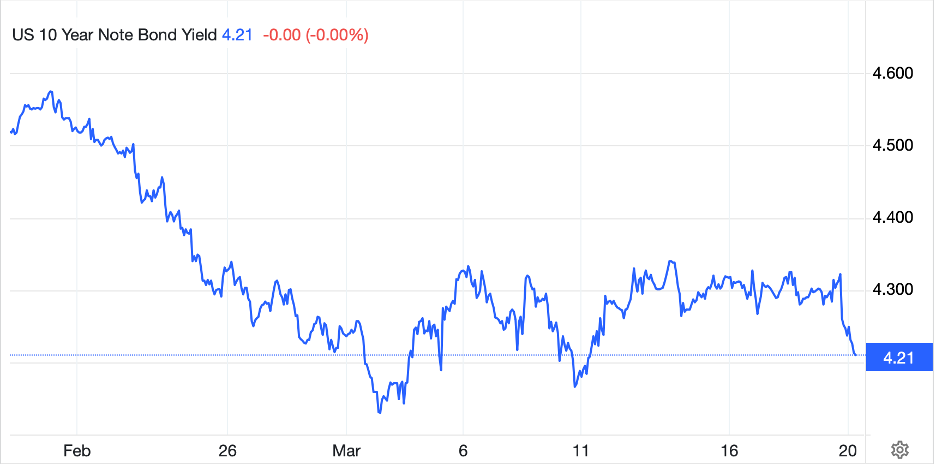
In the bond market, Treasury yields are lower by a further -4bps this morning and down to 4.20%, still well within the recent trading range (see chart below).  As to European sovereigns, they too are lower by between -3bps and -5bps, as despite concerns over potential new issuance, fear seems to be today’s theme.  Oh yeah, JGB yields are still pegged at 1.50%.

Source: tradingeconomics.com

In the commodity bloc, oil is little changed this morning, and net, on the week little changed as well.  It is difficult to see short-term drivers although I continue to believe we will see it drift lower over time as supply continues apace while demand, especially in a slowing growth scenario, is likely to ebb.  Gold (-0.6%) is having its worst day in more than a week, but the trend remains strongly higher.  Arguably a bit of profit taking is visible today.  This is dragging silver (-1.8%) along for the ride although copper (+0.1%) is sitting this move out.

Finally, the dollar is firmer again this morning, higher by 0.5% according to the DXY, with the biggest currency laggards the AUD (-1.1%), SEK (-0.8%) and ZAR (-0.75%).  But the dollar’s strength is universal this morning.  One possibility is that traders have decided Powell is not going to cut rates, hence more pressure on US equities, and more support for the dollar.  I don’t agree with that thesis, as I believe Powell really wants to cut rates, but for now, the other argument has the votes.

On the data front, we get the weekly Initial (exp 224K) and Continuing (1890K) Claims as well as the Philly Fed (8.5) all at 8:30.  Then at 10:00 we see Existing Home Sales (3.95M) and Leading Indicators (-0.2%).  Also, at 8:00 we will get the BOE rate decision, with no change expected.  However, as I have been explaining, central bank stories are just not that important, I believe.  Investors in the UK are far more worried about the Starmer fiscal disaster than the BOE.

There are no Fed speakers on the schedule today, so, I suspect it will be headline bingo.  While the dollar has outperformed for the past two sessions, I continue to believe the trend is lower for the buck and higher for commodities.  Perhaps today is a good day to take advantage of some dollar strength for payables hedgers.

Good luck

Adf