A Loose Upper Bound

One percent is now
A loose upper bound, rather
Than a key level

Yen participants
Saw a signal to sell.  Is
Intervention next?

Below is what appears, to me at least, to be the critical comment from the BOJ after last night’s policy meeting.  As well, that graphic comes straight from the BOJ presentation.

“It is appropriate for the Bank to increase the flexibility in the conduct of yield-curve control, so that long-term interest rates will be formed smoothly in financial markets in response to future developments.”
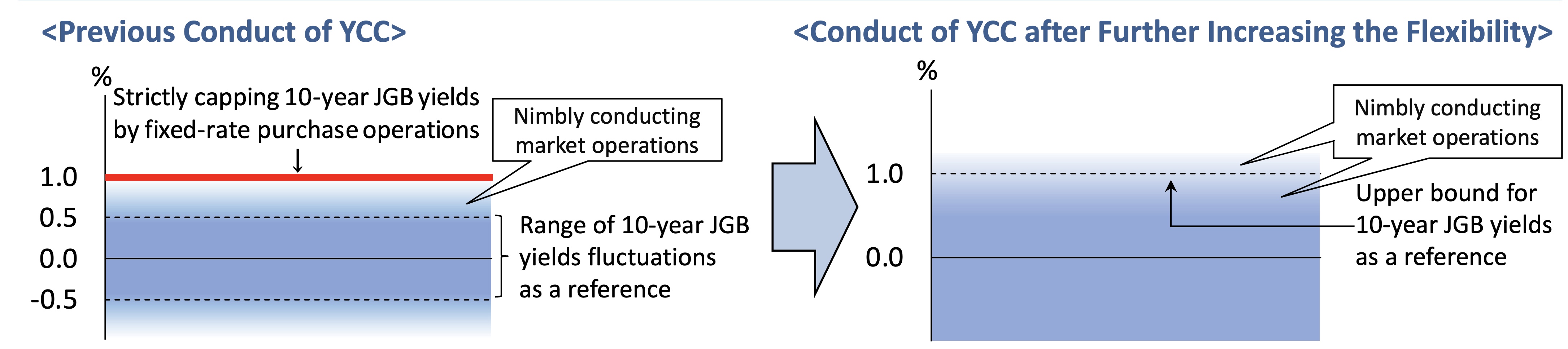
The essence of this is that YCC as we knew it, where the control part was the key, is now dead.  Instead, Ueda-san is going to allow a great deal more leeway for the market to determine the yield on the 10-year JGB, and the entire yield curve there.  While they have not yet adjusted the policy rate, which remains at -0.10%, I imagine that change is only a matter of time.  Remember, though, the BOJ currently owns somewhere around 56% of the outstanding JGBs in the market.  It is very clear they are not going to sell any.  To me the question, which I did not see answered last night, is whether they will replace the bonds in their portfolio when old ones mature.  There was no mention of QT, but I guess we will have to see.  Based on their history, however, I would expect that the current balance of JGB’s they own will remain pretty constant going forward, at least on a nominal basis.  Given the Japanese government continues to run deficits, that will eventually reduce the percentage of holdings.  Of course, I suspect that this is subject to change if things get politically uncomfortable, but we shall see.

The market response was somewhat counter to what might have been expected.  Arguably, many were looking for a yen rally as higher yields in Japan would create a greater incentive for Japanese institutional investors to bring their money home.  But that is not what happened at all.  This morning, USDJPY is firmly above 150.00 with no hint that there is intervention coming anytime soon.  It seems, at least for now, that the MOF and BOJ are going to allow markets to find a new level by themselves.  If that is the case, I expect that USDJPY is going to revert to form and follow USD interest rates.  In fact, that is really the key, and something about which I have written in the past.  When the Fed turns their policy toward easier money, at that time the dollar will come under significant pressure.  However, until then, the dollar remains the place to be.

In China, the data has shown
The ‘conomy’s not really grown
Will Xi add more cash
To try for a splash
Or will he leave things on their own?

The other news overnight was from China where their PMI data proved weaker than expected for both manufacturing and services with the former falling back below the key 50.0 level at 49.5 and the latter falling to its lowest print since last December during the zero-Covid policy Xi had implemented.  It seems that slowing growth around most of the world plus a limited domestic economic impulse combined with the ongoing collapse of the Chinese property market is just too much to overcome right now.  Expectations are that Xi will agree to yet more stimulus (remember earlier this month they put forth a CNY 1 trillion (~$137 billion) plan, but that has not seemed to have had the desired impact.  At least not yet.  While Japanese equities rallied on the back of the BOJ activity, Chinese equities came under pressure, especially the Hang Seng (-1.6%) although mainland shares fell as well.  As to the renminbi, it continues to grind lower (dollar higher) and remains pegged at the 2% boundary vs. the PBOC’s daily fixing rate.  Nothing has changed my view of further weakness in the renminbi going forward, at least as long as the Fed retains its current policy stance.

If I were to sum up the situation in Asia at this time, I would suggest that the two major economies there are both very busy dealing with substantial domestic economic questions, although those questions are different in nature.  Japan is trying to come to grips with rising inflation absent substantial economic growth while China has a problem defined by weakening growth with inflation not a current issue.  But lack of growth is the common denominator here and as we have seen countless times around the world, I suspect we will see further fiscal stimulus in both nations before long.  

Of course, when it comes to fiscal stimulus, China and Japan are mere pikers compared to the US which has completely rewritten the record books on this matter.  And there is nothing that indicates the US is going to back off, at least while the current administration is in place, and likely the next regardless of the letter after the president’s name.  

On this subject, though, while yesterday I described the QRA as critical, the first part of the Treasury story was revealed yesterday morning when they announced that the funding requirement for Q4 would be $776 billion, some $75 billion less than the consensus estimates before the announcement.  But the key difference was that Secretary Yellen is aiming for an average TGA balance of “only” $750 billion, far less than some estimates of $1 trillion, and less than the current balance of $835 billion.  In fact, the difference between the current balance and the target is what makes up for the difference in the issuance estimates.  Under no circumstances should anyone believe that fiscal prudence is coming soon.

But this lower number has relieved some pressure in the bond market where we have seen yields slide a few more basis points this morning with the 10-year now trading at 4.83%.  This movement has been followed by the European sovereign market, where yields have fallen by between 4bps and 6bps across the board in sympathy.  In fact, the only major market that saw yields rise was the JGB market, where the 10yr yield is now at 0.93%, up 5 more bps from yesterday’s closing levels.  I suspect that we will be trading at 1.00% soon enough, and it will be quite interesting to see just how ‘nimble’ the BOJ will be if yields start to run higher more quickly.

As to equity markets, yesterday’s US rally has been followed by the European bourses, all up between 0.6% and 1.2% despite somewhat soft economic growth data released this morning.  However, Eurozone inflation data was also slightly softer than forecast and it seems traders are looking for the ECB to reverse to rate cuts sooner rather than later.  US futures, meanwhile, are very marginally firmer this morning as all eyes now turn toward tomorrow afternoon’s FOMC outcome.

Oil prices have bounced a bit, up 0.9%, but this seems to be a trading move rather than anything either fundamental or geopolitical.  Regarding the latter, the fact that the beginnings of the Israeli ground invasion of Gaza have not produced nearly the pyrotechnics feared, nor that the conflict has spread throughout the Middle East, at least not yet, has resulted in traders returning their attention to inventories and demand.  Slowing growth in most places around the world is likely the key driver right now.  As to gold, it has maintained its recent gains and is trading right at the $2000/oz level.  Clearly, there is a fear factor there, but remember, if the equity bulls are correct and the Fed is going to tell us they are done, that will be seen as dovish and we should see a reversal in the dollar, a rally in commodities, including gold, and an initial rally in stocks and bonds.  That is not my base case, but you cannot ignore the possibilities.

Finally, the dollar is best described as mixed today as the strength in USDJPY (+1.1%) has been offset by weakness in the greenback vs the euro (+0.4%) and the pound (+0.2%), as well as a number of EMG currencies (MXN +0.4%, PLN +0.5%, ZAR +0.6%).  If one considers the DXY, that is virtually unchanged on the day.

On the data front, this morning brings the Employment Cost Index (exp 1.0%), Case Shiller Home Prices (1.6%), Chicago PMI (45.0) and Consumer Confidence (100.0).  obviously, there are no Fed speakers as their meeting starts this morning and runs through tomorrow afternoon when we will see the statement and Powell will meet the press at 2:30.  

It seems to me like traders will be cautious ahead of the FOMC tomorrow.  I would think they would want more confirmation that the Fed has finished before running back into bonds as well as reversing the recent stock declines.  While the Fed is unlikely to do anything tomorrow, it will be all about the statement and press conference.  Til then, I suspect a quiet time.

Good luck

Adf
A Havoc Nightmare

While real wages fall
Kishida’s polls fall faster
Will Ueda act?

The first big thing this week is tonight’s BOJ meeting where many in the market are anticipating another tweak to the current YCC framework.  I have seen several analysts calling for a widening of the band to +/- 1.25% from the current +/- 1.00%.  While current yields have yet to reach the cap, they continue to grind higher and are currently at 0.88%, new highs for the move.  Ironically, it is likely the BOJ will need to buy even more JGB’s if they make an adjustment as the wider band would give the green light for speculators to short bonds even more aggressively.  Recall, since they widened from 0.50% to 1.00%, there have been at least five unscheduled bond buying episodes by the BOJ, with the last one, just a week ago, being the largest to date.

One thing to remember about the BOJ is that the concept of central bank independence is not as strong in Japan as it is, perhaps, elsewhere in the Western world.  (Of course, it is not that strong elsewhere either, but Japan is closer to China on this front than the US).  At any rate, the most recent polls in Japan show that PM Kishida’s approval ratings have fallen to new lows for his tenure, with an approval of just 33% according to the most recent Nikkei poll.  And this was after the announcement that he was cutting taxes to help people deal with the consistently rising inflation in Japan.  While it has not grown to levels seen in the US or Europe, it is clearly far higher than they have seen there in more than a generation.

But it doesn’t seem to be enough.  Now, there is no requirement for an election until sometime in 2025, but that doesn’t mean Kishida-san won’t feel the pressure to do more.  And arguably, one of the things they can do to fight inflation is raise rates and see if the yen can recapture some of the 35%+ that it has declined over the past two years.  

So, will they act?  My one observation on this is that unlike the Fed, which never likes to surprise the market, the BOJ has figured out that they only way they can have an impact is if they do surprise the market.  Given that an increasing number of people are starting to look for this outcome, I think the probability of a BOJ policy change tonight is quite low.  I would not be surprised, if I am correct, to see USDJPY head back through 150 and start to grind to new highs above the 152+ peak seen just before the intervention last year.

Meanwhile, for the rest of the week
Both meetings and data might wreak
A havoc nightmare
So, traders, beware
Of comments or data that’s bleak

Beyond tonight’s BOJ meeting, the week is jam-packed with other potential market moving catalysts between central bank meetings (FOMC on Wednesday, BOE on Thursday) and important data including ISM (Wednesday) and NFP on Friday.  However, there is one other thing set to be released Wednesday morning, well before the FOMC announcement and that is the Quarterly Refunding Announcement (QRA).  While, as its name suggests, this is released every quarter, it has generally been relegated to the agate type of market information as a technical feature for bond traders.  But this time, it has gained far more interest given the combination of the bond market’s performance since the last QRA (yields are higher by 80ish basis points) and the fact that the government budget deficit is continuing to grow with many new forecasts for a $2 trillion deficit this year thus a need for even more borrowing. 

Back in August at the last QRA, the Treasury increased issuance more than anticipated which has been seen as one of the drivers of the recent bond market decline.  If they were to increase it significantly again, there is certainly concern that bond yields can move much higher still.  Now, the Treasury could issue more short-term T-bills to take pressure off the bond market but bills already represent about 22% of the total debt outstanding.  That is a couple of points higher than the top of the historic range of 15%-20% and may be seen as a point of contention.  The positive is that given T-bill yields are all above 5.3%, there will be plenty of demand for their issuance.  However, on the flip side, that means that refinancing will need to occur far more frequently and that makes it subject to market dislocations and disruptions.

Another key part of the discussion will be just how large Secretary Yellen wants to keep the Treasury General Account (TGA), which is the government’s ‘checking’ account at the Fed.  As of Thursday, it held $835 billion and there has been talk she wants to increase it to $1 trillion to make sure the government has ample liquidity going forward, especially if there is another issue regarding government financing in Congress.  Historically, the Treasury has issued bills when they are seeking to build up balances in the TGA, which would tend toward seeing even more bills issued rather than substantial growth in the longer-dated maturities.  All in all, it is possible the QRA is going to have the largest potential impact on markets this week so beware.

In truth, the overnight session has been somewhat dull.  While the Israeli-Palestinian situation has seemed to enter a new phase regarding Israel’s incursion into Gaza, markets are non-plussed over the matter with bond yields little changed across the board, the dollar little changed across the board and oil prices sliding (-1.5%) this morning.  Even gold (-0.6%), which has been the best performer in the wake of the middle east crisis, has slipped back below the $2000/oz level, although remains higher by almost 10% in the past month.

In fact, the one area where things are moving is in equity space where we are seeing gains across the board in Europe, somewhere between 0.5% and 1.1%, in the major bourses as inflation data there showed that price rises have begun to slow down and Germany’s economy “only” shrunk by -0.1% in Q3, a much better than expected outcome!  US futures are also higher at this hour (7:15), up by 0.5% or so after a pretty awful week last week.  In fact, the only real outlier was Japan where the Nikkei slid -0.5% as Chinese shares were stronger along with most of the APAC markets.

As mentioned earlier, though, we do have a lot of news coming out this week so let’s go through it here:

TuesdayBOJ Rate Decision-0.1% (unchanged)
 BOJ YCC+ / – 1.00% (unchanged)
 Case Shiller Home Prices1.6%
 Chicago PMI45
 Consumer Confidence100
WednesdayADP Employment150K
 QRA$114 billion (+$11 billion)
 ISM Manufacturing49.0
 JOLTS Job Openings9.2M
 Construction Spending0.4%
 FOMC Decision5.5% (unchanged)
ThursdayBOE Decision5.25% (unchanged)
 Initial Claims210K
 Continuing Claims1795K
 Nonfarm Productivity4.0%
 Unit Labor Costs0.8%
 Factory Orders1.9%
FridayNonfarm Payrolls188K
 Private Payrolls145K
 Manufacturing Payrolls0K
 Unemployment Rate3.8%
 Average Hourly Earnings0.3% (4.0% Y/Y)
 Average Weekly Hours34.4
 ISM Services53.0

Source: tradingeconomics.com

So, as you can see, there is a lot of stuff coming our way starting tonight in Tokyo.  What that tells me is that we are not likely to see very much movement today as traders and investors await the plethora of new information that is due.  However, by the end of the week, we could have a very different narrative.  

Good luck

Adf

A Rough Week

Investors have had a rough week
As both stocks and bonds sprung a leak
The hope is, today
The data will say
Inflation is well past its peak

The thing is, Q3’s GDP
Described a robust ‘conomy
Will that push the Fed
When looking ahead
To restart their tightening spree?

I imagine most of us are a little tired of the negativity in markets on a daily basis of late.  Yesterday was just another in a series of negative equity market sessions with the US indices declining between -0.75% (DJIA) and -1.75% (NASDAQ).  And this happened despite (because of?) a significantly higher GDP report than most analysts had forecast.  The print, 4.9%, was truly impressive and it was accompanied by stronger than expected Durable Goods orders (4.7%) and continuing solid Initial Claims data (210K).  In other words, the data points to a robust US economy which, one might conclude, would be a positive for risk assets.  One would be wrong.

It seems there are many possible explanations for this seeming conundrum although I favor the following: ongoing elevated interest rates are putting pressure on earnings multiples and driving them lower.  The fact that GDP growth remains robust implies the Fed will be in no hurry to cut rates thus maintaining its higher for longer attitude for even longer.  In this situation, the discount cash flow model, which underlies much, if not most, stock market analysis, tells us that companies growing at 10% cannot be valued at 50x earnings, the math just doesn’t work.  Hence, despite solid performance, investors are rerating the value of these companies lower.  The bigger problem is that the current market multiple remains well above its long-term average so there is further, potentially, to fall.

One other thing to note regarding the economy is that it is quite common for there to be very strong quarterly GDP prints just before a recession begins.  Clearly yesterday’s number was quite strong, in fact the strongest (excluding the post-covid rebound) since Q1 2014.  However, that does not preclude the fact that we may still be headed toward a recession.  Now, arguably, a recession, or at least if the data starts to look like a recession is upon us, would get the Fed to change their tune and consider relaxing their current policy stance.  However, recessions tend to come with much lower earnings and historically are not that good for risk assets either.  It is this concern that has so many praying calling for a soft landing.  Alas, I would not wager on that outcome.

I think it is important to remember that market movements do not have to be driven by outside catalysts but can happen of their own volition.  In fact, that is my point on the rerating of market multiples.  This can occur regardless of any data, whether good or bad.  If the investor community is becoming nervous, and if there is an alternative like we have today with short-dated Treasuries yielding 5% or more, equity prices can decline much further around the world, whatever their current valuations are.  While we all try to rationalize movements in the markets after the fact, on any given day, no specific catalyst is needed from outside the market itself.

With this in mind, though, the rest of the world has not followed yesterday’s US market lead and instead we have seen a rebound in Asian shares with the Hang Seng (+2.1%) leading the way but the rest of the space mostly higher by at least 1%.  European bourses are more mixed with a combination of mostly small gains and losses although the CAC in Paris is an outlier (-1.0%).  US futures, though, are mostly in the green with the NASDAQ the leader (+0.6%) at this hour (7:45).

The bond story, though, is quite interesting as there has been a great deal of volatility in this space of late.  You may recall that I mentioned the abysmal 5-yr auction on Wednesday.  Well, yesterday the Treasury auctioned 7-year paper and the results were outstanding with the best bid-to-cover ratio since March 2020.  This led to a major rally in the bond market with yields continuing their yoyo movement and falling 14bps although this morning they are bouncing from those levels and are higher by 3bps.  European sovereigns did not come along for the Treasury ride yesterday showing much less movement and this morning they are edging lower by between 1bp and 3bps. This is in the wake of yesterday’s ECB meeting where Madame Lagarde left policy on hold for the first time after eleven consecutive rate hikes, and tried to explain that they would be completely data dependent for the time being.  Not for nothing but the recent data from Europe looks pretty awful, so if that is the case, I would expect to see cuts on the horizon there.

Volatility continues apace in the oil market as well with yesterday’s decline followed by 1.5% rally this morning.  It seems that yesterday’s story about a potential de-escalation of the Israeli-Palestinian crisis was trumped by news that the US had bombed several sites in Syria in response to attacks on US bases in Iraq last week.  Ostensibly these sites are controlled by Iranian proxies indicating the possibility of a widening conflict in the Middle East.  I suspect that we are going to continue to see volatility here, but net, the structural issues remain beneficial for oil in my view.  As to gold, it is little changed this morning and simply maintaining its recent gains as fear continues to be a market driver right now.  Base metals were clearly cheered by the strong US data as both copper (+1.1%) and aluminum (+0.25%) are firmer this morning.

Looking at the dollar, it should be no surprise that it continues to perform well overall.  Between the risk issues and the strong economic data, the US certainly seems a better place to put your money than most others right now.  USDJPY continues to trade above 150 but is not running away and there is no indication the BOJ has been involved at all.  The euro keeps pushing toward 1.05 and the pound looks like it is headed down to 1.20 soon.  USDCNY is back near its recent highs as the perceived benefits of Chinese fiscal stimulus are not seen as yuan positives at this point, especially given the divergence between US and Chinese monetary policy.  It is very difficult, at this time, to come up with a reason for the dollar to decline in any substantial way.

On the data front, this morning brings Personal Income, (exp 0.4%), Personal Spending (0.5%), and the all-important Core PCE (0.3%, 3.7% Y/Y) with Michigan Sentiment (63.0) coming later at 10:00.  At this point, all eyes remain on the FOMC meeting next week where there is essentially no expectation of a rate move.  We would need to see a REALLY hot PCE number this morning to change that.  As such, I expect that a consolidation in risk markets is quite possible with little movement in the dollar overall.  Beware, however, if stocks sell off later today as that could be a tell that there is more pressure to come.  I clearly recall that the Friday before Black Monday in October 1987, stocks sold off aggressively, just not as aggressively as they did on the Monday!.

Good luck and good weekend

Adf

Many More Pains

Reporting of real GDP
Is what most investors will see
But nominal data
Is what could create a
New narrative reality

Combining both growth and inflation
This number could be the foundation
For further yield gains
And many more pains
Inflicted on stock adoration

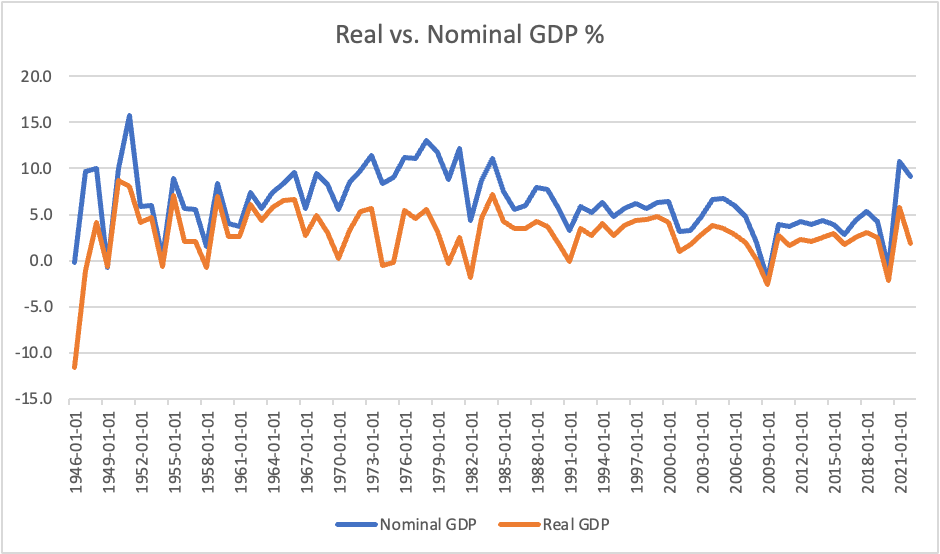
After another lousy day in the equity markets, today the first Q3 GDP data will be released.  The current consensus forecast is for a 4.3% gain while the Atlanta Fed’s GDPNow number is up to 5.4%.  And that’s the real GDP (rGDP) number, which removes inflation from the discussion.  However, given all that is ongoing, it may be worthwhile to take a look at nominal GDP (nGDP), which is simply the change in total activity including price changes and economic output.  As you can see from the below graph (data source, FRED database), in the post-WWII era, we’ve had 10 periods where rGDP fell below zero, better known as recessions, but only 3 periods where nGDP was negative, with the GFC in 2009 being the worst at -2.0%.  The gap between the two lines is inflation, and you can also see how that has ebbed and flowed over time.

But turning to the current period, it is noteworthy that in the wake of the GFC, which was rightly called the worst financial crisis since the Great Depression and up through the Covid recession in 2020, nGDP had been pretty modest overall.  In fact, a quick look at the data shows that the average nGDP during that decade was just 3.4%.  This compares quite unfavorably with the long-term historical average of 6.4% since 1946.  Looking at rGDP data, the average between the GFC and Covid was just 1.8%, again comparing quite unfavorably to the long-term growth of 2.9%.

The thing is, we have all gotten quite used to that economic environment of slow growth and low inflation and there are many professional investors, let alone non-investment professionals, who believe that is the way the world works.  Well, let me tell you, that was the exception, not the rule.  Instead, if you look at the very right side of the chart, you can see that both nGDP and rGDP have risen sharply in the wake of the Covid recession as the deluge of fiscal spending combined with, first supply chain constraints and now reshoring/deglobalization efforts, has changed the framework.  In fact, I would contend that it is in the government’s best interest to continue down this path of high nominal growth and high inflation in order to try to outgrow the increase in debt.  After all, if nGDP can grow faster than the fiscal deficit, the real value of US debt will ultimately decline.  Of course, while it would be fantastic if the bulk of that high growth was a function of gains in productivity and high real growth, the FAR more likely outcome will be persistent high inflation.

What does this mean for markets?  As we have seen over the past several sessions, equities can quickly come under pressure in this scenario, and I believe they have further to decline.  While top-line revenues can continue to grow, the problem will come from a market that is going to derate the market multiple, especially in the tech sector, from its current nosebleed levels.  High inflation will also continue to press on bond prices and the value of the long-term 60/40 portfolio is likely to continue to be eroded.  In my view, the best place to hide will be in commodities as during inflationary periods, they tend to hold their value.

An anecdote from my early days in trading is that bond traders used to believe that the “natural” yield for 10-year Treasuries was right around nGDP.  If yields rose above that level, bonds were probably a buy, and below that level, they would have a short bias.  Nominal GDP for the past two years has been 10.7% in 2021 and 9.1% in 2022.  On this basis, there is considerably further for bond prices to fall and yields to rise.  Something to keep in mind as the talking heads work to convince you to catch the falling knife that is the bond market.

Ok, so how have things behaved ahead of today’s data, and ahead of the ECB’s rate decision this morning?  Equity markets around the world have been under pressure with the Nikkei (-2.1%) leading the way as most regional markets fell sharply, notably in South Korea and Taiwan, although Chinese shares held their own on the back of still more stimulus promised by the government there.  It is clear that President Xi is growing increasingly worried about the financial situation at home.  In Europe, we are also seeing weakness, with red across the screen on the order of -1.0% or more and US futures are also pointing lower at this hour (7:30) down by -0.75% or so across the board.

Bond markets are little changed this morning with most seeing yields creep very slightly higher, maybe 1bp or so, but that is after another bond sell-off yesterday which saw Treasury yields continue their rebound from Monday’s sharp drop.  As I type, we are back at 4.97% on the 10-year and the curve inversion is down to -15bps.  As an FYI, the 2yr-30yr curve is back to flat now and I expect it is only a matter of days before the 2yr-10yr is there as well.  Yesterday’s 5yr auction was particularly poorly received with a very wide tail and concern is growing that will be the case for all coupon auctions going forward.  Yields are heading higher folks.

Oil prices are falling this morning, down -1.8%, which has basically reversed yesterday’s rally.  EIA data showed inventory builds and it seems the longer Israel holds off on its ground invasion of Gaza, the more people are willing to believe that there will be no escalation.  However, gold prices continue to rally, up another 0.4% this morning and getting ever closer to the $2000/oz level.  Meanwhile, this morning, ahead of the GDP data, both copper and aluminum are in good spirits and rising.

Finally, the dollar is clearly back in the ascendancy with USDJPY finally breaking through that 150.00 level with no sign of intervention yet, while the euro is pressing back toward 1.05 and the pound is below 1.21.  We are seeing strength across the board for the greenback, against both G10 and EMG currencies as the yield story continues to be the driver.  As to the ECB today, expectations are for no change in policy, and the real question will be whether Madame Lagarde can maintain a hawkish bias, or if the obvious weakening in the data will reveal her inherent dovishness.  If it is the latter, look for the euro to break below 1.05 before tomorrow’s close.

In addition to the rGDP data (exp 4.3%), we see Initial (208K) and Continuing (1740K) Claims as well as Durable Goods (1.7%, 0.2% ex transports).  The ECB Press conference starts at 8:45 and will be carefully watched.  Yesterday’s New Home Sales data was much stronger than expected and the BOC left rates on hold with a hawkish commentary, although the CAD was unable to gain much in the wake.  The world continues to point to higher yields to fight structural inflationary pressures.  At the same time, the dollar will retain its status and remains in demand.  While it may not rally that sharply, I see very little case for any substantive weakness in the near and medium term.

Good luck

Adf

Bad Dreams

In China, the property bubble
Continues to cause Xi much trouble
So, they will add on
A trillion more yuan
Of debt, as help efforts redouble

And though Chinese markets did rise
They finished well off of their highs
Investors, it seems
Are having bad dreams
‘bout growth there and seek to downsize

Poor President Xi!  Instead of focusing all his energy on his saber rattling in the South China Sea and hinting at a Taiwanese invasion, he finds himself essentially forced to deal with the economy.  This was made clear yesterday when he made a surprise visit to both the PBOC and the SAFE (State Administration of Foreign Exchange), the two top Chinese financial institutions, and then today when the government announced an effective supplemental budget spend of CNY 1 trillion (~$137 billion) to support further infrastructure investment in the country.  

This move will increase the national government’s budget deficit for the year to 3.8%, well above the 3.0% target they had been shooting for, but obviously, the concern of continuing slow growth is being seen as a growing problem for Xi.  This is also a change from the previous process where local governments would issue debt to fund infrastructure investment and ultimately repaid that debt by selling land.  Of course, that is what led to the inflation of the massive property bubble in China, so that model is now clearly broken.

Arguably, the biggest worry is that if the domestic situation continues to deteriorate, Xi will get more adventuresome internationally as the standard national leadership political playbook is to seek to distract the population from the economic failures of a government by stoking nationalism and instigating conflict overseas.  We just saw it in Russia, and quite frankly, given the support for intensifying the war effort in the US, it is also being executed here in the US.

In the end, though, a 0.8% of GDP budget boost is unlikely to have a huge impact on the economy.  The problem the Chinese have is that they, too, have a very high debt level and are trying quite diligently to prevent it from growing out of hand.  The tradeoff there is that the amount of support is going to be restricted.  Initial economist estimates are that the package will raise GDP growth by 0.1% in Q4 and up to 0.5% in 2024 overall.  

It can be no surprise that shares in China rose on the news with the Hang Seng jumping 2.5% on the news while the CSI 300 jumped 1.3% initially.  However, both faded fast and closed higher by about 0.5%, not bad, but certainly not a huge vote of confidence.  Meanwhile, the yuan just continued is weak performance, falling another 0.2% and continuing to push against its 2% band vs. the daily CFETS fixing.

Away from that news, however, it has been dullsville this morning with pretty modest movement across both equity and bond markets around the world.  Yesterday’s PMI data indicated that the massive amount of fiscal stimulus that has been enacted in the US compared to elsewhere in the world is having the desired impact, at least from a statistical point of view, as US data continues to show relative strength compared to Europe, Japan and the rest of the G10.  However, despite those efforts, the political accolades remain absent as the national attitude is consistently measured in downbeat terms. 

And consider, if the data here are relatively better and the government is not gaining any ground, how bad it is for governments elsewhere in the world where the data is clearly worse and falling.  We continue to see populist parties from both sides of the aisle gaining in strength.  Do not be surprised to see quite a few new governments around the world over the next several years as support for incumbents continues to fall.  (It will be quite interesting to see the results of the Argentine election in a few weeks and see how Javier Milei, the upstart “anarcho-capitalist” who has promised to take a chainsaw to the government and shutter the central bank while dollarizing the economy, performs.)  A victory there could well be a harbinger of future shakeups everywhere.

Turning to markets, yesterday’s solid US performance was ultimately followed by 0.5% ish gains in China and Japan, although weaker performances elsewhere in Asia with a number of regional markets declining.  European bourses are showing very modest gains this morning, on the order of 0.1% while US futures are mostly softer at this hour (8:00), down roughly -0.4%.

The massive reversal in bonds seen on Monday is now history and we are seeing yields begin to creep back higher with Treasury yields up 3bps and similar rises throughout Europe, although Italian BTPs are the true laggard with yields there rising 6bps.  JGB yields also rose 2bps last night but have been largely capped at 0.85% by the market as there was no sign of extra intervention by the BOJ.  The yield curve inversion remains at -24bps, not quite at its tightest levels but still clearly trending toward normalization.

One thing to consider about the Treasury market is the fact that the US trade deficit has been steadily shrinking amidst the efforts at reshoring and all the CHIPS act spending on manufacturing capacity, as well as the simple fact that US energy exports continue to be quite robust.  The point is that one of the key demands for Treasury bonds in the past was the recycling of all those deficits, but if the deficits shrink, then there is less to recycle and therefore less demand for Treasuries.  Combine this process with the fact that the government continues to increase the amount of issuance and it is not hard to conclude that bond yields have further to rise over time.  The fact that an oversold market responded to a major psychological level does not mean the bond market move has ended.  Rather I would argue it has simply paused and yields will once again climb going forward.

Turning to the commodity markets, oil is marginally higher this morning, up 0.3%, but that is after another sharp decline yesterday as the market appears to believe that the odds of a widening of the Israeli-Palestinian conflict are shrinking amid growing pressure from organizations around the world.  Add to that the signs of weaker economic activity which implies reduced demand, and it is easy to understand why oil has retraced. However, inventories fell again last week, and the structural issues of supply remain in place.  The big picture remains for further strength over time in my eyes.  As to the metals markets, gold continues to benefit from its haven status, edging higher by 0.25% this morning while copper is suffering on the weaker growth story, falling -0.4%.

Finally, the dollar is stronger overall with the euro > 1% lower than its recent highs Monday afternoon which were seen in the wake of the bond market rally that day.  USDJPY is right back below 150.00 although it has not yet touched the level since early this month which was followed by what appeared to be intervention.  But generally, we are seeing the dollar gain against both G10 and EMG rivals as US rates once again edge higher, 2yrs as well as 10yrs.

On the data front today, New Home Sales (exp 680K) are due at 10:00 as well as the Bank of Canada rate decision where no change is expected.  We also see EIA oil inventory data later this morning and then Chairman Powell speaks late this afternoon.  I continue to believe it is unlikely that he will add anything to his message from last week.  As such, it is a status quo day.  If yields continue higher, look for the dollar to follow.  But I have a feeling that there will be very little movement today overall.

Good luck

Adf

Waved Adios

There once were two gents, both named Bill
Whose market views oft could be shrill
Now Ackman and Gross
Have waved adios
To shorts, with positions now nil

When others all learned of this action
The bond market really gained traction
So, does five percent
In truth, represent
The highs? Or is this a distraction?

It ought to be no surprise that the bond market had a significant hiccup yesterday after the 10-year yield finally breached the 5.0% level for the first time in more than 15 years given the market’s penchant to focus on big round numbers.  However, as can be seen in the chart below, the response by traders and investors was dramatic as it appears many were waiting for that level to ‘buy the dip’ in bonds.  As such, after climbing to a high of 5.025%, the market reversed sharply with yields falling nearly 20bps at one point, although they closed slightly off the lows.

Source: Tradingeconomics.com

Ostensibly, a key driver of this move was a Tweet by hedge fund manager Bill Ackman explaining he had covered his bond short positions.  “We covered our bond short.  There is too much risk in the world to remain short bonds at current long-term rates. The economy is slowing faster than recent data suggests.”  Similarly, former bond king, Bill Gross, tweeted that he was buying bonds across the curve after calling for a recession in the 4th quarter (that’s now!).  And that’s all it took to reverse a substantial portion of the recent sell-off in Treasuries.  Perhaps more interesting was the fact that the ongoing normalization of the yield curve was not impacted much at all.  Yesterday, the 2yr-10yr spread had fallen to -18bps and this morning it is -22bps, so not all that different.

The question, of course, is what can we expect going forward?  The thing that continues to bother me is the ongoing supply question, and at what price will the Treasury be able to sell new bonds to price sensitive buyers rather than the Fed.  Nothing has changed that part of the equation and until the Fed ends QT, let alone restarts QE (which I do expect at some point in the future), I continue to believe bond yields will trend higher.  And this view considers the fact that some further economic slowing seems highly probable to me.  However, the supply issue is going to continue to be the dominant feature going forward.

One other issue is the ongoing Israeli-Palestinian conflict and how that could evolve, with many talking heads concerned that growth in that conflict will result in demand for more safety.  Certainly, the gold price has been a huge beneficiary of that situation with the barbarous relic having gained more than $120/oz in price since the attack while bond yields are actually higher by 6bps, even after yesterday’s sharp decline in yields.  However, my experience indicates that after the immediacy of any conflagration, whether Russia in Ukraine, or even 9/11, market behavior tends to move off that narrative and back to whatever was deemed relevant before the news.  I see no reason for this to be different, and before the attack, yields were rising on the supply story and robustness of the US economy.  That is the narrative that needs to change to reverse bond yields.

So, is there going to be a change in that narrative soon?  Well, depending on one’s view of the value of PMI data, the flash releases this morning were all pretty crummy with all of Europe and the UK remaining below the key 50.0 level and last night’s Australian and Japanese data also quite weak, although Japanese Services data did manage to hold above the 50.0 level.  As well, German GfK Consumer Confidence fell to -28.1, down from last month and below consensus expectations, so perhaps some economic weakness is coming our way.  

However, first, those are not US numbers and second, the US data has consistently shown hard data (NFP, Retail Sales, IP, etc.) firmer than any of the survey data.  So, while there continues to be gloom and doom on people’s minds, their actions have not yet matched those views.  Now, a case can certainly be made that the US hard data is all lagging and the current situation is far worse than those numbers imply, but the Fed is not going to respond to that story.  As long as the hard data offers cover for the Fed to maintain their current policy stance as they fight inflation, they are going to do so.  

Summing it all up leads me to believe that nothing has changed the big picture.  While yesterday’s bond move was certainly exciting, the fact that one hedge fund manager took profits is not enough to change the investment landscape.  I continue to expect stickier inflation going forward as well as a grind higher in 10yr yields as the curve normalizes.  

So, how did markets respond to all the new information?  Well, after a mixed day in the US yesterday, we saw a similar picture in Asia with the Hang Seng falling -1.0%, but most other markets edging a bit higher.  European bourses are slightly firmer this morning, but really no great shakes and US futures at this hour (8:30) are firmer by 0.6% or so.  Fear is not that evident today.

On the bond side, this morning has seen a modest bounce in US yields, just 2bps, but we are seeing a continuation lower in Europe with most sovereigns seeing yields fall about 2bps.  JGBs have also edged away from their recent high in yields, although that was after the BOJ had yet another unscheduled bond buying session, this one the largest of the five unscheduled ones so far implemented after they adjusted the YCC cap to 1.00%.  

On the commodity front, oil is essentially unchanged this morning although that is after a sharp decline yesterday which wiped out the previous week’s gains.  Gold, while still holding up reasonably well, is softer by -0.4% this morning and copper is bucking this trend, rising 0.6%, although still hovering just above 1yr lows.

Finally, the dollar, which fell yesterday a bit as yields decline sharply in the US, is bouncing this morning with the euro sliding back toward 1.06 and the DXY back at 106.00.  Neither JPY nor CNY really responded to yesterday’s price action, it was mostly European currencies doing the damage to the buck.  One thing to note is the question of whether the 10-year yield is still a key driver of the dollar or is it something else?  Brent Donnelly, a well-respected FX analyst, has an excellent article out discussing how the dollar appears to be more linked to the 2-year yield than the 10-year.  I had mentioned last week how that relationship between the dollar and yields seemed to be breaking down and his analysis shows that if you look at the 2yr yield, which hasn’t moved much at all compared to the 10yr lately, it makes more sense.  It is well worth the read.

With that in mind, then perhaps the dollar’s strength is unlikely to manifest itself as it did while the Fed was aggressively raising rates earlier in the year and 2yr yields were rising rapidly.  Instead, it is quite possible we are in for a period of relative quietude in the dollar, at least against the majors.  Emerging market currencies have a clear life of their own, and hedging decisions there need to be independent of views on the euro or pound.

On the data front, the Flash PMI’s are due here as well (exp 49.5 Manufacturing, 49.8 Services) and then the first look at oil inventories late this afternoon.  Interestingly, despite the Fed’s ostensible quiet period, Chairman Powell will be making Introductory Remarks at the 2023 Moynihan Lecture in Social Science and Public Policy tomorrow at 4:30pm.  Given the quiet concept, I find it difficult to believe he will focus on monetary policy but be aware.

All signs point to a quieter session today and perhaps for a while going forward, at least in the G10 currencies.  However, hedging is always a good idea!

Good luck

Adf

Wrecked

There once was a Treasury note
Whose yield every trader could quote
Of late, its price dive
To yields above five
Has tongues wagging while bond bears gloat

Now, looking ahead I expect
This rise in yields could architect
More problems worldwide
As risk assets slide
And equity markets get wrecked

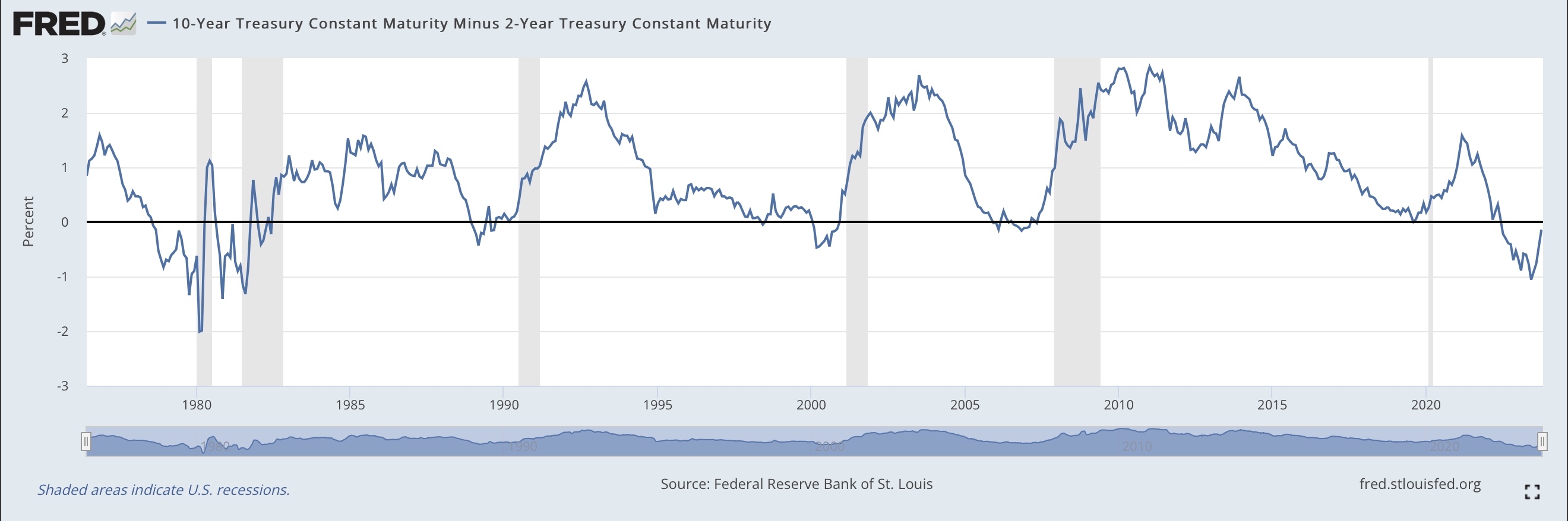
There is only one story in financial markets today, and that is the fact that the 10-year US Treasury note is now yielding above 5.0%.  We briefly touched that level last Thursday, and then saw a pullback in yields on Friday, but today there is no question about a breach of that key psychological level.  As a corollary to that price action, the 2yr-10yr spread is down to -12bps and looks quite clearly as though it is going to complete the normalization process this week.  The real question is, how much further will it steepen?  A quick look at the chart below from the St Louis Fed’s FRED database shows that the average steepness of this spread is somewhere around +100bps.  The implication is that if the Fed continues to hold Fed funds at their current level, and higher for longer is the way forward, then 10-year Treasury yields could easily head to 6.00% and simply be back to their long-term relationship with the 2-year Treasury.

The other thing to note is why there is so much focus on the shape of the yield curve.  As you can see from the shaded gray areas on this chart, every recession was preceded by a curve inversion (negative 2yr-10yr spread) but then when the recession was in process, the curve was steepening dramatically.  It is this history that has economists and analysts concerned given the speed with which the curve is steepening of late.

And yet…two headlines in the WSJ this morning show a completely opposite expectation.   A Recession is no Longer the Consensus is one of them, explaining a survey of economists now shows that fewer than half anticipate a recession will arrive at all, let alone soon.  In addition, we have The Economy was Supposed to Slow by Now.  Instead it’s Revving Up” which describes the fact that recent data has been firmer than expected (see Retail Sales and NFP earlier this month) and now the proverbial soft landing is the new consensus call.  

Now, maybe this time really will be different, but that is always a hard pill to swallow.  There are many things that continue to haunt the economy with respect to things like bank lending standards tightening and consumer debt and delinquencies rising, neither a sign of economic strength.  In fact, there was a terrific note published this weekend on Substack by GrahamsBenjamins going into more detail.  The point is that there is a significant amount of economic stress in the economy and that combined with the rapid steepening of the yield curve has always been a sign of a looming recession.  And folks, if (when?) that recession arrives, you can be confident that risk assets are going to decline sharply in value.  Just sayin!

Ok, with that cheery opening, let’s see how markets have behaved overnight.  Following last week’s lousy price action in the US, Asian shares were lower across the board, somewhere between -0.75% and -1.0% while European bourses are also lower, perhaps a little less dramatically, with an average decline on the order of -0.5%.  US futures, too, are in the red, -0.6% or so at this hour (7:15), and not feeling very good.

Meanwhile, we already know the Treasury story, but it is important to understand that European sovereign yields are also rising rapidly, with most of them higher between 4bps and 6bps this morning.  That critical Bund-BTP spread continues to trade just north of 200bps and holds the potential to be quite destabilizing if it widens much further.  As well, we saw JGB yields creep up 2bps and are now at 0.85%. Inflation in Japan has been above 3.0% for the past 14 months,  and more and more analysts are concluding the BOJ is going to have to tweak their policy yet again.  There is far more to the bond market than just Treasuries, although Treasuries are clearly still story number one.

On the commodity front, oil (-0.6%) is a bit softer this morning although this seems a consolidation of last week’s strength.  The biggest question in this market is the tension between the possible recession and a corresponding reduction in demand, and the structural supply shortages that are currently being exacerbated by the Saudi and Russian production cuts.  My money is still on higher prices over time.  Meanwhile, gold is little changed this morning, holding up quite well in the face of rising yields and seeming to be showcasing its haven status of late.  As to the base metals, both copper and aluminum continue to grind lower with copper having fallen to its lowest level in a year and seemingly an indication of economic weakness to come.

Finally, the dollar is mixed to slightly softer this morning although slightly is the operative word.  Looking across the G10 currencies, the Skandies are under a bit of pressure, but the majors are essentially unchanged.  The real news is that the correlation between the dollar and Treasury yields seems to be disintegrating.  If that is changing, then there are certainly many reasons to believe the dollar can decline given the US fiscal situation and the continuous growth in the US debt portfolio.  As is often said, nothing matters until it matters.  Throughout my entire career, spanning > 40 years, there has been a constant drumbeat of how the dollar should decline because of the massive budget and trade deficits that the US has run consistently.  And that drumbeat has been studiously ignored for all that time.  But perhaps, it will soon matter.  While that is not my base forecast, one has to assign that outcome some real probability.

On the data front this week, this is what we see:

TodayChicago Fed National Activity-0.16
TuesdayFlash PMI Manufacturing49.5
 Flash PMI Services49.9
WednesdayNew Home Sales680K
ThursdayInitial Claims209K
 Continuing Claims1720K
 Durable Goods1.5%
 -ex Transport0.2%
 GDP Q34.2%
FridayPersonal income0.4%
 Personal Spending0.5%
 Core PCE0.3% (3.7% Y/Y)
 Michigan Sentiment63.0

Source: Tradingeconomics.com

Weirdly, while the Fed is supposed to be in its quiet period, I see three speeches scheduled, with Chairman Powell ostensibly speaking Wednesday afternoon.  I will need to confirm that as it would be highly unusual at this time.

It seems to me the big question is whether the dollar – rates correlation is breaking down.  If that is the case, then I will need to rethink, and likely adjust, my views of a stronger dollar over time, at least vs. the majors.  But tick by tick price action is not necessary for the relationship to generally hold.  I still like the dollar over time but am certainly going to review the situation more closely to see if something truly has changed.

Good luck

Adf

Dim-Witted

Said Jay, though we’re strongly committed
To make sure no ‘flation’s permitted
Quite frankly we’re lost
And ‘fraid of the cost
If we screw up cause we’re dim-witted

So, we’ll watch the data releases
And act if inflation increases
But if it should fall
Then it will forestall
More hiking lest we step in feces

As expected, the Powell comments were yesterday’s highlights as he once again explained that the goal of 2% inflation remains their primary effort.  Not surprisingly, given what we have heard from the onslaught of Fed speakers over the past two weeks, he made clear that there will be no rate hike at the November meeting, but December is still in play.  When asked about the rise in long-term yields, he did indicate it could be doing some of the Fed’s work for them, just like we heard earlier this week from Lorrie Logan and others.  Somewhat surprisingly, he mentioned the rising budget deficits, describing them as on an “unsustainable” path.  Now, we all know this is true, but Powell has been extremely careful not to discuss government funding throughout his tenure as Chair.  I suspect his next testimony to Congress could be a little spicier!

Of course, the other six speakers added exactly nothing to the conversation as they merely reiterated in their own words the same message.  Perhaps of more interest was that despite effective confirmation that there was no hike upcoming and that the bar for a December rate hike was quite high, bonds continued to sell off with the 10yr yield closing at 5.0% while stocks took it on the chin again.  Methinks there is more than a little concern starting to grow amongst asset managers that the concept of the Fed put may finally be gone.  

The other really interesting outcome yesterday was the fact that gold rallied another 1.3% despite the ongoing rise in interest rates.  As there was no new news out of the Middle East of any real note, one possible explanation is that investors are simply getting quite scared overall.  

One thing is quite certain and that is if the situation changes such that Powell and company become concerned that the economy is reversing course and they have, in fact, overtightened monetary policy, any reversal of the current message is likely to lead to some very big moves.  In that case I would expect a much weaker dollar, a huge rally in gold and other commodities, an initial rally in equities and, remarkably, not much movement in bonds.  I remain of the strong belief that the supply issue is the key bond market driver, so that will only increase in the event of an economic slowdown and that cannot help the bond market, even if the Fed starts to buy them again.  But that is all hypothetical.

Turning to the overnight session, while risk continues to be shed in Asia and Europe, we did see Japanese inflation data where the headline rate declined to 3.0% and the core to 2.8% although their super core reading is still at 4.2%.  Certainly, Ueda-san must be pleased that the numbers are beginning to edge a bit lower although they remain far above the 2% target.  Of course, the very fact that they are edging lower implies that any end to QQE is even further in the future.  Recall, Ueda-san has been clear that he does not believe 2% inflation is yet sustainable in the economy and is concerned it is going to slip back below that level in the medium term.  With that attitude, he has exactly zero incentive to end YCC or QQE and seems far more likely to continue with them.  

The implication of this outcome is that the yen seems likely to weaken further.  Currently, USDJPY is trading at 149.95 and although it hasn’t touched the 150 level since that first brush on October 3rd, it has been grinding ever so slowly back there again.  This price action has all the earmarks of stealth intervention, something that may be carried out by the three Japanese mega banks at the BOJ’s behest.  However, given the ongoing trajectory in US interest rates, it seems only a matter of time before we once again breech 150.  It will be quite interesting to see the MOF/BOJ reaction at that time, although I suspect they will, at the very least, “check rates.”  For hedgers, be careful here.

And really, that’s all we’ve got to talk about today.  As mentioned above, equity markets fell in Asia overnight, with losses on the order of -0.5% or so and European bourses are all down about -1.0% this morning heading into the US open.  As to US futures, at this hour (7:00) they are off about -0.4% as we head into an option expiration session.  Thus far, earnings season has not been sufficient to excite investors and fear seems to be the driver of note.

Turning to the bond market, while we have backed off from yesterday’s closing highs of 5.0% by 5bps, we remain at multi-year highs and there is no reason to believe that we have seen the top in yields.  In fact, this move appears to be driven by rising real yields, not inflation concerns.  While real yields have already risen substantially over the past 6 months, rising from ~1.0% to the current 2.45%, history has shown that real yields can easily rise to 4% or more in the right circumstances, and these may just be those circumstance.  Again, there is no evidence that Treasury yields have topped.  As to European sovereigns this morning, they are edging lower by about -1bp after a large rally yesterday as well.  US Treasury price action continues to be the global driver for now.

Oil prices (+1.5%) continue to trade higher as concerns over a widening of the Israeli-Palestinian conflict keep traders on edge.  Combine this with the weaker production numbers from the US and the drawdown in inventories and you have the ingredients for a further price rally.  News that a US Missile Cruiser in the Red Sea shot down several drones and missiles launched from Yemen cannot have helped sentiment.  Meanwhile, gold (+0.4%, +2.6% this week) continues to play the role of safe haven.  Either that or there is a lot of short-covering ongoing.  The price is approaching $2000/oz, one of those big round numbers on which markets tend to focus so I would look for a test there if nothing else.  However, base metals are softer this morning as the price action today is not economically related.

Finally, the dollar continues to tread water this morning with most of the major currencies within +/- 0.2% of yesterday’s closing levels while EMG currencies seem to be edging a bit lower, down on the order of -0.3%.  The renminbi is little changed this morning despite (because of?) the PBOC injecting CNY733 billions of fresh liquidity into the market/economy there overnight.  Again, just like the yen, the diametrically opposed monetary policy of China and the US should lead to further currency weakness here over time.  Now, the PBOC doesn’t like to see sharp movement and will continue to prevent a blowout move, but the spot rate is currently trading right at its 2% band vs. the CFETS fixing, so something has got to give soon.  In the end, the dollar trend remains intact, but I must admit I am surprised it is not a bit stronger given the underlying fear in the market.

On the data front, there are no statistics released and we hear from two more Fed speakers, Harker and Mester, to finish things off before the quiet period begins.  It seems hard to believe that anything they say will be seen as more important than Powell’s comments yesterday.  As such, looking at today’s market activity, while there will be tape-watching regarding the Middle East and any escalation in hostilities, I suspect the equity market will have the most influence on things.  At this point, further weakness seems the most likely outcome, especially as traders will be reluctant to be overly long risk heading into the weekend.  

Good luck and good weekend

Adf

Five Percent

The number one story today
Is that 10-year bond yields soon may
Trade to five percent
As bond bulls lament
Their theory’s no longer in play

As I write this morning at 6:45, 10-year Treasury yields are now trading at 4.95% having touched 4.98% a few hours ago.  This has become the biggest story of the day given the psychological impact of yields rising to that level and the fact 5.00% is such a big round number.  There is a lot of sentiment regarding round numbers in markets, so things like parity in EURUSD or $100/bbl in oil or even stock indices (e.g., S&P at 4000) take on a life of their own whether or not there is any fundamental driver of a particular situation.  But let’s face it, the market is all about psychology, so if people care, it matters. 

If (when) we trade through 5.00% will anything have changed?  Unlikely, but it is definitely today’s narrative.  It appears that the drivers are anticipation of yet more supply next week as well as continued confirmation that the Fed is going to maintain Fed funds at current levels for quite a while, even if there are no more rate hikes.  We also continue to hear stories of selling by major holders although I addressed that yesterday.  Certainly, part of the market zeitgeist is the idea that the continued strong US economic data are the seeds for ongoing inflation pressures leading to higher yields.  But in the end, the only thing of which we are sure is that demand for paper, despite the highest yields in more than sixteen years, is underwhelming.  At least relative to the supply of paper that is available and due to come soon.

For now, I expect that as yields continue to climb, we are going to see ongoing struggles in the equity market, dollar strength and commodity prices struggling.  Of course, gold continues to buck that trend as it is holding up extremely well in the face of higher yields. 

In the meantime, it is worth remembering the Fed stance, which clearly still matters.  

Said Waller, we’ll “wait, watch and see”
How things in the broad ‘conomy
Evolve before moving
And if they’re improving
More rate hikes will be the decree

Said Williams, the time’s not arrived
To alter the rates we’ve contrived
Though, progress we’ve made
We’re still quite afraid
That falling inflation’s short-lived

It is becoming abundantly clear from the comments by all the Fed speakers during the past two weeks that there will be no policy rate movement at the next meeting.  Of course, Chairman Powell has yet to offer his views, which are due today at noon.  However, it seems difficult to believe that this overwhelming agreement of a pause to, as Governor Waller put it, “wait, watch and see,” the evolution of the economy has not been approved by the Chairman.  Nonetheless, you can be sure that his words will be parsed especially carefully later today.

Of course, the data continues to show that the economy is not slowing down in any substantive fashion and the bond vigilantes are out in force.  After yesterday’s 8bp yield rally above 4.90%, this morning’s movement should be no surprise.  We also saw European sovereign yields explode higher yesterday with UK Gilts up 15bps and continental bonds up between 5bps and 10bps.  As I have been consistently writing, this move is nowhere near over.  One other thing that has not yet garnered much attention is that the Bund-BTP spread is now at 206bps after the Italian government just passed a financing bill that includes a 4.2% government deficit, well above the 3.0% EU limit and above the promises made when PM Meloni first entered office.  Concerns are growing that Italian finances may soon become a real problem, not just for Italy, but for Europe as a whole.

We should also discuss the JGB market where the 10-year yield is now at 0.85%, creeping ever closer to their new alleged line in the sand at 1.00%.  Recall, the BOJ is the only major central bank that is explicitly buying bonds and has promised to buy an unlimited amount to prevent yields from rising above that 1.00% level. In fact, 1.00% JGB yields is the only round number that has any true significance.

Ultimately, the current interest rate / yield story is the key driver across all markets.  In addition to the dramatic movement we have seen in bond markets, yesterday saw pronounced weakness in equity markets and strength in the dollar.  After falling more than -1.0% here, Asian markets fell even more sharply, between -1.5% and -2.0%.  European bourses are also under pressure this morning, but not quite to the same extent as they suffered somewhat yesterday in their afternoon sessions.  As to US futures, they are unchanged at this hour (7:15) awaiting Powell’s comments.

Oil prices (-1.25%) are backing off a bit from their recent rally after news that the administration has relaxed sanctions on Venezuela indicating that there will be a bit more supply available.  However, yesterday’s inventory data showed significant drawdowns and cannot be ignored as a fundamental driver which would imply higher prices going forward.  Gold, after another spike yesterday of more than 1% is creeping still higher this morning with the best explanation a growing concern over a much more uncertain future.  After all, if investors are losing their faith in Treasury bonds, and as evidenced by the ongoing selling pressure, that is one possible explanation, gold has always served as the ultimate safe haven.  As to the base metals, they are also firmer this morning, arguably on the back of still surprisingly strong US economic data.

Finally, the dollar is mixed this morning, with gains vs. the pound and the commodity bloc while the euro has managed to edge higher.  USDJPY remains stuck just below the 150 level as though someone is working very hard to prevent that level from trading again.  In fact, we have traded between 149.40 and 149.85 for the past week, an extremely tight range that looks quite artificial.  Do not be surprised if we finally breech the 150 level for a time and then see another bout of intervention by the MOF/BOJ driving it back down again.  Ultimately, though, if the BOJ maintains its current stance, the yen is going to trend weaker.  

A quick look at the EMG bloc shows that CNY is trading to its weakest point in more than a month as news that Country Garden, the erstwhile largest property developer in China, failed to make a coupon payment yesterday for the second time and is set to file for bankruptcy has raised concerns over the entire economic process there.  Elsewhere, IDR (-0.5%) fell during its session although I would expect some strength tonight as the central bank there surprised the market and raised their base rate by 25bps after the market closed.  In general, the EMG bloc has seen weakness across the board with the dollar ‘wrecking ball’ wreaking havoc for those companies and countries that need to service their USD debt.

On the data front we see Initial (exp 212K) and Continuing (1710K) Claims as well as the Philly Fed (-6.4) and then Existing Home Sales (3.89M).  In addition to Chairman Powell, we hear from six other Fed speakers, although with Powell speaking and the second in the lineup, I don’t imagine the other comments will matter much.  Remember, after tomorrow, the Fed enters its quiet period as well.

Looking at the totality of the situation, it would be shocking if Powell added anything new to the debate.  At this point, I expect that the bond market will remain the driver of everything.  I also expect that 10-year yields above 5.00% are coming soon to a screen near you and that the normalization of the yield curve will be completed before the end of the year.  Right now, the 2yr-10yr spread is down to -28bps and an eventual move to +50bps – +100bps would put us back in ‘normal’ territory.  In other words, 10-year yields could rise much further!  In that situation, I still like the dollar overall.  I will need to see something substantial change before the dollar’s bullish trend turns around.

Good luck

Adf

Growth Dynamo

The data continues to show
Economies still want to grow
Here in the US
The Retail success
Came ere China's growth dynamo

The upshot is all of the talk
That bonds are where people should flock
Turns out to be wrong
Then those who went long
Are likely to soon be in shock

Wow!  That’s all you can say about the data from yesterday where Retail Sales were hot and beat on every measure (headline 0.7%, ex-autos 0.6%, control group 0.6%) while IP (0.3%) and Capacity Utilization (79.7%) also indicated that economic activity remains quite robust in the US.  On the data front, this was followed by last night’s Chinese data dump where every one of their monthly indicators; GDP (4.9%), IP (4.5%), Retail Sales (5.5%), Fixed Asset Investment (3.1%), Capacity Utilization (75.6%) and Unemployment (5.0%), was better than expected.

Perhaps the idea that a recession is right around the corner needs to be reconsidered.  And remember, I have been in that camp as well, but the data is the data and needs to inform our opinions.  The immediate reaction to yesterday’s US data was a sharp decline in both stocks and bonds, while oil rallied, gold edged higher and the dollar tread water.  Of this movement, I was most surprised at the dollar’s lack of dynamism given the rate situation.  Unremarkably, given the ongoing belief in the Fed pivot, by the end of the day, US equities were tantamount to unchanged.  But the bond market remains under severe pressure with yields having risen another 12bps in the 10-year and having now reversed the entire safe haven move on the back of the Israeli-Hamas war situation.  

I continue to believe that yields have much further to rise and stronger data will only add to the case.  My view had been based on the combination of stickier inflation than the punditry describes along with massive amounts of new issuance requiring a lower price (higher yield) to clear markets.  But if we are going to continue to see strong economic growth, then there is an added catalyst for yields to rise.

One of the problems about which we hear constantly these days is the fact that there are no more natural buyers of US Treasury debt, at least not at current yield levels.  Many point to the decline in ownership by both Japan and China, the two largest foreign holders of Treasuries, and claim they are both selling their holdings.  However, I have a quibble with that thesis and would contend that perhaps, they are merely suffering the same mark-to-market losses that the banks are.  For instance, according to the US Treasury Department, holdings by these two nations from July 2022 through July 2023 declined by -9.6% (Japan) and -12.5% (China) respectively as can be seen in the chart below.  (data source US Treasury)

But ask yourself what has happened to interest rates over the past year?  They have risen dramatically (10yr yields +85bps) and that means the price of bonds has declined.  As a proxy, in the past 12 months, TLT (the long bond ETF) has declined by more than 13% in price.  So, if you have the exact same amount of bonds and their prices declined by 13%, it is not hard to understand how when you measure the value of your portfolio it has shrunk by upwards of 13%.  I have no idea what the maturity ladders for Japan and China look like, and it is likely they own a mix of short and long-dated bonds, but it is not at all clear to me they have actually been selling Treasuries.  Likely, they are simply holding tight, and I would not be surprised, given the dramatic rise in yields here, if they roll maturities into new bonds.  All I’m saying here is that the narrative about everybody fleeing bonds may not be correct.  In fact, regarding the TLT, which is a pretty good proxy for bond demand of the retail investor, there is a case to be made that demand is quite high.  My understanding is that calls on the TLT are amongst the most active contracts in the options market, and people don’t buy calls if they are bearish!

With that in mind, though, the underlying point is US yields continue to rise and that is going to be the driver for all markets.  In global bond markets, the US unambiguously leads the way and we have seen European sovereigns show similar movement to the US with large moves higher in yields yesterday, on the order of 10bps – 15bps depending on the nation, and consolidation today with virtually no movement, the same as Treasuries.  Last night, JGB yields managed to rally 3bps as well, another indication that as goes the US, so goes the world.

But the more interesting thing to me is the ability of the equity market to hold onto its gains.  The fact that US markets rallied back nearly one full percent from the immediate post-data lows was quite impressive.  Consider that the leadership of the US stock market has been the so-called magnificent 7 tech stocks (Apple, Microsoft, Google, Amazon, Nvidia, Meta (nee Facebook), and Tesla) most of which are essentially long duration assets with their extreme values based on a belief that they will continue to grow at incredible rates.  But with yields rising, the present value of those anticipated earnings continues to decline which should generally be a negative for their price.  So far, they have held up reasonably well, but cracks are definitely starting to show.  I suspect that at some point in the not-too-distant future if yields continue on their current trajectory, that equity market comeuppance will arrive and these stocks will feel the brunt of it.  But not yet apparently.  Interestingly, despite the positive Chinese data, equities in Hong Kong and the mainland both declined about -0.5%.  And looking at Europe, weakness is the theme with all the major bourses lower by -0.5%.  As to US futures, -0.25% covers the situation at this hour (8:00).

Meanwhile, the escalation in Israel and concerns about a wider Mideast war have joined with the stronger economic data, especially from China, to push oil prices higher again this morning, up 1.8%.  And that war theme has gold rocking as well, up 1.3% to new highs for the move with both copper and aluminum rising on the better economic data.  High nominal growth and high inflation (so low real growth) is going to be a powerful support for commodity prices.

Finally, turning to the dollar, this is where I lose my train of thought.  Given the higher yields and seeming increased worries about a wider Mideast war, I would have expected the dollar to continue to rally.  But that has not been the case.  Instead, it has been stable, stuck in a tight range against most of its major and emerging market counterparts.  Perhaps this market is waiting to hear from Chairman Powell tomorrow before traders take a view, but I need to keep looking for a reason to sell the dollar as the evidence to buy it seems strong, higher yields and safety.

Today’s data brings Housing Starts (exp 1.38M) and Building Permits (1.45M) as well as the EIA oil inventory data.  We also hear from a bunch more Fed speakers; Waller, Williams, Bowman Harker and Cook, so it will be interesting to see if there are more definitive views on a pause, especially after the recent hot data.  I have not changed my view that the dollar has further to rise, but its recent relative weakness is a potential warning that something else is driving things.  I will continue to investigate, but for now, higher still seems the better bet.

Good luck

Adf