
Source of Despair

There once was a US VP
Who pined for the presidency
Her views were well-known
But many had shown
The voters could well disagree
 
So last night, amidst great fanfare
She finally took to the air
Disclaimed all her views
And thought to accuse
The Right as the source of despair
 
The reason for pointing this out
Is many are starting to doubt
If she wins the race
That she won’t debase
The buck, which could head for a rout


While this poet is always reluctant to discuss politics in the morning, sometimes that is the story that is driving the discussion.  Today, that is the case in the wake of VP Harris’s first interview of her presidential campaign.  One of the major complaints about her campaign was she had ostensibly changed many long-held views by 180° without explanation.  This was supposed to be rectified in the interview.  It should be no surprise that her supporters claim she did just that swimmingly while her detractors feel they know nothing more this morning than they did before the interview aired.

For instance, a key question is about energy markets, specifically fracking.  From a market perspective, if a President Harris were indeed to ban fracking, her long-standing view, oil prices would surge dramatically given that somewhere around 6mm-7mm barrels per day are pumped using this method.  At the margin, removing 6% of supply in the oil market could easily double the price given the relative inelasticity of demand as per the chart below.
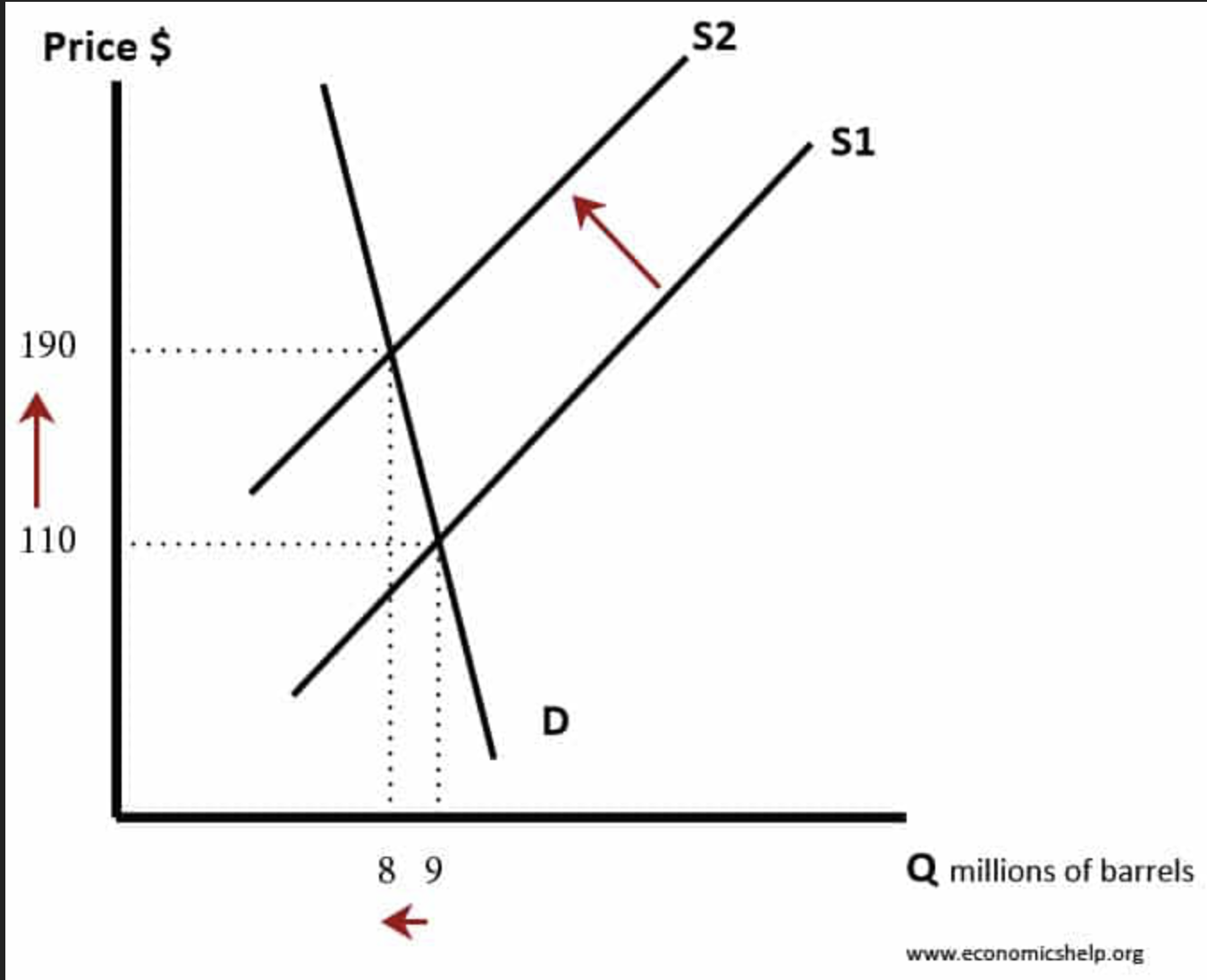
My take is that would be quite destructive to the economy, dramatically reducing growth while raising inflation substantially.  My point is these policy pronouncements matter, and market participants know that.  Now, based on the price behavior of oil (unchanged today) and still trading in the middle of its recent year-long trading range, it is clear the market is not too concerned about that outcome.  Whether that is because the market is betting on a Trump victory or the market is betting that she will not be able to withstand the political pain of higher gasoline prices that would come with a dramatic reduction in US oil production, I have no idea.  

I am merely highlighting that the consequences for the economy and markets are very large depending on the outcome of the upcoming presidential election here.  And those consequences will be felt worldwide.  Were the US to decide to cede its energy status, it would be quite easy to see the dollar fall substantially in value as capital seeks a safer home elsewhere or simply because there would be less demand for dollars to pay for oil.  It would be quite easy to see bond yields rise as investors seek alternatives or demand higher yields to hold US paper.  These outcomes are not guaranteed, they are merely one direction in which things could turn.  

Remarkably, away from that story, there is precious little else of note ongoing as we await this morning’s PCE release.  It’s not that there wasn’t other data, there was, but the outcomes were close enough to expectations to result in limited movement.

For instance, last night Japanese data showed a modest rise in the Unemployment Rate to 2.7% as well as a rise in Tokyo CPI (2.6%, 2.4% core, 1.6% super core) with all three readings higher than last month.  Meanwhile, both Korean and Japanese IP were soft.  But none of that fazed markets as we saw gains in both the Nikkei (+0.75%) and KOSPI (+0.45%) while the yen (-0.25%) and won (0.0%) really did very little nor did JGB yields move.

Meanwhile, this morning there was a raft of European data with inflation readings from both France (1.9%) and Italy (1.1%) helping to complete the Eurozone composite rate (2.2%).  These readings follow Germany’s lower than expected 1.9% yesterday and seem to cement a 25bp cut by the ECB next month.  Alas for the French, GDP continues to underperform with Q2 printing at 0.2% M/M, 1.0% Y/Y, helping to boost the case for a rate cut.  The market response here has been more focused on the potential for cuts than the lackluster economic performance as equity markets are higher throughout Europe (DAX +0.2%, CAC +0.4%, IBEX +0.6%) and the UK (+0.3%).

Perhaps more interesting is the fact that UK economic data continues to outperform the continent with the most recent data showing the housing market there remains solid, at least based on new mortgage approvals and mortgage lending data.  This dichotomy is most evident in the EURGBP exchange rate which has moved sharply in the favor of the pound, more than 2.5%, over the past three weeks, after the BOE cut rates at their last meeting but in a very close 5/4 vote indicating that concerns over inflation remain, and future cuts are not baked in.
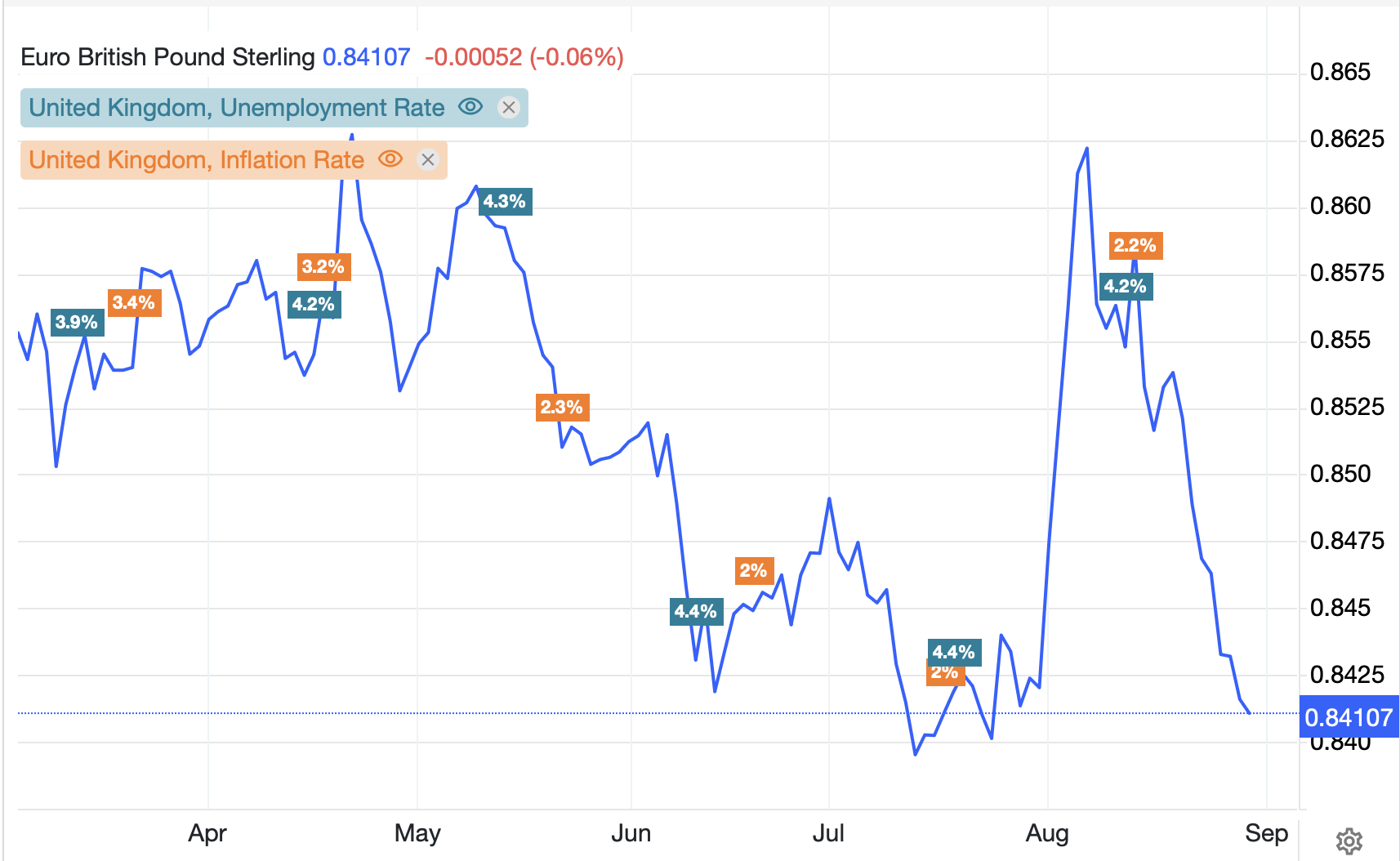
Source: tradingeconomics.com

And I feel that really sums up the overnight discussions.  In other markets of note, Chinese shares (CSI 300 + 1.3%) finally got off the schneid and had their first up day in a week.  Too, the Hang Seng (+1.1%) rallied alongside.  As to US futures, ahead of the PCE all three major indices are seeing futures higher following yesterday’s gains.

In the bond market, Treasuries are unchanged this morning and European sovereign yields are lower by 1bp across the board.  Clearly, there is little concern of either a collapse in Europe, nor a runaway higher in activity.  And that 25bp cut is baked in at this point.

In the commodity markets, as mentioned above, oil prices are unchanged awaiting the next shoe to drop, which in the metals markets, gold (0.0%) is unchanged, holding its recent gains while both silver (+0.5%) and copper (+1.0%) rebound further from some weakness earlier in the week.  

Finally, the dollar continues its mixed performance, with a number of the high yielding EMG currencies showing strength this morning (MXN +0.9%, ZAR +0.7%, BRL +0.6%) as the belief in the market is that the Fed will not only cut in September but will continue to do so going forward.  However, in the G10 bloc, the movement has been far less significant with only the yen moving more than 0.2%.  in my opinion, this is due to a combination of curiousity about the data this morning and the fact that it is the Friday of a holiday weekend in the US, hence most desks are lightly staffed.

As to that data, we see Personal Income (exp 0.2%), Personal Spending (0.5%) and PCE (0.2%, 2.6% Y/Y) along with Core PCE (0.2%, 2.7% Y/Y).  Later this morning we get Chicago PMI (45.5) and Michigan Consumer Sentiment (68.0).  Yesterday’s Claims data was on the button and the GDP data was actually revised higher to 3.0% in a surprise.  Once again, it remains difficult for me to understand the idea that the Fed needs to cut rates aggressively given the economy seems to be working well, at least based on the data the Fed discusses with us.  And yet, the market is still pricing in a one-third probability of a 50bp cut next month.

Putting it all together, while I believe the Fed is more focused on unemployment than inflation, as they have basically claimed victory over the latter, if we see a soft reading this morning, I suspect the market will price a greater probability of a 50bp cut and the dollar will suffer while stocks and bonds rally.  But a strong reading will not have the opposite effect as the focus will be on next week’s unemployment data.

Good luck and good weekend

Adf

Wasn’t Whizzbang

There once was a time in the past
When earnings reports were forecast
If companies beat
It was quite a treat
If not, CEOs were harassed
 
But that was before Jensen Huang
Described the AI bell he rang
Nvidia now
Is what defines tao
Alas, last night wasn’t whizzbang


In what cannot be that great a surprise, given the remarkable hype that continues to surround Nvidia, their earnings were great, but not great enough to exceed the outsized expectations that have become commonplace.  And while revenues and earnings more than doubled, and their profit margins are above 50%, it wasn’t enough to satisfy the underlying belief that exists.  What is that belief?  The best I can tell is that the true believers are certain Nvidia will be the only company left on earth when AI takes over, and so it’s value will equate to global economic activity, currently approximately $105 trillion, so it has much further to climb.  Perhaps the oddest result was that there were actual ‘watch parties’ for the earnings release.  It is not clear to me if that is more hype than a Jensen Huang fan asking him to sign her breast or not, but it is certainly a lot of hype.
 
And yet, the world continues to turn this morning despite the disappointment and US stock futures are actually higher after a lackluster day yesterday where all three main indices declined. As is always the case, in hindsight, the hype is revealed for just what it was, but usually the rest of our lives feel no impact.  That said, it was clearly the market driver yesterday and will almost certainly continue to have an outsized impact on things for a while yet.  But let’s move on.
 
Said Bostic, I need to see more
Results on inflation before
I’m banging the drum
For that cut to come
‘Cause I don’t know what more’s in store

Back in the macro world, we heard from Atlanta Fed president Bostic last night and he was far more circumspect of a rate cutting cycle than the market currently believes was signaled by Chairman Powell last week in Jackson Hole.  As of this morning, the market continues to price a one-third probability of a 50bp cut in September, a total of 100bps of cuts in the rest of 2024 and a total of 225bps of cuts by the end of 2025.  Meanwhile, Mr Bostic explained, “I don’t want us to be in a situation where we cut and then we have to raise rates again.  So, if I’m going to err on one side, it’s going to be waiting longer just to make sure that we don’t have that up and down.”

Now, I know I’m not a Fed funds trader, or even a fixed income trader (I’m just an FX guy) but these comments didn’t sound like he was ready to start slashing rates anytime soon.  Bostic is a voter this year, and while I’m pretty sure the Fed is going to cut next month, I remain in the 25bp camp, and I might suggest that there are still several FOMC members who see no reason to cut rates quickly.  After all, absent a serious downturn in the labor market, and given the economy continues to perform reasonably well, at least according to the data they watch, what is the rationale for a cut?  And remember, if the Fed is cutting rates quickly it means they are responding to economic difficulties.  That doesn’t seem like an outcome we want to see.

Beyond those two stories, though, once again, there is a dearth of new information on which to make decisions.  China continues to struggle and there are now more bank analysts (UBS being the latest) who are lowering their forecasts for GDP growth there to the 4.5% range, well below President Xi’s 5.0% target.  The ongoing implosion of the Chinese property market continues to weigh heavily on the economy there and, as the chart below shows, the Chinese stock market.

A graph with blue lines and numbers

Description automatically generated

Source: Bloomberg.com

Aside from the irony of a strictly communist country even having the very essence of capitalism, an equity market, I believe the incredibly poor performance in Chinese shares is an ongoing signal that not all is well in China, regardless of what official statistical data they present.  President Xi has many problems to address, and I expect he will spend far more of his time trying to smooth international trade relations than anything else for the time being.  After all, the blank paper protests that led to the end of Covid restrictions in China are evidence that Xi is still subject to some popular sentiment.  If the economy were to crater, it would become a major problem for his power, and potentially his health.

Ok, let’s run through the overnight price action.  Asian markets were a mixed bag overnight with Japan essentially unchanged while China (-0.3%) continues to lag virtually all other markets.  The Hang Seng (+0.5%) managed a rally alongside India and Singapore, but there were more laggards including Australia, Korea, Indonesia and New Zealand.  But that is not the story in Europe this morning with all markets in the green led by the CAC (+0.7%) and DAX (+0.6%) on the back of somewhat softer German state inflation data (the national number is released at 8:00am) and what appears to be modestly better than expected Eurozone sentiment indices regarding services and industry, although consumers are still a bit unhappy.

In the bond market, everyone is asleep it seems as there has been no movement of more than 1 basis point in any major market.  Given the lack of new economic inputs, this should not be a great surprise.  I suspect that this morning’s US data, and especially tomorrow’s PCE data may shake things up if there are any unusual outcomes.

In the commodity markets, oil (+0.3%) has stopped falling for now as yesterday’s EIA inventory data showed a total draw of more than 4 million barrels, the 9th drawdown in the past 10 weeks and an indication that supply is falling to meet the alleged weakening demand.  Gold (+0.6%), which started off under pressure yesterday rebounded in the afternoon and continues this morning dragging silver along for the ride.  Copper (-1.9%) however, remains under pressure on both the softening demand story and a technical trading move.

Finally, the dollar, at least the DXY, is continuing to rebound from its Tuesday lows although there is a lot of mixed activity here with some gainers (AUD +0.55%, NZD +0.5%, ZAR +0.85%, CNY +0.6%) and some laggards (EUR -0.25%) along with the CE4 showing weakness.  The big outlier is CNY, which is showing one of its largest single day gains in the past year.  This seems a bit odd given the ongoing lackluster equity market performance and the data showing that foreign investment into China has reversed course and is now divestment.  None of that speaks to a currency’s strength, but as yet, I have not found a good rationale for the renminbi’s strength.  I will keep looking.

On the data front, we finally see some things this morning starting with Initial (exp 232K) and Continuing (1870K) Claims, the second look at Q2 GDP (2.8%) and all the attendant data that comes with that release (Real Consumer Spending +2.3%, PCE +2.6%, 2.9% core).  As well, Mr Bostic as back at it this afternoon at 3:30.  

My take is given the elevated importance of the employment report, today’s data that really matters will be the Claims numbers with any substantial miss (>15k different than forecast) leading to some price action and potential concerns.  But otherwise, Bostic certainly won’ change his tune in less than 24 hours, and the current market zeitgeist appears to be that the dollar, while headed lower, is going to chop to get there.  If we do see a high Claims number, above 245K, look for the dollar to fall more sharply, retracing its overnight bounce.

Good luck

Adf

Numb

It seems that nobody is willing
To trade, ere Nvidia’s spilling
The beans on their income
So, markets remain numb
Awaiting an outcome, fulfilling


Some days it is extremely difficult to find a noteworthy story at all, and today is one of those days.  The combination of a lack of new economic data on which to build theories and models, along with most of the central banking community taking their summer vacations has left the trading and investment communities without any new catalysts for action.  Arguably, the story that will soon drive things is this afternoon’s Nvidia earnings report, but that is far outside this poet’s lane of travel.  With this in mind, it should be no surprise that market movement overnight has been quite limited.

Perhaps the most interesting story was a speech given by BOJ Deputy Governor Ryozo Himino (the Japanese don’t typically take off all of August) describing that the BOJ would continue to “normalize” policy, albeit at an indeterminate rate.  Speaking in Yamanashi prefecture, west of Tokyo, he said [emphasis added], “The bank’s basic stance on the future conduct of monetary policy is that it will examine the impact of market developments and the July rate hike and that, if it has growing confidence that its outlook for economic activity and prices will be realized, it will adjust the degree of monetary accommodation.”  You will not be surprised after a ‘powerful’ statement like that, the Nikkei managed a 0.2% rally while JGB yields edged higher by 2bps.  Perhaps the latter qualifies as a large move although the 10yr yield there remains well below 1.00%.

Otherwise, passing comments by two different ECB bankers, one a hawk (Knot saying he wants more data before deciding on a September cut) and one a dove (Centeno saying it is clear another cut is due) were the best that we had.  Perhaps that was enough to generate some excitement as the dollar has managed to rebound from the lows seen yesterday, although that is just as likely a trading bounce as a change in sentiment.

So, with this very limited amount of new information in mind, and prospects for a quiet day ahead, let’s look at what happened overnight.  While US markets did edge slightly higher yesterday, the movement was tiny, less than 0.2%.  And that type of movement was the rule of thumb in Asian markets as well with one exception, both China (-0.6%) and Hong Kong (-1.0%) continue to lag global markets as ongoing concerns over the pace of growth in the Chinese economy weigh on markets there.  I believe one of the new concerns is that Western nations (Canada being the latest) are coming together as one with respect to tariffs on Chinese goods in an effort to prevent a massive onslaught that damages their own companies.

In fairness, European shares have seen some more positive performance, notably the DAX (+0.8%), although that is due to some slightly better than expected corporate earnings releases rather than any broader macro story.  Looking across the rest of the continent, and the UK, there is a mix of gainers and laggards with nothing more than 0.2% in either direction.  Again, not much excitement here.  As to the US, futures are essentially unchanged at this hour (7:10) as all eyes are on the tape after the close when Nvidia releases its earnings.

In the bond market, yields, which backed up a few basis points yesterday, are ceding those gains this morning.  10-year Treasuries are lower by 1bp while European sovereigns are down by as much as 4bps to 5bps.  However, that is tracking what Treasuries did yesterday afternoon after the European close.  In the end, fixed income markets in the G10 remain rangebound in yield as investors continue to try to determine the timing of the widely anticipated rate cuts.  Yields have clearly declined from levels seen in the spring, but I believe for much further movement will need to see a far more aggressive rate cutting stance by central banks.

In the commodity markets, oil (-2.0%) is giving back its recent gains as supply disruption fears that were piqued by the shutdown of part of Libya’s production seem to have dissipated, or at least have been overwhelmed by the weak demand story on slowing growth in China and Europe.  At this point, it is very difficult for me to get too bullish on oil as there appears to be ample spare production capacity in OPEC to prevent disruptions and the global economic outlook is clearly fading.  Arguably of more interest is the metals markets which are under pressure this morning with gold (-0.8%) giving back some of its recent gains, although remaining above $2500/oz, while both silver (-1.8%) and copper (-3.6%) feel far more pressure on the weak economic story.  

One other potential drag on the metals markets is the dollar, which has bounced nicely from its lows yesterday.  For instance, the euro (-0.5%) is the G10 laggard although that is after testing the round number of 1.12 again yesterday.  It seems that Klaas Knot is not seen as a viable spokesman for the ECB with visions of rate cuts coming.  But we are seeing weakness in the pound (-0.25%), yen (-0.3%) and even Swiss franc (-0.2%).  In other words, it is pretty broad-based dollar strength.  In the EMG bloc, the CE4 are all substantially weaker, more than -0.5%, while KRW (-0.6%) led most APAC currencies down.  The one exception this morning is MXN (+1.0%) which is rallying nicely on the back of Banxico comments that they will maintain restrictive monetary policy for the time being.  

The data calendar has only the EIA oil inventories coming at 10:30, with more drawdowns expected, and then much later this evening, Atlanta Fed president Bostic speaks.  As trading desks remain lightly staffed given the Labor Day holiday approaching next week and given that there is important data coming after the close as well as tomorrow (Initial Claims) and Friday (PCE), today has all the hallmarks of a sleeper.

Good luck

Adf

Still Weak

In Germany, data’s still weak
For Europe, that doesn’t, well, speak
So, riddle me this
Are traders remiss
For claiming that euros are chic?
 
It’s true interest rates matter most
And Powell said Fed funds are toast
But can M. Lagarde
Just simply discard
The Germans, though they’re comatose?


There is a growing opinion that the dollar is going to decline sharply as the Fed begins to cut rates.  Numerous analysts believe that the market is underpricing how many Fed fund cuts are coming as they are all-in on the US recession story.  After Friday’s Jackson Hole speech, it certainly appears that we will get at least one cut come September, but stranger things have happened.  And obviously, given Powell’s pivot from inflation to unemployment as job #1, the NFP report a week from Friday is going to be crucial.

But we must never forget that the FX market is a relative concept.  It is not simply that one country’s economy is doing well or poorly, nor that their interest rates are high or low, or perhaps moving up or down, it is how those data points compare to other countries that determines the movement in the FX markets, at least the fundamentals, but also frequently the capital flows.  It is with this in mind that on a quiet day we have time to dissect the story in Germany for a bit.  Early this morning, Germany’s Federal Statistical Office released two data points, the GfK Consumer Confidence reading, which fell sharply to a below consensus reading of -22.0 and the Final GDP Growth numbers for Q2, which printed at -0.1% Q/Q and 0.0% Y/Y.  Now, this is not a single quarter feature in Germany as is illustrated in the below chart.

A graph with blue and yellow squares

Description automatically generated

Source: tradingeconomics.com

In fact, GDP growth in Germany has averaged just 0.3% annually over the past 5 years, a pretty anemic level, and one that bodes ill for Europe as a whole.  Recall, Germany’s economy is the largest in Europe (and 3rdlargest in the world) and represents about 28.6% of the Eurozone’s total economy.  If the largest economy in a group of nations is stagnating, it is very difficult for the group’s overall growth rate to expand.  Compare that to the fact that the data to date in the US indicate that growth remains fairly solid (GDP +2.8% in Q2), and then ask yourself, where are the opportunities for activity more prevalent, Europe or the US?  Again, the macro picture seems to point to the US as a continued preferred destination for capital.

And yet, the euro is pushing back to its highest level since a brief spike in July 2023, and otherwise, early 2022 prior to that.  So, does it really make sense for the euro to continue to rally from here?  Literally, the only argument in its favor is that the Fed has now committed to begin easing policy and the market is pricing in about 200bps of rate cuts through the end of 2025.  Meanwhile, although the ECB has implemented their first rate cut, and seem set to execute their second next month, the market is only pricing in 125bps of cuts by December 2025, and just 50bps total for 2024, compared to 100bps for the Fed.

As such, here is the explanation for the euro’s recent solid performance.  But I believe the question to ask is, can this last?  If Germany’s economy is going to continue to bounce along at essentially zero growth, and there is nothing indicating a rebound is coming soon, it seems more likely to me that the rest of Europe follows it lower, rather than ignores Germany and powers ahead.  It’s not that individual small nations in the Eurozone won’t grow more quickly, but Germany’s position in the Eurozone, notably as a trade partner, implies that things are more likely to sag than soar.  

Yes, the euro has rebounded lately, but that has been in response to the interest rate pricing described above.  I think it is a fair bet that Madame Lagarde, when faced with a Eurozone that is growing more slowly than desired, is likely to accelerate interest rate cuts there.  And when that happens, the euro’s recent rise will very likely retrace.  I am not saying that the dollar is going to climb against everything, just that the euro’s strength feels suspect.  One poet’s view.

I’m sorry for the focus on Germany, but some days, there is very little macro news of note, and this seemed the most important, especially given that the idea of a much weaker dollar going forward is gaining traction.  

Ok, with that in mind, let’s look at the overnight activity, which was not all that substantial.  After yesterday’s split between tech shares (NASDAQ -0.85%) and industrials (DJIA +0.16% and a new ATH), Asian shares were mixed as well.  The Nikkei (+0.5%) had a solid session as did the Hang Seng (+0.4%) although mainland Chinese shares (-0.6%) continue to suffer, last night due to a much weaker than forecast earnings result from the parent company of Temu.  Of more concern than the result was the commentary by their CEO that prospects for consumption were dimming.  In Europe, there are some very modest gains, with the DAX (+0.2%) surprisingly holding up well, although the move is obviously quite minimal.  I cannot look at the Eurozone economy and expect anything other than more aggressive rate cuts from the ECB going forward.  As to US futures, at this hour (7:30), they are essentially flat.

In the bond market, yields are backing up from their recent lows with Treasuries higher by 3bps and European sovereigns by between 5bps and 7bps.  In fact, the real outlier is the UK gilt market where 10yr yields are higher by 9bps as there is an increasing concern that the Starmer government is going to blow up the budget there as the PM tries to implement his new policies.  You may remember what happened when Liz Truss was PM and proposed a high spending, high deficit budget and caused all kinds of havoc in the gilt market back in October 2022.  I would not rule out another situation like that quite frankly.  Finally, JGB yields edged lower by 1bp last night, continuing to prove that normal monetary policy in Japan remains a distant prospect.

In the commodity markets, oil (-0.4%) which is higher by > 5% in the past week, has stopped climbing for now.  Perhaps the fact that there have been no new military incursions in the Middle East has been sufficient to get the algos to start selling again on the poor demand story.  Gold (-0.2%) is also biding its time, as are the other metals, although all are retaining the bulk of their recent gains.  Generically, my dollar view is that it will weaken vs. stuff like commodities, not necessarily vs. other currencies.  Of course, this implies a rebound in inflation, something which I continue to see going forward.

Lastly, the dollar is little changed this morning, with most G10 and EMG currencies +/-0.2% or less compared to yesterday’s closing levels.  The biggest mover today is NZD (+0.4%), although I am hard-pressed to see any fundamental reason as there was neither data nor central bank commentary.  Arguably, this is the result of some position changes rather than a fundamental move.  And after that, nothing has moved much at all.

Yesterday’s Durable Goods print of +9.9% was astonishingly high, although the ex-transport reading of -0.2% was a tick lower than forecast.  I guess Boeing sold more planes than anticipated.  As to this morning, we see Case-Shiller Home Prices (exp 6.0%) and Consumer Confidence (100.7), neither of which seems likely to have a major impact.  SF Fed president Daly reiterated the Powell idea that the time has come to cut rates, and I expect every Fed speaker going forward up to the quiet period to say the same.  I guess the real problem will be if the NFP report is hot.  Right now, the early forecasts are for 100K NFP and the Unemployment Rate to remain unchanged at 4.3%.  But what if it prints at 200K and Unemployment slips back a tick?  Will they still be anxious to cut?  I’m not forecasting that, simply reminding us all that assumptions need to be tempered.

As it is the last week of August with holidays rife around the Street, I suspect it will be very quiet overall.  At this point, we need more data to make decisions, so look for limited activity in the FX markets, although I guess the world is really waiting for Nvidia’s earnings tomorrow more than anything else.

Good luck

adf

The Time Has Come

(with apologies to Lewis Carroll)

The time has come, the Chairman said,
To speak of many things.
Of joblessness and how inflation,
            Social unrest, brings
And whether we have done our job
            Although we live like kings
 
But wait a bit, the pundits cried
            Before you do explain
For we thought that inflation was
            The overwhelming bane
It was, the Chairman did remark
            But now its jobs that reign


On Friday morning, Fed Chair Jay Powell laid out his vision for the immediate future, and much as many had hoped, he was quite clear in his belief that the inflation mission is accomplished.

A person in a suit and tie

Description automatically generated

Now, many of us remember how that worked out for the last official who exclaimed that concept a bit too early, but hey, maybe this time IS different!  At any rate, during his Jackson Hole speech, the below comments were what got speculative juices quickening, although a quick look at history indicates all may not be well, at least in the risk asset world.  But first to the soothing words of the Chairman [emphasis added]:

The time has come for policy to adjust. The direction of travel is clear, and the timing and pace of rate cuts will depend on incoming data, the evolving outlook, and the balance of risks.”  

“We will do everything we can to support a strong labor market as we make further progress toward price stability. With an appropriate dialing back of policy restraint, there is good reason to think that the economy will get back to 2 percent inflation while maintaining a strong labor market. The current level of our policy rate gives us ample room to respond to any risks we may face, including the risk of unwelcome further weakening in labor market conditions.”

So, why, you may ask, would anything negative occur if the Fed is finally going to cut rates?  After all, lower rates add monetary stimulus and allow companies to borrow more cheaply while allowing individuals to reduce their borrowing costs and afford more stuff, like cheaper mortgages making houses more affordable.  But under the rubric, a picture is worth a thousand words, the following chart purloined from X in @allincapital’s feed, does an excellent job of highlighting how equity markets have performed after the Fed pivots to cutting rates.

A screenshot of a graph

Description automatically generated

You may have notices that each pivot led to a substantial decline in the S&P 500.  Of course, if you think it through, the basic reason the Fed is pivoting is because the economy is typically heading into, or already in, a recession.  And there has never been a recession when corporate earnings rose across the board. 

This is the crux of the recession argument.  If those who are convinced we are already in a recession are correct, then the prospects for risk assets are dour at best.  On the other hand, for those who remain pollyannaish and believe that the data continues to point to economic strength, the first question is, why should the Fed cut?  And the second question is, why is the data showing rising unemployment, which has an almost perfect correlation of occurring during recessions, not indicating a recession this time?

One last thing, inflation.  You remember that bugaboo, the thing that has had the Fed’s undivided attention for the past two plus years.  Well, given that the money supply has resumed its growth, and money velocity continues to rise, while Chairman Powell has convinced himself that he won the battle, so did Chairman Arthur Burns…three times!  Friday, the equity bulls were in the ascendancy and the market moved to price a 36% chance of a 50bp cut in September with 100bps priced in for the rest of the year while the major indices all rose > 1%.  Personally, I’m a bit wary.

But enough of Friday.  It will take a great deal of new and contradictory information to change the narrative now with the next real chance the NFP report to be released on September 6th.  In the meantime, let’s see what happened overnight.  There was very little in the way of data or activity with only German Ifo readings showing a continuation in their trend lower, printing at 86.6.  It has become increasingly difficult to look at Germany, and its place within Europe as the largest economy by far, and not be concerned over the entire continent’s economic situation.  Energy policies around the Eurozone have hamstrung the economy significantly, and there is no indication that this is either recognized, or if it is, of concern to the governments across the continent.  I understand the short-term view that the Fed is going to start cutting rates and that the dollar has the opportunity to decline because of that, but the longer-term prospects for the euro seem far more dire, at least to my eyes.

Ok, let’s see how markets are handling the unmitigated joy of the Fed finally doing what everyone was so fervently wishing them to do.  In Asia, the Nikkei (-0.7%) didn’t get the bullish memo, likely suffering on the yen’s strength (+1.3% Friday, +0.2% this morning) which started on Friday, right as the Powell speech began.  However, the Hang Seng (+1.0%), India (+0.75%) and Australia (+0.8%) all followed the US movement.  Alas, mainland Chinese shares (-0.1%) continue to lag as the PBOC left rates on hold last night, although some were hopeful of another cut.  In Europe, Germany (-0.3%) is the laggard this morning, not surprisingly given the Ifo data, but overall, markets are moving very little with only the FTSE 100 (+0.5%) showing any life as the only market there following the US.  As to US futures, at this hour (7:10) they are essentially unchanged.

In the bond market, Treasury yields are unchanged this morning, but did fall 5bps on Friday.  In Europe, sovereign yields have all rebounded 2bps, basically unwinding the Friday declines seen in the wake of the Powell comments.  In truth, this is surprising given the lackluster data that was released from Germany, but markets can be that way.  As to JGB yields, they slipped 1bp lower overnight, still not showing any evidence that there is concern the BOJ is going to tighten policy substantially going forward.

In the commodity markets, oil (+2.6%) is rocketing higher after Israel initiated a pre-emptive attack on Hezbollah in Lebanon and Hezbollah responded.  While the WSJ headline is that both sides are now trying to de-escalate things, the oil market, which has seemingly been underpricing risks of a greater supply disruption, has woken up to those risks this morning.  Arguably part of that wakening was the fact that Libya just declared force majeure and has stopped pumping oil because of internal conflict over the central bank and its use of monetary reserves.  Hence, a supply disruption!  Remember, though, the Saudis have a decent amount of spare capacity to fill in if prices start to rise “too” quickly.  

In the metals markets, green is today’s theme with gold (+0.6%) continuing to show its luster as a haven asset.  Meanwhile, silver (+0.9%) has been gaining rapidly amidst stories that China is hording it along with stories that there is not enough silver around to meet the plans for all the solar panels that are still expected to be built.  This movement is dragging copper and aluminum higher as well.

Finally, the dollar is slightly higher this morning overall, although there are some reasonably large movers in smaller currencies.  Surprisingly, NOK (-0.9%) is under pressure despite the big move in oil price higher.  As well, NZD (-0.5%) has slipped, but that was after a very sharp rally on Friday of nearly 2% which seemed to be based on the Fed rate cut story, although NZD responded far more aggressively than any other currency.  We are also seeing weakness in MXN (-0.4%) and SEK (-0.5%) while the euro (-0.2%) and pound (-0.2%) hold up slightly better.  ZAR (-0.1%) may be the best performer today as the metals’ strength seems to be offsetting the dollar’s own strength.

On the data front, there is a decent amount of new information culminating in the PCE data on Friday.

TodayDurable Goods5.0%
 -ex transport-0.1%
TuesdayCase Shiller Home Prices6.0%
 Consumer Confidence100.6
ThursdayInitial Claims234K
 Continuing Claims1870K
 Q2 GDP (2nd look)2.8%
 Goods Trade Balance-$97.5B
FridayPCE0.2% (2.5% Y/Y)
 Ex food & energy0.2% (2.7% Y/Y)
 Personal Income0.2%
 Personal Spendinmg0.5%
 Chicago PMI45.5
 Michigan Sentiment68.0

Source: tradingeconomics.com

In addition to the data, we hear from Fed Governor Waller and Atlanta Fed president Bostic but given that Powell just basically gave the market the roadmap for the Fed’s thinking, it would be surprising if either one changed anything at all.  And given the next really important data point is NFP at the end of next week, Fed speak is likely not that important right now.

At this point, Powell has explained what the Fed is going to do, so the data will help traders and investors adjust the amount of risk they want to take, at least until the point where a recession is more obvious.  Maybe Powell will have successfully prevented a recession, but I still believe the odds are against him.  With that in mind, though, I expect the dollar will remain under pressure for as long as the market believes that Powell is going to cut more aggressively than everybody else.

Good luck

Adf

Like a Stone

When Ueda-san
Raised rates, stocks responded by
Falling like a stone
 
Now Ueda-san
Is treading lightly, lest an
Avalanche begins


I’m sure we all remember the day, just three weeks ago, when the Nikkei Index fell more than 12% leading to a global rout in stocks.  At that time, the proximate cause was claimed to be the combination of a more hawkish BOJ and a less dovish FOMC leading to a massive unwinding of the yen carry trade.  It was a great story, and almost certainly contained much truth.  But was it really the only thing going on?

It seems quite plausible that the dramatic market reactions at that time may have been sparked by that combination of central bank events, but the sole reason the moves were so dramatic was the fact that leverage in the markets has become a key driving force in everything that occurs.  This is the reason that central banks around the world, which continue to try to reduce their balance sheets, are forced to move so slowly.  There have already been two noteworthy accidents in balance sheet reduction processes; the September 2019 repo problem in the US and the October 2022 UK pension problem, both of which were exacerbated, if not specifically driven, by excess leverage.

With this in mind, the most recent market dislocation was the main topic of discussion last night in Tokyo when BOJ Governor Ueda was called on the carpet in a special session of the Diet to explain what he’s doing.  (As an aside, the underlying premise that cannot be forgotten is that despite all the alleged focus on economic outcomes, the only thing that gets governments exorcised is when stock markets fall sharply.  At that point, inquiries are opened!)

At any rate, last night, Ueda-san explained the following: “If we are able to confirm a rising certainty that the economy and prices will stay in line with forecasts, there’s no change to our stance that we’ll continue to adjust the degree of easing.” He followed that with, “We will watch financial markets with an extremely high sense of urgency for the time being.”  In other words, the BOJ is still set on tightening monetary policy but will continue with their major goal, which is to prevent significant market dislocation (read declines).  

The upshot here is that nothing has really changed, at least at the BOJ.  Given the pace with which the BOJ acts on a regular basis, it is not surprising that they expect to continue to tighten policy very gradually and will adjust the pace to prevent major financial market moves.  The market response to these comments was for the yen to rally initially, with the dollar falling nearly one full yen, but then reversing course as Ueda backed away from excessive hawkishness.

A graph with lines and numbers

Description automatically generated

Source: tradingeconomics.com

Which takes us to Chairman Powell and his speech this morning.

There once was a banker named Jay
Whose goal was for both sides to play
When joblessness rose
The question he’d pose
Was, see how inflation’s at bay?

It is somewhat ironic to me that the most recent market ructions were a response to the combined efforts of the BOJ on a Tuesday night and the Fed on a Wednesday morning, less than 12 hours apart.  And here we are this morning with Ueda-san having spoken on a Thursday night with Chair Powell slated to speak Friday morning, although this time a bit more like 15 hours apart.  Should we be concerned that more ructions are coming?
 
As per the above, it seems as though the BOJ is going to make every effort to tighten policy, albeit slowly, given that the inflation picture in Japan is not improving in the manner they would like to see.  In fact, last night, the latest figures were released showing that headline inflation remained at 2.8% and core rose a tick to 2.7%, although that was the expected outcome.  The one bright spot was their “super-core” reading fell to 1.9%.  In the past, I was given to understand that super-core was the number that mattered the most to the BOJ, but given Ueda seems keen to continue to tighten policy, I suspect it will not be the focus for now.
 
Which takes us to the other side of this equation, the Fed.  What will Chairman Powell tell us today?  Well, yesterday we heard both sides of the argument from FOMC members with Boston’s Susan Collins and Philadelphia’s Patrick Harker both explaining that the time for cutting rates was coming soon and that the process would be gradual.  On the other side, the host of the Jackson Hole shindig, newly named KC Fed president Jeffrey Schmid, explained, “It makes sense for me to really look at some of the data that comes in the next few weeks. Before we act — at least before I act, or recommend acting — I think we need to see a little bit more.”  
 
Based on the Minutes released on Wednesday, it certainly appears that the committee is ready to cut rates next month.  The real question is at what pace will they continue once they start.  Despite all the hubbub about the NFP revisions in the Twitterverse, none of the FOMC members interviewed explained that it altered their opinions about the economy.  As I type, three hours before Powell speaks, the Fed funds futures market is pricing a 26.5% probability of a 50bp hike with a 25bp hike fully priced in.  I have read arguments by some analysts that they need to start with 50bps because the payroll revisions paint a less positive picture of the economy.  But it is hard for me to believe that Powell will want to act more than gradually absent a major dislocation in the data still due between now and the next meeting.  If NFP is <50K or the Unemployment Rate jumps to 4.5% or 4.6%, that could see a 50bp cut, but otherwise, I believe Powell will be measured and not really give us anything new today.
 
Ok, let’s look at how markets have behaved ahead of his speech.  After yesterday’s disappointing US session, the Nikkei shook off any initial concerns about Ueda’s hawkishness and rallied 0.4% on the session.  But most of the rest of the region was in the red, with Hong Kong, Korea and Australia all sliding although the CSI 300 managed a 0.4% gain.  In Europe, though, green is the theme with every major market firmer this morning led by Spain’s IBEX (+0.7%) and Germany’s DAX (+0.65%).  There was no notable data, so it is not clear the driver here.  Of course, US futures are rallying at this hour as well, with the NASDAQ futures higher by 1.0% leading the way.  Based on these markets, there is clearly a belief that Powell will be dovish.
 
In the bond markets, Treasury yields have slipped 1bp this morning but have been hanging around the 3.85% level for several sessions.  There was a dip on Wednesday after the Minutes seemed dovish, but that reversed course before the day ended and we have done nothing since.  In Europe, investors and traders are also biding their time with virtually no change in yields there.  Finally, JGB yields did rise by 3bps in response to Ueda’s marginal hawkishness.
 
In the commodity markets, oil (+1.3%) is continuing to rebound from its recent lows in what looks like a technical trading bounce although the EIA data on Wednesday did show more inventory draws than expected.  In the metals markets, while yesterday was a terrible day in the space, with metals selling off hard during the NY session, this morning they have rebounded and are higher across the board.  Nothing has changed my view that if the Fed turns dovish, metals markets, and commodities in general, will rally sharply.
 
Finally, the dollar is under pressure this morning, slipping broadly, but not deeply.  The euro is unchanged, while the pound (+0.2%) and AUD (+0.4%) pace the gainers in the G10.  In the EMG bloc, ZAR (+0.4%), MXN (+0.3%) and KRW (+0.3%) all showed modest strength as it appears traders are looking for a somewhat dovish Powell speech as well.  The dollar will be quite reactive to Powell, I believe, so watch closely.
 
In addition to Powell, and any other FOMC members that are interviewed at the symposium, we only see New Home Sales (exp 630K).  Yesterday, Existing Home Sales stopped their declines and printed as expected at 3.95M.  Claims data was also as expected although the Chicago Fed National Activity Index printed at a much lower than expected -0.34 after a revision lower to the previous month.  That is a negative economic indicator.
 
This poet’s view is Powell will try to be as middle of the road as possible, acknowledging the likelihood of a cut in September but not promising anything beyond that.  That said, I believe the market is looking for a much more dovish speech.  If he does not provide that, I expect that we could see some market negativity overall with the dollar rebounding.
 
Good luck and good weekend
Adf

Unnerved

The Claims data last week preserved
The markets, which had been unnerved
By thoughts that Japan
Did not have a plan
To exit QE unobserved
 
Now yesterday’s data revisions
To Payrolls cemented decisions
That when Powell speaks
He’ll say, “in four weeks
Rate cuts are quite clear in my visions”


Well, the big news was that the BLS revised down the number of new jobs created between April 2023 and March 2024 by 818K, not far from the extreme calls of 1MM.  Alas, this has become more of a political talking point than an economic one with claims of subterfuge on the part of the current administration in an effort to flatter their record.  From an economic perspective, however, to the extent that we believe this data is accurate, it offers a far greater case for the Fed to cut rates next month.  After all, the strong labor market had been one of the key rationales for the Fed to maintain higher for longer, so if that market is not as strong as previously believed, lower rates would be appropriate.

In addition to the NFP revisions, which had gotten virtually all the press, the FOMC Minutes of the July 31stmeeting were also released.  It turns out that according to those Minutes, the discussions in the room included several members calling for a cut at that meeting, and unanimity in a cut by September.  That feels a bit more dovish than the post-meeting press conference where Powell wouldn’t commit to a September cut, seemingly trying to retain some optionality.  Now, the market has been pricing in a full 25bp cut since a week before the last meeting, so it’s not as though people have been fooled.  And we are still looking at a 30% probability of a 50bp cut in September, but to this poet, absent a negative NFP reading in two weeks’ time, September is going to bring a 25bp cut.

Here’s the thing, though, will it matter?  It certainly won’t have any impact on the economy for any appreciable time (remember those long and variable lags) although it could be a signaling event.  But exactly what does it signal?  If the economy is truly robust, why cut?  If the economy is weakening quickly, or not as strong as previously thought, then why just 25bps?  In the big scheme of things, 25bps has exactly zero marginal impact on economic activity.  If they were to explain they are entering a series of more aggressive rate cuts to accommodate weakening growth, well that seems like a signal they don’t want to send either, especially politically.  One final thought, when things are going well in the economy, nobody is talking about any kind of ‘landing’, whether soft or hard.  The very fact people are discussing a ‘soft-landing’ is recognition that the economy is slowing down.  I believe that most of us understand that is the case, but for the media to inadvertently admit that is the case in this manner speaks either to their stupidity or their cupidity.

Ok, so how did markets respond to these two stories?  The first thing to note is that while the NFP revisions were scheduled to be released at 10:00, they were a bit late.  As you can see in the chart below, there was an immediate jump in the equity market, which slowly retraced until the Minutes were released and then the dovishness was complete, and we saw a steadier appreciation.  

A green line graph with numbers and a black dot

Description automatically generated

Source: Bloomberg.com

Net, the clear belief from the investment community was that the Fed is more dovish than they have been letting on, and so equity markets in the US rallied on the day.  Once again, that followed through in Asia, where pretty much all markets except mainland China (CSI 300 -0.25%) followed suit with the Hang Seng (+1.45%) the leader, but strength throughout the region overall.  In Europe, Flash PMI data was released this morning showing that Germany continues to stumble, especially in the manufacturing sector, and that the whole of Europe is lackluster at best.  While the Olympics seemed to help French services output, net, there is not much excitement.  The upshot is that ECB members are talking up further rate cuts and the result is European bourses are gaining some ground this morning, but only on the order of 0.2%.  As to US futures, they are little changed at this hour (7:15).

In the bond market, yields are edging higher with Treasury yields up by 2bps and similar gains across Europe and the UK.  In truth, I would have expected European yields to slide a bit on the PMI data, but clearly that is not the case.  Interestingly, 10yr JGB yields slipped lower by another 1bp as the market there prepares for testimony by BOJ Governor Ueda tonight.  In a truly unusual event, the Diet (Japan’s congress) called him in to testify before both the Lower and Upper houses even though it is technically not in session.  It seems they are very concerned about his hawkishness and how it impacted Japanese stock markets and the yen two weeks ago.  (As an aside, I cannot imagine something like that happening in the US, it would be extraordinary given the ostensible independence of the Fed.)

Turning to commodity markets, after falling 1% further yesterday, oil (+0.5%) is bouncing slightly, although it remains far closer to the lower end of its trading range than even the center.  Gold (-0.3%) continues to hang around just above $2500/oz but has not made any real headway above since it first broke through that level last Friday.  A very interesting X thread on this subject by Jesse Colombo (@TheBubbleBubble), a pretty well-known commentator on markets (167K followers on X),  highlighted that while gold has made new all-time highs vs. the dollar, it has not done so vs. other currencies and that process needs to be completed to see a more significant move.  I raise this idea because if/when it occurs, it is likely to be a signal of far more distress in the economy and markets than we are currently seeing.  As to the rest of the metals complex, they are having lackluster sessions as well, with copper ceding -1.0% and silver (-0.15%) a touch softer.

Finally, the dollar refuses to collapse completely despite the growing view that the Fed is getting set to embark on a series of rate cuts.  While both the euro (-0.2%) and pound (+0.1%) are little changed this morning, both sit near 1-year highs vs. the dollar.  The thing about both these currencies that has me concerned is that energy policies currently being implemented in both Germany and the UK, with many other continental countries going down the same path, are almost guaranteed to destroy all manufacturing capability and force it to leave for somewhere with lower energy prices.  While both of those economies are clearly services driven, I assure you that the destruction of manufacturing capacity is going to have long-term devastating impacts on those nations, and by extension their currencies.  Just something to keep in mind.  Elsewhere, the yen (-0.6%) is slipping today and has been in a fairly tight range since the pyrotechnics from two weeks ago.  But we are also seeing weakness in ZAR (-0.75%), NOK (-0.5%) and SEK (-0.4%) to name a few, and general weakness, albeit in the -0.2% to -0.3% range across the rest of the G10 and EMG blocs.  The dollar is not dead yet.

On the data front, this morning brings Initial (exp 230K) and Continuing (1870K) Claims as well as the Chicago fed National Activity Index (.03) at 8:30.  Later this morning, Flash PMIs (manufacturing 49.6, services 53.5) are due and then Existing Home Sales (3.93M) finishes things off.  There are no scheduled Fed speakers but then all eyes are on Jackson Hole tomorrow when Chairman Powell speaks.

Given what we learned yesterday regarding both the labor market and the last FOMC meeting, it seems clear the Fed is going to cut 25bps next month.  Of more interest, I believe, will be the way Powell lays out his vision for what needs to occur for the Fed to continue the process and his guideposts.  Remember, they are still shrinking the balance sheet, albeit slowly, but cutting rates and reducing liquidity simultaneously may have unintended consequences.  If they stop shrinking the balance sheet, though, I believe the market will view that as a very dovish signal, and the dollar would fall sharply.  I’m not saying that’s what I expect, just that would be the result.  But for today, it is hard to believe we see a large move ahead of tomorrow’s speech.

Good luck

add

Waxes and Wanes

The story of note for today
Is how will the BLS play
Employment revisions
And then what decisions
Will Powell be likely to weigh?
 
For now, markets still seem assured
That rate cuts will soon be secured
The doves still want fifty
But most are more thrifty
With twenty-five likely endured
 
But what if Chair Powell decides
Inflation, just like ocean tides
Both waxes and wanes
And though they’ve made gains
No rate cuts, to Fed funds, provides


So, the big story today, which I briefly discussed on Monday, is that the BLS is going to make benchmark revisions to their NFP data for the year through March 2024.  These revisions come from a closer analysis of the Quarterly Census on Employment and Wages (QCEW) data, which is the most comprehensive data set on jobs available.  Remember, for their monthly reports, the BLS uses a model that incorporates samples of data from respondent companies, and then includes their own adjustments based on the birth-death model of new businesses and how many jobs they create.  But the QCEW data doesn’t model things, it counts all the data from states regarding unemployment insurance and reports required to be filed by companies regarding quarterly contributions.  It is the gold standard.

Naturally, when the QCEW is released (the most recent was released in June), the analyst community goes through everything and makes their own estimates as to the changes that will occur.  Prior to any revision, the BLS data show that the economy added 2.9 million jobs in the 12 months from April 2023 through March 2024.  But analyst estimates range from a reduction in that number ranging from 300K to as much as 1 million fewer jobs.  

Given the increased importance the Fed has placed on the employment side of their mandate lately, and given that one of the reasons, if not the key reason, Powell has been willing to leave rates at current high levels is the employment situation has remained robust, if he and his colleagues were to suddenly find out that there were one million less employed people around, that would likely have a serious impact on their views as to where rates should be.

Based on the stories that I have seen on this topic over the past several days, as well as the positioning that is being revealed by the Commitment of Traders’ reports showing massive long positions in both treasury bond futures and SOFR call options, both of which are real money expressions of expectations of lower interest rates coming soon, it strikes me that the pain trade is the opposite.  In other words, what if this revision is much smaller than the largest estimates, maybe 100K or something.  Suddenly, the idea that the Fed is going to be pressured into cutting rates despite the fact that inflation, though lower, remains well above their target, is not quite as certain.  

The thing is, based on what I keep reading and hearing, it strikes me that the market is set up for a bond sell-off and higher yields today.  Either, the number is large, about 1 million jobs removed, and then we will see profit taking on the outstanding positions, or the number is small, and the entire story needs to be rewritten regarding the timing of the first rate cut, which means that positions need to be abandoned.  I’m not sure what the goldilocks number needs to be to have traders maintain their positions ahead of Friday’s Powell speech, but given that is a wild card as well, I think that is the least likely outcome, no change in positions.

Elsewhere, the only other noteworthy thing was a story about a BOJ staff paper that discussed the idea that inflation in Japan is still structural and that higher rates are still appropriate, but that is a staff paper, and not necessarily Ueda-san’s view.  The BOJ next meets on September 20, two days after the FOMC, so Ueda-san will have lots more new information to decide just how hawkish he wants to be.  Recall, the dramatic market collapse in Japan at the beginning of the month, while completely reversed now, forced their hand to back off their hawkishness.  Perhaps, the second time, if they remain hawkish, they will be able to withstand that type of movement.

So, as we all await this BLS revision, which comes at 10:00 this morning, here is how things behaved overnight.  After the first down day in the US in 9 sessions, Japanese (-0.3%) and Chinese (-0.3%) markets were also soft although the rest of the region was mixed with some gainers (India, Indonesia, Australia) and some laggards (Hong Kong, Taiwan, New Zealand).  In Europe, though, equity markets are modestly firmer this morning, somewhere between 0.25 and 0.5%, although there has been a lack of new information seemingly to drive things.  As to the US, futures at this hour (7:30) are edging higher by about 0.1%.

In the bond market, Treasury yields have edged up 1bp this morning, although they have been trending down for the past week in anticipation of this BLS employment adjustment.  European sovereign yields are essentially unchanged this morning while JGB yields dipped 1bp.  The story there remains that 10-year JGBs are yielding well less than 1.00%, the perceived key level at which more Japanese funds flow home.  I think we will need to see a much more hawkish BOJ to get that trade going.

In the commodity markets, oil (0.0%) has stopped falling for the time being, but remains under pressure overall, down more than 6.6% in the past month.  Yesterday’s API data (the private sector version of the EIA data to be released later this morning) showed a small build of inventory as opposed to the continued draws that we have seen lately and that were expected.  However, a look at the oil chart tells me that we are much closer to the bottom of its trading range for the past 3 years, than the top, and seem likely to rebound a bit.  Gold (-0.15%) is consolidating its recent gains and remains above that big round $2500/oz level but both silver (+0.5%) and copper (+0.5%) are rallying today.  I keep reading stories about how the physical shortages in both those markets, due to increased production of solar panels and batteries, is going to become the key driver going forward.  While I have believed that story, it is always hard to ascribe a given day’s movement to something like that absent a major new piece of information, and I haven’t seen that piece of the puzzle.

Finally, the dollar is bouncing slightly this morning, although that is after a pretty straight-line decline for the past two months.  Given the hype about Fed rate cuts, especially adding in this new focus on the BLS job data adjustment, it is easy to see why traders are looking for much lower US rates and therefore selling the dollar.  But remember, in the big scheme of things, at least based on the Dollar Index, the dollar is pretty much at its long-run average, neither weak nor strong.  I will say that if the Fed does enter a serious rate cutting cycle, the dollar is likely to weaken quite a bit more, perhaps with the euro testing 1.15 – 1.20 before it ends.  However, remember, if the Fed starts cutting aggressively, so too will the ECB, BOE and BOC, so any weakness will be somewhat limited.  As to today’s price action, the dollar’s strength is universal, but pretty modest overall with the biggest mover JPY (-0.5%) although obviously there are other things ongoing there.  

Aside from that employment report revision, there is no other data to be released and there are no Fed speakers scheduled today.  Today will be driven by that revision.  The larger the revision, the more likely we see the dollar decline, although the initial reaction on interest rates may be opposite on profit taking.

Good luck

Adf

Waiting for Jay

While everyone’s waiting for Jay
And hope he’s got good things to say
No stories of note
Have lately been wrote
And bulls keep on getting their way
 
The only place that’s not been true
Is China, where, policies, new
Allow new home prices
To make sacrifices
And slide hoping sales follow through


Although there has been a dearth of new information to drive activity, at least with respect to hard data, equity markets are mostly trading higher as the rebound from the early August correction continues.  In the US this week, the big news won’t be out until Friday, when Chairman Powell speaks at the Jackson Hole symposium.  Elsewhere, while we do see things like both Japanese and Canadian inflation as well as the flash PMI data, so much importance has been attributed to the Powell speech, it is hard for traders to get excited about very much.  For instance, early this morning the Swedish Riksbank cut their policy rate by 25bps, as expected, and indicated that there could be another 3 cuts during 2024, but nobody really cared.  In fact, the Swedish stock market is lower on the day, simply proving that rate cuts are not a stock market panacea.

However, not every nation is using the same playbook right now, and while Japan may be the biggest outlier, attempting to tighten monetary policy, albeit not as successfully as they had hoped, China is taking a different approach to fiscal and economic policy.  As I have mentioned before and has been widely reported for the past several years, the property market in China has been under severe stress.  What has become a bit clearer in that time is that much of the Chinese growth miracle was the result of massive overinvestment in housing.  The stories about ghost cities, that were built but where nobody lived, which had made the rounds for a while turned out to be true. 

In essence, a key driver of the Chinese economy was the property market.  Cities and states would sell land to property developers, using the funds to help themselves develop infrastructure.  Meanwhile, property developers had a ready market for their homes (mostly condos in high rises) as the Chinese people felt more comfortable with property as a savings vehicle than banks or the stock market.  Looking at the performance of the Shanghai Composite below, it is no wonder that people gravitated toward property.  After a peak in the summer of 2015, the PBOC devalued the renminbi 2%, stocks fell nearly 50% in the ensuing six months, and have remained at that lower level ever since.

A graph with numbers and lines

Description automatically generated

Source: tradingeconomics.com

But for the past four years, since China Evergrande, a major property developer, started to crumble, the desire of the Chinese people to own property has greatly diminished.  This has had a major impact on Chinese local government finances as the demand for property they were selling to fund themselves collapsed.  At this point, there is a glut of unfinished homes around as developers ran out of funding, so the country is in a bad spot.  Not surprisingly, one of the problems is regulatory, as Chinese city and state governments have had restrictions on new home prices, trying to prevent them from declining thus keeping the cycle of new homes funding the cities ongoing.  But recently, some major cities and states have relaxed those restrictions and suddenly, new home prices have fallen to make them competitive with resales.  Remarkably, sales volumes are picking up.  Who would have thunk?  

It is ironic that Communist China is defaulting to market pricing activity to help markets clear while in the ostensibly capitalist US, we have a major party seeking to intervene in housing markets to achieve a social goal of home ownership, regardless of the fact it will push prices higher.  At any rate, the upshot is that property prices in China continue to decline which is weighing on the share prices of those developers that have not already gone bust.  And that is dragging down the entire Chinese stock market and adding to that underperformance we see above.

But you can tell it is a slow day if that is the most interesting story I can discuss!  So, without further ado, let’s take a look at the overnight activity as we await the NY open.  While the CSI 300 (-0.7%) and Hang Seng (-0.3%) were both in the red, the rest of Asia followed the US higher with Japan (+1.8%) and Korea (+0.8%) leading the way higher.  As to European bourses, it is much less exciting as continental exchanges are all +/- 0.1% from yesterday’s close although the FTSE 100 (-0.6%) is under a bit of pressure with the energy sector weighing on the index amid the decline in oil prices.  As to US futures, they are essentially unchanged at this hour (7:20).

In the bond market, the doldrums also describe the price action with Treasury yields unchanged on the day and the same virtually true across all of Europe and Asia.  This is a situation where it is very clear that both traders and investors are waiting anxiously for Godot Powell.

While oil prices have stopped their slide this morning, they have fallen -6.0% in the past week as the slowing growth/recession story is on the minds of traders everywhere.  Concerns over supply on the back of either Ukraine/Russia or Israel/Iran are clearly no longer part of the discussion.  It feels to me like that is somewhat short-sighted, but I am not an oil trader.  In the metals markets, the barbarous relic (+0.85%) continues to pull all metals higher as it is trading at yet another new all-time high this morning ($2525/0z) and dragging silver (+1.3%) and copper (+0.2%) along for the ride.  While the silver movement makes some sense given it has precious characteristics, copper is wholly an industrial metal, so it is giving opposite signals to the oil market.  They both cannot be right.

Finally, the dollar remains under pressure, with the euro (-0.1% today, +0.75% this week) pushing toward its end 2023 highs.  Remember, back then, markets were pricing 6-7 Fed rate cuts this year, something which is clearly not going to happen.  As well, we are seeing the strength in CHF (+0.3%), SEK (+0.3% despite the rate cut and threats of more) and JPY (+0.2%). Interestingly, in the EMG space, ZAR (-0.6%) and MXN (-0.6%) are both under pressure this morning despite the rally in metals markets.  As well, I guess given the general malaise in China, it can be no surprise that the renminbi (-0.2%) has fallen.  Perhaps a more interesting thing to consider is the fact that the renminbi fixing has been right around current market levels, an indication that pressure on the PBOC to devalue has faded, and a sign that the dollar is losing some fans.  In fact, I suspect that this is a key feature of the dollar’s recent softness, and if the Fed does get aggressive, do not be surprised if the market pushes USDCNY to the other side of the +/- 2% trading band around the fix.

On the data front, there is no US data today at all, with the most interesting thing to be released being the Canadian inflation report (exp 2.5%).  We do hear from two Fed speakers this afternoon, Atlanta Fed president Raphael Bostic and Governor Michael Barr, but with Powell on the horizon, it would be hard for them to get much traction in my view.  As an aside, the Atlanta Fed’s GDPNow has fallen to 2.0% as of last Friday, down nearly 1% last week.  This, of course, is another brick in the recession story.

Net, today seems like it will be a quiet one, with markets biding their time until Friday.  Of course, given that these days, biding their time means equities will keep rallying and the dollar keep sliding, I think that seems like the best bet for now.

Good luck

Adf

A Future, Austere

So, what if the payroll report
Was wrong, and job numbers fall short
When they are revised
And so, they disguised
The ‘conomy’s on life support
 
Will this mean recession is here
And Jay will get rate cuts in gear?
But if that’s the case
Are stocks the right place
To hide with a future, austere?


After last week’s remarkable rally that has reversed so much of the negativity inspired by the BOJ/yen carry trade unwind/end of the world scenarios from just two weeks ago, this week is starting off in a fairly muted manner.  Add to this the fact that the data stream this week is limited, and you have all the makings of a quiet, summer doldrums-like, period.  Except…Thursday begins the KC Fed’s Jackson Hole symposium and Friday morning at 10:00am EDT, Chairman Powell will be speaking.  This speech often has great significance as historically, Fed chairs will give strong clues about policy changes coming at this exact opportunity.  This is not to say Powell is going to give us a schedule of his planned rate cuts, but more that he has the chance to explain his (and by extension the Fed’s) reaction function to future data releases.

It is this topic that is critical for us to monitor as lately there have been several articles regarding the nature of the annual benchmark revisions to the payroll reports that will be coming early next year.  The punch line is that expectations are growing that much of the NFP growth seen thus far in 2024, currently totaling ~1.4 million new jobs, may be erased, with estimates of downward revisions rising to 1 million or more.  For instance, in California, the Legislative Analyst’s Office, which is a non-partisan (assuming such a thing exists) group under the auspices of the California state legislature, has revised down their job growth estimates for all of 2023 to just 9K from well in excess of 100K in the initial reporting.  Given California’s status as the largest state in the union and its general importance to the economy, this is quite concerning.  

The BLS revisions will not be released until March 2025, but there have been numerous concerns registered by economists and analysts of all stripes indicating that the BLS model, specifically the birth-death portion regarding new businesses, is wildly out of sync with the reality on the ground.  One of the things that has allowed the Fed to maintain their higher for longer stance is their belief, based on the BLS data, that the employment situation is still quite solid in the US.  Of course, the recent rise in the Unemployment Rate is beginning to raise some eyebrows, but those who believe there is no recession will point to the increase in job seekers in the latest report, essentially raising the numerator rather than reducing the denominator in that data point. And maybe that is true.  However, the vibe that appears to be growing around the country is that the job situation is not as robust as the numbers might indicate.

The implications of this are that it is entirely possible that the minority of analysts who claim we are already in a recession will turn out to have been correct, and the NBER will backdate the beginning of the recession to early this year.  As to the Fed, they will find themselves in a much different place and be forced to cut rates far more aggressively than what seems to be the current belief in the Eccles building.

Right now, the Fed funds futures market is pricing in a bit more than 200 basis points of cuts by September 2025.  While that seems like a lot, if the economy is actually in recession already, that is likely understating the case.  When it comes to the tradeoff between inflation and recession, while Powell was able to talk tough regarding recession when it didn’t seem to be coming, methinks he will have a different tone if these job numbers are revised as dramatically as some are contending.  And let’s face it, if the California government is explaining that is the case, along with some research by the Philly Fed, which is also indicating less job growth than initially reported, this could well be the 2025 story of note.

To summarize, questions regarding actual job growth vs. reported job growth are starting to be asked.  If the answers lean toward the negative end of the spectrum, the likelihood of more aggressive Fed easing rises. However, the specter of inflation looms large in the background as despite its seeming recent quiescence, it is not nearly back at the Fed’s target level.  Can the Fed cut aggressively if inflation remains above target?  Of course they can, and if the economic situation deteriorates rapidly, they almost certainly will.  But that will not solve the inflation problem.  If, and it is a big if, this is the case going forward, my longstanding contention of a significant decline in the dollar versus commodities will likely play out.  As well, I would not want to own duration in the bond market, and while stocks might start out ok, recession does not pad profit margins, it impairs them, so stocks will have trouble as well.

In the meantime, let’s look at what happened overnight.  Friday’s continuation rally in the US saw some follow through in Asia, but it was truly a mixed picture there.  Japan’s Nikkei 225 (-1.8%) fell sharply as the yen rallied more than 1%.  Remember, about 40% of the Nikkei’s profits come from international sales and activity, and as the yen strengthens, it impairs those earnings in local terms.  Elsewhere, China (+0.3%) and Hong Kong (+0.8%) fared well, but Korea (-0.85%) suffered.  The other markets showed marginal gains.  In Europe, though, Spain (+1.0%) is leading the way higher although the rest of the continent is seeing much more limited gains, on the order of +0.25%, as a lack of new data or commentary seems to be allowing for a follow-on from the US session Friday.  UK shares are unchanged and so are US futures as traders await the big Powell speech on Friday.

In the bond market, Treasury yields are lower by 1bp, and we are seeing slightly larger yield declines in Europe, with sovereign yields down by between -2bps and-4bps.  Again, a lack of data and commentary means this is trading inspired, and not based on new information.  JGB yields rose 1bp, perhaps in sync with the yen’s rise overnight.

In the commodity markets, oil (-0.9%) continues to suffer as the slow growth, slowing demand story is the driver with absolutely no concern over the potential for an increase in supply tensions based on the ongoing wars in Ukraine and Israel/Gaza.  Meanwhile, gold (-0.8%) which closed above $2500/oz on Friday for the first time ever, is consolidating a bit and dragging silver (-0.5%) with it.  Interestingly, copper (+0.5%) is holding its own despite the slowing growth story.  That seems to be much more of a technical trading story than a fundamental one, although the long-term fundamentals remain quite bullish in my view.

Finally, the dollar is under further pressure this morning, falling against all its G10 counterparts and many of its EMG counterparts as well.  it should be no surprise that CNY (+0.3%) is stronger alongside the yen, but we also saw KRW (+0.85%) really benefit and almost every EMG currency, save MXN (-0.3%), which is today’s ultimate laggard.  If the story is turning to more aggressive US rate cuts, the dollar will continue its decline.

On the data front this week, there is not much other than the Jackson Hole symposium, but here it is for you:

TodayLeading Indicators-0.3%
WednesdayFOMC Minutes 
ThursdayInitial Claims230K
 Continuing Claims1881K
 Flash Manufacturing PMI49.5
 Flash Services PMI54.0
 Existing Home Sales3.92M
FridayNew Home Sales630K

Source: tradingeconomics.com

So, as you can see, other than Powell on Friday, and three other Fed speakers (Waller, Bostic and Barr), earlier in the week, there is not much to see.  My take is the rate cut narrative is building momentum and that we are going to see further pressure on the dollar until either the data indicates no cuts are coming, or we have a more significant risk-off event where people run to dollars to hide.

Good luck

Adf