
Most days there’s a singular theme
To energize which reigns supreme
But sometimes the news
Does naught but accuse
All parties of ruining our dream

So, French Revolution is back
And Houthis keep up their attack
While AI gets smashed
And metals all crashed
It’s Friday so let’s all step back
Yesterday was a pretty clear risk-off session although to my eye, it seemed an accumulation of issues rather than a singular concept driving the bus. Under the guise of, if it bleeds, it leads, we continue to see graphic video of the ongoing rioting in France and there is ongoing discussion amongst the analyst community about just how much further French bond yields can rise before the ECB needs to step in. However, this situation is different than the Eurozone crisis of 2011-12 as back then, Germany was still an economic powerhouse while today, they are enfeebled by their own energy policies. The point is made very clearly below by one of the smarter folks I follow on X, Michael Arouet.
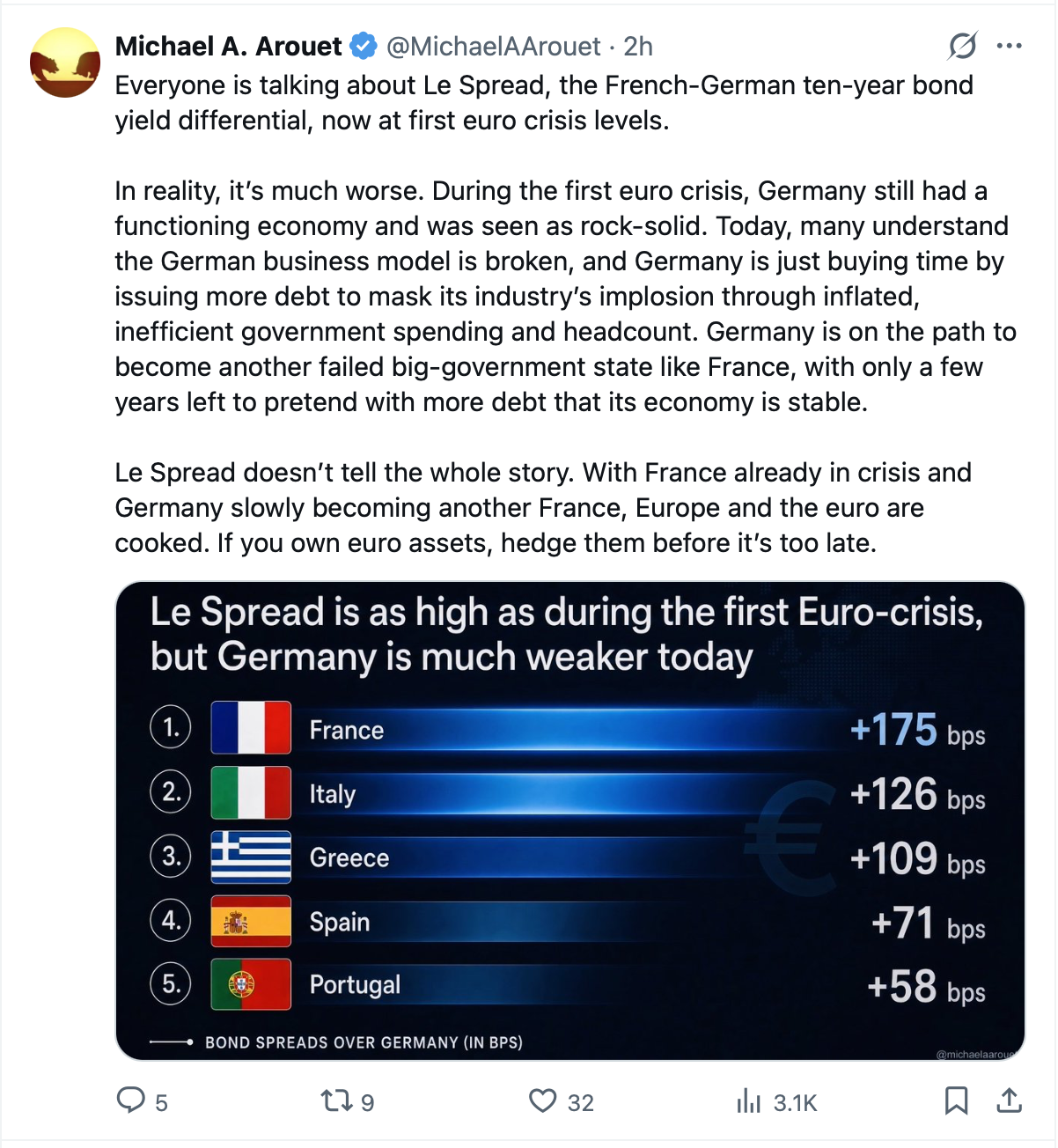
The point is that while the post WWII history has been Germany saves the continent because of its healthy economy, that may not be an option anymore. Again, another reason to dislike the euro over time.
Adding to the French Revolution, part deux, is the growing concern about an increase in military action in Iran and the Persian Gulf. The WSJ headline, “Iran Threatens Retaliation on Economic and Civilian Targets if US Attacks” says it all with the article highlighting the specifics and trying to prognosticate on the likelihood of the outcome. Oil prices (+1.7%) are higher again this morning and back above $100/bbl, although I read that prompt prices for physical delivery have been slipping as it appears the US Navy has been successful in escorting a significant number of ships through the Strait and flow are back above 80% of the pre-war level.
Turning to the equity markets, yesterday’s downdraft (S&P 500 -1.2%, NASDAQ -2.6%) was blamed on further concerns over the AI story. During the summer, it was all AI, all the time and the idea was that there was going to be a nonstop inflow of capital to the sector. But as interest rates globally rose, financing those dreams became more difficult and then the naysayers were able to get their message out that AI was a bubble. Adding to the sectors problems has been the anti data center movement and all the controversy surrounding the impact data centers have on retail electricity prices. Of course, this fits nicely with the ‘crisis of affordability’ that gets so much airtime as well.
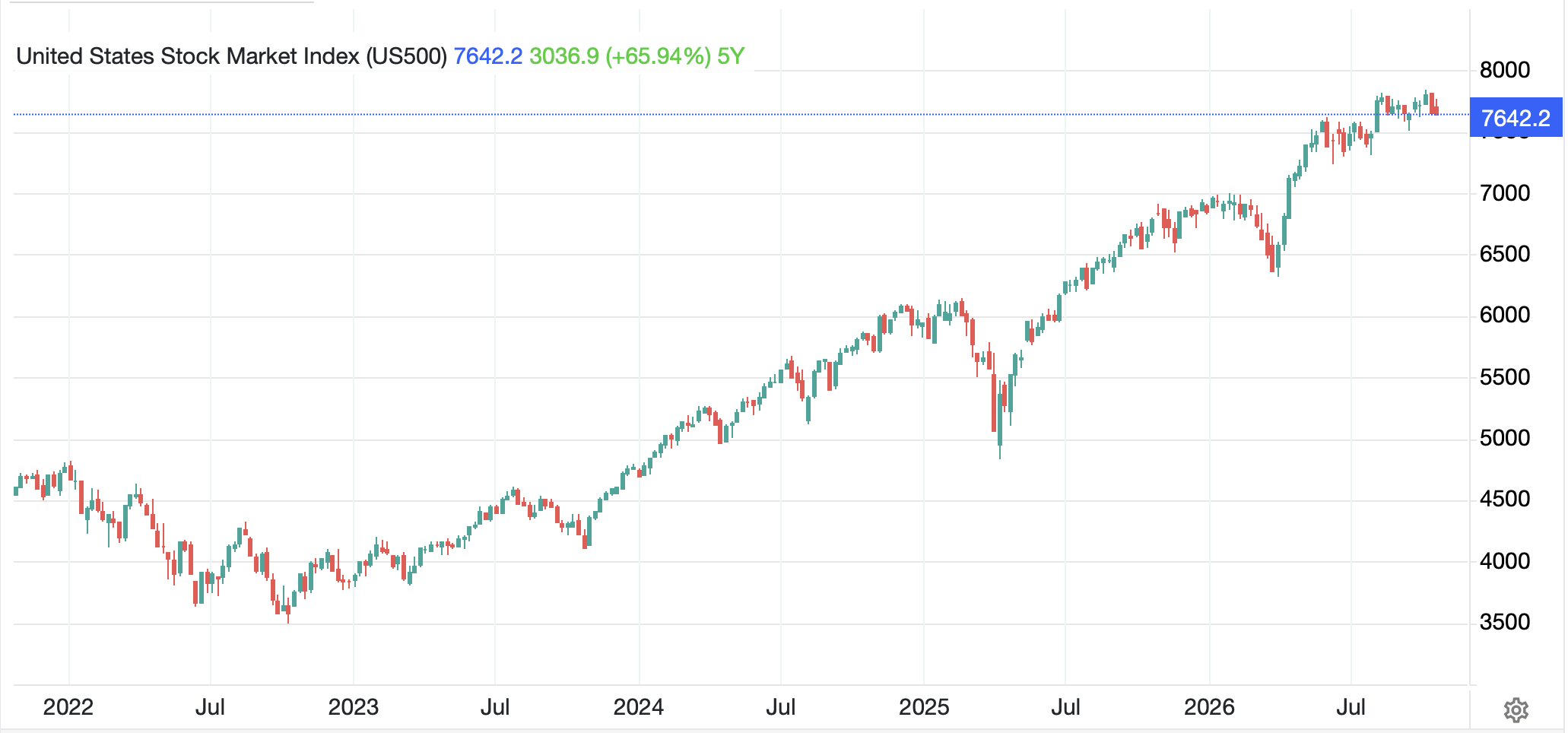
Now, yesterday was the 21st time the S&P 500 fell more than 1% this year. That may seem like a lot but the average number of days that has occurred over time is…29 days. In other words, this is hardly new ground. And remember, it is still higher by nearly 14% YTD. The world is not ending, just look at the chart below, but it would not be surprising to have a period of range trading before the next major catalyst arrives.
Source: tradingeconomics.com
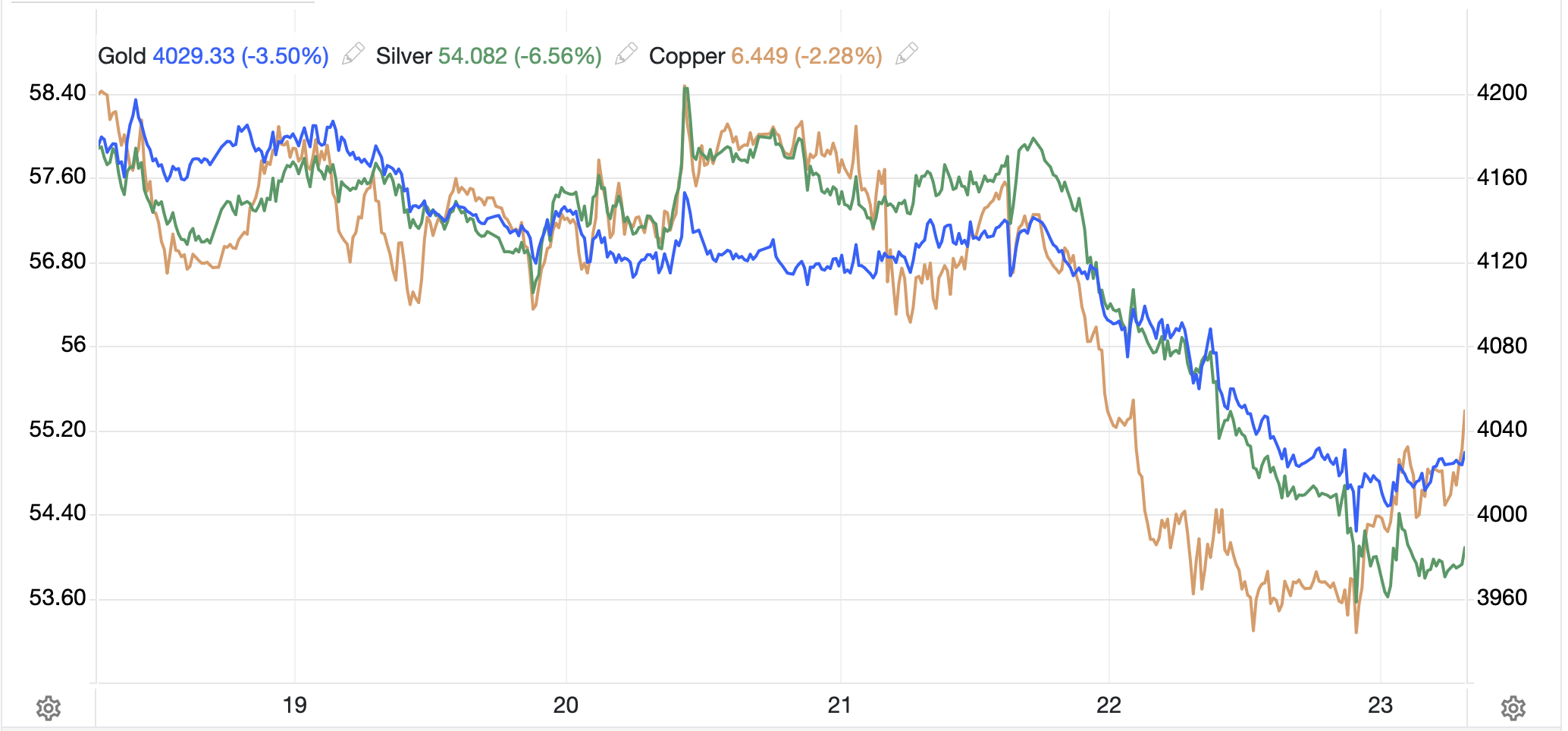
Looking at the metals markets, I believe the idea of a picture is worth 1000 words is very clear here.
Source: tradingeconomics.com
I cannot tell if this is long liquidation or short initiation, we will know more after the Commitment of Traders report is released this afternoon, but there are clearly more aggressive sellers than buyers here. However, a look at the history of metals markets, especially precious metals, is one of long periods of stagnation followed by significant rises over time. There are those who believe we are entering a deflationary economy, but I disagree with that view. While productivity enhancements are very likely to be a result of AI adoption, the biggest deflationary force over the past 25 years has been globalization and the movement of so much manufacturing to China. As more and more production gets returned to other nations, that price pressure will decrease and inflation will rise. Personally, I have not observed much in the way of deflation, or even disinflation. I’d be interested in hearing if you have.
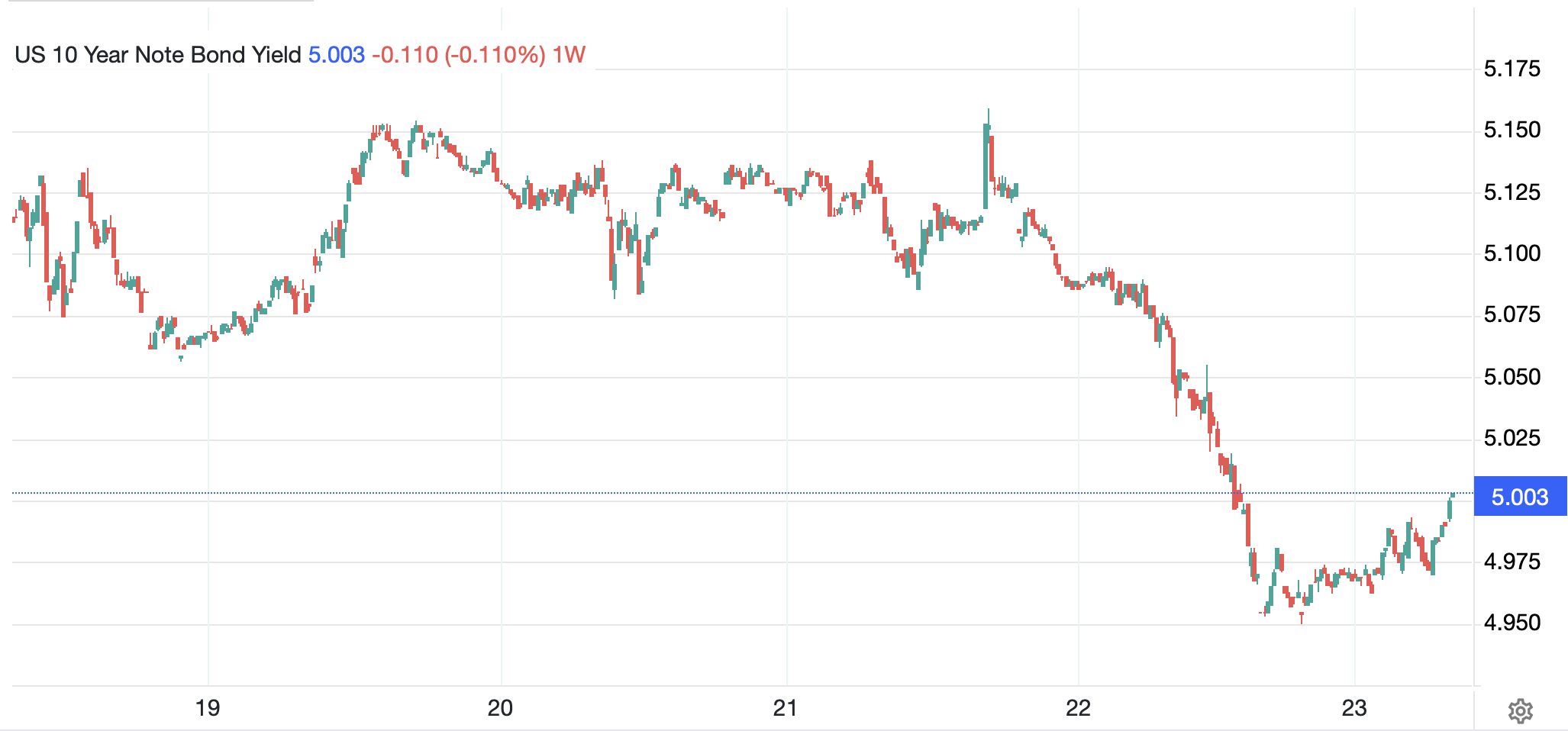
One last thing about yesterday, which perhaps should have been at the top, is US Treasury yields. While this morning they have edged higher by 4bps, that is after a 16bp decline yesterday as per the below chart.
Source: tradingeconomcis.com
If ever there was a clear sign of flight to quality/safety, yesterday’s bond market activity is Exhibit A. Perhaps the more interesting feature of this was that the dollar did not rally in sync with the bond market. In fact, it slipped a bit yesterday, although is higher by 0.2% this morning. again, history has shown that in a significant risk-off session, the dollar typically rises sharply if for no other reason than international buyers of Treasury bonds need to buy dollars. So, either they already had those dollars, or all the movement was domestic. At least those are the two best theories I can come up with for now. The yen did rally 0.9% yesterday, showing its haven status while the Swiss franc rallied 0.5%, although that has given it all back this morning. It appears that many long-standing relationships are coming under pressure lately.
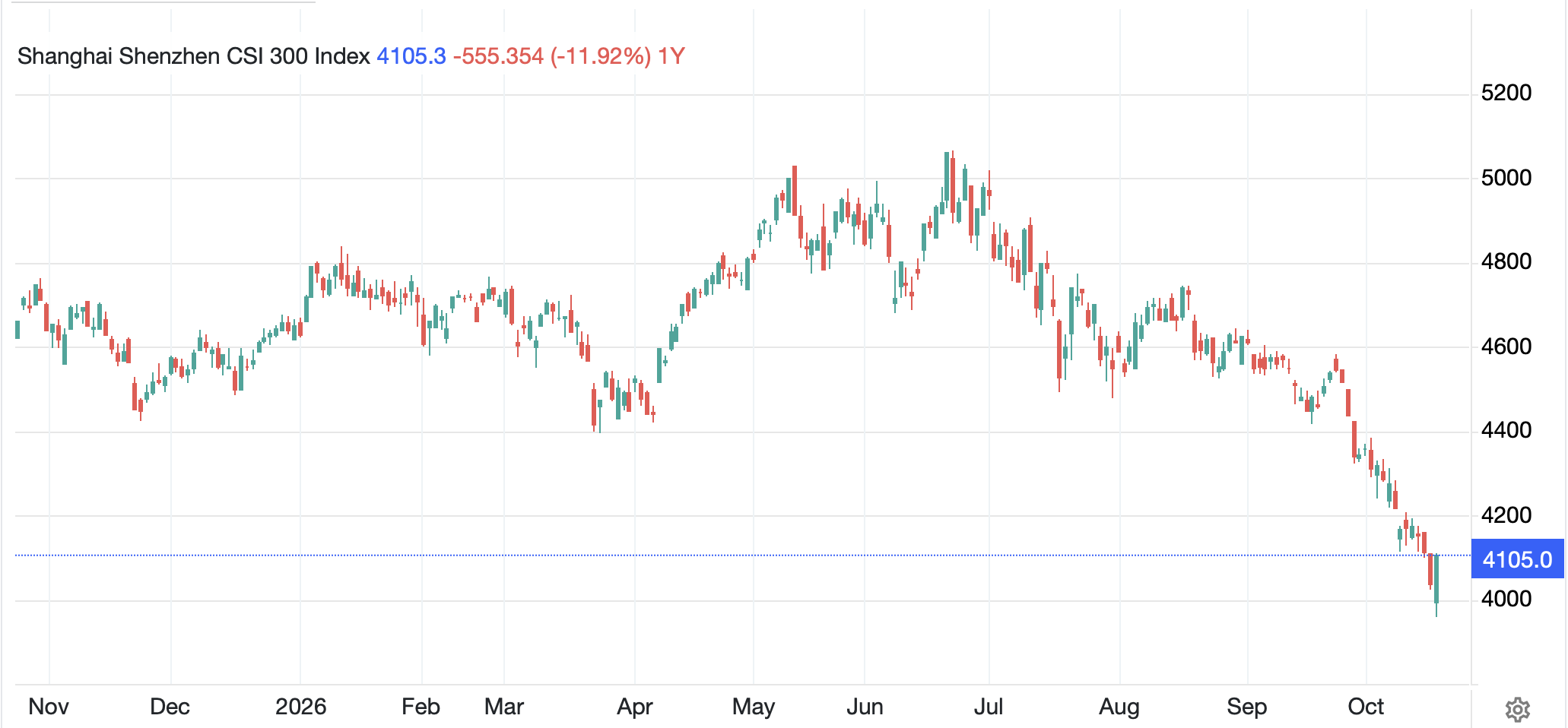
OK, let’s look at how other markets behaved overnight and what they are doing this morning. in the equity markets, Tokyo (-0.3%) slipped a bit and we saw weakness throughout many of the other regional bourses (India -0.2%, Taiwan -1.8%, Philippines -0.9%), but China (+1.7%) and HK (+0.7%) were the beneficiaries of the Plunge Protection China National Team buying aggressively as they try to halt the months’ long slide that had really accelerated over the past month as per the below. Since its high in late June, the CSI 300 had fallen more than 20% before last night’s official action.
Source: tradingeconomics.com
Alas for the Europeans, they don’t have enough money to support their own stock markets, and every major bourse is lower there this morning ranging from the DAX (-0.7%) to Spain’s IBEX (-0.2%). The news of note was that the Flash PMI data was released at weaker than last month, and weaker than expected levels, notably France was very weak, not surprisingly. As to US futures, they are somewhat softer this morning, with the DJIA (-0.6%) the laggard although yesterday that was unchanged. The other two major indices are only slightly lower.
In the bond markets, European bonds are little changed to 1bp higher this morning and only some of them benefitted from that haven trade yesterday. But JGBs (-7bps) and AGBs (-9bps) both saw real demand. Again, the bond market story appears to be a growing willingness to own with the current yield structure.
We discussed commodities already and the dollar remains lackluster at best. While it is slightly higher against other G10 currencies this morning, we are talking about 0.2%, nothing to get excited about. In the EMG space, ZAR (-0.7%) is today’s laggard as it continues to suffer from weak gold prices and high oil prices, a deadly combination for that country, and it has its own internal fiscal issues as well. However, my observation is that the FX market, which for the past decade, at least, had become tightly intertwined with other markets, seems to be breaking away to its prior status as a very large, liquid place but living on its own stories rather than broad market themes. Perhaps this is just a short stint of this, but we will need to watch closely going forward.
On the data front, this morning brings Flash PMI here (exp Mfg 55.5, Services 58.0) and then Michigan Confidence (46.3). As next week is central bank week, we will touch on those things then, but for now, the market assumption is no Fed action next week.
And that’s really it. My portfolio hedge did its job yesterday, but I do not anticipate a wipeout today, rather a fairly dull market seems the most likely outcome. It’s a beautiful weekend in NY, don’t be surprised if markets slow down early as traders look to get out for a late season break ahead of the coming winter.
Good luck
Adf

