Just a Bad Dream

Before yesterday traders whined
‘Bout how much that vol had declined
But President Trump
Caused copper to dump
And still, Chairman Powell, maligned
 
So, chaos is now the new theme
Though most hope it’s just a bad dream
And ere the week ends
Based on recent trends
We could see, results, more extreme


It isn’t often that copper is the talk of the town, but this is a new world in which we live, and as I’ve repeatedly explained, all that we think we knew about the way things work, or have worked in the past, is generically wrong.  It is with this in mind that I lead with a chart of the copper price, which after having rallied dramatically back in April, after Liberation Day, and again in July, both times on the back of tariff announcements, collapsed yesterday when President Trump altered the conversation by explaining that tariffs on copper would not be on the raw metal itself, but rather on refined products instead.  As you can see from the chart, this resulted in a massive decline, nearly 23% in the past twenty-four hours. 

Source: WSJ.com

Essentially, the US price, as traded on the COMEX, returned to be in line with the ROW price, as traded on the LME.  That doesn’t make the move any less dramatic, but the question of how long those price differentials could be maintained was always an open one.  At any rate, that was the biggest mover of the day yesterday and naturally, it had knock-on effects elsewhere with the entire metals complex falling sharply (Au -1.85%, Ag -3.0%, Pt -9.7%) as well as some currencies that are linked to those metals like CLP (-1.5%) and ZAR (-1.4%).  Remember how much complaining there was because market activity had slowed so much?  I bet most folks are looking wistfully at that pace this morning!

Turning to the other key focus of yesterday, the FOMC meeting, the FOMC statement was exactly as expected, with continued focus on “solid” labor market conditions and moderate economic activity acting as the rationale to leave rates on hold.  As widely expected, both Governors Bowman and Waller dissented, each calling for a 25 basis point cut.  The two schools of thought continue to be 1) headline data releases have been masking underlying economic weakness (declining home sales, declining air travel and restaurant activity); and 2) while those issues may be real at the margin, the fact that financial markets continue to rise, with significant speculative activity in things like meme coins and cryptocurrency in general, as well as Private Credit, indicate there is ample liquidity in the market and no reason to adjust policy.

This poet, while not a PhD economist (thankfully!), comes down on the side of number 2 above.  There has been talk by numerous, quite smart analysts, about the underlying weakness in the economy and how the data would be demonstrating it very soon.  Whether it is the makeup of the employment situation, the housing market showing a huge imbalance of homes for sale vs. buyers (at least at current prices) or the added uncertainty of tariffs and how they will impact the economy, this story has been ongoing for more than three years without any proof.  In fact, yesterday’s GDP reading for Q2 was a much higher than expected 3.0%, once again undermining the thesis that the economy is already in a recession.  If so, it is the fastest economic growth ever seen in a recession.

In fact, I do not understand the rationale for so many that a rate cut is necessary.  I realize the market continues to price a 60% probability of a cut in September and about 35bps of cuts by year end, but it makes no sense to me.  In fact, the market is pricing for 110 basis points of cuts through 2026.  Now, either market participants are anticipating a significant slowdown in inflation, which given all the tariff talk seems unlikely, or they see that recession on the horizon.  At this point, I have come to believe it is nothing more than wishful thinking because there is such a strong belief that Fed funds rate cuts lead to higher equity prices, and after all, isn’t that the goal?

Chairman Powell, despite all the pressure he receives from the White House, has not budged.  In this instance, I believe he is correct.  After all, if the data suddenly implodes, the Fed can cut far more substantially and do so on an intermeeting basis if necessary.  Remember, ahead of the election, he cut rates 50bps for no discernible reason based on the data.  Unemployment had risen from 3.9% to 4.2% over the prior three months and that was enough to scare him (although there was clearly a political motive as well).  If the Unemployment Rate rises to 4.5% on September 5th, they could cut that day if they thought things were really unraveling.  If the Fed is truly data dependent, then the data does not yet point to a major economic problem.  And the one thing we know about the Trump administration’s policies is they are going to try to run the economy as hot as possible.  That does not speak to lower interest rates.

Ok, let’s look at how markets around the world absorbed these changes, and how they are preparing for today’s PCE and tomorrow’s NFP data.  Despite all the noise, the DJIA was the worst performer yesterday, sliding just -0.4%, while the NASDAQ actually rallied at the margin, +0.15%.  And this morning, futures are pointing much higher (NASDAQ +1.4%, SPU +1.1%) as both Meta and Microsoft beat estimates handily.

Overnight, while Japanese shares (+1.0%) rallied nicely, China (-1.8%) and Hong Kong (-1.6%) significantly underperformed as weaker than expected PMI data put a damper on the idea that stimulus was going to solve Chinese problems.  A greater surprise is that Korea (-0.3%) didn’t perform better given the announcement that they had agreed a trade deal with the US with 15% baseline tariffs, although that may have been announced after the markets there closed.  But the rest of Asia had a rough session with most key regional exchanges (Singapore, Philippines, Indonesia, Malaysia) all declining about -1.0% with only Taiwan (+0.35%) on the other side of the ledger.  However, if we continue to see strength in the US tech sector, and trade deals keep getting inked, I suspect these markets will be able to rebound.

In Europe, the picture is also mixed, with the CAC and DAX essentially unchanged after in-line inflation readings, while Spain’s IBEX (+0.5%) reacted positively to Current Account data while the FTSE 100 (+0.5%) rallied on strong earnings data from Rolls Royce and Shell Oil.

Perhaps the most interesting aspect of yesterday was how the bond market sat out the chaos.  Treasury yields edged higher by 2bps yesterday and this morning they have fallen back by -1bp.  European sovereign yields this morning are essentially unchanged, although a few nations have seen yields slip -1bp.  In many ways, I feel that this is confirmation that despite a lot of noise, not much has really changed.

Oil (-0.5%), is giving back some of yesterday’s $2.00/bbl surge which was based on more sanctions talk from President Trump on Russia and reviving the discussion on 100% secondary sanctions on nations that import oil from Russia.  While EIA data showed a major inventory build, the talk was more than enough to spook traders.

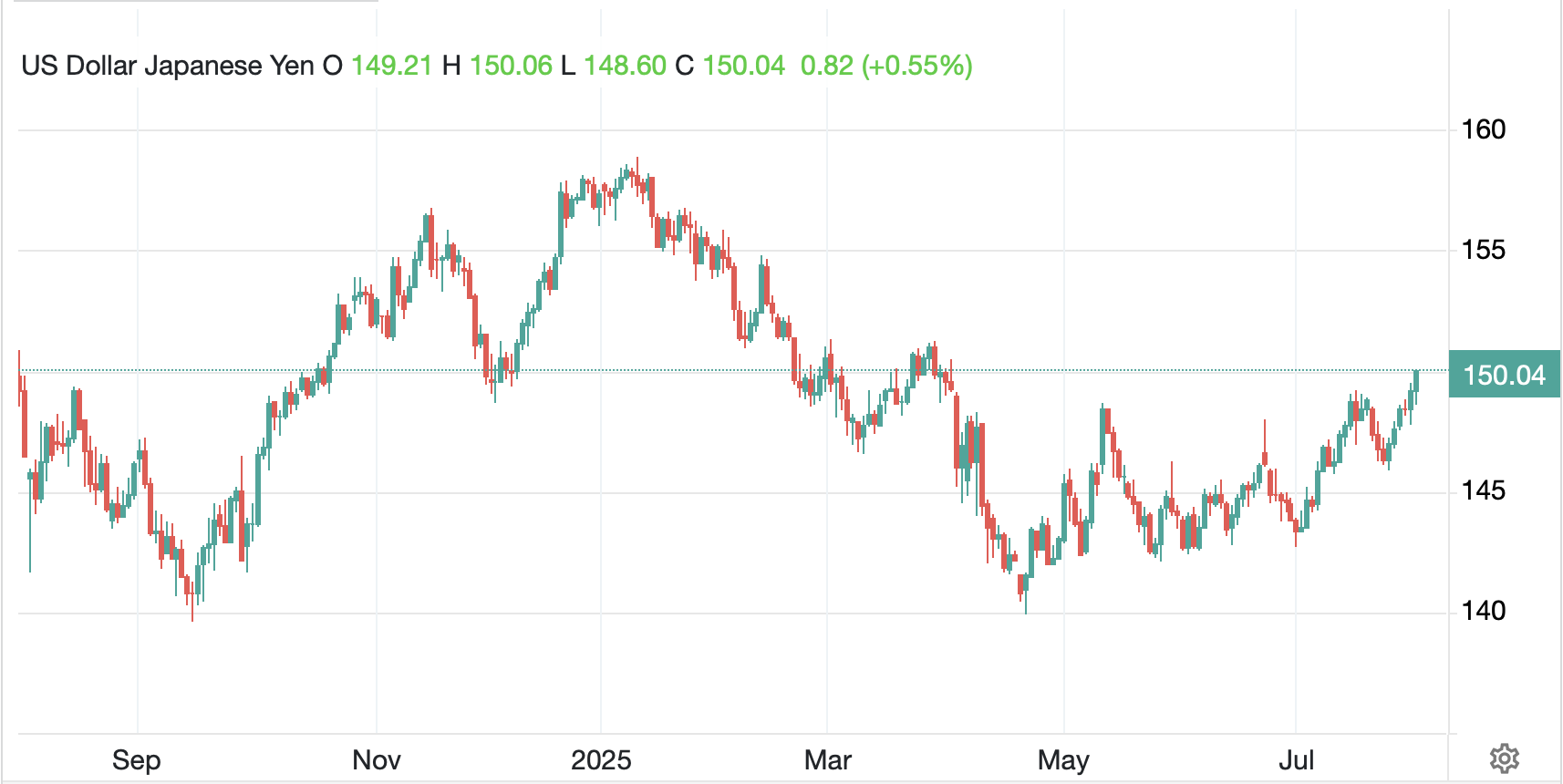
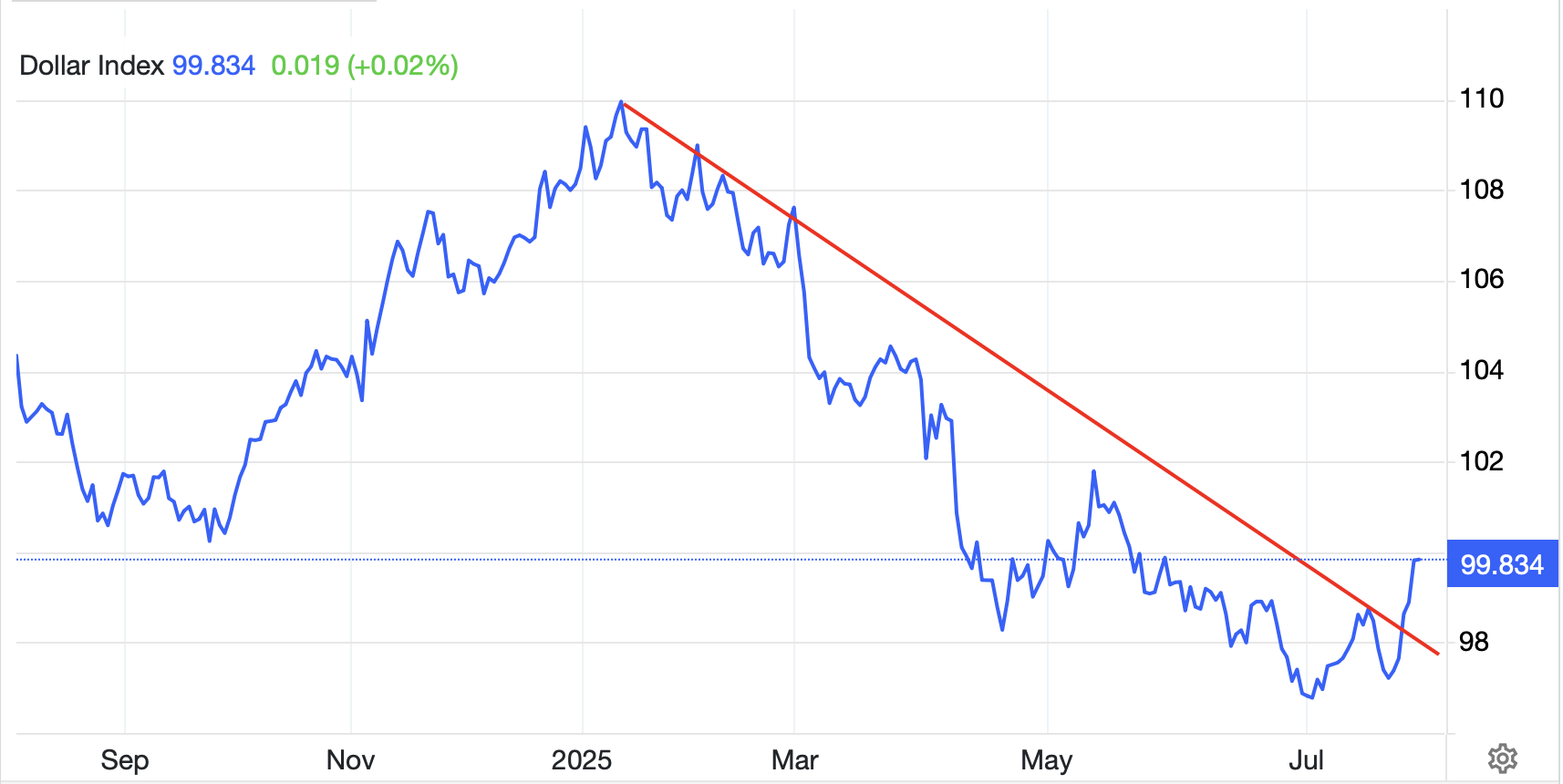
Finally, currency markets, which have seen dollar strength for the past several sessions, are relatively calm this morning, at least in the G10, where the DXY is unchanged, although at its highest level since just before Memorial Day.  In that bloc, JPY (-0.5%) is the laggard after the BOJ left policy on hold, as expected, and while the yen has not been the market’s focus lately, it is back to 150.00 this morning for the first time since March.
Source: tradingeconomics.com

Remember all the talk about the end of the carry trade and how the yen was going to explode higher?  Me neither!  As to the EMG bloc, other than the aforementioned metals focused currencies, there has not been much movement in this space either.  However, overall, while the longer-term trend has clearly been lower, this bounce looks more and more like it is gaining strength.  The DXY is a solid 2% through the trendline and a move to 102 seems well within reason in the near term.
Source: tradingeconomics.com

On the data front, this morning brings Initial (exp 224K) and Continuing (1960K) Claims, Personal Income (0.2%) and Spending (0.4%) and PCE (0.3%, 2.5% Y/Y headline, 0.3%, 2.7% Y/Y Core) all at 8:30.  Then at 9:45 we see Chicago PMI (42.0).  There are no Fed speakers and assuming today’s data is in line, I expect that all eyes will turn to earnings from Apple and Amazon after the close and then NFP tomorrow.  So, despite yesterday’s volatility, I see a respite for the day.

Good luck

Adf
The Tariff Watusi

Undoubtedly, most are confused
And many portfolios bruised
The problem I fear
Is throughout this year
Both bulls and bears will be contused


Right now, it’s the tariff Watusi
With rules that seem quite loosey-goosey
So, traders are scared
While pundits declared
The president’s just too obtuse-y


But will volatility reign
All year with the requisite pain?
Or will, as Trump said
When looking ahead
The outcome be growth once again?

(Before I start, “Ball of Confusion” is brilliant and timeless.  But isn’t Billy Joel’s “We Didn’t Start the Fire” covered and updated by Fall Out Boy, really the same song for a different generation?) Now, back to our regular programming.

  • Tariffs are a tax.  So, say seemingly all the most credentialed analysts and economists around.  
  • Tariffs are inflationary.  So, say many of these same analysts and economists.  
  • Ergo, taxes are inflationary.  So, say…well none of the credentialed analysts and economists.  (H/T to Alyosha for highlighting this idea last week.)  

But it is important to recognize this dichotomy as we listen to the many pundits and analysts who are now telling us that a recession is coming, if not already here, and the world is ending.  It seems to me if you cannot recognize this connection then your views may be colored by something other than strict logic.

We are experiencing a complete regime change in both financial markets and economic outcomes around the world and as old as I am, the last time something like this occurred was long before I was born.  I am very wary of any analyst who demonstrates any certitude in their views at this point.  Frankly, I am more inclined to listen to historians than economists, as they have potentially studied previous regime changes.  Alas, I have not so I am reliant on those who I read.

The current confusion remains over tariffs, their implementation and their impact.  To me, the key point that is missing in most of the tariff discussions is the elasticity of demand for any given product.  If something is highly inelastic and tariffs are added, then the price of that item is very likely to rise.  However, if something has very elastic demand, then a tariff will do one of two things, either the producer will absorb the cost or the volume of sales will drop dramatically, but any price rise will be constrained.

I highlight this because the weekend’s ostensible pause in tariffs on electronic goods from China is the latest discussion point.  It strikes me that under the thesis tariffs are inflationary, then inflation forecasts and expectations should now be declining.  But I haven’t seen that yet.  In the end, though, I don’t believe anybody really knows how things will evolve from here, although I believe the end goal is becoming clearer.  

It appears that President Trump’s goal is seeking to isolate China from much of the developed world.  He wants to create a situation where nations declare they are either with the US or against the US when it comes to economic relations.  I read this morning that 75 nations are in negotiations with the US regarding tariff reductions.  Given that, by themselves, the G10 represent nearly 50% of global GDP, even not knowing which nations are negotiating, the group almost certainly represents upwards of 70% or more of the global economy.  

I would contend it is still very early days with respect to the results of President Trump’s actions.  There is no question he has unleashed a certain amount of chaos in the government and in markets, but I don’t believe he is greatly concerned by that, and in fact he may welcome the process.  Regime changes are always messy, and this one is no different.  Be nimble.

Ok, let’s look at how things behaved overnight.  Friday’s US equity rally was followed by strength throughout most of Asia (Japan +1.2%, Hong Kong +2.4%, China +0.2%, Korea +1.0%, India +1.8%) with Taiwan (-0.1%) the true laggard in the region.  Clearly the tariff reprieve, even if temporary, was welcomed.  In Europe, too, the gains are strong and widespread with the DAX (+2.3%) leading the way but the rest of the Continent and the UK all up at least 1.8%.  And at this hour (6:30) US futures are higher by around 1.0% as well.

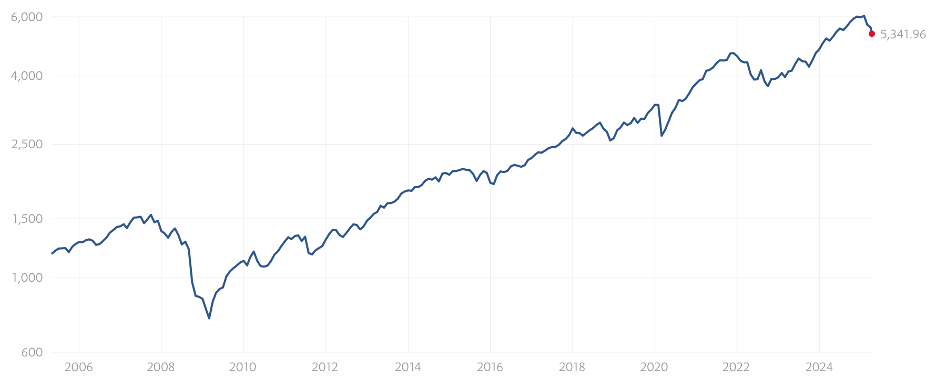
But let’s keep things in perspective.  The below chart of the S&P 500 over the past 20 years can help you understand the magnitude (or lack thereof) of the recent decline.  Yes, the index is lower by about 12% from the all-time highs set in February, and yes, uncertainty is rife.  But if you ever wanted to understand what has happened since the Fed’s response to the GFC led to the financialization of the entire economy, the latest minor dip is being described as catastrophic by the punditry.  It’s not!

Source: multpl.com

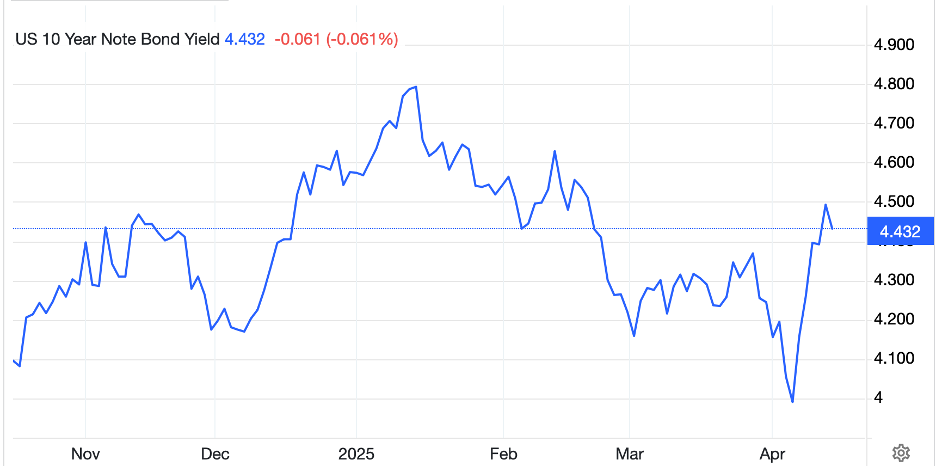
Next, the Treasury bond market has been the focus of a great deal of angst lately.  Once again, these same analysts and economists claim the world is ending because yields have risen over the past week.  I grant the movement has been sharp, but my experience tells me that when a market as liquid as 10-year Treasuries moves this sharply, it is a position liquidation that is driving the move.  In fact, both the 10-year and 30-year auctions last week seemed to have gone quite well, with strong demand.  So, I am not of the opinion the bond market is about to collapse, nor do I believe that China is liquidating their Treasury holdings.  Rather, hedge funds carrying significant leverage and being forced to unwind seems the most likely culprit here.  Too, remember that 10-year yields are right in the middle of their range for the past six months at 4.43% (-6bps today).

Source: tradingeconomics.com

In fact, European sovereign yields are also retreating this morning led by Italy and Greece (-9bps) with German bunds (-4bps) the laggard of the session.  With equity markets around the world rallying, it doesn’t appear this is safe haven buying.  However, I do believe that there are many investors who are pushing at least some of their equity portfolios into fixed income amidst overall uncertainty.

Turning to commodities, oil (+1.25%) seems to have found a bottom, at least in the short-term, just below $60/bbl.  While a recession doesn’t necessarily drive inflation lower, I am very comfortable with the idea that it reduces demand for energy and oil prices can slip.  Is the recent move a harbinger of recession?  I think there is too much noise to discern the signals the market is giving us right now, although a recession, which has been long awaited by many analysts, certainly seems possible.  

As to the metals markets, while both gold (-0.7%) and silver (-0.3%) are a bit softer this morning, one need only look at their performance in the past week (both higher by more than 7%) to recognize that there is a great deal of growing demand for precious metals.  Dr Copper (+0.9%), like oil today, is not indicating that a recession is coming as it, too, rose 7% last week and is higher by 15% YTD.  Again, there is a lot of noise to get through to find the signal.

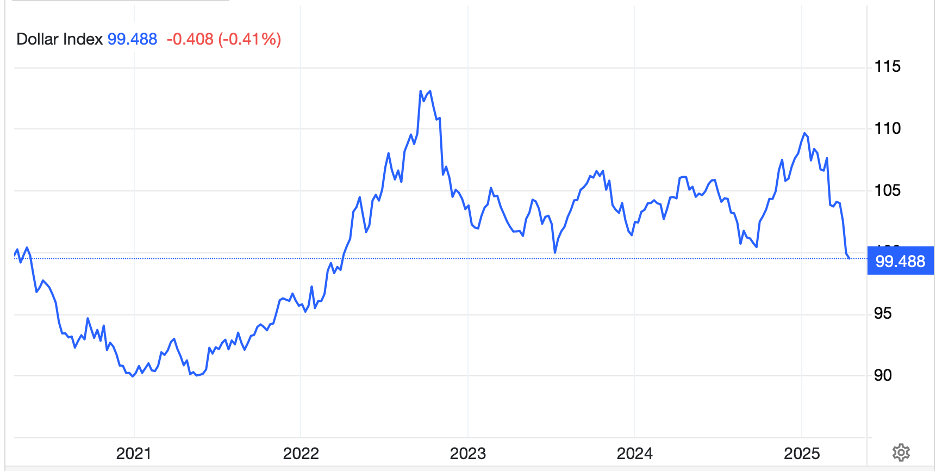
Finally, the dollar, is lower again today and is back at levels last seen…in September 2024.  And before that in July 2023 and March 2022.  In fact, if you look at the chart of the DXY below, I challenge you to show me that this decline was more dramatic than any of the three other major declines we have lived through in the past 3 years.

Source: tradingeconomics.com

Net the dollar has declined by about 10% since its recent peak in February, not insubstantial, but not unprecedented by any stretch.  In fact, over the long-term, the dollar is within spitting distance of its long-term average, which as measured by the DXY is about 104.  Looking at individual currencies, there is a strange grouping of currencies that have fallen vs. the greenback this morning, BRL (-0.85%), TRY (-0.5%), CHF (-0.5%) and CNY (-0.4%).  Given the pause in tariffs on Chinese electronic goods, CNY is confusing, as is CHF, which might imply havens are out of favor (but then why is JPY stronger?).  TRY is its own case and BRL is quite confusing.  Commodity prices have held their own or risen lately, and BRL is nothing, if not a commodity currency.  I need to search further here.  Perhaps we are seeing some carry trades being unwound.

I apologize as once again my Monday missive has grown too long for comfort.  I will highlight the data tomorrow with Retail Sales on Wednesday as the most important data release this week and the BOC and ECB meetings on Wednesday and Thursday respectively with the market looking for no change and a 25bp cut respectively.

The world is a messy place right now, with armed conflict now being joined by economic conflict.  Opinions are hardening along political lines, and I don’t see how this changes in the short run.  If you are managing risk, maintain your hedges, even if they seem expensive.  There are too many opportunities for large movements that can be costly.

Good luck

Adf