Stress and Dismay

The only discussion today
Is how badly tariffs will weigh
On stocks and on growth
As certainly both
Will feel some more stress and dismay
 
But hopefully, once they’re in force
It will change the pundits’ discourse
‘Cause I’m sick and tired
That it’s now required
We all, tariffs, hate or endorse


A funny thing happened on the way to the market collapsing yesterday, especially given the early morning portents, and that is the market didn’t collapse at all.  Equities opened lower and rallied all day with the Dow even having a quite respectable 1% gain when all was said and done.  I think the lesson that needs to be taken from this is markets have a tendency to get ahead of the news and reversals are pretty frequent.  In fact, this is a perfect example of ordinary market behavior, a sharp move in one direction is suddenly reversed for no obvious reason.  Certainly, there was nothing said or done yesterday that seemed a specific catalyst for a short-term rebound.  That, my friends, is simply how markets work.

However, for now, with tomorrow being President Trump’s “liberation day” when tariffs will be announced, they remain the major story across both financial markets and political narratives.  As I sit here in the cheap seats, observing the back and forth, what has become abundantly clear is that the politicization of economic actions is the true reality.  Yesterday I highlighted the difference between Democrat and Republican views on future inflation.  Reading through the commentary on X, as well as stories in Bloomberg and the WSJ, I think this is the same situation, with Democrats certain tariffs will be the downfall of the economy and lead to rampant inflation, while Republicans believe they will help the nation recapture lost manufacturing capacity.  Personally, I’m just looking forward to moving on to a different story as we have been discussing tariffs for more than two months straight and it is tiresome.

Here’s the one thing of which I am confident, however, and that is nobody has any idea what the impacts will ultimately be on either markets or the economy.  I maintain that pretty much every model that has been in use for the past two decades, all of which were developed based on data during a period of low inflation and declining interest rates as well as significant increases in central bank provided liquidity, no longer work.  After all, those underlying conditions no longer exist.  Inflation remains much higher than during the pre-pandemic decades;
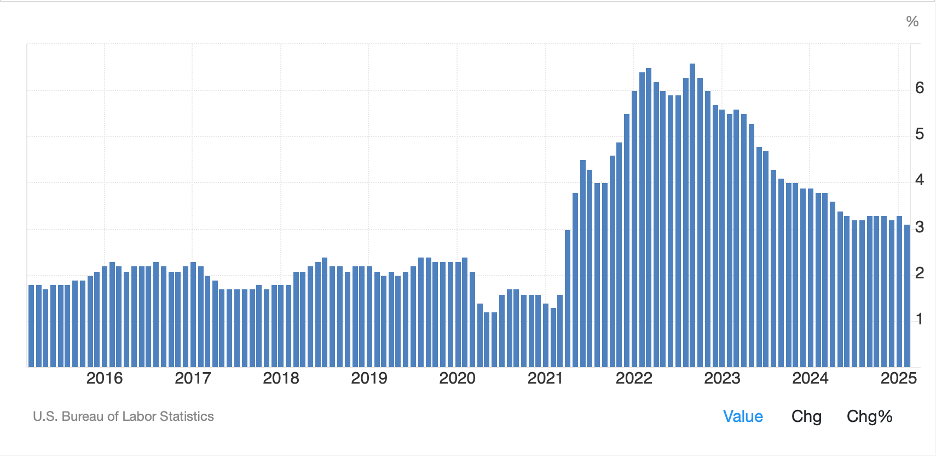
Source: tradingeconomics.com

Interest rates are much higher;

Source: fred.stlouisfed.org

And central banks have been reducing net liquidity for some time now (think QT). 

Source: tradingeconomics.com

So, if all the underlying conditions have changed, it seems unlikely that the models based on those conditions will add much value.  After all, nobody really knows how elastic prices are for any given goods directly, nor how willing companies will be to sacrifice margin to maintain sales.  As such, forecasting short-term movements is a mugs’ game here.  In fact, yesterday’s price action is a perfect example of how things are not necessarily how they appear.

With that in mind, let’s see how yesterday’s risk reversal in US equity markets fed into the rest of the world.  Asian equities saw a wide range of price action overnight.  While Japan, Hong Kong and China were all tantamount to unchanged, Korea (+1.6%) and Taiwan (+2.8%) saw significant bounces while India (-1.8%) fell after concerns that President Trump’s mooted additional sanctions on any nation that buys Russian oil hit home as India buys, I read, 44% of their oil from Russia.  Meanwhile, in Europe, screens are green this morning with gains across the board of between 0.7% and 1.0%.  This is despite weaker PMI data, with every nation in Europe reporting a sub 50 manufacturing number.  However, inflation fell a tick more than expected with Core falling to 2.4% and headline down to 2.2% and this has encouraged traders to believe that the ECB will be cutting again later this month despite some commentary to the contrary from several ECB members.  As to US futures, at this hour (7:15) they are pointing lower by about -0.4% across the board.  

In the bond market, 10-year yields continue to slide around the world with Treasuries (-5bps) falling back to their lowest level in a month and prior to that since early December.  Too, European sovereigns are seeing yields fall sharply, with declines of between -6bps and -10bps as the combination of slowing inflation and weak PMI data has overwhelmed the previous concerns about German defense spending.  In fact, that is a story we have not heard in a while, eh?  Last week, that was the end of European bond markets, today it is ancient history!

Turning to commodities, oil (+0.1%) is consolidating after a sharp $2/bbl rise yesterday that was fomented by Trump’s threats to both Russia and Iran (he threatened to bomb them if they didn’t renounce their nuclear ambitions).  The thing about oil’s price action is since late 2022, it has remained in a trading range of $65/$80 more or less, so despite the large move yesterday, I would argue no new ground has been covered.  Certainly Trump’s efforts to open up more area for drilling is likely to weigh on prices over time, but over what timeframe remains to be seen.  As it is a day ending in “y”, gold is higher again, this morning by 0.3%, but there is no indication this trend is running out of steam.  The remarkable thing is the steadiness of the move.  However, the other two major metals, silver (-0.35%) and copper (-0.3%) have slipped a bit this morning.

Finally, the dollar remains confused.  Versus the euro (-0.25%) it is stronger, but versus the CHF (+0.25%) and JPY (+0.5%) it is weaker.  Now, you might say that is a sign of a risk-off trade, but equity markets are rallying in Europe along with bonds.  So, is this a move to havens or risk?  The biggest mover this morning is CLP (-0.9%) but it has been one of the biggest gainers YTD, so with copper soft, this looks a lot like some profit taking.  Otherwise, movements of +/- 0.2% are the order of the day.

Here’s a crazy theory, perhaps President Trump is seeking to drive the economy weaker in order to force the Fed to cut rates.  After all, that appears to be the Fed’s bias, but recent inflation data has made them uncomfortable to do so.  If Trump can drive up Unemployment, maybe it does the trick!

Ok, let’s see the data the rest of the week as yesterday’s Chicago PMI (47.6) while modestly better than expected really didn’t seem to matter that much.

TodayISM Manufacturing49.5
 ISM Prices Paid65.0
 JOLTS Job Openings7.63M
WednesdayADP Employment105K
 Factory Orders0.5%
 -ex Transport0.7%
ThursdayInitial Claims225K
 Continuing Claims1860K
 Trade Balance-$123.0B
 ISM Services53.0
FridayNonfarm Payrolls128K
 Private Payrolls110K
 Manufacturing Payrolls1K
 Unemployment Rate4.2%
 Average Hourly Earnings0.3% (3.9% Y/Y)
 Average Weekly Hours34.2
 Participation Rate62.4%

Source: tradingeconomics.com

In addition to all this, we hear from six Fed speakers including Chairman Powell Friday morning at 11:30am.  For today and tomorrow, tariffs will be the primary story, although it is not clear it is the primary driver.  However, once they are announced, I expect we will move onto the next big thing, although I have no idea what that will be.  But the one thing on which we can count regarding President Trump is there will be another big thing.  Stay hedged is all the advice I can give because uncertainty is extremely high.

Good luck

Adf
As It’s Been Wrote

Though China would have you believe
Their goals, they are set to achieve
Their banks are in trouble
From their housing bubble
So capital, now, they’ll receive
 
Meanwhile, with Ukraine there’s a deal
For mineral wealth that’s a steal
This will help the peace
If war there does cease
And so, it has broader appeal
 
But really, the thing to denote
Is everything is anecdote
The data don’t matter
Unless it can flatter
The narrative as it’s been wrote


Confusion continues to be the watchword in financial markets as it is very difficult to keep up with the constant changes in the narrative and announcements on any number of subjects.  And traders are at a loss to make sense of the situation.  This is evidenced by the breakdown in previously strong correlations between different markets and ostensibly critical data for those markets.  

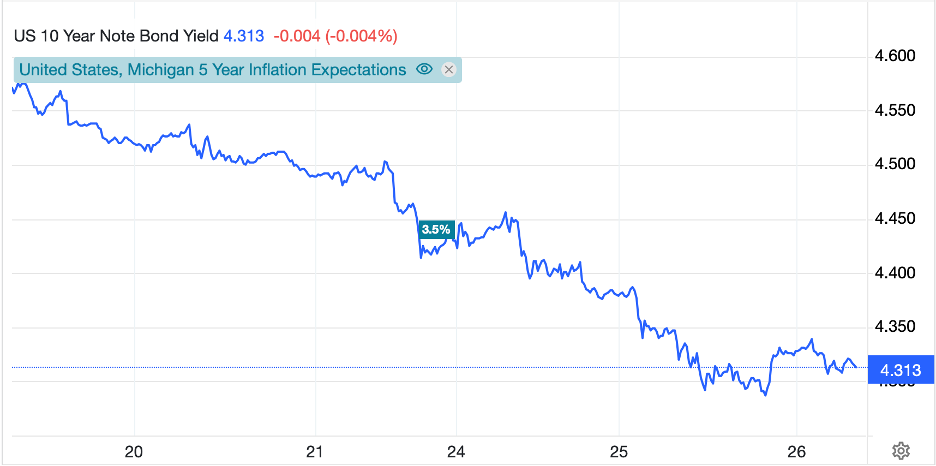
For example, inflation expectations continue to rise, at least as per the University of Michigan surveys, with last week’s result coming in at 4.3% for one year and 3.5% for 5 years.  And yet, Treasury yields continue to fall in the back end of the curve, with 10-year Treasury yields lower by nearly 15bps since that report was released on Friday.  So, which is it?  Is the data a better reflection of things?  Or is market pricing foretelling the future?

Source: tradingeconomics.com

At the same time, the Fed funds futures market is now pricing in 55bps of cuts this year, up from just 29bps a few weeks ago.  Is this reflective of concerns over economic growth?  And how does this jibe with the rising inflation expectations?  

Source: cmegroup.com

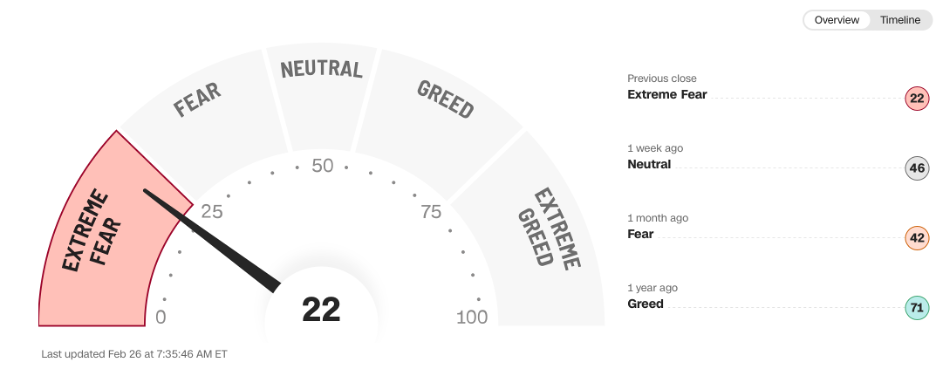
If risk is a concern, why is the price of gold declining?  

Source: cnn.com

My point is right now, at least, many of the relationships that markets and investors have relied upon in the past seem to be broken.  They could revert to form, or perhaps this is a new paradigm.  In fact, that is the point, there is no clear pathway.

Sometimes a better way to view these things is to look at policy actions at the country level as they reflect a government’s major concerns.  I couldn’t help but notice in Bloomberg this morning the story that the Chinese government is going to be injecting at least $55 billion of equity into their large banks.  Now, government capital injections are hardly a sign of a strong industry, regardless of the spin.  This highlights the fact that Chinese banks remain in difficult straits from the ongoing property market woes and so, are clearly not lending to industry in the manner that the government would like to see.  I’m not sure how injecting capital into large banks that lend to SOE’s is helping the consumer in China, which allegedly has been one of their goals, but regardless, actions speak louder than words.  Clearly the Chinese remain concerned over the health of their economy and are doing more things to support it.  As it happens, this helped equity markets there last night with the Hang Seng (+3.3%) ripping higher with mainland shares (+0.9%) following along as well.  Will it last?  Great question.

Another interesting story that seems at odds with what the narrative, or at least quite a few headlines, proclaimed, is that the US and Ukraine have reached a deal for the US to have access to Ukrainian rare earth minerals once the fighting stops.  The terms of this deal are unclear, but despite President Zelensky’s constant protests that he will not partake in peace talks, it appears that this is one of the steps necessary for the US to let him into the conversation.  Now, is peace a benefit for the markets?  Arguably, it is beneficial for lowering inflation as the one thing we know about war is it is inflationary.  If peace is coming soon, how much will that help the Eurozone economy, which remains in the doldrums, and the euro?  Will it lower energy prices as sanctions on Russian oil and gas disappear?  Or will keeping the peace become a huge expense for Europe and not allow them to focus on their domestic issues?

Again, my point is that there are far more things happening that add little clarity to market narratives, and in some cases, result in price action that is not consistent with previous relationships.  With this I return to my preaching that the only thing we can truly anticipate is increased volatility across markets.

With that in mind, let’s consider what happened overnight.  First, US markets had another weak session, with the NASDAQ particularly under pressure.  (I half expect the Fed to put forth an emergency rate cut to support the stock market.)  As to Asian markets, that Chinese news was well received almost everywhere except Japan (Nikkei -0.25%) as most other markets gained on the idea that Chinese stimulus would help their economies.  As such, we saw gains virtually across the board in Asia.  Similarly, European bourses are all feeling terrific this morning with the UK (+0.6%) the laggard and virtually every continental exchange higher by more than 1%.  Apparently, the Ukraine/US mineral rights deal has traders and investors bidding up shares for the peace dividend.  Too, US futures are higher at this hour, about 0.5% or so across the board.

As to bond yields, after a sharp decline in Treasury yields over the past two sessions, this morning, the 10-year is higher by 1bp, consolidating that move.  Meanwhile, European sovereign yields are all slipping between -2bps and -4bps as the peace dividend gets priced in there as well.  While European governments may be miffed they have not been part of the peace talks, clearly investors are happy.  Also, JGB yields, which didn’t move overnight, need to be noted as having fallen nearly 10bps in the past week as the narrative of ever tighter BOJ policy starts to slip a bit.  While the yen has held its own, and USDJPY remains just below 150, it appears that for now, the market is taking a respite.

In the commodity markets, oil (-0.25% today, -2.0% yesterday) has convincingly broken below the $70/bbl level as this market clearly expects more Russian oil to freely be available.  OPEC+ had discussed reducing their cuts in H2 this year, but if the price of oil continues to slide, I expect that will be changed as well.  Certainly, declining oil prices will be a driver for lower inflation, arguably one of the reasons that Treasury yields are falling.  So, some things still make some sense.  As to the metals markets, gold (-0.2%) still has a hangover from yesterday’s sharp sell-off, although there have been myriad reasons put forth for that movement.  Less global risk with Ukraine peace or falling inflation on the back of oil prices or suddenly less concern over the status of the gold in Ft Knox, pick your poison.  Silver is little changed this morning but copper, which had been following gold closely, has jumped 2.7% this morning after President Trump turned his attention to the red metal for tariff treatment.

Finally, the dollar is firmer this morning, recouping most of yesterday’s losses.  G10 currencies are lower by between -0.1% (GBP) and -0.5% (AUD) with the entire bloc under pressure.  In the EMG space, only CLP (+0.45%) is managing any strength based on its tight correlation to the copper price.  But otherwise, most of these currencies have slipped in the -0.1% to -0.3% range.

On the data front, New Home Sales (exp 680K) is the only hard data although we do see the EIA oil inventory numbers with a small build expected.  Richmond Fed president Barkin speaks again, but as we have seen lately, the Fed’s comments have ceased to be market moving.  President Trump’s policy announcements are clearly the primary market mover these days.

Quite frankly, it is very difficult to observe the ongoing situation and have a strong market view in either direction.  There are too many variables or perhaps, as Donald Rumsfeld once explained, too many unknown unknowns.  Who can say what Trump’s next target will be and how that will impact any particular market.  In fact, this points back to my strong support for consistent hedging programs to help reduce volatility in one’s financial reporting.

Good luck

Adf

A Fifth Wheel

Confusion is clearly what reigns
As even the punditry strains
To understand whether
Investors will tether
Their future to stocks or take gains


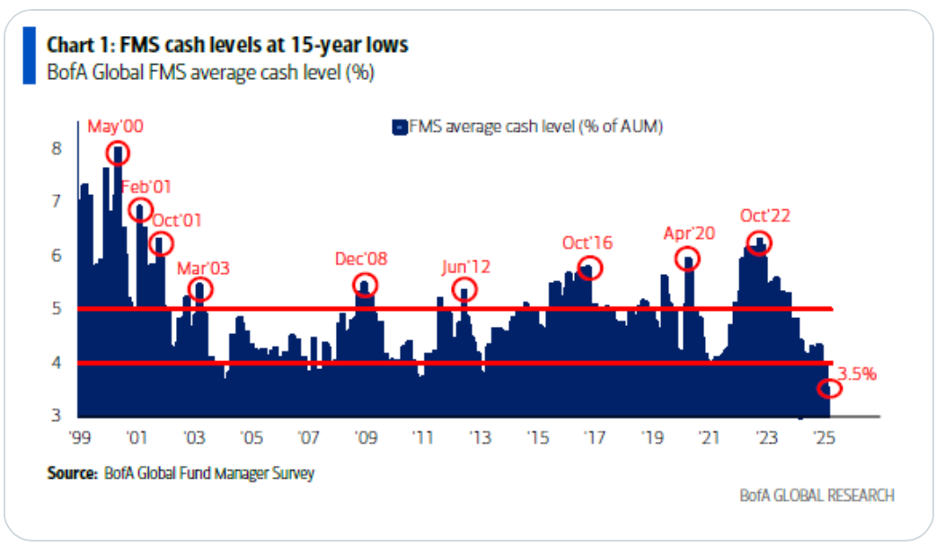
As there was no activity in the US financial markets yesterday, it seems there was time for analysts to consider the current situation and make pronouncements as to investor behavior.  Ironically, we saw completely opposite conclusions from two major players.  On the one hand, BofA posted the following chart showing that investors’ cash holdings are at 15-year lows, implying they remain fully invested and quite bullish.

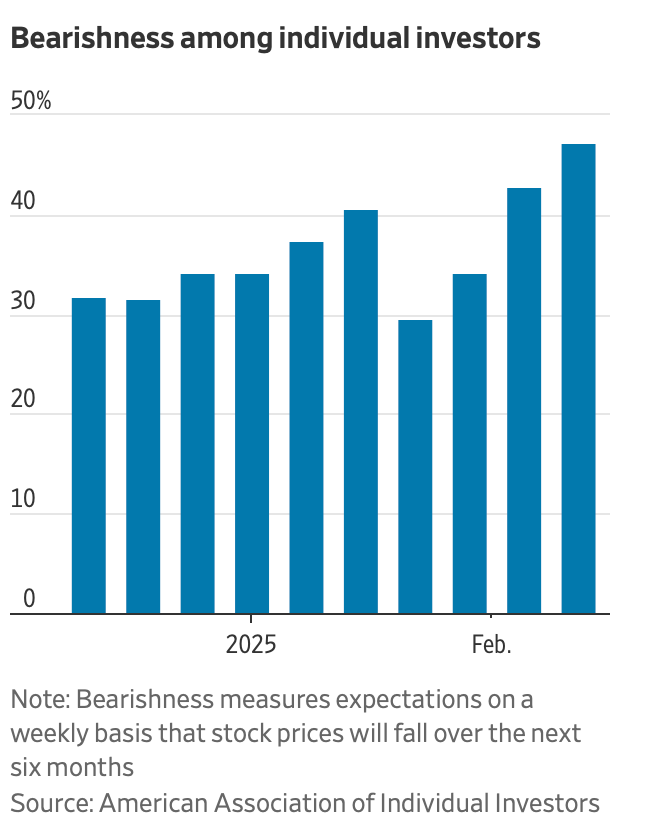
Meanwhile, the WSJ this morning has a lead article on how bearish investors are, claiming they are the most bearish since November 2023 according to the American Association of Individual Investors.  Apparently, 47.3% of investors surveyed believe stock prices will fall over the next 6 months.

So, which is it?  Are investors bullish or bearish?  To me this is a perfect description of the current situation.  Everyone is overloaded with information, much of which is contradictory, and so having a coherent view has become extremely difficult.  This is part and parcel of my view that the only thing we can clearly expect going forward is an increase in volatility.  In fact, someone said that Donald Trump is the avatar of volatility, and I think that is such an apt description.  Wherever he goes, mayhem follows.  Now, I also believe that people knew what they were voting for as change was in demand.  But for those of us who pay close attention to financial markets, it will take quite the effort to keep up with all the twists and turns.

Fed speakers are starting to feel
Like they have become a fifth wheel
So, let’s get prepared
For Fed speaking squared
As they work, their views, to reveal

Away from the conundrum above, the other noteworthy thing is that FOMC members are starting to feel left out of the conversation.  Prior to President Trump’s inauguration, market practitioners hung on their every word, and they apparently loved the power that came with that setting.  However, now virtually every story is about the President and his policies with monetary policy falling to a distant issue on almost all scorecards.  Clearly, for a group that had grown accustomed to moving markets with their words, this situation has been deemed unacceptable.  The solution, naturally, is to speak even more frequently, and I fear believe this is what we are going to see (or hear) going forward.  

Yesterday was a perfect example, where not only, on a holiday, did we have multiple speakers, but they actually proffered different messages.  From the hawkish side of the spectrum, Governor Michelle Bowman, the lone dissenter to the initial 50bp rate cut back in September, explained caution was the watchword when it comes to acting alongside President Trump’s mooted tariff and other policies, “It will be very important to have a better sense of these policies, how they will be implemented, and establish greater confidence about how the economy will respond in the coming weeks and months.”  That does not sound like someone ready to cut rates anytime soon.

Interestingly, from the dovish side of the spectrum, Governor Christopher Waller, an erstwhile hawk, explained in a speech in Australia (on the day the RBA cut rates by 25bps for their first cut of the cycle and ending an 18 month period of stable rates) that, “If this wintertime lull in progress [on inflation] is temporary, as it was last year, then further policy easing will be appropriate.”  I find it quite interesting that Governor Waller suddenly sounds so dovish as many had ascribed to him the intellectual heft amongst the governors.  This is especially so given that is not the message that Chairman Powell articulated either after the last meeting or at his Humphrey-Hawkins testimony recently.  

So, which is it?  Is the Fed staying hawkish or are they set for a turn?  That will be the crux of many decision-making processes going forward, not just in markets but also in businesses.  We will keep tabs going forward.

Ok, on to the market’s overnight performances.  Lacking a US equity market to follow, everybody was on their own last night which showed with the mixed results.  Japan (+0.25%) showed modest gains while the Hang Seng (+1.6%) rocketed higher on the belief that President Xi is going to be helping the economy, notably the tech firms in China, many of which are listed in Hong Kong.  Alas, the CSI 300 (-0.9%) didn’t get that memo with investors apparently still concerned over the Trump tariff situation.  Elsewhere in the region, Korea and Taiwan rallied while Australia lagged despite the rate cut.  In Europe, unchanged is the story of the day with most bourses just +/-0.1% different than yesterday’s close.  Right now, in Europe, the politicians are trying to figure out how to respond to the recent indication that the US is far less interested in Europe than in the past, and not paying close attention to financial issues.  As to the US, futures at this hour (7:25) are pointing higher with the NASDAQ leading the way, +0.5%.

In the bond market, yields are climbing led by Treasuries (+4bps) with most of Europe seeing yields edge higher by 1bp or 2bps as well.  Remember, yesterday European sovereign yields rose smartly across the board.  Also, I must note JGB yields (+4bps) which have made further new highs for the move and continue to rise.  It appears last night’s catalyst was a former BOJ member, Hiroshi Nakaso, explained he felt more rate hikes were coming with the terminal rate likely to be well above 1.0%.  While I believe the Fed will be cautious going forward, I still think they are focused on rate cuts for now.  With that in mind and the ongoing change in Japanese policy, I am increasingly comfortable with my new stance on the yen.

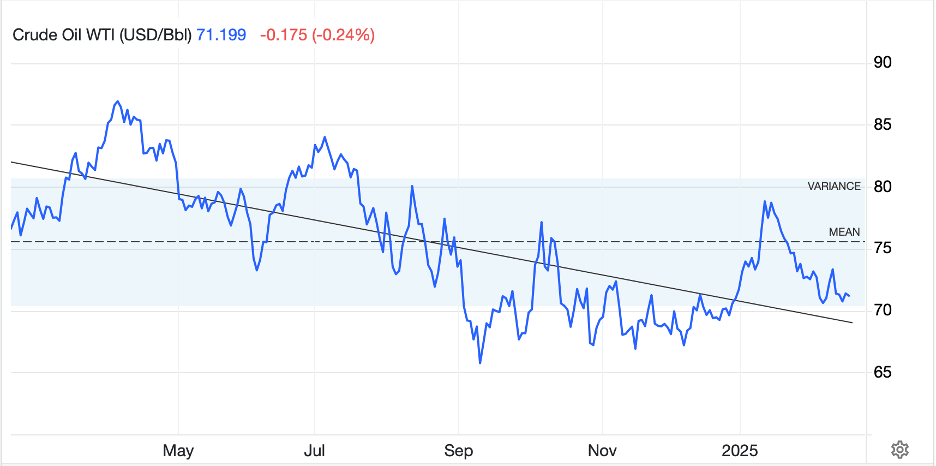
In the commodity markets, last Friday’s sell-off in the metals markets is just a bad memory with gold (+0.5%) rallying again and up more than 1% since Friday’s close.  I continue to believe those moves were positional and not fundamental.  Too, we are seeing gains in silver (+0.2%) and copper (+0.6%) to complete the triad.  Meanwhile, oil (-0.25%) continues to lag, holding above its recent lows but having a great deal of difficulty finding any buying impulse.  Whether that is due to a potential peace in Ukraine and the end of sanctions on Russian oil, or concerns over demand growth going forward is not clear to me, but the trend, as seen in the chart below, is clearly downward and has been so for the past year.

Source: tradingeconomics.com

Finally, in the FX markets, the dollar is firmer this morning rising against all its G10 counterparts with NZD (-0.6%) the laggard.  But losses of -0.2% are the norm this morning.  In the EMG bloc, we are seeing similar price behavior in most markets although MXN (+0.2%) is bucking the trend, seemingly benefitting from what appears to be a hawkish stance by Banxico and the still highly elevated interest rate differential in the peso’s favor.

On the data front, Empire State Manufacturing (exp -1.0) is the only data point although we will hear from two more Fed speakers, Daly and Barr.  I cannot believe that they have really changed their tune and expect that caution will remain their guiding principle for now, although I expect to hear that repeated ad nauseum as they try to regain their place in the spotlight.

Aside from my yen view, I still find it hard to be excited about many other currencies for now.  There is still no indication the Fed is going to move anytime soon, and other central banks are clearly in easing mode.  That bodes well for the dollar going forward.

Good luck

Adf

Waved Adios

There once were two gents, both named Bill
Whose market views oft could be shrill
Now Ackman and Gross
Have waved adios
To shorts, with positions now nil

When others all learned of this action
The bond market really gained traction
So, does five percent
In truth, represent
The highs? Or is this a distraction?

It ought to be no surprise that the bond market had a significant hiccup yesterday after the 10-year yield finally breached the 5.0% level for the first time in more than 15 years given the market’s penchant to focus on big round numbers.  However, as can be seen in the chart below, the response by traders and investors was dramatic as it appears many were waiting for that level to ‘buy the dip’ in bonds.  As such, after climbing to a high of 5.025%, the market reversed sharply with yields falling nearly 20bps at one point, although they closed slightly off the lows.

Source: Tradingeconomics.com

Ostensibly, a key driver of this move was a Tweet by hedge fund manager Bill Ackman explaining he had covered his bond short positions.  “We covered our bond short.  There is too much risk in the world to remain short bonds at current long-term rates. The economy is slowing faster than recent data suggests.”  Similarly, former bond king, Bill Gross, tweeted that he was buying bonds across the curve after calling for a recession in the 4th quarter (that’s now!).  And that’s all it took to reverse a substantial portion of the recent sell-off in Treasuries.  Perhaps more interesting was the fact that the ongoing normalization of the yield curve was not impacted much at all.  Yesterday, the 2yr-10yr spread had fallen to -18bps and this morning it is -22bps, so not all that different.

The question, of course, is what can we expect going forward?  The thing that continues to bother me is the ongoing supply question, and at what price will the Treasury be able to sell new bonds to price sensitive buyers rather than the Fed.  Nothing has changed that part of the equation and until the Fed ends QT, let alone restarts QE (which I do expect at some point in the future), I continue to believe bond yields will trend higher.  And this view considers the fact that some further economic slowing seems highly probable to me.  However, the supply issue is going to continue to be the dominant feature going forward.

One other issue is the ongoing Israeli-Palestinian conflict and how that could evolve, with many talking heads concerned that growth in that conflict will result in demand for more safety.  Certainly, the gold price has been a huge beneficiary of that situation with the barbarous relic having gained more than $120/oz in price since the attack while bond yields are actually higher by 6bps, even after yesterday’s sharp decline in yields.  However, my experience indicates that after the immediacy of any conflagration, whether Russia in Ukraine, or even 9/11, market behavior tends to move off that narrative and back to whatever was deemed relevant before the news.  I see no reason for this to be different, and before the attack, yields were rising on the supply story and robustness of the US economy.  That is the narrative that needs to change to reverse bond yields.

So, is there going to be a change in that narrative soon?  Well, depending on one’s view of the value of PMI data, the flash releases this morning were all pretty crummy with all of Europe and the UK remaining below the key 50.0 level and last night’s Australian and Japanese data also quite weak, although Japanese Services data did manage to hold above the 50.0 level.  As well, German GfK Consumer Confidence fell to -28.1, down from last month and below consensus expectations, so perhaps some economic weakness is coming our way.  

However, first, those are not US numbers and second, the US data has consistently shown hard data (NFP, Retail Sales, IP, etc.) firmer than any of the survey data.  So, while there continues to be gloom and doom on people’s minds, their actions have not yet matched those views.  Now, a case can certainly be made that the US hard data is all lagging and the current situation is far worse than those numbers imply, but the Fed is not going to respond to that story.  As long as the hard data offers cover for the Fed to maintain their current policy stance as they fight inflation, they are going to do so.  

Summing it all up leads me to believe that nothing has changed the big picture.  While yesterday’s bond move was certainly exciting, the fact that one hedge fund manager took profits is not enough to change the investment landscape.  I continue to expect stickier inflation going forward as well as a grind higher in 10yr yields as the curve normalizes.  

So, how did markets respond to all the new information?  Well, after a mixed day in the US yesterday, we saw a similar picture in Asia with the Hang Seng falling -1.0%, but most other markets edging a bit higher.  European bourses are slightly firmer this morning, but really no great shakes and US futures at this hour (8:30) are firmer by 0.6% or so.  Fear is not that evident today.

On the bond side, this morning has seen a modest bounce in US yields, just 2bps, but we are seeing a continuation lower in Europe with most sovereigns seeing yields fall about 2bps.  JGBs have also edged away from their recent high in yields, although that was after the BOJ had yet another unscheduled bond buying session, this one the largest of the five unscheduled ones so far implemented after they adjusted the YCC cap to 1.00%.  

On the commodity front, oil is essentially unchanged this morning although that is after a sharp decline yesterday which wiped out the previous week’s gains.  Gold, while still holding up reasonably well, is softer by -0.4% this morning and copper is bucking this trend, rising 0.6%, although still hovering just above 1yr lows.

Finally, the dollar, which fell yesterday a bit as yields decline sharply in the US, is bouncing this morning with the euro sliding back toward 1.06 and the DXY back at 106.00.  Neither JPY nor CNY really responded to yesterday’s price action, it was mostly European currencies doing the damage to the buck.  One thing to note is the question of whether the 10-year yield is still a key driver of the dollar or is it something else?  Brent Donnelly, a well-respected FX analyst, has an excellent article out discussing how the dollar appears to be more linked to the 2-year yield than the 10-year.  I had mentioned last week how that relationship between the dollar and yields seemed to be breaking down and his analysis shows that if you look at the 2yr yield, which hasn’t moved much at all compared to the 10yr lately, it makes more sense.  It is well worth the read.

With that in mind, then perhaps the dollar’s strength is unlikely to manifest itself as it did while the Fed was aggressively raising rates earlier in the year and 2yr yields were rising rapidly.  Instead, it is quite possible we are in for a period of relative quietude in the dollar, at least against the majors.  Emerging market currencies have a clear life of their own, and hedging decisions there need to be independent of views on the euro or pound.

On the data front, the Flash PMI’s are due here as well (exp 49.5 Manufacturing, 49.8 Services) and then the first look at oil inventories late this afternoon.  Interestingly, despite the Fed’s ostensible quiet period, Chairman Powell will be making Introductory Remarks at the 2023 Moynihan Lecture in Social Science and Public Policy tomorrow at 4:30pm.  Given the quiet concept, I find it difficult to believe he will focus on monetary policy but be aware.

All signs point to a quieter session today and perhaps for a while going forward, at least in the G10 currencies.  However, hedging is always a good idea!

Good luck

Adf