
Dine and Dash

The president left in a flash
Completing a quick dine and dash
But so far, no word
On what, this move, spurred
Though I’ve no doubt he’ll make a splash
 
Then last night the BOJ passed
On hiking, though none was forecast
And Germany’s ZEW
Implied there’s a view
That growth there will soon be amassed


I have to admit that when I awoke this morning, I expected there to have been significantly more news regarding the Iran/Israel conflict based on President Trump’s early departure from the G-7 meeting.  But, from what I see so far, while markets have reversed some of yesterday’s hope that a ceasefire was coming soon, my read is we are back to overall uncertainty in the situation.  Of course, the concept of the fog of war is well known, and I expect that we will not find out very much until those in control of the information, whether the IDF or the US military, or Iranian sources, choose to publicize things.  The one thing we know is that everything we learn will be biased toward the informants’ view, so needs to be parsed carefully.  I do think that Trump’s comments to the press when he was leaving the G-7 about seeking “an end. A real end. Not a ceasefire, an end,” to the ongoing activities is telling.  It appears the Israelis planned on a 2-week campaign and that is what they are going to complete.

From a market perspective, as we have already seen in the price of oil, and generally all asset classes, absent a significant escalation, something like a tactical nuclear strike by the Israelis to destroy the Iranian nuclear bomb-making capabilities, I expect choppiness on headlines, but no trend changes.  At some point, the fighting will end, and markets will return their focus to economic and fiscal concerns and perhaps central banks will become relevant again.

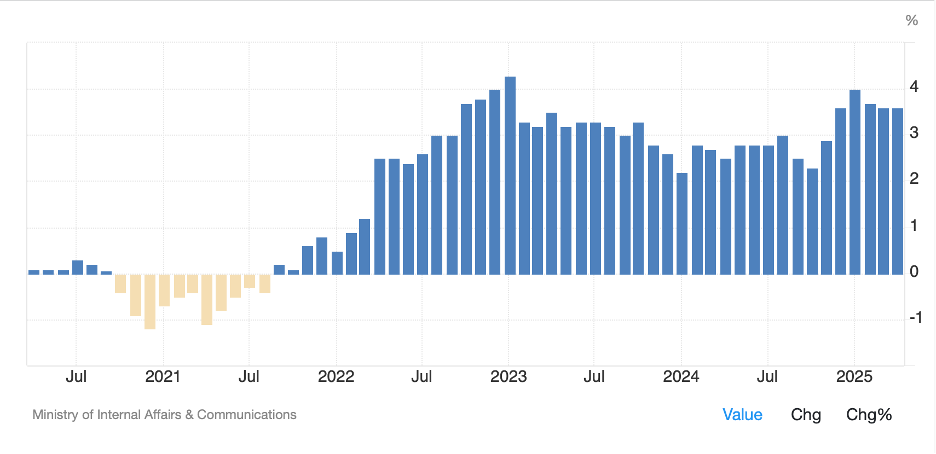
So, let’s turn to that type of news which leads with the BOJ leaving policy rates on hold, although they did reduce the amount of QE to ¥200 billion per month, STARTING IN APRIL 2026!  You read that correctly.  The BOJ, which has been buying ¥400 billion per month of JGBs while they raised interest rates in their alleged policy tightening, has decided that ten months from now it will be appropriate to slow the pace of QE.  Yes, inflation has been running above their 2.0% target for more than three years (April 2022 to be exact) as you can see in the below chart, but despite a whole lot of talk, action has been slow to materialize.
Source: tradingeconomics.com

You may recall about a month ago when Japanese long-end yields, the 30-year and 40-year bonds, jumped substantially, to new all-time highs and there was much discussion about how there had been a sea change in the situation in Japan.  Expectations grew that we would start to see Japanese institutions reduce their holdings of Treasuries and bring their funds home to invest in JGBs, leading to a collapse in the dollar.  The carry trade was going to end, and this was another chink in the primacy of the dollar’s hegemony.  Well, if that is the case, it is going to take longer than the punditry anticipated, at the very least, assuming it happens at all.  As you can see from the charts below of both USDJPY and the 40-year JGB, all that angst has at the very least, been set aside for now.

Source: tradingeconomics.com

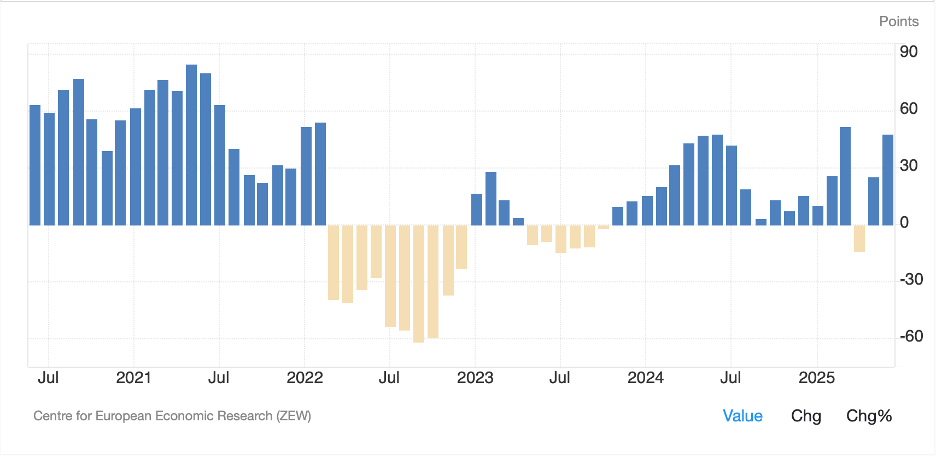
Elsewhere, the German ZEW data released this morning was substantially stronger than both last month and the forecasts for an improvement.  As you can see from the chart below, it is back at levels that are consistent with actual economic growth, something Germany has been lacking for several years.  It appears that a combination of the continued tariff truce, the promises of massive borrowing and spending by Germany to rearm itself and the ECB’s easy policy have German business quite a bit more optimistic that just a few months ago.
Source: tradingeconomics.com

Ok, while we await the next shoe to drop in Iran or Israel, let’s see how markets have behaved overnight. Yesterday’s nice rally in the US was followed by a mixed picture in Asia with the Nikkei (+0.6%) gaining after the BOJ showed that tighter policy is not coming that soon.  Elsewhere in the region, China, HK and India were all down at the margin, less than 0.4% while Korea and Taiwan managed some gains with Taiwan’s 0.7% rise the biggest mover overall.  In Europe, though, the excitement about a truce in Iran is gone with bourses across the continent lower (DAX -1.25%, CAC -1.05%, IBEX -1.5%, FTSE 100 -0.5%).  Apparently, there is fading hope of trade deals between the US and Europe and concerns are starting to grow as to how that will impact European activity.  I guess the ZEW data didn’t do that much to help.  US futures at this hour (7:00) are all pointing lower by about -0.5%, largely unwinding yesterday’s gains.

In the bond market, Treasury yields, which backed up yesterday, are lower by -3bps this morning, essentially unwinding that move.  However, European sovereign yields have all edged higher between 1bp and 2bps with Italy’s BTPs the outlier at +3bps.  Quite frankly, it is hard to have an opinion as to why bond yields move such modest amounts, so I’m not going to try to explain things.

In the commodity space, fear is back in play as oil (+1.7%) is rallying as is gold (+0.4%) which is taking the rest of the metals complex (Ag +2.3%, Cu +0.3%, Pt +3.0%) with it.  These are the markets that are most directly responding to the ongoing ebbs and flows of the Iran/Israel situation, and I expect that will continue.  In the end, I continue to believe the long-term trend for oil is toward lower prices while for gold and metals it is toward higher prices, but on any given day, who knows.

Finally, the dollar doesn’t know which way to turn with modest gains and losses vs. different currencies in both G10 and EMG blocs.  The euro, pound and yen are all within 0.1% of yesterday’s closing levels while we have seen KRW (-0.4%) and INR (-0.3%) suffer and NOK (+0.4%) and SEK (+0.4%) both gain on the day.  However, those are the largest movers across the board, so it is difficult to make a case that anything of substance is ongoing.

On the data front, yesterday’s Empire State Manufacturing index was quite weak at -16, not a good look.  This morning, we see Retail Sales (exp -0.7%, +0.1% ex-autos), IP (0.1%), and Capacity Utilization (77.7%).  As well, the FOMC begins their meeting this morning with policy announcements and Powell’s press conference scheduled for tomorrow.  Helpfully, the Fed whisperer, Nick Timiraos, published an article this morning in the WSJ to explain why the Fed was going to do nothing as they consider inflation expectations despite the lack of empirical evidence that those have anything to do with future inflation.  But it is a really good sounding theory.

For now, the heat of the Iran/Israel situation will hold most trader’s attention, but I suspect that this will get tiresome sooner rather than later.  The biggest risk to markets, I think, is that the Iranian regime collapses and a secular regime arises, dramatically reducing risks in the Middle East and reducing the fear premium in oil substantially.  If that were to be the case, I expect the dollar would suffer as abundant, and cheap, oil would help other nations more than the US on a relative basis given the US already has its own supply.  But a major change of that nature would have many unpredictable outcomes.  In the meantime…

Good luck

Adf

Manna From Heaven

On Friday, the world nearly ended
On Monday, investors felt splendid
Today the G7
Brings manna from heaven
But will rate cuts work as intended?

Of course, everyone is aware of yesterday’s remarkable equity market rally as investors quickly grasped the idea that the world’s central banks are not going to go down without a fight. While there were separate statements yesterday, this morning the G7 FinMins and Central bankers are having a conference call, led by Treasury Secretary Mnuchin, to discuss next steps in support of the global markets economy.

It is pretty clear that they are going to announce coordinated actions, with the real question simply what each bank is going to offer up. The argument in the US is will the cut be 25bps or 50bps? In the UK it is clearly 25bps. The ECB and BOJ have their own problems, although I wouldn’t be shocked to see 10bps from them as well as a pledge to increase asset purchases. And, of course, Canada remains largely irrelevant, but will almost certainly cut 25bps alongside the Fed.

But equity markets rebounded massively yesterday, so is there another move in store on this new news? That seems less probable. And remember, Covid-19 has not been cured and continues to spread pretty rapidly. The issue remains the government response, as we continue to see large events canceled (the Geneva Auto Show was the latest) which result in lost, not deferred, economic activity. The one thing that is very clear is that Q1 economic data is going to be putrid everywhere in the world, regardless of what the G7 decides. But perhaps they can save Q2 and the rest of the year.

The interesting thing is that bond markets don’t seem to be singing from the same hymnal as the stock markets. We continue to see a massive rally in bonds, with 2-year yields down to 0.87% while the 10-year is at 1.15%. That is hardly a description of a rip-roaring economy. Rather, that sounds like fears over an imminent recession. The only thing that is certain is that there are as many different views as there are traders and investors, and that has been instrumental in the significant increase in volatility we have observed.

As to the dollar, it has been under significant pressure since yesterday morning, with the euro climbing to its highest level since mid-January. I maintain the dollar’s weakness can be ascribed to the fact that the Fed is the only major central bank with room to really cut rates, and the market is in the process of pricing in 4 cuts for 2020, with more beyond. So further USD weakness ought not be too surprising, but I expect it is nearer its bottom than not, as in the end, the US remains the best place to invest in the current global economy. My point is that receivables hedgers need to be active and take advantage of the dollar’s recent decline. I don’t foresee it lasting for a long period of time.

The first actions were seen in Asia, as both Australia and Malaysia cut their base rates by 25bps while explaining that their close relationships with China require action. And that is certainly true as the extent of how far the Chinese economy will shrink in Q1 is still a huge unknown. Interestingly, AUD managed to rally 0.35% after the rate cut as investors seemed to approve of the action. The thing is, now rates Down Under are at 0.50%, so there is precious little room left to maneuver there. MYR, on the other hand, slipped slightly, -0.1%, although stocks there managed to rally 0.8% on the news.

Meanwhile, the market continues to punish certain nations that have their own domestic problems which are merely being exacerbated by Covid-19. A good example is South Africa, where the rand tumbled 1.45% this morning after Q4 GDP was released at a much worse than expected -0.5% Y/Y, which takes the nation to the edge of recession. And remember, this was before there was any concern over the virus, so things are likely to get worse before they get better. This doesn’t bode well for the rand in the near and medium term.

But overall, today has been, and will continue to be driven by expectations for, and then the response to the G7 meeting. While it is certain that whatever statement is made will be designed to offer support, given yesterday’s huge rebound in markets, there is ample chance for the G7 to disappoint. Arguably, the risks for the G7 are asymmetric as even an enormous support package of rate cuts and added fiscal spending seem mostly priced into the market. On the other hand, any disappointment could easily see the next leg down in both equity markets and bond yields as investors realize that sometimes, the only way to deal with a virus is to let it run its course.

Good luck
Adf


No Solutions Are Near

There is a group that’s quite elite
And every six months they all meet
In France this weekend
They tried to pretend
That problems, worldwide, they could treat

Alas what was really quite clear
Is that no solutions are near
The trade war remains
The source of most pains
And Brexit just adds to the fear

It has been a pretty dull session overnight with the dollar somewhat softer, Treasuries rallying and equities mixed. With the G7 meeting now over, the takeaways are that the US remains at odds with most members over most issues, but that those members are still largely reliant on the US as their major trade counterparty and overall security umbrella. In the end, there has been no agreement on any issue of substance and so things remain just as they were.

And exactly how are things? Well, the US economy continues to motor along with all the indications still pointing to GDP growth of 2.0% annualized or thereabouts in Q3, continuing the Q2 pace. This contrasts greatly with the Eurozone, for example, where German GDP was confirmed at -0.1% in Q2 this morning as slowing global trade continues to weigh on the economy there. Perhaps the most remarkable thing is that Jens Weidmann, the Bundesbank president, remains firm in his view that negative growth is no reason for easier monetary policy. While every other central bank in the world would be responsive to negative output, the Bundesbank truly does see things differently. As an aside, it is also interesting to see Weidmann revert to his old, uber-hawkish, self as opposed to the show of pragmatism he displayed when he was vying to become the next ECB President. You can be sure that Madame Lagarde will have a hard time convincing him that once the current mooted measures (cutting rates further and more QE) fail, extending policy to other asset purchases or other, as yet unconsidered, tools will be appropriate.

And the rest of Europe? Well, Italy continues to slide into recession as well while the country remains without a government. Ongoing talks between Five-Star and the center-left PD party remain stuck on all the things on which weird coalitions get stuck. But fear of another election, where League leader, Matteo Salvini, is almost certain to win a ruling majority will force them to find some compromise for a few months. None of this will help the economy there. Meanwhile, France is muddling along with an annualized growth rate below 1.0%, better than Germany and Italy, but still a problem. Despite the fact that the Fed has much more monetary leeway than the ECB, the problems extant in the Eurozone are such that buying the euro still seems quite a poor bet.

Turning to the UK, PM Johnson was quite the charmer at the G7, but with just over two months left before Brexit, there is still no indication a deal is in the offing. However, I remain convinced that given the dire straits in the Eurozone economic outlook, the willingness to allow a hard Brexit will fall to zero very quickly as the deadline approaches. A deal will be cut, whether a fudge or not is unclear, but it will change the tone completely. While the pound has edged higher this morning, +0.4%, it remains quite close to its post-vote lows at 1.2000 and there is ample room for a sharp rebound when the deal materializes. For hedgers, please keep that in mind.

The other story, of course, remains the trade war, where the PBOC is overseeing a steady deterioration in the renminbi while selectively looking for places to ease monetary policy and support the economy. Growth on the mainland has been slowing quite rapidly, and while I don’t expect reported data to surprise on the downside, indicators like commodity inventories and electricity usage point to a much weaker economy than one sporting a 6.0% growth handle. Of course, the G7 did produce a positive trade story, the in-principal agreement between the US and Japan on a new trade deal, but that just highlights the other pressure on the EU aside from Brexit, namely the need to make a deal with the US. Bloomberg pointed out the internal problem as to which constituency will be thrown under the bus; French farmers or German automakers. The US is seeking greater agricultural access, and appears willing to punish the auto companies if it is not achieved. (Once again, please explain to me how the EU can possibly allow a hard Brexit with this issue on the front burner).

And that is really today’s background news. The overnight session saw modest dollar weakness overall, and it would be easy to try to define sentiment as risk-off given the strength in the yen (+0.3%), gold (+0.2%) and Treasuries (-3bps). But equities are holding their own and there is no palpable sense in the market that fear has been elevated. Mostly, trading desks remain thinly staffed given the time of year, and I expect more meandering than trending in FX today. Of course, any tweet could change things quickly, but for now, yesterday’s modest dollar strength looks set to be replaced by today’s modest dollar weakness.

Good luck
Adf