The Mayhem-ber

Five years ago, some will remember
George Floyd was the riotous ember
But while cities burned
What some of us learned
Was markets ignored the mayhem-ber
 
Of late, as the headlines are filled
With riots, no one’s been red-pilled
While some may disdain
Risk assets, it’s plain
That most buying stocks are still thrilled


The tragic goings on in LA remain the top story as we have now passed the fourth day of rioting.  It strikes me that ultimately, the constitutional question that may be addressed is how much power the federal government has in a situation where a state government seemingly allows rampant destruction of private property.  Of course, we saw this happen just over five years ago in the wake of George Floyd’s death in May 2020 and the ensuing riots in Minneapolis which ultimately spread to Portland, Oregon and Seattle.  

With this as a backdrop, I thought I would take a look at market behavior during that period, if for no other reason to be used as a baseline.  Of course, there are major caveats here as that was during Covid and the government had recently passed a massive stimulus bill while the Fed began to monetize that debt.  Now, we cannot ignore the BBB which looks a lot like a massive stimulus bill as well, so perhaps things are closer in kind than I originally considered.  At any rate, the chart below shows the S&P 500 leading up to and through the 2020 riots.
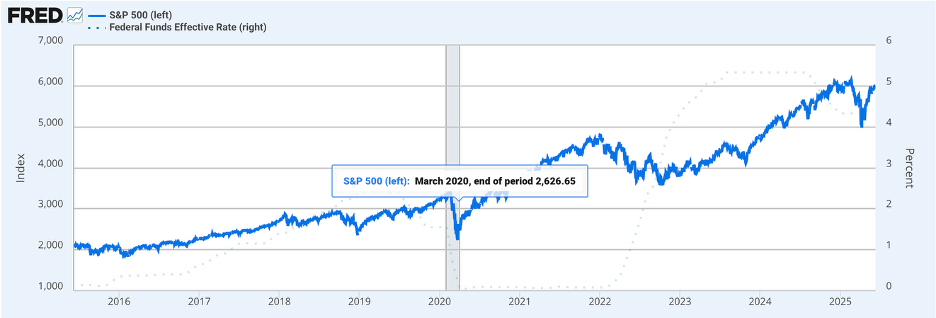
The huge dip before the riots began was the Covid dip, and the faint dotted line is the Fed Funds rate, so you can see things were clearly different.  However, the point I am trying to make is that despite the violence and disagreements over President Trump’s authority, I would contend the market doesn’t care at all about the situation there.  Investors remain far more concerned about the ongoing trade talks with China that are taking place in London and are “going well” according to Commerce Secretary Lutnick.  From what I read on X, it seems there is a growing expectation that a China deal of some sort will be announced soon and that will be the latest buy signal for stocks.  My larger point is that just because something dominates the headlines, it doesn’t mean that something is relevant in the financial world.

Funnily enough, because the LA riots are sucking the oxygen from every other story, there is relatively little to drive market activity, hence the relatively benign market activity we have been seeing for the past few days.  Yesterday was a perfect example with US equity markets trading either side of unchanged all day and closing pretty much in the same place as Friday.  In Asia overnight, the picture was mixed with the Nikkei (+0.3%) edging higher while both the Hang Seng (-0.1%) and CSI 300 (-0.5%) finished slightly in the red.  The one big outlier there was Taiwan (+2.1%) with other markets showing less overall interest.  I suspect this movement was on the back of the positive vibe the market is taking from the US-China trade talks.

As to Europe, the continent has a negative flavor this morning with the DAX (-0.5%) the laggard and other major indices edging lower by just -0.1% or so.  However, the FTSE 100 (+0.4%) has managed a gain after softer than expected employment data has increased discussion that the BOE will be cutting rates a bit more aggressively.  US futures are still twiddling their proverbial thumbs with no movement at this hour (7:10).

In the bond market, Treasury yields have slipped -3bps and we are seeing similar yield declines throughout the continent.  However, UK gilts (-7bps) are really embracing the slowing labor market and story of a more aggressive BOE rate cut trajectory.

In the commodity markets, oil (+0.5%) continues to climb higher despite the alleged increases in supply and is close to filling the first gap seen back in April (see chart below from tradingeconomics.com)
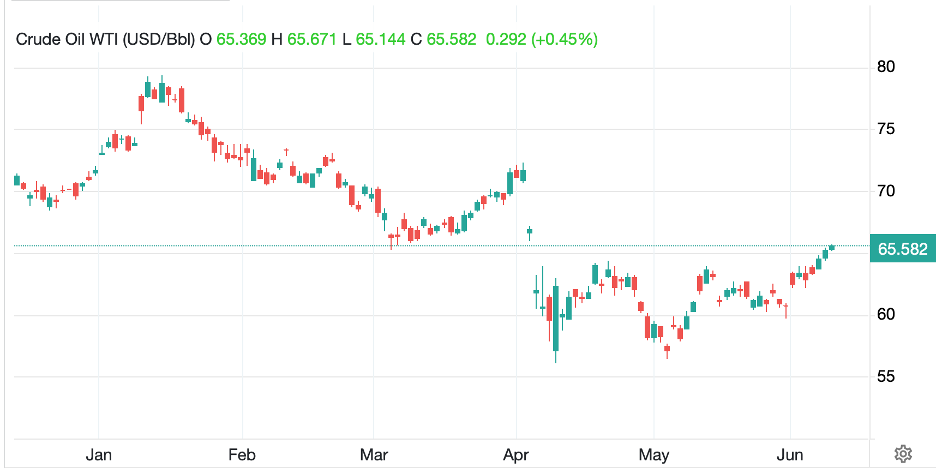
Given OPEC+ and their production increases, this is a pretty impressive move, especially as the recession narrative remains largely in place.  One tidbit of information, though, is that the Baker Hughes oil rig count is down 37 rigs since the 1st of May, a sign that US production, despite President Trump’s desires for more energy, may be slipping a bit.  As to the metals markets, gold (+0.45%) keeps on trucking, with a steady grind higher although both silver and copper are little changed this morning.  I must mention platinum as well, given I discussed it yesterday, and we cannot be surprised that after a remarkable run, it is softer by -1.3% this morning taking a breather.

Finally, the dollar, like equities, is directionless overall with the pound (-0.3%) slipping on the weak labor data but the rest of the G10 within 0.1% of Monday’s closing levels.  In the EMG bloc, KRW (-0.9%) is the outlier, apparently responding to the positive signals from the US-China trade talks.  However, I question that narrative as no other APAC currency moved more than 0.1% on the session in either direction.  And truthfully, that pretty well describes the rest of the bloc in LATAM and EEMEA.

On the data front, the NFIB Small Business Optimism Index was released this morning at a better than expected 98.8, which as you can see below, is a solid reading overall, certainly compared to most of 2022-2024.

Source: tradingeconomics.com

And here is the rest of what we get this week:

WednesdayCPI0.2% (2.5% Y/Y)
 -ex food & energy0.3% (2.9% Y/Y)
ThursdayPPI0.2% (2.6% Y/Y)
 -ex food & energy0.3% (3.1% Y/Y)
 Initial Claims240K
 Continuing Claims1908K
FridayMichigan Sentiment53.5
 Michigan Inflation Expected6.6%

Source: tradingeconomics.com

However, we must take that Inflation expectation number with at least a few grains of salt (even assuming it has value as an indicator at all), as yesterday, the NY Fed released their own survey of Inflation expectations which fell to 3.2%.  A quick look at the two indicators overlaid on one another shows that the Michigan indicator, if nothing else, has much greater volatility which reduces its value as an indicator.

Source: tradingeconomics.com

It is difficult to get excited about movement in either direction right now.  At some point, the mayhem in LA will end and news sources will look for the next story.  I suspect that trade deals are going to grow in importance as Mr Trump will need to sign some more before long.  As well, the BBB, which I continue to believe will be passed in some form, is going to add some measure of certainty and stimulus to the economy, which, ceteris paribus, implies that the long-awaited reckoning in the stock market may be awaited even longer.  If that is the case, then the weak dollar story, one I understand, is likely to fade for a while as well.

Good luck

Adf
Nobody Knows

The punditry’s now out in force
As they hope, their views, we’ll endorse
When tariffs arrive
On Wednesday they’ll strive
To claim they were right, but of course
 
The problem is nobody knows
Exactly what Trump will propose
So, models will fail
While Trump haters wail
More chaos is all that he sows


Well, folks, it’s month and quarter end today and many are decrying that President Trump’s policies have derailed the bull market in risk assets.  And they are almost certainly correct.  Yet, at the same time, there has been a broad recognition across a wide spectrum of analysts and politicians that the situation he inherited was unsustainable.  Whether the 7% budget deficits, the $36+ trillion in government debt or the ongoing inflationary pressures, the only people who were happy were those who saw their equity portfolios rise against all odds.  (I guess the gold holders have been pretty happy too, in fairness.)

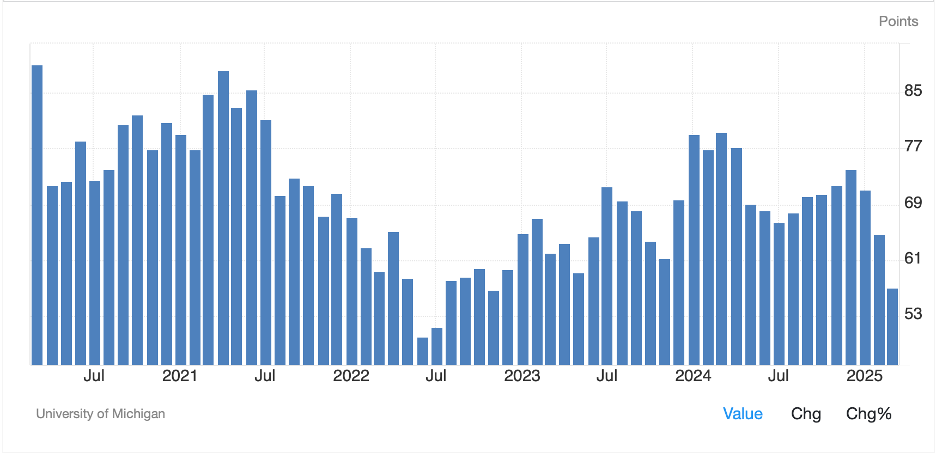
However, the underlying reality of a situation is rarely enough to alter a good story, or a story that somebody wants to tell.  For instance, the Michigan Consumer Survey was released on Friday, and it fell more than expected to a reading of 57.0, its lowest reading since July 2022, when inflation was peaking.

Source: tradingeconomics.com

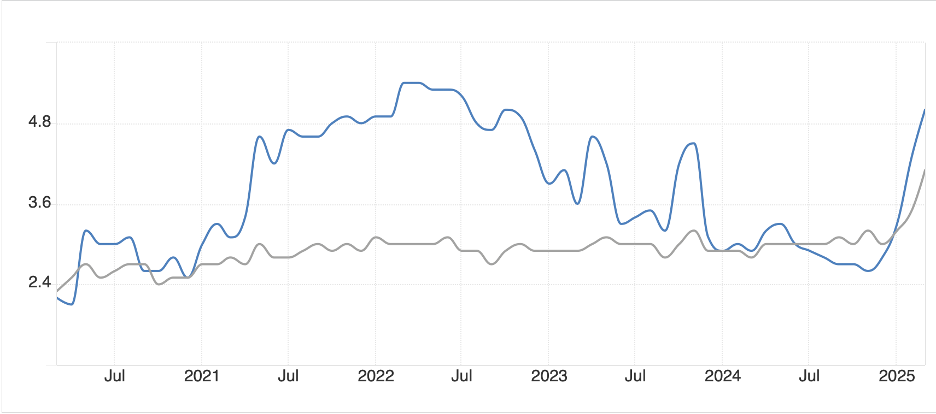
But the story that has been getting all the press is the extraordinary rise in inflation expectations.  As you can see below, both 1-year (blue line) and 5-year (grey line) have risen sharply in 2025.  Conveniently for the mainstream media this has been blamed on President Trump’s policies given their efforts to discredit everything the president does.

However, the Michigan Survey, while having a long pedigree, isn’t that large a survey.  As such, it is possible that non-economic factors may be impacting the results.  For instance, when the survey is taken, the respondents’ political leanings are asked as well.  Now, take a look at the data when split by political views as per the below.  Perhaps, we need to take this survey with a grain or two of salt as it appears the question may be seen as a way to express one’s opinion about the current administration rather than unbiased views of future inflation.

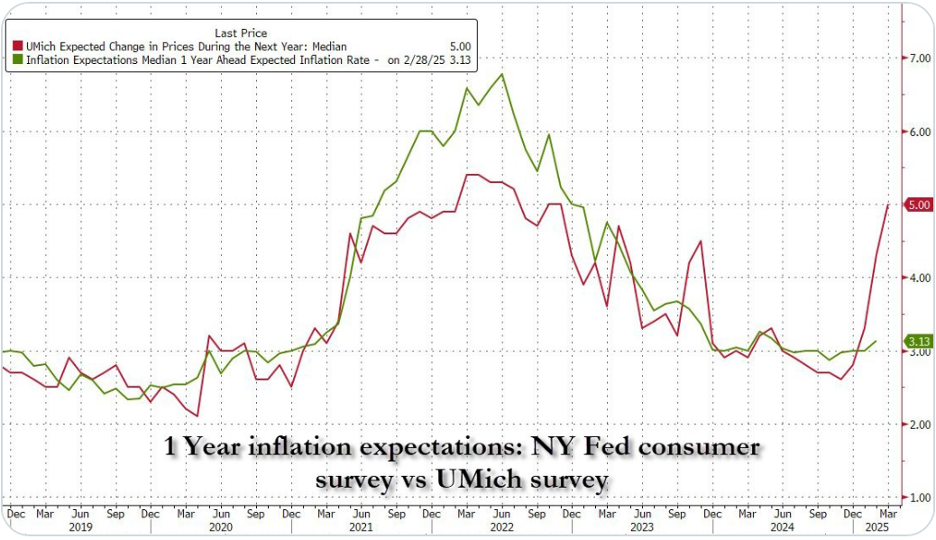
This is especially true when we look at other measures of expected inflation, like the NY Fed’s Consumer inflation survey shown below with the green line compared to that Michigan survey in red.

Source: zerohedge.com

My point is, we need to be careful to notice the non-economic factors that enter into things like expectations surveys.  As well, the idea that inflation expectations are a critical driver of future inflation, although a staple of current central bank thinking, does not have much empirical backing.  For instance, my friend Mike Ashton, the Inflation Guy™, explained in this article way back in 2015, that inflation expectations do not have much empirical proof of effectively forecasting future inflation.  But perhaps, if you don’t believe him, you will consider a scholarly paper by a Fed economist, Jeremy Rudd, written in 2021 that is pretty damning with respect to the idea that the Fed relies on this data as part of their policy toolkit.  

In the end, the one truism of which I am highly confident is that pretty much all the models that have been utilized for the past twenty plus years are no longer reflective of the reality on the ground today.  Not just for inflation, but for growth and trade and every other aspect.  President Trump has not merely upset the applecart; he has broken it into pieces and burned them all to cinders.  All the fiscal problems mentioned above are still extant, but President Trump appears set on changing them in the direction desired by almost all mainstream economists.  They don’t like his methods, but it’s not clear how changes of this magnitude can be made smoothly.  So, perhaps the proper question is just how rough things are going to be.  If the overnight session is any indication, they could get pretty rough.

The dominant feature today
Is fear is what’s now holding sway
As markets decline
More pundits consign
The blame on Trumps tariff pathway

Investors have risk indigestion this morning, as their appetite to own equities anywhere in the world has significantly diminished.  After a rough week ending session on Friday in the US, equity markets in Asia have almost universally declined led by Tokyo (-4.05%) but with sharp declines seen in Korea (-3.0%), Taiwan (-4.2%), Australia (-1.75%), Malaysia (-1.45%) and Thailand (-1.5%).  Chinese (-0.7%) and Hong Kong (-1.3%) shares also fell, although perhaps not quite as far as others.  The entire conversation today is about President trump’s promise to impose tariffs around the world on Wednesday, with many analysts trying to estimate what damage will occur despite no clarity on the size and breadth of the tariffs.  But investors have decided that havens are a better place to hide for now.

European bourses are also sharply lower, although more in the -1.7% to -2.0% range, with every major index in Germany, France, Spain and Italy down by those amounts.  There continues to be a great deal of discussion amongst the European leadership about how they will respond to the mooted tariffs, but of course, like everybody else, they have no idea exactly what they will be.  As to US futures, at this hour (6:45) the picture is grim with declines between -0.6% (DJIA) and -1.3% (NASDAQ).  Right now, the only people who are happy are those holding puts.

Of course, in this risk-off environment, it should be no surprise that bond yields have slipped a bit as, at the margin, investors are flocking to own Treasuries (-5bps) and European sovereigns (Bunds -3bps, OATs -2bps, Gilts -4bps).  Even JGBs (-5bps) saw yields decline last night with any thoughts of the BOJ hiking rates in the near term fading away completely.  

On the other hand, commodities are finding a lot more interest this morning with gold (+1.15%) leading the way higher and proving itself to continue to be one of the most consistent safe havens available.  Interestingly, oil (+0.5%) is rallying this morning despite a number of Wall Street analysts upping their estimate of the probability of a US recession.  However, offsetting the potential future demand weakness is the news that President Trump is “pissed off” at Vladimir Putin for his ongoing aggression in Ukraine and seeming unwillingness to move to a ceasefire.  This has raised the specter of further sanctions on Russian oil output, potentially reducing supply.  As well, the Trump administration continues to tighten the noose on both Iranian and Venezuelan oil sales, so potentially reducing supply even further.  I guess this morning, the supply story is bigger than the demand story.

Finally, as we turn to the currency markets, the dollar is generally firmer this morning, although by widely varying amounts depending on the currency.  For instance, in the G10, NOK (-0.75%) is the laggard despite oil’s gains, followed by AUD (-0.6%) and NZD (-0.55%), with all three of these being major commodity producers at a time when commodities are doing well.  As to the rest of this bloc, JPY (+0.35%) is off its best levels, but behaving as a haven, and the others are just marginally changed from Friday’s closing levels.  In the EMG bloc, ZAR (+0.25%) is the exception this morning, clearly benefitting from gold’s ongoing run to new all-time high prices, but otherwise, most of these currencies are modestly softer (MXN -0.2%, PLN -0.2%, KRW -0.25%).

Speaking of currencies, though, there is an article on this morning’s Bloomberg website that is worth reading, I believe, for everyone involved in the FX market.  The gist of the article is something that I have been discussing for the past several years, the fact that market liquidity here, despite the extraordinary volumes that trade on average each day (currently estimated by the BIS at $7.5 trillion across all FX products) is not nearly as deep as might be anticipated.  

My observation from my time on bank desks was that while there was a great deal of electronic flow, likely driven by HFT firms seeking to extract the last tenth of a pip out of thousands of transactions, when a real client, generally a corporate, had a need to do something specific to address a business need, and that amounted to more than $100 million equivalent, the liquidity situation was far more suspect. 

My personal theory was as follows: bank consolidation reduced the net amount of risk-taking appetite as larger banks did not increase their risk-taking commensurate with the reduction that occurred by small banks being gobbled up.  Combining this with the introduction of high-frequency trading firms in the business, who had no underlying client base to whom they owed a price, and therefore, could turn off their machines in a difficult market, further reducing liquidity, led to a situation where liquidity was a mile wide and an inch deep.  My point is for all the corporates out there who have significant transactions to execute, you must carefully consider the best way to approach the situation to avoid a potentially significant increase in execution costs.

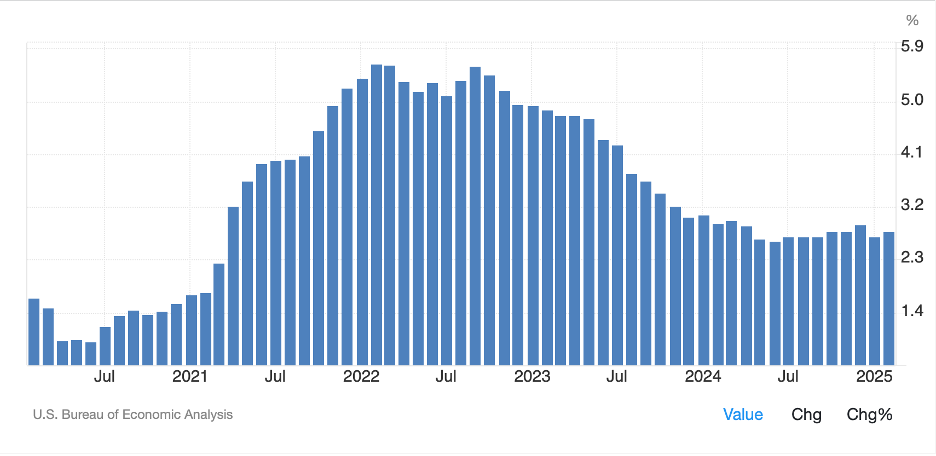
Turning to the data, before we look at this week, which ends with NFP, a quick word on Friday’s core PCE data, which came in at a hotter than expected 0.4% taking the YY number to 2.8%.  The Fed cannot be happy with this outcome as a quick look at the recent readings makes it hard to accept inflation is continuing its decline from the 2022 highs.  Rather a look at the below chart, at least to my eye, shows me a stability in Core PCE of somewhere between 2.5% and 3.0%, well above the Fed’s target range, and hardly a cause to cut rates further.

Source: tradingeconomics.com

As this note has already gotten a bit longer than I like, I will list the week’s data tomorrow but note that Chicago PMI (exp 45.4) is the only noteworthy data point to be released today.  

Absent a complete reversal of Trump’s tariff plans, I see nothing positive on the horizon for risk assets, and expect that equities will maintain, and probably extend the overnight losses while gold and bonds both rally, at least for now.  As to the dollar, my take is it will not benefit universally in this risk-off scenario, although there are currencies that will clearly suffer.  Remarkably, despite the performance of Aussie and Kiwi overnight, I do believe the commodity bloc has the best prospects for now.

Good luck

Adf

Data Confusion

The ongoing data confusion
Is certainly not an illusion
Some numbers are solid
While others are squalid
And each begs a different conclusion
 
Last night, Chinese data revealed
The ‘conomy there hasn’t healed
And Germany’s ZEW
Showed weakness, beaucoup
More rate cuts will soon be, out, wheeled
 
But here in the US we learned
The NFIB, up, had turned
And yesterday showed
Inflation has slowed
Investors, though, still are concerned


As we await today’s US PPI data, and more importantly, tomorrow’s US CPI data, the one consistency we have observed is that the data remains all over the map.  Or does it?  The below chart (data from NY Fed, chart from @fx_poet) shows the median readings of 1-year ahead and 3-year ahead inflation expectations, based on a survey of 1300 households.  While the 1-year ahead expectations are unchanged at 3.0%, the 3-year ahead expectations fell to 2.3%, the lowest in the series’ history since the NY Fed began the survey in June 2013.

If you’re Jay Powell, that certainly must be good news as the Fed puts great stock into the idea that inflation expectations lead inflation outcomes. While this is not a universally held belief amongst economists and analysts, it is certainly the majority view.  However, given that the Fed is a strong believer in this theory, the fact that inflation expectations, as measured here, are declining will help inform their decisions going forward.  Based on this, it is easy to believe that September will bring a 50 basis point cut.

Of course, one might ask, why are inflation expectations declining?  And that is not part of the data that is collected, or at least not reported.  If the expectation is that the economy is headed into recession, that implies there is still great concern amongst households going forward.  However, if this result is due to a strong belief in the Fed’s policies, then economic optimism should abound.  As such, we need to see other data to help interpret things.

Perhaps the first piece we can observe is this morning’s NFIB Small Business Optimism Index, which printed at 93.7, its highest level since March 2022.  That is certainly encouraging as given the importance of small businesses to the overall economy, if things there are starting to look up, it should translate into stronger growth going forward.  On the flip side, in the anecdata department, earnings calls from Expedia, Marriott, Airbnb and Hilton indicated that there is real weakness in the travel economy.  This WSJ report indicates that perhaps things are not as strong as might be indicated by other data.

Now, if we look overseas, the data is also mixed, but there is more negative than positive.  For instance, Chinese money and lending data was released at substantially lower levels than last month and well below expectations.  As well, the PBOC is becoming very concerned about the Chinese bond market inflating a bubble.  Last week, ostensibly, they told several banks to renege on deals to buy Chinese government bonds because they are trying to prevent the back end of the yield curve from declining too far.  It seems they are worried (and probably rightly so) that regional Chinese banks don’t have the capability to manage interest rate risks effectively.  But slowing loan growth and a weak equity market continue to indicate that the Chinese economy is lagging.

As to Europe, the German ZEW data was released and it was, in a word, putrid.  The Economic Sentiment Index fell from 41.8 to 19.2, far below expectations while the Current Conditions index fell to -77.3.  Granted, these surveys were taken the week after the weak NFP data in the US when people were screaming for an emergency 75bp rate cut, so perhaps they are not reflective of the ongoing situation.  But this highlights the problems with survey data, if you are asked about something on a day when the world seems to be ending, your response is likely to be more negative than not.  In fact, this is a caution for all survey data.

So, what are we to make of all this mixed information?  Well, we are right where we started, with no clearer picture of the current situation, let alone how the future may unfold.  In fact, this is why unfettered markets are so important.  Markets are excellent indicators of both future activity and sentiment, and when they are manipulated for political outcomes, investors lose a great deal of information.

But let’s see what the markets are telling us today.  Yesterday’s US session was mixed with modest gains and losses across the board.  But I’ll tell you what, last night Tokyo took the bull by the horns and continued its strong rebound from the previous week’s collapse with the Nikkei rallying 3.5%.  it seems that not only was this move a continuation after the Monday holiday of last week’s rebound, but a former BOJ official, Makoto Sakurai, explained, “they [the BOJ] won’t be able to hike again, at least for the rest of the year.  it’s a toss-up whether they can do one hike by next March.”  You will not be surprised that traders and algorithms jumped on those comments to buy more stocks.  As to the rest of the major markets in Asia, they mostly edged slightly higher, but only about 0.2% or so.  In Europe, there are more laggards than gainers, with the CAC (-0.3%) the worst of the bunch, but as you can see by the relatively small decline, markets here are also quiet.  Finally, US futures are up 0.4% at this hour (8:15).

In the bond market, yields are edging lower this morning with Treasuries down -1bp while European sovereigns are lower by between -2bps and -3bps.  Given the tenor of the economic data, this should be no surprise.  Interestingly, JGB yields remain unchanged at 0.83%, well below that 1.00% critical level and hardly indicative that the BOJ is going to tighten further.

In the commodity space, oil (-0.5%) after touching $80/bbl for WTI yesterday, is slipping a bit as traders await the apparently imminent Iranian attack on Israel to see if a wider war starts.  Meanwhile, the metals complex is lower across the board with gold (-0.4%) giving back some of yesterday’s gains while copper (-1.0%) is also under pressure, arguably on the weak economic story.

Lastly, the dollar is firmer this morning, notably against the yen (-0.3%) and CHF (-0.4%) although there are exceptions to this rule.  I find it quite interesting that the yen carry trade unwind story has basically ended with several large banks explaining that the alleged $20 trillion that was outstanding has been unwound.  Personally, I think that is ridiculous and that there is plenty left in place.  Remember, this trade has been building since the Fed began raising interest rates in 2022 and there are many investors whose entry points are far, far below the current spot level.   A quick look at USDJPY over the past 5 years shows that while the latest batch of entrants may have left the building, there is likely still a lot of borrowed yen funding other positions.

A graph with a line drawn on it

Description automatically generated

Source: tradingeconomics.com

When the Fed started raising interest rates, USDJPY was about 115.  I assure you the carry trade has not ended.

Turning to the data, this morning brings PPI (exp headline 0.2%, 2.3% Y/Y) and (core 0.2%, 2.7% Y/Y), although I believe the data will need to be very different for traders and investors to change their view that inflation is continuing to decline.  And later this afternoon, Atlanta Fed President Bostic speaks.

I believe the narrative remains that the soft-landing is still in play and that the Fed’s cut in September will be adequately timed to prevent a recession.  As of this morning, the futures market is still pricing in a 50:50 chance of either a 25bp or 50bp cut.  Right now, my money is on 25bps, but there is a lot to learn between now and then.  In the meantime, it is hard to turn too negative on the dollar as everybody else is cutting rates as well, and growth elsewhere seems anemic at best.

Good luck

Adf

Magical Stuff

A critical piece of inflation’s
Aligned with the broad expectations
Of where it will be
In one year and three
As this feeds Jay’s model’s foundations
 
So, yesterday’s data release
That showed expectations decrease
Is magical stuff
And could be enough
To make sure all tight’ning will cease


While Thursday’s CPI report remains the key data point this week, there are plenty of other data points that get released on a regular basis that can give clues to how the economy is behaving, and perhaps more importantly to how the Fed’s reaction function may respond.  One of the lesser-known inflation readings is published by the NY Fed each month and shows Consumer Inflation Expectations one year ahead.  As can be seen in the below chart from tradingeconomics.com, the trend has been very positive (lower inflation expectations) for the past two years.

This must warm Powell’s heart as it appears his efforts at anchoring inflation expectations continue to work.  When combining this data with comments from two Fed speakers, Bostic and Bowman, who both indicated some satisfaction with the recent trajectory of inflation and were comfortable with the idea of rate cuts later this year, it is easy to see why yesterday was such a bullish one for risk assets.

Perhaps of more interest, at least to me, was the Consumer Credit Change report which showed that in November, consumer credit rose by a very large $23.75B!  This was the largest increase in twelve months and plays to the idea that people are using their credit cards to purchase consumer staples because they cannot afford them anymore.  On the flip side, given the way economic growth is measured, this will be a positive for Q4 as it implies more ‘stuff’ is being bought.  To my eye, this seems to be a short-term positive, but offers the chance of being a medium-term negative as delinquency in loans is typically not seen in a beneficial light and there are already many stories of people being overextended on their credit cards.

As well, Tokyo CPI was released overnight at 2.4%, 2.1% Core, which was right on expectations, but more importantly, indicative of the fact that inflation pressures in Japan are quickly ebbing.  Perhaps the BOJ’s view that they did not see sustainable price inflation despite almost 2 years of CPI prints above their 2.0% target, is turning out to be correct.  This has huge implications as it means there is little reason for the BOJ to consider exiting its current monetary policy combination of NIRP and QE combined.  As an aside, 10-year JGB yields fell 2bps last night and are currently at 0.58%.  This does not seem like a panicky level, nor one that is necessarily going to attract a lot of internationally invested Japanese money back home.  For all the JPY bulls out there, this is not a good sign.

Away from that news, European data continues to show Germany in a world of hurt, with IP falling -0.7% in November, far worse than expected and the 6th consecutive decline in the series.  However, Eurozone unemployment fell a tick, back to 6.4% and the lowest in the history of the series.  Meanwhile, the ECB just published a report indicating that the inflation suffered by the Eurozone was due almost entirely to supply chain disruptions with a small dose of energy price spike.  It had nothing to do with their policies!  To an outsider like me, this sounds like they are preparing to cut rates as soon as they can.  I wouldn’t be surprised if Madame Lagarde was on the phone with Chairman Powell right now!

And that’s really all we have seen overnight.  After yesterday’s strong rebound in the US, the overnight equity picture was somewhat mixed with Japan having a good session on the weak inflation data although the Hang Seng continues to slide.  Overall, there was no unifed trend in Asia with gainers and losers both.  European shares, though, are in the red this morning led by Spain’s IBEX (-1.75%) although that is the outlier worst performer.  (It seems that a single stock, Grifols, a pharma name, is down -28% on some recent reports about manipulated accounting and that is dragging the whole index lower.). However, US futures are also softer, down about -0.4% at this hour (8:00).  There is still much discussion if last week’s sell-off was just a reaction to a huge late 2023 rally, or the beginning of something much bigger.

In the bond market, Treasury yields have edged up 1bp this morning but remain either side of 4.0% for now.  European yields, though, are higher across the board once again, by between another 5bps and 6bps.  Now, this move is based on yesterday’s close, which saw a drop in yields at the end of the session there.  While the trend in European yields looks higher, they are little changed from this time yesterday.

Oil prices (+3.1%) are rebounding nicely from yesterday’s sharp decline.  You may recall that Saudi Arabia cut its selling price yesterday and the market read that as a sign of weak demand.  However, this morning, that story has faded and continuing tensions in the middle east seem to be having a bigger impact.  This is confirmed by the fact that gold (+0.35%) is rebounding as well although the base metals are mixed this morning with copper slightly higher and aluminum slightly lower.

Finally, the dollar is a touch stronger this morning, but not really by much.  Versus the G10, I see gains of about 0.15% or so with NOK (+0.25%) the exception as it is responding to the rebound in oil.  Versus the EMG bloc, the picture is clearer with almost all these currencies a bit softer, albeit between -0.2% and -0.4% generally.  The dollar continues to be the least interesting asset bloc around for now and is likely to remain so until the Fed starts to actually change policy rather than simply hint at it.

On the data front, we see the Trade Balance (exp -$65.0B) and we have already seen NFIB Small Business Optimism print at a better than expected 91.9.  But, while that is a nice outcome, recall that the index is back at levels below Covid and only above those seen in 2008 and 1980!  Fed Vice-Chair for regulation, Michael Barr speaks at noon, but my guess is he will be right in line with the recent commentary that things look good, but they are not done yet.

As I wrote yesterday, with the bulk of the focus on Thursday’s CPI print, I expect that while markets might be choppy, there will not be much directional information overall.  

Good luck

Adf

Fugacious

For months the Fed had been mendacious
In calling inflation fugacious
But that view’s expired
And Jay has retired
The word that had been so fallacious

So, later this morning we’ll see
The reason that transitory
Is out on its ear
As it will be clear
Inflation’s not hyperbole

Chairman Powell must be chomping at the bit this morning as he awaits, along with the rest of us, the release of the November CPI data.  For us, it will be the latest data point to which the inflationistas will point and say, ‘see? I told you so.’  But, given the timing of the release, just days before the FOMC is scheduled to meet and therefore during the Fed’s self-imposed quiet period, whether the print is higher than the expected (0.7% M/M, 6.8% Y/Y) number or lower, no Fed speaker will be able to try to shape the discussion.  Instead, they will be left to the mercy of the punditry and the markets, something with which they have never been comfortable, at least not since Paul Volcker retired from the Fed.

Of course, they are not completely without capabilities as you can be sure the WSJ is going to run an article later this morning by Nick Timiraos, the current Fed Whisperer, which will be designed to explain the Chairman’s views without attribution.  However, given the recent history of the median forecast, which have consistently underestimated the rise in CPI (and PCE for that matter), it seems likely the official narrative will fall further behind the curve.  Speaking of the curve, looking at the Fed funds futures markets, expectations are for the first rate hike to come in either May or June of next year, which means if the Fed truly wants to finish QE before raising rates, current expectations for a doubling of the speed of tapering may be underestimating the pace.

We have also heard recently from former Fed officials, who clearly remain in contact with the current group, and virtually every one of these has forecast that the dot plot will show a median of two rate hikes next year with a chance of three and then another four in 2023 with the eventual neutral rate still anchored at 2.50%.  And yet, this quasi-official view remains at odds with all the other information we have regarding inflation expectations.  For instance, later today we see the University of Michigan stack of data which last month showed 1-year inflation expectations at 4.9% and the 5-10-year figure at 3.0%.  Since the Fed is one of the greatest champions of the inflation expectations theory (i.e. inflation can be self-fulfilling, so higher expectations lead to higher actual inflation), it would seem that if the dot plot does indicate long-term rates ought be centered around 2.50%, the Fed believes the neutral rate is negative in real terms.  Either that, or they are willing to dismiss data that doesn’t suit the narrative.  However, it is more difficult to understand how they are willing to dismiss the data they themselves compile, like the NY Fed’s Consumer Expectations survey which indicates 1-year inflation is expected at 5.7% and 3-year at 4.2%.

Ultimately, there is nothing that we have seen of late that indicates either inflation or inflation expectations are peaking.  In addition, inflation continues to be a major topic on Capitol Hill, so for now, it seems clear the Fed will continue to preen its hawkish feathers.  This speaks to the dollar resuming its upward trend and calls into question the ability of the equity markets to maintain their euphoria.  In fact, a reversal in equity markets will pose a very real conundrum for the Fed as to how to behave going forward; fight inflation or save the stock market.  You already know my view is they will opt for the latter.

Anyway, with all eyes set to be on the tape at 8:30, here’s what we have seen overnight.  After a late sell-off in the US, equity markets in Asia (Nikkei-1.0%, Hang Seng -1.1%, Shanghai -0.2%) all suffered although European bourses have managed to recoup early weakness and are essentially unchanged across the board as I type.  The only data of note has come from the UK, where October GDP rose a less than expected 0.1% pouring some more cold water on the BOE rate hike thesis for next week.  US futures, however, are trading higher at this hour, with all three major indices looking at gains of 0.3% or so.

The bond market is under modest pressure this morning, with yields edging higher in the US (+1.4bps) as well as Europe (Bunds +2.4bps, OATs +1.9bps, Gilts +2.8bps) as investors around the world continue to prepare for a higher interest rate environment.  Remember, just because the G10 central banks have been slow to tighten policy doesn’t mean that is true everywhere in the world.  For instance, Brazil just hiked rates by 150 bps to 9.25% and strongly hinted they would be raising them another 150bps in February given inflation there just printed at 10.74% this morning.  Mexico, too, has been steadily raising rates with another 25bps expected next week, and throughout Eastern Europe that has been the norm.  The point is that bond markets have every chance of remaining under pressure as long as inflation runs rampant.  In fact, that is exactly what should happen.

In the commodity world, early weakness in the oil price has been reversed with WTI (+1.1%) now firmly higher on the day.  NatGas (+1.3%) is also firmer although we are seeing much less movement from the metals and agricultural spaces with virtually all of these products withing 0.1% or so of yesterday’s closing levels.

As to the dollar, it is broadly firmer again this morning, albeit not by very much.  NZD (-0.25%) and JPY (-0.25%) are the laggards in the G10, although one is hard-pressed to come up with a rationale other than position adjustments ahead of the data release this morning.  In fact, that is true with all the G10 currencies, with movements other than those two of less than 0.2%.

The same cannot be said for the EMG space, where TRY (-1.05%) continues to slide as the combination of rampant inflation and a leadership that is seeking to cut interest rates as a means to fight it is likely to undermine the lira for the foreseeable future.  Thus far, TRY has not quite reached 14.00 to the dollar, up from 9.00 in mid-October.  But there is nothing to prevent USDTRY from trading up to 20 or higher as long as this policy mix continues.  Elsewhere, KRW (-0.6%) fell on the news that Covid infections grew at their fastest pace in a year and concerns over potential government actions to slow its spread.  Otherwise, weakness in PLN (-0.4%), INR (-0.35%) and CLP (-0.3%), for instance, all seem to revolve around expectations for tighter US monetary policy rather than local weakness.

In addition to the headline CPI discussed above, expectations are for core (+0.5% M/M, +4.9% Y/Y) and Michigan Sentiment is expected at 68.0.  Until the data is released, there should be very little in the way of movement.  Afterwards, though, I would look for the dollar to rally on higher than expected data and vice versa.  We shall see.

Good luck, good weekend and stay safe
Adf

Prices Rise in a Trice#CPI, #inflationexpectations

There once was a world where the price
Of stuff stayed the same…paradise
But then central banks
Were born, and now thanks
To them prices rise in a trice

Now, worldwide the story’s the same
As these banks, inflation, can’t tame
They’re all terrified
That stocks might just slide
And they would come in for the blame

“I’d expect price increases to level off, and we’ll go back to inflation that’s closer to the 2% that we consider normal.  In the 70’s and 80’s inflation expectations became embedded in the American psyche.  That isn’t happening now.”  So said Treasury Secretary Yellen yesterday in an interview on NPR.  One has to wonder on what she bases these expectations.  Certainly not on any of the evidence as per the most recent data releases.

For instance, the NY Fed’s latest Inflation expectation survey was released yesterday with 1-year (5.7%) and 3-year (4.2%) both at the highest level in the series’ history since it began in 2013.  She cannot be looking at yesterday’s PPI data (8.6%, 6.8% core) as an indicator given both of these are at their highest level on a final demand basis since PPI started being measured in this manner in 2011.  However, a look a little deeper at the intermediate levels, earlier in the supply chain, show inflation running at levels between 11.8% and 27.8% Y/Y.  While all of these costs are not likely to flow into the price of finished goods, you can be sure that the pressure to raise prices throughout the chain for both goods and services remains great.  And of course, later this morning we will see the CPI data (exp 5.9% Y/Y, 4.3% ex food & energy) with both indicators forecast to show substantial increases from last month.  Secretary Yellen continues to try to sell the transitory story and twelve months of increasing prices later, it is wearing thin.

The US, though, is not the only place with this problem, it is a global issue.  Last night China released its inflation readings with PPI (13.5%) rising far more than expected and touching levels not seen since 1995.  CPI there rose to 1.5%, a tick higher than expected which indicates that either there is a serious lack of final demand in the country or they are simply manipulating the data to demonstrate that the government is in control.  (In fact, it is always remarkable to me when a Chinese data point is released that is not exactly as expected given the control the government exerts on every aspect of the process.)  Regardless, the fact is that price pressures continue to rise in China on the back of rising energy costs and shortages of available energy, and ultimately, given China’s status as the world’s largest exporter, those costs are going to feed into other nations’ import prices.

How about Europe?  Well, German CPI rose 4.5% Y/Y in October, the highest level since September 1993 in the wake of the German reunification which dramatically shook up the economy there.  Remember, too, the German’s have a severe phobia over inflation given the history of the Weimar Hyperinflation, so discontent with the ECB’s performance is growing apace in the country.

Essentially, it is abundantly clear that rising prices have become the norm, and that any idea that we are going to ease back to moderate inflation in the near-term are fantasy.  Naturally, with inflationary pressures abundant, one might expect that central banks would be out to address them by tightening policy.  And yet, while peripheral nations have already done so, the biggest countries remain extremely reluctant to tighten as concern over economic output and employment growth continue to dominate their thoughts.

Historically, central bank decision making always required balancing the two competing goals of pumping up supporting the economy while preventing prices from running away.  Between the GFC and the pandemic, though, there was no need to worry as measured inflation never reared its ugly head, so easy money supported growth with no inflationary consequences.  But post-pandemic fiscal largess has changed the equation and now central banks have to make a decision, with significant political blowback to either choice.  Yet the biggest risk is the lack of a decisiveness may well lead to the worst of all worlds, rising prices and slowing growth, i.e. stagflation.  I promise you a stagflationary environment will be devastating to financial assets all over.

Now, as we await the CPI data, let’s take a look around the markets to see how traders and investors are responding to all the latest news and data.

Equity markets are mostly following the US lead from yesterday with declines throughout most of Asia (Nikkei -0.6%, Hang Seng +0.7%, Shanghai -0.4%) and most of Europe (DAX -0.2%, CAC -0.3%, FTSE 100 +0.4%).  US futures are all pointing lower at this hour as well (DOW -0.3%, SPX -0.3%, NASDAQ -0.5%) so there is little in the way of joy at the current moment.  Risk is definitely under pressure.

What’s interesting is that bonds are not seen as a viable replacement despite declining stock prices as yields in Treasuries (+2.7bps) and throughout Europe (Bunds +0.8bps, OATs +2.1bps, Gilts +3.4bps) are higher.  So, stocks are lower and bonds are lower.  Did I mention that stagflation would be negative for financial assets?

On this very negative day, commodity prices, too, are under pressure with oil (-0.6%), NatGas (-1.8%), gold (-0.35%), copper (-0.3%) and tin (-1.1%) all suffering.  In fact, throughout the entire commodity complex, only aluminum (+2.0%) and corn (+0.5%) are showing gains.  At this point, oil remains in a strong uptrend, so any pullback is likely technical in nature.  NatGas continues to respond to the glorious weather in the northeast and Midwest with reduced near-term demand.  Even in Europe, Gazprom has finally started to let some more gas flow hence reducing price pressures there although it remains multiples of the US price.

Turning to the dollar, it is today’s clear winner, gaining against 9 of its G10 brethren, with CAD (flat) the only currency holding its own.  SEK (-0.6%) and NOK (-0.5%) lead the way lower with the latter tracking oil’s declines while the former is simply showing off its high beta characteristics with respect to dollar movement.  In the EMG bloc, TRY (-1.1%) is the laggard as traders anticipate another interest rate cut, despite high inflation, and there is concern over the fiscal situation given significant foreign debt payments are due next week.  ZAR (-0.9%) is slumping on the commodity story as well as concerns that the budget policy may sacrifice the currency on the altar of domestic needs.  But the weakness extends throughout the space with APAC currencies under pressure as well as LATAM currencies.  This is a dollar story today, with very little holding up to the perceived stability of the buck.

As well as the CPI data, given tomorrow’s holiday, we see Initial (exp 260K) and Continuing (2050K) Claims at 8:30.  There are actually no further Fed speakers today with Bullard yesterday remarking that two rate hikes were likely in 2022.  We shall see.

With the inflation narrative so strong, this morning’s data will be key to determining the short-term direction of markets.  A higher than expected print is likely to see further declines in both stocks and bonds with the dollar benefitting.  A weaker outcome seems likely to unleash yet another bout of risk acquisition with the opposite effects.

Good luck and stay safe
Adf

Likely to Fade

The bond market’s making it clear

Inflation, while higher this year,

Is likely to fade

Just like Jay portrayed

While bottlenecks soon disappear


The data though’s yet to support

Inflation’s rise will be cut short

Perhaps CPI

Next week will supply

The data the Fed does purport

For the past month, virtually every price indicator in the G20 has printed higher than forecast, which continues a multi-month trend and has been a key support of the inflationist camp.  After all, if the actual inflation readings continue to rise more rapidly than econometric models indicate, it certainly raises the question if there is something more substantial behind the activity.  At the same time, there has been a corresponding increase of commentary by key central bank heads that, dammit, inflation is transitory!  Both sides of this debate have been able to point to pieces of data to claim that they have the true insight, but the reality is neither side really knows.  This fact is made clear by the story-telling that accompanies all the pronouncements.  For instance, the transitory camp assures us that supply-chain bottlenecks will soon be resolved as companies increase their capacities, and so price pressures will abate.  But building new plant and equipment takes time, sometimes years, so those bottlenecks may be with us for many months.  Meanwhile, the persistent camp highlights the idea that the continued rise in commodity prices will see input costs trend higher with price rises ensuing.  But we have already seen a significant retreat from the absolute peaks, and it is not clear that a resumption of the trend is in the offing.  The problem with both these stories is either outcome is possible so both sides are simply talking their books.

While I remain clearly in the persistent camp, my take is more on the psychological effects of the recent rise in so many prices.  After all, even the Fed is focused on inflation expectations.  So, considering that recency bias remains a strongly inbred human condition, and that prices have risen recently, there is no question many people are expecting prices to continue to rise.  At the same time, one argument that had been consistently made during the pre-pandemic days was that companies could not afford to raise prices due to competition as they were afraid of losing business.  But now, thanks to multiple rounds of stimulus checks, the population, as a whole, is flush with cash.  As evidenced by the fact that so many companies have already raised prices during the past year and continue to sell their wares, it would appear that the fear of losing business over higher prices has greatly diminished.

And yet…the bond market has accepted the transitory story as gospel.  This was made clear yesterday when both Treasury and Gilt yields tumbled 8 basis points while Bund and OAT yields fell 6bps.  That is not the behavior of a bond market that is worried about runaway inflation.  

So, which is it?  That, of course, is the $64 trillion question, and one for which nobody yet has the answer.  What we can do, though, is try to determine how markets may move in either circumstance.

If inflation is truly transitory it would seem that we can look forward to a continued bull flattening of yield curves with the level of rates falling alongside the slope of the yield curve.  Commodity prices will arguably have peaked as new production comes online and equity markets will benefit significantly from lower interest rates alongside steady growth.  As to the dollar, it seems unlikely to change dramatically as lower yields alongside lower inflation means real yields will be stable.

On the other hand, if prices rise persistently for the next quarters (or years), financial markets are likely to respond very differently.  At some point the bond market will become uncomfortable with the situation and yields will start to rise more sharply amid a steeper yield curve as the Fed will almost certainly remain well behind the curve and continue to suppress the front end.  Commodity prices will have resumed their uptrend as they will be a key driver in the entire inflationary story.  Energy, especially, will matter as virtually every other product requires energy to be created, so higher energy prices will feed into the economy at large.  Equity markets may find themselves in a more difficult situation, especially the high growth names that are akin to very long duration bonds, although certain sectors (utilities, staples, REITs) are likely to hold their own.  And the dollar?  If, as supposed, the Fed remains behind the curve, the dollar will suffer significantly, as real yields will decline sharply.  This will be more evident if we continue to see policy tightening from the group of countries that have already begun that process.

In the end, though, we are all just speculating with no inside knowledge of the eventual outcome.  It is for this reason that hedging is so important.  Well designed hedge strategies help moderate the outcome regardless of the eventual results, and that is a worthy goal in itself. Hedging can reduce earnings/cash flow volatility.

Onward to today’s markets.  Starting with bonds, after yesterday’s huge rally, we continue to see demand as, though Treasury yields are unchanged, European sovereign yields have fallen by between 0.3bps (Gilts) and 1.5bps (Bunds), with the rest of the major nations somewhere in between.

Equity markets have been more mixed but are turning higher.  Last night saw the Nikkei (-1.0%) and Hang Seng (-0.4%) follow the bulk of the US market lower, but Shanghai (+0.7%) responded positively to news that the PBOC may soon be considering cutting rates to support what is a clearly weakening growth impulse in China.  (Caixin PMI fell to 50.3 in Services and 51.3 in Manufacturing, both far lower than expected in June.)  European markets have been in better stead with the DAX (+0.9%) leading the way and FTSE 100 (+0.5%) putting in a solid performance although the CAC (+0.1%) is really not doing much.  The big news here was the European Commission publishing their latest forecasts for higher growth this year and next as well as slightly higher inflation.  Finally, US futures markets are all pointing higher with the NASDAQ (+0.5%) continuing to lead the way.

Commodity prices are definitely higher this morning with oil (+1.5%) a key driver, but metals (Au +0.6%, Ag +1.0%, Cu +2.0% and Al +0.3%) all finding strong bids.  Agricultural products are also bid this morning and there is more than one analyst who is claiming we have seen the bottom in the commodity correction with higher prices in our future.

As to the dollar, it is somewhat mixed, but arguably, modestly weaker on the day.  In the G10, NZD (+0.4%), NOK (+0.3%) and AUD (+0.3%) are the leaders with all three benefitting from the broad-based commodity rally.  SEK (-0.25%) is the laggard as renewed discussion of moderating inflation pressures has investors assuming the Riksbank will be late to the tightening party thus leaving the krona relatively unattractive.

In the EMG bloc, ZAR (+0.5%), MXN (+0.35%) and RUB (+0.25%) are the leading gainers, with all three obviously benefitting from the commodity story this morning.  CNY (+0.25%) has also gained after investor inflows into the Chinese bond market supported the renminbi.  On the downside, KRW (-0.7%) and PHP (-0.6%) fell the most although the bulk of those moves came in yesterday’s NY session as the dollar rallied across the board and these currencies gapped lower on the opening and remained there.  Away from these, though, activity has been less impressive with few stories to drive things.

Two pieces of data today are the JOLTS Job Openings (exp 9.325M) and the FOMC Minutes this afternoon.  The former will simply serve to highlight the mismatch in skills that exists in the US as well as the fact that current policy with enhanced unemployment insurance has kept many potential workers on the sidelines.  As to the Minutes, people will be focused on any taper discussion as well as the conversation on interest rates and why views about rates changed so much during the quarter.

Our lone Fed speaker of the week, Atlanta Fed President Bostic, will be on the tape at 3:30 this afternoon.  To date, he has been in the tapering sooner camp, so I would expect that will remain the situation.  

Yesterday’s dollar rally was quite surprising given the decline in both nominal and real yields in the US.  However, it has hardly given back any ground.  At its peak in early April, the dollar index traded up to 93.4 and the euro fell to 1.1704.  We would need to break through those levels to convince of a sustained move higher in the dollar.  In the meantime, I expect that the odds are the dollar can cede some of its recent gains.

Good luck and stay safe

Adf