Just Swell!

The markets were truly surprised
As yesterday’s Minutes advised
That higher for longer
Intent was much stronger
Than prior belief emphasized
 
The market response was to sell
Risk assets and thus, prices fell
But after the close
Nvidia rose
And now everything is just swell!


It turns out that Chairman Powell’s press conference had a distinctly more dovish feel to it than the tone of the FOMC meeting at the beginning of the month.  At least that appears to be the situation based on the Minutes of the meeting that were released yesterday afternoon.  In truth, it is somewhat surprising that given all the comments we have heard by virtually every member of the FOMC in the intervening three weeks, a reading of the Minutes resulted in altered opinions of how policy would evolve going forward.

While every Fed speaker has maintained the view that higher for longer remains the baseline, at the press conference, Powell essentially ruled out further rate hikes.  But in the Minutes, it turns out “various” members indicated a willingness to raise rates if necessary.  In addition, “a few” members would have supported continuing the QT process at the previous $60 billion/month runoff rather than adjusting it lower.  Finally, “many” questioned just how restrictive current monetary policy actually is, and whether it is sufficient to drive inflation back to their target.  Net, it appears there was quite a lively discussion in the room and the hawks are not willing to be ignored.

With this more hawkish stance now more widely understood, it cannot be surprising that risk assets sold off yesterday afternoon.  While I grant that the equity declines were modest, between -0.2% and -0.5% in the US, the tone of conversation clearly changed.  Meanwhile, the real damage occurred in the commodity markets where the recent sharp rise in metals prices ran into a proverbial buzzsaw and all of them fell sharply.  For instance, gold fell -1.5% yesterday and is lower by another -0.7% this morning.  Silver was a bit more volatile, losing -3.0% yesterday and down a further -1.25% today and the king of this move was copper, which tumbled more than -4% yesterday although it seems to be basing for now.

While there are several pundits who are describing these commodity price moves as a reaction to the dollar’s rebound, I actually see it more as a response to the idea that the Fed may be willing to fight inflation more aggressively than previously thought.  Remember, a key to the metals markets’ rally is the idea that the Fed is going to allow inflation to run hotter than target going forward, with 3% as the new 2%, and the widely mooted rate cuts would simply hasten that outcome.  In that scenario, ‘real’ stuff will retain its value better than paper assets and metals are as real as it gets.  However, if the Fed is truly going to stay the course and is willing to raise rates further to achieve their 2% goal, that is a very different stance which will support the dollar and paper assets far better.

Of course, none of this really mattered because the most important news yesterday was after the equity market close when Nvidia reported even stronger than expected results and also split their stock 10:1.  And, so, all is now right in the universe because…AI!  

Alas, this poet is not an equity analyst and has no useful opinion on the merits of the current valuations of AI stocks, so I will continue to focus on the macroeconomic story and try to interpret how things may evolve going forward.

Keeping in mind that the Fed may well be more hawkish than previously thought, that is quite a change in mindset compared to most other central banks where rate cuts appear far more likely as the summer progresses.  For instance, yesterday Madame Lagarde explained, “I’m really confident that we have inflation under control. The forecast that we have for next year and the year after that is really getting very, very close to target, if not at target. So, I am confident that we’ve gone to a control phase.”  This is her rationale for essentially promising, once again, that the ECB will cut rates next month.  However, we continue to get pushback from the ECB hawks that a June cut does not mean a July cut or any other cuts afterwards.  Now, I am inclined to believe that while they may skip July, they will cut again in September and probably consistently after that.

Of course, this is a very different stance than what was indicated by the FOMC Minutes, and I expect that there should be a greater divergence between European and US markets going forward because of this.  In fact, I am quite surprised that the FX market has not taken this to heart and that the euro remains as well bid as it is.  While the single currency has slipped about 2% since the beginning of the year, it is higher this morning by 0.2% and well above the lows seen back in mid-April.  Today’s price action has been driven by slightly better than expected Flash PMI data, but the big picture strikes me that there is more room for the euro to fall than rise.

And really, isn’t that the entire discussion overall, relative policy stances by the main central banks?  I continue to see that as the key driving force in markets at this time, and the macro data helps inform what those stances are likely to be.  If the US growth story is accelerating vs. other G7 countries, then we should expect to see continued outperformance by US assets and the dollar.  However, if the rest of the G7 is catching up, perhaps those tables will turn.  While PMI data has not been a particularly good indicator lately, the fact that European data (and Japanese data overnight) were slightly better than forecast may be an indication that things are changing.  Later this morning we will see the US version (exp 50.0 Manufacturing, 51.3 Services, 51.1 Composite) so it will be interesting to see if the market responds to any surprises there.

As to the rest of the overnight session, markets in Asia were mixed with more gainers (Japan, India, South Korea, Taiwan) than laggards (China, Hong Kong, Australia) with the gainers generally benefitting from somewhat better than expected PMI data and the laggards the opposite.  European bourses are mostly higher on the back of that better data as well.  As to US futures, at this hour (7:30) Nvidia has pulled the entire complex higher with the NASDAQ (+1.1%) leading the way.

In the bond markets, most major countries have seen essentially zero movement this morning with the UK (-3bps) the one exception as the PMI data there was a touch softer than expected.  Of course, you may recall that yields rose sharply in the UK yesterday after the hotter than expected CPI data, so this is a bit of a give-back.  JGB yields, interestingly, slipped back 1bp and are now back below 1.00% despite a modestly better than expected PMI reading.

Oil prices (+0.7%) are bouncing slightly after a string of down days and despite slightly larger than expected inventory builds in the US.  But for now, it seems clear there is ample supply.  And, of course, we already discussed the metals markets.

Finally, the dollar is a touch softer overall this morning with most of the movement as you might expect.  For instance, NOK (+0.7%) is rallying alongside oil and adding to the dollar’s broad weakness.  However, ZAR (-0.5%) remains beholden to the metals complex and is still under pressure.  Of minor note is the fact that the CNY fixing last night at 7.1098 was the weakest renminbi fix since January and some are claiming this is a harbinger of the PBOC relaxing its control of the currency.  While that may be true, I suspect it will be extremely gradual.  And the yen continues to tend weaker, not stronger, as the interest rate differential is too wide for traders and investors to ignore.  As well, it is fair to ask if Japan is really concerned about the level of the yen, or if they truly are only concerned with a slow and steady movement.  

Before the PMI data, we see Initial (exp 220K) and Continuing (1799K) Claims and the Chicago Fed National Activity Index (0.16).  Then, at 10:00 we see New Home Sales (680K) which are following yesterday’s much softer than expected Existing Home Sales data.  It seems clear that there is an ongoing problem in the housing market.  Finally, this afternoon, Atlanta Fed president Rafael Bostic speaks, and it will be quite interesting to hear his views now in the wake of the Minutes.

While actions speak louder than words, yesterday’s FOMC Minutes certainly have given me pause regarding my view that they were going to ease policy more quickly than inflation data may warrant.  That should help support the dollar and keep pressure on risk assets.  Of course, given the ongoing euphoria over AI and the Nvidia earnings, I don’t expect equity traders to care much about that at all.

Good luck

Adf

Likely Passé

The markets continue to snooze
Although today we’ll get some news
But Home Sales don’t spark
A narrative arc
About which most folks would enthuse
 
As well, given all that they’ve said
Those dozens of folks from the Fed
The Minutes today
Are likely passé
So, markets will head back to bed


Another very lackluster session yesterday resulting in marginal equity gains in the US as the dearth of new information continues to weigh on trading volumes and overall activity.  Of course, the one thing we did get yesterday was another tsunami of Fedspeak but all of it was the same as what we have already heard.  There is no need to go into details but suffice to say that the theme remains, April’s CPI reading was encouraging, but not nearly enough to consider rate cuts soon.  Instead, while they all believe that inflation will continue to head back to their 2% goal (although none of them have explained why they believe that) it appears that the first cut is not likely to be warranted before the fourth quarter.  In fact, it seems that several FOMC members are lining up with a December cut in mind although the Fed funds futures market continues to price a 60% probability of that first cut coming in September.

But here’s the thing I don’t understand; why are they so keen to cut rates at all?  This is the actual language in the Federal Reserve Act as amended in 1977 [emphasis added]:

“The Board of Governors of the Federal Reserve System and the Federal Open Market Committee shall maintain long run growth of the monetary and credit aggregates commensurate with the economy’s long run potential to increase production, so as to promote effectively the goals of maximum employment, stable prices and moderate long-term interest rates.”

As is typical with legislation, there is no specificity as to what each of these terms mean and thus, they are open to interpretation by each Fed chair.  For instance, prior to 2012, the concept of stable prices did not have a numeric attachment, and, in fact, when Alan Greenspan was Fed chair, he explicitly mentioned that 0% inflation was indicated.  However, Ben Bernanke determined that in the wake of the GFC, a numeric definition would be appropriate and that is how we got the 2% target.

On the employment question, the economic concept of NAIRU (non-accelerating inflation rate of unemployment) had been the north star for the Fed for decades and that number had typically been estimated at 5% +/- a bit.  The concept is that there is a theoretical unemployment rate below which wage pressures will rise and drive inflation higher and above which the opposite will occur.  However, just like the Fed’s other imaginary friend, R*, NAIRU is not observable, and nobody knows where it is.  Recent indications are that it is at a much lower level than previously thought as evidenced by the fact that Unemployment (ignoring the pandemic activity) was able to hover below 4% without any inflationary pressures of note.  At least that was true until the pandemic response flooded the economy with massive amounts of liquidity and funding directly to the population via stimulus checks.  But, as I said, nobody really knows what that level is, and so the concept of maximum employment is extremely nebulous.

Finally, moderate long-term interest rates are another bridge too far for the Fed given its ordinary operations.  While the Fed clearly controls the short end of the curve via the Fed funds markets and its interest payments on reserves, the long end of the interest rate curve is a completely different story.  Certainly, QE was a direct effort to impact long-term interest rates and was quite successful at lowering them, although the definition of moderate remains missing in action.  For instance, a look at the below chart with data from the FRED database shows that the long-term average 10-year yield (my definition of long-term interest rates in this context) is 5.56%.

Source: data FRED database; calculations @fx_poet

With this in mind, the current level of 4.45% or so remains relatively low, not high, and so the idea that rate cuts are necessary to meet the Fed’s mandate seems disingenuous at best.  This is especially true given that inflation is still well above their target of 2%.  Unless there has been a complete sea change of economic theories at the Fed where suddenly higher interest rates are inflationary*, not deflationary, it seems that there is something else at play here.

In the end, my point is that Fedspeak, which is widely followed, usually highlights that there is no guiding star as to what they want to achieve.  As well, their definitions are apt to change quickly if there is a perceived political expedient.  However, I will say that at the current moment, it certainly appears the entire committee is on the same page and wants to cut rates but cannot come up with an excuse they believe the market will accept as real.

Essentially, this was all a preamble to today’s FOMC Minutes release, which given just how much Fedspeak there has been between the meeting and today indicates there is very little new information likely to be revealed.  In the meantime, markets overall remain quiet and rangebound with commodities the lone exception.

Equity markets overnight were mixed in Asia while European bourses are marginally lower (albeit still near all-time highs) and US futures are essentially unchanged yet again.  Bond yields are rising a bit with Treasuries higher by 3bps and European yields higher by 4bps with an outlier UK rise of 10bps after a much hotter than expected inflation reading this morning (3.9% vs. 3.6% expected) reduced the chance of a rate cut next month.  And finally, 10-year JGB yields broke through the 1.00% level last night although the JPY (-0.15%) is actually weaker on the news.

Commodities, though, continue to be the most interesting story around with oil (-0.7%) slipping further after a bigger than expected inventory build from the API data as well as news that the Biden administration is looking to release a portion of gasoline inventories into the market to lower prices ahead of the election.  In the metals markets, the big three are softer again this morning (Au -0.4%, Ag -085%, Cu -2.3%) although on the charts, all remain above key support levels.  It can be no surprise that they are consolidating after their massive runs of the past week or two.

Finally, the dollar is tracking Treasury yields higher with strength almost across the board.  The notable exception is NZD (+0.4%) which has rallied after the RBNZ, while maintaining interest rates unchanged, was far more hawkish in their commentary and indicated they discussed further rate hikes given inflation’s stubbornness overall.  But otherwise, ZAR (-0.8%) is the worst performer, which given the metals market moves should be no surprise, but the dollar’s strength is otherwise universal.

On the data front, as well as the Minutes this afternoon, we see Existing Home Sales (exp 4.21M) at 10:00 and then the EIA oil inventory data at 10:30.  Mercifully, there are no Fed speakers scheduled today, although I wouldn’t be surprised if one gets interviewed somewhere.

Rumors of the dollar’s demise seem badly overblown, and it remains tightly linked to the move in US yields.  Unless we see yields take a serious step lower, I suspect the dollar is likely to remain well bid overall.

Good luck

Adf

*As an aside, several years ago Turkish President Erdogan made this case and kept firing central bankers who wanted to raise interest rates in Turkey to fight their significant inflation problems.  At that time, the economics profession ridiculed the idea completely.  However, lately, there have been a number of articles published that have made the case Erdogan was correct.  Of course, that seems to be an effort to encourage the Fed to cut rates despite high inflation.  As of yet, this brainworm has not infected Chairman Powell, but who knows what will happen as the election approaches.

Bears’ Great Dismay

Their confidence clearly was lacking
So, now on rate cuts they’re backtracking
As well, they’re concerned
Some banks have not learned
To manage their risk and need smacking
 
But really the news of the day
Is AI remains the key play
NVIDIA beat
And all of Wall Street
Is buying to bears’ great dismay
 
Starting with the FOMC Minutes, the two things that stood out to me were these two lines, “The staff provided an update on its assessment of the stability of the U.S. financial system and, on balance, characterized the system’s financial vulnerabilities as notable. The staff judged that asset valuation pressures remained notable, as valuations across a range of markets appeared high relative to fundamentals.”  Arguably, this was why the Fed removed the line from the statement about “The U.S. banking system is sound and resilient,” which had been included since the Silicon Valley Bank debacle.  Perhaps they see something amiss.  As well, there was discussion regarding the timing of the end of QT with July seeming to be the latest thinking for its initial reduction.  But otherwise, as evidenced by the fact that virtually every Fed speaker has indicated they lack confidence inflation is dead, and that while policy is currently restrictive, it is still too soon to think about cutting rates, was clearly the broad theme of the meeting.  Next week we see the PCE data so perhaps that can change some opinions, but right now, given what we have just seen from CPI/PPI, they cannot have gained confidence it is time to cut.
 
As to NVIDIA, huge results, beating expectations and the word from the CEO is that demand will outstrip supply at least through the end of the year.  The market response here has been as one would expect; a big rally in stocks, especially tech.  ‘Nuff said.
 
Nikkei all-time high
Thirty-four years in waiting
Has finally come

Under the heading a picture is worth 1000 words, behold the relationship between NVIDIA and Nikkei 225 (chart from Weston Nakamura’s Across the Spread substack):

Pretty tight correlation, no?  Arguably, the question is which is driving which?  Does a stronger Nikkei drive NVIDIA’s performance or the other way around?  The first thing to note is that breaking down the Nikkei’s performance, similar to the NASDAQ, there are a handful of AI related stocks that have been the drivers of the move.  If you read Nakamura-san’s take, he believes that it is the Nikkei which is driving things, but I would argue while the Nikkei’s move happens earlier in the global day, the reality is that everything is an echo of the current AI craze which NVIDIA started.  

The next question is, just how long can this continue?  Remember two things here; first, trees don’t grow to the sky, and neither will NVIDIA’s stock; and second, new technologies take MUCH longer to assimilate than the initial hype would have you believe.  We are already seeing issues with Google’s Gemini AI with respect to drawing remotely accurate historical images of US presidents, as an example.  We are still in the very early innings of the AI phenomenon and there will be more hiccups along the way.  One last thing regarding AI is its power consumption, which is off the charts high.  If the world is going to be run by AI, we need a lot more electricity than is currently being produced and that alone will slow its incorporation into things.

Ok, on to more macro views, last night and this morning saw the release of the Flash PMI data all around the world.  Of the seven major releases thus far, only India is in expansion with it continuing to motor along in the low 60’s.  Otherwise, everything else (Australia, Japan, Germany, France, the Eurozone and the UK) are all in contraction in manufacturing.  Services is more mixed with several slightly above the 50 boom/bust line, but overall, while things might be seen as slightly improving, they are still pointing to recessions in Europe, Japan and the UK.

Despite this weakening data, virtually every one of these nations’ currencies is stronger vs. the dollar this morning.  In fact, the dollar is having a pretty rough session, down between 0.3% and 0.5% against most G10 counterparts with a slightly smaller decline vs. its EMG counterparts.  One of the odd things about this is that US yields have not really fallen much (Treasuries -1bp) which is right in line with the price action in European sovereigns and what we saw overnight in Asia across the board.

Add to the bond story the message from the Fed of higher for longer and it doesn’t appear that interest rates are today’s driver of the markets.  We already have seen that equity markets are rocking with the Nikkei (+2.2%), Hang Seng (+1.5%), CSI 300 (+0.9%), and most of Europe higher by 0.9% or more.  US futures, of course, are really flying with the NASDAQ (+2.2%) leading the way, but everything in the green.  I grant that a typical risk-on reaction is a weaker dollar but given the amount of funds that are flowing into the US equity markets, it is very hard to understand why the dollar is under pressure.  Something seems amiss.

If we look at the commodity markets, energy is softer across the board with oil (-0.2%) edging lower and basically unchanged on the week, while NatGas (-2.7%) is suffering as well.  As to the metals markets, gold (+0.2%) is edging higher on the back of the weaker dollar but both copper and aluminum are little changed on the day, less than 0.1% different from yesterday’s closing levels.  

Perhaps this is the new risk-on look, strong equity markets, a weak dollar and nobody cares about bonds.  But bonds have been far too important a driver of market activity to suddenly be ignored.  Now, yesterday, the Treasury auctioned some 20-year bonds and it did not go well, with a tail of 3.3bps, implying demand for the long-end remains tepid.  Given my personal view on inflation, that makes perfect sense, but arguably, the longest duration assets around are tech stocks and the divergence between bonds and those stocks is hard to reconcile.  I guess we will learn more as time progresses, but for now, I would be at least a little wary.  Absent a change in the inflation narrative back to the Fed has won, it does feel like there is still some risk to be seen.

On the data front, this morning brings the Chicago Fed National Activity Index (exp -0.15) which is a comprehensive view of financial conditions around the country and closely followed by the Fed.  As well we get Initial (218K) and Continuing (1885K) Claims and the Flash PMI’s (50.5 Manufacturing, 52.0 Services).  We close with Existing Home Sales (3.97M) and the oil inventory data and throughout the day we hear from four different Fed speakers, Jefferson, Harker, Cook and Kashkari.  Will any of this data matter?  I doubt it.  Can we expect anything new from the Fed speakers?  I kind of doubt that as well as there has been exactly zero evidence that the economy is slowing and dragging inflation lower since last week’s CPI and PPI data.   So, look for that lack of confidence in the demise of inflation to be widespread.

As to the dollar, something doesn’t smell right today.  I feel like it should be better bid and expect that by the end of the day, it will see that type of movement.

Good luck

Adf

The NASDAQ in Tatters

The only thing that really matters
Is whether NVIDIA shatters
It’s forecasted earnings
And market bulls’ yearnings
Else watch for the NASDAQ in tatters
 
Of lesser importance we see
The thoughts from the FOMC
Since last they all met
Stock bulls have beset
The rate hawks with obvious glee


While I know this is a macro focused discussion, and that is what this poet understands best, unquestionably, the biggest market news for the day, for all markets, is the NVIDIA earnings release after the close this afternoon.  There has been more press about this particular number, and more commentary on Fintwit (FinX?) than any other single stock earnings number I can remember.  And let me be clear, I have no idea what is forecast, let alone what the whisper number is, nor do I really care.  But I am definitely in the minority.  My take is that there are many analysts who will consider adjusting their big picture view of the economy and markets based on one company’s earnings.  This might be a sign that things are somewhat unhinged in markets.  

Before then, absent any hard statistical data, we will see the FOMC Minutes from the January 31st meeting.  You may remember that as the one where Chairman Powell flopped back to hawkish after he flipped to a dovish pivot in December.  Since then, there has been a pretty steady drumbeat from all the FOMC members that they are still not confident they have beaten inflation and so want to wait further before they cut rates.  And it’s a good thing they have had that view as last week we all saw that inflation was not cooling quite like the doves had expected.  In fact, they look pretty smart right now because of their reluctance to join the rate cutting mania.

A review of the Fed funds futures this morning shows that the probability for a March cut has fallen to just 6.5% while May is down to a 37.3% probability.  As a demonstration of just how much things have changed in the past month, in the middle of January, March was priced for a 46% probability and May for an 85% probability of the first cut in the cycle.  As well, we have seen the number of cuts priced for the full year fall from 6 down to just under 4, not far from the dot plot guidance we received back in December.  So far, the Fed has been successful in getting its message across despite a great deal of wailing and gnashing of teeth that if they didn’t cut soon, the world would end.

This begs the question, why is everybody so keen to see the Fed cut rates at all?  Consider the issue from the perspective of the saver and retiree.  Things are much better when one’s money market account yields 5% than 0% so I expect that most retirees are pretty happy at the current state of affairs.  From the equity market’s perspective, the very fact that we have set 11 new S&P 500 all-time highs so far in 2024 indicates that the current level of interest rates is not that big a problem broadly speaking.  Yes, there are segments of the market that have underperformed but that is always the case.  

On the flipside, of course, Janet Yellen would like to see rates decline as it would cut her interest rate bill, and certainly all those commercial property holders with mortgages coming due this year, a number that has grown to ~$960 billion I understand, are desperate for lower rates, but that is a pretty small subset of the country.  All I’m saying is that if the current rate structure is benefitting savers and also putting downward pressure on the rate of inflation, it’s just not clear why so many are desperate for a change.  And what if, just for argument’s sake, PCE is hot as is the February CPI print which comes ahead of the next FOMC meeting?  Rate hikes are going to start to get discussed a lot more frequently.

One other thing to keep in mind is that the US economy is currently the only major one that is showing any real life.  Europe, the UK and Japan are all in recession and China’s growth is effectively stagnating.  Other nations are desperate to cut interest rates to help support their economies but are unwilling to do so for fear that their currencies will fall further and invite even more inflation (China excluded) onto their shores.  So, they really want the Fed to cut so they can follow along without the concomitant problem of a falling currency.  But is the Fed responsible for the problems in Europe or Japan?  I think not.

At any rate, we will not solve this dilemma today, and all we can do is observe how things play out over the coming weeks and months.  FWIW, which is probably not a huge amount, I have seen precious little evidence that inflation is going to collapse, and rather expect it to stay here or edge higher.  In that case, I think the Fed may maintain their current rates for far longer than even June.  Absent a banking crisis, perhaps started by more trouble in the commercial real estate sector, my view remains, at most, one token cut this year.  Of course, if we do see that banking crisis, then 300bps will be the minimum.

Ok, overnight, most markets remain in thrall to the NVIDIA earnings story with one exception, China, where the regulators there tightened things even further instituting a new rule that there can be no net selling by institutional accounts in the first 30 minutes of trading or the last 30 minutes of trading.  This was in response to an algorithmic hedge fund selling a huge chunk of shares Tuesday ($350mm) in just a one-minute window and pressuring the whole market lower.  Apparently, they have been fined and prevented from trading for the rest of the week.  The idea behind the rule seems to be that if there can be no net selling in the last 30 minutes, the Chinese plunge protection team can work its magic unimpeded and push things higher on command.  I continue to wonder why the Chinese Communist Party is so keen to support the very essence of capitalism, but there you have it.  

With this in mind, you will not be surprised to know that the CSI 300 rallied 1.4% and the Hang Seng 1.6% overnight.  But the rest of Asia was less positive with most markets following the US lead lower.  Europe, though, except for the UK’s -0.85% performance, is higher on the day despite an absence of any major data or news.  The scuttlebutt is that there is a positive vibe for NVIDIA earnings.  Seriously!  As to the US futures, at this hour (7:45), they are continuing yesterday’s decline with the NASDAQ leading the way lower by -0.65%.

In the bond market, Treasury yields are softer by 1bp this morning while most European yields are higher by 1bp, so in other words, not much movement overall.  Asia saw a similar lack of movement as traders are awaiting the Minutes, NVIDIA and the uptick in Fedspeak tomorrow.

Oil prices (-0.4%) are a bit lower this morning but are just giving up yesterday’s small gains.  In fact, they are essentially unchanged so far in February as concerns over weakening global growth have been offset by concerns over an uptick in the middle east anxiety.  Speaking of energy, what I haven’t mentioned is NatGas, which while higher today by 10%, given it has fallen to $1.75/MMBtu, the move is not that impressive.  Warmer than expected weather has really undermined the price action lately.  In the metals markets, gold (+0.3%) continues to creep higher and today copper (+0.3%) is following suit.  As to aluminum, it is much higher, +2.4%, as concerns over fresh US sanctions on Russian aluminum have raised the risk of overall market disruption.

Finally, the dollar is little changed against most of its counterparts, G10 and EMG.  The biggest mover I see is ZAR (+0.4%) after core CPI ticked higher than expected and raised thoughts of tighter monetary policy there.  In the G10, NZD (+0.25%) is also responding to a higher-than-expected PPI print bringing a rate hike more sharply into focus there.  Otherwise, nada.

Aside from the Minutes, there is nothing else of note on the data calendar.  We do hear from Atlanta’s Raphael Bostic and Governor Michelle Bowman today, but I don’t expect either to waver from the current lack of confidence story.  It feels like it is going to be a quiet session overall, with the real fireworks reserved for 4:15 or so when NVIDIA reports.

Good luck

Adf

Somewhat Miffed

The Minutes did naught to explain
Why Jay might need raise rates again
But if we all harken
The Fed’s Thomas Barkin
The future seems cloudy with rain
 
So, now it seems Jay’s somewhat miffed
As he and his team try to shift
The views he expressed
That rate cuts were blessed
And markets did act sure and swift


Remember the certainty with which market participants determined that the Fed had not only finished raising interest rates, but that they would be cutting them quite soon?  That is so last year!  It seems that after a powerful Santa Claus rally that was inaugurated by Secretary Yellen’s move to issue more T-bills and less coupons, and then seemingly confirmed at the December FOMC meeting, where the dot plot showed no more rate hikes and a median expectation of three cuts this year, and where Chairman Powell, when given a chance to push back on this new narrative in the press conference, went out of his way to embrace the ‘rate cuts coming soon’ narrative, the Fed is no longer happy about the situation.  Instead, now they seem to want the market to ratchet back these expectations for a quick decline in interest rates.  At least, that’s what we heard from Richmond Fed president Tom Barkin yesterday, “The FOMC’s December meeting got a lot of attention. We acknowledged the progress on inflation and explicitly reaffirmed our willingness to hike if necessary.”  [emphasis added].

Meanwhile, the Minutes seemed to lean more hawkish than not, “It was possible that the economy could evolve in a manner that would make further increases in the target rate appropriate.  Several also observed that circumstances might warrant keeping the target range at its current value for longer than they currently anticipated.”  Arguably the best line, though, was “Participants generally perceived a high degree of uncertainty surrounding the economic outlook,” which is likely the most honest statement they have ever made.  In the end, the Minutes didn’t sound very dovish to me, but as I mentioned above, the press conference came across far more dovishly.  One other thing to note is that they mentioned QT for the first time in quite a while.  It seems that they recognize the incongruity of shrinking the balance sheet while cutting interest rates, so they have begun to consider how to message any changes there.

With this new information being absorbed, the market is now in the process of re-evaluating the idea that rate cuts are going to happen as quickly and as substantially as thought just a week ago.  At this time, there is just a 10% probability of a cut at the end of this month (it was nearer 20% last week) and the March probability is down to 70% (it was 79% last week) though the market is still pricing in 6 cuts in 2024.  FWIW, that seems outside the bounds of how things will ultimately play out, and I maintain that while a cut could easily be made by the May meeting, I do not foresee inflation cooperating which will force a lot of rethinking.

To summarize the Fed story, the market has sensed a disturbance in the easing force that had been widely assumed and a key driver of the late 2023 risk rally.  This morning, markets have stabilized after two consecutive negative days to open the year.  As such, let us keep our eyes peeled for more, new and, potentially non-narrative, information going forward. 

Looking at the latest data releases overnight and this morning, they consisted of the Services PMI data as well as German state inflation.  Regarding the former, both Australian and Japanese data were soft although Chinese data was better than expected with the Caixin Services PMI printing at 52.9, continuing its rebound from summer lows.  Across Europe, Italian (49.8), French (45.7), German (49.3) and the Eurozone composite (48.8) all showed contractionary numbers although the UK (53.4) vastly outperformed.  As to the German state-by-state inflation readings, every one of them bounced sharply from last month’s recent lows and the market is looking for a sharp rebound in the national CPI to 3.7% later this morning.  As I have written before, that combination of rising inflation and weak growth is a tough situation for Madame Lagarde.  My money is still on her to address the growth rather than the inflation, although she will likely wait until the Fed moves before doing so in Frankfurt.

With all this in mind, let’s take a look at the overnight market activity.  In Asia, the picture was mixed although there was more red than green on the screen.  While the Nikkei (-0.5%) fell, other Japanese indices held their own, and we saw some strength in Indian shares as well.  However, China remains under pressure, despite the stronger than anticipated PMI reading and that has been weighing on South Korea, Hong Kong and Australia overall.  However, in Europe, we are seeing modest gains this morning, only on the order of 0.1% or 0.2%, but green is more pleasant than the red of the past two days.  As to US futures, they are little changed at this hour, although again, better than their recent performance.

In the bond market, from the time I wrote yesterday morning, yields fell through the rest of the session by nearly 7bps in the 10yr Treasury market, and this morning, they have bounced back from the closing levels by 4bps.  We have seen similar price action throughout Europe where yesterday’s declines to closing lows have been reversed and we are now between 6bps and 9bps higher than the end of Wednesday’s session.  JGB yields, though, remain anchored at 0.60%, unchanged.

Oil (+1.0%) is continuing to rebound as the situation in the Middle East seems to be getting more complex.  The Houthis continue to attack Red Sea shipping, Israel killed a Hezbollah leader in Lebanon, potentially widening the conflict and there was a terrorist bombing in Iran (with the best guess it was internally executed by an unhappy faction) which can only serve to increase the overall tension levels.  While the broader weakness we have seen in this space is likely a response to weaker overall economic activity, especially in China, at some point, that activity will pick up and I expect oil prices to do so as well.  In the metals complex, base metals are under further pressure this morning, with both copper and aluminum down -0.6% or so, although gold (+0.2%) is bucking that trend, perhaps on the back of the dollar’s marginal weakness this morning.

Speaking of the dollar, as measured by the DXY it is -0.2% softer this morning with pretty uniform losses vs the major G10 and EMG currencies.  The one exception is the yen (-0.6%) which continues to suffer based on the idea that the BOJ will not be able to consider interest rate normalization in the wake of the recent earthquake on the country’s west coast.  In truth, the dollar seems to be quite the afterthought in markets right now, with much greater focus on the bond market and central bank actions as the drivers.  While I would carefully watch if the dollar starts to break these correlations, I don’t see it as a key driver right now.

On the data front, we see a few things this morning, starting with ADP Employment (exp 115K) and then Initial (216K) and Continuing (1883K) Claims.  As well the Services PMI data is released later this morning (51.3) and finally we get the EIA oil inventories with another large draw of 3.7 million barrels expected which ought to continue to support the black, sticky stuff.

There are no Fed speakers on the calendar although we must all be watchful for the pop-up CNBC interview if they feel their message, whatever it may currently be, is not getting proper attention.  While the first two sessions of the year were certainly uncomfortable for risk assets, I do not believe that my idea of a solid first half followed by more evident problems in the second half of the year has been dismantled.  Clearly, tomorrow’s NFP data will be critical, and we will discuss it ahead of the release.  Until then…

Good luck

Adf

A Raw Deal

The Minutes according to Jay
Explained more rate hikes are in play
At least that’s the spin
From media kin
But could that lead us all astray?

Yesterday’s key news was the release of the FOMC Minutes.  The market read, at least the headline read, was that they were hawkish which played a key role in the equity market decline in the afternoon, as well as the bond market decline leading to the highest 10yr yields since 2008.  Below is what I believe is the key paragraph from the Minutes with my emphasis.

“With inflation still well above the Committee’s longer-run goal and the labor market remaining tight, most participants continued to see significant upside risks to inflation, which could require further tightening of monetary policy. Some participants commented that even though economic activity had been resilient and the labor market had remained strong, there continued to be downside risks to economic activity and upside risks to the unemployment rate; these included the possibility that the macroeconomic effects of the tightening in financial conditions since the beginning of last year could prove more substantial than anticipated. A number of participants judged that, with the stance of monetary policy in restrictive territory, risks to the achievement of the Committee’s goals had become more two sided, and it was important that the Committee’s decisions balance the risk of an inadvertent overtightening of policy against the cost of an insufficient tightening.” 

It strikes me that based on the fact we have already heard from two FOMC voting members, Harker and Williams, that rate cuts are on their mind for 2024, and the lines I have highlighted above, the once unanimous view of a hawkish Fed is beginning to fall apart.  Now, if the data continues to outperform expectations like it has recently (consider the Retail Sales data from Tuesday) I expect the FOMC to maintain their hawkishness.  The Atlanta Fed’s GDPNow forecast has just risen to 5.75%, far above trend growth and certainly no implication for the end of tightening.  But remember, that is a volatile series, and we are a long way from the end of Q3.  Ultimately, I suspect that a growing number of FOMC members are starting to get queasy over the higher for longer mantra given the equity market’s recent shudders.  We shall see.

The Chinese are starting to feel
That Xi’s given them a raw deal
The yuan keeps on falling
While growth there is stalling
And values of homes are unreal

The PBOC was pretty vocal last night as they explained all the things they are going to do to manage a clearly deteriorating situation in China.  Here are some of the comments they released:

PBOC: TO MAKE CREDIT GROWTH MORE STABLE, SUSTAINABLE

PBOC: TO USE VARIOUS TOOLS TO KEEP REASONABLY AMPLE LIQUIDITY

PBOC: TO RESOLUTELY PREVENT OVER-ADJUSTMENT IN EXCHANGE RATE

PBOC: TO OPTIMIZE PROPERTY POLICIES AT APPROPRIATE TIME

PBOC: CHINA IS NOT IN DEFLATION RIGHT NOW

PBOC: LOCAL FISCAL BALANCE PRESSURE INCREASING

PBOC: HAS EXPERIENCES, TOOLS TO SAFGUARD STABLE FOREX MARKET

Which was followed by the following headline, CHINA TOLD STATE BANKS TO ESCALATE YUAN INTERVENTION THIS WEEK.

Add it all up and the Chinese are getting increasingly worried.  There is a great chart in Bloomberg today that shows the change in house prices across China, which puts paid to the official narrative that prices have fallen just 2.4% from the August 2021 highs.  They have clearly fallen a lot more as evidenced by this chart and the comments above.

In the end, the Chinese have a lot of work to do to keep their economy going.  While they remain concerned over the weakening CNY, it is clearly one of the best relief valves they have, and it will slowly weaken further.  Money is leaving the country.

An attitude change
Is becoming apparent
No JGBs please!

And finally last night the BOJ auctioned off some 20yr JGBs and the auction results were awful.  The tail was the widest, at nearly 8bps, since 1987, while the spread between 10yr and 20yr bonds widened by nearly 5bps.  It seems that demand was not nearly as robust as had been expected.  Given that nominal yields in the 20yr are 1.35% and CPI is 3.2% core, it is not that surprising.  Bonds everywhere are losing their luster, at least longer duration bonds, and I see no reason for that trend to end until economic activity is clearly declining.  China’s woes have not yet bled to either the US or Japan, while inflation remains sticky.  Today, globally yields are higher by between 4bps and 6bps.  This process still has more to go in my estimation.

Which brings us to the rest of the overnight session, where after another weak equity performance in the US, we saw Japan and non-China Asia soften, although Chinese markets held in on the back of the PBOC comments and promises of more support for the economy there.  European bourses are somewhat softer this morning but nothing dramatic and at this hour (7:30) US futures are higher by about 0.25% across the board.

Oil prices (+0.9%) have rebounded and after a brief foray below $80/bbl have recaptured that key level.  Metals prices are also firmer this morning across the board as both base and precious varieties see demand.  This seems largely in line with the fact the dollar is under modest pressure this morning.

And the dollar is under modest pressure this morning, at least vs. the G10, where every currency is firmer, but the moves are very small.  NOK (+0.4%) is the leader on the back of the oil move, but everything else is higher by between 0.1% and 0.25%.  In the emerging markets, the picture is a bit more mixed, with some gainers (ZAR +0.45%, HUF +0.35%) and some laggards (MYR -0.55%, PHP -0.5%) with both those currencies feeling pressure from concerns their respective central banks will not maintain the inflation fight.

On the data front, we see Initial (exp 240K) and Continuing (1700K) Claims as well as Philly Fed (-10.4) and Leading Indicators (-0.4%).  The data continues to have both highs and lows with yesterday’s IP jumping 1.0%, much better than expected, but the Empire Mfg data on Tuesday a very weak -19.  There are no Fed speakers today so I expect much will depend on whether or not dip buyers emerge in the equity markets.  It feels like we are teetering on the edge of a bigger risk-off move with another 10% down in equities entirely possible.  In that event, I do like the dollar to show resolve.

Good luck

Adf

Angina

This week all the problems in China
Have given the markets angina
Last night, we are told
Stocks oughtn’t be sold
While Xi tries to hold a hard line-a

For the third day in a row, China is the story du jour.  Two stories from last night illustrate the problems in the Chinese economy are either spreading more widely or simply becoming more widely known outside China.  The litany of issues are as follows: Chinese authorities requested that investment funds not be net sellers of equities this week; the PBOC added the most cash to the economy via reverse repos in six months; investors who have not been repaid by Zhongrong International Trust were seen outside the company’s Beijing HQ protesting openly; and the yuan continues to slide despite PBOC efforts to moderate the currency’s decline.

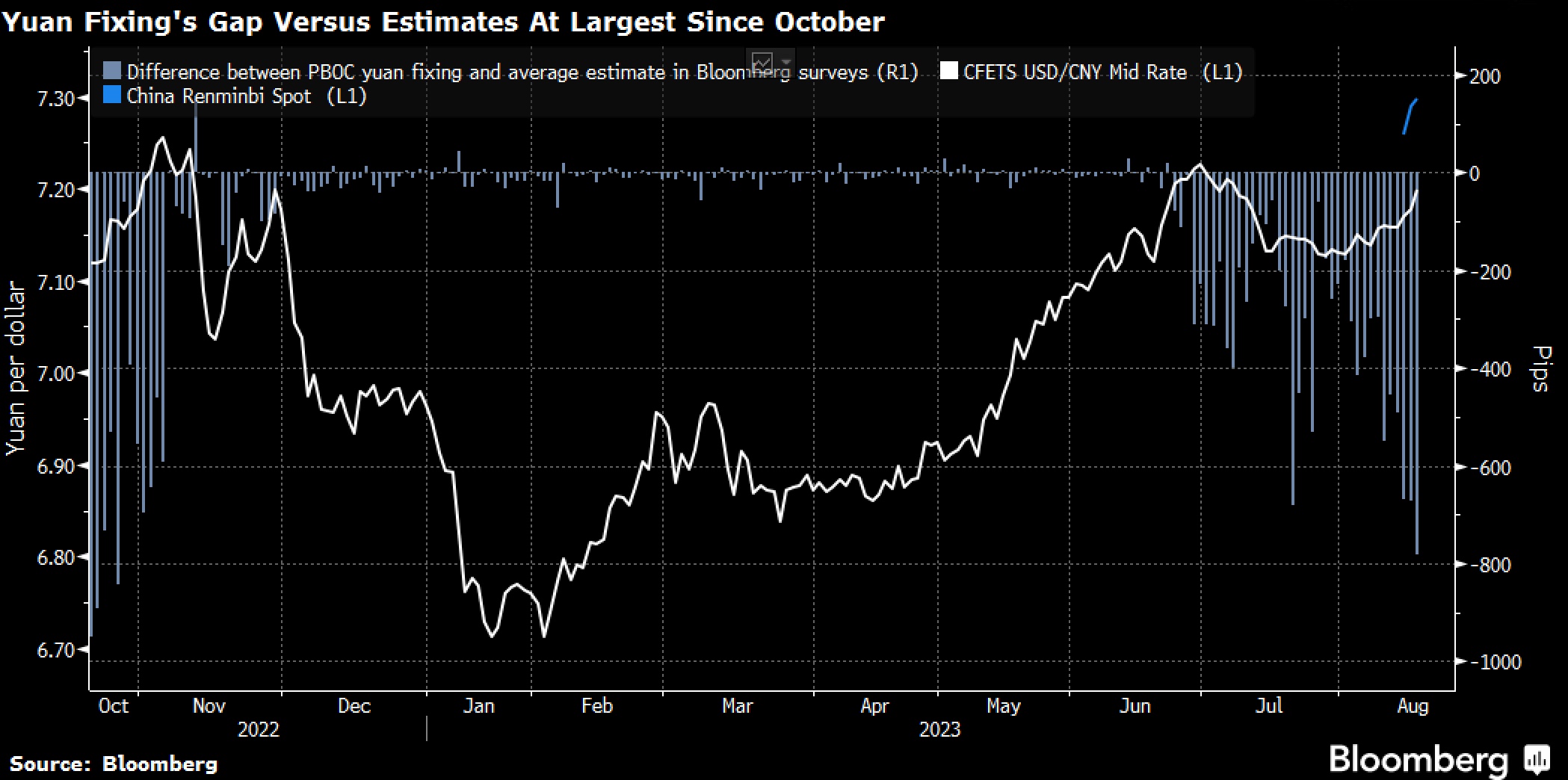
A brief recap of the process in the onshore CNY market shows that each morning the PBOC sets a central rate for the day (the CFETS rate), ostensibly based on a basket of currencies they follow, and when the market starts trading, it must remain within a +/- 2% band around that central rate.  Historically, when the PBOC wanted to signal that the currency was getting too strong or too weak, that CFETS rate would be set further in their desired direction than the model implied to help guide the market.  Well, lately, the PBOC has been setting the CFETS rate for a much stronger than expected CNY, but the market has largely been ignoring that. Bloomberg has an excellent chart showing the rising discrepancy that I have reprinted below.

The bars on the chart represent the difference, in pips on the RHS axis, between the actual CFETS fix and the estimates from analysts’ models.  Notice that from November 2022 through the beginning of July, that difference was virtually nil.  The point is the models have proven themselves over time to be accurate, so these big discrepancies are policy choices.

As the PBOC watches the currency of its closest ally, Russia, collapse in slow-motion, it is clearly concerned about its own situation.  The added pressure of slowing growth and the problems in the investment sector are making things more difficult.  The fact that China is on a monetary easing path while the rest of the world is still tightening is naturally going to undermine the value of the renminbi, but the great fear in China is a rapid devaluation.  

The biggest problem the PBOC has is that unlike the situation with youth unemployment, where they simply decided to stop publishing the data, they don’t really have that choice in this situation.  They cannot hide what they are doing and expect that the FX market will be able to function realistically.  And China needs an FX market because of the huge portion of their economy that is reliant on international trade.  

There is no easy answer for the Chinese here.  If they seek to support the domestic economy with easier monetary policy, the renminbi is very likely to continue to fall as locals seek to get their money out of the country and invest in higher yielding assets.  The fact that the Chinese equity markets have been slumping simply adds more pressure to the situation.  There is a well-known idea in international finance called the impossible trilemma which states that no country can have the following three things simultaneously:

  1. A fixed foreign exchange rate 
  2. Free capital movement
  3. Independent monetary policy

China’s situation is that while the FX rate is not actually fixed, it is carefully and closely managed; while there are significant capital controls, there is still a steady flow of funds leaving the country, often via international real estate investments, so there is some freedom of flows; although of course, there is no attempt at independence by the central bank.  However, what we can readily observe is that even maintaining control of the currency while there is any ability to move capital offshore is virtually impossible these days.  Nothing has changed my view that we are headed to 7.50 and beyond over time.  And, to think, I didn’t even have to discuss weak earnings from Tencent or further concerns about Country Garden going bankrupt.

With that as our backdrop, it cannot be surprising that risk is under some pressure.  After all, the Chinese economy remains the second largest in the world.  The big change for markets is that after two decades of China being the fastest growing major economy in the world, now it is much slower than both Japan and the US (Europe is still in the dumps) and portfolio adjustments are still being made.

Looking at the overnight session, after a weak US market, with all three major indices lower by more than -1.0%, Asia followed suit completely, with markets there also under significant pressure, falling by -1.0% or more pretty much throughout the time zone.  European bourses, though, have edged higher after a weak performance yesterday, but the gains are di minimis, and in the UK, after inflation data showed the BOE’s job is not nearly done, the FTSE is a bit softer.  US futures are little changed this morning as the market awaits the FOMC Minutes this afternoon.

Treasury yields have backed off a bit, down about 2bps, and we are seeing similar movements in Europe. However, 10yr Treasury yields remain well above 4.0% and certainly seem like they are trending higher.  In the wake of the much stronger than expected Retail Sales data yesterday morning, 10yr yields spiked to 4.26%, their highest level since last October, and tantalizingly close to the highest levels seen in more than 15 years.

Oil prices (+0.3%) which have been sliding for the past week, consolidating their strong move over the past two months, seem to be stabilizing above $80/bbl for now.  We are also seeing modest strength in the metals complex today, although the movement has been very tiny.  Gold has managed to hold the $1900/oz level, but its future performance will depend on the dollar writ large I think.

And finally, the dollar, which has been quite strong overall lately, is softening a touch this morning, with only two weaker currencies in the EMG bloc, KRW (-0.5%) and CNY (-0.1%) as both respond to the problems mentioned above.  But elsewhere, this seems to be a bit of a relief rally with the dollar sagging broadly.  The G10 space is seeing similar price action with only CHF (-0.2%) and JPY (-0.1%) lagging slightly, while the rest of the bloc edges higher.  But movement of this tiny magnitude tends to mean very little.

On the data front, Housing Starts (exp 1450K) and Building Permits (1463K) come first thing with IP (0.3%) and Capacity Utilization (79.1%) at 9:15.  Finally, at 2:00 the Minutes from the July FOMC meeting will be released and given the change in tone we have heard from several members lately, with cuts now on the table for next year, it will be interesting to see how that plays out.

Today feels like a consolidation day, without any significant catalysts, so I expect a quiet session overall.  Unless the Minutes change everyone’s views regarding the next steps by the Fed, I maintain my view of dollar strength over time.  At least until the Fed actually turns things around.

Good luck

Adf

Inflation’s Fate’s Sealed

The Minutes revealed that the Fed
When pondering their views ahead
Are no longer all
Completely in thrall
With hiking til more ink is red

However, they also revealed
That some felt a still higher yield
Was proper for June
And want more hikes soon
To make sure inflation’s fate’s sealed

Yesterday’s FOMC Minutes were interesting for the fact that after more than a year of the committee remaining completely in sync, it appears we have finally reached the point where there is a more robust discussion of the next steps.  The hawkish pause skip was very clearly an uneasy compromise between those members who thought it was appropriate, after 10 consecutive rate hikes, to step back and see if things were actually playing out in the manner their models predicted and those that remained adamant it was inappropriate to delay their process as there has been far too little progress on the reduction in services inflation.  Remember, the Fed’s models are entirely Keynesian in that they assume higher interest rates reduce demand by forcing financing costs higher.  It is why Chairman Powell has repeatedly explained that in order to achieve their goals, a little pain is going to be required.


But consider the nature of the current bout of inflation.  Was this driven by excess money being created in the banking sector and spent on business investment, or even share buybacks?  Or was this inflation driven by excess money being created, and then handed directly to the public in order to help everyone during the government-imposed lockdowns, thus spent immediately on goods, and eventually on services once the lockdowns were lifted?


I would argue that the latter is a more accurate representation of the current situation, one more akin to the post WWII economy than the 1970’s oil embargo led economy.  If this is the situation, then perhaps continuing to raise interest rates may not be the best solution to the problem.  In fact, as Lynn Alden indicates in her most recent piece, it could well be counterproductive.  If this inflation is fiscally (meaning government led) driven rather than monetarily (meaning bank lending led) driven, higher interest rates simply add to the amount of money available to spend by the public.  In fact, this process becomes circular as higher interest rates increase the amount of interest paid to bondholders adding to their disposable incomes, while simultaneously increasing the size of the fiscal deficit, thus increasing debt issuance, and driving interest rates higher still.  This is an unenviable place for the Fed to find itself, especially since its models don’t really accept this premise.  Rather, they continue to fight the 1970’s inflation via the Volcker playbook, which may only exacerbate the situation.


My growing concern is that the Fed is fighting the wrong enemy, and in fact, has no tools to fight the excessive fiscal spending which is currently the key driver of demand.  As such, it is very realistic to expect inflation, whether measured as PCE or CPI, is going to remain elevated on a core basis for quite a while yet.  When combining this thesis with both deglobalization and incremental labor shortages, the case for higher inflation for longer becomes even more compelling.  We have already seen that the housing market has not behaved at all in the manner expected by the Fed’s (or anybody’s) models, with prices holding up far better than anticipated given the dramatic rise in interest rates over the past 18 months.  It is not hard to believe that other variables in the Fed’s models are equally wrong.  In the end, this is further confirmation, to me, that the Fed will be fighting its inflation battle for a very long time.


How have markets reacted to this new information?  Not terribly well with financial assets falling in value around the world.  This is true in equities, where yesterday’s modest US declines were followed by much sharper falls in Asia and Europe with the Hang Seng (-3.0%) the laggard but all of Europe down by more than -1.0% today.  US futures are also under pressure, down about -0.4% as I type (7:30).


But despite the fall in equity markets, bond prices are tumbling as well with yields rising around the world.  Treasury yields are actually the best performers, rising only 4bps this morning, although that has taken them tantalizingly close to the 4.00% level which has proven to be a more significant hurdle for equities in the recent past.  But in Europe and the UK, bond yields are screaming higher with Gilts (+10bps) leading the way, but all Continental sovereigns seeing yields rise by at least 6bps.  This is interesting given the fact that the only data released today was Construction PMI data which was incredibly weak across all of Europe and the UK.  Clearly, the prospect of higher Fed funds is one of the driving forces here as higher for longer gets more deeply embedded in the market belief set.


Speaking of higher Fed funds, the market is currently pricing an 85% probability of a hike later this month and then only a slight chance of a second one, despite the Fed’s comments.  In Europe, the situation is similar, with a 90% probability priced for July but only one more hike in total by the end of the year.  And remember, the ECB is 125bps behind the Fed in terms of the level of rates, and inflation remains higher in the Eurozone than in the US.  It feels like there will be more changes to come in these markets.


Oil prices, meanwhile, continue to be supported with the rationale being the Saudi’s continued production cuts.  While there is a story that Iran has been pumping more oil into the market, the price action has certainly been a bit more bullish lately.  Structurally, there is still going to be a shortage of oil over time, but for now, that doesn’t seem to matter.  Meanwhile, base metals are edging lower this morning, after the weak construction data, and gold remains stuck in its consolidation.


As to the dollar, it is generally, though not universally, lower this morning with the yen (+0.6%) the leading gainer on fading risk sentiment, although there is also a building story that Ueda-san is going to be making some adjustments in the near future in order to mitigate the recent weakness.  While it has been relatively slow and steady, as it approaches 145, it clearly seems to be generating some discomfort.  But in the G10, the weakness is broad.  However, in the EMG bloc, the dollar has had a much better showing rising against a majority of the group with ZAR (-0.9%) the laggard on the weaker metals’ prices, but weakness throughout APAC and LATAM currencies as well.  If we continue to see US rates climb higher, I expect that the dollar will be dragged along for the ride.


On the data front today, there is a lot of stuff, starting with ADP Employment (exp 225K) and followed by the Trade Balance (-$69.0B), Initial Claims (245K), Continuing Claims (1734K), JOLTS Job Openings (9885K) and finally ISM Services (51.2) at 10:00.  I saw a story that there has been a seasonal adjustment issue with the Claims data because of the Juneteenth holiday, which is quite new, and so not necessarily properly accounted for in the release.  Over time, these things will smooth out, but do not be surprised if today’s Claims print is higher than expected.  And of course, this all leads up to tomorrow’s NFP report, something I will discuss then.  Dallas’s Lori Logan speaks today, but she is not currently a voter.  Next week, however, we hear from a lot of Fed speakers, so perhaps some fireworks are on the horizon.


Overall, I think there is a case to be made that the Fed is looking in the wrong direction and that they will continue to raise the Fed funds rate and drive all yields higher without having the desired disinflationary impact.  In that scenario, I think the dollar still looks the best of the bunch.


Good luck

Much Pain

There once was a nation quite strong

Whose policies worked for so long

But war in Ukraine

Inflicted much pain

And now it seems they were all wrong

Relying on, energy, cheap

They rose to the top of the heap

But when prices rose

They’d naught to propose

‘Bout how to, advantages, keep

It turns out that Germany has fallen into a recession after all.  The German Statistics office revised down their Q4 2022 GDP reading from stagnation at 0.0%, to a -0.5% reading after adjusting for a substantial decline in government spending.  Meanwhile, Q1 GDP growth fell -0.3%, so Germany is solidly in a recession, at least based on the traditional definition of two consecutive quarters of negative GDP growth.  It certainly is remarkable that an economy that predicated itself on levering cheap, imported energy into the manufacture of steel, chemicals and machinery would encounter any problems simply because it became totally reliant on raw materials from a communist regime…NOT!  But in fairness, the Germans have hamstrung themselves by spending hundreds of billions of euros in their Energiewende program to reduce greenhouse gas emissions.  Unfortunately, this included shuttering their entire nuclear power fleet, which had produced upwards of 25% of their electricity with zero emissions and replacing it with heavily subsidized solar and wind power generation.  (By the way, whoever thought that solar power was a good idea in Northern Europe?  Arizona I get, Germany not so much.)

Granted, prior to Vladimir Putin invading Ukraine, things were going along swimmingly.  China was soaking up so much of what Germany was producing, and of course the rest of Europe were huge customers as well.  But it turns out risk management is a real thing, and not just when it comes to your foreign exchange or interest rate risks.  If we learned nothing else from the Covid pandemic it is that surety of supply of critical products or inputs is worth a lot, perhaps just as much as the price of that supply.  

Once Russia invaded, though, the world changed dramatically, and a critical flaw in the German economy was exposed.  Prior to the invasion, because of Energiewende, German electricity prices were the highest in Europe and approaching the highest in the world.  And that included cheap Russian gas as a source.  Now those prices are higher still and major manufacturers are picking up stakes and moving their facilities to places where they can get reliable, and relatively inexpensive, energy.  BASF moving key production to both China and Saudi Arabia is merely indicative of the problems Germany will have going forward.  It strikes me that Germany has a long road to hoe in order to get their economy back working as effectively as it had in the past.  This does not bode well for the euro (-0.2%) which is continuing its slow grind lower this morning, as the dollar continues to buck the majority analyst view of USD weakness.

The future belongs to AI

At least that’s what bulls glorify

So, last night we learned

Nvidia earned

A ton helping futures to fly

Obviously, this is not an equity piece and so I rarely cover specific names, but the buzz on Nvidia’s earnings is having a significant impact on markets overall.  The most instructive thing is to look at the performance of the NASDAQ vs. that of the Dow, at least in the pre-market futures trading.  At this hour (7:30), NASDAQ futures are higher by 2.0% while Dow futures are lower by -0.4%.  This dichotomy continues to grow on a daily basis, with the tech megacaps generating virtually all of the equity market performance seen this year, hence the relative outperformance of the NASDAQ vs. both the S&P 500 and the Dow.  The narrowing breadth of the market’s performance, with 7 names accounting for more than the entire S&P 500 gains this year means the other 493 names are actually lower.  From a more macro point of view, historically, price action of this nature has preceded significant bear markets every time it has occurred.  It is very easy to look at the totality of information including still high US inflation, softening growth metrics and a stock market that is reliant on just 7 names for its performance, and conclude a reckoning is coming.  Oh yeah, did I mention that the Fed remains committed to keeping its policy at current, relatively tight levels?  It is no wonder that the recession that is forecast to come soon is so widely forecast.

Quickly, the FOMC Minutes yesterday indicated that while there was a lot of discussion as to whether or not rates needed to go higher, there was zero discussion that rates would need to decline anytime soon.  The commentary we have heard since the last meeting has certainly had a less conclusive tone regarding further hikes, with several members indicating they thought a pause for observation was worthwhile.  But unless the economy craters, and Unemployment spikes much higher, there is no reason  to believe the Fed is going to change course.  And that, my friends, will continue to support the greenback for quite a while.

As to the overnight session, after a weak US equity performance yesterday, Asia was mixed and most European bourses are edging lower on the order of -0.2%.  It is certainly no surprise that the DAX is falling, and we have also seen lackluster data from France weighing on the CAC.  The problem for Europe is they don’t have any megacap tech stocks to support the indices.

Bond yields continue to mostly edge higher with gains on the order of 1bp this morning although there was a standout here, Gilt yields have risen by 9bps, still feeling the hangover from yesterday’s inflation data.

Meanwhile, in commodities, recession is the watchword as oil prices (-1.2%) are giving back some of their recent gains, although copper has seen a trading bounce.  

And finally, in the FX markets, the dollar continues to perform well, rising against all its G10 and most EMG counterparts.  Remarkably, the debt ceiling concerns seem to be the driver as the dollar is still considered the safest of havens despite the issues here.  There have been no outstanding stories to note other than the risk-off nature of things.

On the data front, we see Initial (exp 245K) and Continuing (1800K) Claims as well as the second look at Q! GDP (1.1%).  Also, Chicago Fed  National Activity (-0.2) is released, which has been pointing to slowing economic growth for a while now.   Two Fed speakers, Barkin and Collins are on the slate today, but I feel that mixed message continues unabated and won’t be changed here.

Ultimately, until the Fed backs off, the dollar is going to continue to perform well, keep that in mind.

Good luck

Adf

Somewhat Bizarre

Apparently, no one expected
The Fed, when they last met, detected
Their actions thus far
Were somewhat bizarre
And so, a new stance was erected

Not only would they halt QE
But also, a shrinkage they see
In balance sheet sizing
So, it’s not surprising
The bond market filled bears with glee

“…it may become warranted to increase the federal funds rate sooner or at a faster pace than participants had earlier anticipated.”
“… participants judged that the appropriate timing of balance sheet runoff would likely be closer to that of policy rate liftoff than in the Committee’s previous experience.”
“Many participants judged that the appropriate pace of balance sheet runoff would likely be faster than it was during the previous normalization episode.”

These were the words from the FOMC Minutes of the December meeting that roiled markets yesterday afternoon.  Arguably there were more as well, but these give the gist of the issue.  Suddenly, the Fed sounds so much more serious about their willingness to not only taper QE quickly, and not only begin to raise the Fed Funds rate, but also to actually shrink their balance sheet.  If the Fed does follow through on this, and finishes QE by March, starts raising the Fed Funds rate and also begins to reduce the size of the balance sheet, then you can expect that the global risk appetite is going to be pretty significantly reduced.  In fact, I would contend it is the last of these steps that is going to undermine risk assets, as balance sheet reduction will likely result in higher long-term bond yields and less liquidity available to flow into risky assets.  As I have highlighted in the past, in 2018, the last time the Fed was both raising interest rates and shrinking the balance sheet, the resulting 20% equity market decline proved too much to withstand.  Are they made of sterner stuff this time?

One other thing to note was that while omicron was mentioned in the Minutes, it was clearly not seen as a major impediment to economic growth in the economy.   The fact that, at least in the US, there doesn’t appear to be any appetite/willingness for complete lockdowns implies that the nation is beginning to move beyond the pandemic fear to a more relaxed attitude on the issue.  Granted there are still several city and state governments that are unwilling to live and let live, but for the nation writ large, that does not seem to be the case.  From an economic perspective, this means less demand interruptions but also, likely, less supply interruptions.  The inflationary impact on this change in attitude remains uncertain, but the underlying inflationary trends remain quite strong, especially housing.  Do not be surprised to see CPI and PCE peak in Q1, but also do not be looking for a return to 2.0% levels anytime soon, that is just not in the cards.

And really, that was the driving force in yesterday’s market activity and is likely to be the key feature going forward for a while.  We will certainly need to pay close attention to Fed comments to try to gauge just how quickly these changes will be coming, and we will need to pay attention to the data to insure that nothing has changed in the collective view of a strong employment situation, but in the US, at least, this is the story.

The question now is how did other markets respond to the Minutes and what might we expect there?  Looking at equities, the picture was not pretty.  Following the release, US equity markets sold off sharply with the NASDAQ falling 3.3% on the day and both the Dow (-1.1%) and S&P500 (-1.9%) also suffering.  Activity in Asia was also broadly weaker with the Nikkei (-2.9%) and Australia’s ASX (-2.75%) both sharply lower although Chinese stocks were less impacted (Hang Seng +0.7%, Shanghai -0.25%).  The story there continues to revolve around the property sector and tech crackdowns, but recall, both of those markets had been massively underperforming prior to this Fed news.  As to Europe this morning, red is the color of the day (DAX -1.0%, CAC -1.2%, FTSE 100 -0.5%) as the data mix showed continued high inflation in Germany with every Lander having reported thus far printing above 5.1%.  As to US futures, they are not buying the bounce just yet in the NASDAQ (-0.5%), but the other two indices are faring a bit better, essentially unchanged on the day.

It can be no surprise that the bond market is under further pressure this morning as the Fed has clearly indicated they are biased to not only stop new purchases but allow old ones to mature and not be replaced.  (There is no indication they are considering actually selling bonds from the portfolio.  That would be truly groundbreaking!)  At any rate, after the Minutes, yields jumped an additional 3bps and have risen another 2.8bps this morning.  This takes the move in 10-year yields to 23 basis points since the beginning of the week/year.  Technically, we are pushing very significant resistance levels in yields as these were the highs from last March.  If we do break higher, there is some room to run.  As well, the rise in Treasury yields is driving markets worldwide with European sovereigns all selling off (Bunds +3.5bps, OATs +4.2bps, Gilts +5.5bps) and similar price action in Asia, where even JGB’s (+2.0bps) saw yields rise. Real yields have risen here, although as we have not seen an inflation print in the US since last month, that is subject to change soon.

On the commodity front, the picture is mixed today with oil (+1.2%) higher while NatGas (-1.2%) continues to slide on milder weather.  Uranium (+3.9%) has responded to the fact that Kazakhastan is the largest producer and given the growing unrest in the country, concerns have grown about its ability to deliver on contracts.  With yields higher, gold (-0.6%) and silver (-2.2%) are both softer as are copper (-1.4%) and aluminum (-0.5%).  Clearly there are growing concerns that higher interest rates are going to undermine economic growth.

Finally, in the FX markets, the broader risk-off tone is manifesting itself as a generally stronger dollar (AUD -0.7%, NZD -0.6%, NOK -0.35%) with only the yen (+0.25%) showing strength in the G10.  In the EMG bloc, the picture is a bit more mixed with laggards (THB -0.9%, CLP -0.7%, MYR -0.5%) and some gainers (ZAR +0.8%, RUB +0.7%, HUF +0.5%).  Rand is the confusing one here as the ruble is clearly benefitting from oil’s rise and the forint from bets on even more aggressive monetary policy.  However, I can find no clear rationale for the rand’s strength though I will keep looking.  On the downside, THB is suffering from an increase in the lockdown levels while MYR appears to be entirely dollar driven (higher US rates driving dollar demand) while the peso seems to be suffering from concerns over fiscal changes regarding the pension system.

On the data front, this morning brings Initial Claims (exp 195K), Continuing Claims (1680K) and the Trade Balance (-$81.0B) at 8:30 then ISM Services (67.0) and Factory Orders (1.5%, 1.1% ex transport) at 10:00.  But tomorrow’s payroll report is likely to have far more impact.  And the Fed calendar starts to fill out again with Daly and Bullard both on the slate for today and seven more speakers over the next week plus the Brainerd vice-chair hearings.

I’m a bit surprised the dollar isn’t stronger in the wake of the new Fed attitude, but perhaps that is a testimony to the fact there are many who still don’t believe they will follow through.  However, for now, I expect the dollar will continue to benefit from this thesis, albeit more gradually than previously believed, but if we do see risk appetite diminish sharply, look for a little less tightening enthusiasm from Mr Powell and friends, and that will change sentiment again.

Good luck and stay safe
Adf