
Some Regrets

Six central bank meetings this week
Will give us a new inside peak
At their dedication
To wipe out inflation
And just how much havoc they’ll wreak
 
Investors have made all their bets
And so far, today, risk assets
Show green on the screen
Ere any convene
Methinks, though, there’ll be some regrets


It is central bank week as we hear from more than half of the G10 between tomorrow and Thursday.  The BOJ kicks things off followed by the RBA, FOMC, Norgesbank, the SNB and finally the BOE.  A great deal of stock has been put into these meetings by both traders and investors as everyone is seeking clues for the future. Alas, looking for central banks, whose crystal balls are cloudier than most, to give solid clues is probably not the best idea.  But let’s take a quick look at each meeting and expectations:

BOJ – next to the Fed, this is the meeting that has gotten the most press both because Japan is the largest of the other economies, but also because there is much talk that they are going to raise their base rate for the first time in 17 years!  At this point, despite the most recent dovish comments from Ueda-san two weeks’ ago, the best indicator seems to be Nikkei News, which has had several articles (courtesy of Weston Nakamura’s Across the Spread substack) declaring that rate hike is coming.  Apparently, they have a perfect record in these forecasts, so it looks a done deal.

Arguably, the question is will they do anything else beyond moving from NIRP to ZIRP?  There are several analysts who believe they will adjust YCC as well, either eliminating it completely, or changing the terms to buy a fixed amount each period rather than responding to market conditions.  As well, they continue to buy equity ETFs and REITs so it is quite possible they end those programs.

The funny thing is so many believed that when the BOJ finally started their tightening cycle that would be the signal for selling JGBs and buying yen.  Well, if that has been your strategy going into the meeting, it has not worked out that well.  JGB yields (-3bps) have been consolidating around the 0.75% level virtually all year while the yen, which did have a little pop higher at the beginning of the month, is now back close to 150 again.  Regarding the yen, the driver in the currency continues to be US interest rates and the incremental adjustment by the BOJ is just not enough to move the needle absent a firm commitment by Ueda-san to hike regularly going forward.  And there is no evidence of that.  As to JGB yields, a slow grind higher seems possible, but a run up above 1.0% seems highly unlikely, especially given the economic cycle has just turned down with two consecutive quarters of negative real GDP activity.

RBA – there is no policy movement anticipated here for this meeting as both growth and inflation remain above targets but have not been relatively stable.  In fact, there is a minority looking for a cut, but that seems unlikely right now simply based on the inflation data.  Generically, I find it extremely difficult to believe that any central bank will be able to cut their rates with inflation running well above the target and, in most places, looking like it has found a bottom.  I realize there is a significant desire to cut rates by virtually all central bankers, but given the current economic situation, if they want to salvage whatever credibility they may have left, it is a hard case to make to cut right now.  

One other thing to remember is that Australia is more dependent on China than any other G10 nation and China last night published better than expected economic data with IP jumping to 7.0%, far better than expected and its fastest pace in two years.  If China is starting to pick up again, that will be a net benefit for Australia and put upward pressure on commodity prices and prices in general Down Under.  I think they remain on hold for a while yet.

FOMC – suffice to say no change in rate policy but we will discuss the other features tomorrow regarding the dot plot and potential guidance.

SNB – The Swiss may be the other central bank to move this time as inflation there has fallen to 1.2%, well below the ceiling of their 0% – 2% target range.  While the market consensus remains no change and the franc has softened nearly 4% vs. the euro so far this year, we cannot forget that it remains far stronger than its historic levels and the opportunity to weaken the currency a bit to help its export industries while inflation remains quiescent is something that may appeal to SNB President Jordan.  Keep an eye out here.

Norgesbank – No change here as inflation remains far too firm, ~5%, while oil’s recent rebound has helped the currency rebound.  I don’t think there is anything to be learned from this outcome.

BOE – Here, too, no change is expected and there is no press conference.  As such, the most interesting question will be the vote split.  Last time, the split was 1-6-2 for a cut, hold and hike respectively.  (Talk about not seeing things the same way!  How is it possible that two committee members can look at the same data and believe opposite conclusions?  Seems there is some ideology in play there.). At any rate, a change in the vote count will be a signal.  Recent data has shown that wages are still hot, but slowing down, while inflation is similarly hot but slowing.  The latest CPI data will be released on Wednesday so the BOE will have that to account for as well as everything else.  At this point, I’m in the no move camp with the same split of votes the outcome.

With that recap, let’s look at the overnight session briefly.  As mentioned above, equities are green everywhere with the Nikkei (+2.7%) leading the way around the world and pushing back close to the key 40K level.  But there was strength in every market in Asia.  Europe, too, is all green, albeit less impressively, with gains on the order of 0.25% while US futures are looking good at this hour (7:45) with the NASDAQ leading the way, up 1.0%.  (Here, many are counting on more amazing news from Nvidia as they have a weeklong conference starting today.)

After last week’s rush higher in yields on the strength of the hotter inflation prints from the US, this morning is seeing very little movement overall ahead of the central bank meetings this week.  Basically, every market is within 1bp of Friday’s closing levels, with a few higher and others lower.  One other thing I failed to mention was the PBOC will be revealing their 5-year Loan Prime Rate on Tuesday night, and while no change is forecast, it was last month when they cut this to help the property market that kicked off the idea more stimulus was coming.

Oil prices continue to perform well on the back of several different factors.  First, we have seen inventory draws much greater than expected in the US.  At the same time, Ukraine has damaged several Russian refineries thus reducing the supply of products and we still have OPEC+ maintaining their production restrictions.  Add to this China’s apparent rebounding growth supporting demand and that is a recipe for higher prices.  As to the metals markets, despite the dollar’s recent rebound, gold continues to hold its own and copper is still rising consistently.  In fact, the red metal is higher by 5% in the past week, a potential harbinger of better global growth.

Finally, the dollar is a touch softer this morning, but only a touch.  The biggest mover is ZAR (-0.6%) which is opposite the broader trend of very slight dollar weakness.  While South African equities have been drifting lower of late, today’s move feels more like an order in the market than a fundamental change.  Away from that, though, no currency of note has moved more than 0.2% on the day as traders await the onslaught of central bank news.

Speaking of news, we have other things beyond the central banks as follows:

TuesdayHousing Starts1.43M
 Building Permits1.50M
ThursdayInitial Claims216K
 Continuing Claims1815K
 Philly Fed-2.5
 Current Account-$209.5B
 Existing Home Sales3.95M
 Flash PMI Manufacturing51.7
 Flash PMI Services52.0
Source: tradingeconomics.com

In addition, starting Thursday, the first Fed speakers will be back on the tape to reinforce whatever message Chair Powell articulates on Wednesday.

From my vantage point, it appears that the BOJ’s rate hike has been accepted and priced in already, while the biggest surprise could be Switzerland.  However, the fate of the dollar lies in the hands of Powell, and that is an open question we will discuss tomorrow.  For today, don’t look for too much of anything in any market.

Good luck

Adf
Concerns Are Severe

One look at the dot plot makes clear
Inflation concerns are severe
So, higher for longer
Is growing still stronger
And Jay implied few cuts next year

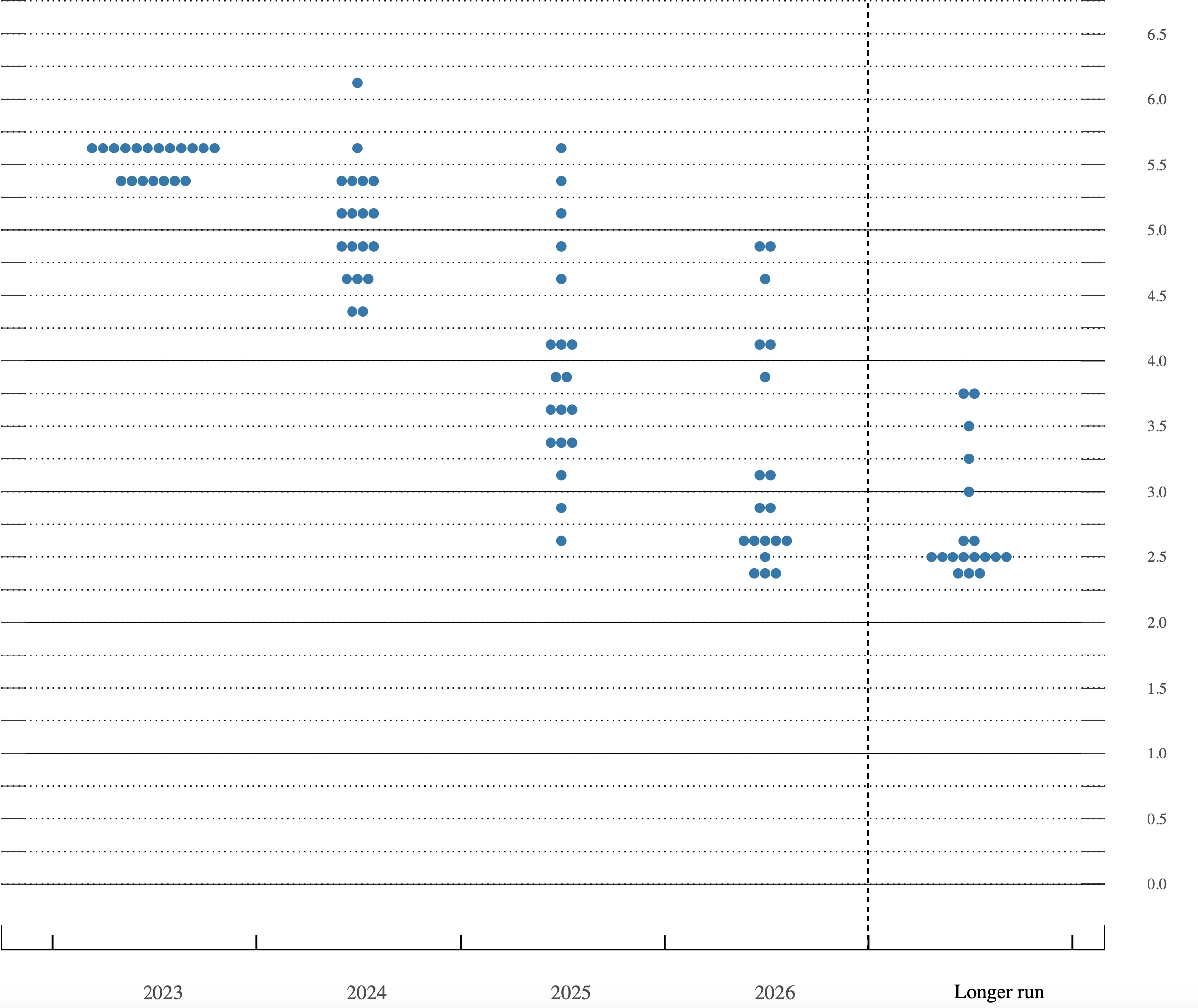
First, let’s recap the FOMC meeting.  The term hawkish pause had been used prior to the meeting as an expectation, and I guess that was a pretty apt description.  While they left policy on hold, as expected, the change in the dot plots, as seen below, indicate that even the doves on the Fed see fewer rate cuts next year, with just two now priced in from four priced in June.

Source: Fedreserve.gov

A quick reading shows that a majority of members expect one more hike this year, and now the median expectation for the end of 2024 has moved up to 5.125%, so 50bps lower than the median expectation for the end of 2023 and 50bps higher than the June plot.  To me, what is truly fascinating is the dispersion of expectations in 2025 and 2026, where there are clearly many opinions.  And finally, the longer run expectation has risen to 2.5% with many more members thinking it should be even higher than that.  The so-called neutral rate estimations seem to be creeping higher.  If you think about it, that makes some sense.  After all, given the ongoing forecasts for continued labor market tightness due to demographic concerns, and add in the massive budget deficits leading to significantly higher Treasury debt issuance, there is going to be pressure on rates to find a higher level.

The market response was quite negative, albeit not immediately, only after Powell started speaking.  But in the end, equity markets fell across the board in the US, with the NASDAQ taking the news the hardest, down -1.5%, as its similarity to long duration bonds was made evident.  Asian markets all fell overnight as well, with most tumbling more than -1.0% and European bourses are all under similar pressure, down -1.0% or so as well.  The one exception in Europe is Switzerland, where the SNB surprised the market and left rates on hold resulting in a weaker CHF and a very modest gain in their equity market.

However, the bigger market response was arguably in bonds, where yields rose to new highs for the move with the 2yr at 5.15% and the 10yr at 4.43%.  Once again, I point to the significant increase in debt that will be forthcoming from the US Treasury as they need to fund those budget deficits.  I have been making the case that a bear steepener would be the more likely outcome for the US yield curve.  That is where long-term rates rise more quickly than short-term rates due to the US fiscal policy and shrinking demand for US debt by key players, notably the Fed, but also China and Japan.  Nothing has changed that view.

Then early this morning, up north
Both Sweden and Norway brought forth
A quarter point hike
To act as a dike
Preventing price rises henceforth

After the Fed’s hawkish pause, we turn our attention to Europe, where the early movers, Sweden and Norway, both hiked twenty-five basis points, as expected, while both hinted that further hikes are not out of the question.  Inflation remains higher than target in both nations and in both cases, the currency has been relatively weak overall.  Switzerland left rates on hold, pointing to the fact that for the past three months, inflation has been within their target range, and they are beginning to see downward pressure on economic activity which they believe will keep that trend intact.

And lastly, from London we’ve learned
Another rate hike has been spurned
Though voting was tight
They said they’re alright
With waiting to see if things turned

As to the bigger story, the UK, expectations were split on a hike after yesterday’s tamer than expected CPI report while the pound fell ahead of the news.  And the change in expectations was appropriate as in a 5-4 vote, the BOE opted to remain on hold for the first time in two years.  They see that inflation may be easing more rapidly than previously expected, and they are concerned about overtightening.  While I have a hard time understanding how a 5.15% Base rate is tight compared to CPI running at 6.7% and core at 6.2%, I am clearly not a central banker.  At any rate, the pound fell further on the news and is now at its lowest level since March, while the FTSE 100 rallied back and is close to flat on the day from down nearly -1.0% before the announcement.  Gilt yields, however, are moving higher as the bond market there doesn’t seem to believe that the BOE is serious about fighting inflation.

And really, those are today’s key stories.  Late yesterday, Banco Central do Brazil cut the SELIC rate by 0.50%, as expected, and at the same time the BOE announced, the Central Bank of Turkey raised their refinancing rate by 5 full percentage points, to 30.0%, exactly as expected.  And to think, we get concerned over rates at 5%!

As to the rest of the day, there is a bunch of US data as follows: Philly Fed (exp -0.7), Initial claims (225K), Continuing Claims (1695K), Existing Home Sales (4.1M) and Leading Indicators (-0.5%).  As is typical, there are no Fed speakers scheduled the day after the FOMC meeting, but we will start to hear from them again tomorrow.

Putting it all together tells me that the Fed is not nearly ready to back off their current stance and will need to see substantial weakness in economic activity before changing their mind.  Meanwhile, last week’s ECB meeting and this morning’s BOE meeting tell me that the pain of higher interest rates in Europe is becoming palpable and the central banks are leaning more toward inflation as an outcome despite their mandates.  This continues to bode well for the dollar as the US remains the place with the highest available returns in the G10.

Tonight, we hear from the BOJ, where no change is expected.  I would contend, though, that the risk is there is some level of hawkishness that comes from that meeting as being more dovish seems an impossibility.  As such, there is a risk that the yen could see some short-term strength.  Keep that in mind as you look for your hedging levels.  

Good luck

Adf

A Pitiful Claim

Said Jay, we’ve “a long way to go”
Ere driving inflation too low
Employment’s still tight
But we’ll get it right
Or not… it’s too early to know

His colleagues, though, aren’t in sync
As some of them seemingly think
They’ve tightened enough
And now would rebuff
The call for more Kool-Aid to drink

Lots to touch on this morning between Powell’s testimony yesterday along with other Fed speakers and then a raft of central bank meetings with rate hikes across the board.


Starting with the Fed, Powell tried to be very clear that his expectation, and that of the bulk of the FOMC, is interest rates have further to rise.  While they chose to skip a hike last week, they are under no illusion that they have beaten inflation.  Instead, Powell was very clear in his comments that they “have a long way to go” before they have finished the job with inflation.  Of course, yesterday I laid out a theme of why their medicine for inflation is not likely to be that effective, but that is not a conversation that Powell, or any FOMC member, is likely to entertain.


However, despite Powell’s insistence that there are likely two more 25bp rate hikes in the offing, we are finally beginning to hear some dissent from the rest of the committee.  Yesterday both Raphael Bostic from Atlanta and Austin Goolsbee from Chicago were clear that a pause at the current level made the most sense and they would support that outcome.  While Governor Christopher Waller remains on board with further rate hikes, Bostic is not a voter (Goolsbee is) so I expect that the July meeting will have a lot of discussion.


Interestingly, the market reaction was different in different markets, with the equity markets hearing Powell and accepting his words at face value thus selling off, while the FX market seems more suspect, with the dollar failing to gain after his comments.  In fact, the euro has traded back above 1.10 this morning for the first time in more than a month.  As to the Treasury market, yields are pushing higher again, with 10yr yields up by 1.5bps this morning, but the real movement has been in the 2yr which has seen the curve inversion push back to -99bps.  Bond investors seem to believe Powell.

In Europe, though, things ain’t the same
As central banks still try to blame
Their failure to slow
Inflation and grow
On Russia, a pitiful claim

In the meantime, three central banks met today in Europe and all three hiked rates, with two, Norway and the UK, hiking by 50bps and Switzerland hiking just 25bps.  The 50bp hikes were more than expected and indicative of the fact that both nations, and in truth the entire continent, remain far behind the curve in their respective inflation fights.  Alas, for these nations, too, I fear they are not using the best tool to address the issue as all were guilty of excessive fiscal stimulus and all face worse demographic trends than the US, so are unlikely to get the desired response from rate hikes. 


It should be no surprise that both the pound and krone have rallied sharply on the day, with NOK higher by 1.3% and the best performing currency in the world, as investors and traders are concluding that these central banks are going to keep at it until such time as inflation finally does slow down.  The pound reacted immediately, with a quick 0.5% pop, although it is since retraced those gains and is only slightly higher on the day now. 


What should we make of all this central bank activity?  While there are a growing number of analysts and economists who continue to believe that inflation is due to decline sharply over the summer, apparently none of them work in any central bank.  The relative amount of tightness from one bank to another may vary slightly, but other than the BOJ, which is completely uninterested in adjusting its policy anytime soon, it is very easy to believe that interest rates have higher to go from here.  Plan accordingly.


So, what have these comments and actions wrought in markets?  Well, my entire equity market screen is red this morning with Japan and China both sharply lower as well as every major index in Europe falling by at least -1.0%.  US futures are also in the red after a weak session yesterday, and it is very easy to believe that we are due a correction, if nothing else, given the remarkable run up we have seen lately.


Bond yields, as mentioned above, are generally higher, although 10yr Gilts are bucking the trend, falling 3bps in the wake of the BOE action as investors are hopeful they are truly going to be able to halt the inflationary spiral.  As with most other things, JGB’s are not following suit and in fact, with the 10yr yield back down to 0.367%, virtually all discussion of the end of YCC has vanished.  Ueda-san is one lucky guy.


On the other hand, oil (-2.1%) is under pressure this morning as the idea of higher interest rates slowing economic growth continues to pervade the market.  Perhaps more surprisingly, both copper and aluminum have rallied a bit and are holding onto their gains in the face of higher rates.  Ultimately, copper especially, is a resource that is in short supply for all the grandiose electrification plans that are bandied about by politicians worldwide, and so I expect, just like oil, there is a structural deficit and it should trade higher.  I am simply surprised it is doing so in the current environment.


Finally, the dollar is mixed this morning, as after the NOK, the rest of the G10 is +/- 0.2% from yesterday’s closing levels, hardly enough to discuss.  In the emerging markets, the biggest mover is TRY (-2.3%) after the central bank disappointed by only raising rates from 8.50% to 15.0%!  With a new central bank chief, the market was expecting a move to 20.0%, which would still be far below the current level of CPI there, which at last reading was 39.6%.  But away from that, the dollar is mixed with no outliers in either direction.


Today we do get a lot of data as follows: Chicago Fed National Activity Index (exp -0.10); Initial Claims (259K); Continuing Claims (1785K); Existing Home Sales (4.25M); Leading Indicators (-0.8%) and KC Fed Manufacturing Index (-5).  Chair Powell also speaks to the Senate Banking Committee today, but I doubt much new will come from that.  Look at the Initial Claims data, which is the best real time indicator of the employment situation as any jump there will likely get tongues wagging about the end of the Fed rate hikes.


Right now, investors are a bit nervous about just how hawkish the Fed is going to ultimately be, so my take is we will see caution, meaning profit taking and a modest correction in risk assets, until such time as participants are all convinced that the pivot is coming.  The fact that a pivot means the economy is distressed does not seem to matter right now. As to the dollar, it will have a hard time as long as traders question the Fed’s conviction while other central banks raise rates.  So, while the yen and renminbi should be the worst performers, the G10 is likely to outperform the buck for now.


Good luck

Adf

Twiddling Their Thumbs

Investors are twiddling their thumbs
Awaiting the next news that comes
The Old Lady’s meeting’s
Impact will be fleeting
And Jay’s finished flapping his gums

Which leads to the question at hand
Is risk on or has it been banned?
The one thing we know
Is growth’s awfully slow
Beware, markets could well crash land

Markets are taking a respite this morning with modest movement across all three major asset classes. While the Bank of England is on tap with their latest policy announcement, the market feels certain they will leave rates on hold, at 0.10%, and that they will increase their QE purchases by £100 billion, taking the total to £745 billion, in an effort to keep supplying liquidity to the economy. It is somewhat interesting that the story from earlier in the week regarding positive movement on Brexit had such a modest and short-term impact on the pound, which has actually begun to decline a bit more aggressively as I type. After peaking a week ago, the pound has ceded 2.5% from that top (-0.6% today). There is nothing in the recent UK data that would lead one to believe that the economy there is going to be improving faster than either the EU or the US, and with monetary policy at a similar level of ease on a relative basis, any rationale to buy pounds is fragile, at best. I continue to be concerned that the pound leads the way lower vs. the dollar, at least until the current sentiment changes. And while the BOE could possibly change that sentiment, I would estimate that given yesterday’s inflation reading (0.5%) and their inflation target (2.0%), they see a weaker pound as a distinct benefit. Meanwhile, remember the current central bank mantra, ease more than expected. If there is any surprise today, look for £150 billion of QE, which would merely add further urgency to selling pounds.

But aside from the BOE meeting, there is very little of interest to the markets. The ECB announced that their TLTRO III.4 program had a take-up of €1.31 trillion, within the expected range, as 742 banks in the Eurozone got paid 1.0% to borrow money from the ECB in order to on lend it to their clients. But while an interesting anecdote, it is not of sufficient interest to the market to respond. In fact, the euro sits virtually unchanged on the day this morning, waiting for its next important piece of news.

In the G10 space, the only other mover of note is NOK, which has rallied 0.5% on the back of two stories. First, oil prices have moved a bit higher, up slightly less than 1% this morning, which is clearly helping the krone. But perhaps more importantly, the Norgesbank met, left rates on hold at 0.00%, but explained that there was no reason for rates to decline further, once again taking NIRP off the table.

However, away from those two poles, there is very little of interest in the G10 currency space. As to the EMG space, it too is pretty dull today, with RUB the leading gainer, +0.55%, on the oil move and ZAR the leading decliner, -0.4%, amid rising concern over the spread of Covid there as the infection curve remains on a parabolic trajectory. Similar to the G10 space, there is not much of broad interest overall.

Equity markets have also “enjoyed” a mixed session, with Asian markets showing gainers, Shanghai +0.1%, and losers, Nikkei -0.25%, but nothing of significant size. In Europe, the news is broadly negative, but other than Spain’s IBEX (-1.0%) the losses are quite modest. And finally, US futures are mixed but all within 0.1% of yesterday’s closing prices.

Lastly, bond markets are generally firmer, with yields falling slightly as 10-year Treasuries have decline 3 basis points on the session, broadly in line with what we are seeing in European government bond markets. Arguably, we should see the PIGS bonds perform well as that TLTRO money finds its way into the highest yielding assets available.

Perhaps we can take this pause in the markets as a time to reflect on all we have learned lately and try to determine potential outcomes going forward. From a fundamental perspective, the evidence points to April as the nadir of economic activity, which given the widespread shutdowns across the US and Europe, should be no surprise. Q2 GDP data is going to be horrific everywhere, with the Atlanta Fed’s GDPNow number currently targeting -45.5%. But given the fact that economies on both sides of the Atlantic are reopening, Q3 will certainly show a significant rebound, perhaps even the same percentage gain. Alas, a 45% decline followed by a 45% rebound still leaves the economy more than 20% lower than it was prior to the decline. And that, my friends, is a humongous growth gap! So, while we will almost certainly see a sharp rebound, even the Fed doesn’t anticipate a recovery of economic activity to 2019 levels until 2022. Net, the economic picture remains one of concern.

On the fiscal policy front, the US story remains one where future stimulus is uncertain and likely will not be nearly as large as the $2.2 trillion CARES act, although the Senate is currently thinking of $1 trillion. In Europe, the mooted €750 billion EU program that would be funded by joint taxation and EU bond issuance, is still not completed and is still drawing much concern from the frugal four (Austria, Sweden, the Netherlands and Denmark). And besides, that amount is a shadow of what is likely necessary. Yes, we have seen Germany enact their own stimulus, as has France, Spain and Italy, but net, it still pales in comparison to what the US has done. Other major nations continue to add to the pie, with both China and Japan adding fiscal stimulus, but in the end, what needs to occur is for businesses around the world to get back to some semblance of previous activity levels.

And yet, investors have snapped up risk assets aggressively over the past several months. The value in an equity is not in the ability to sell it higher than you bought it, but in the future stream of earnings and cashflows the company produces. The multiple that investors are willing to pay for that future stream is a key determinant of long-term equity market returns. It is this reason that there are many who are concerned about the strength of the stock market rebound despite the destruction of economic activity. This conundrum remains, in my view, the biggest risk in markets right now and while timing is always uncertain, provides the potential for a significant repricing of risk. In that event, I would expect that traditional haven assets would significantly outperform, including the dollar, so hedgers need to stay nimble.

A quick look at this morning’s data shows Initial Claims (exp 1.29M), Continuing Claims (19.85M), Philly Fed (-21.4) and Leading Indicators (+2.4%). The claims data remains the key short-term variable that markets are watching, although it appears that economists have gotten their models attuned to the current reality as the last several prints have been extremely close to expectations.

Overall, until something surprising arises, it feels like the bulls remain in control, so risk is likely to perform well. Beware the disconnect, though, between the dollar and the stock market, as that may well be a harbinger of that repricing on the horizon.

Good luck and stay safe
Adf


Somewhat More Bold

The Old Lady left rates on hold
But Norway was somewhat more bold
They cut rates to nil
And won’t move them til
The virus is fin’lly controlled

Once again, central banks are sharing the headlines with Covid-19 as they attempt to address the havoc the virus is causing throughout the world. The latest moves come from the Bank of England, which while leaving policy unchanged, hinted at further stimulus to come next month, and the Norgesbank.

The base rate in the UK is currently at a record low level of 0.10%, and they have been adamant that there is no place for negative rates in the island nation. This means that QE is the only other serious tool available, and while they did not increase the amount of purchases at this meeting, it seems the current guidance, to reach a total of £465 billion, will be exhausted in July. Hence, two MPC members voted to increase QE today with the rest indicating that is a more appropriate step next month. In sum, expectations are now for a £100 billion increase at the June meeting. The other noteworthy thing from the meeting was the BOE’s economic forecast, which forecast a 14% decline in GDP in 2020 before a sharp rebound in 2021. This is by far the most dire forecast we have seen for the UK. Through it all, though, the pound has held its own, and is actually modestly higher this morning, although it remains lower by nearly 2% this month.

Meanwhile, the Norgesbank surprised almost every analyst by cutting its Deposit rate to 0.0%, a new record low for the country. With oil prices having rebounded so sharply over the past two weeks, one might have thought that prospects in Norway were improving. However, the commentary accompanying the cut indicated that the council members are trying to ensure that there will be no liquidity constraints when the economy starts to reopen post-virus, and so sought to stay ahead of the curve. They also indicated that there was virtually no chance that interest rates would move into negative territory, although we have heard that song before. The market is now expecting the Deposit Rate to remain at 0.0% for another two years. As to the krone, it is actually the strongest currency in the G10 (and the world) this morning, having risen by 1.6% vs. the dollar as I type, although it was even stronger prior to the Norgesbank action.

Today’s news simply reinforces that central banks remain the first line of defense for nearly every nation with regard to economic support during this period. As much as fiscal stimulus is critical for helping support any rebound going forward, central banks are still best positioned to adjust policies as necessary on a timely basis. Just remember how long and hard the process was for the US congress to write, debate, vote on and implement the CARES act. The same is true throughout the developed world, where legislative bodies don’t move at the speed of either the virus or markets. And so, for the foreseeable future, central banks will remain the primary tool for virtually every nation in seeking to mitigate the impact of Covid-19.

The biggest problem with this circumstance is that most central banks, and certainly the major ones, have nearly exhausted their ammunition in this fight. In the G10, the highest overnight rate currently is 0.25%, with the US, Canada, Australia and New Zealand all at that level. While QE was clearly a powerful tool when first widely introduced in 2010, it has lost some of its strength. At least with respect to aiding Main Street as opposed to Wall Street. That is why QE has evolved from government bond purchases to central bank purchases of pretty much any asset available. And yet, despite their collective efforts, monetary policy remains an extremely inefficient instrument with which to fight a viral outbreak. However, you can be sure that there will be many distortions to the economy for years to come as a result of all this activity. And that has much longer-term implications, likely slowing the pace of any recovery and future growth significantly.

Meanwhile, markets this morning are in fairly fine fettle, with equity indices in Europe all higher by something under 1%. And this is despite some pretty awful data releases showing French IP fell 16.2% in March and 17.3% Y/Y. Germany’s data, while better than that, was still awful (IP -9.2% in March and -11.6% Y/Y) and Italy regaled us with collapsing Retail Sales data (-21.3% in March). But no matter, investors are now looking into 2021 and the prospects of a strong recovery for their investment thesis. The only problem with this theory is that the potential for a non-V-shaped recovery is quite high. If this is the case, I would look for markets to reprice valuations at some point. Earlier, APAC equity markets were mixed, with the Nikkei edging higher by 0.3%, but Hang Seng (-0.6%) and Shanghai (-0.2%) both a bit softer. Finally, US futures are looking pretty good at this hour, higher by nearly 1.5% across the board.

Bond prices have edged a bit lower this morning, but movement has been modest to say the least. Yesterday saw Treasury yields rise from 10-years on out as the Treasury announced a surprisingly large 20-year auction of $20 billion. It seems that we are about to see more significant Treasury issuance going forward, and if the Fed does not continue to expand its balance sheet, we are likely to see the back end continue to sell off with correspondingly higher interest rates and a steeper yield curve. But that is a story for another day.

Elsewhere in the FX markets, Aussie (+0.9%) and Kiwi (+0.7%) have been the next best performers after NOK, as both are benefitting from the current narrative of reopening economies leading to the bottom of the economic peril. On the flip side, the yen (-0.4%) has given back some of its recent gains as risk appetite grows.

In the EMG space, the major loser is TRY, which has fallen 1.0% this morning, to a new historic low, after the central bank enacted rules to try to prevent further speculation against the currency. Alas, as long as it is freely traded, those rules will have a tough time stopping the rout. On the plus side, the three main movers have been RUB (+0.9%), ZAR (+0.8%) and MXN (+0.65%), all of which are benefitting from this morning’s positive risk attitude. One other thing to note is BRL, which while not yet open, fell another 2.5% yesterday and is back pushing its historic low levels vs. the dollar. The story there continues to be political in nature, with increasing pressure on President Bolsonaro as his most popular cabinet members exit and markets lose confidence in his presidency. My take is 6.00 is coming soon to a screen near you.

On the data front, yesterday’s ADP print of -20.236M was pretty much on the money and didn’t seem to have much impact. This morning we see Initial Claims (exp 3.0M), Continuing Claims (19.8M), Nonfarm Productivity (-5.5%) and Unit Labor Costs (4.5%). At this stage, we will have to see much worse than expected data to have a market impact, something which seems a bit unlikely, and beyond that, given tomorrow is the NFP report, I expect far more attention will be focused there than on this morning’s releases.

Overall, risk is in the ascendancy and so I would look for the dollar to generally remain under pressure for today, but I would not be surprised to see it recoup some of its early losses before the session ends.

Good luck and stay safe
Adf


Not the Nadir

The Chairman explained to us all
Preventing the ‘conomy’s stall
Required a cut
Of twenty-five but
Don’t look for, rates, further to fall

However, it’s not the nadir
For all rates, that’s certainly clear
Brazil cut a half
While BOJ staff
Will check if they’re now too austere

As I mentioned on Monday, the Fed was merely the first in a long list of major central banks meeting this week. By now we all know the FOMC cut rates by 25 bps and released a statement that was certainly more hawkish than many had hoped for expected. The vote was largely as expected, with the July dissenters, George and Rosengren, continuing to vote for no change, while this month, St. Louis Fed President James Bullard also dissented, voting for a 50bp cut. Of more interest was the dot plot, which showed five members forecasting no further cuts this year, five looking for one more cut and seven looking for two cuts. That is actually quite a bit more hawkish than expected going into the meeting. In the end, equity markets sold off initially, but rallied late in the day to close essentially unchanged. Treasuries rallied all day leading up to the meeting, but ceded those gains in the wake of the announcement and press conference while the dollar rallied against most currencies, although it has given back those gains overnight.

Powell’s explanation for cutting was that the committee was still concerned over issues like global growth, trade policy and Brexit, and so felt a cut was merited to help insure steady growth. My impression is Powell is not anxious to cut again, but arguably it will depend on how the data evolves between now and the October meeting.

Meanwhile, late yesterday afternoon the Central Bank do Brazil cut their SELIC rate by 50bps to 5.50%, a new record low for the rate, but also a widely expected move by the market. Inflation in Brazil continues to slow, and with growth extremely sluggish, President Roberto Campos Neto made clear that they expect inflation to remain quiescent and will do what they can to help bolster the economy there. Look for another 50bps this year and potentially more next year as well. It should be no surprise that the real weakened yesterday, falling 0.8%, and I expect it has further to fall as Neto was clear that a weaker currency would not deter him.

Then overnight we heard from a number of central banks with Bank Indonesia cutting the expected 25bps top 5.25%, while the HKMA also cut in order to keep step with the US. Both currencies, IDR and HKD, were virtually unchanged overnight as the market had fully priced in the moves. Arguably of more importance was the BOJ meeting, where they left policy unchanged, but where Kuroda-san explained that the BOJ would undertake a full review of policy by the October meeting to insure they were doing everything they could to support the economy. There were a number of analysts who were expecting a rate cut, or at least further QE, and so the disappointment led to a 0.5% rally in the yen.

When Europe walked in, there were three central bank meetings scheduled with the Swiss maintaining policy rates but adjusting the amount of reserves exempt from the deposit rate of -0.75%. While Swiss banks have been complaining about this, given there was already a tiered system it was not anticipated that things would change. The upshot is that the franc is firmer by 0.6% in the wake of the announcement, although traders are a bit on edge given the SNB was clear that intervention remained on the table.

The biggest surprise came from Norway, which hiked rates 25 bps to 1.50%. While several of the Norwegian banks were calling for the hike, the market at large did not believe the Norgesbank would raise rates while the rest of the world was cutting. But there you go, the situation there is that the economy is doing fine, inflation is perking up and because of the government’s ability to tap the oil investment fund, they are actually utilizing fiscal policy as well as monetary policy in their economic management. With all that in mind, however, they were pretty clear this is the last hike for the foreseeable future. NOK rallied 0.5% on the news, but it has given all those gains back and now sits unchanged on the day.

Finally, in what is no surprise at all, the BOE just announced that policy remains unchanged for the time being as all eyes turn toward Brexit and what will happen there. The UK also released Retail Sales data which was bang on expectations and so the pound remains beholden entirely to the Brexit situation.

Speaking of Brexit, today is the third day of hearings at the UK Supreme Court regarding the two lawsuits against the Johnson government’s decision to prorogue parliament for five weeks. If you recall, late Tuesday when word got out that the justices seemed to be very hard on the government, the pound rallied. Interestingly, this morning there are stories all over the press about how the likelihood of a no-deal Brexit seems to be growing quickly. Everybody is tired of the process and thus far, neither side has blinked. I maintain the EU will blink as the economic damage to Germany, the Netherlands and Ireland adding to the entire EU’s economic malaise will be too much to tolerate. But we shall see. As I have been typing, the pound has been edging lower and is now down 0.2% on the day, but in the big picture, that is the same as unchanged.

Turning to this morning’s US data, we start with Philly Fed (exp 10.5) and Initial Claims (213K) and then at 10:00 see Existing Home Sales (5.38M). Yesterday’s housing data, starts and permits, were much better than expected, which given the sharp decline in mortgage rates and still robust employment situation, should not be that surprising. As to Fed speakers, there is no one on tap for today, but three (Williams, Rosengren and Kaplan) due to speak tomorrow. Equity futures are pointing slightly lower right now and if I had to guess, the dollar is more likely to rally slightly than not as the day progresses although large moves are not on the cards.

Good luck
Adf

Not Yet Inflated

Said Chairman Jay, we are frustrated
That prices have not yet inflated
So, patient we’ll be
With rates ‘til we see
More growth than now’s anticipated

The market response was confusing
With stocks up, ere taking a bruising
While Treasuries jumped
The dollar was dumped
And gold found more buyers, it, choosing

Close your eyes for a moment and think back to those bygone days of… December 2018. The market was still giddy over the recent Brexit deal agreed between the UK and the EU. At the same time, hopes ran high that the US-China trade war was set to be defused following a steak dinner in Argentina with President’s Trump and Xi hashing out a delay of tariff increases. And of course, the Fed had just raised the Fed Funds rate 25bps to its current level of 2.50% with plans for two or three more hikes in 2019 as the US economy continued to outperform the rest of the world. Since that time, those three stories have completely dominated the dialog in market and economic circles.

Now, here we are three months later and there has been painfully little progress on the first two stories, while the third one has been flipped on its head. I can only say I won’t be unhappy if another major issue arises, as at least it will help change the topic of conversation. But for now, this is what we’ve got.

So, turning to the Fed, yesterday afternoon, to no one’s surprise, the Fed left policy rates on hold. What was surprising, however, was just how dovish Chairman Powell sounded at the press conference, essentially declaring that there will be no more rate hikes in 2019. He harped on the fact that the Fed has been unable to push inflation to their view of stable, at 2.0%, and are concerned that it has been so long since prices were rising at that pace that they may be losing credibility. (I can assure them they are losing credibility, but not because inflation has remained low. Rather, they should consider the fact that they have ceded monetary policy to the stock market’s gyrations and how that has impacted their credibility. And this has been the case ever since the ‘Maestro’ reacted in October 1987!)

So, after reiterating their current patient stance, markets moved as follows: stocks rallied, bonds rallied, and the dollar fell. Dissecting these moves leads to the following thoughts. First stocks: what were they thinking? The Fed’s patience is based on the fact that the US economy is slowing and that the global economy is slowing even more rapidly. Earnings growth has been diminished and leverage is already through the roof (Corporate debt as %age of GDP is at record levels, above 75%, with more than half of the Investment Grade portion rated BBB, one notch from junk!) Valuations remain extremely high and history has shown that long-term returns from periods of high valuations are de minimus. Granted, by the end of the session, they did give back most of those gains, but it is difficult to see the bull case for equities from current levels given the economic and monetary backdrop. I would argue that all the best news is already in the price.

Next bonds, which rallied to the point where 10-year Treasury yields, at 2.51%, are now at their lowest level since January 2018, and back then, Fed Funds were 100bps lower. So now we have a situation where 3mo T-bills are yielding 2.45% and 10-year T-bonds are yielding 6bps more. This is not a market that is anticipating significant economic growth, rather it is beginning to look like one that is anticipating a recession in the next twelve months. (My own view is less optimistic and that we will see one before 2019 ends.) Finally, the dollar got hammered. This makes sense as, at the margin, with the Fed clearly more dovish than the market had expected, perception of policy differentials narrowed with the dollar on the losing side. So, the 0.6% slide in the broad dollar index should be no surprise. However, until I see strong growth percolating elsewhere, I cannot abandon my view the dollar will remain well supported.

Turning to Brexit, the situation seems to be deteriorating in the final days ahead of the required decision. PM May’s latest gambit to get Parliament to back her bill appears to be failing. She has indicated she will request a 3-month delay, until June 30, but the EU has said they want a shorter one, until May 23 when European parliament elections are to be held (they want the UK out so there will be no voting by UK citizens) or a much longer one so that, get this, the UK can have another referendum to reverse the process and end Brexit. It is remarkable to me that there is so much anxiety over foreign interference in local elections on some issues, but that the EU feels it is totally appropriate to tell the UK they should vote again to overturn their first vote. Hypocrisy is the only constant in politics! With all this, May is in Brussels today to ask for the delay, but it already seems like the EU is going to need to meet again next week as the UK Parliament has not formally agreed to anything except leaving next Friday. Suddenly, the prospect of that happening has added some anxiety to the heretofore smug EU leaders.

Meanwhile, the Old Lady meets today, and there is no chance they do anything. In fact, unless the UK calls off Brexit completely, they will not be tightening policy for years. Slowing growth and low inflation are hardly the recipe for tighter monetary policy. The pound has fallen 0.5% this morning as concerns over the Brexit outcome are growing and its value remains entirely dependent on the final verdict.

As to the trade story, mixed signals continue to emanate from the talks, but the good news is the talks are continuing. I remain more skeptical that there will be a satisfactory resolution but thus far, equity markets, at least, seem to believe that a deal will be signed, and all will be right with the world.

Turning away from these three stories, we have heard from several other central banks, with Brazil leaving the Selic rate on hold at 6.50%, a still historic low, with a statement indicating they are comfortable with this rate given the economic situation there. Currently there is an attempt to get a new pension bill through Congress their which if it succeeds should help reduce long-term debt implications and may open the way for further rate cuts, especially since inflation is below their target band of 4.25%-5.25%, and growth is slowing to 2.0% this year. Failure of this bill, though, could well lead to more turmoil and a much weaker BRL.

Norway raised rates 25bps, as widely expected, as they remain one of the few nations where inflation is actually above target following strong growth throughout the economy. Higher oil prices are helping, but the industrial sector is also growing, and unemployment remains quite low, below 4.0%. The Norgesbank indicated there will be more rate hikes to come this year. It should be no surprise that the krone rallied sharply on the news, rising 0.9% vs. the dollar with the prospect for further gains.

Finally, the Swiss National Bank left rates unchanged at -0.75%, but cut its inflation forecast for 2019 to 0.3% and for 2020 to 0.6%. The downgraded view has reinforced that they will be sidelined on the rates front for a very long time (and they already have the lowest policy rates in the world!) and may well see them increase market intervention going forward. This is especially true in the event of a hard Brexit, where their haven status in Europe is likely to draw significant interest, even with a -0.75% deposit rate.

On the data front today, Philly Fed (exp 4.5) and Initial Claims (225K) are all we’ve got. To my mind, the market will continue to focus on central bank policies, which given central banks’ collective inability to drive the type of economic rebound they seek, will likely lead to government bond support and equity market weakness. And the dollar? Maybe a little lower, but not for long.

Good luck
Adf