
Voters Have Doubt

In France, Monsiuer Bayrou is out
In Norway, though, Labor held stout
Japan’s been discussed
And Starmer’s soon Trussed
In governments, voters have doubt
 
Investors, though, see all this news
And none of them have changed their views
Just one thing they heed
And that’s market greed
At some point they’ll all sing the blues


Here we are on Wednesday and already we have seen two major (Japan and France) and one minor (Nepal) nations make governmental changes.  Actually, they haven’t really changed yet, they just defenestrated the PM and now need to figure out what to do next.  In Japan, it appears there are two key candidates vying to lead a minority LDP government, Sanae Takaichi and Shinjiro Koizumi, although at this point it appears too close to call.  Regardless, it will be rough sledding for whoever wins the seat as the underlying problems that undermined Ishiba-san remain.  

In France, President Macron has, so far, said he will not call for new elections, nor will he resign despite increasing pressure from both the left and the right for both measures.  He will appoint a new PM this week and they will go through this process yet again as the underlying issue, how to rein in spending and reduce the budget deficit, remains with nobody willing to make the hard decisions.  A side note here is that French 10-year OATs now trade at the same level as Italian 10-year BTPs, a catastrophic decline over the past 15 years as per the below chart. 
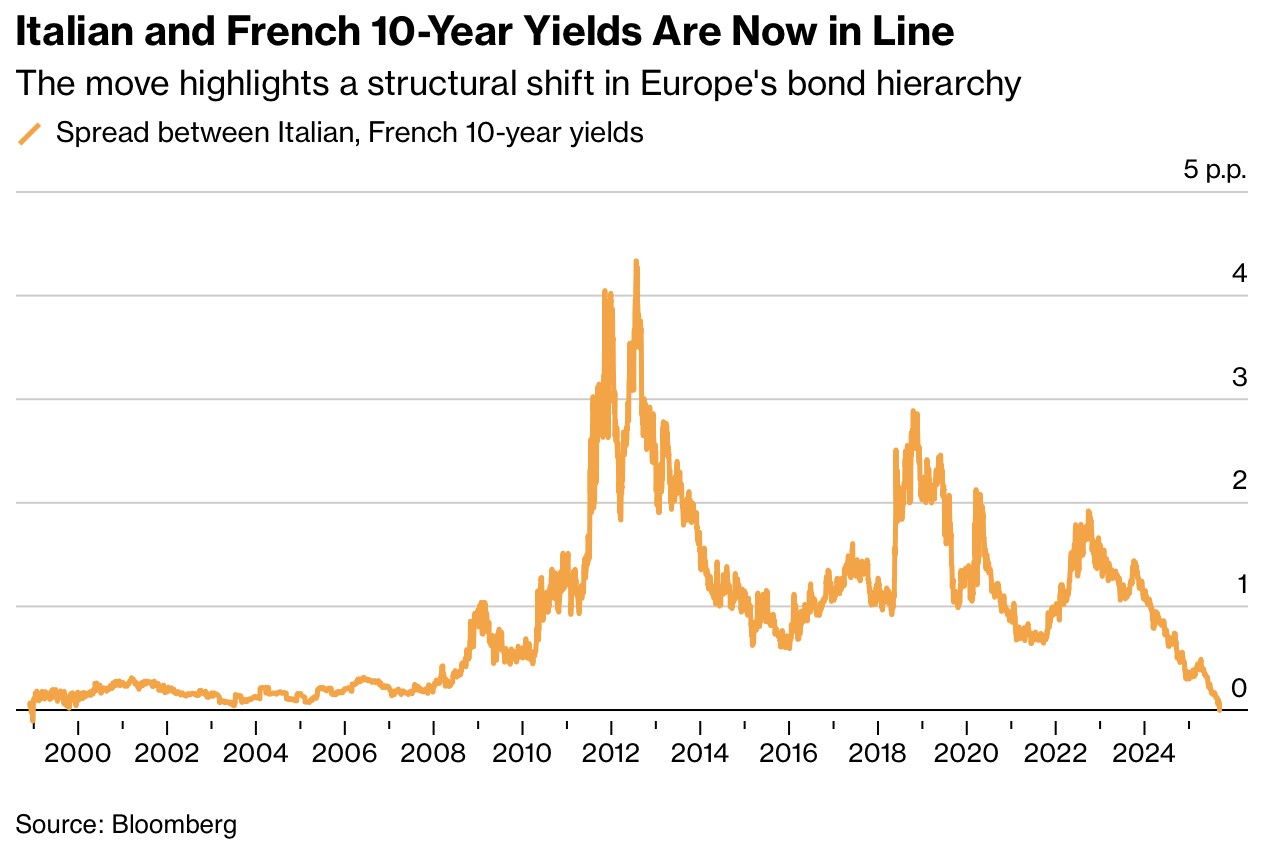
Recall, during the Eurozone crisis in 2011, Italy was perceived as the second worst situation after Greece in the PIGS, while France was grouped with Germany as hale and hearty.  Oh, how the mighty have fallen.

Nepal is clearly too insignificant from a global macroeconomic perspective to matter, but it strikes me that the fall of the PM there is merely in line with the growing unhappiness of populations around the world with their respective governments.

A friend of mine, Josh Myers, who writes a very thoughtful Substack published last night and it is well worth the read.  He makes the point that the Washington Consensus, which has since the 1980’s, underpinned essentially all G10 activity and focused on privatization of assets, free trade and liberalized financial systems, appears to have come to the end of the road.  I think this is an excellent observation and fits well with my thesis that the consensus views of appropriate policies are falling apart.  Too many people have been left behind as both income and wealth inequality in the G10 is rampant, and those who have fallen behind are now angry enough to make themselves heard.  

This is why we see governments fall.  It is why nationalist parties are gaining strength around the world as they focus on their own citizens rather than a global concept.  And it is why those governments still in power are desperately struggling to prevent their opponents from being able to speak.  This is the genesis of the restrictions on speech that are now rampant in Germany and the UK, two nations whose governments are under extreme pressure because of policy failures, but don’t want to give up the reins of power and are trying to prevent anybody from saying anything bad about them, thus literally jailing those who do!

And yet…investors are sanguine about it all!  At least that seems to be the case on the surface as equity indices around the world continue to trade higher with most major equity markets at or within a few percent of all-time highs.  This seems like misplaced confidence to me as the one thing I consistently read is that markets are performing well in anticipation of the FOMC cutting Fed funds next week, with hopes growing that it will be a 50bp cut.  

But if we look at the Treasury market, which has seen yields slide steadily since the beginning of the year, with 10-year yields now lower by 75bps since President Trump’s inauguration, it is difficult to square that circle.  
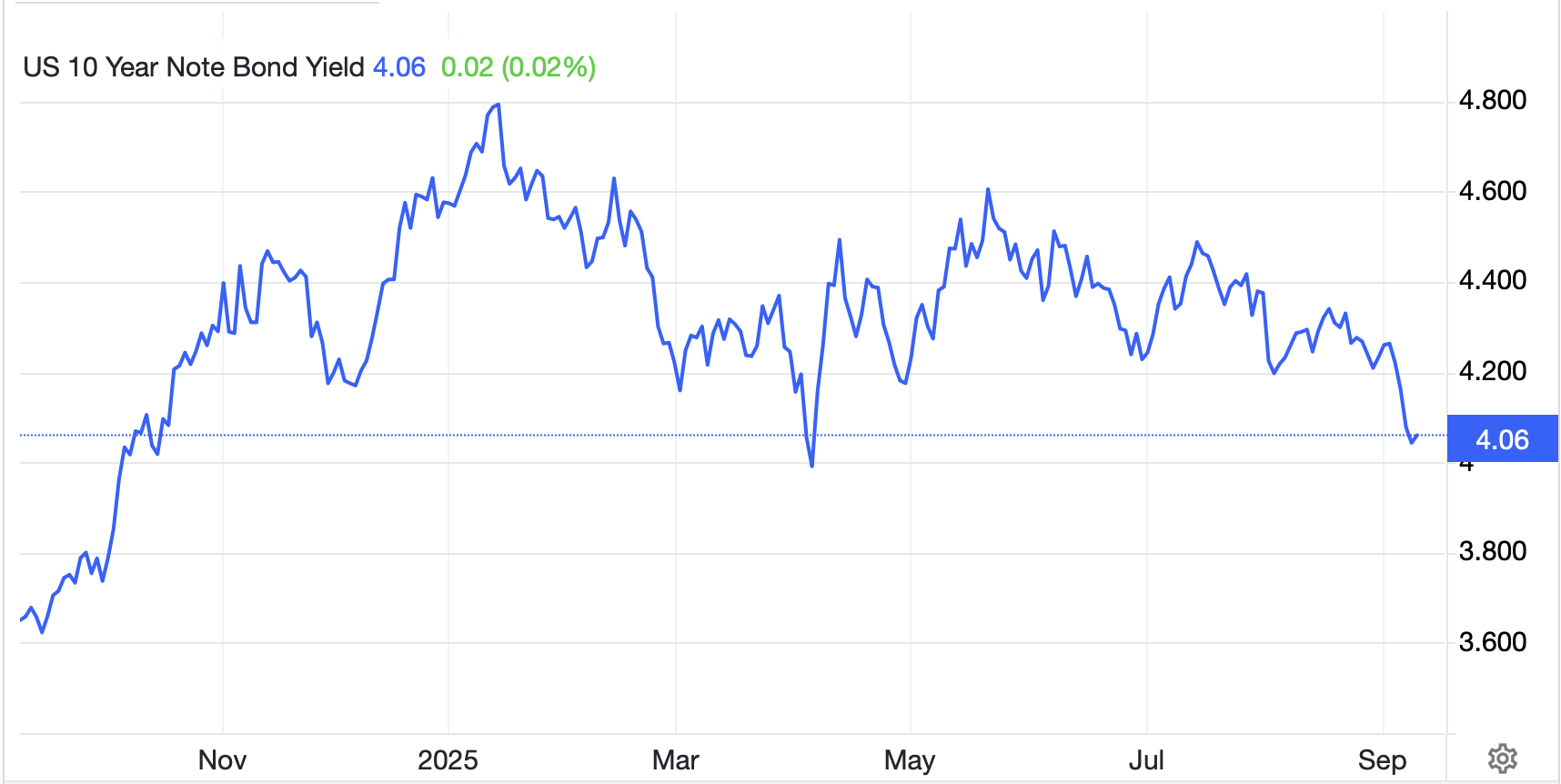
Source: tradingeconomics.com

Bond yields typically rise and fall based on two things, expected inflation and expected growth as those two have been conflated in investor (and economist) minds for a while.  The upshot is if yields are declining steadily, as they have been, it implies investors see slowing economic activity which will lead to lower inflation.  Now, if economic activity is set to slow, it strikes me that will not help corporate profitability, and in fact, has the potential to exacerbate the situation by forcing layoffs, reducing economic activity further.  Alas, it is not clear if that will drive inflation lower in any meaningful way.  The point is the bond market and the stock market are looking at the same data and seeing very different future outcomes.

Is there a tiebreaker we can use here?  The FX market might be one place, but the weakness in this idea is that FX rates are relative rates, not descriptive of the global economy.  Sure, historically the dollar has been the ultimate safe haven with funds flowing there when things got rough economically, but its recent weakness does not foretell that particular story.  Which brings us to the only other asset class around, commodities.  And the one thing we have seen lately is commodity prices continuously rising, or at least metals prices doing so, specifically gold.  Several millennia of history showing gold to be the one true store of value is not easily forgotten, and that is why the barbarous relic has rallied 39% so far in 2025.  

A number of analysts have likened the current situation to that of Wile E Coyote and I understand the idea.  It certainly is a potential outcome so beware.

Well, once again I have taken much time so this will be the lightning round.  Starting with bonds, this morning, yields in the US and Europe are higher by 2bps across the board, with one exception, France which has seen yields rise 6bps as discussed above.  JGB yields are unchanged as it appears investors there don’t know what to think yet and are awaiting the new PM decision.

In equities, yesterday’s very modest late rallies in the US were followed by a mixed session in Asia (Japan -0.4%, China -0.7%, HK +1.2%) although there were more winners (Korea, India, Taiwan, Thailand) than laggards (Australia, New Zealand, Indonesia) elsewhere in the region.  In Europe, mixed is also the proper adjective with the CAC (+0.4%) remarkably leading the way higher despite lousy IP data (-1.1%) while Germany (-0.4%) and Spain (-0.4%) both lag.  As to US futures, at this hour (7:20) they are marginally higher, 0.15% or so.

Oil (+0.8%) continues to trade back and forth each day with no direction for now.  I’m sure something will change the situation here, but I have no idea what it will be.  Gold (+0.5%) meanwhile goes from strength to strength and is sitting at yet another new all-time high, above $3600/oz.  While silver and copper are little changed this morning, the one thing that seems clear is there is no shortage of demand for gold.

Finally, the dollar is arguably slightly lower this morning, although mixed may be a better description.  The euro (-0.15%) is lagging but JPY (+0.6%) is the strongest currency across both G10 and EMG blocs.  Otherwise, it is largely +/-0.2% or less as traders ponder the data.

While CPI is released on Thursday, I think this morning’s NFP revision is likely to be the most impactful number we see this week, and truly, ahead of the FOMC next week.

TodayNFP Revision-500K to -950K
WednesdayPPI0.3% (3.3% Y/Y)
 -ex food & energy0.3% (3.5% Y/Y)
ThursdayECB Rate Decision2.0% (unchanged)
 CPI0.3% (2.9% Y/Y)
 -ex food & energy0.3% (3.1% Y/Y)
 Initial Claims235K
 Continuing Claims1950K
FridayMichigan Sentiment58.0

Source: tradingeconomics.com

As I type, the Fed funds futures market is pricing a 12% probability of a 50bp cut next week and an 80% chance of 75bps this year.
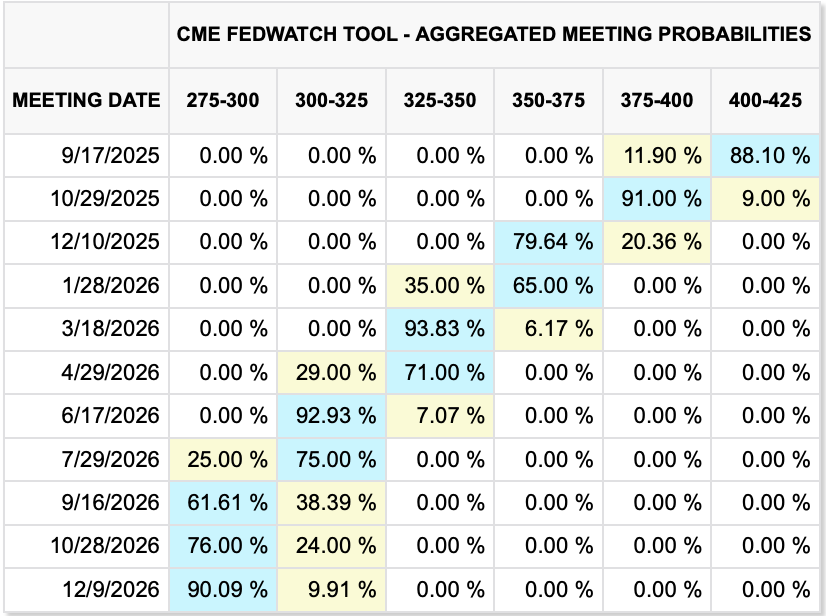
Source: cmegroup.com

If the NFP revisions are more than -500K, I suspect that rate cut probabilities will rise sharply with the dollar falling, gold rising, and bond yields heading lower as well.  Equity markets will probably rally initially, although it strikes me that this type of bad news will not help corporate earnings.  So, buckle up for the fun this morning on a release that has historically been ignored but is now clearly center stage.

Good luck

Adf

Make Hay

The Fed, today’s, finally set
To start to buy corporate debt
Meanwhile the UK
Did start to make hay
With its largest Gilt issue yet

While markets are fairly docile this morning, there are four interesting stories to note, all of which are likely to have bigger impacts down the road.

The first of these emanates from the Mariner Eccles Building in Washington, where the FOMC will begin to implement its Secondary Market Corporate Credit Facility (SMCCF), purchasing its first investment grade bond ETF’s. Ironically, in their effort to stabilize corporate credit markets that are suffering a hangover of excess issuance prior to the Covid-19 crisis, the Fed is going to ramp up margin debt for the purchases. A little ‘hair of the dog’ it seems is the best idea they have. Consider, the process of these purchases is that the Treasury has deposited $37.5 billion into an SPV account which will serve as collateral for that SPV to purchase up to 10x that amount in securities. Talk about speculative! If the SPV purchases its full allotment, then the Fed will effectively be increasing the total amount of margin debt outstanding by nearly 80%. Granted, there is no concern about the Fed being able to pay for these securities in actuality, it’s just the legal questions that may arise if they fall in price by more than 10% and the Fed has actual losses on its balance sheet. Naturally, the idea is that with the Fed buying, there is almost no possibility that prices could fall. However, do not believe that for a moment, just as we have seen in the Treasury market, despite the Fed buying $ trillions worth, bond prices still decline all the time. And don’t forget what we saw in March, when yields rocketed higher for a period of time. Perhaps the most surprising aspect is that US equity futures have been trading either side of flat despite this new money entering the market.

The second interesting story comes from across the pond, where the UK issued gilts via a syndicate for the first time, offering a new 10-year bond and garnering £65 billion pounds of demand, a record amount of attraction. It seems that one of the things that got buyers excited was a comment by BOE Deputy Governor Broadbent hinting that negative rates are not out of the question as the Old Lady seeks to insure sufficient policy support for the economy.

While on the subject of negative rates, it is worth noting that two Fed regional presidents, Bostic and Evans, were both circumspect as to the need for the Fed to ever go down that road. That is certainly good news, but one cannot forget the language change made in September of last year when the Fed stopped referring to the “zero lower bound” and began calling it the “effective lower bound”. Observers far more prescient than this one have noted that the change clearly opens the door for negative rates in the future. There is certainly no indication that is on the cards right now, but it is not an impossibility. Keep that in mind.

From Austria, Herr PM Kurz
Admitted that fiscal transfers
Are what are required
Lest Rome is inspired
To exit, which no one prefers

Another interesting headline this morning comes from Vienna, where Austrian PM Sebastian Kurz explained that the only way Italy can survive is via debt mutualization by the EU, as there is no way they will ever be able to repay their debt. While it is refreshing to hear some truth, it is also disconcerting that in the very next comment, PM Kurz explained there was no way that Austria was comfortable with that course of action. While Austria stood ready to support Italy, they would not take on their obligations. Of course, this is the fatal flaw in the EU, the fact that the Teutonic trio of Germany, Austria and the Netherlands are the only nations that can truly help fund the crisis but are completely unwilling to do so. I once again point to the German Constitutional Court ruling last week as a sign that the euro is likely to remain under pressure for a time to come. While this morning it is now higher by 0.2%, it remains near the bottom of its recent range with ample opportunity to decline further. Beware the ides of August, by which time the ECB will have responded to the court.

And finally, it must be noted that it is raining in Norway. By this I mean that the Government Pension Fund of Norway, the world’s largest wealth fund, is going to be selling as much as $41 billion in assets in order to fund the Norwegian government and its response to the crisis. This is exactly what a rainy-day fund is meant for, so no qualms there. But it does mean that we are going to see some real selling pressure on financial assets as they liquidate that amount of holdings, many of which are in US stocks. NOK, however, has been the beneficiary, rallying 0.8% this morning on the news. Given the krone has been the worst performing G10 currency this year, it has plenty of room to rally further without having any negative economic impacts.

Those are the most interesting headlines of the day, and the ones most likely to have a market impact. However, today, for the first time in a while, there is not much market impact in any markets. Equity prices in Asia were modestly softer, while those in Europe are mixed but edging higher. Bond prices are within a tick or two of yesterday’s closing levels, and the dollar is having a mixed session, although I would estimate that on net it is slightly weaker.

On the data front, it has been extremely quiet overnight with a few Sentiment indicators in France and Japan, as well as the NFIB here in the US, all printing terrible numbers, but none quite as terrible as the median forecasts. My observation is that analysts are now expanding their view of just how bad things are and beginning to overstate the case. As for this morning, we have CPI on the docket, with expectations of a 0.4% headline print and 1.7% core print. While inflation may well be in our future given the combination of monetary and fiscal policy response, it is not in the near future.

Barring some other news story, markets seem pretty happy to consolidate for a change, and I expect that is what we will see today. However, nothing has changed my view that a substantial repricing of risk is still in our future, and with it, a stronger dollar. While we don’t know what the catalyst will be, I have my eye on the ECB response to the German Constitutional Court ruling.

Good luck and stay safe
Adf

Frustrations

The global economy’s state
Continues to see growth abate
As trade between nations
Has met with frustrations
While central banks try to reflate

Markets have been extremely quiet overnight as investors and traders await the release of the US payroll report at 8:30 this morning. Expectations, according to Bloomberg, are as follows:

Nonfarm Payrolls 85K
Private Payrolls 80K
Manufacturing Payrolls -55K
Unemployment Rate 3.6%
Average Hourly Earnings 0.3% (3.0% Y/Y)
Average Weekly Hours 34.4
Participation Rate 63.1%
ISM Manufacturing 48.9
ISM Prices Paid 50.0
Construction Spending 0.2%

While the GM strike has ended, it was in full swing during the survey period and explains the expected significant decline in manufacturing jobs. One other thing having a negative impact is the reduction of census workers. Given these idiosyncratic features, we must look beyond the headline number to ascertain if the employment situation remains robust, or is starting to roll over. Consider that most analysts expect that the GM strike was worth about 50K jobs and the census situation another 20K. If we add those back to the median expectation of 85K, we wind up at essentially the 3-month average of 157K. However, it is important to remember that the 1-year average is higher, 179K, which indicates that there has been an ongoing decline in new hiring for a little while now. Some of this is certainly due to the fact that, as we have heard repeatedly, finding good employees is so difficult, especially in the service industries. But certainly, the trade situation and the fact that the US economy is growing more slowly is weighing on the data as well.

The reason this is important, of course, is that the NFP report is one of the key metrics for the Fed as they try to manage monetary policy in an uncertain world. Unfortunately for them, the Unemployment Rate is backward looking data, a picture of what has been, not what is likely to be. In truth, they should be far more focused on the ISM report at 10:00. At least that has some forecasting ability.

A quick recap of this week’s central bank activity shows us that there were 3 key meetings; the Bank of Canada, who left policy unchanged but turned dovish in their statement; the FOMC, which cut rates and declared they were done cutting rates unless absolutely necessary; and the BOJ, which left policy unchanged but hinted that they, too, could be induced to easing further if things don’t pick up soon. (I can pretty much promise the BOJ that things are not going to pick up soon, certainly not inflation.) Perhaps the most interesting market response to this central bank activity was the quietest bond market rally in history, where 10-year Treasury yields are, this morning, 15bps lower than Monday’s opening. Only Canada’s 10-year outperformed that move with a 20bp decline (bond rally). Given the rate activity, it ought not be surprising that equity markets retain their bid overall. This morning, ahead of the NFP report, US futures are pointing higher and we have seen gains in Europe (FTSE, CAC, and DAX +0.33%) as well as most of Asia (Hang Seng +0.7%, Shanghai +1.0%) although the Nikkei did fall 0.3%.

And what about the dollar? Well, in truth it is doing very little this morning, with most currencies trading within a 0.20% band around yesterday’s closing levels. The one big exception has been the Norwegian krone which has rallied sharply, 0.65%, after a much better than expected Manufacturing PMI release. Interestingly, this movement has dragged the Swedish krona higher despite the fact that Sweden’s PMI disappointed, falling to 46.0. However, beyond that, there is nothing of excitement to discuss.

We hear from five Fed speakers today, starting with Vice-chairman Richard Clarida, who will be interviewed on Bloomberg TV at 9:30 this morning before speaking at 1:00 to the Japan Society. But we also hear from Dallas Fed President Richard Kaplan, Governor Randall Quarles, SF Fed President Mary Daly and NY’s John Williams before the day is out. It seems to me that the market was pretty happy with Chairman Powell’s comments and press conference on Wednesday so I expect we will see a lot of reaffirmation of the Chairman’s thoughts.

So, all in all, it is shaping up to be a pretty dull day…unless Payrolls are a big surprise. I have a funny feeling that we are going to see a much weaker number than expected based on the extremely weak Chicago PMI data and its employment sub index, as well as the fact that the Initial Claims data seems to be edging higher these days. Of course, the equity market will applaud as they will start to price in more rate cuts, but I think the dollar will suffer accordingly.

Good luck and good weekend
Adf

Brexit’s Impact

From England and Scotland and Wales
The data is telling us tales
That Brexit’s impact
Is set to subtract
From growth and reduce Retail Sales

With less than seven weeks left before the UK is scheduled to leave the EU, the impact of two years of uncertainty is becoming clearer. This morning’s GDP data showed that growth declined -0.4% in December, dragging the Q4 number down to a below expected 0.2% and a full year number of just 1.4%, its weakest since 2009. As is always the case, uncertainty is the bane of economic activity. While the politics of brinksmanship may make sense in the long run, it is difficult to see the near-term benefits. And brinksmanship appears to be PM May’s last hope at putting in place the agreed deal by the UK Parliament. Despite her renewed efforts at getting the EU to offer some adjustments to the negotiated deal, there has been little willingness evident on the EU side to do so. However, the EU mandarins are not so ignorant as to believe that a hard Brexit will have no impact on their own nations’ economies, it is just that they believe that by holding firm the UK will blink first and Parliament will ratify the deal. I think PM May is of the same opinion. And perhaps they are correct, that is exactly what will happen. However, politics is not an exact science, and it appears there is still a very real probability that a hard Brexit is what we will get.

In the meantime, the market took no succor in this morning’s data, with the pound falling a further 0.35% on the day, increasing its month-to-date decline to 1.7% with the trend still firmly lower. While BOE Governor Carney has claimed repeatedly that he may need to raise rates in the event of a hard Brexit due to a price shock, I continue to believe there is virtually no probability that will occur. The initial negative impact on the economy will overwhelm any inflationary impulse, certainly from a political perspective, if not actually from an economic one. Despite the fact that the Fed appears to be on hold at this time, I would still bet on further policy ease rather than tightness from the BOE.

But the pound is not the only currency suffering this morning, in fact every G10 currency is weaker vs. the dollar as it becomes clearer with each passing day that the ability of central banks to remove policy accommodation from a weakening global economy is becoming more and more restricted. A good example is Norway, where growth has held up reasonably well (1.7% in Q4) but inflation has failed to meet expectations. This morning’s CPI data showed the headline rate fall a more than expected 0.4% to 3.1%. While that is clearly above their target, it is a product of the recent rise in oil prices. On a core basis, inflation is quickly falling back to its 2.0% target, and while the market is still pricing a rate hike for March, it is with less conviction. Another weak reading before the next Norgesbank meeting in March is likely to ice that expectation completely. Tightening into an environment of slowing global growth is extremely difficult for any country, let alone a peripheral oil exporter, to accomplish successfully. As it happens, NOK is lower by 0.55% as I type.

But it is not just G10 currencies under pressure this morning, it is the entire complex of dollar counterparts. EMG has seen broad based, albeit not extreme, weakness. The leading decliner is ZAR, with the rand falling 1.1% after the main electric utility, Eskom, disclosed further power cuts leading to concerns over slowdowns in production and mining. The utility is struggling under a massive debt burden and has been on the edge of bankruptcy for some time. But away from that country specific outcome, the dollar’s gains have averaged on the order of 0.2%-0.3% throughout all three EMG blocs.

Looking ahead to data this week we will see January inflation data as well as the delayed Retail Sales numbers amongst a full slate.

Tuesday NFIB Small Business 103.2
  JOLT’s Job Openings 6.9M
Wednesday CPI 0.1% (1.5% Y/Y)
  -ex food & energy 0.2% (2.1% Y/Y)
Thursday Initial Claims 225K
  PPI 0.1% (2.1% Y/Y)
  -ex food & energy 0.2% (2.5% Y/Y)
  Retail Sales 0.2%
  -ex autos 0.1%
Friday Empire Manufacturing 7.0
  IP 0.1%
  Capacity Utilization 78.7%
  Michigan Sentiment 94.5

We also have nine Fed speeches from six different FOMC members including Chairman Powell tomorrow afternoon. However, the Fed has lately been very consistent with the market clearly understanding that they are on hold for the time being. In fact, the market is beginning to price rate cuts into the curve by the end of this year, although the Fed itself has not indicated anything of the sort. One last Fed note; SF Fed President Mary Daly, in an interview on Friday, indicated that the FOMC was actively discussing the merits of using the balance sheet as part of the ‘regular’ toolkit, not simply keeping it for emergencies when interest rates were at the zero bound. That is a bit ironic given that prior to the financial crisis, the balance sheet was the main feature of how the Fed managed interest rates, increasing or reducing reserves in order to guide interest rates to their desired levels. But in this case, it sounds more like the first oblique embrasure of MMT, the idea that debt monetization is not only fine, but that it is immoral not to manage policy in that manner if there are still unemployed people out there. After all, the only risk is inflation, and they have that under control!!!

I am the first to admit that the dollar’s recent strength has surprised me. While I have maintained that it would eventually strengthen, I did not foresee the market embracing the idea that every other central bank would reverse the tightening bias so quickly. But it has. So for now, the US remains the tightest monetary policy out there, and the dollar is likely to continue to benefit accordingly.

Good luck
Adf