Old Theses Are Reeling

The temperature’s rising on trade
As China, rare earths, did blockade
It seems they believe
That they can achieve
A triumph with cards that they’ve played
 
Investors worldwide are now feeling
Concern as old theses are reeling
This new world now shows
It’s capital flows
And trust, which is why gold’s appealing


Escalation in the trade war between the US and China is clearly the top story.  There are a growing number of analysts who believe that currently, China may have the upper hand in this battle given the recent history of deindustrialization in the US and the West.  Obviously, rare earth minerals, which are critical to manufacturing everything from magnets to weapons, and semiconductors, are China’s big play.  They believe this is the bottleneck that will force the US and the West to back down and accept their terms.  The Chinese have spent decades developing the supply chain infrastructure for just this situation while the West blithely ignored potential risks of this nature and either sought lower costs or virtue signals.

Before discussing the market take, there is one area where China lacks capacity and will find themselves greatly impaired, ultra-pure silicon that is used to manufacture semiconductors.  The global supply is almost entirely made in Japan, Germany and the US, and without it, Chinese semiconductor manufacturing will encounter significant problems.  So don’t count the West out yet.

Anyway, the interesting question is why have equity markets continued to behave so well in the face of this growing bifurcation in the global economy?  After all, it is clear why gold (+0.75%) continues to rise as central banks around the world continue to buy the barbarous relic for their reserves while individual investors are starting to jump on board if for no other reason than the price has been rising dramatically.  (As an aside, the gold price chart can fairly be called parabolic at this point, and history has shown that parabolic rallies don’t last forever and reverse course dramatically.)

Source: tradingeconomics.com

But equity prices are alleged to represent the discounted value of estimated future cash flows, and those are certainly not parabolic.  Of course, there is something that has been rising rapidly that feeds directly into financial markets, and that is liquidity.  Consider the process by which money is created; it is lent into existence by banks and used to purchase either financial or real assets.  The greater the amount of money that is created, the more upward pressure that exists for asset prices (as well as retail prices).  This is the essence of the idea that inflation is the result of too much money chasing too few goods.

Turning to the IIF for its latest statistics, it shows, as you can see in the chart below, that global liquidity continues to rise, and there is nothing to indicate this rise is going to slow down.  The chart below shows global debt across all sectors (government and private) has reached $337.8 trillion at the end of Q2 2025, which is 324% of global GDP.  If you are wondering why asset prices continue to rise in the face of increased global macroeconomic risks, look no further than this chart.
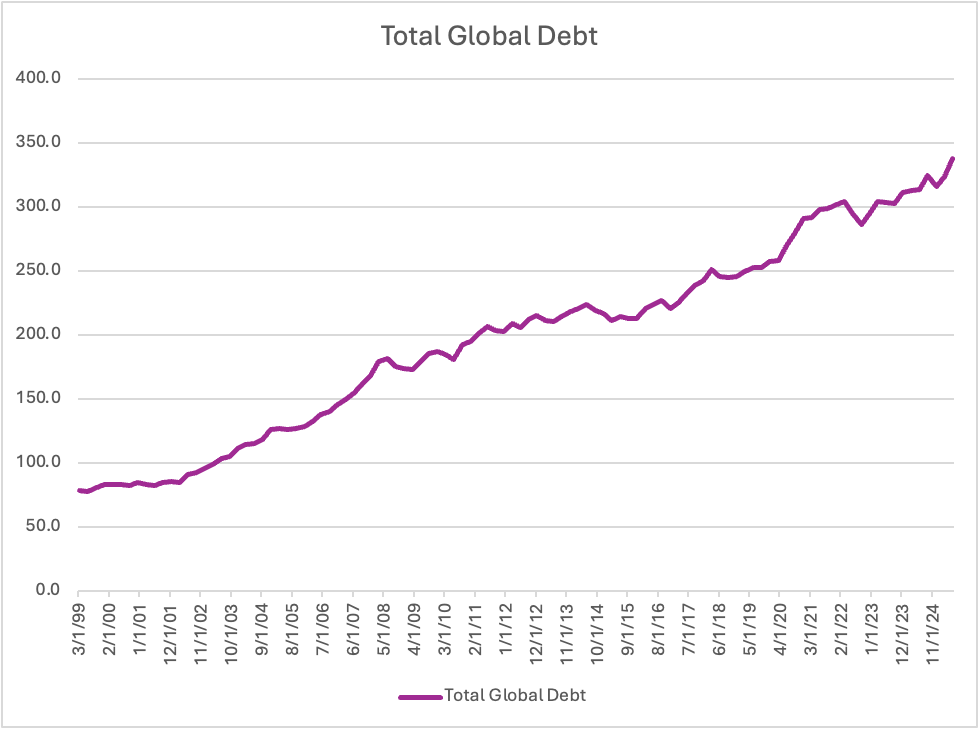
And if you think about the fact that literally every major nation around the world, whether developed or EMG, is running a public budget deficit, this number is only going to grow further.  It is very difficult to make the case for a reversal unless this liquidity starts to dry up.  And the one thing central bankers around the world have figured out is that they cannot turn off the liquidity flow without causing severe problems.  As to CPI inflation, some portion of this liquidity will continue to seep into prices paid for things other than securities and financial assets.  Ironically, if President Trump succeeds in dramatically reducing the budget and trade deficits, the impact on global financial markets would be quite severely negative.  This is the best reason to assume it will never happen…by choice.

In the meantime, this is the world in which we live, and financial markets are subject to these flows so let’s see how they behaved overnight.  After yesterday’s modest gains in the US markets, Tokyo (+1.3%) continued its recent rally despite a growing concern that Takaichi-san will not become the first female PM in Japan as all the opposition parties seem to be coming together simply to prevent that outcome, rather than because they share a grand vision.  HK (-0.1%) and China (+0.25%) had lackluster sessions as the trade war will not help either of their economies either, while the rest of the region had a strong session across Korea (+2.5%), India (+1.0%), Taiwan (+1.4%), Australia (+0.9%) and Indonesia (+0.9%).  One would almost think things are great there!

As to Europe, France (+0.75%) is the leader today as PM LeCornu survived a no-confidence vote by agreeing not to raise the retirement age from 62 to 64 despite this being seen as President Macron’s crowning achievement.  (I cannot help but look at public finances around the world and see that something is going to break down, and probably pretty soon.  Promises to continue spending while economic activity stagnates are destined to collapse.  Of course, the $64 trillion question is, when?).  As to the rest of Europe, equity markets are little changed, +/- 0.15% or less.  At this hour (7:40) US futures are pointing nicely higher though, about 0.5% across the board.

In the bond market, the place where the growth in liquidity should be felt most acutely, there is no obvious concern by investors at this stage.  Yields across the board in the US and Europe are essentially unchanged in the session and there was no movement overnight in JGBs.  It feels as though the entire situation is becoming more precarious for investors, but thus far, no real cracks are visible.  However, you can be sure that if they start to develop, we will see the next wave of QE to support these markets.

Away from gold, this morning silver (+0.1%) and copper (-0.1%) are little changed although platinum (+0.7%) is working to keep up with both of the better-known precious metals and doing a pretty good job of it.  Oil (+0.9%) is bouncing off recent lows but remains below $60/bbl and seems to have lost the interest of most pundits and traders, at least for now.  

Finally, the dollar continues to edge lower, with most G10 currencies a touch higher (GBP +0.2%, SEK +0.2%, NOK +0.3%, EUR +0.05%) although the yen (-0.15%) and CHF (-0.2%) are both slipping slightly.  But the reality is there has been no noteworthy movement here.  Even in the EMG bloc, movement is 0.2% or less virtually across the board this morning.  The dollar is an afterthought today.

On the data front, Philly Fed (exp 10.0) is the only data release with some positive thoughts after yesterday’s Empire State Manufacturing Index rose a much better than expected 10.7.  We also hear from a whole bunch more Fed speakers (Barkin, Barr, Miran, Waller, Bowman) as the IMF / World Bank meetings continue.  Yesterday, to nobody’s surprise, Mr Miran said that rates needed to be lower to address growing uncertainties in the economy.  I suspect he will repeat himself this morning.  But the market is already pricing two cuts for this year, and absent concrete data that the economy is falling off a cliff, it is hard to make the case for any more (if that much) given inflation’s stickiness.

The world is a messy place.  Debt and leverage are the key drivers in markets and will continue to be until they are deemed too large.  However, it is in nobody’s interest to make that determination, not investors nor governments.  This could go on for a while.

Good luck

adf

Rare Earths No More

Said Xi, we’ll sell rare earths no more
Said Trump, well that means we’re at war
The stock market puked
As traders got spooked
And Trump imposed tariffs galore
 
The question is just why would Xi
Get feisty when things seemed to be
Improved for both sides
With fewer divides
Did Mideast peace kill his esprit?


Let’s talk about markets for a moment.  Sometimes they go down and go down fast when you’re not expecting it.  That is their very nature, so it is important to understand that Friday’s price action, while dramatic relative to what we have seen over the past 6 months, is not that uncommon at all over time.  It appears the proximate cause of the market decline was the word from China that they would stop selling and exporting rare earth minerals. 

It can be no surprise that President Trump immediately responded by threatening an additional 100% tariffs on all Chinese exports and new controls on software, all to be implemented on November 1st.  There is a lot of tit-for-tat in the dueling messages from China and the Trump administration and it is hard to tell what is real and what isn’t.  However, equity markets clearly weren’t prepared for a break in the previous expectations that the US and China were closing in on a more lasting trade stance.

But weekends are a long time for markets as so much can happen while they are closed.  This weekend was a perfect example.  After the carnage on Friday, we cannot be that surprised that both sides of this new tiff modified their responses.

First we saw this on Truth Social:

Then China backed off clarified that what they are really doing is require licensing for all rare earth minerals and products that contain them in exports.  China claims that applications that meet regulations will be approved although the regulations have not yet been defined. Ostensibly this is for national security reasons, and it is unclear exactly who will receive licenses, but this is clearly not the same as ending exports.  

And just like that, many of the fears that were fomented on Friday have been alleviated as evidenced by this morning’s equity market moves in the futures markets.

Source: tradingeconomics.com

But why did Xi make this move in the first place?  I have no idea, nor does anyone but Xi, although here are two completely different thought processes, one very conspiratorial and one rooted in the broader escalation of geopolitical affairs.

As to the first, (Beware, you will need your tinfoil hat here!) consider if the Israel-Gaza peace settlement, (with the hostages returned as of the time I am writing this morning at 5:30) does not serve China’s interest.  First, the one Middle East nation that will be on the outside is their ally, Iran.  Second, the ongoing problems there were always a distraction for the US, something that clearly suits Xi and China.  After all, if the US is focused there, they will have more difficulty paying attention to things Xi cares about like Taiwan and the South China Sea.  If the peace in Israel-Gaza holds, and the Abraham Accords extend to the bulk of the rest of the region, Xi loses a major distraction that cost him virtually nothing.  Plus, this opens the door for tightening sanctions on Iran even further, which could negatively impact China’s oil flows.  

The second is much more esoteric and I read about it this weekend from Dr Pippa Malmgren, someone who has a deep insight into global politics from her time as a presidential advisor as well as from her father, Harold Malmgren, who advised four presidents.  In her most recent Substack post she explained the importance of Helium-3 (3He), a rare isotope of helium that has major energy and military implications and where the largest deposit of the stuff known to man is on the moon.  Her claim is this is the foundation of the recent acceleration in the space race between the US and China and without rare earth minerals, the US ability to achieve its goals and obtain this element would be greatly hampered opening the door for China to get ahead.

Are either of these correct?  It is not clear, but I would contend each contains some logic.  In the end, though, as evidenced by the quick retreat on both sides, I suspect that the trade situation between the US and China will move forward in a positive manner, although there could well be a few more hiccups along the way.  And those hiccups could easily see equity markets decline such that there is a real correction of 15% to 20%.  Just not today.

So, what is happening today?  Let’s look.  First, I would be remiss if I didn’t highlight the following Bloomberg headline: ‘Buy the Dip’ Call Grows Louder as China Selloff Seen Containedas it perfectly encapsulates the ongoing mindset in equity markets.  At least in US equities.  Asia had a much rougher session despite the backtracking with HK (-1.5%) and China (-0.5%) under pressure and weakness virtually universal in the time zone (Korea -0.7%, India -0.2%, Taiwan -1.4%, Australia -0.8%). Tokyo was closed.  It appears there are either still concerns over the trade situation, or perhaps the fact that globally, markets have had long rallies has led to some profit taking amid rising uncertainties.  

European bourses, though are all in the green, with the continent seeing gains of 0.5% or so across the board although the UK is lagging with a miniscule 0.05% gain at this hour (6:30).  As to US futures, as seen above, gains range from 1.0% (DJIA) to 2.0% (NASDAQ).

Meanwhile, bond yields also saw a dramatic move on Friday, tumbling -8bps and back to their lowest level seen in a month as per the below chart from tradingeconomics.com

This morning, those yields are unchanged.  European sovereign yields, which followed Treasury yields lower on Friday are also little changed at this hour, down another -1bp as concerns begin to arise that economic growth is going to be impaired by the escalation in trade tension between the US and China.  

I would argue that commodities are the one area where the back and forth is raising the most concern.  At least that is true in metals markets, with gold, which rallied 1% Friday amid the equity carnage, higher by another 1.6% this morning, to more new highs and we are seeing silver (+1.6%), copper (+4.2%) and Platinum (+3.6%) all in sync.  To me, this is the clearest indicator that there is an underlying fear pervading markets.  Oil (+1.8%) has rebounded from Friday’s rout as the easing of trade tensions appears to have calmed the market somewhat, although WTI remains just below $60/bbl at this point.  

Finally, the dollar is firmer again this morning as, although it softened slightly Friday, it has since regained most of those losses and is back on its recent uptrend as you can see below.

Source: tradingeconomics.com

While Tokyo was closed overnight, we did see further JPY weakness as the yen retraced most of its Friday gains like the rest of the market.  The biggest G10 mover was CHF (-0.9%) followed by AUD (-0.7%) and JPY (-0.7%) with other currencies less impacted and NOK (+0.2%) benefitting from the oil rally.  However, the EMG bloc has seen a much wider dispersion with MXN (+0.5%), ZAR (+1.1%) and CLP (+0.8%) all rallying sharply on the metals rally while PLN (-0.5%) and CZK (-0.4%) lag as they follow the euro lower.

And that’s enough for today.  With the government still on hiatus, no official statistics will be released although we do get a little bit of stuff as follows:

TuesdayNFIB Small Business Index100.5
WednesdayEmpire State Manufacturing-1.8
 Fed’s Beige Book 
ThursdayPhilly Fed Manufacturing9.1

Source: tradingeconomics.com

But, with the lack of data, it appears Chairman Powell has instructed his minions to flood the airwaves with a virtual cacophony of speeches this week, I count 18 on the calendar including the big man himself on Tuesday afternoon.  It seems difficult to believe that their opinions on the economy will have changed very much given the lack of new data.  The market is still pricing a 98% chance of a cut at the end of this month and another 91% chance of a cut in December.  With the increased trade tension, there is much more discussion regarding a slower economic course ahead, which would play into further rate cuts.  However, while that would clearly help precious metals as it ends any ideas of an inflation fight, it is not clear it will weaken the dollar very much as everybody else will almost certainly follow along.

Good luck

Adf

As It’s Been Wrote

Though China would have you believe
Their goals, they are set to achieve
Their banks are in trouble
From their housing bubble
So capital, now, they’ll receive
 
Meanwhile, with Ukraine there’s a deal
For mineral wealth that’s a steal
This will help the peace
If war there does cease
And so, it has broader appeal
 
But really, the thing to denote
Is everything is anecdote
The data don’t matter
Unless it can flatter
The narrative as it’s been wrote


Confusion continues to be the watchword in financial markets as it is very difficult to keep up with the constant changes in the narrative and announcements on any number of subjects.  And traders are at a loss to make sense of the situation.  This is evidenced by the breakdown in previously strong correlations between different markets and ostensibly critical data for those markets.  

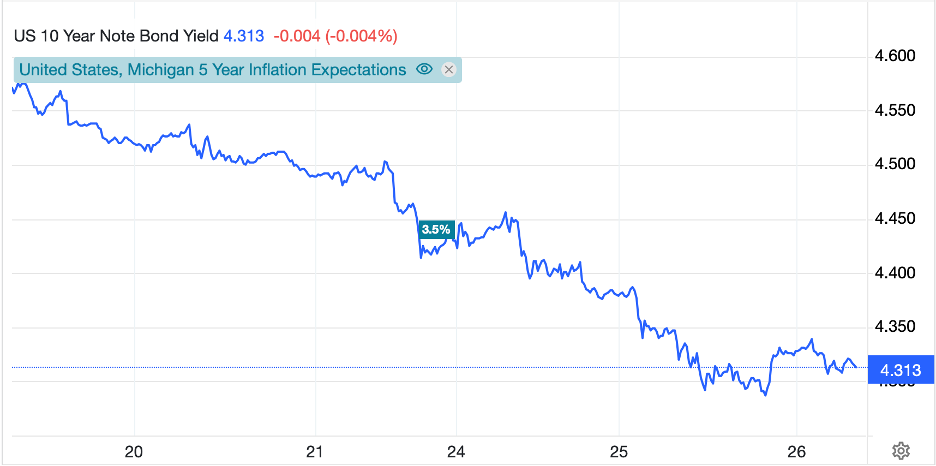
For example, inflation expectations continue to rise, at least as per the University of Michigan surveys, with last week’s result coming in at 4.3% for one year and 3.5% for 5 years.  And yet, Treasury yields continue to fall in the back end of the curve, with 10-year Treasury yields lower by nearly 15bps since that report was released on Friday.  So, which is it?  Is the data a better reflection of things?  Or is market pricing foretelling the future?

Source: tradingeconomics.com

At the same time, the Fed funds futures market is now pricing in 55bps of cuts this year, up from just 29bps a few weeks ago.  Is this reflective of concerns over economic growth?  And how does this jibe with the rising inflation expectations?  

Source: cmegroup.com

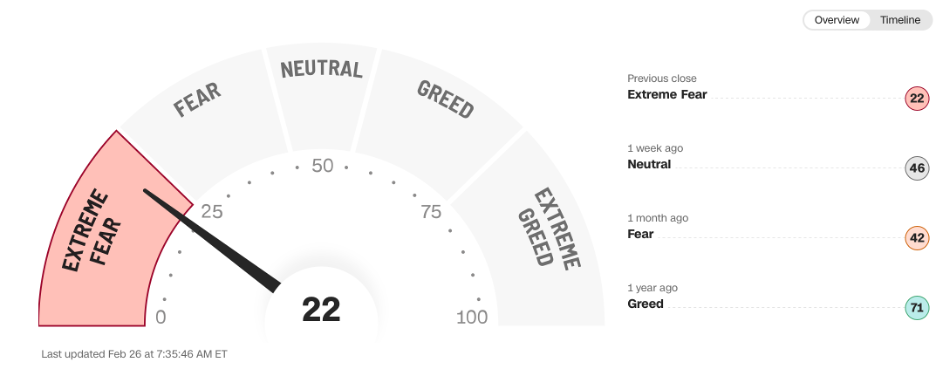
If risk is a concern, why is the price of gold declining?  

Source: cnn.com

My point is right now, at least, many of the relationships that markets and investors have relied upon in the past seem to be broken.  They could revert to form, or perhaps this is a new paradigm.  In fact, that is the point, there is no clear pathway.

Sometimes a better way to view these things is to look at policy actions at the country level as they reflect a government’s major concerns.  I couldn’t help but notice in Bloomberg this morning the story that the Chinese government is going to be injecting at least $55 billion of equity into their large banks.  Now, government capital injections are hardly a sign of a strong industry, regardless of the spin.  This highlights the fact that Chinese banks remain in difficult straits from the ongoing property market woes and so, are clearly not lending to industry in the manner that the government would like to see.  I’m not sure how injecting capital into large banks that lend to SOE’s is helping the consumer in China, which allegedly has been one of their goals, but regardless, actions speak louder than words.  Clearly the Chinese remain concerned over the health of their economy and are doing more things to support it.  As it happens, this helped equity markets there last night with the Hang Seng (+3.3%) ripping higher with mainland shares (+0.9%) following along as well.  Will it last?  Great question.

Another interesting story that seems at odds with what the narrative, or at least quite a few headlines, proclaimed, is that the US and Ukraine have reached a deal for the US to have access to Ukrainian rare earth minerals once the fighting stops.  The terms of this deal are unclear, but despite President Zelensky’s constant protests that he will not partake in peace talks, it appears that this is one of the steps necessary for the US to let him into the conversation.  Now, is peace a benefit for the markets?  Arguably, it is beneficial for lowering inflation as the one thing we know about war is it is inflationary.  If peace is coming soon, how much will that help the Eurozone economy, which remains in the doldrums, and the euro?  Will it lower energy prices as sanctions on Russian oil and gas disappear?  Or will keeping the peace become a huge expense for Europe and not allow them to focus on their domestic issues?

Again, my point is that there are far more things happening that add little clarity to market narratives, and in some cases, result in price action that is not consistent with previous relationships.  With this I return to my preaching that the only thing we can truly anticipate is increased volatility across markets.

With that in mind, let’s consider what happened overnight.  First, US markets had another weak session, with the NASDAQ particularly under pressure.  (I half expect the Fed to put forth an emergency rate cut to support the stock market.)  As to Asian markets, that Chinese news was well received almost everywhere except Japan (Nikkei -0.25%) as most other markets gained on the idea that Chinese stimulus would help their economies.  As such, we saw gains virtually across the board in Asia.  Similarly, European bourses are all feeling terrific this morning with the UK (+0.6%) the laggard and virtually every continental exchange higher by more than 1%.  Apparently, the Ukraine/US mineral rights deal has traders and investors bidding up shares for the peace dividend.  Too, US futures are higher at this hour, about 0.5% or so across the board.

As to bond yields, after a sharp decline in Treasury yields over the past two sessions, this morning, the 10-year is higher by 1bp, consolidating that move.  Meanwhile, European sovereign yields are all slipping between -2bps and -4bps as the peace dividend gets priced in there as well.  While European governments may be miffed they have not been part of the peace talks, clearly investors are happy.  Also, JGB yields, which didn’t move overnight, need to be noted as having fallen nearly 10bps in the past week as the narrative of ever tighter BOJ policy starts to slip a bit.  While the yen has held its own, and USDJPY remains just below 150, it appears that for now, the market is taking a respite.

In the commodity markets, oil (-0.25% today, -2.0% yesterday) has convincingly broken below the $70/bbl level as this market clearly expects more Russian oil to freely be available.  OPEC+ had discussed reducing their cuts in H2 this year, but if the price of oil continues to slide, I expect that will be changed as well.  Certainly, declining oil prices will be a driver for lower inflation, arguably one of the reasons that Treasury yields are falling.  So, some things still make some sense.  As to the metals markets, gold (-0.2%) still has a hangover from yesterday’s sharp sell-off, although there have been myriad reasons put forth for that movement.  Less global risk with Ukraine peace or falling inflation on the back of oil prices or suddenly less concern over the status of the gold in Ft Knox, pick your poison.  Silver is little changed this morning but copper, which had been following gold closely, has jumped 2.7% this morning after President Trump turned his attention to the red metal for tariff treatment.

Finally, the dollar is firmer this morning, recouping most of yesterday’s losses.  G10 currencies are lower by between -0.1% (GBP) and -0.5% (AUD) with the entire bloc under pressure.  In the EMG space, only CLP (+0.45%) is managing any strength based on its tight correlation to the copper price.  But otherwise, most of these currencies have slipped in the -0.1% to -0.3% range.

On the data front, New Home Sales (exp 680K) is the only hard data although we do see the EIA oil inventory numbers with a small build expected.  Richmond Fed president Barkin speaks again, but as we have seen lately, the Fed’s comments have ceased to be market moving.  President Trump’s policy announcements are clearly the primary market mover these days.

Quite frankly, it is very difficult to observe the ongoing situation and have a strong market view in either direction.  There are too many variables or perhaps, as Donald Rumsfeld once explained, too many unknown unknowns.  Who can say what Trump’s next target will be and how that will impact any particular market.  In fact, this points back to my strong support for consistent hedging programs to help reduce volatility in one’s financial reporting.

Good luck

Adf