Just a Dream

Inflation is clearly passé
As traders and markets display
Remarkable trust
The Fed will adjust
The path of rate hikes come what may

The upshot is there’s a new meme
A landing so soft it would seem
No jobs will be lost
And there is no cost
Alas I fear it’s just a dream

I’m not sure if you saw the announcement yesterday, but everything is beautiful!  Inflation is a thing of the past, the economy continues to tick over quite nicely with employment remaining robust and the idea of recession is just a figment of the permabears’ imagination.  At least that’s what it seems like based on market movements of late.

Yes, PPI printed lower than forecast, which after the somewhat softer CPI and the known base effects, was not hugely surprising.  Perhaps a bit more surprising was that the Claims data, both on an Initial and Continuing basis, printed lower than expected.  The implication here is that the labor market remains quite robust with those folks who have been laid off able to find new employment quite rapidly.  While there is still plenty of data pointing to a manufacturing recession (ISM, IP, Factory Orders), the Services situation remains far better with increased activity and rising wages still apparent.  So, perhaps the optimists have it nailed, and believe Chairman Powell has managed to create a soft landing, where inflation comes back to target without having to cause a recession.

However, it feels like it is still a little early to take that victory lap.  After all, the inflation data was literally one data point driven largely by base effects and regardless of your view, one data point does not a trend make.  Certainly, the equity market is all-in on the soft-landing scenario.  The Treasury market, at least since the CPI print on Wednesday has rallied dramatically (another 10bps yesterday) and is now 29bps lower over the past week.  In fact, the 2yr Treasury has rallied even further, with yields there falling by 35bps over the same period.  To say that the market has adjusted its views on the Fed’s future activities would be an understatement.   There is still a 91% probability priced into a 25bp rate hike this month, but there are no more hikes after that priced at this stage and the first cut is seen in either March or May next year, at least according to the Fed funds futures market.

And what of the dollar?  While it is bouncing a little today, that is clearly modest position adjustment amid profit-taking as it is sharply lower on the week against all its G10 counterparts and almost all its EMG brethren.  

There is, of course, one fly in the ointment, oil prices, and commodities in general.  One of the key features of markets over time is that they tend to be self-correcting.  The saying, the solution to high prices is high prices is trying to explain the idea that high prices result in additional supply coming to market (to take advantage of those high prices) which results in prices falling back to earlier, lower levels.  The same process occurs with low prices as well, where low prices inspire increased demand and reduced supply thus driving prices higher again.  

Well, oil is exhibit A for this process.  Since oil continues to be priced and traded largely in dollars, when the dollar is strong, non-dollar countries (basically everybody else) finds that oil is expensive and so demand wanes a bit resulting in softening oil prices.  However, when the dollar declines, as we have seen in the past week, that opens the door for oil, and most commodities which are priced in dollars, to rally sharply.  Of course, if you are the Fed and continue to try to dampen price pressures, the last thing you want is a weak dollar and high commodity prices as both lead directly to rising inflation.  In fact, one reason that US inflation did not reach the levels seen in Europe and the UK is that the dollar remained quite strong throughout this period thus reducing inflationary pressures.  But right now, that dynamic is reversing with the dollar under pressure and commodity prices rising.  That bodes ill for continued declines in CPI and PPI which is certainly not part of the new narrative.  

(As an aside, it is this very feature that drives the de-dollarization narrative as you can easily understand why China, who is the largest importer of oil in the world, would like to see the dollar dethroned so they can pay for their imports with their own currency (printed as necessary) rather than have to earn dollars elsewhere to pay for their oil and other commodity imports.)

At any rate, I feel it is very important for everyone to remember that it is never the case when all signals point in the same direction.  It is only the case that the market responds to a group of signals that reinforce their underlying view, happily ignoring the rest.  As another saying accurately makes clear, nothing matters until it matters.

Ok, as we head into the weekend with a week’s worth of euphoria behind us, what is today shaping up to be?  Well, equity markets are muddling about with most ever so slightly higher but some sliding after the previous two days’ strong rallies.  US futures are also lackluster at this hour (8:00) barely higher as traders prepare for another summer weekend.  

Bond markets, too, are quiet after a raucous week, with yields little changed on the day in the US and throughout Europe and in Japan.  One cannot be surprised by the market response to the CPI data and now that this new narrative of rainbows, unicorns and lollipops is making its way around to every corner of the market, there is no reason to think that much will change in the near term.  Arguably, even if inflation is beaten and is heading back to 2%, a big IF, there is precious little reason for 10-year yields to fall very far as they would currently be offering a 1.75% real yield, a very normal situation throughout history.  Although, there would certainly be cause to believe the 2yr is set to see yields decline further and the yield curve normalize.  But again, I believe it is very early to take that as gospel.

Commodity markets are following the same pattern here, consolidation after a week of strong rallies in all the major commodities so the question is, will those rallies continue next week?  Or have we reached the end.  This story is true of the dollar as well, which is intimately linked to the commodity story.

Will today’s Michigan Sentiment (exp 65.5) change any views?  I doubt it although if the reading is quite strong, and given the growing bullish zeitgeist, it could certainly pump risk assets further.  However, a soft reading seems unlikely to derail the current risk attitude at this point.  With the Fed commentary under wraps until the FOMC meeting, today is likely to be entirely equity focused.  To that end, the big banks have been reporting Q2 earnings this morning and so far, they have all beaten (dramatically reduced) forecasts.  I expect that is all that is needed for risk to retain its luster, so do not be surprised to see the dollar continue its recent slide and stocks and commodities finish higher on the day.

Good luck and good weekend
adf

More Woe

It wasn’t all that long ago
When everyone forecast more woe
As long as the Fed
Kept moving ahead
And, higher rates, still did bestow

But now that is all in the past
As CPI fell, at long last
Below current rates
So everyone waits
For Jay’s monetary recast

I am old enough to remember when the market was pricing in two more Fed funds rate hikes and an extended period of time at those higher interest rates as the default position.  After all, the Fed has been harping on about higher for longer quite a while and at their June meeting, they explicitly published their collective forecasts that showed a median expectation of an additional 50bps of tightening and then no real decline for at least a year.  That view, however, is so 24 hours old!  The new theme is…BUY STONKS!  This was a remarkably fast turn of opinions, even for markets that produce whiplash on a regular basis.

By now, you are certainly aware that the CPI data printed a bit lower than the median forecasts with the headline at 3.0% and the core at 4.8%.  These are the lowest levels since March 2021 and October 2021 respectively and are certainly encouraging news.  However, we all knew that the base effects were a key part of the puzzle as to why the year over year numbers fell so much.  But, in fairness to the bulls, the monthly increases were also quite low, 0.2% in both cases, and it remains to be seen if that monthly trend can continue.

As I suggested yesterday, the lower-than-expected readings led to an immediate explosion higher in risk appetite with equity markets in the US having a great day which was followed by strength throughout Asia and Europe this morning.  And Europe had a good day yesterday as well.  Meanwhile, US futures continue to bathe in the glow of declining inflation, rising further as I type (7:00am) with NASDAQ futures up more than 1.2% at this hour.  Risk is back, baby!

Perhaps a better indicator of the market’s renewed vigor is the bond market, where 10-year Treasury yields are lower today by a further 4.3bps and have fallen 25bps since Friday’s close.  All those fears that a 4.0% 10-year yield could lead to further economic breakage are now merely bad dreams, with no seeming basis in the new, current reality.  As to European sovereigns, they have fallen even further since yesterday, with declines on the order of 10bps nearly across the board on the continent and 7bps in the UK.  Granted, part of the European movement seems to be on the back of comments by uberdove Yannis Stournaras, the Greek central bank head and ECB council member, who explained this morning that they never promised a July rate hike and now that the data is softening, a pause may well be appropriate.  

As to yesterday’s Fed speakers, Barkin was first up and his comments, right at 8:30 when the CPI data was released, got lost in the news.  So, the fact that he said inflation remains too high and they still need to do more was completely ignored.  Governor Barr was entirely focused on bank capital plans, indicating that the Fed would look to tighten capital requirements going forward as the best way to improve bank solidity.  In other words, nobody cared what they said from a market’s perspective.

Overnight we saw some Chinese data that also spoke to slowing overall demand and economic activity, thus implying slowing inflationary pressures, as the Chinese trade data, while growing their surplus to $70.6B, exposed a much weaker export performance, with exports there falling -12.4% Y/Y.  That is a strong indication of slowing global growth, hence a view that also bodes well for future inflation declines.

Alas, there is one area that might have a detrimental impact on all this falling inflation euphoria, oil prices.  The black sticky stuff rallied again yesterday and is higher yet again this morning, albeit just by 0.3% right now, but has risen >4% in just the pat 3 days with WTI firmly above $75/bbl while Brent crude is now above >$80/bbl.  While I am no market technician, I do know that there is a huge amount of focus on the 200-day moving average and a potential break above that level which currently sits at $77.34/bbl.  If one looks at the ongoing production cuts by the Saudis as the short-term impetus and combines that with the structural shortage from the lack of drilling and exploration over the past decade due to ESG focused policies, it is easy to understand the bullish case.  One other thing that has not seemed to have received much press is that the Biden administration is apparently trying to refill the SPR to some extent, and so are a bid in the market as well.  

The one thing that we all know well is that higher oil prices tend to lead to higher gasoline prices which are a critical part of both inflation and inflation expectations.  This could well throw a spanner in the works for the collapsing inflation story, as well as the Fed is finished story.  It is certainly too early to draw that conclusion, but if WTI pushes above that moving average and to $80/bbl or more, just watch how quickly opinions shift.    

Ironically, despite concerns over slowing growth, both base and precious metals have been rallying as well, almost entirely on the back of a weaker dollar.  Now, it is a chicken and egg question here as to whether the weaker dollar is driving commodity (and stock) prices higher, or whether the rally in those markets is driving the dollar down, but whichever way the causality runs, that is the current price action.

Actually, it makes sense.  If the declining inflation story is taken at face value, and the market has removed further rate hikes by the Fed and is actually bringing the first rate cuts closer in time, then the dollar’s attractiveness as an asset is going to be reduced.  And that is exactly what has happened.  The buck is down against virtually all its counterparts, both G10 and EMG and the only thing that is likely to change that trajectory is data showing inflation is rebounding in the US and the Fed will be called on for more aggressive tightening.  Today’s PPI data seems highly unlikely to provide any information of that sort, so while the market continues to price in a strong likelihood of a 25bp rate hike in a few weeks, the strong belief is that will be the last.

Yesterday I posited that the one scenario that was not getting much love was that a recession was imminent, rather than either being delayed into 2024 or not even showing up.  But even the inflation data is somewhat indicative of reduced demand.  A little mentioned outcome regarding Consumer Credit on Monday showed growth of ‘just’ $7.24B, the lowest number since coming out of the pandemic in October 2020, and, perhaps, an indication that things are not as rosy as some would have us believe.  And while confirmation of weaker US economic activity is likely to weigh on the dollar and US yields, it is also likely to weigh on US equity prices, so do not forget that connection.

While I don’t believe today’s PPI data will be that impactful, keep an eye on the Claims data (exp 250K Initial, 1720K Continuing) as if those numbers keep edging higher, that too will play into the Fed’s thinking.  I have maintained for many months that employment is the key, not inflation per se.  Rising unemployment will lead to a quick reversal of Fed policy but will also be a harbinger of much weaker economic activity and just maybe that most anticipated recession in history will finally arrive.

Lastly, we have two more Fed speakers today, Daly and Waller, which are the last before the quiet period begins.  Given the sudden shift in narrative and the softer CPI data, it will be very interesting to hear if they are going to fight the new narrative or adjust their tone.  Daly is first at 11:10 this morning on CNBC, so all eyes will be there.

I would not fight this current trend for a lower dollar and frankly, with the euro back above 1.11 for the first time since March 2022, and the pound back above 1.30, the dollar bears are firmly in control.  If this dollar weakness persists for another 1%-2% I believe it could open up a much further decline, so consider what it takes to manage that kind of movement.  An additional 10% is quite easy to believe on that break.

Good luck
Adf

The Battle’s Been Won

‘Bout Jay and the FOMC
The market has come to agree
The battle’s been won
And hiking is done
So, buy stocks with verve and with glee

In Europe, though, Madame Lagarde
Is finding that things are still hard
Inflation’s not tamed
And she will be blamed
If prices, she cannot retard

Meanwhile on the world’s other side
Where growth has begun to backslide
The PBOC
More cash will set free
As Xi tries to hold back the tide

When looking at the market activity yesterday, it is easy to conclude that the market believes the Fed has instituted their last hike.  This was evident in the equity market’s performance where all three major indices rallied more than 1% and it was evident in the FX market where the dollar was pummeled, falling by 1% or more against 7 of its G10 counterparts as well as about half the EMG bloc.  In addition, Treasury yields fell sharply as the idea that the Fed is going to continue hiking, as implied by Chairman Powell in his comments on Wednesday, seems to have faded from memory. 


But that’s not all!  While key markets are beginning to discount any further Fed activity, the ECB not only raised their rate structure by 25bps as expected, but Madame Lagarde essentially promised another hike in July and this morning the ECB’s hawks are circling and hinting that a September rate hike is quite possible as well. 


Now, we already know that the Fed’s dot plot is calling for 2 more rate hikes this year, but the Fed funds futures market is not in accord with that view.  Rather, it is pricing a 70% probability of a July hike as the final move.  But, will they hike again?  Clearly, between now and the end of July we will all have seen a great deal more data, including both an NFP and CPI report, and that will have a major impact on the Fed.  But after yesterday’s US data dump, which showed Retail Sales holding up far better than expected while both the Import and Export Price Indices showed price declines, there has been a significant increase in the chatter of the Fed pulling off a soft landing after all.  And, if the landing is soft, do they need to hike more?


Although the manufacturing side of the economy remains lackluster, Services have been killing it.  There is one other reason to believe the Fed will remain on hold as well, and that is the employment situation.  While we have seen a much hotter than forecast NFP print basically each month for the past year, we are starting to see Initial Claims data tick higher.  Yesterday’s 262K was both higher than expected and the highest print since October 2021 when claims were tumbling during the post-pandemic recovery.  More ominously, the 4-week and 13-week moving averages (analyzed to seek a trend and remove the weekly choppiness) are both clearly trending higher.  If that number continues to rise, the Fed’s confidence in the economic recovery continuing is likely to be impaired.  In fact, I think this is the feature that is most likely to cause the Fed to stop hiking.


If we pivot to Asia for a moment, we see a completely different set of concerns in both China and Japan.  Starting with China, after cutting their lending rates earlier this week, the PBOC is still struggling to figure out how to support what is a clearly softening economy.  Although there has been much lip service paid to the fact that China will no longer prop up the property market and investment and is instead seeking to generate more domestic consumption, the fact that the youth unemployment rate is at a record 20.8% and that the only playbook the Chinese really understand is infrastructure spending and leveraged property speculation, they are falling back into that trap.  Rumors abound that the government is going to put forth a CNY1 trillion (~$140B) spending package and that the PBOC is going to ease restrictions on property lending, removing the ban on second home purchases in small cities.  Remember, property speculation was a critical part of China’s rapid growth as people there have little confidence in a social safety net and were using those second homes as an investment to secure their nest egg.  Alas, with China’s population shrinking, that may no longer be an interesting investment for the middle class.  So, while China’s problems are different, they are no less severe than those in the West.


Uncertainty is
“Extremely high” over both
Wages and prices

So, Ueda-san
Will keep liquidity flows
Like flooding rivers

As to Japan, I’m old enough to remember when there was a growing belief that once Kuroda-san stepped down as BOJ head, his replacement would have free rein to tighten policy. Boy, were we ever wrong about that.  After last night, while there was no policy adjustment as expected, Ueda-san’s comments can only be construed as strongly dovish and the market got the message.  JGB yields slid a few basis points and are back below 0.40% while the yen is the only currency that is underperforming the dollar.  Meanwhile, the Nikkei (+0.65%) continues its recent strong performance as the second best major index after only the NASDAQ.

The one thing that we know is that things do not seem to be evolving as per much of the consensus from earlier this year.  While there is still a long way to go before this cycle ends, and I still expect a more significant economic slowdown globally, the possibility that Chairman Powell pulls off a soft landing cannot be dismissed.  And as I saw on Twitter yesterday, if he does so, he will be hailed as the greatest Fed chair ever, even more so than Paul Volcker.  Alas, I fear things will not work out that way.  Remember that monetary policy works with long and variable lags, and I would contend that the economy is likely just beginning to feel the true impacts of tighter policy.  Now, this may only happen in the manufacturing sector, where the cost of capital is such a critical input, but history has shown if that sector stumbles, it drags the economy down with it.  Remember that so much of the service economy exists to service manufacturing, so the two are quite intertwined.

Remember, too, there are potential exogenous shocks, both positive and negative, that can have a big impact.  What if the Ukraine war ended?  What if China invaded Taiwan?  What if there was an escalation of fighting in the Middle East with a dramatic reduction in oil production?  All I am pointing out is that myopically focusing on just the economic data is not sufficient for a risk manager.  Sh*t happens and it can matter a lot.

Ok, as to today, we already know that risk is on.  The data coming out this morning is Michigan Sentiment (exp 60.0) and of the three Fed speakers, two have already commented with Governor Waller not talking economics or policy, but rather bank regulation and Bullard was more theoretical than policy focused, so really there has been nothing new there either.  In a little while, Richmond’s Barkin will discuss inflation, so that could be interesting.  But for right now, the market has made up its mind.  Everything is right as rain so add risk.  That means the dollar is likely to remain under pressure with a test of its lows (EUR 1.11, DXY 102) coming soon to a screen near you.

Heading into a bank holiday weekend, I expect positions to be lightened but the recent dollar weakening trend to remain intact.

Good luck and good weekend

Adf

Which One Means More?

The question is, which one means more?
The headline inflation? Or core?
The former declined
But please bear in mind 
The latter rose more than before

Which brings us today to the Fed
Where skipping a rate hike is said
To be what they’ll try
Then come late July
Will hike ere more water they tread

By now you are all aware that CPI’s release yesterday was a bit of a mixed bag with the headline number falling slightly more than expected to 4.0% while the core (ex food & energy) fell slightly less than expected to 5.3%.  As always, my go-to source on inflation is @inflation_guy, who in yesterdays’ post clearly laid out that there is very limited evidence that core inflation is going to decline sharply from these levels anytime soon.  In a nutshell, the key issue is that the housing portion of the index remains robust and that represents slightly more than one-third of the entire reading. 


Ask yourself the following question; why would a landlord reduce his asking rents if his costs are rising (taxes and maintenance) and his potential customers are all seeing wages rise healthily, at least as per measured by the BLS and the Fed?  Of course, the answer is that landlord is unlikely to reduce rents, but rather raise them, and that is not going to feed into lower inflation.  One other thing to note is the price of energy, which was the key driver of the decline in headline CPI, has the earmarks of a bottom here.  Not only have we seen production cuts from OPEC+, but it appears the Biden administration is beginning the process of finally refilling the SPR which means they have likely mapped the bottom of oil prices which have rebounded more than 5% from the lows seen Monday after the news broke.


As expected, the equity market took this news as a huge positive and continued its recent rally as it is almost certain that the Fed will be holding rates unchanged when they announce their policy update this afternoon.  The Fed funds futures market has reduced its pricing for a rate hike to just 9% this morning although the implied probability of a hike in July has risen to 71% now.  As an aside, the futures market is still pricing in the first rate cut by December or January 2024, although I suspect we will need to see a more significant decline in economic activity with much higher Unemployment for that to come to fruition.


This afternoon’s FOMC statement, and more importantly Chairman Powell’s press conference are the next critical features for the market.  There is much talk of this being a ‘hawkish pause’ where they will not change rates but really play up the still hot core inflation data to make sure that everyone knows they are not going soft on inflation.  As I have repeatedly explained, I continue to look at NFP as the most critical data point these days because as long as that number keeps printing solidly and beating expectations, the Fed will not be overly concerned a recession is coming and will feel comfortable tightening further if inflation starts to tick higher again.  And so, at this time, all we can do is wait for the outcome at 2pm.


Ahead of that, here’s what’s been happening:  risk has largely been in favor as yesterday’s US equity rally was followed by strength in Japan (+1.5%) and Australia (+0.3%) although many other APAC markets, notably China and South Korea, fell.  The China situation is quite interesting as there is news that the Chinese government has convened several meetings with business leaders to get ideas as to how to improve the economy there.  Not surprisingly, according to a Bloomberg story, the discussions focused on more market-oriented actions and less state planning as well as better coordinated fiscal and monetary policy stimulus.  My guess is that President Xi is not keen to let the market do the work as he will not control that, so it will be interesting to see how things there progress.  Meanwhile, European bourses are all much stronger this morning, even the FTSE 100 (+0.6%) despite a modestly weaker than expected set of GDP and IP data being released.  And of course, US futures continue to edge higher, at least NASDAQ futures do, although it would be quite surprising to see any large movement ahead of the FOMC this afternoon.


Of much greater interest to me is that bond yields rose so sharply yesterday with 10yr Treasuries rising 7 bps yesterday and another 1.5bps this morning, despite (because of?) the CPI data being soft.  The curve inversion remained essentially unchanged at -85bps, so I guess the story I saw that might have been the driver was when Treasury secretary Yellen was asked in Congressional testimony about the Fed and Treasury being prepared if China were to liquidate their entire portfolio of Treasuries, which is ~$875 billion.  That seems highly unlikely to me, but I guess anything is possible.  European sovereign yields are also rising after gains yesterday, which seems at odds with the equity markets that clearly believe in lower inflation.  Things are quite confusing these days.  As well, there will be much attention paid to China tonight to see if the PBOC follows through with a 10bp rate cut in the 1yr lending facility, or perhaps, if they are concerned about economic weakness, opts for more.


As mentioned, oil prices continue to rebound, pushing back to $70/bbl while gold got crushed yesterday seemingly in response to the rise in Treasury yields.  This morning the barbarous relic is ever so slightly firmer but in a bigger picture view, remains relatively unchanged over the past month.  Copper has continued its recent countertrend rally, but I expect that we will need to see real signs of an economic rebound for the red metal to get back to levels seen earlier this year above $4.00/pound.


Finally, the dollar remains under modest pressure overall, sliding about 0.25% against most of its G10 counterparts and a bit further against several EMG currencies.  Notably, ZAR (+1.0%) is the best performer today, after a solid Retail Sales print this morning.  As well, we see PLN (+0.7%) rising on rising zloty yields after the government increased the budget deficit on increased spending.  On the downside, KRW (-0.55%) is the laggard, falling after several days of a sharp rally has led to profit-taking.


Ahead of the Fed, we see PPI this morning (exp 1.5%, 2.9% ex food & energy) although that seems anti-climactic after yesterday’s CPI.  Add to that the Fed is coming and I cannot believe it will have any impact at all.


So, it is all about the Fed and how they sound since it seems pretty clear that they will not be adjusting rates today.  Look carefully at the dot plot as well, for clues to their forward-looking beliefs.  As to the dollar’s response, nothing has changed my big picture view that higher rates here will continue to support the greenback.


Good luck

Adf

Worries Now Past

With debt default worries now past

And jobs data set for broadcast

Risk preference has grown

As folks want to own

The highest of flyers, and fast


Meanwhile, the idea that the Fed

Will raise rates this month is now dead

Inflation is sliding

And pundits are chiding

Those who think price gains are widespread


In what can only be surprising to those who traffic in fear porn, the Senate passed the debt ceiling bill, and it heads to President Biden’s desk today for his signature and enactment.  This outcome was always going to be the case, especially once the House passed its debt ceiling increase bill.  All the histrionics about the president’s unwillingness to negotiate were simply part of the theater that goes with the current form of politics.  However, there were enough people who bought into the drama and created hedges so that this outcome has had a market impact.  You may recall that there were fears of a US debt default and if that were to occur, equity markets would sell off sharply.  And that is likely very true, if the US were to default on its debt, that is what would happen.  However, as I wrote from the beginning, that was a highly unlikely outcome.  Nonetheless, yesterday did see a rally in equity markets in the US with the rest of the world following suit overnight.  Risk is back baby!


Meanwhile, we got further confirmation that the Fed is going to pause skip a rate hike this meeting and the Fed funds futures market has now fallen to a 25% probability of any movement.  One of the interesting things about this ongoing repricing is that the data is not showing any signs of a slowdown that would help reduce inflationary pressures.  For instance, yesterday’s ADP Employment data was a much stronger than expected 278K, beating forecasts by more than 100K, while Initial Claims data continue to slide from their recent peak in March.  In other words, as we await today’s NFP data, the latest data points show continued strength in the US labor market.  Helping that story was the employment sub index of the ISM report, which while the headline remains weak at 46.9, saw the employment index rise to 51.4.  In other words, companies, at least manufacturing companies, are still looking for employees.


So, what is on the cards for today?  Here are the latest median forecasts according to Bloomberg:


Nonfarm Payrolls

195K

Private Payrolls

165K

Manufacturing Payrolls

5K

Unemployment Rate

3.5%

Average Hourly Earnings

0.3% (4.4% Y/Y)

Average Weekly Hours

34.4

Participation Rate

62.6%


Certainly, none of this data is vaguely representative of a recession, at least in the traditional definition, where growth turns negative, and Unemployment rises sharply.  While Powell and company may skip a hike this meeting, looking at this data, as well as at the fact that the inflation data, whether CPI or PCE, continues to run well above their target, even if that target is an average, certainly does not indicate the Fed is done hiking.  And remember, while we had all gotten quite used to the idea that interest rates at 0% or 1% were the norm, that is not the long-term reality.  Going back to 1970 (all the data I have), the average Fed funds rate has been 4.92%, essentially where we are today, with a peak of 20.0% in March 1980 and of course a floor of 0.0%, which was the level until the recent hiking cycle for the bulk of the previous 13 years. 


My point is that anticipation of the Fed stopping because Fed funds are so much higher than they were for the last decade is a serious mistake.  Rates can go much higher, and at this point, as long as the Unemployment rate remains at or near its current level, all the evidence of this Fed points to higher rates in the future.  In fact, it has been this thesis that drives my dollar expectations for continued strength because I believe the US economy is far better placed to handle higher rates than are most others, and these high rates will continue to support the greenback.  Once again, this is why I continue to believe the NFP data is far more important than CPI, as NFP will be the trigger for a policy change, not CPI (or PCE).


As we await the data, the market is clearly in a good mood.  As mentioned above, equity markets worldwide have rallied nicely with every virtually every major market higher by 1% or more (the Hang Seng jumped 4% last night on rumors of further Chinese government support for its still faltering economy.)  Naturally, US futures are also pointing higher this morning as well, with all three major indices up at least 0.5%.


Meanwhile, bond yields have edged higher this morning with Treasury yields up less than 1bp while European sovereigns are seeing yields creep up 2bp-3bps.  This has all the feel of a risk-on move with investors moving from fixed income to equity investments at the margin.  After all, no US default combined with a Fed pause skip is as good as it gets!


In a reversal of recent moves, commodity prices are feeling quite frisky this morning with oil (+1.5%) and copper (+1.5%) both benefitting from the same story that helped the Hang Seng, further Chinese stimulus on the way.  Meanwhile, gold (+0.1%) is holding onto yesterday’s sharp gains as the dollar is under pressure this morning.


Speaking of the dollar, despite my medium-term view of pending strength, it is definitely on its back foot this morning. The bulk of the G10 is firmer, with the highest beta currencies leading the way (SEK +0.85%, AUD +0.75%, NOK +0.6%) as commodity strength feeds through the market.  In addition, there is a growing belief that the RBA may have one more hike in them if data continues to show strength.  In the emerging markets, the story has largely been the same with almost the entire bloc firmer vs. the dollar led by KRW (+1.25%) and ZAR (+1.0%).  The rand story is clearly a commodity one, while the won story is in sync with the Chinese stimulus idea given how dependent South Korea is on Chinese growth.  I should note the renminbi has also rallied about 0.5% this morning on that very same story.


And that’s really it.  At this point, all we can do is wait for the labor market data to be released.  Until then, don’t look for any movement of note.  If we see another strong NFP print, something like last month’s 253K, I expect that the dollar should benefit and reverse some of its overnight losses, although equities may very well remain supported on the soft landing scenario that continues to reappear.  FWIW, this poet sees continued NFP strength for now, but we shall see shortly.


Good luck and good weekend

Adf


The New Bling

Though pundits on all sides maintained

A debt default soon was ordained

Instead, what we got

Was spending a lot

Of cash sans debt issues restrained


So, fear has now faded away

While risk preference is on display

AI is the thing

That is the new bling

And everyone wants it today!


This poet is in no position to discuss the particular merits, or lack thereof, regarding the debt ceiling deal that was reached over the weekend.  The only thing that ultimately matters is that a deal was reached and that despite a great deal of huffing and puffing yet to come, will almost certainly be passed and signed into law this week thus preventing any chance of a debt default by the US Treasury.  As such, another “crisis” has been averted and the market can go back to focusing on its favorite topic, the Fed.  Or is AI the market’s new favorite topic?


Having been around long enough to well remember the dot com bubble of 2000-2001, the AI discussion certainly seems to have a lot of parallels to that time.  Essentially, look for company after company to announce they are utilizing AI to improve their productivity and enhance the features of their products as they try to share the current positive attitude investors have on the subject.  And this is not to dispute that AI has the potential to be very beneficial over time as its strengths and weaknesses are better understood, it is just a comment that in the early stages of a new mania, association with the ‘thing’ is just as important as how that ‘thing’ is used.  I have a sense that like in the gold rush in 1849 in California, the ones making money will not be the miners (all those companies claiming AI is part of their process), but rather the sellers of the picks and shovels and supplies (NVDA and other semiconductor manufacturers) who are building the pieces needed to create AI.  But that doesn’t mean that equity markets won’t rally a bunch from here, regardless of valuations.  Be wary.


However, let’s head back to the macro discussion, an area more in tune with poetry.  Starting with the debt ceiling deal, as with all compromises, neither side is happy as both feel they gave away too much.  But the important thing is that, as always, the time pressure was sufficient to force movement on both sides and whatever the final shape of the bill, it will be passed.  This is especially true because you can be sure that now that a compromise has been reached, any failure to complete the process will be squarely blamed on the House Republicans by the entire global media complex regardless of the particulars.


With that out of the way, a quick look back to Friday’s PCE data shows that despite a growing sentiment that inflation is heading back down to, and below, 2% shortly, the Core PCE reading was a tick higher than forecast at 0.4% M/M and 4.7% Y/Y.  Meanwhile, the rest of the data Friday showed relative economic strength.  Durable Goods rose sharply, +1.0%, while Personal Income and Spending remained robust.  Not only that, but the Advance Goods Trade Balance widened to a -$96.8B deficit, indicating a lot of imports coming in, and Michigan Sentiment rose to 59.2, still largely awful, but above forecasts.


But all this data was in conflict with other data, notably Gross Domestic Income (GDI).  As per the below from Investopedia, GDI measures the amount of earnings while GDP measures the amount of production:

  • GDI = Wages + Profits + Interest Income + Rental Income + Taxes – Production/Import Subsidies + Statistical Adjustments
  • GDP = Consumption + Investment + Government Purchases + Exports – Imports


The fudge factor is Statistical Adjustments, but GDP has been the benchmark as the data tends to be more recent.  In theory, they should be equal, but that is just not the case, largely because of the timing of data releases.  Here’s the thing, the GDI data released last week, alongside the GDP data, showed that in Q1, GDI fell -2.3% while Q4 2022 GDI was revised lower to -3.3%.  That is two consecutive quarters of negative GDI, a situation that, when it has occurred in the past, has always happened during a recession.  So, once again we are seeing conflicting data with some numbers indicating ongoing economic strength while others are indicating the opposite.


What’s a risk manager to do?  The beauty of hedging is that when done properly, it helps mitigate large movement in whatever is being hedged, whether that is profitability, cash flow or expenses.  However, if pressed, it remains very difficult to believe that we can have the Fed raise interest rates as quickly and as far as they have already done without having some negative economic consequences coming down the line.  Remember, monetary policy works with ‘long and variable lags’ which has historically varied between 6 and 29 months from the onset of policy changes.  We are only 14 months into this process (first rate hike in March 2022), and while the housing market has clearly felt an impact, it is not clear that the rest of the economy has seen that much yet.


Looking ahead, there is still a huge wall of debt refinancing to come with rates much higher than before thus, at the very least, significant cost pressures on companies bottom lines.  And there will be those companies that cannot find financing at a level allowing continued operations.  In fact, bankruptcies have already been running at a record rate with more than 230 so far this year (counting companies with >$50 million in liabilities).  There is no reason to believe that trend will slow down as the Fed continues to raise rates.


Speaking of the Fed, the market is now pricing a 60% probability of a 25bp rate hike in June, up from just 30% one week ago, 13% two weeks ago and 0% immediately following the last meeting.  In addition, the market is removing its pricing of rate cuts as well, with now just 2 rate cuts priced in one year from now.  That number had been upwards of 150bps of cuts last month.  The point is that the market is finally taking the Fed at their word that rates will remain higher for longer, and that another hike or two are well within the realm of possibility.


It remains difficult for me to see how risk assets can continue to outperform with ongoing monetary policy tightening as well as slowing growth elsewhere in the world, notably Germany, which is already in recession, and China, where growth continues to lag forecasts and models as the property market, which had been a primary mover for decades, continues to flounder.


As to markets today, risk is mixed with modest gains in Asia overnight, a mixed bag in Europe this morning and US futures pointing to continued NASDAQ gains while the rest of the market stagnates.  Bond markets have seen yields decline sharply as fears over that debt default disappear with Treasury yields falling 8.3bps and similar size yield declines throughout Europe.  In the commodity space, oil (-2.0%) is falling on concerns slowing economic growth will continue to undermine demand while both gold (+0.8%) and copper (+4.5%) are rallying, the former on a bit of dollar weakness while the latter has been getting a huge amount of press regarding the structural shortages that will be exacerbated by the attempts to electrify everything.


Finally, the dollar is mixed, largely stronger vs. most of the EMG basket, albeit not hugely so, while the G10 has been outperforming this morning with GBP (+0.6%) the leader after BRC shop prices hit a new all-time high of 9.0% encouraging belief the BOE will need to tighten further.


This is a big week for data as we get the payroll report on Friday but plenty before then.


Today

Case Shiller Home Prices

-1.60%


Consumer Confidence

99.0


Dallas Fed Manufacturing

-18.0

Wednesday

Chicago PMI

47.2


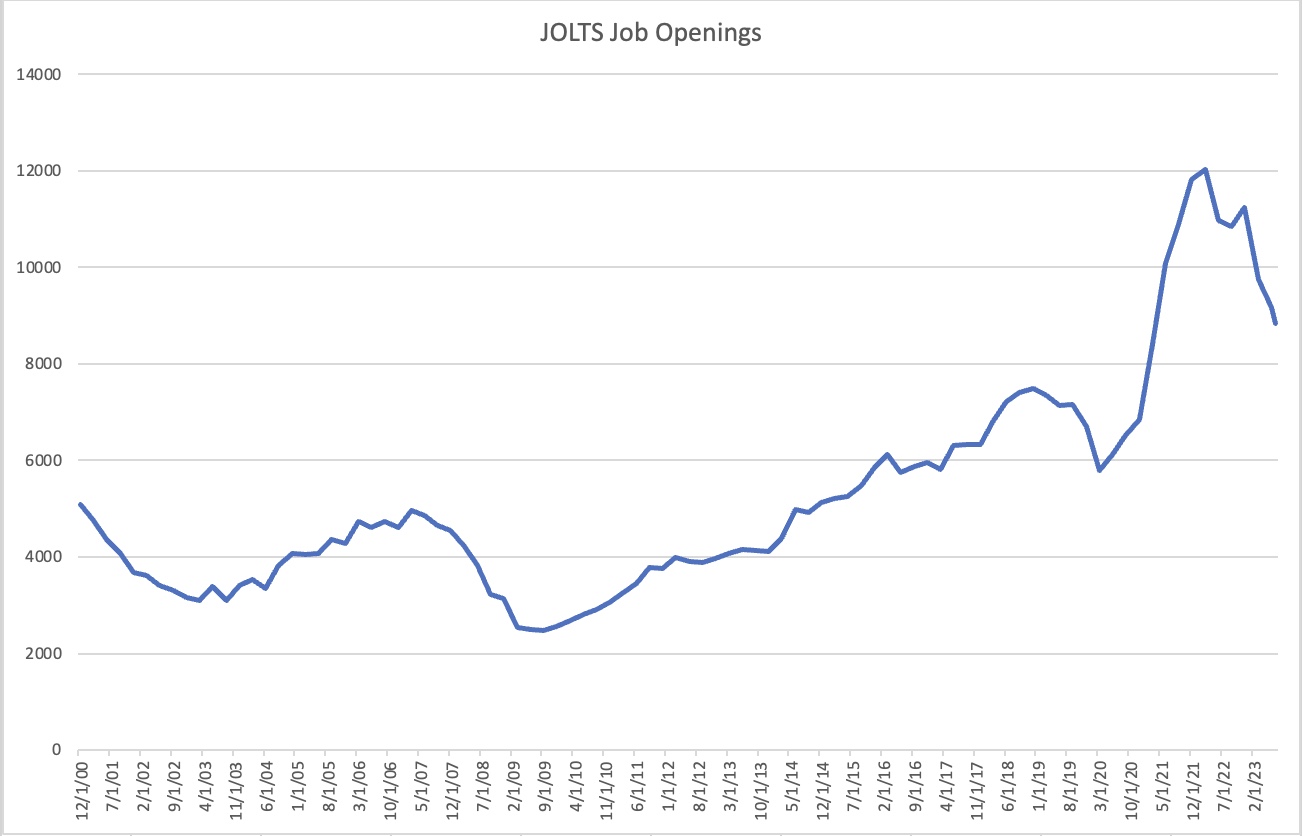
JOLTS Job Openings

9439K


Fed’s Beige Book


Thursday

ADP Employment

165K


Initial Claims

235K


Continuing Claims

1803K


Nonfarm Productivity

-2.6%


Unit Labor Costs

6.3%


ISM Manufacturing

47.0


ISM Prices Paid

52.5

Friday

Nonfarm Payrolls

193K


Private Payrolls

173K


Manufacturing Payrolls

5K


Unemployment Rate

3.5%


Average Hourly Earnings

0.3% (4.4% Y/Y)


Average Weekly Hours

34.4


Participation Rate

62.6%

Source: Bloomberg


Clearly, all eyes will be on NFP on Friday, but there is much to be gleaned between now and then.  On the Fed speaker front, we hear from 5 more speakers ahead of the beginning of the quiet period starting Friday.  I maintain that the NFP data is the key for the Fed.  As long as it remains strong, Powell has cover to raise rates as much as he likes.  But once it cracks, look out below.  For now, nothing has changed my dollar view of continued strength until such time as policies change. 


Good luck

Adf


Quite a Surprise

This morning’s report on inflation
Is forecast as verification
The Fed is behind
The curve and must find
The will to cease accommodation

While last night from China we learned
The trend in inflation has turned
In quite a surprise
It fell from its highs
A positive for all concerned

Ahead of this morning’s CPI report (exp 7.0%, 5.4% ex food & energy) investors around the world have been feeling positively giddy about the current situation.  Sure, China’s growth forecasts have been cut due to omicron infection outbreaks and the Chinese response of further lockdowns, but that just means that combined with the first downtick in PPI there since February 2020 (10.3%, exp 11.3%, prev 12.9%), talk has turned to the PBOC cutting interest rates next week by between 5 and 10 basis points.  So, while many other nations are aggressively fighting inflation (Brazil, Mexico, Hungary) or at least beginning to tighten policy (UK, Sweden, Canada), the market addiction to ever increasing liquidity may now be satisfied by China.  While it is still too early to know if lower interest rates are coming from Beijing, what is clear is that the credit impulse in China (the amount of lending) seems to have bottomed and is starting to reverse higher.  That alone augers well for future global growth; so, buy Stonks!

Meanwhile, I think it is valuable to consider what we heard from Chairman Powell yesterday at his renomination hearings, as well as what the two erstwhile hawks, Esther George and Loretta Mester, had to say about things.  Mr Powell, when asked why the Fed was continuing to purchase assets with inflation well above target and unemployment near historic lows inadvertently let the cat out of the bag as to the most important thing for the Fed, that if they were to move at a more aggressive pace, it could upset markets and there could be declines in both the stock and bond markets.  Apparently, the unwritten portion of the Fed’s mandate, prevent markets from falling, remains the most important goal.  While Powell paid lip service to the idea that the Fed would seek to prevent the inflationary mindset from becoming “entrenched”, he certainly didn’t indicate any sense of urgency that the Fed’s glacial pace of change was a problem.

Perhaps more surprisingly, neither Mester nor George were particularly hawkish, with both explaining that the Dot Plot from December was a good guide and there was no reason to consider a rate hike as soon as March.  Regarding QT, neither was anxious to get that started either although both wanted to see it eventually occur.  Finally, this morning, former NY Fed President (and current Fed mouthpiece) Bill Dudley explained in a Bloomberg column that there was no hurry to reduce the size of the balance sheet and that when it begins, the impact would be “like watching paint dry.”  Now, where have we heard that before?  Oh yeah, I remember.  Then Fed Chair Yellen used those exact same words to describe the last attempt to shrink the balance sheet right up until Powell was forced to pivot after the equity market’s sharp decline in 2018.  Apparently, the dynamics of drying paint are more interesting than we have been led to believe.

For those seeking proof that investors welcomed yesterday’s comments, one need only look at market behavior in their wake.  US equity markets rallied after the testimony and never looked back all day.  Treasury bonds did very little, with the sharp trend higher in yields having hit a key resistance and unable to find the will to push through.  Finally, the dollar took it on the chin, declining vs virtually every major and emerging market currency yesterday with many of those moves continuing overnight.  Recapping: higher stocks, unchanged bonds and a weaker dollar are not a sign that the market expects much tighter policy from the Fed.

Ok, so how are things looking this morning?  Well, in the equity market, the screen is entirely green. Last night, Asia followed the US lead  with gains across the board (Nikkei +1.9%, Hang Seng +2.8%, Shanghai +0.8%), and European bourses are also higher (DAX +0.35%, CAC +0.5%, FTSE 100 +0.7%) as data from the continent showed much better than expected Eurozone IP growth (2.3% vs 0.2% exp) as well as the first indication that inflation might be peaking in Germany with PPI there “only” printing at 16.1%, down from last month’s record 16.6%.  As to US futures, they are modestly higher ahead of the data, between 0.1%-0.2%.

In the bond market, while 10-year Treasury yields have edged higher by 0.7bps at this hour, they remain just below 1.75% and have shown no inclination, thus far, of breaking out much higher.  Arguably this implies that market participants are not yet full believers in the Fed tightening policy aggressively, and after yesterday’s performances, I think that is a good bet.  Meanwhile, European sovereign bonds are all rallying with yields falling nicely (Bunds -1.8bps, OATs -1.7bps, BTPs -1.3bps) as it remains clear that there is not going to be any tightening of note by the ECB this year.

On the commodity front, we continue to see strength in energy (WTI +0.5%, NatGas +5.2%) as well as industrial metals (Cu +2.9%, Zn +2.2%) although both gold -0.2%, and silver -0.2% are consolidating after strong moves higher yesterday.

Looking at FX markets, I would say the dollar is modestly weaker overall, albeit only in a few segments.  In the G10, NOK (+0.7%) and CAD (+0.2%) are the largest movers, by far, with both benefitting from oil’s continued rise.  The rest of the bloc, quite frankly, is tantamount to unchanged this morning.  In emerging markets, the picture is a bit more mixed with both gainers and losers about evenly split.  However, only 3 currencies have shown any real movement, BRL (-0.4%), KRW (+0.4%) and CLP (+0.3%).  The real seems to be consolidating some of its massive gains from yesterday, when it rallied 1.7% on the back of central bank comments implying that though inflation would fall back in 2022, it would require continued tight policy to achieve that outcome.  On the flip side, the won benefitted from a better than expected employment report showing more than 770K jobs added in the last year and indicating better economic growth going forward.  Finally, the Chilean peso seems to be benefitting from copper’s strong rally today.

Aside from this morning’s CPI report, we also see the Fed’s Beige Book at 2:00pm which has, in the past, been able to move markets if the narrative was strong enough.  Only one Fed speaker is on the docket, Kashkari, and even he, an uber-dove, is calling for 2 rate hikes this year as per his last comments.

The Fed tightening narrative is definitely having some difficulty these days which implies to me that the market has fully priced in its expectations and those expectations are that the Fed will not be able to tighten policy very much.  If the Fed is restrained, and tighter policy continues to get pushed further out in time, the dollar will suffer much sooner than I anticipated.  For those with opex and capex needs, perhaps moving up the timetable to execute makes some sense.

Good luck and stay safe
Adf

A New T#heme

The news yesterday from the Fed
Was Vice-Chair Clarida has fled
While later today
Chair Jay seeks to sway
The Senate to keep him Fed head

But in the meantime, it would seem
The narrative has a new theme
It seems pretty clear
Four rate hikes this year
Have gone from the fringe to mainstream

As we walk in this morning, there seems to be a lot of movement with respect to market expectations regarding the Fed’s actions going forward and exactly how those actions are going to impact the various markets.  Today’s headline event is Chairman Powell’s renomination testimony in the Senate as everyone is waiting to see just how much effort Senator Elizabeth Warren puts into trying to derail the process.  It is widely known that the Senator does not care for Mr Powell going so far as to calling him “dangerous” in his recent semi-annual testimony to the Senate.  Yesterday, she also wrote a letter demanding to see all the personal trading records of all Fed officers which probably was part of the impetus for vice-Chair, Richard Clarida, to step down early from his post.  So, on the one hand, we will be treated(?) to the scene of some Senators trying to play gotcha with the Fed Chair today with the ever-present possibility that some comment is made with a real market impact.

On the other hand, the tightening train has not merely pulled away from the station but is starting to gather serious speed.  Earlier this morning, Atlanta Fed President Bostic commented that he sees 3 rate hikes this year and that the Fed “will act to ensure inflation doesn’t run away from us.”  Futures markets are now pricing in a more than 60% probability of a fourth rate hike in 2022 with an increasing number of Fed speakers explaining a rate hike in March would be appropriate.  We are also hearing the 4-hike scenario from an increasing number of pundits with Goldman Sachs economists publishing that view yesterday while JPMorgan Chairman Jamie Dimon explained that “four rate hikes of 0.25% each would not have an enormous effect on the economy.”  And that is likely correct, a Fed Funds rate of 1.0% doesn’t seem that onerous for businesses.  Of course, what impact would four interest rate hikes have on financial asset prices, especially if they were joined with a reduction in the size of the Fed’s balance sheet?  And it is this latter question that seems likely to be the key as we continue to hear from more and more Fed speakers that the idea of allowing the balance sheet to ‘run-off’ is appropriate.

For those of you with shorter memories, the last time the Fed tried to reduce the size of its balance sheet, from 2017-2018, they were also raising interest rates, albeit far more slowly.  Of course, CPI had peaked below 3.0% in that cycle, GDP was running at 2.4% and wages were growing at 2.5% while the balance sheet was less than half its current size.  The point is conditions were clearly very different.  However, not only did the equity market’s 20% decline inspire the Powell Pivot on Boxing Day 2018, but nine months later, the repo market blew up forcing the Fed to take dramatic action to ensure that sufficient liquidity was made available to the banking system.  I assure you, neither of those outcomes were part of the carefully described plans the Fed had made to ‘normalize’ monetary policy.

Will this time be different?  While starting conditions certainly are different, the one thing of which we can be sure is that the complexities of the international money markets remain opaque even to the central banks charged with their oversight.  While there is no way to anticipate exactly what will happen to derail the current plans, one can almost be certain that things will not work out the way they are currently planned.  Personally, I remain convinced that markets will have a very difficult time handling any reductions in the excess liquidity that has been the dominant feature of the post Covid-19 global financial markets, and that despite a lot of tough talk now, the Fed, at least, will be walking back that hawkishness before too long.

And perhaps, markets are beginning to agree with me.  After all, hawkish monetary policy is rarely the backdrop for a risk-on attitude.  Yet that is a pretty fair description of today’s price action.  Equities are rebounding along with commodities; bonds are benign, and the dollar is softening.

While yesterday saw US equity markets in the red most of the day, the NASDAQ staged a furious late day rally to close flat although market breadth was awful (1205 gainers vs. 2201 losers).  And while Asia was still under pressure (Nikkei -0.9%, Hang Seng 0.05, Shanghai -0.7%), Europe has taken heart from something as we are seeing solid gains across the board there (DAX +1.15%, CAC +1.35%, FTSE 100 +0.7%) despite a complete lack of news.  US futures, too, have turned green with all three main indices up about 0.3% at this hour.

The Treasury rout is on hold with yields essentially unchanged this morning and the 10-year right at the key level of 1.75%.  In Europe, Bunds (-0.9bps) and Gilts (-2.3bps) are both trading well while the rest of the sovereign market is virtually unchanged.  Again, there has been essentially no news of note.

Oil prices are rallying (WTI +1.4%) while NatGas (-0.9%) has consolidated some of yesterday’s gains despite the fact it is 14 degrees here in NJ this morning.  Gold (+0.3%) and silver (+0.6%) are both firmer, as are industrial metals (Cu +0.6%, Al +0.1%, Zn +2.4%) and the ags are strong as well.

Finally, the dollar is under modest pressure with NOK (+0.4%) leading the G10 revival on the strength of oil’s rally, while CAD (+0.3%) follows closely behind.  JPY (-0.25%) is the only laggard here, again pointing to the risk characteristics in today’s price action.  EMG markets have seen similar price action with THB (+0.6%) the leading gainer followed by HUF (+0.4%) and KRW (+0.35%), all benefitting from the pause in the US yield rally and generally better risk appetite.

Today’s only data point has been released, NFIB Small Business Optimism (98.9, slightly better than 98.7 expected) and has had virtually no impact on the market.  This brings us back to the Fed as today’s most likely catalyst, as not only will we hear from Chair Powell starting at 10:00, but also from two of the most hawkish regional bank presidents, Mester and George between 9:00 and 9:30.

With risk in vogue for the session, I expect the dollar will have difficulty gaining any ground, but nothing has changed my short-term view that the Fed’s hawkishness is going to be the key driver of a stronger dollar…right up until they reverse course!

Good luck and stay safe
Adf

Out of Place

The holiday season has passed
And this year the reigning forecast
Is for higher rates
Right here in the States
Thus, dollars will soon be amassed

But frequently, as is the case
Consensus is, here, out of place
Though some nations will
Raise rates, like Brazil
The Fed soon will turn about-face

Reading the many forecasts that are published this time of year, the consensus certainly appears to be that the Fed is going to continue to tighten policy and the only question is how soon they will begin raising interest rates; March, May or June?  The Fed narrative has evolved from there is no inflation, to inflation is transitory to inflation is persistent and we will address it with our tools.  But will they?  Since Paul Volcker retired as Fed Chair (1979-1987) we have had a steady run of people in that seat who like to talk tough, but when there is any hiccup in the market, are instantly prepared to add more liquidity to the system.  Starting with the Maestro himself, in the wake of the October 1987 stock market crash, to Bennie the Beard, the diminutive Ms Yellen and on up to today’s Chair Powell, history has shown that there is always a reason NOT to tighten policy because the consequences of doing so are worse than those of letting things run hotter.  Ultimately, I see no reason for this time to be any different than the past 35 years and expect that as interest rates begin to climb here, and equity markets reprice assumptions, the Fed will not be able to withstand the pain.

But for now, the higher US interest rate story remains front and center.  This was made clear yesterday when 10-year yields rallied 12 basis points in a thin session, trading back to levels last seen in November.  Perhaps not surprisingly, the dollar reversed its late year losses as well, rallying vs. almost all its counterparts with the yen (-0.7%) by far the worst performer in the G10.  It seems that the Japanese investor community has decided that a 155 basis point spread in the10-year, in an environment where expectations for a stronger dollar are rampant is a sufficient reason to sell yen and buy dollars.

And the truth is that given inflation is a global phenomenon these days, there are only a handful of nations where expectations don’t include higher interest rates.  For instance, Japan, though they have stopped QE are not even contemplating higher interest rates.  The ECB has indicated QE will be reduced to some extent (they claim cut in half, but I will believe that when I see it) but is certainly not considering higher interest rates.  Turkey is kind of a special case as President Erdogan continues to try his unorthodox inflation fighting methodology, but if the currency reprises the late 2021 collapse, which is entirely realistic, if not probable, that is subject to change.

However, there is one more nation of note that is almost certainly going to be working against the grain of higher interest rates this year, China.  President Xi has a growing list of economic problems that will result in further policy ease regardless of any inflationary consequences at this time.  The fundamental flaw is the Chinese property market, which has obviously been under severe pressure since the problems at China Evergrande came to light.  This is fundamental because it represents more than 30% of the Chinese economy and has been THE key reason that Chinese GDP has been growing as rapidly as it has over the past two decades.  With Evergrande and several (many?) other property developers going to the wall, the property sector is going to have a much slower growth trajectory, if it is positive at all, and that is going to drag on the entire economy.  After all, if they are not going to build ghost cities (Evergrande’s specialty), they don’t need as much concrete, steel, copper, etc., and the whole support framework that has been created for the industry will slow down as well.  The upshot is that the PBOC seems highly likely to continue to ease policy in various ways including RRR cuts, as well as reductions in interest rates.

On the surface, one would expect that to work against CNY strength and fit smoothly with the stronger dollar thesis.  However, the competing view is that President Xi is more focused on the long-term viability of the renminbi as a stable store of value and strong currency, and I expect that imperative will dominate this year and in the future.  Thus, while your textbooks would explain the renminbi should fall, I beg to differ this year.  We shall see as things evolve.

Ok, starting the year, there is clearly a solid risk appetite.  Yesterday saw strong gains in the US equity market which was followed by the Nikkei (+1.8%) last night, although Shanghai (-0.2%) and the Hang Seng (0.0%) failed to follow suit.  Europe (DAX +0.7%, CAC +1.4%, FTSE 100 +1.4%) are all bullish this morning as are US futures (+0.35% across the board).  Record Covid infections are clearly not seen as a problem anymore.

After yesterday’s dramatic sell-off in Treasuries, this morning yields there have consolidated and are essentially unchanged.  In Europe, though, there has been a mixed picture with Gilts (+8.3bps) following the US lead, while the continent (Bunds -1.5bps, OATs -2.5bps) are clearly more comfortable that interest rates have no reason to rise sharply there anytime soon.

In the commodity markets, oil (+0.3%) is continuing its run higher from last year and, quite frankly, shows no sign of stopping.  This is a simple supply demand imbalance with not nearly enough supply for ongoing demand.  NatGas (+1.8%) continues to trade well as cold weather in the NorthEast and much of Europe and a lack of Russian deliveries to the continent continue to demonstrate the supply demand imbalance there as well.  Gold (+0.25%) has bounced after getting roasted yesterday, although it spent the last weeks of the year grinding higher, so we remain around $1800/oz.  Industrial metals, though, are mixed with copper (-0.8%) under some pressure while aluminum (+1.4%) and zinc (+2.4%) are both having good days.

As to the dollar, aside from the yen’s sharp decline, the rest of the G10 is +/- 0.15% or less, not enough to consider for a story rather than position adjustments at the beginning of the year.  In the EMG space, though, the dollar has had a bit more positivity with ZAR (-0.9%) and RUB (-0.8%) the worst performers (I need to ignore TRY given the insanity ongoing there).  In both cases, rapidly rising inflation continues to outpace the central bank efforts to rein it in and the currency is weakening accordingly.  In fact, that is largely what we are seeing throughout this bloc, with central banks throughout lagging the rise in prices.  In the EMG space, this trend has room to run.

On the data front, we get a decent amount of stuff this week, culminating in the payroll report:

Today ISM Manufacturing 60.0
ISM Prices Paid 79.3
JOLTS Job Openings 11,100K
Wednesday ADP Employment 420K
FOMC Minutes
Thursday Initial Claims 195K
Continuing Claims 1682K
Trade Balance -$81.0B
Factory Orders 1.5%
-ex transport 1.1%
ISM Services 67.0
Friday Nonfarm Payrolls 424K
Private Payrolls 384K
Manufacturing Payrolls 35K
Unemployment Rate 4.1%
Average Hourly Earnings 0.4% (4.2% Y/Y)
Average Weekly Hours 34.8
Participation Rate 61.9%

Source: Bloomberg

In addition to the data, we start to hear from FOMC members again with Kashkari, Bullard, Daly and Bostic all on the calendar this week.  My impression is that investors and traders will be looking for hints as to the timing of rates liftoff.  But we are a long way from that happening yet.

For now, though, the narrative is clear, and a firmer dollar seems the most likely outcome in the near term.

Good luck and stay safe
Adf

Til ‘flation Responds

Apparently, Powell has learned
Why everyone’s been so concerned
With prices exploding
The sense of foreboding
‘Bout ‘flation seemed very well earned

So, Jay and his friends at the Fed
Said by March, that they would stop dead
The buying of bonds
Til ‘flation responds
(Or til stocks fall deep in the red)

By now you are all aware that the FOMC will be reducing QE twice as rapidly as their earlier pace, meaning that by March 2022, QE should have ended.  Chairman Powell was clear that inflation has not only been more persistent than they had reason to believe last year but has also moved much higher than they thought possible, and so they are now forced to respond.  Interestingly, when asked during the press conference why they will take even as long as they are to taper policy rather than simply stop buying more assets now if that is the appropriate policy, Powell let slip what I, and many others, have been saying all along; by reducing QE gradually, it will have a lesser impact on markets.  In other words, the Fed is more concerned with Wall Street (i.e. the stock market) than it is with Main Street.  Arguably, despite a more hawkish dot plot than had been anticipated, with the median expectation of 3 rate hikes in 2022 and 3 more in 2023, the stock market rallied sharply in the wake of the press conference.  If one is seeking an explanation, I would offer that Chairman Powell has just confirmed that the Fed put remains alive and well and is likely struck far closer to the market than had previously been imagined, maybe just 10% away.

One other thing of note was that Powell referred to the speed with which this economic cycle has been unfolding, much more rapidly than the post-GFC cycle, and also hinted that the Fed would consider reducing the size of its balance sheet as well going forward.  Recall, however, what happened last time, when the Fed was both raising the Fed funds rate and allowing the balance sheet to run off by $50 billion/month back in 2018; stocks fell 20% in Q4 and the Powell Pivot was born.  FWIW my sense is that the Fed will not be able to raise rates as much as the dot plot forecasts.  Rather, the terminal rate will be, at most, 2.00% (last time it was 2.50%), and that any shrinkage of the balance sheet will be minimal.  The last decade of monetary policy has permanently changed the role of central banks and defined their behavior in a new manner.  While not described as such by those “independent” central banks, debt monetization (buying government bonds) is now a critical role required to keep most economies functioning as debt/GDP ratios continue to climb.  In other words, MMT is the reality and it will require a much more dramatic, and long-lasting, negative shock for that to change.

One last thing on this; the bond market has heard what Powell said and immediately rallied.  The charitable explanation is that bond investors are now comforted by the Fed’s recognition that inflation is a problem and will be addressed.  Powell’s explanation about foreign demand seems unlikely, at least according to the statistics showing foreign net sales of bonds.  Of more concern would be the explanation that bond investors are concerned about a policy mistake here, where the Fed is tightening too late and will drive the economy into a recession, as they always have done when they tighten policy.

With Jay and the Fed finally past
The market will get to contrast
The Fed’s hawkish sounds
With Europe’s shutdowns
And watch Christine hold rates steadfast

But beyond the Fed, this has been central bank policy week with so many other central bank decisions today.  Last night the Philippines left policy on hold at 1.50%, as did Indonesia at 3.50%, both as expected.  Then, this morning the Swiss National Bank (-0.75%) left rates on hold and explained the franc remains “highly valued”.  Hungary raised their Deposit rate by 0.30% as expected and Norges Bank raised by 0.25%, also as expected, while promising another 0.25% in March.  Taiwan left rates unchanged at 1.125%, as expected and Turkey continue their unique inflation fighting policy by cutting the one-week repo rate by 1.00%, down to 14.00% although did indicate they may be done cutting for now.  As to the Turkish lira, if you were wondering, it has fallen another 3.8% as I type and is now well through 15.00 to the dollar.  YTD, TRY has fallen more than 51% vs. the dollar and quite frankly, given the more hawkish turn at the Fed, seems like it has further to go!

Which of course, brings us to the final two meetings today, the ECB and the BOE.  Madame Lagarde and most of her minions have been very clear that they are not about to change policy, meaning they will continue both the PEPP and APP and are right now simply considering how they are going to manage policy once the PEPP expires in March.  That is another way of saying they are trying to figure out how to continue to buy as many bonds as they are now, while losing one of their programs.  I’m not worried about them finding a way to continue QE ad infinitum, but the form that takes is the question at hand.  While European inflation pressures have certainly lagged those in the US, they are still well above their 2.0% target, and currently show no signs of abating.  If anything, the fact that electricity prices on the continent continue to skyrocket, I would expect overall prices to only go higher.  But Madame Lagarde is all-in on MMT and will drag the few monetary hawks in the Eurozone down with her.  Do not be surprised if the ECB sounds dovish today and the euro suffers accordingly.

As to the BOE, that is much tougher to discern as inflation pressures there are far more prevalent and members of the MPC have been more vocal with respect to discussing how they need to respond by beginning to raise the base rate.  But with the UK flipping out over the omicron variant and set to cancel Christmas impose more lockdowns, it is not clear the BOE will feel comfortable starting their tightening cycle into slower economic activity.  Ahead of the meeting, the futures market is pricing in just a 25% probability of a 0.15% rate hike.  My money is on nothing happening, but we shall see shortly.

Oh yeah, tonight we hear from the BOJ, but that is so anticlimactic it is remarkable.  There will be no policy shifts there and the yen will remain hostage to everything else that is ongoing.  Quite frankly, given the yen has been sliding lately, I expect Kuroda-san must be quite happy with the way things are.

And that’s really the story today.  Powell managed to pull off a hawkish turn and get markets to embrace risk, truly an impressive feat.  However, over time, I expect that equity markets will decide that tighter monetary policy, especially if central bank balance sheets begin to shrink, is not really a benefit and will start to buckle.  But right now, all screens are green and FOMO is the dominant driver.

In the near term, I think the dollar has further to run higher, but over time, especially when equity markets reverse course, I expect the dollar will fall victim to the impossible trilemma, where the Fed can only prop up stocks and bonds simultaneously, while the dollar’s decline will be the outlet valve required for the economy.  But that is many months away.  For now, buy dollars and buy stocks, I guess.

Good luck and stay safe
Adf