What’s the Rush?

Said Waller, my god “what’s the rush?”
‘Cause things are OK at first blush
The ‘conomy’s roaring
The stock market’s soaring
And so, dreams of cuts, I must crush

But really, does anyone care
What Powell or Waller declare?
NVIDIA rallied
And gains have been tallied
So, rate cuts don’t have savoir faire

I am old enough to remember when the inherent strength of the US economy was based on its diversity of industry and geography as well as its bounty of abundant natural resources.  The governmental framework of property rights and the rule of law were critical aspects of what made this nation stand out.  But that is sooooo last week.  Instead, let me recount a famous scene from the movie, The Graduate, but updated for today:

Mr McGuire: I just want to say one word to you.  Just one word.
Benjamin: Yes, sir.
Mr McGuire: Are you listening?
Benjamin: Yes, I am.
Mr McGuire: Plastics NVIDIA

At this point, I might refute the idea of the Magnificent 7 stocks, first because Tesla hasn’t been following the script all year, but second because the reality is there is only one true god stock, NVIDIA.  It appears that the entire nation’s economy is reliant on that single company continuing to outperform analyst expectations and grow at 100% annually.  As long as it continues, the US will maintain its status as the world’s most important economy.  Seems pretty simple.  In fact, it is not clear to me why anyone would own any other stock than NVIDIA at this point, perhaps with a small percentage of assets in Bitcoin.  Only then will an investor be ready for the future!

Of course, this is not what I believe, nor would I ever suggest that someone consider this approach.  But, boy, if there is another piece of news that is remotely as important, I am still searching for it.  Every market seems to take its cues from the stock and government policies seem to be designed to either support its growth or inhibit its products from getting into the wrong hands.  Perhaps it is time to rename our nation to The United States of NVIDIA and be done with it.

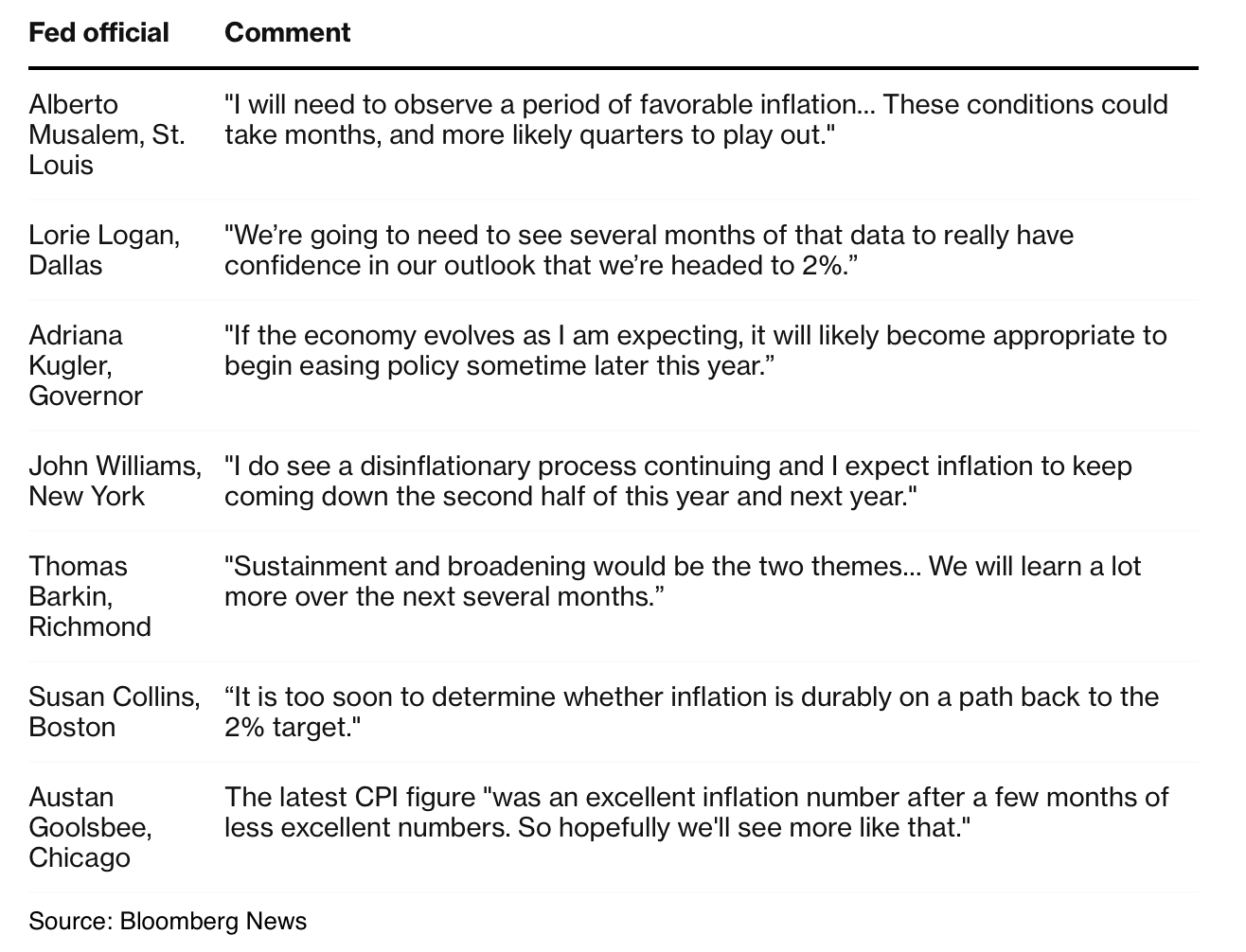
Alas for this poet, equity markets are not my primary focus so I will try to look through the other scraps of information and see if there is anything interesting.  Top of the list were the assorted commentaries by four different Fed speakers yesterday, all of whom said essentially the same thing, while they expect rate cuts at some point this year, it is still too early as they are not yet confident that inflation will sustainably return to their 2% target.  That was the message from Wednesday’s FOMC Minutes, that was the message from Powell at the press conference and that has been the consistent message since the last meeting.

Happily, it appears that the markets are starting to understand this idea as a look at the Fed funds futures market shows the probabilities of rate cuts continues to decline, now 2.5% in March, 21% in May and just 66% in June.  In fact, for the full year, the market is now pricing just 85bps total, not much more than the last dot plot’s median outcome showed.

From my perspective, I remain uncertain as to why they are even considering cutting interest rates.  After all, GDP continues to power along, financial conditions continue to ease with a rising equity market, and inflation has many earmarks of remaining sticky.  Absent a collapse in the commercial real estate market that drags down a number of banks, or some other true black swan type event, it appears that the need to cut rates in the US is limited at best.  Do not be surprised to see the dot plot in March show just 2 rate cuts as the median end-2024 outcome as the hawks will have to reevaluate their stance given the economy’s strength since December.  And as I have said before, if inflation really does start to tick higher again, a rate hike seems possible, which is clearly not on very many bingo cards right now.

But really, the Fed discussion pales in comparison to the NVIDIA discussion and the impact on equity markets in general.  Since there has been very little other data even released, let’s recap the overnight session and head into the weekend.

After the massive rally in the US yesterday, with all 3 major indices setting new all-time highs, most markets in Asia were unable to follow through in any real manner, with very modest gains everywhere that was open (Japan was closed for a holiday).  In Europe, the picture is mixed with some gainers (CAC +0.6%), some losers (IBEX -0.5%) and some nothings (FTSE 100 and DAX unchanged). As there was limited data to drive things and the ECB speakers are trying to hew the line that they, too, will remain patient, nothing has changed there of late.  I continue to believe that the ECB will cut before the Fed because the Eurozone economy is in much worse shape than the US economy.  As to US futures, at this hour (7:30) they are basically unchanged.

In the bond market, after yields rising yesterday afternoon by some 6bps, Treasuries are unchanged this morning.  There are growing concerns that the supply question is going to begin to impact yields in the US, with more than $500 billion of new coupon issuance due over the rest of the year.  It is possible yields will need to rise to find buyers for all that.  As to Europe, yields there are higher by 3bps or so this morning as they missed most of the US move.

Commodity markets are under some pressure this morning with oil (-1.7%) giving up any recent strength and now lower on the week.  However, I believe it remains rangebound and need to see compelling evidence of something changing to see a real move here.  In the metals markets, gold, which slid a bit yesterday is edging higher this morning but both copper and aluminum are under pressure on demand concerns.

Finally, the dollar, which did recover yesterday to finish roughly flat on the session, is beginning to soften a bit as NY is walking in after an extremely quiet overnight session.  But overall, the movement here remains marginal with most currencies, both G10 and EMG, remaining within a +/-0.25% range from yesterday.  With monetary policies around the world seemingly on hold for now, it is unrealistic to look for large moves in the FX market.  We will need to see a change in central bank tunes to make this happen.  (either that or Jensen Huang, NVIDIA’s CEO, will need to explain that the dollar needs to move in one direction or another to boost earnings!)

There is no US data to be released and there are no Fed speakers on the calendar either.  With that in mind, equity markets are going to be the driver of note.  If the rally continues, and risk is embraced, I suspect the dollar can slide a bit further.  However, if there is any late week profit-taking, perhaps the dollar finds a bid.

Good luck and good weekend
Adf

Bears’ Great Dismay

Their confidence clearly was lacking
So, now on rate cuts they’re backtracking
As well, they’re concerned
Some banks have not learned
To manage their risk and need smacking
 
But really the news of the day
Is AI remains the key play
NVIDIA beat
And all of Wall Street
Is buying to bears’ great dismay
 
Starting with the FOMC Minutes, the two things that stood out to me were these two lines, “The staff provided an update on its assessment of the stability of the U.S. financial system and, on balance, characterized the system’s financial vulnerabilities as notable. The staff judged that asset valuation pressures remained notable, as valuations across a range of markets appeared high relative to fundamentals.”  Arguably, this was why the Fed removed the line from the statement about “The U.S. banking system is sound and resilient,” which had been included since the Silicon Valley Bank debacle.  Perhaps they see something amiss.  As well, there was discussion regarding the timing of the end of QT with July seeming to be the latest thinking for its initial reduction.  But otherwise, as evidenced by the fact that virtually every Fed speaker has indicated they lack confidence inflation is dead, and that while policy is currently restrictive, it is still too soon to think about cutting rates, was clearly the broad theme of the meeting.  Next week we see the PCE data so perhaps that can change some opinions, but right now, given what we have just seen from CPI/PPI, they cannot have gained confidence it is time to cut.
 
As to NVIDIA, huge results, beating expectations and the word from the CEO is that demand will outstrip supply at least through the end of the year.  The market response here has been as one would expect; a big rally in stocks, especially tech.  ‘Nuff said.
 
Nikkei all-time high
Thirty-four years in waiting
Has finally come

Under the heading a picture is worth 1000 words, behold the relationship between NVIDIA and Nikkei 225 (chart from Weston Nakamura’s Across the Spread substack):

Pretty tight correlation, no?  Arguably, the question is which is driving which?  Does a stronger Nikkei drive NVIDIA’s performance or the other way around?  The first thing to note is that breaking down the Nikkei’s performance, similar to the NASDAQ, there are a handful of AI related stocks that have been the drivers of the move.  If you read Nakamura-san’s take, he believes that it is the Nikkei which is driving things, but I would argue while the Nikkei’s move happens earlier in the global day, the reality is that everything is an echo of the current AI craze which NVIDIA started.  

The next question is, just how long can this continue?  Remember two things here; first, trees don’t grow to the sky, and neither will NVIDIA’s stock; and second, new technologies take MUCH longer to assimilate than the initial hype would have you believe.  We are already seeing issues with Google’s Gemini AI with respect to drawing remotely accurate historical images of US presidents, as an example.  We are still in the very early innings of the AI phenomenon and there will be more hiccups along the way.  One last thing regarding AI is its power consumption, which is off the charts high.  If the world is going to be run by AI, we need a lot more electricity than is currently being produced and that alone will slow its incorporation into things.

Ok, on to more macro views, last night and this morning saw the release of the Flash PMI data all around the world.  Of the seven major releases thus far, only India is in expansion with it continuing to motor along in the low 60’s.  Otherwise, everything else (Australia, Japan, Germany, France, the Eurozone and the UK) are all in contraction in manufacturing.  Services is more mixed with several slightly above the 50 boom/bust line, but overall, while things might be seen as slightly improving, they are still pointing to recessions in Europe, Japan and the UK.

Despite this weakening data, virtually every one of these nations’ currencies is stronger vs. the dollar this morning.  In fact, the dollar is having a pretty rough session, down between 0.3% and 0.5% against most G10 counterparts with a slightly smaller decline vs. its EMG counterparts.  One of the odd things about this is that US yields have not really fallen much (Treasuries -1bp) which is right in line with the price action in European sovereigns and what we saw overnight in Asia across the board.

Add to the bond story the message from the Fed of higher for longer and it doesn’t appear that interest rates are today’s driver of the markets.  We already have seen that equity markets are rocking with the Nikkei (+2.2%), Hang Seng (+1.5%), CSI 300 (+0.9%), and most of Europe higher by 0.9% or more.  US futures, of course, are really flying with the NASDAQ (+2.2%) leading the way, but everything in the green.  I grant that a typical risk-on reaction is a weaker dollar but given the amount of funds that are flowing into the US equity markets, it is very hard to understand why the dollar is under pressure.  Something seems amiss.

If we look at the commodity markets, energy is softer across the board with oil (-0.2%) edging lower and basically unchanged on the week, while NatGas (-2.7%) is suffering as well.  As to the metals markets, gold (+0.2%) is edging higher on the back of the weaker dollar but both copper and aluminum are little changed on the day, less than 0.1% different from yesterday’s closing levels.  

Perhaps this is the new risk-on look, strong equity markets, a weak dollar and nobody cares about bonds.  But bonds have been far too important a driver of market activity to suddenly be ignored.  Now, yesterday, the Treasury auctioned some 20-year bonds and it did not go well, with a tail of 3.3bps, implying demand for the long-end remains tepid.  Given my personal view on inflation, that makes perfect sense, but arguably, the longest duration assets around are tech stocks and the divergence between bonds and those stocks is hard to reconcile.  I guess we will learn more as time progresses, but for now, I would be at least a little wary.  Absent a change in the inflation narrative back to the Fed has won, it does feel like there is still some risk to be seen.

On the data front, this morning brings the Chicago Fed National Activity Index (exp -0.15) which is a comprehensive view of financial conditions around the country and closely followed by the Fed.  As well we get Initial (218K) and Continuing (1885K) Claims and the Flash PMI’s (50.5 Manufacturing, 52.0 Services).  We close with Existing Home Sales (3.97M) and the oil inventory data and throughout the day we hear from four different Fed speakers, Jefferson, Harker, Cook and Kashkari.  Will any of this data matter?  I doubt it.  Can we expect anything new from the Fed speakers?  I kind of doubt that as well as there has been exactly zero evidence that the economy is slowing and dragging inflation lower since last week’s CPI and PPI data.   So, look for that lack of confidence in the demise of inflation to be widespread.

As to the dollar, something doesn’t smell right today.  I feel like it should be better bid and expect that by the end of the day, it will see that type of movement.

Good luck

Adf

Widow Maker

The widow maker
Looks like it is about to
Make some more widows

For those unacquainted with the term as it relates to the financial markets, the widow maker trade has been going short JGB’s and buying JPY under the assumption that at some point, the BOJ would normalize monetary policy.  Lately, this trade has been reinvigorated in a major way on the back of the belief that Ueda-san is going to raise the base rate from its current level of -0.10%.  Granted, 10-year JGB yields have risen about 35bps since last summer, which given their starting level of 0.35%, is quite a bit.  Simultaneously, the yen weakened dramatically, falling more than 8% over the same timeframe.  An unstated, but critical, underlying part of the idea was that the Japanese economy was chugging along nicely and would continue to do so.  This would pressure wages higher and force the BOJ to join the rest of the world in raising interest rates.

But a funny thing happened to those plans last night when the Japanese government released its latest GDP data showing that Q4 GDP fell -0.1% Q/Q, far below the expected +0.3% gain.  This, when combined with Q3’s revised decline of -0.8% Q/Q (also worse than before) is the very definition of a recession.  Hence, the problem for all those traders who are short JGB’s and long the yen.  If Japan is in recession, it seems highly unlikely that Ueda-san is going to be tightening monetary policy in the near-term.  Rather, I would expect more fiscal and monetary stimulus which ought to result in lower yields and a still weaker yen.  And this is why the trade is nicknamed the widow maker.  It has fooled traders for some 30 years so far, and many have lost fortunes on its back.

One other quirk of this outcome is that Japan, heretofore the world’s third largest economy, has now slipped into fourth place behind Germany.  Part of this outcome is due to the fact that the weak yen has altered the calculations such that a given yen amount is worth many fewer dollars.  Relatively speaking, the euro has not fallen nearly as much, hence the switch in the rankings.  Should the yen regain even a quarter of its losses over the past two years, the two economies are likely to switch back to their old places.

In Europe and in the UK
The story is growth’s gone away
Recession is nigh
And if you ask why
It’s policy blunders at play

It was not just the Japanese who have fallen into a technical recession, the UK has also managed the trick as Q4 GDP data released this morning showed Q/Q growth of -0.3%, which when following Q3’s -0.1% leaves us with two consecutive quarters of negative GDP growth, the same definition of a recession.  In fairness, the Eurozone managed to skirt recession, but is there for all intents and purposes.  Yesterday, they released their data which showed that Q4 GDP growth was a resounding 0.0% following Q3’s -0.1%, so not a recession, by definition, but certainly a lousy performance.

I highlight these outcomes to contrast them with the data from the US, which has shown massive GDP prints over Q3 and Q4 of 1.2% and 0.8% respectively.  Now, we have discussed that a key part of this growth is the extraordinary amount of deficit spending that is currently ongoing in the US, far more than anywhere in Europe.  But from a monetary policy perspective, it is much easier for the Fed to maintain its current policy stance than it is for either the BOE or the ECB.  It is for this reason that I believe we will see continued changes in market pricing for monetary policy easing going forward.  I expect that Fed funds futures will continue to reduce the number of cuts as well as push out the timing of the first cut while in both the Eurozone and the UK, we start to see pricing that indicates a cut before the US.

As this process plays out, the impact on financial markets will be significant.  Regarding the FX market, this will underpin further strength in the dollar overall.  Although it is certainly possible, if not likely, that the BOJ intervenes to prevent, or at least slow down, further weakness in the yen, there will be no such action by the other two banks.  Regarding bond markets, much will depend on the timing of the first cuts and the status of inflation.  If the pain of economic weakness rises enough to offset the pain of inflation, and cuts come before inflation is under control, look for much steeper yield curves and higher back-end yields.  However, if inflation really does decline as currently wished for projected by all these central banks, then look for those curves to bull steepen, with the front end of the curve rallying and the back remaining fairly static.  After all, 4% or less for 10-year yields does not seem in appropriate in a 2%-3% inflation world.

Summing it all up, there are many potential paths forward, and as has been the case since 2022, inflation remains the number one driver of everything.

Ok, let’s tour markets quickly.  The dip was bought in the US yesterday with decent rebounds in all the major indices.  That was followed by further solid gains in Japan (Nikkei +1.2%) and continuing to make new highs for the run, with most of Asia following suit.  In Europe, equities are doing pretty well, with gains on the order of +0.75% except in the UK which is flat on the day after the weaker GDP data.  As to US futures, at this hour (7:30) they are very slightly firmer, 0.2% across the board.

Bond markets are continuing to rebound from Tuesday’s dramatic declines with yields slipping back further this morning.  Treasury yields are lower by 4bps, and now approaching 4.20% from the high side with many traders expecting that level to be technical support.  European sovereigns are all seeing yields decline either 2bps or 3bps this morning and overnight we saw JGB yields slip 2bps.  Of more note were the moves in Australia (-13bps) and New Zealand (-14bps) after Australian employment data came in a bit soft (Unemployment Rate up to 4.1%) so thoughts of RBA tightening have faded a bit.

Oil prices are continuing yesterday’s slide, -0.7%, after inventory data printed much higher than expected on the back of record US oil production.  Meanwhile, metals prices are mixed with gold edging higher on the softer rates story but copper and aluminum giving opposite signals as the former is higher and the latter lower by about 0.6% each.

Finally, the dollar is a touch softer this morning as US yields drift lower.  Thus far, it has not returned below key perceived levels with USDJPY still above 150 and the DXY still above 104, but I suspect that if risk appetite continues to reassert itself, the dollar may slide further.  The greenback’s movement have been extremely closely tied to 10-year yields of late.

On the data front, we see a bunch of things this morning led by Retail Sales (exp -0.1%, +0.2% ex-autos), Initial Claims (220K), Continuing Claims (1880K), Empire State Manufacturing (-15.0), and Philly Fed (-8.0) all at 8:30.  Later on we see IP (0.3%) and Capacity Utilization (78.8%).  In addition, we hear from Governor Waller at 1:15 this afternoon, so it will be very interesting to get his take on how the recent data is going to impact the FOMC.  There have been no substantive changes in the futures pricing for Fed funds with still less than a 50% probability of a cut in May.

Risk markets were clearly shaken by the CPI data on Tuesday.  More hot data today will further impact those assets negatively in my view.  In fact, this will continue as long as the market is going to trade on interest rate expectations.  At some point, if economic activity manages to continue strongly, it is likely to turn into a positive catalyst for risk assets, but we are not there yet.

Good luck
Adf

Turns to Sh*t

The FOMC’s out in force
Explaining the still likely course
Of rates is to stay
Where they are today
Unless there’s some hidden dark horse
 
Investors, though, don’t give a whit
As Spooz seem quite likely to hit
Five thousand quite soon
Then onto the moon
Take care lest this view turns to sh*t


The WSJ led with an interesting article today with the below graphic as the teaser.  This is called a hair chart, for obvious reasons, with those light blue lines describing Fed funds futures curves and comparing them to the subsequent actual Fed funds rate over time.  The article’s point, which is important to understand, is that the futures market tends not to get things right very often.  In other words, just because the market is pricing in 5 or 6 rate cuts today does not mean that is what will occur over time.  In fact, looking at the chart, it almost seems that 5 or 6 cuts is the least likely outcome.  One need only look at the past several years to see that while they were pricing cuts, the Fed was still hiking.

Of course, this fits with my thesis that the Fed funds futures market is actually reflecting a bimodal outcome of either zero cuts or 10.  But regardless of my view, the equity market is all-in on the idea that the Fed is going to be cutting rates soon as evidenced by the fact that the S&P 500 is now trading just a hair below 5000 after yesterday’s 0.8% gain.  

In the meantime, yesterday we heard from four more Fed speakers and to a wo(man) they all said effectively the same thing; progress has been made on the inflation front but they still don’t have confidence that 2% inflation on a sustainable basis has been achieved.  In fact, several mentioned that the recent hot GDP and NFP data indicated more caution is warranted.  By the way, if we look at the Atlanta Fed’s GDPNow forecast, it currently sits at 3.4%, hardly a level of concern, while their Wage Growth Tracker remains at 5.0%.  Again, that is not data that indicates inflation is collapsing.  It remains very difficult for me to expect inflation to fall given the recent totality of the data.  In other words, nothing has changed my view that inflation will remain stickier than currently priced and very likely start to creep higher again, and that will ultimately have a negative impact on risk assets.  But not today!

The other news overnight was that Chinese CPI rose less than expected in January, just 0.3%, which took the annual change to -0.8%.  As China heads into their two-week Lunar New Year holiday, welcoming the Year of the Dragon, the question for investors around the world is, will Xi do anything to halt the decline?  Thus far, his efforts have been weak and insufficient as evidenced by the equity markets in Hong Kong and on the mainland both having fallen sharply over the past year with little net movement this year despite several efforts at support and stimulus.  Now, Xi has nearly two weeks to come up with a new plan to get things going when markets return on February 20th, but for the past several years he has been unwilling to fire a big fiscal bazooka.  Will it be different this time?  Remember, they still have a catastrophic mess in the property market there which will impinge on anything they do.  I expect there will be some more half-hearted measures, but nothing sufficient to turn things around.  Ultimately, while they don’t want to see the renminbi fall sharply, I suspect it may have a bit more weakness in it before things are done, especially if the Fed really does stay higher for longer.

Ok, let’s look at markets elsewhere overnight.  The Nikkei (+2.0%) rallied sharply after comments by a BOJ member indicating that even when rates get back above zero, they will not move very much higher, and it will take time.  This saw the yen weaken further while stocks benefitted.  Meanwhile, the only loser in Asia overnight was India, where investors were disappointed that the RBI left rates on hold rather than cutting them (see a pattern here?).  Otherwise, everything followed the US rally yesterday.  The same is broadly true in Europe with decent gains, about 0.5%, almost everywhere except the UK, which is flat on the day after comments by a BOE official that cuts may not come as soon as hoped.  As to the US, at this hour (7:30) futures are basically unchanged.

In the bond market, after a generally quiet session yesterday, yields are starting to creep higher again with Treasuries +2bps and European sovereign yields rising a similar amount across the board.  Once again, the global bond markets revolve around Treasury yields with the only exception being JGB’s which saw the yield decline 1bp after those BOJ comments.

In the commodity markets, oil (+0.9%) is higher once again with Brent trading back above $80/bbl, as Secretary of State Blinken returned to the US with no real improvement in the Israeli-Hamas war and no prospects for a cease-fire.  Meanwhile, the US was able to kill the Iranian commander who allegedly led the attack on a US base that killed three soldiers, certainly not the type of thing to cool down tensions in the region.  Between the rise in cost of shipping oil from the Mideast to the rest of the world because of the Red Sea situation, and the lack of hope for an end to the fighting, it seems oil may have some legs here.  As to the metals markets, there is a split with both gold and copper under some pressure but aluminum seeing a bid this morning.  Quite frankly, I understand the former two rather than the gains in aluminum, but in the end, none of these metals has moved very much over the past months and remain trendless for now.

Finally, the dollar is starting to assert itself this morning as though the yen (-0.75%) is leading the way lower, pretty much every G10 and EMG currency is weaker vs. the greenback at this time.  Again, I would contend this is all about the ongoing Fed message of caution and confidence regarding inflation’s disposition, and the prospects of higher for longer.  FWIW, the current probability of a March cut is 18.5%.  barring a collapse in the CPI data next week, I expect that to head toward zero over time.

As to the data situation, we only see the weekly Initial (exp 220K) and Continuing (1878K) Claims data first thing and then it is Fedspeak for the rest of the day.  I expect that traders are going to push the S&P 500 over 5000 early this morning, if for no other reason than to say it was done, but what happens after is far less certain.  Earnings data has been generally ok, but some pretty bad misses have had quite negative impacts on individual names.  As to the dollar, the more I hear Fed speakers urge caution in the idea for rate cuts soon, the better its prospects.

Good luck

Adf

Beware

It wasn’t all that long ago
When Powell commanded the show
At least so it seemed
But maybe we dreamed
Those attributes we did bestow
 
But now traders seem not to care
That Wednesday, Chair Jay said beware
No rate cuts next meeting
Instead, they are treating
That warning’s though it wasn’t there
 
The upshot is bonds are on fire
And stocks turned around and went higher
Today’s NFP
Will help us to see
If Jay is still leading the choir


Well, it seems that Chair Powell’s hawkish message resonated with investors for about 12 hours, at which point they decided to forget all he said and side with Treasury Secretary Yellen and her spending plans.  Or maybe the trading community just doesn’t believe he can pull it off, keep policy rates at 5.5% while the government needs to borrow so much money.

There are other possible explanations as well.  The NYCB meltdown yesterday may have opened some eyes regarding the commercial real estate (CRE) problems that certainly exist everywhere in the world, but notably here in the US.  If reclassifying just two loans was enough for a $100 billion bank to cut their dividend completely and increase loan loss reserves nine-fold, what about all the other CRE loans that are also under pressure on other bank balance sheets?  Perhaps the bond market is sniffing out the next banking crisis in front of our eyes.  For the conspiracy theorists, the Fed did remove the following line from their statement yesterday, “The U.S. banking system is sound and resilient.”  Perhaps that was a hint that it is not sound and resilient.

Regardless of the driver, yesterday saw a ripping rally in the bond market with the 10-year yield touching 3.82% before bouncing, nearly as low as it reached following Powell’s ultra-dovish performance in December.  That certainly doesn’t square easily with the hawkish statement and comments on Wednesday.

I have no good explanation for the movements, and I would argue neither does anyone else.  As has been the case for the past year, at least, economic data is simply a Rorschach test for your underlying views and biases.  Once again, the financial markets appear to be fighting the Fed tooth and nail.  Perhaps one clue was the fact that gold prices rallied yesterday, as did bitcoin.  Now, it is possible that is simply because lower yields enhance the willingness to hold those assets, or perhaps it is because the market smells a banking crisis coming and wants to hide.

Fortunately, we get new and important information this morning with the release of the NFP data at 8:30.  Here are the current median forecasts:

Nonfarm Payrolls180K
Private Payrolls155K
Manufacturing Payrolls5K
Unemployment Rate3.8%
Average Hourly Earnings0.3% (4.1% Y/Y)
Average Weekly Hours34.3
Participation Rate62.4%
Factory Orders0.2%
Michigan Sentiment78.9

Source: tradingeconomics.com

As well, the BLS will be releasing their annual revisions to their data, so everything will be a mess.  However, traders, and trading algorithms, only ever look at the headlines.  The fact that 11 of the past 12 NFP numbers have been revised lower over time seems not to be a major concern to investors, although it is certainly not a positive signal for the economy writ large.

In the end, we are all beholden to this data point and the market’s reaction function.  Based on what we have seen since the FOMC meeting I would suggest that a weak number will be seen as risk-on because it will encourage more rate cut talk and bring March back into view.  (FYI, the current probability of a March cut according to the futures market is 34.5%.  Sub 100K and I would look for that to go back to 50% at least.)  At the same time, a strong print, > 200K, and I expect a risk-on response as it will encourage the earnings growth story and reduce the probability of a recession.  In fact, after the strong earnings reports from Meta and Apple last night, the only way I think we see a risk-off outcome today is if NFP is sharply negative, enough so it forces people to put recession back on their bingo cards.  We shall see.

In the meantime, a quick look at the overnight session shows that Asian equity markets are back on the buy Japan / sell China train with the CSI 300 falling to its lowest level since 2019 as investors remain unimpressed by Xi’s efforts to fix things in China.  But away from China, the rest of the markets in Asia all had good session, up between 0.5% and 1.5%.  In Europe, green is the theme as well with every market higher on average by 0.7% or so.  Not surprisingly given the earnings reports, US futures are green as well, with the NASDAQ +1.0% at this hour (7:10).

Bond markets are all over the map this morning.  Treasury yields are unchanged from the closing level yesterday, although they bounced 5bps from that intraday low print mentioned above.  As to European sovereigns, yields have edged higher by 1bp-2bps on the continent although UK Gilts are higher by 6bps which is a bit strange given the BOE yesterday seemed far more dovish than many expected.  While leaving rates on hold, they explained they expected inflation to temporarily get back to their 2% target in Q2 before bouncing a bit, and the vote included one vote to cut rates, 6 to maintain and 2 to raise, a more dovish tilt.  And yet here we are, with Gilts selling off.  If you were interested, JGB yields have fallen as well, down 2bps and falling away from any ideas of policy changes in Tokyo.

Oil is little changed this morning after getting crushed yesterday on unconfirmed rumors of a cease-fire in the Israel-Gaza conflict.  It seems the betting is that if there is a cease-fire, the Houthis will stop attacking ships in the Red Sea and things will improve everywhere.  However, as of yet, no cease-fire has been reached.  As to the metals markets, gold is little changed after a more than 1% rally yesterday, while both copper and aluminum are softer this morning, although the movements have been small and may be meaningless.

Finally, the dollar is a bit softer this morning with AUD (+0.5%) the leading G10 gainer on the back of the ASX 200 reaching a new all-time high closing level overnight.  But the movement here is broad and shallow, most currencies are a bit stronger vs. the dollar, but that 0.5% move is the largest by far.  My take is that as long as US yields remain under pressure, the dollar will be on its back foot as well.  Hence, a strong NFP this morning could see yields bounce and the dollar along with it.

And that is all we have today.  It has been quite a week between the QRA, the FOMC and Powell presser and now today’s NFP.  While there was a great deal of uncertainty as the week began, at this point, it seems clear that the market has decided that rates are coming lower regardless of what Powell has to say.  We have yet to hear from any other Fed speakers, although I imagine we will be getting a full dose next week.  And Sunday night, on 60 Minutes, Powell will be interviewed so that will be closely watched for any clues.  Until then…

Good luck and good weekend

Adf

Seems Like a Crisis

The Chinese have not finished yet
Their efforts to counter the threat
Of weaker stock prices
Which seems like a crisis
So new triple R rates were set

But one thing I don’t understand
Is while CCP’s in command
Just why do they care
‘Bout stocks anywhere
Perhaps communism ain’t grand

Yesterday, the Chinese government announced that there would be up to CNY 2 trillion of support for Chinese equity markets in their latest effort to stanch the 3-year bear market.  But apparently, that was not enough as last night Pan Gongsheng, the PBOC governor, announced they were reducing the Reserve Requirement Ratio (RRR or triple R) in order to free up additional loan capacity for the banks.  The move, a 0.50% cut in the ratio will ostensibly release another CNY 1 trillion into the economy.

There are two issues I’d like to address here.  First, given the property market in China remains under significant pressure as activity still seems to be lethargic, at best, and the economy overall is not really expanding at a significant pace, why do they think that allowing more loans will encourage people to take more loans.  After all, last week, they left the Loan Prime Rates unchanged, so were not trying to encourage more activity, and it is not clear that loan capacity has been a constraint in any manner during the past several years.  As global growth remains slow overall, it is entirely possible, if not likely, that there is just reduced demand for Chinese manufactures around the world right now.

The second issue is a bigger picture question, why does the Chinese Communist Party care at all about the stock market?  After all, a reading of Das Kapital would explain that there is no place for private ownership at all in a communist system and by extension, no place for shareholders.  The state is supposed to own everything.  My conclusion is that Xi, and the entire CCP, are full of s*it regarding their belief in communism.  In fact, I would contend that is true for every communist regime on the planet.  Rather, those in charge in communist regimes merely see it as the most effective way to command all the power and wealth personally and could care less about the concepts Marx espoused.  In the end, I would argue that the human condition is one where acquiring as much power and wealth as possible is the driving goal for most people.  While many people have much smaller ambitions, the sociopaths who rise to leadership roles in politics know no bounds as to what they believe is their due.  Just sayin!

Regardless of the underlying rationale, though, the PBOC had the desired impact as both the Hang Seng (+3.6%) and the CSI 300 (+1.4%) rallied sharply on the news.  As well, the Nikkei (-0.8%) slid a bit further as it seems there had been a growing position by CTAs and hedge funds in the long Japan/short China trade which I illustrated yesterday.  If China is rebounding, I expect that Japanese shares will have further to slide in the near-term.  As well, after another day with some record high closings in the US yesterday, European bourses are all in the green nicely this morning with the DAX (+1.3%) leading the way although the other main indices are also higher by about 1%.  The laggard here is the UK (+0.4%) and I attribute this movement to the Flash PMI data which was released this morning showing that continental growth continues to slide, hence increasing the chance of a rate cut sooner, while UK data was a bit better than expected, and well above 50 across the board, implying the BOE will lag any rate cuts going forward.  And happily, as I type at 8:00, US futures are all nicely in the green as well.

In the bond market, Treasury yields are a touch softer this morning, down 2bps, but still hanging right around the 4.10% level which has been a pivot for the past week.  European sovereigns have seen yields decline about 3bps across the board after that soft PMI data, while UK Gilts have moved the other direction on the stronger data there.  Of more interest, I think, is that JGB yields have jumped 5bps overnight and are now back above 0.70%.  It seems that there is an evolution in thinking regarding Ueda-san’s comments after the BOJ meeting Monday night, and the belief that they will be exiting NIRP in April is growing stronger.  We shall see.

Commodity prices are higher across the board this morning with oil (+0.3%) continuing to find support, arguably from the troubles in the Middle East, although some short-term issues like the shuttering of a Russian export terminal after a Ukrainian attack have also had an impact.  But metals markets are universally higher this morning as well, with gold (+0.25%) far less impressive than copper (+2.0%) or aluminum (+0.9%) as positivity from the Chinese RRR cut and the potential for stronger growth on the mainland feed through the markets.

Finally, the dollar is under pressure this morning across the board.  This is true in the G10 bloc with the euro and pound both firmer by 0.5%, while the yen (+0.8%) and CHF (+0.8%) are having even better days.  Similarly, the EMG bloc has seen gains across the board with the leader ZAR (+1.1%) on the back of those metals gains, but strength in PLN (+0.8%), CZK (+0.7%) and HUF (+0.65%) showing their high beta with respect to the euro, and gains in APAC currencies (KRW +0.4%, SGD +0.3%, CNY +0.3%) and LATAM currencies (MXN +0.6%, BRL +0.8%) as it is unanimous regarding the dollar’s weakness.

On the data front, today brings only the Flash PMI data (exp 47.9 manufacturing, 51.0 services) and the EIA oil inventories.  There are no Fed speakers due to the quiet period, so I foresee market activity focused on equity earnings releases although none of the big names are due today.  Right now, the dollar is under pressure amid ongoing belief that the Fed is going to cut ahead of other central banks.  Until that story changes, I expect that we could see a bit more dollar weakness.  But in the end, tomorrow’s GDP and Friday’s PCE data are going to really drive views.  Look for a quiet one today.

Good luck
Adf

Others to Blame

Apparently, President Xi
Is not very happy to see
That stocks made in China
Have lost all their shine-a
So, feels he must buy by decree
 
The upshot is two trillion yuan
Is what he will spend, whereupon
He’ll then get to claim
Twas others to blame
Though it’s his ideas that keep on
 
Last night the BOJ meeting was the non-event that was widely expected.  There was no change in policy and when looking at their forecasts, if anything they lowered their inflation views a touch for next year, thus reducing the chance of a policy change even more.  The follow-on commentary was not very inciteful either, explaining that they are prepared to take additional easing measures if necessary but uncertainties on the price outlook are high.  In other words, we still don’t know how to achieve our goal of sustainable 2% inflation so we’re going to watch a bit longer.
 
The punditry has decided that Ueda-san is going to adjust policy at the April meeting after the spring wage negotiations have been completed, but personally, i don’t believe he feels a compelling need to do anything absent a major decline in the yen from current levels.  After all, the economy is still ticking over nicely and the stock market has been rallying consistently for a year and is back at 34-year highs, approaching the 1989 bubble peak.  However, if USD/JPY were to trade back above 150 again and start to move more quickly, I suspect that might be the catalyst the BOJ and Ueda-san need to change their tune.
 
Arguably, of far more interest last night was the news that China is now considering a support package for the stock market there!  (For a communist country, it is quite ironic how much Xi Jinping cares about the most capitalistic institution there is, the stock market.)  The headline number is CNY 2 trillion (~$278 billion) which will be sourced from Chinese state-owned companies (SOEs) overseas and ostensibly will flow into the offshore market for Chinese shares as well as the Hang Seng in Hong Kong.  The below chart, courtesy of Weston Nakamura’s excellent substack is quite explanatory as to why Xi may be feeling some pressure.


The dramatic widening of the spread between Hong Kong and Japanese shares has been remarkable in the first three weeks of 2024, a substantial acceleration of what we have seen since November of last year.  My sense is Xi is taking it personally that the world is dismissing China as a serious global player as evidenced by the fact that nobody wants to invest there at all.  Obviously, there are sanction and tariff issues as well as a comprehensive effort by many western companies to reduce their reliance on China as part of their individual supply chains, but I guess this has become too much to bear for President Xi. 

While this mooted number is twice as large as the previous discussions, it remains to be seen if it will be effective beyond the knee-jerk response by the Hang Seng today (+2.6%).  After all, the Chinese property market is still a disaster, and all the other problems remain intact.  Chinese share prices have been falling for 3 years now, and my sense is it will take real policy changes rather than a buying spree by SOEs to change any views.  Perhaps communist-based stock markets are an oxymoron after all.

Away from those two stories though, not very much is ongoing.  Mainland Chinese shares also rose, but far less, just 0.4%, while Japanese shares were essentially unchanged on the day after the BOJ’s meeting.  In Europe, equity markets are a touch softer, although only about -0.2% or so across the board and after yet another positive day in the US yesterday, US futures are pointing slightly higher at this hour (7:45), about 0.2%.

In the bond market, yesterday’s price action is being reversed with yields across the US (+2bps) and Europe (+2bps across virtually all nations) backing up a bit.  As there continues to be a lack of data on which to trade, this price action seems almost like a classic risk-on take, with equities higher, the dollar softer, and bonds falling in price as well.  However, given that the movement is just 2bps, I would not get excited about any new information here.

In the commodity markets, oil (-0.75%) is slipping a bit this morning, but has been performing pretty well over the past week on the back of the ongoing tensions in the Middle East.  However, we are seeing positive price action in the metals space this morning with gold (+0.2%) and copper (+0.5%) both pushing a bit higher.

Finally, the dollar is mixed this morning, with no consistency across either the G10 or EMG blocs.  CNY (+0.3%) has rallied on the strength of the financing package while ZAR (+0.8%) is benefitting from the metals complex rally, as is CLP (+0.35%) and AUD (+0.25%).  However, the euro (-0.2%) is sliding along with several EMG currencies, notably PLN (-0.75%) and MXN (-0.5%), as idiosyncratic stories drive markets this morning rather than a broad dollar narrative.

The only marginal piece of data this morning is the Richmond Fed Manufacturing Index (exp -11), yet another manufacturing index that has been performing quite poorly.  Interestingly, there was a Twitter (X?) thread this morning from Anna Wong (@annaeconomist), a senior economist at Bloomberg, describing some potential reasons as to why the Initial Claims data, which has been running far lower than the recessionistas expect due to eligibility issues and the fact that UI pays so little, people would rather driver for Uber than collect.  This is another indirect sign that the economy is not nearly as positive as many, especially the soft-landing proponents and equity bulls, would have you believe.  Food for thought.

As to the rest of the day, given the lack of other data as well as the anticipation of the Thursday and Friday info on GDP and PCE, I anticipate a quiet session overall.  Momentum remains higher in stocks, but bonds are uncertain, and the dollar is mixed.  Don’t look for too much movement in either direction here today.

Good luck

Adf

Quite Restrictive

The Fed keeps on spinning the tale
They’re watching like hawks so that they’ll
Be able to jump
In case Donald Trump
Does not look like going to jail
Be able to act
And not be attacked
If ‘flation forecasts start to fail
 
Twas Bostic’s turn yesterday to
Explain that the policy skew
Is still quite restrictive
Though that’s not predictive
Of what they may finally do
 
Atlanta Fed President Raphael Bostic was the latest FOMC member to regale us with his views on current policy settings amid two speeches yesterday.  The essence of his comments lines up with what we have heard for the past two weeks; policy is sufficiently restrictive to help drive inflation down to their 2% target, but they will be vigilant if that is not the outcome.  One of the things that he mentioned, and that has been a really popular chart crime over the past few months, at least for the doves, is he discussed annualizing the most recent three months of PCE data and the most recent 6 months of PCE data as proof that they are doing a good job.  In fact, in one of his two presentations, he used the following chart:

Unquestionably, if you look at the orange line, which represents the annualized value of the past 3 months, it shows that PCE is “now” running below their target.  But let me ask you a question, looking back to H1 of 2022, when inflation was peaking.  Both the 3-month and 6-month changes were well above the annual number at the time.  Do any of you remember the focus on those short-term nonsense numbers?  Me neither.  My point is the only number that matters is the actual annual one as that is their target.  Any indication that it is flattening or turning higher, just like the CPI data did earlier this month, is going to put paid to this story.  While I have no idea where next week’s data is going to print, we must be wary of the narrative spin on the actual data.  If we know one thing about the Fed, by definition, they are reactive.  That is what following the data means.  If they were predictive, they would move before the data, but they never do that. 
 
So, all this talk of cutting before inflation gets too low is not monetary policy.  However, we cannot rule out a cut based on the political implications as they view rate cuts as a way to boost the economy and try to ensure the current president is re-elected rather than the likely Republican candidate gets back in.  Alas, for now, we will have to live with the spin.  Today we hear from two more Fed speakers, SF’s Mary Daly and Governor Michael Barr.  I suspect we will hear exactly the same message from both.  Too early for cuts, but they are ready when the time comes.
 
Meanwhile, across the pond, the preponderance of ECB speakers has been very clear that March is off the table for a rate cut but June seems to be what they see as likely.  Here, too, they see the trend as their friend, but inflation readings are still nowhere near their 2.0% target.  However, it is clear that the pain of higher rates is having a much larger impact on Europe than on the US as GDP data continues to deteriorate.  Germany is in recession and much of the rest of the continent is on its way.  The benefit for Madame Lagarde is that the Europeans did not inject nearly as much stimulus during the Covid years as the US, so it is likely the Eurozone economy is following a better-known path.  In the end, though, they are very anxious for the Fed to get started as they really want to start cutting rates, I believe, but with inflation still far above target and the Fed still holding on, they would have no rational explanation for their actions.
 
One last thing to note is CPI in Japan was released last night and it fell to 2.6% headline and 2.3% core.  Any idea that the BOJ was going to need to tighten policy in the near-term to fight too high inflation has been dissipating quickly.  It turns out that they may have been correct to leave policy unchanged as now they do not need to do anything to be in the right spot.  The market response mostly made sense as the yen weakened with the dollar now above 148, while the Nikkei rose another 1.4% and is pushing those recent 30+ year highs.  The weird thing, though, was the JGB market which saw yields rally 4bps, back to their highest level in a month.  I have been unable to find any solid explanation for this move as certainly it is not fundamental.
 
Anyway, let’s look at the rest of the overnight session to see how things are feeling as we close the week.  After a solid US equity session yesterday, most of Asia had a good go of things with rallies pretty much everywhere except China and Hong Kong.  The equity markets in both those nations have been under significant pressure lately and show no signs of turning.  While the market is not the economy, President Xi has already called for the end of short sales and is now leaning on domestic institutions to not sell at all.  With the property market already in the tank, a rapidly declining stock market is not a good look for the concept of prosperity for all.  Europe, though, is modestly higher this morning and US futures are also in the green following yesterday’s session.
 
In the bond markets, Treasury yields are little changed on the day, but remain above the 4.10% level that some are calling a key technical spot.  European sovereigns, though, are all rallying more aggressively with yields falling between 3bps and 7bps despite what are continuous calls for the ECB to maintain tight policy for longer than the market is pricing.  Perhaps investors are feeling better about inflation prospects if the ECB holds the line.
 
After a rally yesterday, oil prices are essentially unchanged this morning.  The unrest in the Red Sea continues with the Houthis firing more missiles and fewer and fewer ships willing to transit the area while yesterday’s tit-for-tat Iran-Pakistan missile attacks are now merely history.  The fact that oil remains below $74/bbl implies it is not really pricing any possibility of a larger Middle East conflict.  That seems pretty hubristic to me as the probabilities seem to be far larger than zero.  As to the metals markets, both precious and base metals are firmer this morning in sync with softer yields and a softer dollar. 
 
Speaking of the dollar, while it is ever so slightly lower on a DXY basis this morning, it continues to hold the bulk of its gains for the past month.  Versus G10 currencies, the picture is mixed with GBP (-0.2%) underperforming after absolutely abysmal Retail Sales data was released this morning, but the rest of this bloc is higher by about 0.2% or so on average.  In the EMG space, the direction is broadly for currency strength, but the movement remains modest at best, on the order of 0.1%-0.3%.  In other words, not much is going on here.
 
On the data front, yesterday brought a mixed picture with Housing data slightly better than expectations, although starts fell compared to last month.  Initial Claims printed at 187K, their lowest in a very long time, but Philly Fed was at a worse than expected -10.6, not as bad as Empire State, but still not too bullish!  Today brings Michigan Sentiment (exp 70.0) and Existing Home Sales (3.82M) as well as the above-mentioned Fed speakers.  After today, the Fed is in their quiet period, so we will have to make up our own minds as to what the data means.
 
For now, the market seems quite comfortable buying dips and as evidenced by the Fed funds futures market, is still pricing a 55% chance of a March cut.  While that probability is shrinking slowly, there are still 6 cuts priced in for the year.  At this point, my thesis of the market fighting the Fed for the first half of the year before capitulating to higher inflation prospects and higher yields amid slowing growth remains my best guess.  But that is just me.  Absent something really surprising from Daly or Barr, I suspect that there will be limited price movement going into the weekend.
 
Good luck and good weekend
Adf
 

Jay’s Coronation

The word for today is inflation
With many convinced its cessation
Is just round the bend
So, growth will ascend
Alongside Chair Jay’s coronation
 
But what if inflation don’t slow?
And rather, continues to grow
Can bonds stand the pain?
Will stocks feel the strain?
Or will we go on with the show?

The first thing to mention is the Bitcoin ETF was approved by the SEC last evening and the price…is basically unchanged.  As I mentioned yesterday, it seems quite ironic that Bitcoin, a shining symbol of freedom from the government and regulation is now tightly ensconced in government and regulation.  Do not be surprised if it becomes a much less interesting asset having lost one of the key things that makes it different.  Just a thought.

Ok, on to the more important stuff, the economy and today’s CPI report.  Current consensus forecasts are as follows: CPI 0.2% M/M (3.2% Y/Y) and -ex food & energy 0.3% M/M (3.8
% Y/Y).  If realized, these represent a 0.1% rise in the headline and 0.2% decline in the core readings from last month on an annual basis.  Now, in the broad scheme of things, and more importantly, in our day-to-day lives, that 0.1% or 0.2% has absolutely no meaning or impact.  However, the importance allotted to that 0.1% is remarkable.  Entire narratives will be spun about how the Fed has been amazing in their ability to achieve a soft landing, or the Fed is a group of 17 incompetent fools based on an estimated data point that is often revised and does not clearly measure what the words in its name describe.  As such, let’s simply focus on the market reaction function rather than the meaning of the data.

Heading into the release, my take is that given the recent run of softer than forecast inflation readings around the world, whatever the economists and analysts have forecast, the market is leaning toward a soft print.  The fact that oil prices fell about -6% during the month of December, although gasoline prices were nearly unchanged, has tongues wagging.  As well, discussions about slowing growth in China and their negative PPI as a driver of deflation is another key element of the narrative. 

Counter to this is the fact that the Fed refuses to take their victory lap.  Yesterday, John Williams explained, “My base case is that the current restrictive stance of monetary policy will continue to restore balance and bring inflation back to our 2% longer-run goal.  As inflation comes down over time, my expectation is interest rates will also come down over time.”  In other words, things are going well, but we have not reached the finish line.  This certainly didn’t sound like someone who was ready to cut interest rates in two months’ time although the market continues to price a better than 2/3 probability that the Fed will do just that.  Now, if we take him at his word and inflation fell another 0.6% or more by March, maybe that would be enough to get them into a cutting mood.  But I just don’t see that.

One of the things that is often either overlooked or not well understood is the fact that things move REALLY slowly in the economy, especially when it comes to measured moves of economic data points.  Of course, the exception that proves this rule was the Covid recession, but in order to get data to move at the same speed as markets required virtually every government in the world to shut their economies down at the point of a gun!  My take is that will not happen again in our lifetimes, regardless of the threat.  As such, we need to recognize that, to use a well-worn metaphor, the economy is an aircraft carrier and turning it takes time.  

When applying this concept to inflation, and prices more generally, especially wages, they don’t move that quickly.  In fact, they move quite slowly.  People get annual raises, not weekly or monthly ones.  While gasoline prices move up and down on a daily basis, the same is not true for menu prices, items in the supermarket or rent.  Real-time price adjustments are a flaw feature of financial markets, not of real life.  While many will point to the fact that the shelter portion of CPI (and PCE) is a smoothed average of the past twelve months and so not indicative of today’s situation, I would counter that most of the people who pay rent haven’t moved in the past twelve months and their rent remains the same.  It is certainly not declining, and I am still looking for that first story of the landlord who saw the CPI data slipping and cut his tenants rent to keep in line!  

The point is that expectations of a sharp move in a slow-moving data series are misplaced.  Much has been made of the fact that if you annualized the last 3 months or 6 months of CPI monthly data, CPI is already below the Fed’s target of 2.0% and so they should be cutting.  Personally, I find that ridiculous.  But more importantly, the Fed, as evidenced by Williams’ comments above, has no truck with that idea.  Add to this the fact that growth seems to be holding in at trend or better, despite interest rates being “too high” according to the cutting advocates, and it becomes that much harder to believe the Fed is ready to go.

Net, regardless of today’s number, the Fed is not going to change its mind soon.  Markets, however, are a different story.  If the readings are soft, look for a big rally in both stocks and bonds, for the dollar to fall, and for commodity prices to rally nicely.  At least initially.  And the converse should be true as well, a hot number will see red numbers in the stock market, higher yields, a stronger dollar and commodities come under pressure.

Leading up to the number, here’s what we see.  After a nice day in the US yesterday, Asian markets were all in the green led by the Nikkei continuing its rip higher, but this time dragging Chinese shares along for the ride.  In Europe, it appears things are more circumspect as they await the CPI data with most markets +/- 0.2% or less on the day while US futures are currently (7:30) modestly in the green.

Bond yields are definitely in the low inflation reading camp as Treasury yields have fallen 4bps this morning and we are seeing similar movement all across Europe.  The one exception to this story is Japan, where JGB yields edged higher by 2bps despite a couple of soft Leading Economic Index numbers.  However, since the peak, just below 1% in early November, this trend remains clearly lower for yields.

Apparently, the hijacking of an oil tanker in the Persian Gulf has been seen as an escalation of the situation there and oil prices are higher by nearly 2% this morning, although that simply takes the weekly change back to flat.  Gold prices are rallying, 0.5%, and not surprisingly in this environment, so are base metals prices with both copper and aluminum higher by 0.6% this morning.

Finally, on the dollar front, it is lower after a small decline yesterday.  This is of a piece with the inflation expectation story and the idea that the Fed is preparing to cut rates, boost stocks and undermine the dollar.  Even the yen has rallied a bit today, so no currencies are really bucking the trend of a weak dollar, whether G10 or EMG.

Aside from the CPI data, as it’s Thursday we also see Initial (exp 210K) and Continuing (1871K) claims and then early this afternoon we hear from Tom Barkin again.  At this stage, the Fed seems to be of a mind that things are going well, and they are not about to rock the boat in either direction.  Absent a huge surprise in the data this morning, I think this slow grind toward risk on continues.

Good luck

Adf

Sufficiently

Said Madame Lagarde, I don’t care

‘Bout dovishness seen over there
Though I’m not omniscient
We need rates sufficient-
Ly high til inflation is rare

The Old Lady’s governor, too
Expressed that no cuts were in view
But can both withstand
More slowing than planned
And, with their tough talk, follow through?

A little housekeeping to start this morning.  Today will be the last poetry until January 2nd when I will publish my ‘crystal ball’ viewings in a long-form poem.  For all my readers, thank you for reading and have a wonderful Christmas, Hannukah (I know it’s’ over), Kwanzaa, Festivus or whichever holiday is important as well as let’s hope 2024 is a fantastic new year.

So, let us review yesterday’s activity, and then, more broadly, the state of things as we come to the end of the year.

Arguably, the biggest news yesterday was not that the ECB left rates on hold, which was universally expected, but that Madame Lagarde tried very hard to continue to sound hawkish despite the Fed’s turn on Wednesday.  “Based on its current assessment, the Governing Council considers that the key ECB interest rates are at levels that, maintained for a sufficiently long duration, will make a substantial contribution to this goal. The Governing Council’s future decisions will ensure that its policy rates will be set at sufficiently restrictive levels for as long as necessary.” [emphasis added.]

As well, she explicitly mentioned that there was no discussion of interest rate cuts in the meeting.  The hawks on the committee managed to get a bone thrown their way with the announcement of a phased exit from the PEPP program starting in the second half of next year.  At the same time, their staff projections for GDP growth and inflation were all reduced slightly for 2024 and 2025 with low numbers penciled in for 2026.  She maintained that inflation has been “too high for too long”, clearly true, and has been unwilling to consider anything but their inflation fight.

Alas, this morning’s Flash PMI data releases make ugly reading with French, German and the Eurozone overall reading weaker than last month and weaker than expected.  The Eurozone growth engine has been stalling for quite a while despite falling energy costs.  And now, in the wake of the Fed turning dovish, energy costs are rebounding which will almost certainly negatively impact the continent’s growth trajectory.  Maybe Lagarde can hold out for another month, but I suspect if the data continues to erode in the manner, it has recently, the ECB will recognize that the worst is over and it’s time to alter policy, just like the Fed has done. As well, given the economy in Europe is in far worse shape than here in the US, I expect that they will be cutting more quickly as 2024 progresses.  That will not help the euro, but that is a story for some time next year, not for the remainder of this one.

At almost the same time, the BOE also maintained their policy rate and also indicated that they were not anywhere near ready to cut rates.  In fact, 3 voters wanted a 25bp rate hike, which given inflation in the UK is the highest in the western world, with core still at 5.7%, makes sense.  But, as on the continent, economic activity continues to stumble along, with manufacturing, according to this morning’s Flash PMI reading of 46.4 in recession although Services activity, 52.7 does seem to be rebounding.  However, here, too, I believe the gravitational pull of a dovish Fed is going to quickly weigh on the BOE and we are going to see a pivot in the first half of next year amid weaker growth and slowing inflation.

One final note from yesterday was that Retail Sales were a bit stronger than expected, rising 0.3% and failing to show the slowdown that would be expected to help reduce inflationary pressures.  And just think, that was before the Fed pivot, which has ignited a massive risk-on rally in assets and likely will juice things even more in the short-term.

The result of these policy decisions is that stocks are rallying pretty much everywhere in the world, bonds are rallying pretty much everywhere in the world, commodities prices are rallying, and the dollar is falling.  Not only that, I see nothing that is likely to change those views until somewhere toward the end of Q1 2024 at the earliest.

But let’s step back for a moment and consider the medium-term impacts of all this change.  Remember this, a soft-landing is merely the last stop in the cycle before a hard landing.  The soft-landing narrative is clearly the majority view and driving force in markets as 2023 comes to a close.  But is that a realistic outcome?  

I think a very strong case can be made that we have seen the bulk of the disinflationary forces that are coming as the combination of Covid driven supply chain issues being fixed and higher interest rates / QT has weighed on marginal demand.  It has been a fun story while it lasted and has certainly cheered markets.

But structural issues remain, many of which are outside any central bank’s abilities to address adequately.  Consider what I believe is the biggest structural change, the turn from capital-focused economic policies to labor focused economic policies.  This is inherently inflationary and regardless of what Powell or Lagarde or Ueda or anyone in that chair does, this change is going to continue.  It is a political change, and one that is only getting started.  Politically, we call it populism, and one need only read the papers to recognize this is the new world.

For 40 years, since the Reagan/Thatcher leadership, the world has seen low inflation from a combination of demographics and globalization creating downward pressure on wages and reduced taxation increasing the return on capital.  This led to the financialization of western, especially the US, economies and expanded the wealth/income gaps that are prevalent around the world today.  

But this is changing, and changing far more rapidly than the current governments in power would like to see or believe.  As I wrote earlier, 2016 was a test run for what is looming in 2024.  Consider the populist views of recent election outcomes in Argentina and the Netherlands as well as the rise in the polls of the National Front in France, AfD in Germany, and the strength of both Trump and RFK Jr in the US, with populism as the driving force.  2023 saw more labor unrest in the US than any time in the past 20 years and harkens back to conditions in the 60’s and 70’s.  The big difference between now and then is that union membership has declined so dramatically in the interim.  Do not be surprised to see unions rise again in popularity.

But populism drives more than labor unrest, and ultimately rising wages, it also encourages governments to consider trade barriers and tariffs, both of which drive consumer prices higher.  And populism is very easy for governments to adopt because it sounds so good.  Consider the key tenets; buy domestic goods, limit immigration and tax the rich so they pay their fair share.  We will hear some version of these policies in every country around the world in 2024, and not just western nations, but communist bloc countries as well.  

If this is the future, and I believe it is, then the current risk rally is merely a hiatus before things turn much worse.  In a populist driven society, profit margins are going to decline, and capital will flee to where it feels safest.  That may be whichever nations push back against this trend, although they will be few and far between, and things like real assets, commodities, and real estate.  While I believe this will be the general trend, from an FX perspective, given everything is relative there, strength or weakness will depend on the relative decisions made in each nation.  Arguably, the less populist the decision outcomes, the stronger the currency, but ex ante, there is no way to know how that will turn out.  If I had to bet now, I would suggest that the nation least susceptible to this wave is Japan, a truly homogenous society, and that bodes well for the yen going forward.

In the meantime, as I head off, here are today’s data points with Empire State Manufacturing just released at a much worse than expected -14.5.  We are due to see IP (exp 0.3%), Capacity Utilization (79.1%), and the Flash PMI’s (Mfg 49.3, Services 50.6).  Through the rest of the month, the most important data point will be the PCE data on the 22nd, but arguably, Powell already told us it is not going to be hot, that’s why he turned away from higher for longer.

Today is triple witching in the equity markets, with stock options, future options and futures all expiring, so volume should be high and movement can be surprising.  But the trend right now is positive for risk assets, and I believe that will continue through the holidays and into January.

Good luck, good weekend and have a wonderful holiday

Adf