The New Norm

The CPI data was warm
But not warm enough to deform
The view that the Fed
Was moving ahead
With rate cuts which are the new norm
 
While fifty seems out for next week
Investors, by year end, still seek
A full percent cut
Just when, though, is what
Defines why we need Jay to speak


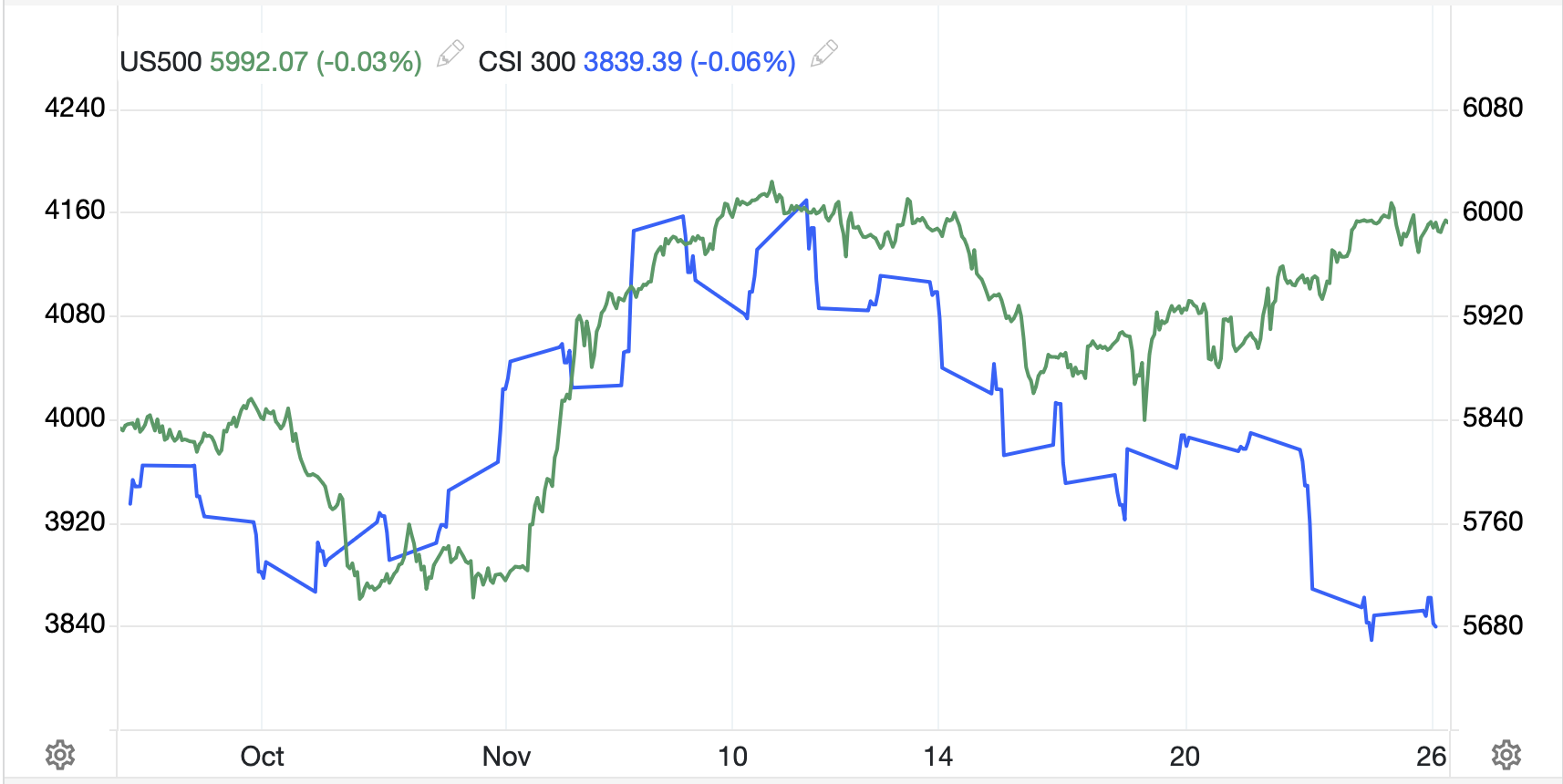
It turns out that core CPI printed a tick higher than expected on the monthly result, although the Y/Y number was right in line with most forecasts.  In the broad scheme of things, it is not clear to me that a 0.1% difference in one month matters all that much, but markets are virtually designed to overreact to ‘surprising’ data.  At least, the algorithms that drive so much trading are designed to do so, or so it seems.  However, as can be seen by the chart below, it was a pretty short-lived dip and then the march higher in equity prices continued.

Source: tradingeconomics.com

While Fed funds futures pricing has adjusted the probability of a 50bp cut next week by the Fed down to just 15%, that market is still pricing in 100bps of cuts by the December meeting which means that there needs to be a 50bp cut in either November or December as they are the only two meetings left after next week.  As @inflation_guy highlighted in his always perceptive writeups on the CPI report, yesterday’s number ought not have changed the Fed’s thinking.  And perhaps that is exactly what we saw from the equity market, the realization that 50bps is still on the table for next week, especially since there is a growing feeling that’s what Powell wants to do.  I’m confident if Powell pushes for 50bps, he will have no trouble gaining quick acceptance around the table.

Ultimately, I think the problem with focusing on CPI is that the Fed doesn’t focus on CPI, even when they are worried about inflation.  However, especially now that they seem to believe they have achieved victory in that part of their mandate, it strikes me that the numbers about which they really care are the employment numbers.  Last week’s NFP report was mixed at best, although the actual NFP data was the weakest part of the report.  This morning, we get the weekly Claims data (exp Initial 230K, Continuing 1850K), but those numbers have been very stable of late, and not pointing to serious difficulties at all.  To my eye, from the perspective of the economic data that we continue to see, there is limited reason for the Fed to cut at all, especially with inflation still well above their target, but Powell promised a cut, and we have seen nothing since his Jackson Hole speech that could have changed view.  

A better question is, are they really going to cut 250bps by the end of 2025?  That would imply, at least to me, that the economy has slowed substantially, and likely headed into recession.  And, if the data turns recessionary, I can assure you that the Fed will have cut far more than 250bps by the end of next year, probably more like 350bps-400bps.  My point is I cannot look at the market pricing of interest rates and make it fit with the economic outlook at this time.  What I can do, however, is feel confident that if the Fed starts to cut rates aggressively with economic activity at current levels (remember, the GDPNow forecast is at 2.5% for Q3), inflation is likely to pick back up more quickly than people anticipate and the dollar, and bond market, will suffer while commodities and gold rise.

In the meantime, in a short while we will hear from Madame Lagarde as she follows up the almost certain 25bp rate cut they will declare today with her press conference.  I would argue the bigger news out of Europe is the ongoing discussion about increasing Eurozone debt issuance, as suggested by Mario (whatever it takes) Draghi in his report I discussed on Monday.  A look at the recent data from the continent shows that Unemployment is currently at historic lows for Europe, although that is still 6.4%, and inflation has fallen to 2.2%, just barely above their 2.0% target.  As such, here too it seems that the data is not screaming out for action.  Now, the punditry is looking for a so-called hawkish cut, one where the commentary does not discuss future cuts as a given, and I think that would be a sensible outcome.  But not dissimilar to the US situation, where a key driver of rate cut desires is the governments who are the biggest borrowers, there is intense political pressure to cut rates and reduce interest expense.  In fact, I believe that is a key reason behind Draghi’s report, to gain support and remove some of that direct interest rate expense from certain countries’ cost structure.  Thinking it through, net this should benefit the euro in the FX market as the Fed seems hell-bent on cutting and the ECB a bit less so.  We shall see,

Ok, so let’s turn to the overnight sessions to see where things are now.  After the US rebounded yesterday afternoon on the back of strength in the tech sector, we saw a huge rally in Tokyo (Nikkei +3.4%) on the same premise.  And while the Hang Seng (+0.8%) had a good session, once again, mainland Chinese shares (CSI 300 -0.4%) did not participate.  In fact, most of Asia was in the green, once again highlighting the weakness in the Chinese market, and the perception of that weakness in the Chinese economy.  As to Europe, it too has seen strength everywhere with gains between 0.8% (FTSE 100, CAC) and 1.20% (DAX).  This story is one of following the US, hopes for a bit more dovishness from the ECB, and a growing story about the potential for bank mergers in Europe with news that Italy’s UniCredit Bank has taken a stake in, and is considering buying, Germany’s Commezbank.  As to the US futures market, at this hour (7:20) they are all very modestly in the green.

In the bond markets, yields continue to back up slowly from the lows seen earlier this week with both Treasury (+2bps) and most European sovereign (Bunds +2bps, Gilts +2bps, OATs +1bp) slightly higher this morning.  Overnight, we saw JGB yields tick up only 1bp despite a relatively hawkish speech from BOJ member Naoki Tamura.  He indicated that rates should be raised to 1.0% by the end of their current forecast cycle, which sounds like a lot until you realize that is the end of 2027!  Maybe the 1bp move is appropriate after all.

In the commodity markets, oil (+1.7%) is continuing yesterday’s rally as questions about how quickly Gulf of Mexico production will restart in the wake of Hurricane Francine are driving markets.  While the weak demand story still has proponents, the reality is that oil prices have fallen more than 12% in the past month, a pretty large decline overall, so a bounce cannot be surprising.  In the metals markets, after a solid session yesterday, metals prices are higher in both the precious and industrial spaces.

Finally, the dollar is doing very little this morning, but if forced to define the move, it would be slightly softer.  While most currencies in both the G10 and EMG blocs are just a touch firmer, between 0.1% and 0.2%, the biggest mover, ironically is a decline, ZAR (-0.4%), although other than short term trading and positioning, there doesn’t seem to be a clear catalyst for the decline.

On the data front, in addition to the Claims data noted above, we see PPI (exp headline 0.1% M/M, 1.8% Y/Y; core 0.2% M/M, 2.5% Y/Y). Of course, there are no Fed speakers, but after the ECB announcement and press conference, we will hear from some ECB speakers as well.  Right now, the dichotomy between what the bond market is expecting (much lower rates anticipating weaker economic activity) and the stock market is expecting (ever higher earnings growth amid economic strength) remains wide.  While there are decent arguments on both sides, my sense is the bond market is more likely correct than the stock market.  And that is probably a dollar negative, at least at first.

Good luck

Adf

If Forecasts Ain’t True

Chair Powell repeated his views
That if Unemployment accrues
The time to cut rates
To meet their mandates
Could very well soon lead the news

Investors have taken this cue
And built up positions, beaucoup,
Designed for a peak
If CPI’s weak
Beware, though, if forecasts ain’t true

It is not clear to me why the punditry is more convinced this morning than they were yesterday morning that Chairman Powell and the Fed are now more focused on the Unemployment situation.  After all, Powell’s opening remarks in front of both the Senate on Tuesday and the House yesterday were identical, and everybody knew going in that would be the case.  But it seems, based on the commentary this morning, that suddenly things that were still blurry before became crystal clear.

Look, it can be no surprise that as the Unemployment Rate rises, the Fed is going to pay attention.  Not only is it part of their mandate, but it is also a touchpoint for politicians as they preen in front of their constituents.  But, in the end nothing has changed since Tuesday’s testimony when Powell highlighted that he and the FOMC were closely watching the evolution of the labor market as well as prices.

At least, nothing has changed on the policy front.  However, the market narrative, as is its wont, has suddenly turned to a far more bullish stance on fixed income in general, and on short-term rates in particular.  It appears that, not for the first time this year, there have been some very large options positions established in the SOFR market looking for a Fed funds rate cut sooner rather than later and a total of three cuts this year.  A quick look at the Fed funds futures market continues to show that the probability of a September cut remains just north of 71% with another cut likely by December.  As such, the fact that somebody is risking $2 million in premium on a third cut implies a great deal of conviction.  A key for this position’s success will be today’s CPI report as a benign outcome will very clearly drive more traders into the camp of more cuts this year.

So, let’s turn our attention to CPI.  Current median expectations are for a 0.1% M/M rise in the headline number, leading to a 3.1% Y/Y outcome and a 0.2% M/M rise in the core number leading to a 3.4% Y/Y outcome.  The broad story is the ongoing analyst belief that shelter costs are set to decline (although they have been incorrectly forecasting that for more than 2 years), along with the continued decline in used car prices and auto insurance, will more than offset any pesky things like food and energy costs rising.  This poet does not have an inflation model to tweak so I can only offer my lived experience, and that remains highly doubtful that prices have stopped rising.  But, the only thing that matters is the numbers, regardless of how we all feel about them, so we will be awaiting, with baited breath, to see if the BLS has determined if the pace of our cost of living has slowed.

As we turn our attention to the rest of the world, apparently everybody believes that to be the case, as risk assets are rising all over.  I cannot find an equity market anywhere that has sold off in the session with the Nikkei (+0.95%) rising to a new all-time high and the Hang Seng (+2.1%) rebounding smartly from yesterday’s levels.  The same is true throughout Asia with Chinese (+1.1%) and Australian (+0.9%) shares also having good days.  In Europe, the gains have been less impressive, on the order of +0.2% to 0.3%, but they are consistent as everybody followed yesterday’s strong US equity performance where all three major indices rose more than 1%.  While US futures this morning are tinged slightly red, the losses are tiny, less than -0.1%.  It seems that everybody is all-in on the idea that the Fed is cutting rates soon.

In the bond market, though, things are slightly different.  While Treasury yields have edged lower by 1bp this morning, all European sovereign yields are moving in the opposite direction, with rises of between 2bps and 3bps.  The inflation data that was released from the continent this morning certainly didn’t demonstrate a rebound, so this seems more akin to a trading response to recent yield declines.

In the commodity markets, oil prices (+0.3%) are continuing their rebound from yesterday after EIA data showed larger inventory draws than expected.  Precious metals markets are also benefitting this morning from the Fed story as the idea of rate cuts generally supports that sector.  The only laggards are industrial metals with both copper and aluminum under a bit of pressure today, but that is after a few solid sessions.

Finally, not surprisingly, the dollar is a touch softer on the idea that US yields may soon be declining.  While the bulk of the movement has been modest, it is fairly consistent with the euro and the pound both higher by 0.15% (the pound benefitting from somewhat stronger than expected GDP data this morning) while most of the rest of the G10 is little changed.  The one exception is NOK (-0.9%) which still seems to be suffering from yesterday’s softer than expected CPI data.  In the EMG bloc, the bulk of the movement has been for stronger currencies with the most notable, in my view, CNY (+0.2%) which has been steadily depreciating but has reversed course on the lower US rate narrative.  I maintain my view that if the Fed is prepping the market for cuts, the dollar has a good distance to fall.

In addition to the CPI data, we see the weekly Initial (exp 236K) and Continuing (1860K) Claims data at 8:30.  The Atlanta Fed’s Raphael Bostic speaks later this morning, but again, after Powell just opened the doors for easier policy based on the employment situation, I don’t foresee this having a big impact.

The risk today is that the CPI data is hotter than expected as everybody is lined up for a soft reading.  If the data is soft, look for the current trends to extend, so higher risk assets and lower yields.  But, if CPI prints higher than expected, there will be a very quick reversal of views, at least for the short run, and I expect we can see a pretty sharp correction, at least for today.

Good luck
Adf

Deep-Rooted

We have now a president, Biden
Who lately, has taken much chidin’
Last night he debated
A man who he hated
Alas, polls against him did widen
 
The market response, though, was muted
With not many trades prosecuted
Instead, we await-a
The PCE data
To learn if inflation’s deep-rooted


While it was painful to watch, I did last through most of the debate.  Unfortunately, it didn’t help me sleep any better!  Clearly the top story around the Western world today is the performance of President Biden and the concerns it raised over his abilities to not merely execute the responsibilities of the President if he is re-elected, but to complete his current term.  There have been numerous calls by high profile Democratic strategists and pundits for him to step down from the ticket.  We shall see what happens, but my personal take is he will not willingly step aside regardless of the situation and that those closest to him will not force him to do so.

The upshot is that in the betting markets, Mr Trump is now a 60% favorite with Mr Biden at 22% and a host of other Democrats making up the difference, at least according to electionbettingodds.com.  Arguably, though, the question that most concerns all of us is how will this outcome impact markets going forward.  And remember, there is a very big election this weekend in France that is also going to have a major impact, not just in France, but in all of Europe.

Perhaps the most surprising thing to me is the non-plussed manner that markets have behaved in the wake of the debate.  Equity markets around the world have traded higher as have US futures.  Bond yields have traded modestly higher and so has oil, metals markets and the dollar.  Clearly, investors do not appear to be concerned that the leader of the free world is in such dire physical condition.  While I would not have expected a collapse, it doesn’t seem hard to foresee a chain of events that results in less positive economic outcomes.  

Or…perhaps the market has absorbed this outcome and determined that central banks, and especially the Fed, are going to be starting to err on the side of easy money to ensure that economies don’t fall into disarray, so all that rate cutting that has been discussed, hypothesized and, frankly, dreamed about may be coming sooner than the hawkish central bankers themselves had considered previously.  I understand that political events typically don’t have a big market response, but the depth and breadth of the damage that last night’s debate had on ideas about President Biden’s mental competence and acuity are stunningly large.  That cannot inspire confidence in investors.  

Of course, of far more importance to the market, obviously, is today’s PCE data release and the corresponding Personal Income and Spending figures.  So, let’s take a look at expectations there.

PCE0.0% (2.6% Y/Y)
Core PCE0.1% (2.6% Y/Y)
Personal Income0.4%
Personal Spending0.3%
Chicago PMI40.0
Michigan Final Sentiment65.8

Source: tradingeconomics.com

Of this grouping of data, the Core PCE reading is the most important as it represents the Fed’s North Star on inflation.  (While we all live in a CPI world, the Fed apparently found out that their models worked better with core PCE and so that became the benchmark.)  At any rate, forecasts are that prices, ex food & energy, did not rise in May.  That was not my lived experience, and I will wager not many of yours either, but we don’t really matter in this context.  However, the Bureau of Economic Analysis, when they are calculating GDP also calculate their own PCE figure for the quarter.  That was released yesterday with the Core PCE printing at 3.7% while GDP was raised to 1.4%.  In total, that implies nominal GDP was at 5.1% in Q1, a slight decline from Q4’s reading of 5.4%.  It should not be surprising that both these PCE measures track one another well, and as per the chart below, that seems to be the case.

Source: tradingeconomics.com

However, I cannot help but look at this chart and see that the blue line (the quarterly BEA data, RHS numbers) is not trending lower at all.  Perhaps it turns around, but perhaps the forecasts for this morning’s numbers are a bit too optimistic.  After all, we saw higher inflation in Canada and Australia this month.  As well, we have seen a continuation in the rise in the price of housing and energy.  None of those are perfect analogs for the PCE data this morning, but I sense that we may have found the lows in inflation.

Ahead of the data, as I discussed briefly above, markets are in fine fettle.  After a modestly positive session in the US yesterday, virtually every market in Asia was in the green as well, with the Nikkei (+0.6%) leading the way and smaller gains, on the order of 0.1% – 0.2% across the rest of the major markets in the region.  In Europe, the CAC (-0.3%) is bucking the trend as investors continue to leave the market ahead of the elections this weekend, but the rest of the bourses are all decently firmer, on the order of 0.35% – 0.55%.  I suppose the reason French investors are concerned is the possibility of a hung Parliament, where no party has a majority and therefore no new legislation will be able to be enacted under a caretaker government for at least a year.  Of course, there are also those who are concerned that a ‘cohabitation’ between President Macron and the RN might have trouble governing as well.  As to US markets, they continue to rally with futures higher across all three major indices this morning, roughly by 0.35%.

In the bond market, yields are higher across the board after they traded up yesterday as well.  This morning, Treasury yields are +2bps while European yields have risen between 3bps (Germany, Netherlands) and 9bps (Spain) with French and Italian yields 6bps higher.  This is the most straightforward explanation as investors demonstrate their concern with a further split between Germany and the rest of Europe regarding fiscal policies.  As to JGB’s they have slipped 2bps lower overnight, despite Tokyo CPI data printing a tick higher than expected at 2.3% headline, 2.1% core.

Oil prices (+0.75%) continue to rally as summer driving demand is now the story of the market despite the large inventory builds seen this week.  In a bit of a conundrum, metals markets are also firmer across the board despite the higher yields, although in the past hour or so, the dollar has reversed some of its earlier gains, so that is giving some support.  However, I suspect that these markets will be subject to a dislocation in the event that we see a surprising PCE report.

Finally, the dollar has edged a bit lower this morning with modest declines vs. the G10 bloc, on the order of 0.1% – 0.2%, and a few outliers vs. EMG currencies like ZAR (+1.4%) and KRW (+0.6%).  The won has benefitted from the upcoming increase in onshore trading hours as the country attempts to increase trading volumes and get more activity and more market participants to help the currency’s international standing.  As to the rand, it appears that the sharp rally today in the Johannesburg stock exchange has drawn in outside investors and supported the currency.

In addition to the data, we hear from both Governor Bowman, again, and SF Fed president Daly this afternoon.  Bowman has already explained, twice, that she would be amenable to raising rates if inflation rebounded, while you may recall Daly exhibited concern over the labor market and what to do if it deteriorates.  Well, labor is a discussion for next week when the NFP report is released.  Today is all about PCE.  My sense is it will be higher than forecast which will probably undermine equities to some extent and keep pressure on bonds while supporting the dollar.  In that situation, I see commodities suffering as well.

Good luck and good weekend

Adf

Just Simply Don’t Care

On Tuesday, six Fed members spoke
And none of them, from the pack, broke
While May’s CPI
Caught everyone’s eye
No ideas of cuts did it stoke
 
But markets just simply don’t care
Instead, all is well, traders swear
Nvidia rose
And at Tuesday’s close
No other firm could quite compare


Another day, another new all-time high for the S&P 500 and the NASDAQ (boy, my call from two weeks ago didn’t age well!).  And so it goes, the Fed imagines it is maintaining tight financial conditions and is trying to rein in spending and price pressures, and equity investors simply buy more NVDA every day.  Yesterday, the chipmaker became the most valuable company in the world, or at least the one with the largest market capitalization, cresting Microsoft and Apple, although all three are now worth about $3.3 trillion each.  I raise the point because it is such a perfect description of market sentiment.  It seems that everyone has placed their hopes (and potentially future wealth) on the back of a single company.  I’m sure it will work out well 😱.

In fact, as the investing community narrows its focus to an ever-smaller number of companies, and news elsewhere appears to show cracks in the façade of a solid economy, I suspect that problems may be coming our way.  For instance, remember Battery Electric Vehicles, and how they were the future?  Not just Tesla, but all these companies like Lucid, Polestar, Nikola, VinFast and Fisker?  Well, every name on this list has either gone bankrupt or is on the edge with Fisker being the latest to file Chapter 11.  The point is that in an environment where liquidity is abundant, or overly so, investment decisions tend to be less well thought out.  While the Fed has certainly tightened policy dramatically and been resolute in its efforts to maintain that tighter policy while inflation still percolates, the federal government’s excessive largesse (the CBO just announced they now expect a budget deficit this fiscal year of $1.9 trillion, up from the $1.5 trillion estimate last quarter) is too much for the Fed to stop.

One other thing to note about Nvidia, and AI in general, is that in China, Ali Baba has reduced the charge for using its AI function and it appears that AI, rather than being a new revenue stream for companies may simply become increased overhead of doing business.  In that world, as margins of the Apples and Microsofts and Googles compress, perhaps there will be more discernment before the next order of Nvidia chips.  There are many imbalances in this market, and it appears most of them are a result of the mania for AI.  When this passes, and it will pass, be prepared for some repricing of risk.

Ok, but back to the other stuff, namely the overwhelming amount of Fedspeak that keeps coming from all these FOMC members.  Yesterday, we actually had seven members speak, NY’s John Williams was not on the calendar ahead of time, and to a (wo)man, they explained that patience remains a virtue.  Happily, Bloomberg News put together the following list of key comments from the entire group:

Despite the modestly softer than expected CPI data last week, and even yesterday’s somewhat softer than expected Retail Sales data, it is hard to look at this grouping of comments and expect a rate cut is coming anytime soon.  Now, the one thing we can never forget is that markets can move incredibly quickly when it comes to readjusting its views on a subject.  In addition, history has shown that when the Fed figures out they are behind the curve and the economy is beginning to slow, they have the ability to cut rates very quickly as well.  But right now, I just don’t see the roadmap for a rate cut before the end of the year.  If this is the case, the one thing that seems most evident is that the dollar will maintain its overall bid.  Despite all the talk that the dollar is losing its reserve status, and that too much debt is going to destroy it, the reality remains there is no viable alternative as a means to store wealth and for governments to store reserves.  I don’t doubt the day will come when a substitute is found, but I do doubt I will be around to see it.

Ok, let’s see how the rest of the world celebrated the new leader in the market cap sweepstakes.  In Asia, the Nikkei (+0.25%) edged higher but the Hang Seng (+2.9%) had a fantastic run as the tech stocks resident there seemed to follow Nvidia.  Not surprisingly, Taiwan and Korea had good days, but elsewhere in the region, there was far more red than green as tech stocks are not the basis of those markets.  As to Europe, it is a mixed picture there but probably more red than green.  UK (+0.15%) stocks have edged higher after the UK inflation report showed that the headline number touched 2.0% for the first time in three years, but it doesn’t appear that will be enough to get the Tories re-elected next month.  However, we have seen most of the continent bleed lower after the European Commission warned a series of nations (including France and Italy) that they needed to address their budget deficits which are far above the 3% “limit” that was embedded in the entire Eurozone project.  Meanwhile, despite the fact that the US equity markets will be closed today for the Juneteenth holiday, futures are trading although they are little changed at this hour (7:45).

It is also a bank holiday here, so there will be no bond trading in the US, but in Europe, yields are a bit higher this morning, between 2bps and 4bps, bucking the trend from yesterday’s Treasury market and seeming to demonstrate a little concern over the ongoing political ructions on the continent.  However, there is one place where yields are having difficulty finding a base, Japan.  Despite all the talk that the BOJ was going to allow yields to rise more aggressively, or that there was no cap at 1.00%, JGBs fell 1bp overnight and have shown no inkling of moving higher in any substantial amount.  With this in mind, look for the yen to remain under pressure.

In the commodity markets, the early part of the month, which saw oil prices slide is just a memory now as once again, WTI (+0.1%) is holding onto its gains from yesterday and is now firmly above $81/bbl.  It appears that demand figures are starting to improve and inventory draws are being seen now.  Watch at the pump.  In the metals markets, after rallies yesterday, the precious set are holding the gains, up just 0.1% each, but copper has rebounded a further 1.5%, again an indication that economic activity seems better than feared.

Finally, the dollar is slightly softer this morning, slipping a touch against most of its G10 and EMG counterparts, but the noteworthy thing is that no currency has moved more than 0.25% in either direction.  In other words, nobody seems to care this morning here.

There is no data and no Fed speakers given the holiday so not only will things slow quickly by 11:00am, it seems a safe bet that movement will be di minimus.  Tomorrow brings a reawakening, but for today, enjoy the sunshine.

Good luck

Adf

In Vogue

The cutting of rates is in vogue
And Madame Lagarde won’t go rogue
She’ll cut twenty-five
And keep hopes alive
That with Chair Jay, she did collogue
 
The stock market clearly believes
That soon they’ll be getting reprieves
In higher for longer
So, markets are stronger
As everyone, rate cuts, conceives


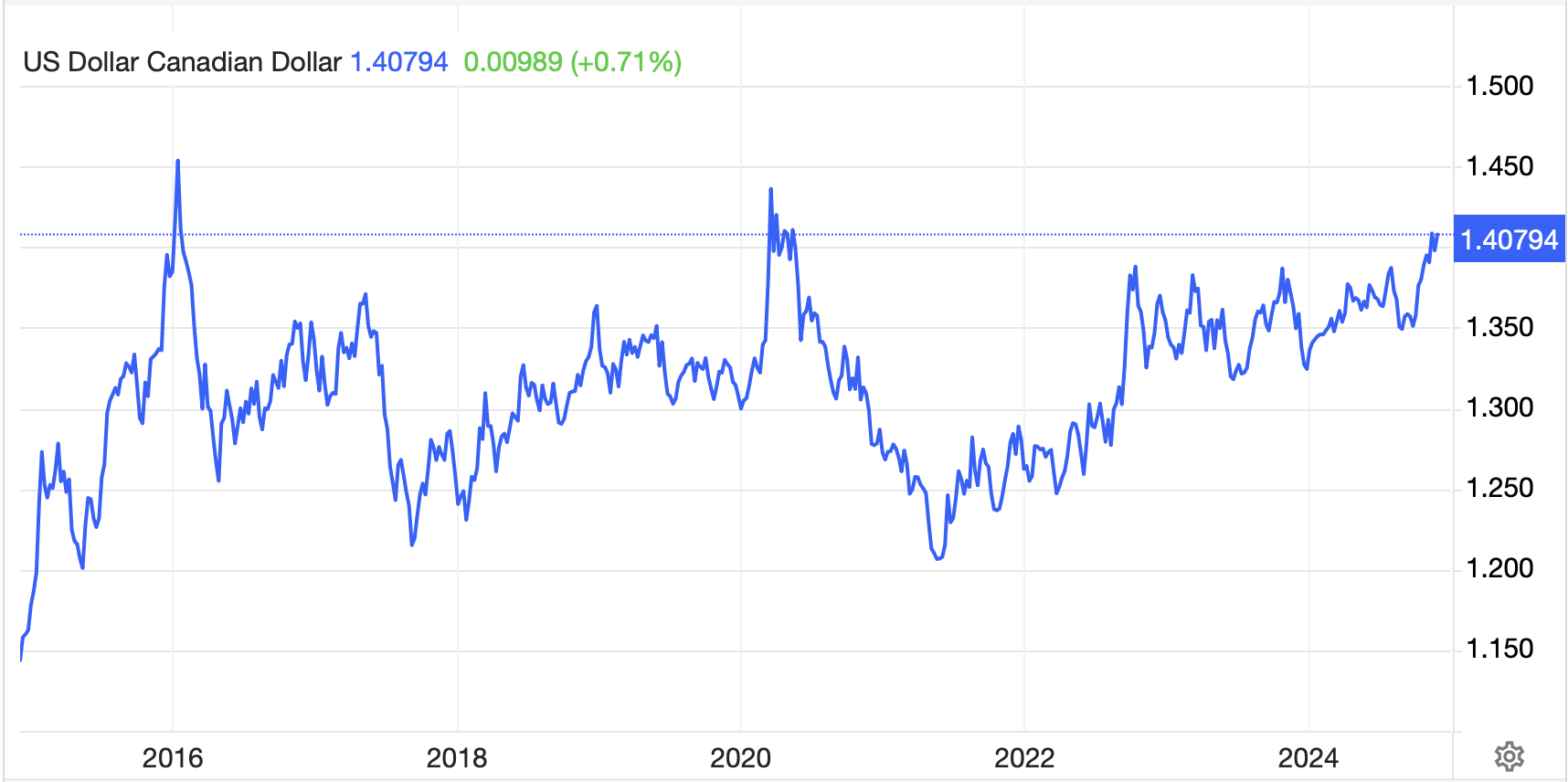
First it was Switzerland in March with a surprise 25bp rate cut.  Then Sweden cut 25bps in early May, although that was more widely touted ahead of the move.  Yesterday, the Bank of Canada joined the fray with a 25bp cut with Governor Tiff Macklem explaining that they are “not close to the limits” of the difference between US and Canadian interest rates and that with both inflation and growth receding, “markets have a very good idea of what’s on our minds” with respect to the value of CAD.  I think the last comment was an indication that they are comfortable if CAD were to weaken further, although after a very short-term dip of about -0.5% yesterday in the wake of the announcement, it is right back to where it was before and unchanged this morning.

With this as background, we turn now to the ECB which has virtually promised us a 25bp rate cut this morning and will almost certainly deliver it.  While many will remember that just last week, Eurozone CPI was released at a higher than expected 2.6% with core CPI also rising, up to 2.8%, at least those numbers have the same big figure as the ECB’s target.  But, as per the CPI chart below from tradingeconomics.com, it is not hard to make the case that the decline in inflation has bottomed above their target.

That could be awkward for their future actions but is also very likely why virtually every ECB speaker has been adamant that a July cut is not a given and they will continue to be data dependent.  Many analysts believe that there will be a total of three cuts this year, June, September and December, as the ECB will roll out their latest forecasts at those meetings, but beyond June, it is a bit less certain.  Market pricing shows that there are about 60bps total priced in at this stage, including today’s cut, as per the chart below.

Source: Reuters.com

Perhaps the most important question is, why do we care?  Well, certainly in the FX markets, given the importance of interest rate differentials, the relative speed of policy rate changes by the ECB and the FOMC can have an impact on the EURUSD exchange rate.  However, absent a surprise, something most central bankers try strenuously to avoid, the movement has already occurred ahead of the announcement.  Arguably, the more important part of this whole charade is the signal it gives for official views of future economic activity.  

When central banks are cutting interest rates, there is obviously concern that prospects for future economic activity to support the government in power are dimmer than they had been previously, hence the need to act.  As such, the very fact that a rate cutting cycle has begun in so many nations is indicative of the fact that expectations for future economic growth are diminishing.  It remains very difficult for me to understand that concept and expect that equity prices should rally substantially on the news.  But clearly, I am very old-fashioned in my thinking as evidenced by the fact that yet again, the S&P 500 and NASDAQ 100 have made new all-time highs on the strength of Nvidia’s non-stop rally.  While the Dow and NASDAQ Composite are still lagging, as are small cap stocks, euphoria remains the theme. (PS, my dour view from last Friday has been damaged, but I remain quite concerned with long-term prospects.)

However, this is where we are today.  The ECB will soon be the fourth major central bank to cut their policy rate and the pressure on the Fed to begin their cutting cycle will increase further.  Alas for the Fed, they continue to receive mixed signals from the data and rate cuts are not necessarily the proper prescription for what ails the US economy.  Just yesterday we received two contradictory signals with the ADP Employment report showing a weaker than expected 152K jobs created after a downwardly revised April number.  A few hours later, the ISM Services indicator was released at a much stronger than expected 53.8 reading, its highest since last August, and certainly not indicating that growth is ebbing.  As well, the Prices Paid subindex was a still hot 58.1, again not screaming out for a rate cut.

As of now, the market is pricing in virtually a zero probability of any rate move next week, but there has been a pickup in chatter about a cut at the July meeting with the probability of a cut then rising to 18.5% as of this morning, according to the Fed funds futures market.  If the Fed were to cut later this summer, nothing has changed my view that it will result in a significant decline in the dollar, and a significant rally in commodities. And, while the first move in both stocks and bonds might be higher, the specter of rising inflation will ultimately squash those moves.  But that is not today’s story, rather it is a story for the future.

Today, after those record highs in the US, we saw strength throughout most of Asia although Mainland Chinese shares did not participate in the fun.  That said, the gains were modest, between 0.25% and 0.5% overall.  In Europe this morning, the screens are all green with gains ranging from 0.3% in the UK to 0.7% in Germany as investors seem to believe in the goldilocks scenario there.  As to the US, futures at this hour (7:00) are unchanged as investors await tomorrow’s NFP data.

In the bond markets, after further declines yesterday, with 10-year Treasury yields touching their lowest level (4.27%) since the end of March, yields have bounced slightly this morning, higher by 2bps.  We are seeing similar price action throughout Europe, yield rallies of 2bps, except for the UK, which has seen a further 2bp decline despite the only data point, Construction PMI, rising the most in 2 years.  One last thing is that JGB yields, the ones that were supposed to be breaking out and running much higher now that the BOJ is leaving them alone, fell 5bps and are at 0.96%, below the 1.00% dotted line in the sand.

Commodity prices are rising this morning, continuing to rebound from the sharp declines earlier in the week, as oil (+0.6%) and NatGas (+0.4%) show there is still demand for energy regardless of the economic situation.  In the metals space, all the big four precious and industrial metals are higher this morning as it appears more and more like the weakness at the beginning of the week was a trading event, not a fundamental one.

Finally, the dollar is little changed overall this morning with the biggest mover being PLN (-0.3%), an indication that there is nothing ongoing.  While some currencies have managed small gains vs. the dollar and others have lagged, my sense is everyone is awaiting tomorrow’s NFP before deciding the next move, given the certitude of the ECB move later today.

We do, however, get some data this morning as follows: Initial Claims (exp 220K), Continuing Claims (1790K), Trade Balance (-$76.1B), Nonfarm Productivity (0.1%), and Unit Labor Costs (4.9%).  While we already know that the growth in the Trade Balance has been the key driver in the decline in the GDPNow figures (net exports are a subtraction from the calculation), I think the Fed may be more focused on the productivity numbers which are hardly inspiring and when combined with rising Labor Costs imply that inflation will have a tough time declining further.

So, the ECB will act first thing and then Madame Lagarde will very likely tell us that they remain data dependent, so nothing is promised for July or anytime the rest of the year.  As to today’s US data, I don’t believe it will be market moving.  This means that the equity bulls will continue to make their case and will need to be strongly disabused of the notion that the world is a great place right now.  When that time comes, beware, but it doesn’t seem likely today.

Good luck

Adf

Losing His Doubt

The jury is no longer out
And Jay may be losing his doubt
That ‘flation is slowing
So, bulls are now crowing
Let’s end, soon, this rate-cutting drought!

I am old enough to remember when Chairman Powell explained that he did not have confidence inflation was falling back to the target level and so maintaining the current, somewhat restrictive, policy stance would be appropriate for longer than had been originally anticipated.  In other words, higher for longer was still the operating thesis.  That is soooo two days ago!  Apparently, when CPI prints at 0.3% M/M for both headline and core with the Y/Y readings at 3.4% and 3.6% respectively, that means the inflation fight is won.  Now, I will grant that the headline monthly number was 0.1% below expectations, but everything else was right on the money.  On the surface, it is not clear to me that this signaled the all-clear for the end of inflation.  As my good friend Mike Ashton (@inflation_guy) said in his write-up yesterday, “the sticky stuff is not yet unstuck.”  But the market saw this news and combined with a clearly weaker than expected Retail Sales print (0.0%) and weaker than expected Empire State Manufacturing print (-15.6) and was off to the races.

So, risk is back in vogue and bond yields are tumbling.  Hooray!  This is the perfect encapsulation of how the actual data may not mean very much per se, but the framework of how investors and traders were positioned and anticipating the data is the key driving force.  So, not only did equity markets in the US rally 1% or more, but Treasury yields fell 10bps in the 10yr and 8bps in the 2yr.  Meanwhile, September is now the odds-on favorite for the first interest rate cut, politics be damned.

At this point, the question becomes will the Fed respond to this small sample of data in the same way the market has?  The first comments from Fed speakers seemed more circumspect than the market opinions.  Chicago Fed president Goolsbee, who was not on the calendar, said the following in an interview, “[inflation showed] some improvement from last time, pretty much what we expected, but still higher than we were running for the second half of last year, so there’s still room for improvement.”  Meanwhile, Minneapolis Fed president Kashkari explained, “The biggest uncertainty in my mind is how much downward pressure is monetary policy putting on the economy? That’s an unknown. And that tells me we probably need to sit here for a while longer until we figure out where underlying inflation is headed before we jump to any conclusions.”

To my eye, there is no indication that the Fed has changed their tune, at least not yet.  If we continue to see data that indicates the long-awaited recession is actually closing in, I expect that we will begin to hear more of a consensus view regarding the initial rate cuts other than the current higher for longer stance.  Of course, if a recession is making an appearance, my sense is that will not be a huge benefit for risk assets either, but what do I know, I’m just a poet. Ok, I don’t think we need to spend any more time on that subject for today so let’s see what is happening elsewhere. 

In Japan, the economic news remains less positive than the Kishida administration would like to see.  Last night, Q1 GDP was released at a worse than expected -0.5%, its second negative print in the past three quarters with Q4 a ‘robust’ 0.0% in between.  While not technically a recession, the situation there certainly does not have a positive feel.  Making things even worse, of course, is the fact that inflation remains higher than their target of 2%, although it has been slowly drifting lower over the past year. 

The interesting thing about this situation is that the BOJ does not have a dual mandate regarding prices and employment; but is focused only on price stability.  However, if economic activity continues to slow there, can Ueda-san really tighten policy further?  And what of the yen?  It has drifted higher (dollar lower) alongside the dollar’s broad down move on the back of the recent decline in US yields.  However, it feels to me like Ueda’s path to tighter policy just got a lot narrower if economic activity in Japan is going to remain so lackluster.  Many pundits have decided that the yen’s weakness reached its peak ahead of the recent bout of intervention two weeks ago.  I am not so sure.  Absent a significant slowdown in the US, I’m sensing that the policy divergence may even widen going forward, not narrow, and the yen would not respond well to that outcome.

With all that in mind, let’s survey the overnight session to see what else is happening.  Asian equity markets followed the US rally with solid gains across the board.  Clearly, the prospect of lower US rates was seen as a positive.  However, the same is not true in Europe, where bourses are all lower this morning albeit not dramatically so.  Declines of between -0.25% and -0.5% are universal.  My take is that this is a bout of profit-taking as to much less fanfare than US markets, many European bourses have just touched all-time high levels, so a little pullback should be no surprise.  This is especially true given there was neither data nor commentary that would indicate something in Europe has changed.  The situation remains slow growth, slowing inflation and rate cuts next month.  Lastly, US futures are essentially unchanged at this hour (6:45) as traders await more data and, perhaps more importantly, 4 more Fed speakers.  I think the trading community is looking for Fed confirmation of their response to the CPI data yesterday which, as mentioned above, was not forthcoming.

Bond markets, which all rallied yesterday following the Treasury move, are little changed this morning with virtually no movement in the US or Europe.  Overnight, JGB yields slipped 3bps in the wake of the US data, but this market is entirely focused on the US economy and the Treasury marker for its lead.

In the commodity markets, oil is a touch softer this morning, but remains firmly toward the middle of its recent trading range as conflicting reports regarding expected demand continue to confuse practitioners.  FWIW any report that indicates demand for oil is going to decrease makes no sense to me given how many people on this earth are energy poor and will do as much as they can to get hold of energy.  But that’s just my view.  The IEA continues to forecast reductions in demand because they are desperately pushing their transition thesis because their models are old and unreliable.  As to metals markets, yesterday saw a major rally in gold and silver, with the latter making a push for $30/oz for the first time since 2013.  Copper, however, may have seen a blow-off top yesterday as it has fallen back sharply from its peak and is now back below $5.00/lb.  In truth, the demand story here remains attractive, but the price action did seem to get out of hand there.

Finally, the dollar, which sold off hard yesterday on the CPI and Retail Sales news is bouncing slightly this morning.  Those sharply lower yields in the US, even though they were matched by Europe, were a signal to sell dollars across the board.  Thus, this morning’s 0.2% ish bounce should not be that surprising.  It is in this segment of the market that I believe the opportunity for the biggest structural changes exist.  After all, the dollar’s strength over the past 3 ½ years has been built on the Fed being the most hawkish central bank around as they belatedly fought inflation.  While they have made clear they want to start to cut interest rates, the data has not been supportive of that move.  If yesterday’s data is the beginning of a more consistent slowdown in the US, those rate cuts may be coming sooner than currently priced and regardless of what happens to risk assets, the dollar would suffer.  We shall see.

On the calendar today we have a bunch more data and four more Fed speakers (Barr, Harker, Mester and Bostic).  The data brings the weekly Initial (exp 220K) and Continuing (1780K) Claims, Housing Starts (1.42M), Building Permits (1.48M) and Philly Fed (8.0) all at 8:30 then IP (0.1%) and Capacity Utilization (78.4%) at 9:15.  As Chairman Powell has repeatedly explained, he and his colleagues look at the totality of the data, so another wave of soft numbers here would likely get risk asset markets excited.  However, listening to what they have all continued to say informs me that the Fed is not nearly ready to cut rates.  September remains the odds-on favorite for the first cut, but I still suspect that they could be here all year long.  If I am right about that, the dollar will retain its bid overall.

Good luck

Adf

Not Harebrained

While here in the States there’s no chance
That rate cuts, by June, will advance
In England, we learned
They’re growing concerned
The ‘conomy’s still in a trance

So yesterday, Bailey explained
By June, a rate cut’s not hairbrained
But, closer to home
The Frisco Fed gnome
Said cutting rates will be restrained

You can tell that very little continues to happen in the macro world when the key stories that are in the discussion regard secondary players and their commentary.  While it is true that Andrew Bailey is the governor of the Bank of England, the reality is that the UK is just a secondary player on the world stage.  However, after their meeting yesterday, much digital ink has been spilled over the potential for the BOE to cut rates at the June meeting.  Prior to this meeting, it seemed that the BOE was tracking the Fed rather than the ECB, but that idea has now been dispelled.  Governor Bailey indicated that come June, a rate cut “is neither ruled out nor a fait accompli.”  However, he did comment that cuts were likely “over the coming quarters” and the market took him up on the news, with yields sliding and stocks rallying.

A key to the discussion is the fact that the BOE will see two more CPI reports between now and the next meeting on June 20th.  As well, both the ECB and the Fed will have met and potentially acted before they next meet.  As such, despite the fact that the BOE’s own forecasts showed improvement in both GDP and CPI over the next 3 years with current policy, the market is all-in on the cuts for June.  Well, maybe not all-in, but has increased the probability to 50%, up from just under one-third prior to the meeting.  Regarding the pound, if we continue to hear more dovish cooing from the Old Lady, especially given the fact that the Fed is clearly on hold, I expect it could drift back toward 1.20 over time.

Which brings us to the Fed, and an unscheduled appearance by San Francisco Fed president, Mary Daly, yesterday afternoon.  The two key comments she made were as follows: “There’s considerable, now, uncertainty about what the next few months of inflation will be and what we should do in response,” and “It’s far too early to declare that the labor market is fragile or faltering.”  In essence, this is repeating everything that we have heard consistently since the FOMC meeting last week.  I would boil it down to ‘as much as we are desperate to cut rates, neither prices nor the labor market are falling quickly enough to allow us to do so soon.’

Add it all up and you get a picture of a still tight Fed with no indication of a policy ease in the next quarter, at least, while another major central bank elsewhere has opened the doors to cutting rates.  Arguably, this should be a positive for the dollar except for the fact that this has been known, and the basic narrative for a while, so is already in the price.  If these policy divergences maintain for a much longer time, through the end of the year or beyond, then perhaps we will see more aggressive dollar strength.  But for now, I think the FX markets are going to be a dull affair.  The caveat here is if we see US data move away from its current trajectory, either picking up and pushing price pressures higher, or falling more rapidly resulting in a worse employment situation.

One last thing on the prospects for the US economy; there is still a large contingent of analysts who have been parsing the data and looking at secondary indicators and sub-indices of headline data, and who believe that a recession is much closer than the market is currently pricing.  Things like credit card delinquencies and the growing number of bankruptcies, as well as the discrepancy between the establishment and household surveys in the employment data have reached levels consistent with recessions in the past.  While last year I expected that would be the case, at this point, I believe that the ongoing massive fiscal spending (budget deficits >6% of GDP) and the ongoing availability of cheap energy continuing to draw investment into the US will prevent any substantive downturn for the rest of the year, at least.

As to market activity, yesterday’s higher than expected Initial Claims data (231K, highest since October) got the bulls all excited and drove a risk rally in stocks in the US which has been followed all around the globe.  Asian markets saw gains in Japan (+0.4%), Hong Kong (+2.3%) and almost everywhere else in the region except China which was flat on the day.  Meanwhile, European bourses are all green as well, led by the UK (+0.7%) on the back of stronger GDP data as well as the hopes for lower rates in the near future.  But the entire continent is higher as well, mostly on the order of 0.5%.  As to US futures, higher by 0.25% at this hour (7:30).

In the bond market, while Treasury yields drifted lower yesterday after that claims data, this morning they are higher by 1 basis point.  In Europe, though, sovereign yields are slipping 2bps to 3bps as traders and investors get more convinced of rate cuts coming soon.  Overnight, JGB markets did nothing.

In the commodity markets, Wednesday’s declines are a distant memory as we have seen oil (+0.7%) rally again this morning despite modest inventory builds which may be being offset by concerns that Israel is ignoring the recent pressure to stop its Rafah incursion.  However, the precious metals are not ignoring that story with both gold and silver higher by more than 1% this morning and copper rising 2.4%.  The day-to-day vagaries of these markets remain confusing, but the long-term trend, I believe, remains strongly intact, and that is higher prices going forward.

Finally, the dollar is little changed this morning but maintaining its gains from earlier in the week.  Looking across my screen, no currency has moved more than 0.3% in either direction, a clear sign that very little of note is happening.  As I wrote above, absent a major change in policy, I think the dollar is range bound for now.

On the data front, this morning brings only Michigan Sentiment (exp 76) and then a few more Fed speeches from Kashkari, Bowman, Goolsbee and Barr.  Regarding the data, I believe it will need to be a big miss in either direction to get much market reaction.  Regarding the Fedspeak, given the consistency with which every speaker has thus far explained they lack the confidence that 2% is in view, I see very little is likely to be newsworthy.

For today, don’t look for much at all.  For the longer term, the dollar’s future depends on how much longer the Fed maintains its relative tightness, and if that spread widens because either the Fed brings hikes back on the table or other central banks cut more aggressively.  But for now, as we enter the summer, I don’t see much at all.

Good luck and good weekend
Adf

Debased

Said Powell, the path is still clear
For cutting three times all this year
Though data’s been hot
We’ve certainly not
Decided no rate cuts are near

This was, of course, warmly embraced
By traders who bought shares post-haste
But do not forget
The very real threat
The dollar will, thus, be debased

Chairman Powell regaled us once again and yesterday he sounded far more like the December Powell than the March Powell.  Notice in his comments that he has essentially dismissed the recent hotter than expected inflation data and instead insists they are on the right road to achieve their goal.  He explained [emphasis added], “The recent data do not…materially change the overall picture, which continues to be one of solid growth, a strong but rebalancing labor market, and inflation moving down to 2% on a sometimes bumpy path.” And maybe he is correct.  Maybe the January and February data points are the outliers, and the rate of inflation is going to reverse back lower.

But he has to know that when he coos like a dove, risk assets are going to rally sharply.  The difference today is that the bond market is beginning to ignore all the Fed talk as we see despite these dovish tones, yields remain at their highest level (4.36%) since November, with no downward movement at all.  In fact, perhaps the real concern that the Fed should have is that gold continues to rise strongly almost every day, trading to $2300/oz and showing no signs of slowing down.

I have been consistent in my view that if the Fed cuts despite the ongoing better than expected data the result would be a sharp decline in the dollar, a sharp decline in bond prices (rise in yields) and a sharp rise in commodity prices.  I have also indicated that, at least initially, I expected equities to rally, but their medium-term outlook was more suspect.  Well, yesterday, that was exactly how the market behaved with metals markets screaming higher, stocks trading well and bonds lacking any bids.

Yesterday’s data showed the ADP Employment number jumping 184K, well above expectations of 148K, but the ISM Services data was a bit soft at 51.4 (exp 52.7) and more importantly, the Prices sub-index fell to 53.4 down 5 points from last month.  That was the set-up for Powell’s comments, and he jumped on board.  It remains abundantly clear that the Fed is desperate to cut rates almost regardless of the economics.  My take is the reason has more to do with the debt situation than the presidential election although there is a third possible explanation as well, a too-strong dollar.

Consider the following: the dollar remains the world’s reserve currency and the currency most widely used in trade and financing activity.  Because of this, a large majority of the world’s total outstanding debt of approximately $350 trillion is denominated in dollars despite the fact that most companies and countries are not USD functional.  The result of this situation is that all those non-USD functional debtors need to buy dollars in order to service and repay that debt.  If you were looking for an underlying reason as to the dollar’s broad strength, this is another candidate in the mix.

As such, it is entirely realistic that Chairman Powell is feeling intense pressure from the international community to cut interest rates to weaken the dollar.  While I don’t expect that a Plaza Accord type agreement is in the offing, it is possible that Powell sees this as an achievable outcome and one that would not result in global chaos.  However, whatever the reason, as we watch commodities rally, while the dollar and bond market sell off, we are watching Fed credibility dissipate.

Ok, let’s peruse the overnight session to see how markets have responded to the dovish version of Powell. While US equities sold off late in the day yesterday, minimizing gains, the same was not true overseas.  Though Chinese markets were closed for the Ching Ming Festival, pretty much everywhere else in Asia saw equity rallies of substance with the Nikkei’s 0.8% rise a good proxy for all.  Meanwhile, in Europe the screens are all green as well, although not quite as impressively, more on the order of 0.25% – 0.5%.  This performance is in accord with Services PMI data that was released this morning showing broadly better than expected outcomes across all the major nations as well as the Eurozone as a whole.  Finally, US futures at this hour (6:45) are firmer across the board by 0.25%.

In the bond market, Treasury investors do not see the benefits of Powell’s dovish turn amid still high inflation.  The ADP data is certainly a concern as all eyes turn toward tomorrow’s NFP report.  In fact, what we are seeing is a bit of a curve steepening (less inversion) with the 10yr-2yr inversion now down to -31bps from its -40bp level that had been steady for the past several weeks.  However, European sovereign yields are all a touch lower this morning, down between 2bps (Germany) and 6bps (Italy) as comments from Robert Holtzmann, Austrian central bank chief and the most hawkish ECB member finally conceded that a cut in June could be appropriate.  Of course, now there is talk of a cut at the end of this month weighing on yields.  Meanwhile, JGB yields crept higher by 1bp, but remain at 0.75%, showing no signs of running away higher.

Oil prices (-0.3%) are consolidating this morning after yet another positive session yesterday with WTI now trading above $85/bbl and Brent crude just below $90/bbl.  OPEC reconfirmed that production would remain at current levels and two nations, Iraq and Kazakhstan have promised to cut back to bring their numbers back in line with quotas.  As well, EIA data showed a build in crude but a much larger draw in gasoline stocks (which is why prices are rising at the pump) adding support to the market.  Gold (-0.1%), too, is consolidating this morning but the trend remains strongly higher.  At the same time, copper (+0.5% today, +5.75% this week) is continuing its rapid rise and is back to levels last touched in January of last year.  It appears the broader growth story remains a driver here, especially with the idea that the Fed may be cutting rates and goosing it further.

Finally, the dollar is under a bit more pressure this morning after Powell’s dovish stance, sliding against most of its counterparts in both the G10 and EMG blocs.  AUD (+0.65%) and SEK (+0.65%) are the leaders in the G10 space with most of the rest of the bloc following higher.  One exception is CHF (-0.4%) which has fallen after CPI there fell to 1.0% Y/Y (0.0% M/M) and encouraged traders to bet on faster rate cuts from the SNB.  The yen (-0.1%) too, is not following suit, which perhaps indicates we are seeing a reversion to the classic risk-on stance (higher stocks and commodities, weaker dollar and havens), at least for today.  In the emerging markets, most currencies are firmer led by (CLP +0.6% on copper strength) and HUF (+0.4%) which is simply demonstrating its higher beta relative to the euro, although there are key currencies that are little changed like MXN, BRL and CNY.

On the data front, this morning brings the weekly Initial (exp 214K) and Continuing (1822K) Claims data as well as the Trade Balance (-$67.3B).  As well we hear from five more Fed speakers (Barkin, Goolsbee, Mester, Musalem, and Kugler) to add to yesterday’s comments.  The question I would ask is, even if some of them sound more hawkish, given what we just heard from Powell, will it matter?  For instance, yesterday, Atlanta’s Raphael Bostic reiterated his stance that one cut was likely all that was necessary this year and nobody heard him speak, effectively.  We would need to hear every one of them vociferously defend the current stance and call for zero cuts to have an impact.  And that ain’t happening!

With Powell showing his dovish feathers, the dollar is going to remain under pressure while asset prices perform.  I think that’s the most likely outcome ahead of tomorrow’s data, where a particularly hot number could change things.  But we will discuss that then.

Good luck
Adf

Cooed Like Doves

Well, Jay and the Fed cooed like doves
And treated the bulls with kid gloves
But under the hood
Was it quite so good?
It’s clear number up’s what he loves!
 
The upshot is stocks really soared
As everyone’s sure Jay’s on board
To cut first in June
And thrice when Cold Moon
Is seen, near the birth of our Lord


Whatever the pundits thought about the hottish inflation readings in January and February, they clearly did not read the room properly, at least not the room in the Eccles Building.  Despite raising their 2024 forecasts for GDP growth (2.1% from 1.4%) and Core PCE (2.6% from 2.4%), as well as maintaining their forecast for the Unemployment Rate to remain quiescent (4.0% to 4.1%), they are hell-bent on cutting rates this year, with June still the most likely starting point.  I created a little table to show, however, that perhaps the consensus is not quite what the headlines would have you believe.

 DecMar
 MedianAvgMedianAvg
20244.6254.7044.6254.809
20253.6253.6123.8753.783
20262.8752.9473.1253.066
Longer Term2.5002.5862.6252.813

Source: Data FRB, calculations @fx_poet

The highlighted points show that while the median for 2024 remained the same, the average was nearly a full cut less.  In fact, if one more member had adjusted their forecast higher, the median would have come out for just 2 cuts this year.  But as I wrote yesterday, perhaps of more importance is the Longer Term view, where not only did the median rise by 12.5bps, but the average is substantially higher, a full 25bps higher than the December views.  

However, the market has ignored this wonkish number crunching and accepted the numbers at face value; three cuts this year and three more next year helping drive equity prices to yet another set of new all-time highs.

Regarding the tapering of the balance sheet, Powell explained at the press conference that they had, indeed, discussed the topic as they were trying to determine the best way to continue the process without any untoward events, but that is not the issue.  The issue is…BUY STONKS!!!

I would estimate that Chairman Powell is pretty happy with the outcome and am certain that Secretary Yellen is very happy with the outcome.  After all, the equity rally continued while bond yields managed to drift lower by a couple of basis points.  But the really happy campers are the holders of gold which rallied more than 1% and traded above $2200/oz for the first time ever.  The market has reviewed this outcome and decided that the biggest risk going forward is a further devaluation of the dollar vs. stuff, although vs. other fiat currencies it is likely to hold its own.  In other words, inflation ain’t dead.  I expect the bond market to determine this is the case over the next several weeks and see yields rising further, especially if the PCE data next week is hot again.

While Jay may have had the most press
In Switzerland, Tom did aggress
He cut twenty-five
In order to drive
Their growth with a bit more largesse


This morning, we have seen three more G10 central banks and the only surprise comes from Switzerland, where soon-to-retire President, Thomas Jordan, cut their base rate by 25bps to 1.50%.  While there were several analysts who had suggested this might be the case (including this poet on Monday), the bulk of the market was in the no change camp.  However, cut they did, and the result was an immediate 1.1% decline in the Swiss franc, arguably a key part of their goal.  In the statement, they explained that inflation had been well within their target range, and they would have the tool of further currency intervention if they felt the franc was weakening too much.

One theory on the surprise cut is that the SNB wanted to get ahead of the pack as they only meet 4 times each year and their next meeting is after the June Fed and ECB meetings.  As well, many pundits are now saying this is the “proof” that the Fed and ECB are going to cut in June.  My take is that while I agree the ECB is a done deal come June, I think the Fed may have a tougher time as there is still no evidence that inflation is heading back to their 2% target.  We have two more CPI and PCE reports before the June meeting, and if the recent price activity continues (and given energy prices remain buoyant I expect they will), it will be very difficult for Chair Powell to explain the need to cut rates unless Unemployment is surging.  Perhaps that will be the case, but right now, the data does not indicate things are collapsing.  The next three months should be quite interesting.

Ok, let’s see how other markets have responded to Powell and the SNB surprise.  Equity markets are in a happy place right now after records fell in the US yesterday.  The Nikkei (+2.0%) also set a new record and the Hang Seng (+1.9%) continued its recent rebound.  In fact, only mainland Chinese stocks couldn’t muster a rally last night, with every other nation in APAC in the green, often by more than 1%.  In Europe, though, the picture is a bit more mixed with more gainers than losers, but still several nations seeing modest pressure on their equity indices.  It should be no surprise that Swiss stock markets are higher, but France and Denmark are suffering somewhat today.  The best performer is the UK (+0.9%) which seems to be benefitting from a solid uptick in its Flash Manufacturing PMI (49.9, exp 47.8).  Lastly, in what should not be a surprise at all, US futures are pointing higher across the board.

In the bond market, all is right with the world this morning as there are bids everywhere with yields declining correspondingly.  Treasury yields slipped another 4bps overnight and throughout Europe, we are seeing declines between 3bps and 5bps with Swiss bonds lower by 7bps.  In fact, Asia is where things were modestly different as JGB’s remain unchanged (tighter policy remains an idea not a reality yet) and Australian yields rose after much stronger than expected employment data was released last night.

In the commodity space, oil (-0.25%) is a touch softer after a decline of more than 1% during yesterday’s session.  With all the focus on the Fed, there was not a lot of news driving things here specifically.  But the real winner in the commodity space is gold (+1.0%) as the market appears to be calling BS on the Fed’s inflation and QT forecasts.  The thing to remember about gold is it is not so much a good hedge for consumer inflation, but it is a very good hedge for monetary inflation (i.e. the excess printing of money).  While those two inflations tend to be correlated, they are not tick for tick, so gold seems to be amiss at times.  But the very idea that despite ongoing inflationary pressures, and the continued supplying of liquidity by the global central banking cast, is the right time to cut interest rates is a step too far for gold markets.  I believe this has room to run higher.  As well, copper (+0.7%) is also rebounding, and I expect that we will see most commodities continue to perform well going forward in this environment.

Finally, the dollar is under some pressure this morning, adding to yesterday’s declines in the wake of the Fed meeting.  Recall, the dollar had rallied the first half of the week as the punditry was looking for the Fed to seem more hawkish.  But that was not to be and this morning it is broadly, though not universally lower.  AUD (+0.3%) and JPY (+0.2%) are the biggest gainers in the G10 while CHF (-0.65%) is the laggard after the rate cut, although has rebounded from its worst levels.  In the EMG space, PHP (+0.4%), MYR (+0.5%) and IDR (+0.4%) are the leading gainers although we are seeing weakness in EEMEA with ZAR (-0.3%) and CZK (-0.3%) lagging.  

On the data front, as it is Thursday, we see Initial (exp 215K) and Continuing (1815K) Claims as well as the Current Account deficit (-$209B) and Philly Fed (-2.3) all at 8:30.  Then as the morning progresses, we see the Flash PMI data (51.7 Manufacturing, 52.0 Services), Existing Home Sales (3.94M) and Leading Indicators (-0.2%).  As well, we get our first Fed speaker post the meeting, vice-chairman for regulation Michael Barr, this afternoon, but given my assessment that the Fed is happy with the market response, I don’t imagine he will say anything new.

Overall, the bulls and doves are walking hand in hand (what a terrible metaphor, sorry) and that means that risk assets are likely to continue to perform well for now and the dollar seems likely to come under a bit more pressure.  I maintain that the bond market is going to figure out the inflation story is not great and react, but that is not today’s story.

Good luck

Adf

Not Fading Away

The first thing to mention today
Inflation’s not fading away
Instead, CPI
Was one again high
Though risk assets still made some hay

This raises the question again
Of if the Fed will, not of when,
Begin cutting rates
And foster debates
If Powell’s in charge…or Yel-len

Well, the CPI data was hotter than forecast with both headline and core printing at 0.4% and the Y/Y numbers both coming a tick higher than forecast at 3.2% and 3.8% respectively.  While serious analysts are revisiting their thoughts on whether the Fed is anywhere near a position to consider cutting rates, as I predicted yesterday, the Fed Whisperer, Nick Timiraos of the WSJ, was out before noon (at 11:25am to be precise) with his article explaining that the hot CPI print didn’t matter, and the Fed would still be cutting rates come June.

And maybe that is all we need to know.  As the working assumption is he is speaking directly to Chairman Powell, and that was the message he was instructed to convey, then maybe they will be cutting rates then.  But to take the doves’ favorite metric from December, the 3-month running average on an annualized basis, it is now running at 4.3%.  That feels a touch high for the Fed to consider cutting, but in fairness, we are still three months away from that June meeting so many things could change in the interim.

As it happens, the equity markets didn’t wait for the WSJ article to decide that rate cuts are still coming on schedule, as the futures rallied instantly, and stocks were higher all day.  At this point, it is very difficult to see what will derail the current rally as clearly there is no fear of the current rate structure remaining in place.  While trees don’t grow to the sky, apparently, they can get pretty tall!  It is a fool’s errand to try to determine the top ahead of time, and I believe the market, and the economy as a whole, needs to find a non-speculative clearing price (i.e. retreat sharply), but it doesn’t seem like that is a near-term scenario.  In other words, I guess it’s ‘party on!’

The first hints of Spring
Have seen wages in full bloom
Is ZIRP on its way?

Turning to Japan and the Spring wage negotiations there, headlines out of Tokyo this morning show that wages are going to be substantially higher in 2024 than they were in 2023.  Key results that have been announced include Nippon Steel, Nissan, Panasonic, and Toyota, which said its wages would be rising the most in 25 years.  These wage hikes are seen as a precondition for the BOJ to exit NIRP, although it is not clear if it is a sufficient condition.  While the politicians are crowing as higher wages are obviously welcome to the people there, the market is hardly behaving as though these numbers are going to do the job.  For instance, the yen (-0.2%) is a touch softer this morning, 10-year JGB yields didn’t budge while 2-year JGB’s saw yields tick down a bit, and Japanese stocks barely edged lower, down about -0.3%.  My point is the market behavior is not necessarily consistent with the view that Japanese rates are about to move.   The totality of the wage negotiations will be published on Friday, so perhaps that will offer more clarity.

However, at least with respect to USDJPY, given what we just learned about US inflation and the prospects for US rate cuts (which are diminishing in my view), that 10bp rate hike by the BOJ does not feel like it will be sufficient to cause a major adjustment.  We will need to hear Ueda-san explain that any move is the beginning of a new cycle, and rates are heading higher, full stop.  And I don’t see that happening.

And those are really the key stories for the morning, risk is still on, and Japan appears to be edging closer to exiting their negative rate policy.  So, let’s see how markets have behaved overall.

Despite the US rally, there were many more laggards than gainers in the Asia session with China, Hong Kong and India all seeing equity markets under pressure.  As well, the gainers showed only very modest gains (Australia +0.2%, South Korea +0.3%) so generally it was a negative session.  However, in Europe this morning, the screens are green with a mix of very marginal gains (UK, Germany) and strong performances (CAC +0.5%, IBEX +1.5%) with the Spanish and Italian markets making new multi-year highs.  As to US futures, at this hour (7:45) they are very slightly firmer, 0.15%.

The bond market did respond as one would expect on the back of the CPI data, with Treasury yields rising 6bps yesterday.  As well, there was a 10-year Auction which was a bit sloppy with a 0.9bp tail and settlement price of 4.166%.  European yields rose in the wake of Treasuries yesterday but are essentially unchanged this morning, as are Treasury yields.  As long as the inflation story remains on the hot side, it is difficult to see yields declining from these levels.

In the commodity markets, the one thing that really reacted to the CPI data was gold, which fell 1.1% yesterday, although given the recent remarkable run higher, it can be no surprise there was some profit-taking.  And this morning, it has bounced 0.25% so far.  As to oil (+1.6%) it is rallying this morning but that is simply offsetting yesterday’s declines and it remains in the middle of that $75-$80 range.  A quick word about copper (+2.0%) which has traded above $4.00/Lb for the first time in almost a year and looks to be making a strong move higher.  Whether that is on growing economic optimism in China or elsewhere is not clear, but that is the price action.

Finally, the dollar is surprisingly little changed overall.  In the immediate wake of the CPI print yesterday, it did rally nicely, but it has since ceded those gains and is largely unchanged from then.  In fact, net from yesterday’s closing levels, it is softer by about 0.2% against almost all its major counterpart currencies.  I am quite surprised at this price action as I would have expected the dollar to benefit, but not much as of yet.

The only data released today is the EIA oil and product inventories for the week, something which will impact the oil market but not much else.  When looking at the totality of the data, there is no indication to me that inflation is going to be declining soon.  It is very hard for me to look at what is happening and conclude that the Fed is compelled to cut interest rates to prevent a problem.  Until we see a more substantial decline in economic activity, I have to believe that they will stand pat, regardless of the politics.  If they don’t, I would expect the dollar will fall sharply as inflation reignites in the US.  And that doesn’t seem like the conditions they want if they truly want to prevent a change in the White House come November.

For today, and likely through the FOMC meeting in one week’s time, I suspect risk assets will perform well.  But it also feels like more risks are building that can have a negative result.

Good luck
Adf