Cold Growth

Winter approaches
Both cold weather and cold growth
Plague Japan’s future


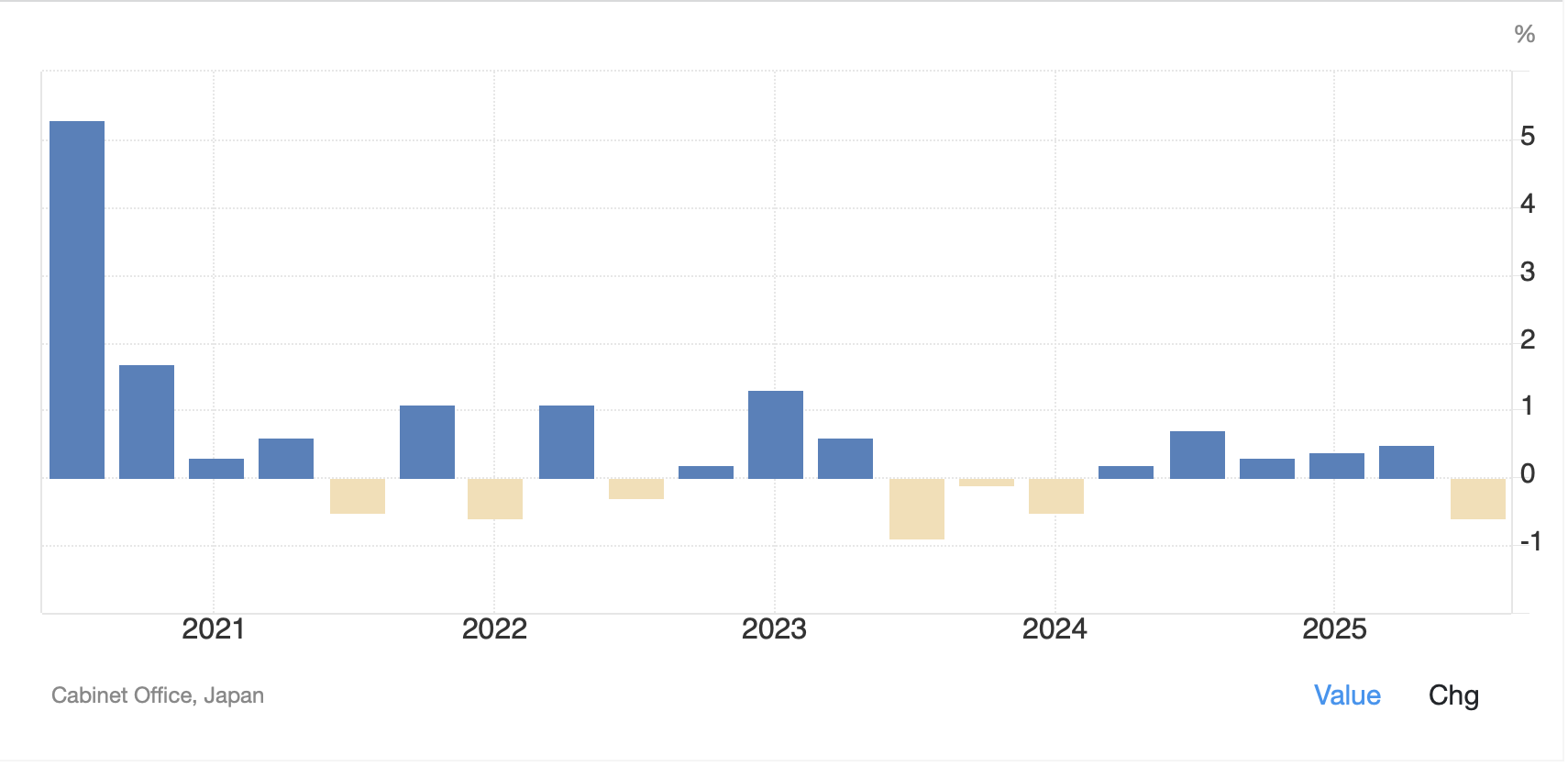
It’s not a pretty picture, that’s for sure.  A raft of Japanese data was released early Sunday evening with GDP revised lower (-0.6% Q/Q, -2.6% Y/Y) and as you can see from the Q/Q chart below, it is hard to get excited about prospects there.
Source: tradingeconomics.com

Of course, this is what makes it so difficult to estimate how Ueda-san will act in a little less than two weeks’ time.  On the one hand, inflation remains a problem, currently running at 3.0% and showing no signs of declining.  Recall, the BOJ has a firm 2.0% target, so they are way off base here.  Add to that the fact that inflation in Japan had been virtually zero for the prior 15 years and the population is starting to get antsy.  However, if growth is retreating, how can Ueda-san justify raising rates?

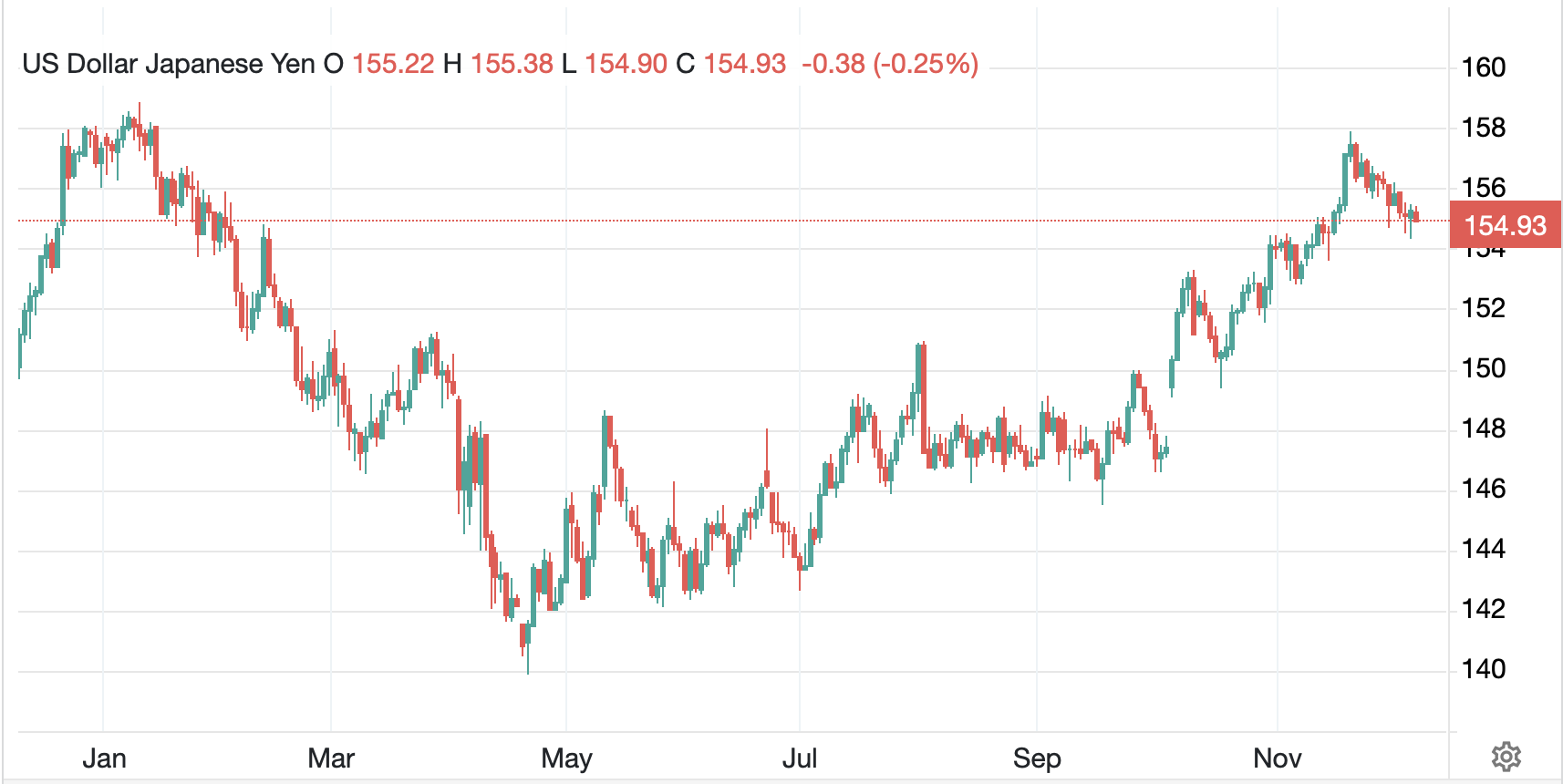
In the meantime, the punditry is having a field day discussing the yen and its broad weakness, although for the past three weeks, it has rebounded some 2% in a steady manner as per the below chart,
Source: tradingeconomics.com

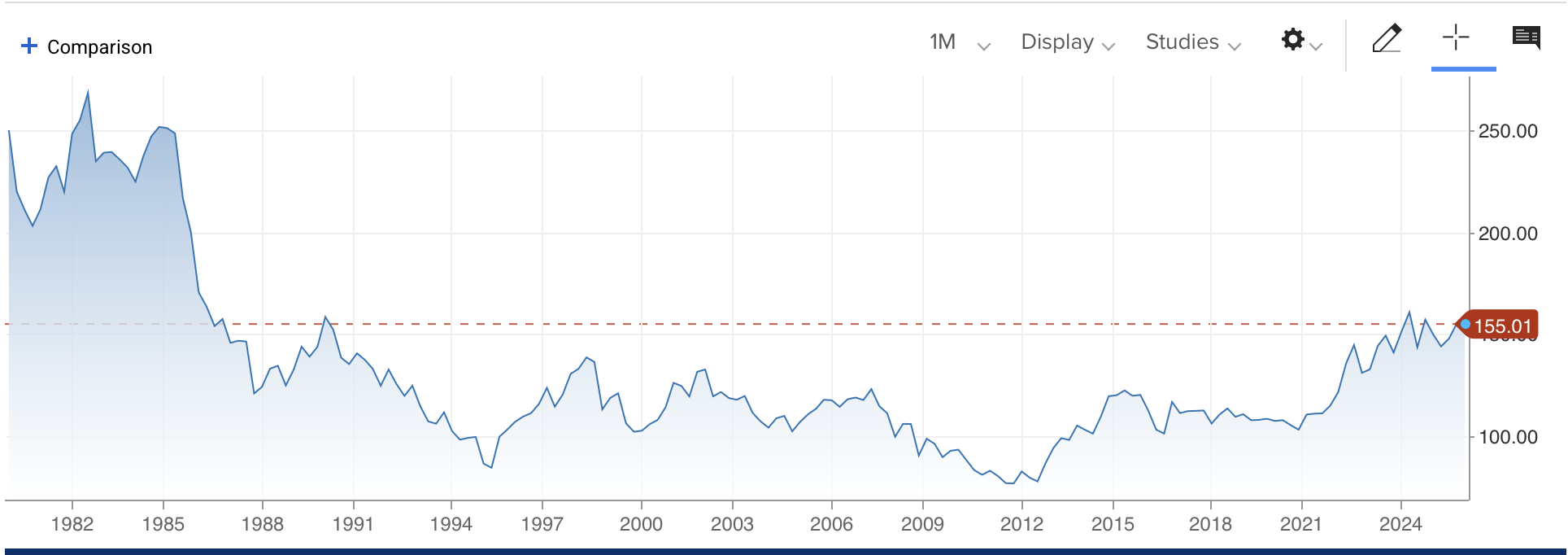
As well, much digital ink has been spilled regarding the 30-year JGB yield which has traded to historic highs as per the below chart from cnbc.com.

There are many pundits who have the view that the Japanese situation is getting out of control.  They cite the massive public debt (240% of GDP), the fact that the BOJ holds 50% of the JGB market, the fact that the yen has declined to its lowest level (highest dollar value) since a brief spike in 1990 and before that since 1986 when it was falling in the wake of the Plaza Accord.
Source: cnbc.com

Add in weakening economic growth and growing tensions with China and you have the makings of a crisis, right?  But ask yourself this, what if this isn’t a crisis, but part of a plan.  Remember, the carry trade remains extant and is unlikely to disappear just because the BOJ raises rates to 0.75% in two weeks.  This means that Japanese investors are still enamored of US assets, notably Treasuries, but also stocks and real estate, as a weakening yen flatters their holdings.  Too, it helps Japanese companies compete more effectively with Chinese competitors who benefit from a too weak renminbi as part of China’s mercantilist model.  Michael Nicoletos, one of the many very smart Substack writers, wrote a very interesting piece on this subject, and I think it is well worth a read.  In the end, none of us know exactly what’s happening but it is not hard to accept that some portion of this theory is correct as well.  The one thing of which I am confident is the end is not nigh.  There is still a long time before things really become problematic.

And the yen?  In the medium term I still think it weakens further, but if the Fed gets very aggressive cutting rates, that will likely result in a short-term rally.  But much lower than USDJPY at 145-150 is hard for me to foresee.

Turning to the other noteworthy news of the evening, the Chinese trade surplus has risen above $1 trillion so far in 2025, with one month left to go in the year.  This is a new record and highlights the fact that despite much talk about the Chinese focusing more on domestic consumption, their entire economic model is mercantilist and so they continue to double down on this feature.  While Chinese exports to the US fell by 29% in November, and about 19% year-to-date, they are still $426 billion.  However, China’s exports to the rest of the world have grown dramatically as follows: Africa 26%, Southeast Asia 14% and Latin America 7.1%.  Too, French president Emanuel Macron just returned from a trip to Beijing, meeting with President Xi, and called out the Chinese for their export policies, indicating that Europe needed to take actions (raise tariffs or restrict access) before European manufacturing completely disappears.  (And you thought only President Trump would suggest such things!)

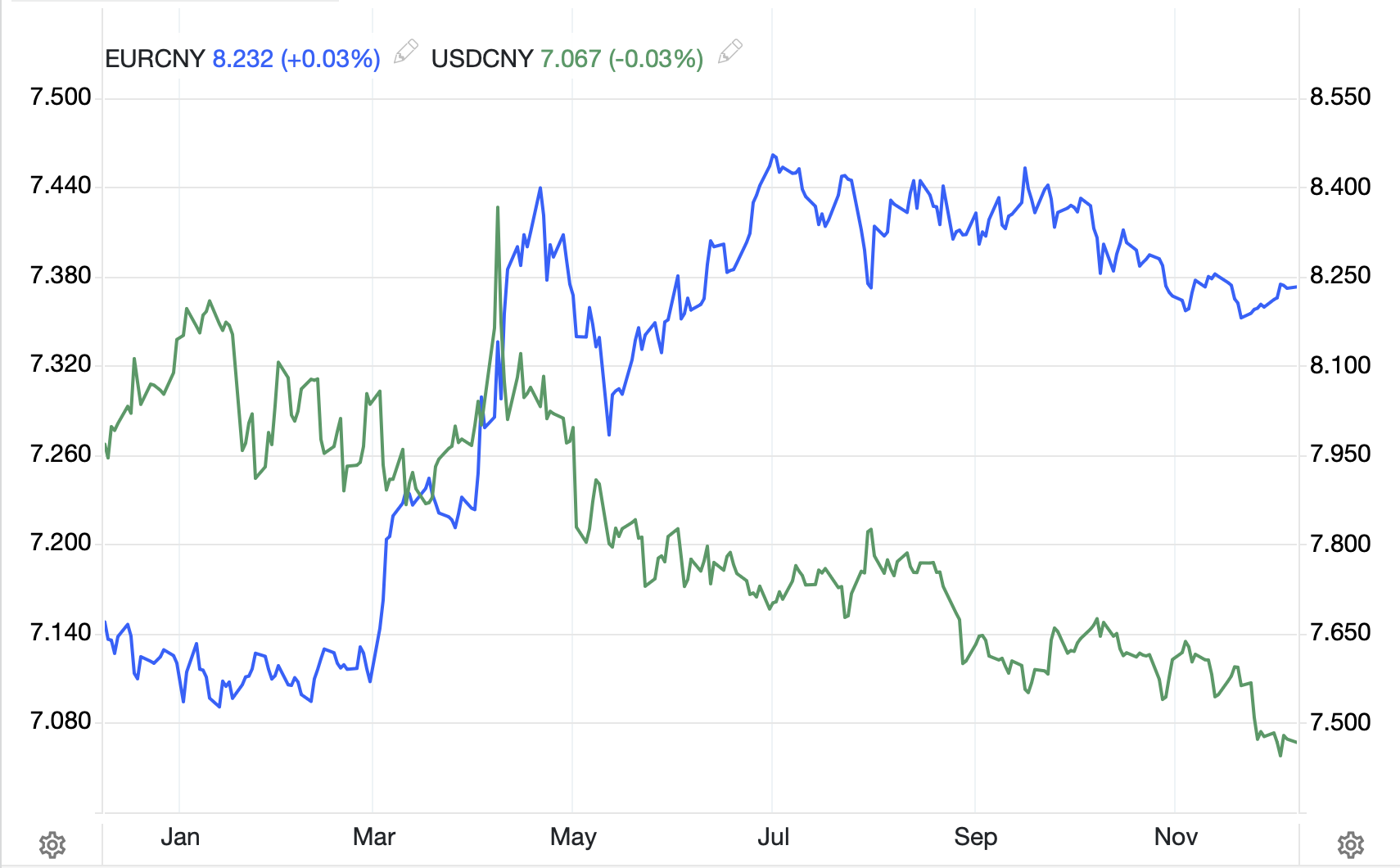
So, how did markets respond to this?  Well, the CSI 300 rose 0.8% (although HK fell -1.2%) and the renminbi was unchanged.  But I think it is worth looking at the renminbi’s performance vs. other currencies, notably the euro, to understand Monsieur Macron’s concerns.
Source: tradingeconomics.com

It turns out that the CNY has weakened by nearly 7.5% vs. the euro this year, a key driver of the growing Chinese trade surplus with Europe (and now you better understand the Japanese comfort with a weaker JPY).  My observation is that the pressure on Chinese exports is going to continue to grow going forward, especially from the other G10 nations.  Expect to hear more about this through 2026.  It is also why I see the eventual split of a USD/CNY world.

Ok, let’s look around elsewhere to see what happened overnight.  Elsewhere in Asia, things were mixed with Tokyo (+0.2%) up small, Korea (+1.3%) having a solid session along with Taiwan (+1.2%) although India (-0.7%) went the other way.  As to the smaller, regional exchanges, they were mixed with small gains and losses.  In Europe, it is hard to get excited this morning with minimal movement, less than +/- 0.2% across the board.  And at this hour (7:25) US futures are little changed.

In the bond market, yields are continuing to rise around the world.  Treasury yields (+2bps) are actually lagging as Europe (+4bps to +6bps on the continent and the UK) and Japan (+3bps) are all on the way up this morning.  This is Fed week, so perhaps that is part of the story, although the cut is baked in (90% probability).  Perhaps this is a global investor revolt at the fact that there is exactly zero evidence that any government is going to do anything other than spend as much money as they can to ensure that GDP continues to grow.  QE will be making another appearance sooner rather than later, in my view, and on a worldwide basis.

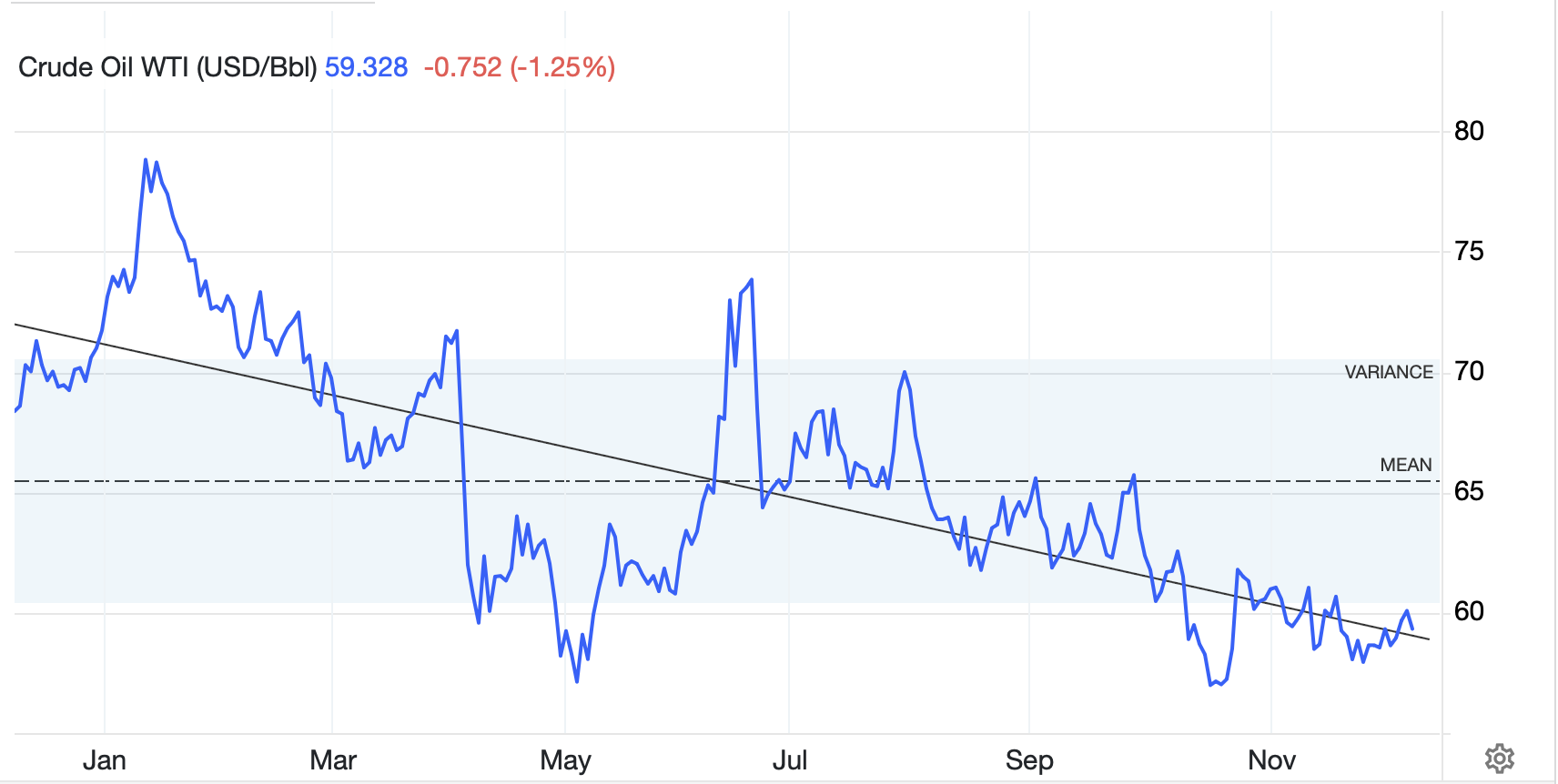
When we see that, commodity prices seem likely to rise even further, at least metals prices will and this morning that is true across the precious metals space (Au +0.3%, Ag +0.3%, Pt +1.2%) although copper is unchanged on the day.  Oil (-1.2%) though is not feeling the love this morning despite growing concerns of a US invasion of Venezuela, ongoing Ukrainian strikes against Russian oil infrastructure and the prospects of central bank rate cuts to stimulate economic activity.  One thing to note in the oil market is that China has been a major buyer lately, filling its own SPR to the brim, so buying far more than they consume.  If that facility is full, then perhaps a key supporter of prices is gone.  I maintain my view that there is plenty of oil around and prices will continue to trend lower as they have been all year as per the below chart.
Source: tradingeconomics.com

Finally, nobody really cares about the FX markets this morning with the DXY exactly unchanged and all major markets, other than KRW (+0.5%) within 0.2% of Friday’s closing levels.  There is a lot of central bank activity upcoming, and I suppose traders are waiting for any sense that things may change.  It is worth noting that a second ECB member, traditional hawk Olli Rehn, was out this morning discussing the potential need for lower rates as Eurozone growth slows further and he becomes less concerned about inflation.  Expect to hear more ECB members say the same thing going forward.

On the data front, things are still messed up from the government shutdown, but here we go:

TuesdayRBA Rate Decision3.6% (unchanged)
 NFIB Small Biz Optimism98.4
 JOLTS Job Openings (Sept)7.2M
WednesdayEmployment Cost Index (Q3)0.9%
 Bank of Canada Rate Decision2.25% (unchanged)
 FOMC Rate Decision3.75% (-25bps)
ThursdayTrade Balance (Sept)-$61.5B
 Initial Claims221K
 Continuing Claims1943K

Source: tradingeconomics.com

There is still a tremendous amount of data that has not been compiled and released and has no date yet to do so.  Of course, once the FOMC meeting is done on Wednesday, we will start to hear from Fed speakers again, and Friday there are three scheduled (Paulson, Hammack and Goolsbee).

As we start a new week, I expect things will be relatively quiet until the Fed on Wednesday and then, if necessary, a new narrative will be created.  Remember, the continuing resolution only goes until late January, so we will need to see some movement by Congress if we are not going to have that crop up again.  In the meantime, there is lots of talk of a Santa rally in stocks and if I am right and ‘run it hot’ is the process going forward, that has legs.  It should help the dollar too.

Good luck

Adf

We All Will Be Fucted

The Fed PhD’s have constructed
Their models, from which they’ve deducted
The future will be
Like post-GFC
In which case, we all will be fucted
 
Instead, perhaps what’s really needed
And for which Steve Miran has pleaded
Is changing impressions
In future Fed sessions
Accepting the past has receded


While we all know that things change over time, human nature tends to drive most of us, when facing a new situation, to call on our experience and analogize the new situation to what we have experienced in the past.  But sometimes, the differences are so great that there are no viable analogies.  For the past several years I have made the point in this commentary that the Fed’s models are broken.  Consider, as an example, how wrong they were regarding the alleged transitory nature of inflation in 2022 which led to policy adjustments that not only were far too late to address the issue, but in reality, only had a marginal impact anyway.

On a different, and topical subject, consider the issue with tariffs.  Economists explained that the imposition of tariffs would be devastating to the US consumer, raise prices dramatically and strengthen the dollar as FX markets adjusted to reflect the new trade policy.  But none of that happened, at least not yet.  In fact, the dollar continued to fall in the wake of the Liberation Day tariff announcements, while CPI since then has, granted, edged higher, but remains in its recent range for now and well below the 2022 levels (see below chart from tradingeconomics.com).

And a more important question regarding inflation is, have the tariffs been the driver, or has it been other parts of the price index, housing and core services for instance, that have been the key issue, neither of which would be directly impacted by tariffs.

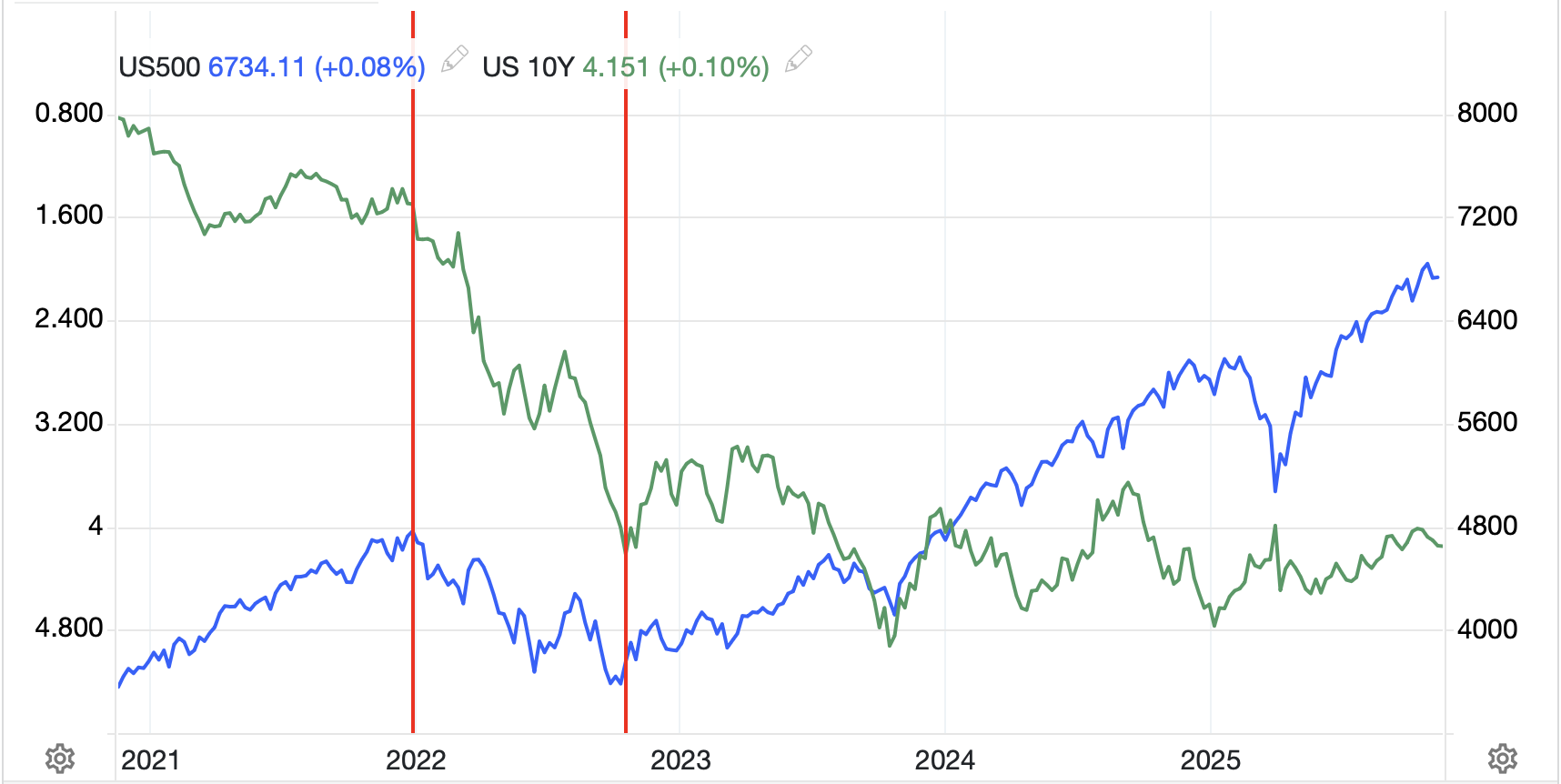
All of this is to highlight the fact that the world has changed and that the evidence of the past several years, at least, is that the Fed’s econometric models are no longer fit for purpose.  I raise this issue because a look at so many previous market relationships show that many are breaking down.  We have seen gold rise alongside rising real interest rates and the dollar rise alongside gold, two things that are 180o from previous history.  Too, think back to 2022 when both stocks and bonds fell sharply at the same time, breaking the decades-long history of bonds behaving in a manner to offset declines in equity markets.

Source: tradingeconomics.com

This contemplation was brought on by a tweet which led me to a very interesting article (just a 5 minute read) by DL Jacobs of the Platypus Affiliated Society, regarding Fed Governor Miran and his recognition that the world has changed and that the Fed needs to change too.  Here is the second paragraph, and I think it explains the issue beautifully [emphasis added]:

He [Miran] used the moment to challenge the foundations of United States monetary policy. “I think it’s important to take these models seriously, not literally,” he said. He warned that models do not take into account the scale and speed of policy changes in light of the Trump administration’s re-election. The problem with the Fed isn’t wrong technique or bad data, he suggested, but rather that the very structure of its models is embedded in the economic and political assumptions of a bygone era. The world the forecasts are trying to measure no longer exists.

(At this point, I have to explain that the Platypus Society is a left-wing organization trying to explain why Marxism failed and recreate it, but that doesn’t make this article any less worthwhile.  I believe they see it as a step in the destruction of capitalism, which appears to be their goal.)

To me, this is just another point indicating that we’re not in Kansas anymore.  Policies need to change, and the Trump administration is working hard to do so.  One of the key points Miran makes is that the Fed and Treasury ought to be considered as a single entity, with the idea of Fed independence an anachronism from a bygone age.  The upshot is the Trump administration is going to continue to run things hot, or as macro analyst Lynn Alden has been saying, “Nothing stops this train”.  

This means that the Fed is going to run relatively easy monetary policy while the government, via the Treasury, is going to ensure there is ample liquidity available for everything, real economic activity and market activity.  The downside of these policies, alas, is that the idea inflation is going to decline in any meaningful way is simply wrong. It’s not.  Keep this in mind as we go forward.

As it happens, there was very little news of note overnight, at least market news, so let’s see how things behaved.  Friday’s mixed session in the US was followed by Chinese weakness with HK (-0.7%) and China (-0.7%) both under pressure.  Tokyo (-0.1%) was not nearly as impacted and the regional exchanges were actually broadly higher (Korea, India, Taiwan, Indonesia, Thailand).  The big news in Asia is the increasing verbal jousting by China and Japan at each other after PM Takaichi said, out loud, that if China attacked Taiwan, it would impact Japan.  Given the proximity, that is, of course, true, but apparently it was a taboo item in the diplomatic dance in the past.  I don’t see this having a long-term impact on anything.

In Europe, though, bourses are lower this morning led by Spain (-0.8%) although weakness is widespread (Germany -0.5%, France -0.4%. UK -0.1%).  There has been no data of note to drive this movement and it seems as though we are seeing the beginning of some longer-term profit taking after strong YTD gains by most bourses on the continent.  US futures at this hour (6:45) are pointing a bit higher, 0.43% or so.

In the bond market, Treasury yields have slipped -3bps this morning despite (because of?) the market pricing a December rate cut as a virtual coin toss.  This is a huge change over the past month as can be seen at the bottom of the chart below from cmegroup.com

Recent Fedspeak has highlighted the Fed’s uncertainty, especially absent data, and the belief that waiting is a better choice than acting incorrectly (what if waiting is the incorrect move?).  At any rate, we are going to be inundated with both Fedspeak (14 speeches this week!) as well as the beginnings of the delayed data so there will be lots of headlines.  Right now, I think it is fair to say that nobody is confident in the current direction of travel in the economy.  But perhaps, a more hawkish tone at the front of the curve has investors believing that inflation will, once again, become the Fed’s focus.  Alas, I don’t think so.  Looking elsewhere, European sovereign yields have followed Treasury yields lower, slipping between -2bps and -3bps this morning.  Perhaps more interesting is Japan, where JGB yields (+3bps) have risen to a new 17-year high as a prominent LDP member put forth a massive new spending bill to be passed.

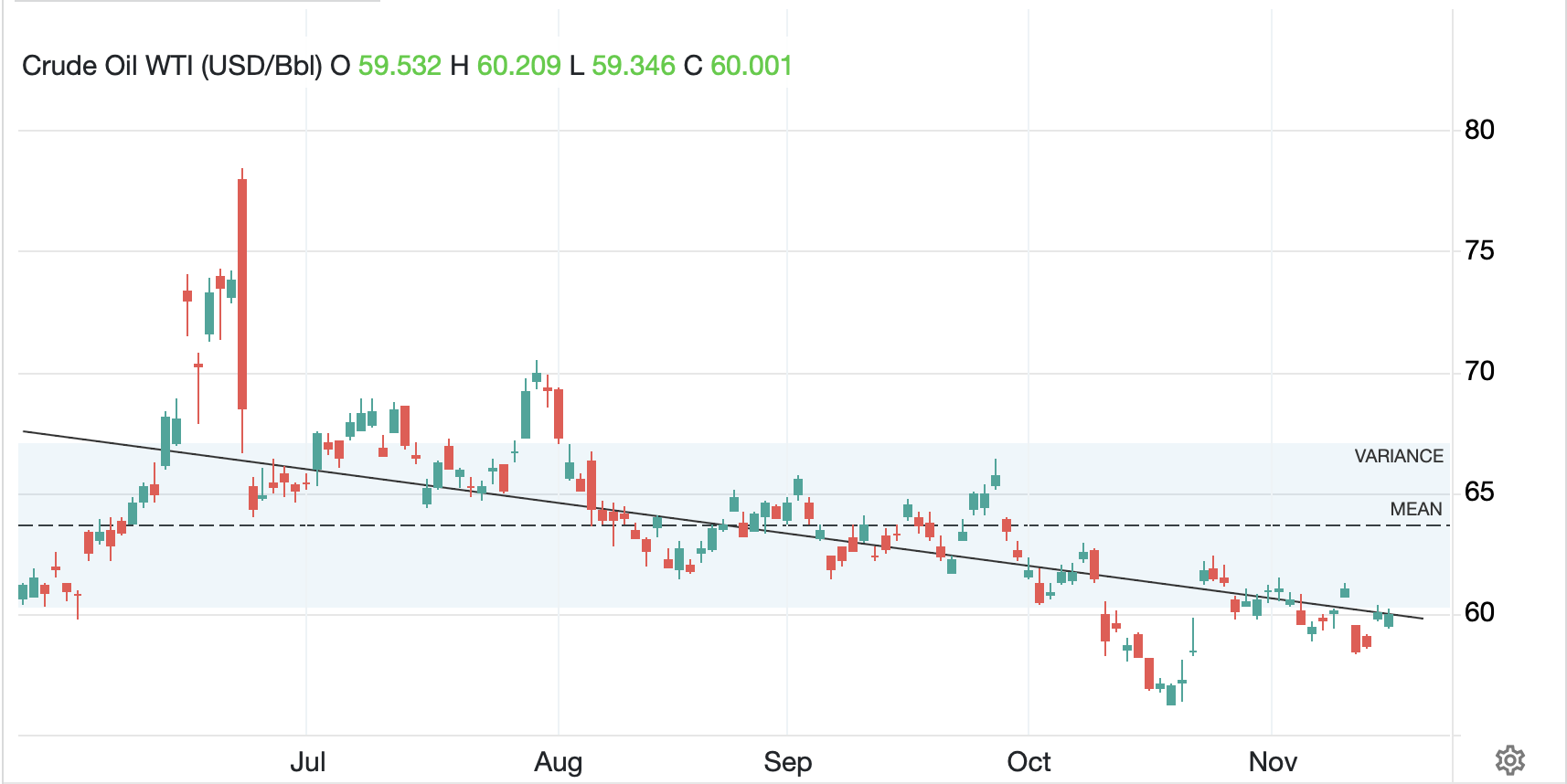
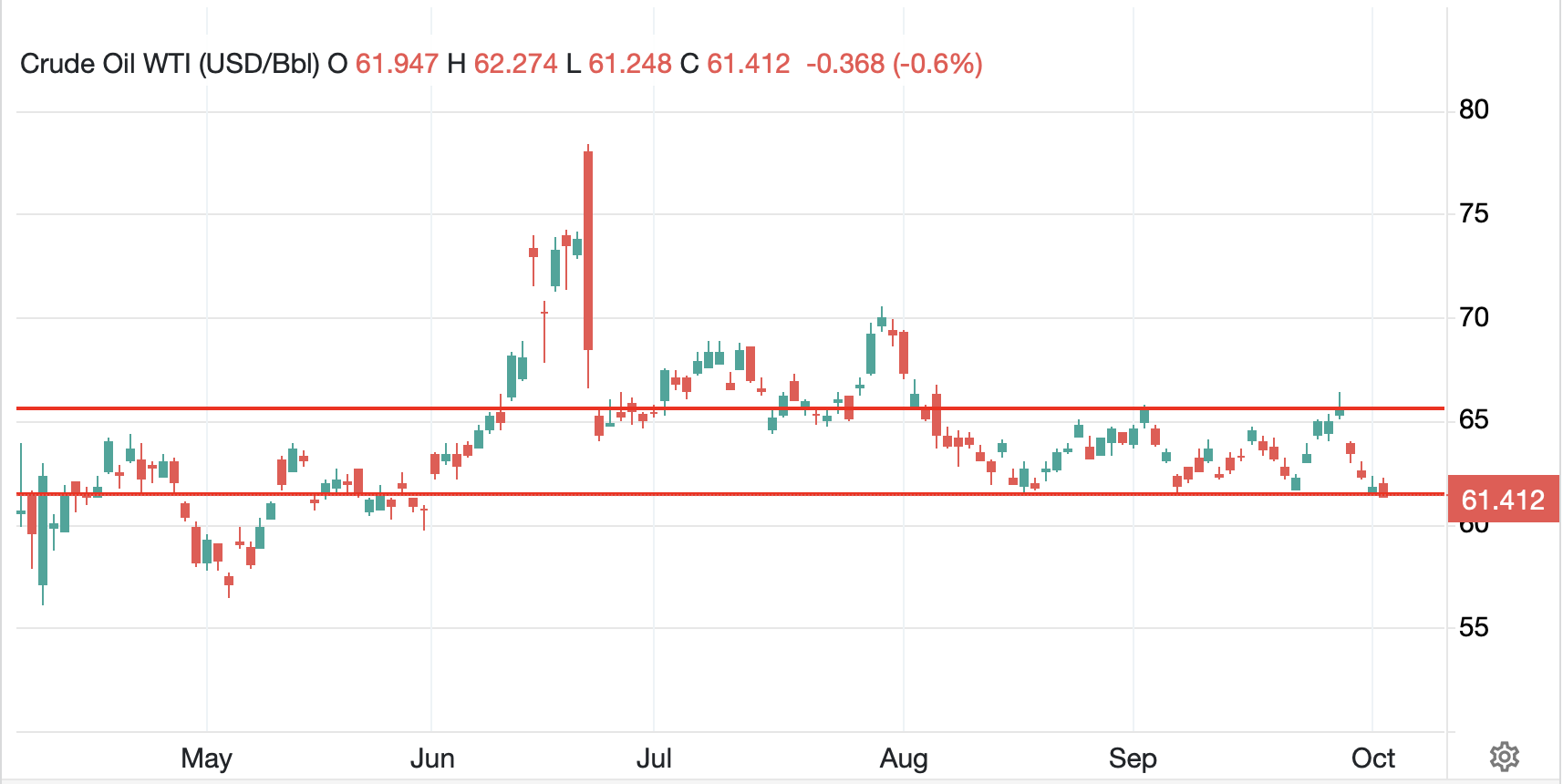
In the commodity space, oil remains pinned to the $60/bbl level with lots of huffing and puffing about Russian sanctions and oil gluts and IEA changes of opinion but in the end, WTI has been either side of $60 for the past month+ and continues to trend slowly lower.  

Source: tradingeconomics.com

Metals remain the most volatile segment of the entire market complex although this morning, movement has not been so dramatic (Au -0.1%, Ag +0.9%, Cu -0.4%, Pt -0.1%).  All the metals remain substantially higher than where they began the year and all have seemingly run into levels at which more consolidation is needed before any further substantial gains can be made.  I don’t think the supply/demand story has changed here, just the price action.

Finally, the dollar is a touch firmer this morning, with the DXY (+0.1%) a good representation of the entire space.  The only two currencies that have moved more than 0.2% today are KRW (-0.9%) which reversed Friday’s price action and is explained as continued capital outflows to the US for investment.  On the flip side, CLP (+1.1%) is benefitting from the first round of Presidential elections in Chile, where the right-wing candidate came out ahead and is expected to consolidate the vote and win an absolute majority in the second round.  Jose Antonio Kast, if he wins, is expected to proffer more market-friendly policies than the current socialist president, Gabriel Boric.  It seems the people in Chile have had enough of socialism for now.  But other than those two currencies, this market remains quiet.

On the data front, there is so much data to be released, but the calendar for much of it has not yet been finalized.  One thing that is finalized is the September employment situation which is due for release Thursday morning at 8:30. This morning we see Empire State Manufacturing (exp 6.0) and Construction Spending (-0.1%) and hopefully, the calendar will fill in as the week passes.

While equity markets remain very near their all-time highs, the Fear and Greed Index is firmly in Fear territory as per the below from cnn.com.

Historically, this has been seen as an inverse indicator for stock markets although it has been down here for more than a month.  Uncertainty breeds fear and the lack of data has many people uncertain about the current state of the US economy since the only information they get is either from the cacophony of social media, the bias of mainstream media or their own two eyes.  But even if you trust your own eyes, they just don’t see that much, likely not enough to come to a broad conclusion. 

FWIW, which is probably not much, my take is things are slower than they have been earlier in the year, but nowhere near recession.  I think it is the correct decision for the Fed to hold next month rather than cut because the drivers of inflation remain extant.  But Jay doesn’t ask me.  Whether Miran is correct in his prescriptions for the economy, I am gratified that he is questioning the underlying structure.  In the meantime, run it hot remains the name of the game and that means any risk-off period is likely to be short.

Good luck

Adf

Who Will Blink First?

The question’s now, who will blink first?
With Democrat leaders immersed
In internal strife
Concerned their shelf life
Is short and their party’s been cursed
 
Or will the Republican leaders
Start caring if New York Times readers
Scream loudly enough
The polls will turn rough?
My bet’s on the Dems as conceders


So, the government is shut down and yet, the sun continues to rise and set, and life pretty much goes on as before.  Is this, in fact a big deal?  It all depends on your point of view, I suppose.  It is certainly a big deal for those furloughed government employees, especially those whose jobs may disappear in the pending RIF.  But as I have often said, if they leave government and become baristas at Starbucks, they are almost certainly adding more value to the economy.  And consider, whenever you have to interface directly with the federal government (post office, passports, IRS, etc.) has the customer service ever been useful or effective?  Explaining that people will have to wait longer is hardly a compelling argument.  In fact, of all the places where AI is likely to be most useful, repetitive government tasks seems one of the most beneficial potential applications.

Nonetheless, this is the story that is going to lead the headlines for a few more days.  Ultimately, as we have already seen several Democrat senators vote to pass the CR, I expect enough others to do so to reopen the government, if not at the next scheduled vote tomorrow, then at the one following next week.  Ultimately, I believe what we’ve relearned is that most politics is simply performance art.

Too, remember that the decision as to who is considered essential, when the government shuts down, is left up to the president.  So, the Democrats shut down the government and have allowed President Trump to decide what gets done.  Pretty soon, I suspect they will figure out that was a bad idea as we have already seen specific projects in NY (home to both House and Senate minority leaders) get halted with the funds flows stopping as well.

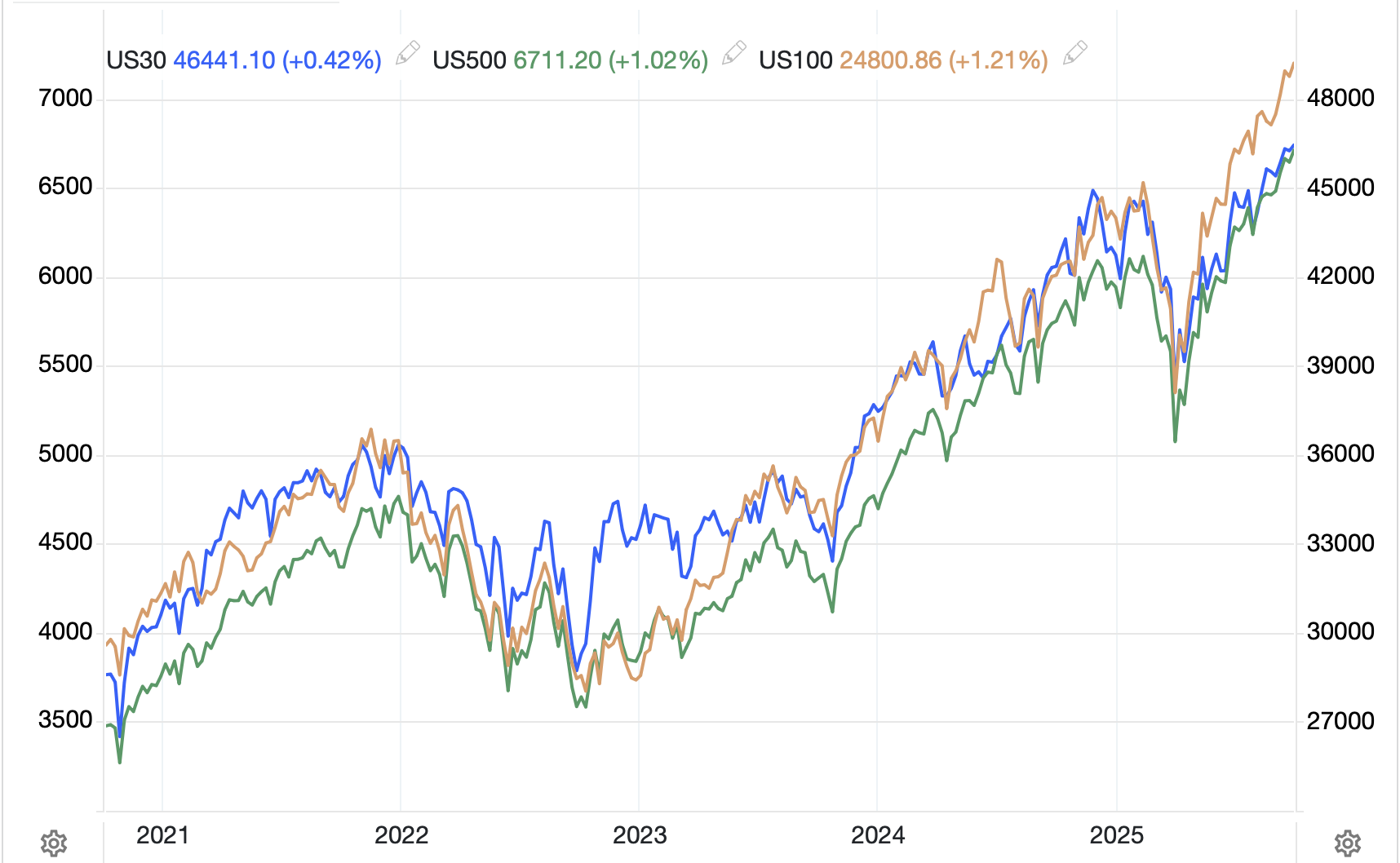
Meanwhile, in the markets, nobody appears to have noticed that the government has shut down.  That is the key conclusion to be drawn from the continuation of the equity market rally where all three major US indices closed at record highs yet again. I am hard pressed to look at the below chart of those indices and glean any concern by markets regarding the government shutting down.  Perhaps, even, they are applauding the idea as it means less spending!

Source: tradingeconomics.com

Arguably, the market’s biggest concern is that government data releases will be missing from the mix, although, that too, might be a blessing.  The person most upset there will be Ken Griffin, as Citadel’s algorithms will not be able to take advantage of the data prints before everyone else!  In fact, I suspect that he is already bending the ears of the Democratic leadership to get things back to normal.

Meanwhile, would it be too much to ask to close the Fed during the shutdown?  Asking for a friend!

Ok, what is happening elsewhere in the world.  Japanese Tankan data the night before last came in a tick weaker than forecast, and than last month, but remains solid overall.  Deputy BOJ Governor Uchida reiterated that if the economy performs as currently expected, the BOJ will continue to remove policy accommodation going forward with expectations for a rate hike at the end of the month priced at a 60% probability.  Interestingly, despite that, the Nikkei (+0.9%) rallied overnight along with the yen (+0.3% overnight, +2.1% in the past week), although the yen move makes more sense.  As to the rest of Asian equity markets, China (+0.5%) and HK (+1.6%) are clearly unperturbed by the US situation as a positive outlook on trade talks with the US are the narrative there heading into their weeklong National holiday.  Elsewhere in the region, every major bourse is higher with some (Korea +2.7%, Singapore +1.7%) substantially so.  The US rally is dragging along the world.

This is true in Europe as well with the DAX (+1.4%) and CAC (+1.3%) leading the way as all major bourses rise alongside the US.  Apparently, increasing global liquidity is good for risk assets.

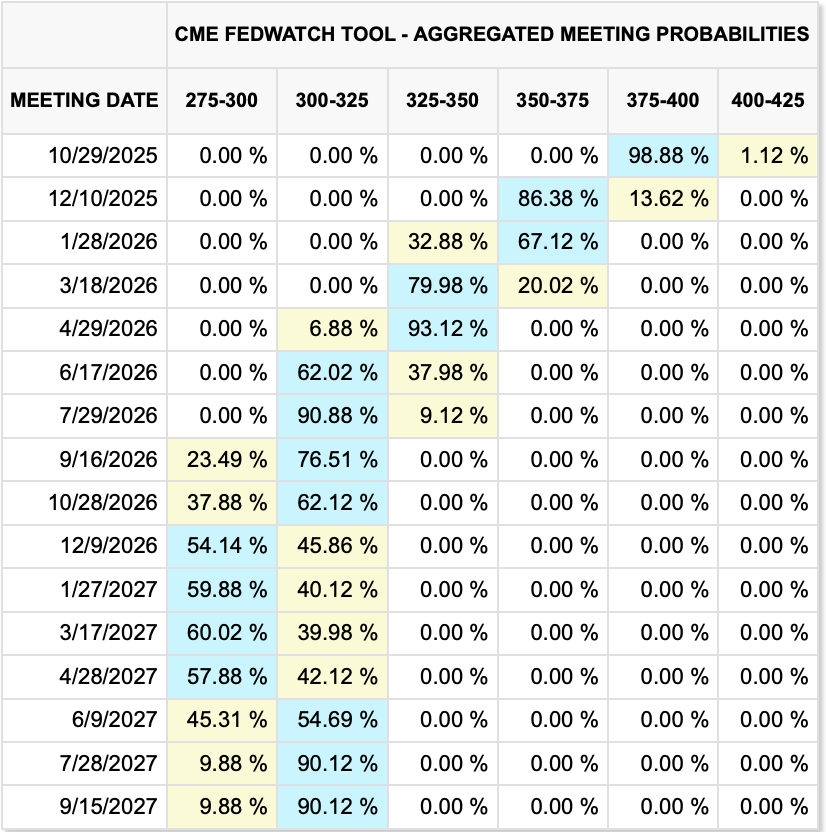
In the bond market, Treasury yields continue to slide, down another -1bp overnight after slipping -4bps yesterday.  The only data was the ADP Employment Report which showed a decline of -32K jobs compared to expectations of +50K.  It is important to recognize that this report included ADP’s benchmark revisions which, not surprisingly, resulted in fewer jobs create last year just like the QCEW showed with the NFP report two months’ ago.  This data took the probability of a Fed cut at the end of the month up to 99% and pushed the probabilities for cuts next year higher as well.

Source: cmegroup.com

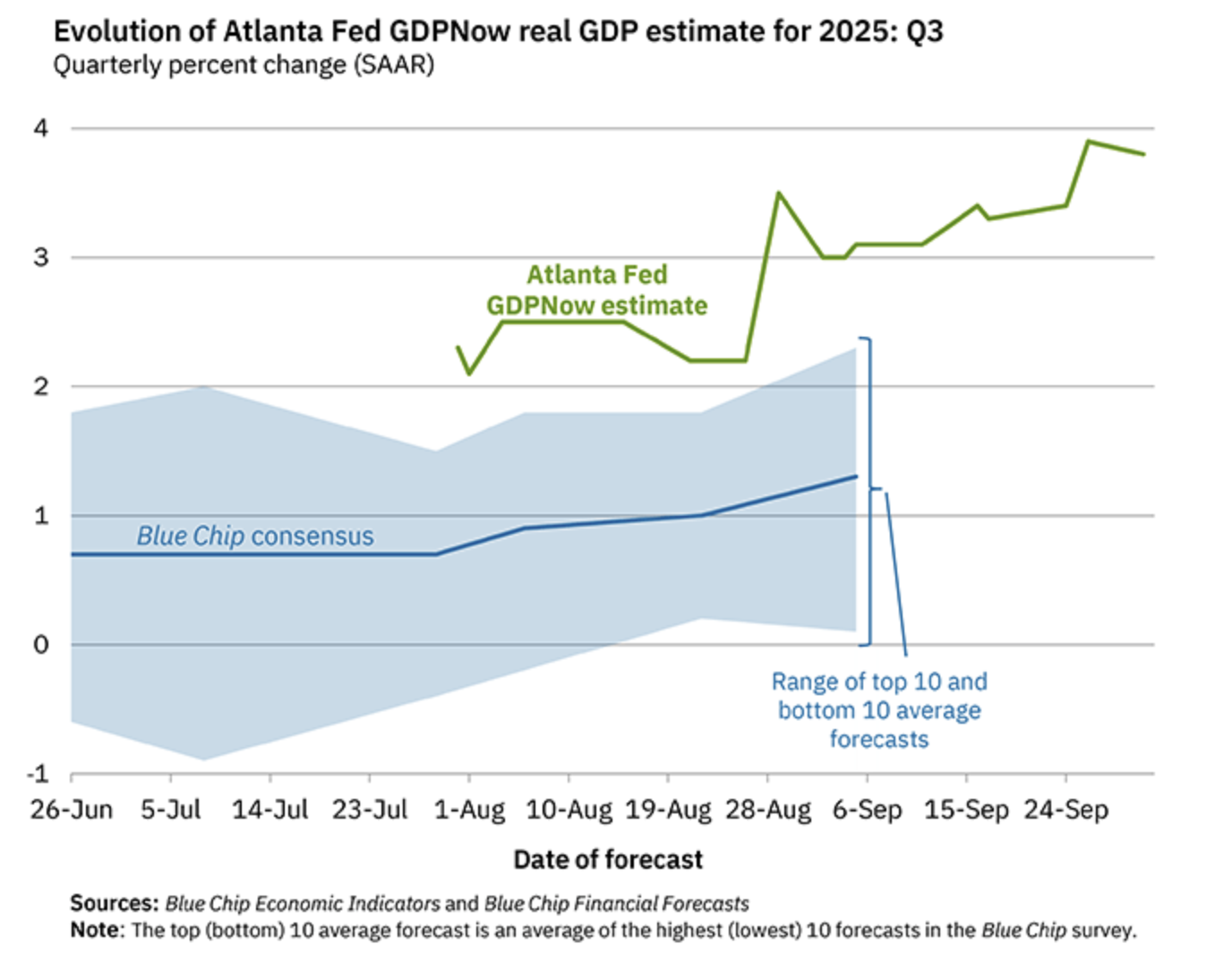
Of course, this is the very definition of bad news is good for equities and bonds, as there continues to be a strong expectation that rate cuts are designed to support asset prices rather than address real weakness in the economy.  And in a way, this makes sense.  After all, the Atlanta Fed’s GDPNow forecast for Q3 is currently at 3.8%, hardly the sign of an impending recession.

So, stronger than long-term growth and rate cuts seem an odd policy pairing, but the stock markets love it!

The other markets that love this policy are precious metals which continue to make new highs as well, for gold (+0.5%) these are all-time highs, for silver (+0.3%) they are merely 14-year highs.  But the one thing that is clear (and this is true of platinum and palladium as well) is that investors are starting to look at the current policy mix and grow concerned over the value of fiat currencies.  Oil (-0.7%), though, is currently on a different trajectory, trading right back to the bottom of its months’ long trading range less than a week after touching the top.

Source: tradingeconomics.com

There seems to be a difference of opinion regarding future economic activity between equity and oil markets.  I have read a number of analyses describing peak oil, yet again, although this time they are calling for peak demand, not peak supply.  Given that fossil fuels continue to generate more than 80% of global energy, and that oil also is the base for some 6000 products utilized around the world in everyday applications and the fact that there are some 7 billion people who are energy starved compared to the Western nations, I find the peak demand story to be hard to accept.  But that’s just me and I’m an FX guy, so what do I know?

Speaking of FX, the decline in yields and growing belief in easier US monetary policy has worked its way into the dollar, pushing it a bit lower, about -0.15% based on the DXY.  But looking across both G10 and EMG currencies, the yen’s 0.3% move describes the maximum gain with the rest having either gained less or declined a bit.  Right now, the dollar doesn’t appear to be the focus of the macro world, although that is certainly subject to change at a moment’s notice.

We know there is no government data coming, although apparently, the Treasury is still auctioning T-bills today, that activity will not be delayed!  We also hear from Dallas Fed President Logan, someone who ostensibly has been mooted as a potential next Fed chair.  Again, the one thing we know about the FOMC right now is that there is no consensus opinion on what to do next, at least based on the dispersion of the dot plot from the last meeting.

While the Trump administration may be getting ready to axe a lot of Federal jobs, that will not stop the liquidity impulse.  It’s not that this government is going to spend less, it is just spending money on different priorities.  But running it hot is clearly the MO for now and the foreseeable future.  Ultimately, if the GDPNow forecast is correct, a much weaker dollar seems unlikely regardless of the Fed’s moves.  But that doesn’t mean a dollar rally, rather we could stay near here for a lot longer.

Good luck

Adf