The Drumbeat

The drumbeat grows louder each day
Catastrophe’s soon on its way
Yet markets ignore
The impact of war
On how things, in future, will play

Right now, Iran says they need U
Although one might ask what they’ll do
As well, on the Strait
They want a toll gate
Methinks this deal, Trump, will eschew

So, are oil tanks running dry?
Will phosphate’s price rise to the sky?
Will food soon run out?
Again, I’m in doubt
But pundits, good times, need deny

This is either setting up to be the greatest market pricing mistake of all time, or the global situation is not as bad as many pundits would have you believe.  There are a bunch of very smart analysts out there who have great expertise in the commodity space, who have continuously explained that the closure of the Strait of Hormuz is setting the world up for catastrophe.  Amongst them are Luke Gromen (@lukegromen), Craig Tindale (@ctindale), Adam Rozencwajg (from Goehring & Rozencwajg Associates) and Javier Blas from Bloomberg.  I read all of them periodically as they have some excellent insights as to what is going on in commodity markets.  And, to a man, they are all singing the same tune that even if the Strait were reopened tomorrow, the damage done is so great that we are heading into a major global economic recession.

Undoubtedly, all of them are smarter than me, a simple FX poet, and while I read a lot, market price action is far too important to ignore, especially as the current situation is not exactly hidden from traders and investors.  Thus, at the end of the day, while I understand their thesis, market prices are telling a completely different story.  Oil and gas production is growing elsewhere in the world and deals are being signed all over the world for new opportunities (Alaska, Brazil, Guyana, Venezuela).  The oil market remains in a steep backwardation which is another sign that markets are not overly concerned about the future.  I’m sorry, I cannot get worked up about this stuff without some clearer price signals, perhaps WTI at $150/bbl or something like that.

As to the Iran news, it is impossible to tell truth from fiction regarding the negotiations as it remains unclear, who in Iran is negotiating and what power they have.  The uranium issue remains key, in my mind, as a nuclear weapon cannot be considered defensive, and given their stated goals of destroying the great Satans of Israel and the United States, I very much fear if they were to create one, they would launch it the next day.  Even Xi agreed they cannot get one.  

All this leads me to believe that there is still quite a bit more back and forth before things end, and if I had to pick a date, I am still in for July 4th as a time to announce an agreement.  We shall see.

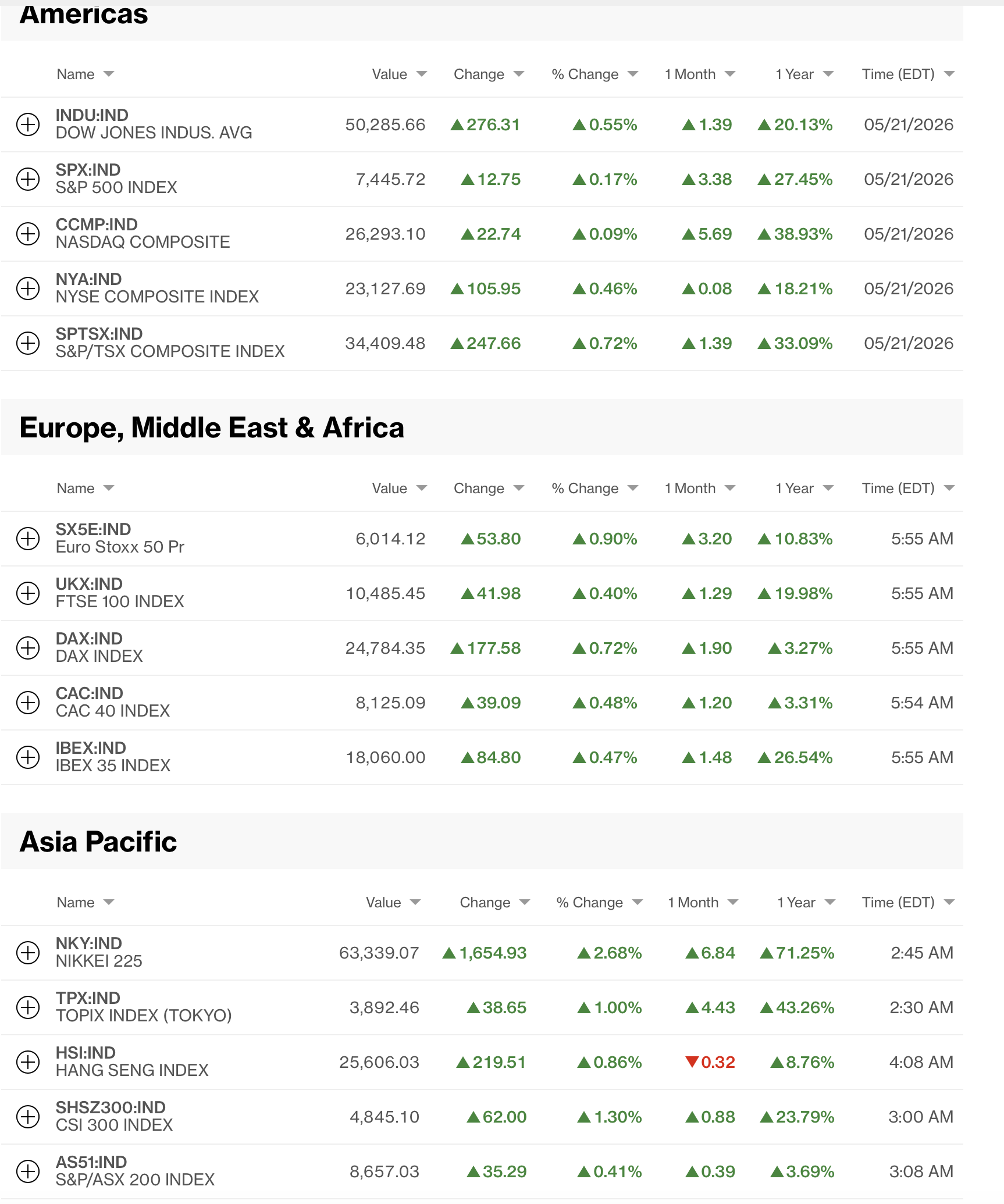
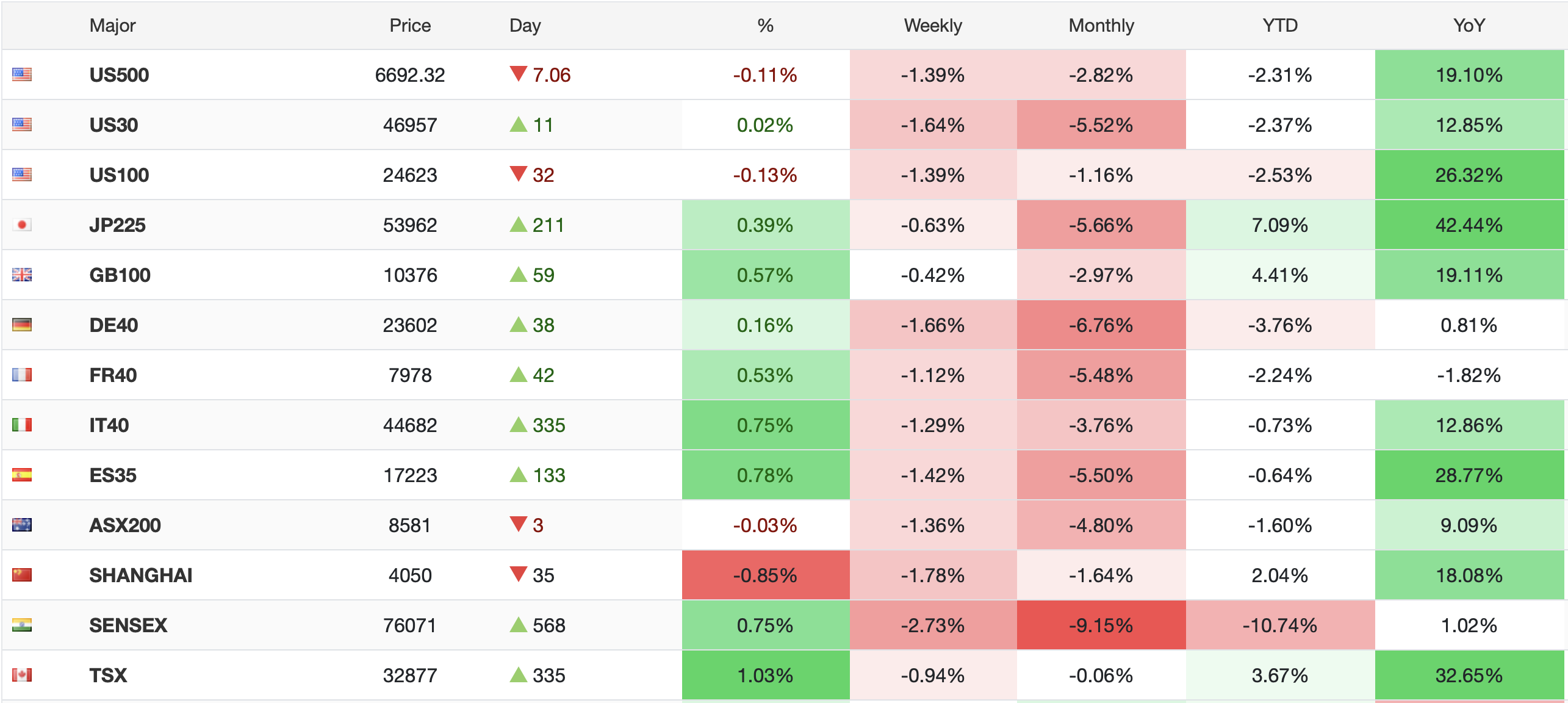
So, given we are not going to solve the Iran conflict here, it’s time to observe how markets are behaving.  And frankly, there is not very much to observe.  Starting with equity markets, as you can see from the Bloomberg screenshot below, things look pretty good right now, regardless of the Iran situation.  Yesterday’s US rally (the concerns raised regarding Iran and its uranium were set aside, it seems) were followed by strength in Asia and this morning in Europe.
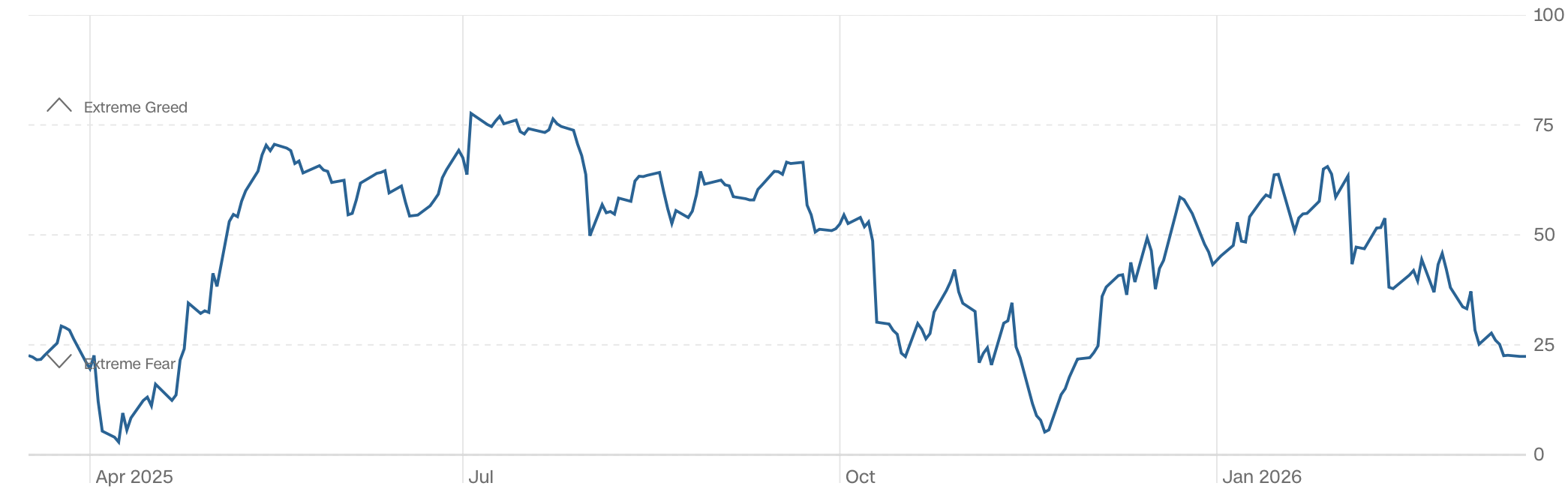
Earnings data continues to be released in a generally positive manner, and despite the ongoing angst amongst the punditry, as discussed above, there is, as yet, no sign that fear is growing amongst the investing set.  Below is a chart of the CNN Fear and Greed Index over the past year.  the current reading is 57, firmly in the Greed bucket and as you can see, the fear over the war began to dissipate at the end of March. 
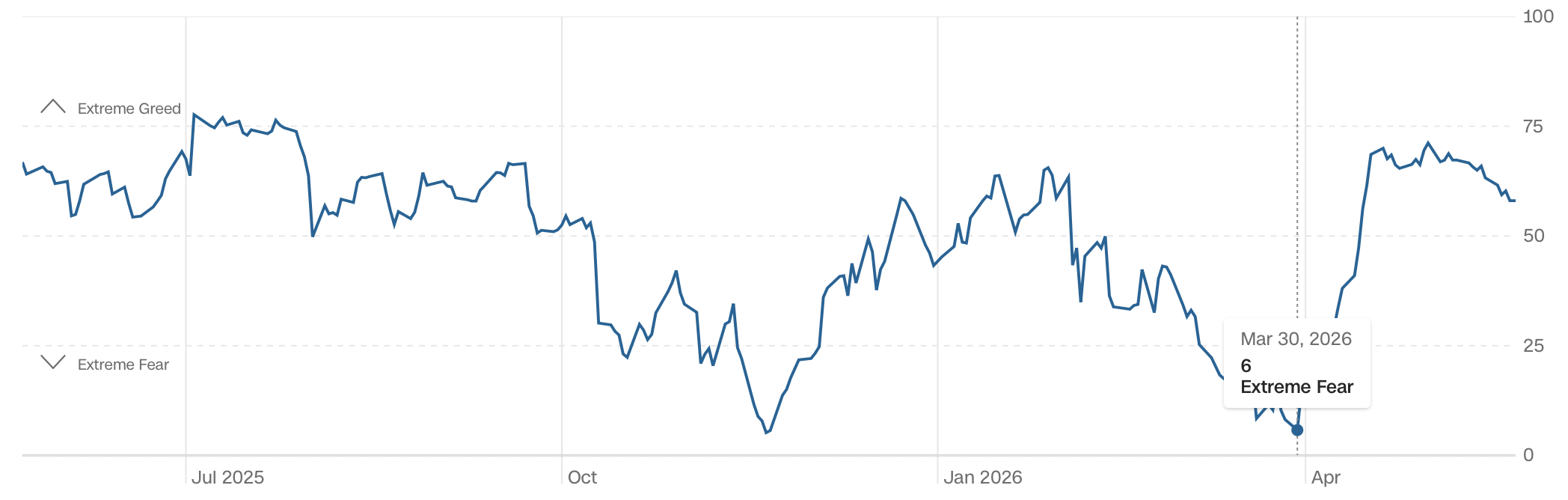
If you think about it, this is really no different than the Ukraine War, which for a relatively short time was seen as catastrophic, and eventually faded into the background.  Honestly, when was the last time you saw an article on the subject?

As to the bond market, it continues its recent uncertainty as to what the future holds.  This morning yields are lower across the board with Treasuries (-2bps) after slipping -3bps yesterday, while European sovereign yields are all lower by between -4bps and -6bps.  The bond market appears to be caught between fears of rising inflation because of the impact of higher oil prices, not only on direct things like transportation, but also secondary impacts as those costs are passed on and adding in the potential for higher food prices if the fertilizer situation is as bad as some forecast.  However, the other side of that coin is the potential for a significant recession, which historically has resulted in substantially lower yields as governments around the world add both monetary and fiscal stimulus.  Place your bets!

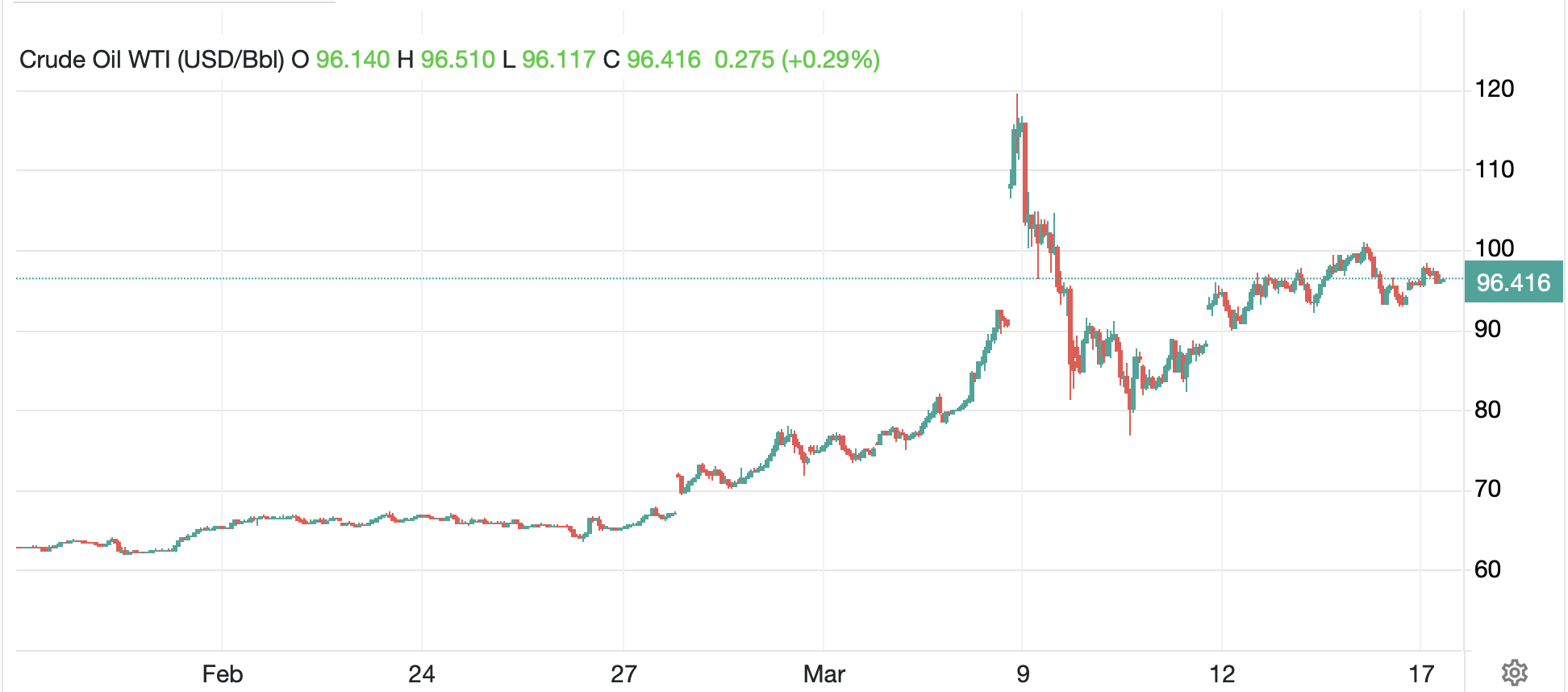
Turning to the oil market, while WTI is higher by 1.8% this morning, as you can see in the chart below, it continues to go nowhere overall.  If the apocalypse is coming, the market is certainly not ready.  Either that, or there is a lot more oil around than people give it credit for.
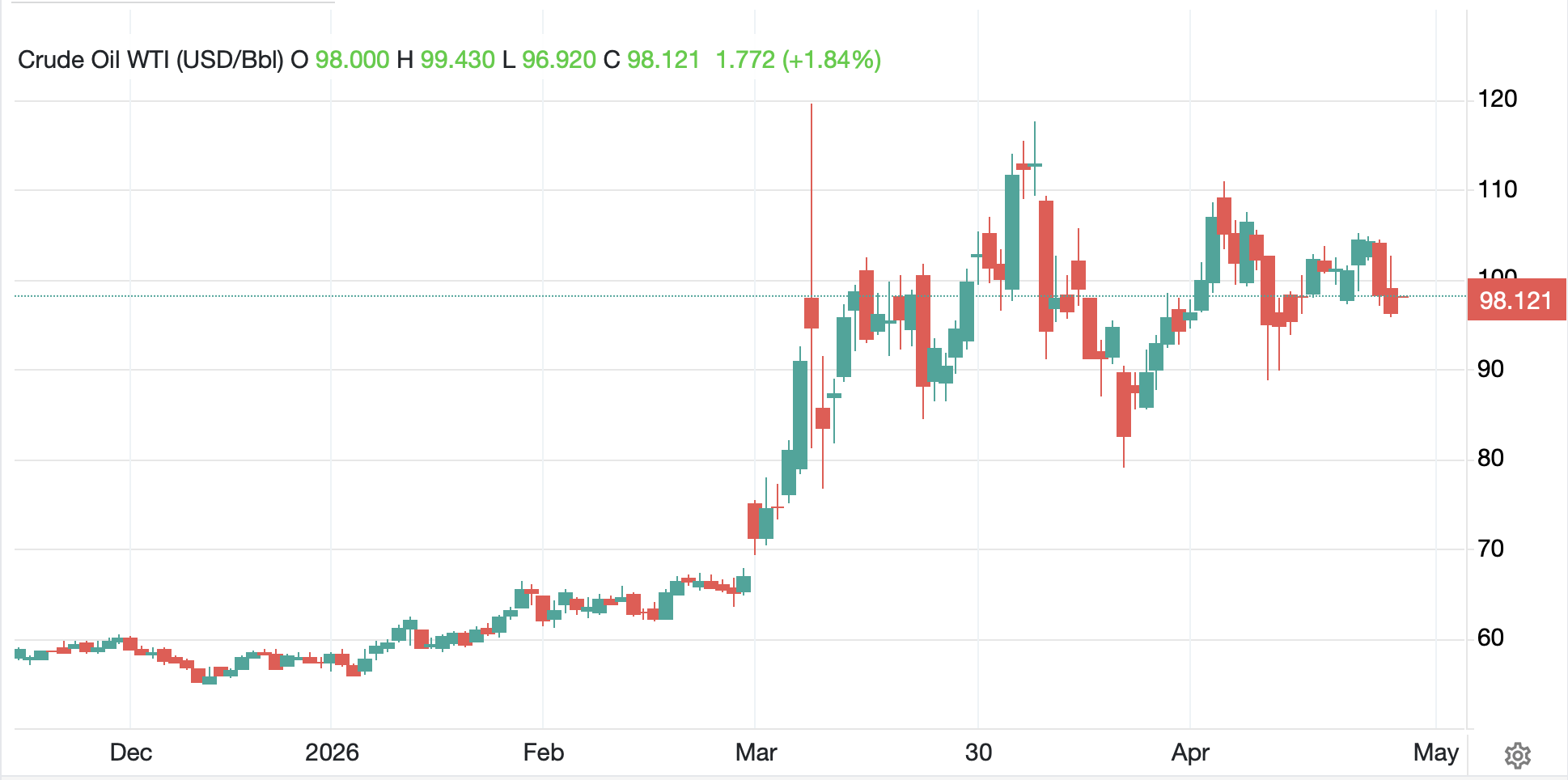
Source: tradingeconomics.com

Of course, as has been the case, when oil’s price rises, gold (-0.6%) and silver (-1.1%) slide as that negative correlation has become firmly entrenched.  Copper (+0.7%) though, is bucking that trend this morning, albeit hardly running away.  I expect that these relationships are likely to hold until there is a resolution of some sort in the Gulf.

Finally, the dollar is generally firmer this morning despite the decline in yields.  In fact, if we look across markets, bonds are today’s outlier.  But back to FX, in the G10, all the currencies are weaker by between -0.1% and -0.3% although in the EMG bloc, there are two more substantial movers, INR (+0.5%) as the RBI continues its intervention process amid fears the rupee will collapse, while KRW (-0.8%) continues to see foreign outflows despite its equity market continuing to be one of the best performing in the world as you can see in the Bloomberg chart of the KOSPI below.
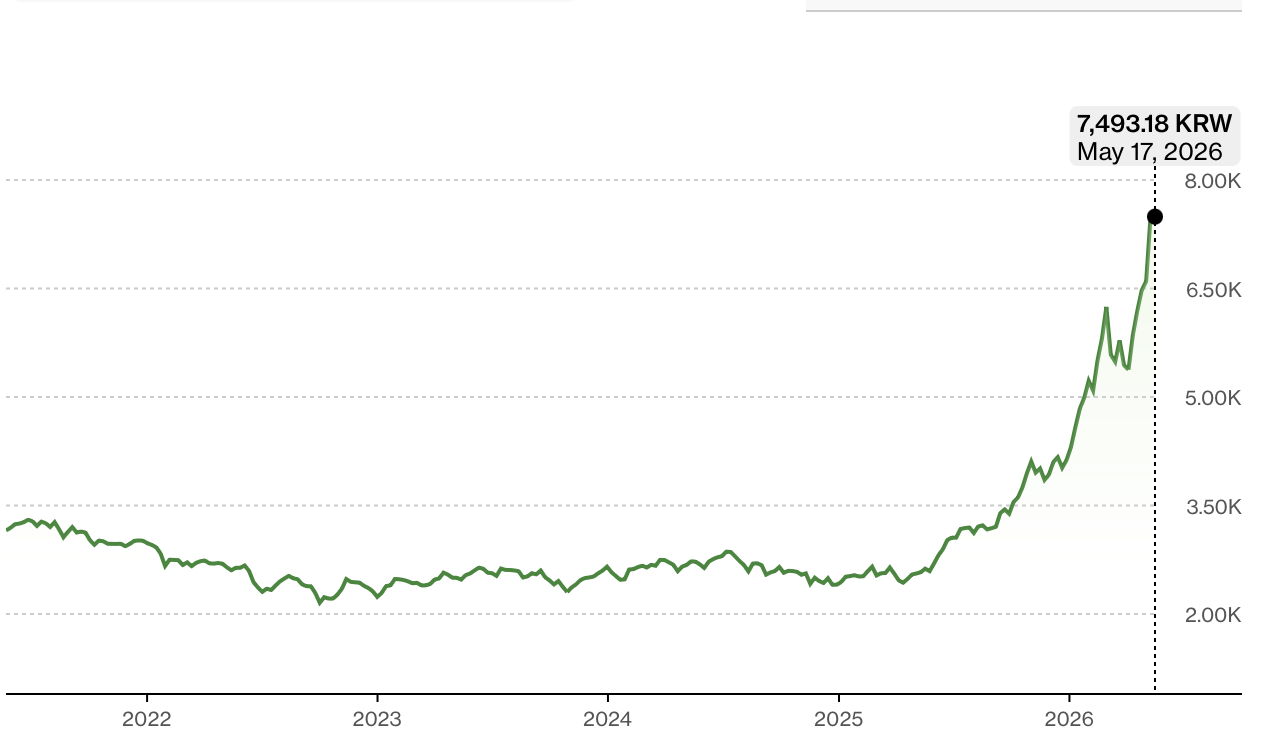
And that’s really it as we head into the weekend.  Perhaps the conflict will heat up during the long weekend, which would likely drive some real movement.  But for now, there is nothing new under the sun.

On the data front, yesterday saw generally solid data with the Philly Fed the lone, weak, exception.  Last night, Japanese CPI was released at a much lower than expected 1.4% for both headline and core.  While there is still a strong expectation that the BOJ is going to raise rates next month, if inflation is truly at 1.4%, that seems like it might be a mistake.  This morning we see Michigan Sentiment (exp 48.2) and Leading Indicators (-0.2%).  Here’s the thing about the Leading Indicators, though, as you can see from the chart below from the Conference Board’s website, it appears they may not be telling us the whole story anymore.
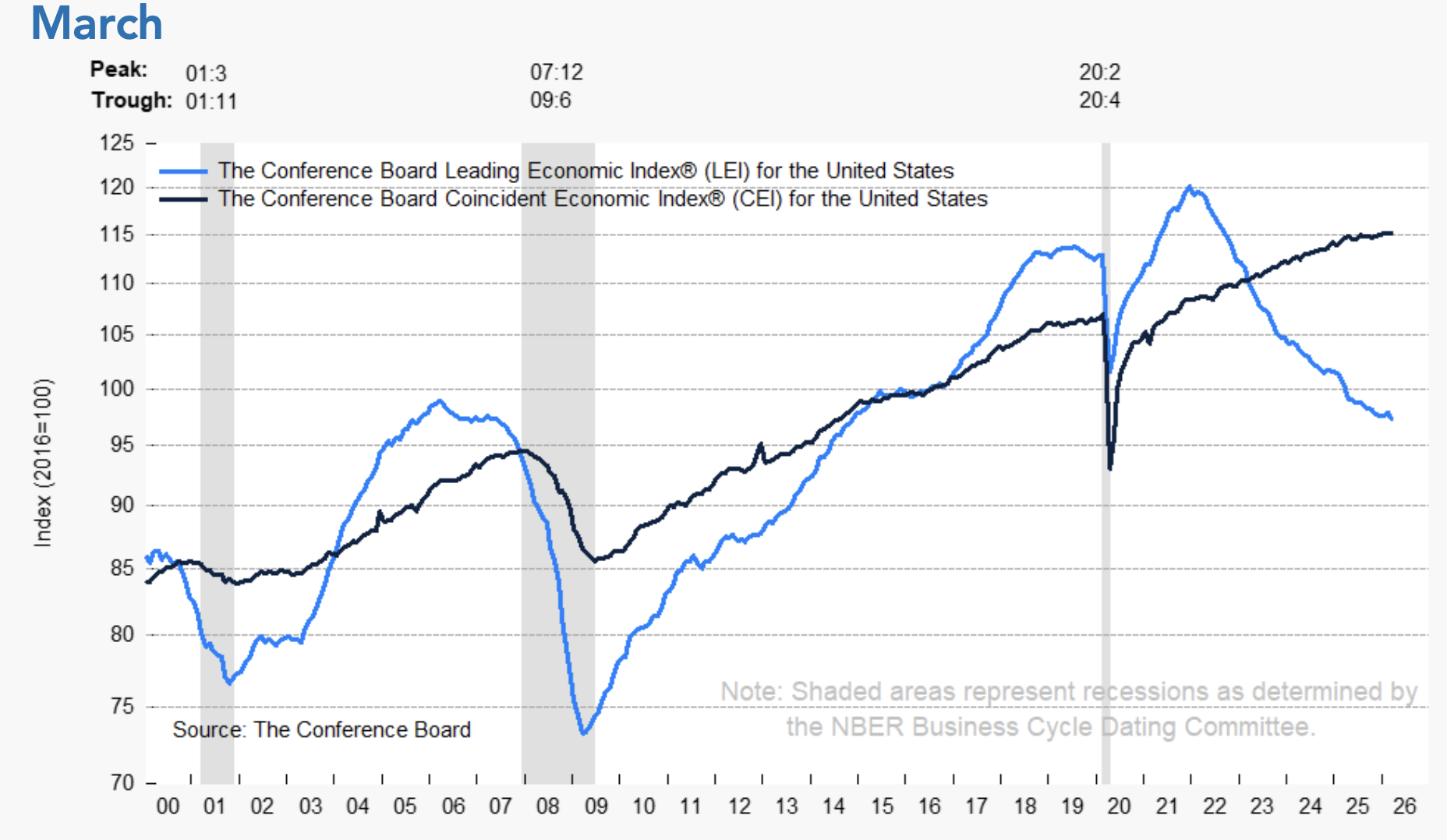
After all, they have been declining steadily since early 2022 despite an economy that has grown solidly during that period.  Again, maybe this truly is a harbinger for the future, but I am not convinced.

And that’s all there is.  Have a wonderful Memorial Day weekend and let’s see what the world looks like on Tuesday morning!

Good luck and good weekend

Adf
All Will Reject

Down Under the latest decision
To raise rates was made midst division
Inflation there’s rising
So, it’s not surprising
The two sides have had a collision

But elsewhere this week I’d expect
That central banks all will reject
A hike in their rate
As long as the Strait
Stays closed, though inflation’s unchecked

For a while now, I have been making the case that central bank activities, at least in the West, had a diminishing impact on market behavior, and that was before the war in Iran began.  My thesis had been based on the idea that fiscal policies had become so overwhelming that market participants realized that the odd 25 basis point rate move was not going to move the needle, at least not on a short-term horizon.  

Then, of course, at the beginning of the month, the Iran conflict began which garnered all the market’s attention, rightfully so.  But here we are, 17 days into the conflict and suddenly, investors seem far less concerned with the situation.  Naturally, the halting of ~20% of daily oil flows through the Strait remains a critical issue, but arguably, until something there changes, the market seems to have absorbed that in its price.  Consider the following screen shot of equity markets from 6:30 this morning.  it is very difficult to look at this and conclude there is any sense of panic.

Source: tradingeconomics.com

Sure, equity markets have slipped over the past month, but the magnitude of that decline has been pretty modest considering oil prices have jumped 50% during that period.   The lesson I take from this is that speculative positioning has been substantially reduced because, frankly, we have not seen nearly as much fear response as I would have anticipated heading into this situation.  If we look at the CNN Fear & Greed Index below, sure it says we are in extreme fear (below 25 on the chart), although this is nowhere near the lows seen during the past year as per the below chart from cnn.com

But if you go to the link above, it shows a series of charts covering different facets of the stock market, and frankly, none of them demonstrate to me that fear is that rampant, despite their labels.  After all, most of the charts show the current readings right in the middle of the range over the past year.

Which takes us back to, what is driving markets these days?  Two and a half weeks into the war, I presume that margin calls have been settled and those positions adjusted or reduced accordingly.  After all, margin clerks demand settlement immediately, not in two weeks’ time, so they are done.  Economic data has been underwhelming, although we are beginning to see the first inklings of war-related weakness with yesterday’s Empire State Manufacturing disappointment (-0.2 vs 7.1 last month and 3.2 expected), but even more so with this morning’s German and European ZEW Economic Sentiment Indices.

                                                                                                                Actual           Previous          Forecast

Source: tradingeconomics.com

This is the first March data we are seeing, and I suspect all of it is going to be lousy.  But again, that is already priced in, I believe, hence the relative lack of movement.

And so, I turn to the central bank community, with virtually the entire G7 having meetings this week.  While I don’t anticipate any rate movement other than last night’s RBA hike of 25bps, which was priced in before the conflict began, I expect that we are going to need to listen to what they all say as our best indication of current expectations of future behavior, and whether they will react to the oil price rise, or recognize higher rates will not open the Hormuz Strait.  At this point, especially since there has been insufficient inflation data to alter decisions, I expect a lot of talk about carefully monitoring the situation, but no promises to do anything.  And remember, knock-on effects of higher oil prices into other things take time to be felt, so given the completely reactive nature of all central banks, that is not going to be a reason to raise rates.  Ironically, central banks are back in the market discussion despite themselves!

Ok, let’s tour the markets and see how things have behaved overnight.  Yesterday saw a very solid US session, although as in the table above, this morning futures are very modestly lower.  In Asia, Tokyo (-0.1%) slipped a bit after Katayama-san, the FinMin, explained she was watching the yen closely and would consider “bold moves” (a euphemism for intervention) if deemed necessary.  Elsewhere in the region, though, only China (-0.7%) failed to follow the US with Korea (+1.6%), India (+0.75%), Taiwan (+1.5%) and Singapore (+1.2%) representative of the price action.  Other markets had lesser gains, but gains they were.

Meanwhile, European bourses are all in the green as well, albeit not as robustly as Asian exchanges showed.  Spain (+0.8%) is the leader, but 0.5% gains in France and the UK are also extant while Germany (+0.1%) is still trying to shake off that horrible ZEW number.

In the bond market, Treasury yields slipped again yesterday, down -3bps, and this morning, European sovereigns are showing similar activity, with yields sliding between -3bps and -5bps across the entire continent and the UK.  This is certainly odd behavior if the market believes that oil prices are going to remain higher for longer.  If I look at the combination of the early March data weakness and the fact that bond investors are not panicking in any sense, there is no indication that central banks are going to do anything for now, but I suspect that economic weakness will be the issue that arises going forward.  After all, inflation has not seemed to be their driver for a while now.

In the commodity space, yesterday saw oil prices slide about 4%, while this morning they are higher by 3.0%.  but a look at the chart tells me that for now, they have found a new equilibrium just below $100/bbl +/- a bit. 

Source: tradingeconomics.com

It is important to remember that despite the large jump in prices recently, on an inflation adjusted basis, the current level is still only half as high as the 2008 spike to $145/bbl.  In other words, I might contend that it is not the price of oil, so much, right now, but rather its availability that is going to be the key issue going forward.  Naturally, Europe has jumped in to explain that they believe high oil prices help them denounce the US removal of sanctions on Russian oil as they will not countenance such things despite the loss of their key suppliers.  I’m glad I don’t live in Europe.

As to the metals markets, Zzzzzzz is the only way to describe them.  While copper (-1.2%) has slipped, neither gold nor silver has moved overnight, and both remain essentially at their new homes of $5000/oz and $80/oz.

Finally, the dollar is also doing little this morning, essentially unchanged vs. most its major counterparts.  NOK (+0.6%) is enjoying oil’s rally while ZAR (-0.5%) is suffering from the lack of gold movement.  And otherwise, it is hard to get excited about anything with movement +/- 0.2% or less across both G10 and EMG currency blocs.

There is no primary data released this morning in the US.  The FOMC begins its two-day meeting and tomorrow at 2:00 we will learn that policy is unchanged, but all eyes will be on the dot plot and the SEP report to try to better understand the potential future path.  But for today, absent a major change in the Iran situation, I don’t imagine it is going to be very exciting anywhere.

Good luck

Adf

A Weapon of War

The Hammer’s a weapon of war
Just ask those who fought against Thor
At midnight on Friday
Iran learned the hard way
That Trump wields one too when called for
 
The interesting thing early on
Is this clearly ain’t a black swan
While oil did rise
Which was no surprise
Most risk gave an aggregate yawn


Obviously, the big news this weekend was the extraordinary attack and destruction of Iran’s three key nuclear enrichment and engineering sites.  While this poet has opinions, since I am just like the rest of you, limited to the peanut gallery and with no voice in the matter, they are not relevant for this discussion.  However, what is relevant is the early movement in markets once they reopened Sunday night in NY.  While it is no surprise that oil’s price rose as you can see below, the early 2.2% gain is pretty lackluster for the alleged (by some) beginning of WWIII.

Source: tradingeconomics.com

As to the rest of the markets early price action, it’s largely what you would have expected directionally, although unimpressive overall with equity indices modestly lower, about -0.35%, the dollar modestly higher, about 0.2%, and bonds little changed.  Gold, too, is little changed.  It appears that, at least initially, the market was anticipating something like this as you can see that even after the oil price spike, it didn’t reach the levels seen on Friday.

With two days to think it all through
Most traders appear to eschew
The idea that war
Is what is in store
Instead, buy more stocks is their view


So, as we wake up Monday morning, despite all the weekend news and the fear mongering thus far, and even though Israel and Iran continue to trade missile fire, the early consensus is that we have seen the worst already.  Iran’s parliament voted to block the Strait of Hormuz, but they have no power to drive actions, that resides with the Supreme Council and as of yet, they have not acted.  In fact, they are in a tricky position for several reasons.  First, China is their largest oil customer by far and 20% or more of their oil transits the Strait which means China’s deliveries would slow dramatically and China is one of their only supporters.  Second, the US navy has significant assets in the region and appears quite ready for that move, likely being able to reopen the Strait quickly.  And third, if they follow through and their objective fails (remember, their objective in this would be to spike the oil price and hurt Western economies accordingly) then they will prove conclusively that they are irrelevant militarily.  That is likely not what the regime there wants to demonstrate.

But the market is pretty smart about these things as the collective wisdom and thoughts of traders and investors is an excellent proxy for issues of this nature.  Therefore, we cannot be surprised that after that initial spike in oil prices, they have retreated to Friday’s pre-attack levels as investors await more information.

Source: tradingeconomics.com

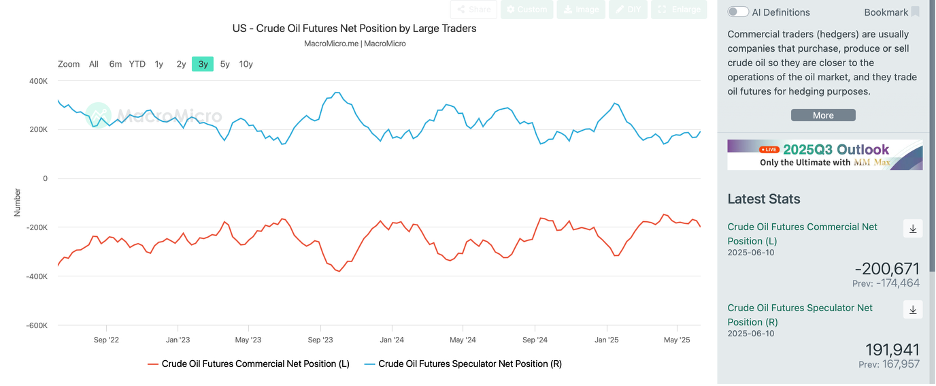
It is also worthwhile to recognize that speculative trader positions in oil are net long just under 200K contracts, so there is no short-covering spree that is likely to arrive and drive prices higher.

Source: en.macromicro.me

The point is that if oil is basically unconcerned with the potential issues in Iran, then other markets will completely ignore the situation.  And that is pretty much exactly what we are seeing this morning.  In Asia, equity markets were mixed with modest overall movement.  The Nikkei (-0.15%) and Australia (-0.35%) slid while Hong Kong (+0.7%) and China (+0.3%) rallied showing no trends whatsoever.  The rest of the region did have more laggards than gainers, but other than smaller markets like Indonesia and Taiwan, both falling -1.5% or more, movement was muted.  In Europe, modest losses are the thing with the DAX (-0.4%), CAC (-0.4%) and IBEX (-0.2%) slipping a bit while the FTSE 100 is unchanged on the morning, but there is certainly no panic.  As to US futures, while they opened lower last night, as I type at 6:30 this morning, they are back to flat on the session.

In the bond market, yields have basically edged higher by 2bps across the US, Europe and Japan, either demonstrating that government bonds are no longer a safe haven, or that no haven is necessary because fears of escalation are minimal.  Despite all the negative talk about bonds, I would still opt for the latter explanation.

In the commodity markets, we’ve already discussed oil at length.  In the metals markets, gold is essentially unchanged this morning although we are seeing a mild divergence between silver (+0.6%) and copper (-0.7%), implying to me that there is no underlying risk trend here.

Finally, the dollar is the one thing that is flexing its muscles from a risk perspective as it is pretty sharply higher across the board.  In the G10, NZD (-1.4%) is the laggard followed closely by the yen (-1.25%), which given the weekend’s events is pretty surprising to most folks.  Perhaps yen is not as haven-like as previously thought.  But AUD (-1.1%) is sliding and the euro and pound are both lower by -0.5%.  In the EMG bloc, the dollar is firmer everywhere, but the moves, other than KRW (-1.2%) are less than might have been expected.  HUF (-0.9%) is the next worst performer with PLN (-0.75%) and CZK (-0.75%) all showing their high beta to the euro.  In Asia, CNY (-0.15%) remains dull and INR (-0.2%) is also lackluster.  LATAM currencies are showing little movement as well, with MXN (-0.4%) the laggard of the bunch.

Looking at data this week shows the following:

TodayFlash Manufacturing PMI51.0
 Flash Services PMI52.9
 Existing Home Sales3.96M
TuesdayCase Shiller Home Prices4.2%
 Consumer Confidence99.8
WednesdayNew Home Sales700K
ThursdayInitial Claims247K
 Continuing Claims1947K
 Durable Goods7.2%
 -ex Transport0.1%
 Final Q1 GDP-0.2%
 Goods Trade Balance-$92.0B
FridayPersonal Income0.3%
 Personal Spending0.1%
 PCE0.1% (2.3% y/Y)
 Ex Food & Energy0.1% (2.6% Y/Y)
 Michigan Sentiment60.3

Source: tradingeconomics.com

As well as all this, with most folks looking forward to Friday’s PCE data, we hear from Chairman Powell as he testifies to the Senate on Tuesday and the House on Wednesday.  In addition, there are 13 more Fed speeches from 10 different speakers.  Too, Madame Lagarde regales us three different times.  A cynic might think that central bankers are concerned their comments are losing their importance!

One never knows what is truly happening on the ground in Iran as all news organizations and governments are trying to tell their own story.  However, I do not believe that this is going to escalate into a greater problem going forward, but rather that there is every chance that tensions reduce over time.  I do not believe Iran will even attempt to block the Strait of Hormuz and if this is the worst that the Middle East can produce in the way of war, look for oil prices to slide back toward $65-$70.  As to the dollar, it feels a bit overdone here, so a modest retracement seems viable as well.

Good luck

Adf