
Just Won’t Evanesce

The RBA left rates on hold
And sounded quite dovish, all told
Meanwhile in Brazil
Old Lula is ill
With something much worse than a cold
 
In Syria, things are a mess
In Taipei they’re feeling some stress
With all this unfolding
It’s no shock beholding
Risk assets just won’t evanesce


Risk is the topic du jour as pretty much everywhere one looks around the world, things are afoot that can inculcate fear (and loathing) rather than embrace those animal spirits.  Perhaps the least frightful, but most directly impactful regarding markets, was the RBA meeting last night at which the committee left rates on hold, as universally expected, but appeared to turn (finally) to the dovish side of the ledger.  The policy statement explained, “Some of the upside risks to inflation appear to have eased and while the level of aggregate demand still appears to be above the economy’s supply capacity, that gap continues to close.  The board is gaining some confidence that inflation is moving sustainably toward target.”   However, the proof is in the pudding and a quick look at the AUD (-0.7%) shows that the market has come to believe the RBA is finally joining the central bank rate cutting party.

Source: tradingeconomics.com

The trend seems pretty clear and it is hard to make a case for a reversal absent a massive spike in inflation Down Under forcing the RBA to change direction or something coming from the US focusing on weakening the USD, but given nothing like that seems likely until Mr Trump is officially in office, I am concerned that the Aussie dog will live up to its nickname and make new lows going forward, perhaps testing 0.6000 before this is over.

Speaking of currencies under pressure, elsewhere in the Southern Hemisphere we find the Brazilian real which has fallen to new historic lows, with the dollar now trading above 6.08.  For those of you who hate to pay away the points in USDBRL to hedge your balance sheet assets, the reason that you need to do it is very evident from the chart below.

Source: tradingeconomics.com

While there were several short-term dips in the dollar during the past year, the spot rate (at which you remeasure your balance sheet each month) moved from 4.92 to 6.08 in 12 months, nearly a 24% decline in the real.  A one-year forward would have cost far less, something like 40-45 big figures, or less than half the actual move, and would have given you certainty as to the cost.  Hedging matters!

Now, why, you may ask is this happening?  Well, news that Brazilian president Lula da Silva had emergency brain surgery has clearly not helped the currency.  Suddenly there are many questions over who is running the country and how they will address the ongoing fiscal issues that are extant.  As an aside, this is likely another deterrent to the idea of a BRICS currency appearing any time soon, if ever.

Turning our gaze elsewhere, the situation in Syria continues to unfold with no clear outcome although increased concerns over what will happen with the beleaguered people of that nation and whether it will foment yet another immigration wave into Europe and elsewhere in the Middle East.  However, right now, the oil market remains nonplussed over this issue as evidenced by yet another day of quiet trading and a slow drift lower in the price (-0.55%).

However, we cannot ignore Taiwan, where China is currently in the process of military maneuvers that appear to be simulating a naval blockade of the nation.  Price action here has shown the TWD (-0.4%) sliding further and pushing back toward its weakest level in more than 15 years (since the GFC), while the TAIEX stock index (-0.65%) is also feeling a little heat, although the story there has been one of consistent gains over the past several years, following the NASDAQ higher given the breadth of technology companies there, notably TSMC.

Putting it all together leaves one wanting with respect to their risk appetite this morning as today seems like another step closer to that Fourth Turning.  So, it should be no surprise that after a down day yesterday in the US, with all three major equity indices declining, we have seen far more red than green on the screens overnight.  The exception to this rule was in Korea, where the KOSPI (+2.4%) rose sharply as it appears that things are starting to revert to more normalcy there politically.  President Yoon is under pressure to resign and seems likely to be impeached and the government is back to functioning in more of its ordinary manner.  But elsewhere in Asia, Hong Kong (-0.5%), Australia (-0.5%) and most of the smaller regional bourses were lower although the Nikkei (+0.5%) rallied on the back of the yen’s renewed weakness, and mainland Chinese shares (+0.7%) seemed to begin to believe that more stimulus is, in fact, on its way.  We shall see about that.

In Europe, the bourses range from flat (DAX, IBEX) to down CAC (-0.5%), FTSE 100 (-0.5%) with both these nations suffering from their own political distress.  French President Macron is trying to form a government but categorically refuses to include Marine Le Pen’s RN party so has no chance of a majority with concerns growing over the fiscal situation there.  Apparently, if they cannot get a financing bill passed, the French will get to experience the heretofore unique American experience of a government shutdown.  Meanwhile, PM Starmer is watching his ratings circle the drain as his government continues to try to raise revenues by raising taxes on the rich and finding out that one thing rich people are really good at is creating new methods of operations to avoid paying higher taxes.  While there is no vote necessary in the UK for years (remember, Starmer won election just this past July 4th) it certainly feels like his government is going to fall sooner rather than later.  Meanwhile, US futures are little changed at this hour (7:30).

In the bond market, yields are rebounding with Treasuries higher by 3bps this morning after a 3bp rally yesterday.  In Europe, there is very little change except for UK Gilts (+4bps) with concerns over inflation rising there while in Asia, Australian yields slipped 6bps on the dovish RBA.  Generally speaking, the bond market has not been very exciting lately which is one reason, I believe, that things have not fallen apart.  If we start to see more volatility here, watch out.

In the commodity markets, aside from oil’s modest decline, gold (+0.65%) continues to find support in this risk-off scenario although both copper and silver are little changed this morning after solid rallies yesterday.

Finally, the dollar is higher again this morning, with the DXY well back above 106.00 and every G10 currency declining led by NZD (-1.0%).  This is suffering from the RBA’s dovishness which is expected to allow the RBNZ to maintain, or even increase, its own dovishness.  But the whole bloc is softer.  In the EMG bloc, there are a few currencies that are holding their own vs. the dollar this morning, but only just, with MXN (+0.2%) arguably the strongest currency around while CNY (+0.1%) is also relatively strong.  But elsewhere in this bloc, ZAR (-0.7%), PLN (-0.55%), and CLP (-0.4%) are indicative of the type of price action we are seeing across the board.  This is a dollar day, though, not really focusing on individual currency foibles.

On the data front, we see only Nonfarm Productivity (exp 2.2%) and Unit Labor Costs (1.5%) and that is really it.  There was nothing yesterday and all eyes are truthfully turned toward tomorrow’s CPI data.  Things don’t feel very positive right now, so I expect risk to remain on its back foot to start the day.  However, given the number of uncertain situations that abound, anything can happen to either change that view or reinforce it.  Once again, this is why you hedge, to mitigate the markets’ inherent volatility.

Good luck

Adf
All Goes to Hell

The Turning is coming much faster
Than forecast by every forecaster
Now Syria’s fallen
And pundits are all in
Iran will soon be a disaster
 
However, the impact on trading
Is naught, with no pundits persuading
Investors to sell
As all goes to hell
Is narrative power now fading?


The suddenness of the collapse of Bashar Al-Assad’s control of Syria was stunning, essentially happening in on week, maybe less.  But it has happened, and it appears that there are going to be long-running ramifications from this event.  At the very least, the Middle East power structure has changed dramatically as Russia and Iran both abandoned someone who had been a key ally in their networks.  Russia is clearly otherwise occupied and did not have the wherewithal to help Assad, but it is certainly more interesting that Iran did not step up.  Rumors are that the government there is growing concerned that an uprising is coming that may change the Middle East even more dramatically.

I have previously discussed the idea of the Fourth Turning when events arise that shake up the status quo, and this is proof positive that Messrs. Howe and Strauss were onto something when they published their book back in 1997.  The thing is, even those who believed the idea and did their homework on the timing of events have been caught out by the speed of recent activities.  Most of the punditry in this camp, present poet included, didn’t expect things to become unruly until much closer to the end of the decade.  And maybe it will be the case that the collapse of Syria is just an appetizer to a much larger conflagration.  (I sincerely hope not!). But my take is these events were not on many bingo cards, certainly not in the financial punditry world.

Now, the humanitarian situation in Syria has been a disaster for the past 13 years, ever since the civil war there really took shape and fomented the European migration crisis.  Alas, it seems likely to worsen for the unfortunate souls who still live there.  But for our purposes, the question at hand is will this have an impact on markets?

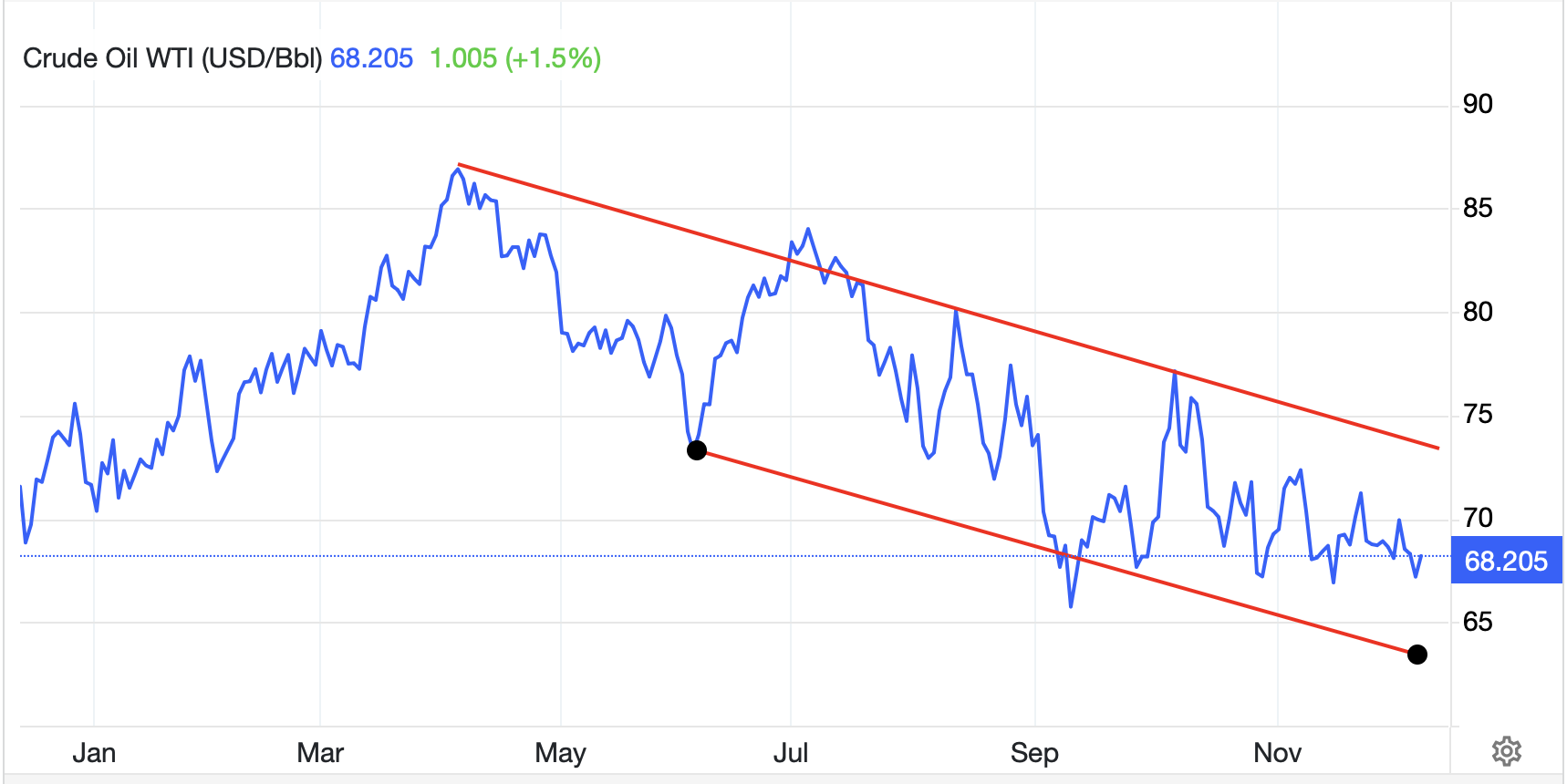
Interestingly, the answer, so far, is none whatsoever.  The obvious first concern would be in oil markets given the proximity to the major oil producing regions in that part of the world.  However, while oil (+1.4%) is a bit higher this morning, it remains well below $70/bbl and while I am no technical analyst, certainly appears to be well within a downtrend as per the below chart.

Source: tradingeconomics.com

Next on our list would be the FX markets, perhaps with expectations that haven currencies would be in demand.  Yet, the dollar is sliding against most of its counterparts this morning, with the notable exception of the yen (-0.3%) which is the one currency under more pressure.  That is the exact opposite behavior of a market that is demonstrating concern over future disruptions.  As to securities markets, they are much further removed from the situation and while US futures are edging lower at this hour (6:20), slipping about -0.15%, overnight activity showed no major concerns and European bourses are mixed, but all within 0.3% of Friday’s closing levels.  

Finally, bond markets are essentially unchanged this morning, with Treasury yields higher by 1bp and European sovereigns almost all unchanged on the day.  We did see yields slip a few bps in Asia, likely on the back of the weaker than forecast Chinese inflation data, but the bond market is certainly showing no signs of concern over the geopolitics of the moment.

On Sunday the Chinese did meet
And promised they’d finally complete
Their stimulus drive
And therefore revive
The growth that has been in retreat

A story that has had an impact on markets this morning is the Chinese Politburo’s comments that they are going to implement a “more proactive” fiscal policy in the upcoming year along with “moderately loose” monetary policy as President Xi scrambles to both improve the growth impulse and prepare for whatever President-elect Trump has in store for China once he is inaugurated.  Now, we have heard these words before and to date, each effort has been, at the very least, disappointing, if not irrelevant.  But hope is a trader’s constant companion and so once again we saw specific markets respond to the news.

Interestingly, mainland Chinese shares did not respond as enthusiastically as one might have expected with the CSI 300 actually slipping -0.2%.  But the Hang Seng (+2.75%) embraced the news warmly.  In the FX markets, early weakness in CNY was reversed although the renminbi closed the onshore session essentially unchanged on the day.  The big winners were AUD (+0.9%) and NZD (+0.5%) as traders bid up the currencies of the two nations likely to benefit most given their export profiles of commodities to China.  But beyond those market moves; it is hard to make a case that anyone was listening.

Ok, let’s look at the rest of the overnight session and see what we can anticipate in the week ahead. Japanese shares (Nikkei +0.2%) were little changed overnight while the big mover in Asia was Korea (-2.8%) as the ructions from the brief interlude of martial law last week continue to weigh on the short-term future of the government and economy there.  However, away from those markets, the rest of Asia saw movement of just +/- 0.3% or less, hardly newsworthy.  In Europe, the story is also mixed with the CAC (+0.5%) leading the way higher, perhaps on the back of the successful reopening of the Notre Dame cathedral, or more likely on the back of hopes that the luxury goods sector would improve based on Chinese stimulus supporting that economy.  As to the rest of the continent, more laggards than winners but movement has been small, 0.2% or less, although the FTSE 100 (+0.4%) is also higher this morning led by the mining shares in the index, also related to Chinese stimulus.

We have already discussed the bond market, which has been extremely quiet ahead of this week’s CPI and next week’s FOMC meeting so let’s turn to the commodity markets, where not only is oil rallying, perhaps more related to China than the Middle East, but we are seeing metals markets rally as well with both precious (Au +0.9%, Ag +2.2%) and industrial (Cu +1.6%, Zn +2.0%) performing well.  Surprisingly, aluminum (-0.25%) is not playing along this morning but if the China story is real, it should follow suit.

Finally, the rest of the currency story shows KRW (-0.5%) continuing to feel the pain, along with its stock market, from the politics last week.  At the same time, we are seeing solid gains in ZAR (+1.1%) on the metals moves and NOK (+0.4%) on the back of oil’s rally.  Elsewhere, while the dollar is broadly softer, it is of a much lesser magnitude, maybe 0.2% or so.

On the data front, this week brings two central banks (BOC and ECB) and a bunch of stuff, although CPI on Wednesday will be the most impactful.

TuesdayNFIB Small Biz Optimism94.2
 Nonfarm Productivity2.2%
 Unit Labor Costs1.9%
WednesdayCPI0.2% (2.7% Y/Y)
 -ex food & energy0.3% (3.3% Y/Y)
 BOC Meeting3.25% (current 3.75%)
ThursdayECB meeting3.0% (current 3.25%)
 Initial Claims220K
 Continuing Claims1870K
 PPI0.3% (2.6% Y/Y)
 -ex food & energy0.2% (3.3% Y/Y)

Source: tradingeconomics.com

Last week saw what appeared to be stronger payroll data on the surface, with the NFP rising 227K and upward revisions, while the Unemployment Rate rose the expected 1 tick to 4.2%.  As well, Average Hourly Earnings rose more than expected, to 4.0%.  And yet, the Fed funds futures market raised the probability of a rate cut next week to 87% (it was over 90% for a while in the session).  Now, there has been a group of analysts who have been claiming that the headline payroll data is very misleading and actually the jobs market is much weaker than the administration is portraying, and it seems they got a bit more traction in their case last week.  Nonetheless, it is hard for me to look at the data and justify another rate cut by the Fed, at least if their objective is to push inflation back to 2.0%.  Of course, that is another question entirely!

Mercifully, the Fed is in their quiet period so we will not hear from them until they pronounce things at the FOMC meeting a week from Wednesday.  Until then, I expect that the China story, as well as assorted Trump related stories, will drive things although keep a wary eye on the Middle East for anything more explosive.  As to the dollar, I have consistently explained that if the Fed eases in the face of rising inflation, that will undermine the greenback.  It will be very interesting to see how things play out this week and next as a set-up for 2025.  For now, I don’t see a good reason for a large move, but if I were a hedger, I would make sure that I am as hedged as I am allowed to be.

Good luck

Adf