That Trade Again

Remember when everyone knew
That BOJ hikes would come through
The Fed would cut rates
And all the debates
Were focused on what next to do?
 
It turns out the very next thing
For those getting back in the swing
Was selling the yen
(Yes, that trade again)
And buying stuff that has more zing


We all know that the carry trade died two weeks ago.  After all, the BOJ hiked rates in a surprise to the markets which was followed by Chairman Powell essentially promising to cut rates.  Those actions spooked traders, and arguably algorithms as well, and we saw a dramatic decline in equity markets around the world, led by Japanese stocks.  The premise was that much of the market activity was driven by borrowing yen at near 0.0% and then converting those yen into other currencies and buying other assets, or just depositing the dollars, or Mexican pesos or Brazilian reals and earning the interest rate differential.

Now, don’t get me wrong, that was an active trade and clearly a part of the ongoing risk asset rally that was evident throughout most of the world.  But that trade took several years to build up, and the idea that it was unwound in a week is laughable.  But, that sharp move two weeks ago succeeded in doing one thing, it scared the 💩 out of the central bankers around the world.  Within days, the BOJ walked back all their tough talk about normalizing monetary policy and ending QQE.  As well, despite desperate calls from some of the punditry for an emergency rate cut, or at the very least, a guarantee of a 50bp cut in September by the Fed, the few Fed speakers we have heard continue with their mantra that while some things are looking encouraging, the time is not yet right to cut rates.

And, you know what that means?  It means that the interest rate differentials between Japan and the rest of the world remain plenty wide enough to reinvigorate that self-same carry trade that was declared dead just two weeks ago.  The obvious proof is in the equity markets which, while not quite back to the highs of July 16th, have rebounded between 6.8% (S&P500) and 8.8% (NASDAQ) from the bottoms seen at the beginning of the month.  (see chart below)

A graph of a line graph

Description automatically generated with medium confidence

Source: tradingeconomics.com

But equally important to this story is the fact that the yen has declined more than 4% from its highs at the peak of the fear as investors are far less concerned about much tighter BOJ policy.  This is also evident in the JGB market, where 10-year yields, while climbing 3bps overnight, remain well below the 1.0% level that was seen as a harbinger of the new monetary framework in Japan.

A graph showing the price of a stock market

Description automatically generated

Source: tradingeconomics.com

Of course, there has been other news that has abetted this price action, namely the recent US data which showed that the employment situation may not be as dire as the NFP report at the beginning of the month.  This was demonstrated yet again yesterday when Initial Claims fell to 227K, its lowest point in 5 weeks and the second consecutive decline in the result.  As well, Retail Sales were a much stronger than expected 1.0% (although the autos component seemed a bit funky), indicating that real economic activity was still growing.  Granted, the IP (-0.6%) and Capacity Utilization (77.8%) data were soft as were both the Philly Fed (-7.0) and Empire State Manufacturing (-4.7) surveys, but none of that matters when the markets get on a roll.

If I had to describe the narrative this morning it would be, everything’s fine.  The economy is still doing well, the jobs market is not collapsing, and the Fed is still on track to cut rates next month.  Goldilocks has come out of hiding and is back headlining the show.  While there are still some doubters out there, their voices are being drowned out by all the shouting to buy more stocks.

So, as we head into the weekend, let’s see how things have performed overnight.  In Asia, markets everywhere rallied following the strength in the US yesterday.  The Nikkei (+3.6%) led the way and has now rebounded more than 20% from its nadir at the height of the fear.  But the Hang Seng (+1.9%) showed strength and we saw strength throughout the region (Australia +1.3%, Korea +2.0%, India +1.7%) with one notable exception, mainland China, where shares edged up just 0.1%.  It seems that President Xi has, at the very least, a marketing problem with respect to getting investors to put money into China. In Europe, most markets are higher between 0.25% (CAC) and 0.6% (DAX) although the FTSE 100 (-0.4%) is struggling this morning after Retail Sales data there were seen as less than stellar.  As to the US, ahead of the opening futures markets are little changed at this hour (7:15).

In the bond market, yesterday’s stock euphoria played out as a sale of bonds with the corresponding rise in yields of 7bps in the US Treasuries.  However, this morning, those yields have backed off by 5bps and we have seen similar price action throughout Europe with sovereigns there showing yield declines of between 3bps and 5bps after following Treasury yields higher yesterday.  For now, bonds are certainly behaving like a haven asset.  Also, it is worth noting that the yield curve inversion is back to -17bps, edging slowing away from normalization.

In the commodity markets, after a solid performance yesterday, oil (-2.6%) is under real pressure this morning as market participants look to the lackluster Chinese economic activity and are worried that demand is not going to pick up anytime soon.  Certainly, yesterday’s Chinese data was nothing to write home about, and this morning they released their Foreign Direct Investment data showing it had decline -29.6% YTD in July.  This does not inspire confidence.  In fact, under the rubric a picture is worth 1000 words, here is a chart of that Chinese FDI.  It seems clear that something has changed in the way the world views China.

A graph of blue and orange lines

Description automatically generated

Source: tradingeconomics.com

As to the metals markets, gold (+0.4%) continues to find support as despite the equity rally, there remains a steady interest to hold something other than USD and fiat currencies.  However, the rest of the complex is softer this morning as weaker industrial activity would indicate less demand.

Finally, the dollar is ceding some of its gains from yesterday with some pretty substantial moves in both G10 and EMG blocs.   Versus the G10, the yen, which fell sharply yesterday, has rebounded 0.75% this morning, although remains above 148.  But we have seen strength in AUD (+0.3%), NZD (+0.7%) and GBP (+0.35%) as virtually all the G10 is firmer.  The pound is a bit odd given the equity market’s response to the UK data, but the other currencies seem to be simply retracing yesterday’s weakness.  In the EMG bloc, ZAR (+0.4%) is firmer on the back of gold and the generally weak dollar, but we are seeing MXN (-0.2%) lag the move.  CNY (+0.2%) is also benefitting today as broad dollar weakness plays out far more aggressively here than it has historically.  While the dollar’s long-awaited demise is still far in the future, today it is under some pressure.

On the data front, this morning brings Housing Starts (exp 1.33M), Building Permits (1.43M) and Michigan Consumer Sentiment (66.9).  As well, this afternoon we hear from Chicago Fed president Goolsbee.  He has been one of the more dovish FOMC members so look for him to talk up the chances of a more aggressive rate cut next month.  However, there is still a lot to learn between now and then with PCE next week, then another NFP and CPI report as well as the Jackson Hole conference.  As it stands this morning, the Fed funds futures market is pricing a 27% chance of a 50bp cut, with 25bps a lock.  But if the data continues to shine, please explain why they need to cut.  I think we are in a ‘good news is good’ scenario, so strength in this morning’s data should support the dollar and weakness impair it.  We shall see.

Good luck and good weekend

Adf

A Joyous Occasion

For those of a certain persuasion
Wednesday was a joyous occasion
Though CPI rose
The doves did propose
That rate cuts complete their equation
 
They claim that the speed of its rise
Is slowing, so Jay should surmise
It’s time to cut rates
Cause everyone hates
When stocks don’t make further new highs


Yesterday’s CPI reading was, on the surface, slightly softer than markets had been expecting.  The headline reading of 2.9% was the slowest increase Y/Y since March 2022.  Of course, back then we were repeatedly told inflation was transitory.  However, looking at the chart below, created by wolfstreet.com, it seems pretty clear that the main driver of the recent decline in the CPI readings has been Durable Goods.

A graph of a number of lines

Description automatically generated with medium confidence

I guess it’s possible that durable goods prices continue to deflate going forward, but that seems unlikely, at least based on the historical record.  While the auto industry, a key segment of the durable goods data, has obviously struggled lately, with significant unsold inventories of EV’s building up and dealer incentives to sell them driving prices down, if you’ve looked for a new washer/dryer or refrigerator lately, I haven’t seen the same price action for those goods.  As to the largest driver of the CPI readings, the shelter component, those numbers were higher than last month and more in line with the overall trend we have seen there for the past several years.  Owners Equivalent Rent, the biggest piece of this puzzle, rose 0.4% in July, just what it has been doing for the previous two plus years prior to the June reading.

In the end, while it was nice to see a headline print below 3.0%, it is not clear to me that inflation is defeated.  Other than the fact that Powell essentially promised he would be cutting rates next month, the data released since the last meeting is not screaming out for more support.  Certainly, the employment report was softer than the forecasts, but it was not indicative that we are in a recession.  And the CPI report, while ever so slightly softer than forecast, is also not a clear signal that things are collapsing in the economy.  I’m pretty confident that Powell will cut next month, but absent some really awful August data, released in early September ahead of the next FOMC meeting, it seems like 25bps is all we should expect.  Even the Fed funds futures market is slowly turning toward that view with the probability of a 50bp cut falling to 37.5% this morning.

The other news of note last night was the monthly Chinese data dump which was, on the whole, not very inspiring.  The best news was that Retail Sales there rose 2.7% Y/Y in July, slightly more than expected.  However, IP and Fixed Asset Investment were both weaker than forecast and weaker than last month although higher than Retail Sales.  Meanwhile, Housing prices continue to decline, -4.9% Y/Y, and the Unemployment Rate ticked up to 5.2%.  As yet, there has been no significant commentary from the government, but the ongoing weakness has encouraged some traders and investors to expect that President Xi will authorize some much larger stimulus in the near future.  At least that’s the story behind the rally in the CSI 300 (+1.0%) last night, because there are few other highlights from the Middle Kingdom.

With this in mind, and as we await this morning’s US data releases, let’s tour the markets to see how things played out after the modest US equity rally yesterday.  Aside from China, in Asia Japanese stocks did well (Nikkei +0.8%) although Hong Kong did not go along with the Chinese story.  Australian employment data was released, arguably a touch better than expected but that good news reduced the chances for a rate cut so equities there only edged higher by 0.2%.  As to the rest of the region, there were some gainers (Korea, New Zealand, Singapore) and some laggards (Taiwan, Indonesia).  

In Europe this morning, the story is one of a seeming lack of interest with no major market having moved more than 0.2%, whether higher or lower, on the session.  On the data front there, the UK GDP data was just a touch softer than the forecast, and the Y/Y output of 0.7% shows that problems remain in the economy.  It will be interesting to see if the new government there can adopt policies that help rejuvenate the nation.  As to the FTSE 100, it is basically unchanged on the day, arguably tension between weaker growth prospects clashing with hopes for rate cuts to support things.  Meanwhile, on the continent there was nothing of note and no major movement.  And lastly, US futures, at this hour (7:00), are little changed awaiting the US data.

In the bond market, Treasury yields, after a little early gyration following the CPI release, basically closed the day unchanged and remain at those levels this morning.  the yield curve remains mildly inverted, just -11bps this morning, but it seems it will require the Fed to actually cut rates, or much worse economic data, to get that process complete and normalize the curve.  In Europe, sovereign yields are largely unchanged, or perhaps higher by 1bp this morning amid very little activity.  Also, a quick look at JGBs shows that while the yield edged up 1bp overnight, the level is still just 0.82%.  I would contend that any ideas of a quick normalization of interest rates in Japan are fading away.

In the commodity space, oil (+0.85%) is rebounding after data showed net draws across all products yesterday.  Obviously, the Iran/Israel situation remains live, but it feels like markets are losing interest in that story.  As to the metals, gold (0.4%) is recouping yesterday’s losses and both silver and copper are firmer this morning, not so much on the demand story, but more on the supply story with potential strikes at key mines in Chile and Peru.

As to the dollar, it is little changed, net, on the day, although it is no surprise to see the commodity bloc performing well (AUD +0.5%, ZAR +0.5%, NOK +0.4%).  But away from those currencies, the euro is unchanged, though the pound (+0.3%) seems to be benefitting from the GDP data.  The yen, too, is unchanged on the day while CNY (-0.2%) is under pressure from the weak data there.  Again, I will note that CNY’s volatility has definitely increased over the course of the past several months.  Partly this is because all currency volatility has moved higher, but I believe there is some real China specific aspect to this change.  Beware as this could continue going forward.

On the data front, this morning brings a bunch here at home:

Initial Claims235K
Continuing Claims1880K
Retail Sales0.3%
-ex autos0.1%
Empire State Manufacturing-6.0
Philly Fed7.0
IP-0.3%
Capacity Utilization78.5%

Source: tradingeconomics.com

You may recall that last week’s Initial Claims number was seen as a savior when it printed a bit lower than forecasts.  However, if the Unemployment Rate is truly heading higher, it would seem that we should see this number resume its climb.  Right now, it is not clear to me if good news is good or bad and vice versa. Generically, the narrative still wants to push for as many rate cuts as quickly as possible, I think, but if the data starts to collapse, that will not be a positive either.  I suspect that Retail Sales is today’s key release.  A strong number there will further reduce the probability of a 50bp cut in September and may weigh on equity markets.  

We also hear from St Louis Fed President Alberto Musalem this morning, one of the newer members of the FOMC who has not spoken much.  However, he appears to be more on the hawkish side thus far.  In my view, markets are looking for reasons to continue to push equities higher but are not getting all the love they need.  The problem is that it is not clear what the right medicine for that is right now.  Strong data may support the economy but reduces the probability of rate cuts, or at least the amount of rate cutting that will come.  As to the dollar, it has been under some pressure of late and I think it will be very clear that weak data will encourage dollar selling and vice versa.

Good luck

Adf

The Mantra Repeated

Inflation has now been defeated
At least that’s the mantra repeated
By equity bulls
Who’re buying bagfuls
Of stocks which last week had depleted
 
But what if the data today
Does not show inflation’s at bay?
Will pundits still call
For Fed funds to fall
Or will cooler heads get their way?


As last week fades into the mists of memory, the narrative writers have been hard at work reimposing the soft-landing thesis and how the Fed is going to ride to the rescue of what seems to be slackening data across most aspects of the economy. The latest piece of information was yesterday’s PPI numbers that indicated, at the producer level, price pressures were ebbing further.  In fact, the core PPI reading for July was 0.0%, a huge victory for the Fed as it continues to add to the story that their timely behavior and strength of will have been having the desired effects.  And maybe they have been doing just that, although there is reason to believe that other things are happening.

Regardless, with the much more important CPI data set to be released this morning, if those PPI numbers are “confirmed” with lower than forecast CPI numbers, there will be no stopping the equity rebound/rally and expectations for a 50bp cut at the September meeting will run rampant.  The current median forecasts, according to tradingeconomics.com are: 

  • Headline (0.2%, 3.0% Y/Y); and 
  • Core (0.2% (3.2% Y/Y).  

Almost by definition, at least half of the punditry is looking for a headline print with a 2 handle, substantially closer to the Fed’s target than we have seen since March 2021.  The basis of this view is that shelter costs are going to continue to trend lower and there is a growing expectation that used car prices are also destined to head lower.  Given the way that shelter costs are implemented in the CPI calculations, I have no opinion on how recent activity will impact the overall results.  However, the anecdata that comes from my neighborhood shows that homes continue to sell over asking prices in short order and that there is no sign of prices declining yet.  I know that what happens here is not necessarily occurring elsewhere in the country, but it is unlikely to be entirely unique.  I guess we’ll all see the answer at 8:30.

In the meantime, the market story has been twofold, equity bulls are basking in the glow of the rebound from last week’s dramatic declines and the interest rate doves are completely willing to ignore actual Fed commentary and are increasing their bets that the Fed starts this cutting cycle with a 50bp reduction.  

As can be seen in the graphic below from the cmegroup.com website, the 50bp cut story is slightly more than a coin flip at the moment.  

A screenshot of a computer

Description automatically generated

But the interesting thing is to see how this pricing has evolved over the past month.  Looking at the table at the bottom of the graphic shows that last week, in the wake of the Japanese market selloff, the belief was much stronger that a 50bp cut was on the way (in fact, on July 5th, that probability was >90%), but a month ago, it was a very low probability event.  Back then, it was only the true believers in an upcoming recession that were looking for 50bps.  But now, it is mainstream thinking, at least among the punditry.  Yesterday, Atlanta Fed president Raphael Bostic explained, “we want to be absolutely sure.  It would be really bad if we started cutting rates and then had to turn around and raise them again.”  However, he did acknowledge that he is likely to be ready to cut “by the end of the year.”  While I have never met Mr Bostic, this does not sound like a man who is desperate to cut interest rates soon, narrative be damned.

Ok, away from all the huffing and puffing on US CPI, we did get some other important news overnight.  The first thing was the RBNZ surprised many folks by cutting their Official Cash Rate by 25bps.  Apparently, they are concerned with slowing growth and gratified that inflation appears to be slowing.  The upshot was that the NZD (-1.0%) fell sharply and the local stock market rallied more than 2%.

Elsewhere, UK inflation was released at a lower than expected 2.2% for July.  While that was an uptick from the June level of 2.0%, the fact that it was lower than both the BOE and Street expectations, and that services inflation rose “only” 5.2%, down from the 5.7% reading in June, has traders increasing their bets for a rate cut in September.  The pound (-0.2%) did slip slightly on the report but remains modestly higher on the year.  As to the FTSE 100, its 0.3% gain pales in comparison to the type of movements we have been seeing in equity markets elsewhere.

The zephyrs of change
Are blowing throughout Japan
Kishida’s leaving

One last piece of news is that Japanese PM, Fumio Kishida, has announced that he will not be running for LDP party leadership, the critical post to become (or in his case remain) Prime Minister.  A series of fundraising scandals has dogged his entire administration, and his approval rating remains below 30%.  The market take is that his leaving will enable the BOJ to act more aggressively, at least according to some local analysts and all depending on who wins the election.  While several of the mooted candidates are on record as calling for more monetary policy normalization (i.e. rate hikes), they are not the leading candidates at this time.  It seems early to make that case in my mind.  In the meantime, while the BOJ may want to raise rates, I think they are going to wait for more rate cutting in the rest of the G10, specifically from the Fed, before considering their next move.  Net, the yen’s response to this story has been nil, although we did see Japanese equities rally (Nikkei + 0.6%).

Elsewhere in equity markets, both the Hang Seng (-0.35%) and CSI 300 (-0.75%) continue to languish relative to other markets around the world as the prospects for the Chinese economy, and by extension its companies, remains lackluster, at best.  The absence of any significant Chinese stimulus remains a weight on the economy and the markets there.  However, most other markets in Asia rallied nicely overnight, following the US price action yesterday.  As to European bourses, they are all green, but the movements have been modest, on the order of 0.3% or so, as Eurozone economic data continues to disappoint (IP -0.1% in June, exp +0.5%).  As to US futures, ahead of the CPI data, they are essentially unchanged.

In the bond market, Treasury yields continue to grind lower, falling 7bps after the PPI data yesterday and down another basis point ahead of the CPI today.  European sovereign yields, though, are slightly higher this morning, between 1bp and 2bps, which based on the data makes no sense.  But the moves are small enough to be irrelevant.  One outlier here is UK Gilt yields, which have declined 4bps on the softer inflation print.

Oil (-0.2%) which suffered yesterday has stopped falling for the moment as the market remains on tenterhooks regarding a possible Iranian attack on Israel.  In the meantime, expectations are for a further draw of oil inventories in the US, although the industry continues to pump an extraordinary 13.4 million bpd despite all the efforts of the current administration to stifle it.  As to the metals markets, gold (+0.4%) continues to find support and is pushing toward new highs yet again.  This morning it is taking the rest of the metals complex with it, although that could be a result of the dollar’s modest weakness.

Finally, the dollar is a bit softer overall this morning, but there are several idiosyncratic stories.  We’ve already mentioned NZD, GBP and JPY.  However, the euro (+0.25%) is now at its highest level of 2024 and back above 1.10.  Meanwhile, the commodity currencies are mostly firmer vs. the dollar this morning (ZAR +0.3%, MXN +0.3%, NOK +0.6%, SEK +0.5%) although Aussie (-0.2%) is bucking that trend.  One other noteworthy mover is CNY (+0.2%) which has been showing far more volatility than normal in the past two weeks.  It seems it is still coming to grips with the Japanese story as well.

And that’s really it for the day.  There are no Fed speakers on the calendar, but we must always be aware of some unscheduled interview.  Remember, they love to talk.  Right now, I would say the market is looking for softer inflation data and is pricing accordingly.  As such, if this data is even modestly warm, let alone hot, be ready for some quick reversals, at least early in the session.  So, stocks lower with bonds while the dollar climbs.  But based on the current zeitgeist, I have to believe that any dip will be bought with reckless abandon.

Good luck

Adf

Data Confusion

The ongoing data confusion
Is certainly not an illusion
Some numbers are solid
While others are squalid
And each begs a different conclusion
 
Last night, Chinese data revealed
The ‘conomy there hasn’t healed
And Germany’s ZEW
Showed weakness, beaucoup
More rate cuts will soon be, out, wheeled
 
But here in the US we learned
The NFIB, up, had turned
And yesterday showed
Inflation has slowed
Investors, though, still are concerned


As we await today’s US PPI data, and more importantly, tomorrow’s US CPI data, the one consistency we have observed is that the data remains all over the map.  Or does it?  The below chart (data from NY Fed, chart from @fx_poet) shows the median readings of 1-year ahead and 3-year ahead inflation expectations, based on a survey of 1300 households.  While the 1-year ahead expectations are unchanged at 3.0%, the 3-year ahead expectations fell to 2.3%, the lowest in the series’ history since the NY Fed began the survey in June 2013.

If you’re Jay Powell, that certainly must be good news as the Fed puts great stock into the idea that inflation expectations lead inflation outcomes. While this is not a universally held belief amongst economists and analysts, it is certainly the majority view.  However, given that the Fed is a strong believer in this theory, the fact that inflation expectations, as measured here, are declining will help inform their decisions going forward.  Based on this, it is easy to believe that September will bring a 50 basis point cut.

Of course, one might ask, why are inflation expectations declining?  And that is not part of the data that is collected, or at least not reported.  If the expectation is that the economy is headed into recession, that implies there is still great concern amongst households going forward.  However, if this result is due to a strong belief in the Fed’s policies, then economic optimism should abound.  As such, we need to see other data to help interpret things.

Perhaps the first piece we can observe is this morning’s NFIB Small Business Optimism Index, which printed at 93.7, its highest level since March 2022.  That is certainly encouraging as given the importance of small businesses to the overall economy, if things there are starting to look up, it should translate into stronger growth going forward.  On the flip side, in the anecdata department, earnings calls from Expedia, Marriott, Airbnb and Hilton indicated that there is real weakness in the travel economy.  This WSJ report indicates that perhaps things are not as strong as might be indicated by other data.

Now, if we look overseas, the data is also mixed, but there is more negative than positive.  For instance, Chinese money and lending data was released at substantially lower levels than last month and well below expectations.  As well, the PBOC is becoming very concerned about the Chinese bond market inflating a bubble.  Last week, ostensibly, they told several banks to renege on deals to buy Chinese government bonds because they are trying to prevent the back end of the yield curve from declining too far.  It seems they are worried (and probably rightly so) that regional Chinese banks don’t have the capability to manage interest rate risks effectively.  But slowing loan growth and a weak equity market continue to indicate that the Chinese economy is lagging.

As to Europe, the German ZEW data was released and it was, in a word, putrid.  The Economic Sentiment Index fell from 41.8 to 19.2, far below expectations while the Current Conditions index fell to -77.3.  Granted, these surveys were taken the week after the weak NFP data in the US when people were screaming for an emergency 75bp rate cut, so perhaps they are not reflective of the ongoing situation.  But this highlights the problems with survey data, if you are asked about something on a day when the world seems to be ending, your response is likely to be more negative than not.  In fact, this is a caution for all survey data.

So, what are we to make of all this mixed information?  Well, we are right where we started, with no clearer picture of the current situation, let alone how the future may unfold.  In fact, this is why unfettered markets are so important.  Markets are excellent indicators of both future activity and sentiment, and when they are manipulated for political outcomes, investors lose a great deal of information.

But let’s see what the markets are telling us today.  Yesterday’s US session was mixed with modest gains and losses across the board.  But I’ll tell you what, last night Tokyo took the bull by the horns and continued its strong rebound from the previous week’s collapse with the Nikkei rallying 3.5%.  it seems that not only was this move a continuation after the Monday holiday of last week’s rebound, but a former BOJ official, Makoto Sakurai, explained, “they [the BOJ] won’t be able to hike again, at least for the rest of the year.  it’s a toss-up whether they can do one hike by next March.”  You will not be surprised that traders and algorithms jumped on those comments to buy more stocks.  As to the rest of the major markets in Asia, they mostly edged slightly higher, but only about 0.2% or so.  In Europe, there are more laggards than gainers, with the CAC (-0.3%) the worst of the bunch, but as you can see by the relatively small decline, markets here are also quiet.  Finally, US futures are up 0.4% at this hour (8:15).

In the bond market, yields are edging lower this morning with Treasuries down -1bp while European sovereigns are lower by between -2bps and -3bps.  Given the tenor of the economic data, this should be no surprise.  Interestingly, JGB yields remain unchanged at 0.83%, well below that 1.00% critical level and hardly indicative that the BOJ is going to tighten further.

In the commodity space, oil (-0.5%) after touching $80/bbl for WTI yesterday, is slipping a bit as traders await the apparently imminent Iranian attack on Israel to see if a wider war starts.  Meanwhile, the metals complex is lower across the board with gold (-0.4%) giving back some of yesterday’s gains while copper (-1.0%) is also under pressure, arguably on the weak economic story.

Lastly, the dollar is firmer this morning, notably against the yen (-0.3%) and CHF (-0.4%) although there are exceptions to this rule.  I find it quite interesting that the yen carry trade unwind story has basically ended with several large banks explaining that the alleged $20 trillion that was outstanding has been unwound.  Personally, I think that is ridiculous and that there is plenty left in place.  Remember, this trade has been building since the Fed began raising interest rates in 2022 and there are many investors whose entry points are far, far below the current spot level.   A quick look at USDJPY over the past 5 years shows that while the latest batch of entrants may have left the building, there is likely still a lot of borrowed yen funding other positions.

A graph with a line drawn on it

Description automatically generated

Source: tradingeconomics.com

When the Fed started raising interest rates, USDJPY was about 115.  I assure you the carry trade has not ended.

Turning to the data, this morning brings PPI (exp headline 0.2%, 2.3% Y/Y) and (core 0.2%, 2.7% Y/Y), although I believe the data will need to be very different for traders and investors to change their view that inflation is continuing to decline.  And later this afternoon, Atlanta Fed President Bostic speaks.

I believe the narrative remains that the soft-landing is still in play and that the Fed’s cut in September will be adequately timed to prevent a recession.  As of this morning, the futures market is still pricing in a 50:50 chance of either a 25bp or 50bp cut.  Right now, my money is on 25bps, but there is a lot to learn between now and then.  In the meantime, it is hard to turn too negative on the dollar as everybody else is cutting rates as well, and growth elsewhere seems anemic at best.

Good luck

Adf

Scuppered

There once was a time many thought
That equities had to be bought
Then, darn it, Japan
It scuppered the plan
And havoc is all that they wrought
 
So, last week, not greed, but fear, won
And risk assets ended their run
But now folks are sure
In fact, it’s de jure
That rate cuts, next month, are, deal, done


Congratulations everyone.  You made it through the end of the world!  I must admit, though, that on this side of that extraordinary event, things don’t really seem that different.  A quick recap reminds us that on July 31st, the BOJ surprised markets and raised interest rates by 15bps, taking their overnight funding rate to 0.25%, its highest level in 15 years.  Twelve hours later, the FOMC did not cut rates, as some had been advocating, but seemed to promise that a cut was coming in September.  Then, two days later, the US employment report showed substantially weaker jobs activity than expected.  Over the ensuing several sessions, USDJPY declined dramatically, falling nearly 10 big figures as can be seen in the first chart below.

A graph with numbers and a line

Description automatically generated

Source: tradingeconomics.com

After an initial reflexive trading bounce, it was starting to slide again when, on August 6th, BOJ vice-governor Ichida explained that the BOJ would not, in fact, be aggressively tightening policy immediately.  The result was a relief rally and now USDJPY sits about halfway between the level prior to the rate hike and the low’s plumbed afterwards.

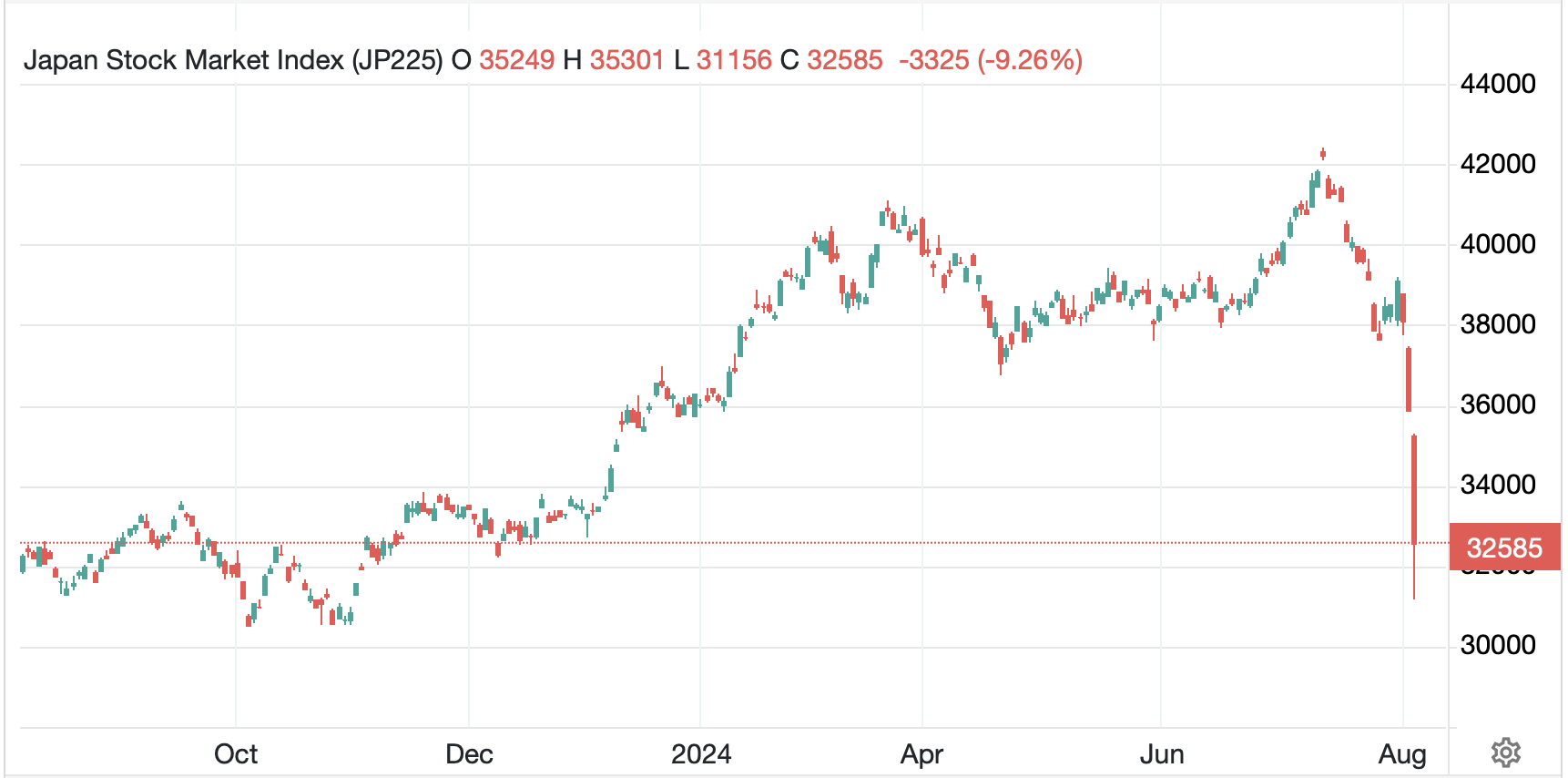
Perhaps just as interesting is the fact that the Nikkei 225 showed virtually the identical trading pattern, with its decline last Monday, August 5th, as the second largest single-day decline in its history.

Source: tradingeconomics.com

And yet, it is not hard to see that the trading pattern for both the Nikkei 225 and USDJPY are virtually identical, with the same catalysts.  In fact, we can look at other markets, 10yr Treasury yields and the NASDAQ come to mind, and see extremely similar price action.  (Alas, I couldn’t get the BOJ and Unemployment rate points on the combined chart, but you can see it is the same pattern.)

A graph of stock market

Description automatically generated

Source: tradingeconomics.com

The one truism that holds is that during a time of stress, all correlations go to one!

But perhaps it’s time to consider, once again, the idea of recession.  As of now, there are still two camps:

  1. Recession is already here and started sometime in the late spring.  This is based on the declining trend in manufacturing activity, the rise in the unemployment rate (the Sahm Rule), the rising number of bankruptcies and increasing size of household debt along with delinquencies.  Constant downward revisions of previous data releases also weigh on the view, and of course, the yield curve continues to point to lower interest rates going forward, the implication being growth is slowing.  One last feature is the dramatic difference between GDP and GDI, two different measures of US economic activity that should show the same thing, however currently, GDI (Gross Domestic Income) is printing below 1% real growth.
  • Meanwhile, the soft/no-landing scenario remains popular amongst a different set of analysts.  Perhaps the most comprehensive discussion comes from Apollo Research’s Torsten Slok as he highlights the fact that real-time indicators like air travel, restaurant seatings, income tax withholdings and Retail Sales remain quite strong.  As well, the Atlanta Fed’s GDPNow is currently running at 2.9%, which certainly doesn’t appear to be pointing to a recession.

So, which is it?  Of course, that’s the $1 trillion question.  However, let us consider a few incontrovertible truths.  First, business cycles still exist.  Despite all the efforts by finance ministries and central banks to create an ever upward trajectory in economic activity, or more accurately because of those efforts, excesses are created and at some point, that growth is no longer sustainable.  In other words, governments and central banks blow bubbles and eventually they pop.  Second, not all parts of the economy grow at the same pace and respond to the same catalysts in a similar manner.  So, certain parts of the economy may be under pressure while others are doing fine.  Third, trees don’t grow to the sky.  There are no magic beans which grow that beanstalk ever higher.  Rather, at some point, gravity becomes a stronger force, and things return to earth. 

From this poet’s viewpoint, we are continuing to see sectoral weakness that has not yet tipped into general weakness.  We’ve all heard about commercial real estate and the problems ongoing in that sector.  As well, we’ve all heard the excitement about AI and the massive (over)investment that has been focused on that sector, supporting the companies at the heart of the story.  In between, there are many shades of grey with some areas holding up better than others.  But on an economy-wide basis, it seems likely that given the amount of ongoing fiscal stimulus that is still being pumped into the economy, overall, a recession will still be delayed further.

Perhaps the bigger problem for the economy is that inflation remains a very real phenomenon. As the WSJnoted this morning, it is the prices of things with which we cannot do without (e.g., food, shelter, insurance) that continue to rise, rather than the discretionary items, which seem to see prices ebbing.  Ultimately, the downturn will come, but you can be sure that the government, and the Fed, will do all they can to prevent it happening, at least before the election.

Ok, with that in mind, let’s look at markets overnight as well as what this week’s data releases will bring.  After modest gains in the US on Friday, with the early part of last week’s dramatic declines essentially elimiated, Asian equity markets were generally stronger (Korea, Taiwan, Australia) although Chinese shares continue to lag (CSI 300 -0.2%) as data showed that investment into China has turned to divestment from China for the second quarter of the past four. (see chart below).  This is obviously not a positive story for the Chinese economy or its equity markets.  As an aside, Japanese markets were closed for a holiday last night.

A graph of a graph showing the value of a stock market

Description automatically generated with medium confidence

Source: Bloomberg.com

Meanwhile, European bourses are generally little changed, +/-0.15% or less except for the UK, where the FTSE 100 is higher by 0.5% despite hawkish comments from BOE member Catherine Mann warning against complacency on inflation and pushing back against the idea of consistent interest rate cuts.  Lastly, US futures are edging higher at this hour (7:15), up about 0.2% across the board.

In the bond market, yields are edging back up this morning, with Treasuries higher by 2bps and similar gains across all of Europe.  To the extent that government bonds are serving as havens again, the idea that equity markets are rebounding would certainly imply less demand for them.  The one place where yields continue to decline is in China, where 10-year yields are trading near the historic lows seen at the end of July, and clearly still trending lower, an indication that growth expectations are falling.

A graph with a line graph

Description automatically generated

Source: tradingeconomics.com

In the commodity markets, oil (+1.25%) is gaining on the growing expectation that Iran is set to finally respond to Israel and launch a significant assault with fears this can grow into a wider conflagration and impact supply.  That fear seems to be bleeding into gold (+0.5%) as well, which is back toward its historic highs, and taking the entire metals complex (Ag +1.8%, Cu +1.1%) with it.

Finally, the dollar is mixed this morning, rising strongly against the yen (-0.7%) and CHF (-0.5%) but lagging the commodity currencies (AUD +0.5%, NZD +0.5%, ZAR +0.6%).  As to the more financial currencies, like EUR, GBP, CAD, they are little changed on the session.  Ultimately, the story remains driven by expectations of Fed activity with the market currently pricing a 50:50 chance of a 50bp rate cut come September.

On the data front, we do see important things this week as follows:

TodayNY Fed Inflation Expectations3.0%
TuesdayNFIB Small Biz Confidence91.7
 PPI0.1% (2.3% Y/Y)
 -ex food & energy0.2% (2.7% Y/Y)
WednesdayCPI0.2% (2.9% Y/Y)
 -ex food & energy0.2% (3.2% Y/Y)
ThursdayInitial Claims235K
 Continuing Claims1880K
 Retail Sales0.3%
 -ex autos0.1%
 Empire State Mfg Index-6.0
 Philly Fed7.0
 IP0.1%
 Capacity Utilization78.6%
FridayHousing Starts1.35M
 Building Permits1.44M
 Michigan Sentiment66.7

Source: tradingeconomics.com

In addition, we hear from several Fed speakers, with at least three on the docket, but I imagine we will get more than that.  Last week’s fears have been memory-holed.  The vibe this morning is that it was all the BOJ’s fault and that everything is going to be great.  Maybe that will be the case, but I remain a skeptic.  Just consider, if everything is great, why would the Fed cut rates?  And the one thing that seems clear to me is that a Fed rate cut is the base case for virtually everyone. I maintain if they cut, especially 50bps, the dollar will fall sharply.  But if that recession data doesn’t start to appear soon, some folks are going to need to change their views, and positions, regarding how things unfold.

Good luck

Adf

Flags at Half-Mast

Twas just seven days in the past
When fears of recession forecast
Were rapidly rising
And folks analyzing
The data had flags at half-mast
 
But in a remarkable twist
Turns out that recession was missed
Instead, all is great
With not long to wait
Til worries no longer exist!


Until this week, I had always understood the Covid-linked recession to be the shortest on record, lasting just a few months.  But apparently, that is no longer the case.  You may recall that after last Friday’s weaker than expected NFP data and the increase in the Unemployment Rate to 4.3%, the commentariat was certain that the Fed had maintained their monetary policy too tight for too long.  The result was that the US had entered a recession, or at least was on the cusp of one.  Certainly, this appeared to be the market narrative as equity markets sold off aggressively on Friday and then again on Monday.  While there was much discussion of the impact of the BOJ’s policy adjustments and that as an additional catalyst, the key is panic was rampant.

However, it appears it was nothing more than a bad dream.  As of this morning, the S&P 500 is essentially unchanged from where it was at last Friday’s close as can be seen in the chart below.  

A graph on a white background

Description automatically generated

Source: tradingeconomics.com

All of the angst that had been felt because of that NFP print (which was still positive at 114K) and all of the clutching of pearls and gnashing of teeth that analysts suffered was unnecessary as the Fed sensibly made no policy changes and the equity market absorbed some volatility and is back to flat on the week.  

Does this imply everything is fine with the world?  Absolutely not.  There are still numerous concerns for both the economy and the financial markets, notably the bond market, but the world has not ended, and equity markets are reflecting that fact.  

All joking aside, the economy continues to show a mixed picture and arguably the biggest medium-term concern should be the willingness of investors to continue to finance the US deficit.  This is a fundamental that cannot be ignored forever and one that revealed itself again this week as both the 10-year and 30-year auctions had tails* of more than 3 basis points.  The implication of those outcomes is that demand for US Treasury debt at current levels could be waning, and that is a genuine problem.  

Consider that, already, interest payments by the Treasury on its debt exceed $1 trillion annually.  If buyers in the market demand higher interest rates and there are no expenditure reductions (which seems likely regardless of the election outcome), either yields will rise, or other buyers will need to be found.  Who might those other buyers be?  Well, obviously, the Fed is the number one suspect, although if they were to restart QE with inflation running above target, I suspect it would be very difficult to hide and the impact on inflation would likely be to push it higher, clearly not their goal.  Therefore, as I have written before, be ready for regulatory changes that require banks and insurance companies to hold larger portfolios of Treasury securities as part of their capital buffers.  This process would be far more opaque politically but would create the price insensitive bid that the Treasury needs.

To recap, the recession has not yet arrived, investors are climbing out of their foxholes and there are potential concerns regarding the bond market and natural demand for the ongoing increases in issuance.  While next week’s CPI data will be closely scrutinized, my sense is the equity narrative is going to be far more focused on production and consumption than on prices. 

In the meantime, let’s review last night’s session and see how things are behaving as we head into the weekend.  After yesterday’s impressive rally in the US, where all Monday’s fears were erased because the Initial Claims number seemed to indicate the job market wasn’t collapsing, Asian markets had a pretty good session as well.  The Nikkei (+0.6%) and Hang Seng (+1.2%) both followed the US higher as did virtually every other market in Asia except mainland Chinese shares (CSI 300 -0.35%) after Chinese inflation figures printed a touch higher than forecast.  It does seem to feel like the Chinese market is decoupling from the rest of the world.  Meanwhile, European bourses are all firmer this morning led by Spain’s IBEX (+0.9%) and the CAC (+0.5%) in Paris.  Clearly, fears over Monday’s meltdown have abated everywhere.  Lastly, at this hour (7:30), US futures are pointing slightly higher as well.  As I said above, Monday was just a bad dream.

In the bond markets, yields are declining almost everywhere with 10-year Treasuries falling 4bps and all European sovereigns seeing yields decline by between -3bps and -5bps.  Whatever fears existed during the auctions seem to have abated somewhat, at least for now.  But the bigger picture concerns over Treasury supply remain in place, if in the background today.

In the commodity markets, oil (+0.4%) continues to creep higher and has now retraced all its losses from the week.  However, the big picture here remains that oil is rangebound between $70/bbl and $90/bbl.  While the Middle East situation continues to cause some concerns, the absence of a widely anticipated strike by Iran on Israel has left traders on edge, but not actively hedging the prospects.  As to the metals markets, both gold and silver, which had very strong rebounds yesterday, are little changed on the morning, consolidating those gains.  Interestingly, copper (+1.6%) is showing a bit of life, perhaps on the view that the recession has not yet arrived, or more likely because traders who had shorted the red metal are closing positions ahead of the weekend.

Finally, the dollar is mixed this morning with a variety of gainers and laggards across both the G10 and EMG blocs.  In the former, AUD (-0.3%) is lagging as it adjusts after yesterday’s strong gains based on a more hawkish RBA view.  At the same time, JPY (+0.5%) is higher this morning although it has been trading either side of 147.00 for the past three sessions with no obvious directional bias.  Given the importance of monetary policy decisions to this currency pair, the fact that the BOJ walked back their hawkishness and the Fed speakers we have heard this week have continued the mantra of the time is not yet right for a cut, although September may be good, it shouldn’t be that surprising that it has found a new short-term equilibrium.

In the emerging markets, the chart below showing the relative moves of ZAR, MXN and BRL, the three key risk proxies, shows that all have strengthened from their worst levels on Monday, an indication that traders are returning to the carry trade.

A graph of stock market

Description automatically generated

Source: tradingeconomics.com

It is also worth noting that CNY (+0.2%) continues to track the yen at a slower pace.  The idea that the PBOC is willing to let the renminbi trade in a more volatile manner as long as it does not strengthen aggressively vs. the yen remains intact.

There is no data on the docket today and once again there are no Fed speakers scheduled either.  To my eyes, the market is exhausted after the wild moves at the beginning of the week.  I expect that there is limited appetite for aggressive price action in any market today and absent either an Iranian attack on Israel or a true black swan event, my best guess is it will be a quiet session heading into the weekend. 

Good luck and good weekend

Adf

*A tail in a bond auction simply describes how much higher the actual results were than the market’s anticipation of those results prior to the auction’s completion as priced in the when-issued market.  Typically, for 10-year bonds, that tail is close to zero, and even 30-year bonds average about 1bp.  A 3bp tail is considered quite wide and concerning as it indicates a lack of buying interest by investors of all stripes.

A New Boogeyman

Confusion today is what reigns
As no pundit clearly explains
Why previous claims
Have gone up in flames
And how much more pain still remains
 
They still blame the Bank of Japan
With spoiling their well thought out plan
And too, yesterday
When bonds went astray
It gave them a new boogeyman


Yesterday started out so well for all those who were convinced that it was the BOJ’s surprising and extreme actions last week that led to an unwarranted selloff in stocks and other risk assets.  First off, the BOJ, via one of its members Ichida-san, basically apologized for their actions and said that they would not be making any other changes after all.  That led to a rally in equities and a sell-off in bonds as risk assets were suddenly back in favor.  Alas, by the end of the day, that was no longer the case.

But let’s look at what the BOJ actually did last week.  On the interest rate front, they raised their base rate to 0.25% and regarding their balance sheet, they indicated they had a plan to slow down its growth at a very gradual pace.  Remember, they did not say they were going to sell JGBs, they said that by 2026 they would be buying half as many JGBs as they do today.

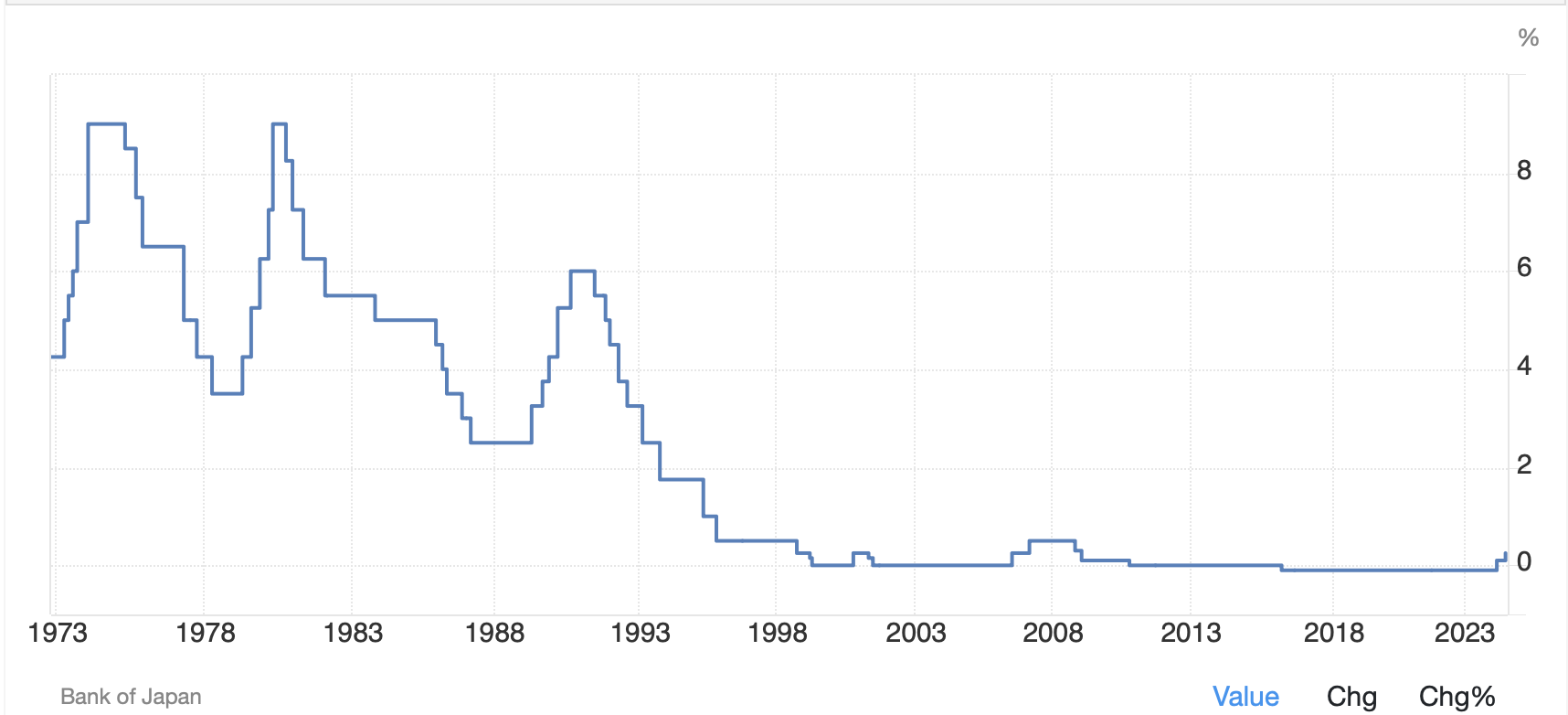
Also, let’s remember that inflation in Japan is currently measured at 2.8%, so the base rate remains deeply negative in real terms.  I understand the signaling impact of what they did as any change in the status quo while there is a significantly leveraged market can have major impacts.  And that is what we saw during the past week.  It is also important to remember that given the length of time that the Japanese have maintained their ZIRP/NIRP monetary policy, the opportunity for very large institutions to build up very large positions was, to be succinct, very large.  The chart below shows for just how long Japanese interest rates have been near zero, more than twenty years.

Source: tradingeconomics.com

My point is that Japanese investors have been seeking alternative opportunities for an entire generation.  As well, the concept of the carry trade has been in place for that same amount of time.  It will take a long time for these ideas to be changed and the positions along with them.  Now, according to a Bloomberg article, JPMorgan’s analysts claimed that three-quarters of the carry trade has already been unwound.  And maybe they are right about that.  But I assure you that three-quarters of Japanese investors have not adjusted their positions in the fixed income market.  We have not come to the end of this road.

So, analysts found another cause for yesterday’s negative outcomes, the 10-year bond auction.  It turns out that investors are seeking more yield than the market had anticipated ahead of the auction.  This led to a 3 basis point tail, meaning that the auction cleared at a yield, 3.96%, 3 basis points higher than traders were pricing ahead of time (typical 10-year tails are well less than 1bp.)  There were less bids than anticipated, and generally this is not a good story for Secretary Yellen and the Treasury.  The story that circulated was that the reason stocks fell in the afternoon was the weak auction.  Alas, the timing of that does not make sense.  Equity markets had already given back their morning gains before the auction results were announced and were lower on the day at 1:00pm.  But narrative writers need a story, and that was a good one.

So, what really happened?  Who knows?  But FWIW this poet has seen enough market action during his career to recognize that while fundamentals matter in the long-run, daily changes are often completely random, or at least seemingly so.  Large orders can drive markets, especially when liquidity is lower because of holiday schedules and the time of year.  And lately, the combination of algorithmic trading and extreme retail speculation will also move markets in surprising directions.

I believe that we remain in a period of change.  Monetary policies around the world are adjusting to the realities of inflation remaining stickier than policymakers want to believe.  In addition, the political cycle continues to be difficult to forecast, notably in the US, with market perceptions of very different economic policies to be implemented depending on the next US president.  And finally, I believe the best way to describe the global economy is that it is in transition.  After a decade or more of easy money policies around the world, as those policies start to change, they impact different segments of the economy at different rates.  This means that some parts of an economy can be in recession while other parts can be doing fine.  And that gives rise to confusing data with no broad trend.  This may explain why manufacturing survey data is so weak while service survey data has held up well.  

My best guess is that we are going to continue to see confusion until policy makers are more aligned.  In fact, that is why there are so many calls for the Fed to start cutting rates soon, so they can catch up and unify monetary policies around the world.

Ok, let’s see how things looked overnight.  After yesterday’s reversal and lower closes in the US, that theme was extended largely around the world.  Japanese shares fell (-0.75%) as did shares everywhere else in Asia (Korea, India, Australia, etc.) except in China, where both mainland and Hong Kong shares were essentially flat.  The story is no better in Europe where shares are lower by between -0.7% (DAX ) and -1.1% (CAC, FTSE 100) as investors demonstrate they are concerned with the future.  As to the US, at this hour (7:15) futures are very slightly lower.

In the bond market, after yesterday’s poor auction, and ahead of today’s 30-year Treasury auction, yields have fallen from their highest points.  Treasury yields (-3bps) are pacing the European sovereign market (Bunds -3bps, OATs -3bps, Gilts -1bp, BTPs -2bps) as the fear factor on stocks seems to be encouraging some haven buying.  But the most interesting thing was that JGB yields fell -5bps overnight and are now back down to 0.84%.  The BOJ Summary of Opinions (effectively their Minutes) was released last night and clarified that they are not interested in a rapid tightening of policy.  Given GDP growth was negative last quarter, this can be no surprise.

In the commodity markets, oil is little changed this morning but has recouped most of its losses from the past week and sits back at $75/bbl.  This is still a range-bound situation, and we need something really big to change that.  Gold (+1.1%) is making a comeback and back over $2400/oz as the fear factor seems to be playing a role here today.  However, copper (-0.2%) continues to demonstrate short-term concerns over economic activity around the world.

Finally, the dollar is having a much less volatile session than we have seen recently.  AUD (+0.5%) is the biggest mover I can find after hawkish comments from the RBA, claiming they will not hesitate to raise interest rates again if inflation reappears.  However, the yen (+0.15%) seems like it has found at least a temporary home, perhaps gaining some support on what appears to be a risk off day.  Funnily, though, the major risk proxies in the EMG space, ZAR and MXN are virtually unchanged this morning.  I believe that like most markets today, more clues are sought before views are expressed.

Speaking of clues, this morning brings the other US data with Initial (exp 240K) and Continuing (1870K) Claims at 8:30.  Richmond Fed president Barkin speaks at 3:00 this afternoon, the same time we will hear from Banxico on their rate decision (no change expected).  But once again, there is not much new information expected, so markets are going to respond, in my view, to equity activity.  If US stocks can find support, look for other markets to follow along.  However, that does not feel like today’s message.  As to the dollar, against the majors, I think it has found a temporary range.

Good luck

Adf

Ueda-san Blinked

Let’s consider fear
It’s not only for traders
Ueda-san blinked


I’m old enough to remember the time when the BOJ turned hawkish, raised their base rate by the most in 15 years and promised to keep going. As well, Ueda-san explained they would slowly reduce their presence in the JGB market.  In fact, I’m willing to wager you remember that too.  After all, that was the message the market gleaned from the BOJ policy meeting that ended on July 31st, just seven days ago.  Since then, equity markets around the world have fallen dramatically, the yen rallied dramatically, bond yields declined dramatically, and risk was definitively reduced.

Narratives were being rewritten around the world and concerns over the strength of the US economy were raised.  Remember the lackluster employment report and all the discussion of the Sahm Rule having been triggered which implied the US was already in a recession?  The global fear was if the US fell into recession, it would drag the rest of the world with it, since for now, the US economy is the strongest one around.

Well, apparently, policymakers around the world decided that the recent market chaos was a bit too uncomfortable for their political masters.  It is a fair question to ask whether it was the BOJ’s more hawkish actions or the FOMC’s less dovish actions which drove recent market gyrations.  But last night, the BOJ is the one that blinked first.  Deputy Governor Shinichi Uchida, speaking to local business leaders in northern Japan said the following [emphasis added]:

“I believe that the bank needs to maintain monetary easing with the current policy interest rate for the time being, with developments in financial and capital markets at home and abroad being extremely volatile. In contrast to the process of policy interest rate hikes in Europe and the United States, Japan’s economy is not in a situation where the bank may fall behind the curve if it does not raise the policy interest rate at a certain pace. Therefore, the bank will not raise its policy interest rate when financial and capital markets are unstable.”

And presto!  Fear has receded dramatically with the removal of concerns of further tightening by the BOJ, at least anytime soon.  The biggest response was by the yen (-1.9%), with the dollar now having retraced about 50% of its decline vs. the yen since the BOJ meeting as per the chart below. (You can see where USDJPY was at the time of the BOJ announcement on the chart.). So, is everything better in the world?  Clearly not, but one of the drivers of recent volatility has been walked back.  As I wrote back on Monday, no politician is willing to tolerate short-term pain for long-term gain, and this is simply further proof of that statement.

Source: tradingeconomics.com

As to the rest of the market complex, most other asset classes are also unwinding some of the recent fear driven moves.  Looking at equities, yesterday’s rebound extended further throughout almost every market in Asia with Japan’s Nikkei (+1.1%) rebounding more than 3% from its early session lows and gains of more than 1% in virtually every market in the time zone.  The lone outlier here was China’s CSI 300 which was essentially flat on the day.  Throughout Europe, as well, we are seeing gains of 1% or more across the board led by the IBEX (+1.65%) and CAC (+1.6%).  As to US futures, at this hour (6:45) they too are showing gains of 1% or more.  

One of the key themes among certain analyst circles has been that the BOJ’s ongoing liquidity spigot, which was ostensibly turned off last week, was THE key driver of all markets globally.  In fact, the conspiratorial view was that global monetary policy was highly coordinated and that the reason the Fed was able to maintain its current policy stance effectively was because the BOJ would knowingly maintain its ultra easy policy. Ostensibly, this allowed the Fed to be seen as fighting inflation, the key political issue in the US, while Japan was able to maintain that inflation was still not stably at their target despite their core rate having printed above the 2% target for the past 28 consecutive months. I am not a fan of conspiracy theories as somebody always talks, but the results that we have seen over the past several years certainly indicate that was possible.

The question going forward is, will the BOJ restart their policy tightening this year?  Perhaps, the next coordinated steps will be the Fed’s first cut in September, and possibly November, followed by the BOJ getting back on the tightening path by December.  But for now, it appears that the past week was far too much market excitement for policymakers to handle.

Turning to bond markets, yields around the world are rebounding with 10-year Treasury yields higher by 4bps this morning and European sovereign yields higher by between 6bps and 9bps.  UK Gilt yields are also 4bps higher and overnight in Asia, Australia, New Zealand and other countries saw yields rebound as well.  The only outlier here was Japan, with JGB yields unchanged.  The armchair analysis is that bonds as havens are not nearly as critical today as they seemed to be on Monday and Tuesday.  If the policy directive is the Fed cuts next, this process should be able to continue.

In the commodity markets, we are also seeing a reversal of the recent losses with oil (+1.75%) really bouncing sharply.  Arguably, part of this move is concern over the anticipated Iranian attacks on Israel and whether that will spill over into a wider Middle East conflagration impacting supply.  But part of this is likely just a trading response to the recent sharp declines seen.  In the metals markets, gold (+0.5%) and silver (+1.0%) are bouncing although gold has been the best performer in this space throughout the past gyrations.  Copper (-1.7%) though is still under pressure and indicating that economic activity is slowing.

Finally, the dollar is firmer this morning, at least based on the DXY, led by its strength vs. the yen and CHF (-1.3%).  However, looking at other currencies, we see AUD (+0.8%), NOK (+1.35%), SEK (+1.0%) and even CAD (+0.4%) all stronger.  As well, both MXN (+1.6%) and ZAR (+1.0%) are firmer as it appears that traders are feeling more confident their carry trade positions are going to work well again.  It should be noted that CNY (-0.4%) has reversed course, lagging the yen move, but then it lagged the yen strengthening move very dramatically.  Currencies remain the final outlet valve for economies as they adjust to changes in policy.  As such, with this new narrative of the BOJ backing off and the Fed getting set to cut, I expect that volatility in this space is likely to settle down for the time being.  We will need a new catalyst to get people trading, and it seems the next opportunity will be next week’s US CPI followed by the Jackson Hole Symposium at the end of the month.  Perhaps, although the beginning of August was far more volatile than expected, we are about to settle back into the doldrums.

There is no first-tier data released today but we do see the EIA oil inventories where further drawdowns are expected.  Yesterday’s API was fairly neutral, but right now, it seems that the story is the Middle East, not inventories.  Interestingly, there are no Fed speakers on the calendar either, although as we have seen consistently, it seems likely that we will hear from at least one before the day is through.

Today is a relief rally based on what appears to be a slight change in the narrative.  It seems the apocalypse of tighter Japanese monetary policy and still tight US monetary policy is to be avoided.  If that is the case, then look for markets to return toward their pre-BOJ levels, at least for now.  For the dollar writ large, I feel like we could see general underperformance although there are clearly still a few currencies that may weaken further, notably the yen.

Good luck

Adf

Never Mind

The markets just said, never mind
Though yesterday’s moves were unkind
Twas all just a game
With punters to blame
It’s they who must need be maligned
 
Today is a whole other story
And one that is somewhat less gory
Now though it seems strange
Things just didn’t change
Believe us, it’s all hunky-dory


As much fear as was felt throughout global markets yesterday, that is how much relief is evident this morning.  In the midst of a panic sell-off, it is impossible to determine both the causes and how far things might run.  In fact, that is why stock exchanges around the world introduced circuit-breakers after the 1987 crash, to try to prevent any extended move lower.  As it happens, the only circuit breakers that triggered were in Asia (Japan, South Korea and Taiwan) as the rest of the world’s markets, though sharply lower, did not see the same magnitude of losses.

But that was so yesterday!  To their credit, no central bank reacted rashly to the movement, and there were precious few comments by any central bankers of note.  SF Fed President Daly spoke at a scheduled event and maintained the party line that they did not yet have enough confidence that inflation was going to sustainably decline to their target, although she is closely watching the labor market after last Friday’s NFP report.  “We’ve now confirmed that the labor market is slowing, and it’s extremely important that we not let it slow so much that it tips into a downturn.  It’s too early to tell if it is slowing to a sustainable pace which allows the economy to continue to grow or if it’s getting to a point where there’s real weakness there,” she explained.

Those comments certainly did not sound like someone who was concerned about the market’s dramatic movement yesterday.  And we should all be happy that is the case.  In fact, the central bank that should have been most concerned, the BOJ, said nothing at all.  As well, the RBA met last night and left policy on hold, as expected.  So, kudos to the central bank community for not overreacting to a stock market move.

Market participants, though, continue to clamor for support as they are confused by numbers that don’t go up.  Now, Tuesday has earned the name ‘turnaround Tuesday’ for a good reason, in that historically, after a large decline on Monday, especially if there was weakness at the end of the prior week, on average, there is a rebound in equity markets.  In fact, there was a very nice article in Bloomberg this morning giving details on that phenomenon.  

But the real question is, was yesterday an aberration or was it a harbinger of things to come?  On the one hand, the only data released yesterday was the ISM Services, which rose 2.6 points to 51.4, a much better than expected outcome, and certainly not seeming to be a signal that the US economy is heading into recession.  Ironically, if there is no recession coming, and the Fed remains sanguine about the economy, there is really no reason for them to worry about the interest rate structure.  I have asked this question many times, why would the Fed need to cut rates if the economy continues to grow at trend and equity markets continue to make new highs? 

But we cannot ignore the signals we have seen from other parts of the economy, notably the still weak manufacturing sector (as evidenced by the weak ISM Manufacturing and other regional Fed manufacturing indices) and the evident slowing in the payroll report.  Many of you will have heard of the Sahm Rule, which describes the relationship between movement in the Unemployment Rate and recessions.  

Briefly, the rule explains that if the three-month average of the Unemployment Rate rises 0.5% from its low point in the past 12 months, that signals the economy is already in a recession.  Last Friday’s rise in the UR ostensibly triggered that “rule”.  However, it is important to understand that the rule is merely the observation that since 1980, that situation has obtained each time a recession has occurred.  It is not a causal factor, just a coincidental indicator, so the fact that it has been triggered does not actually mean we are in a recession, just that historically that has been the case.

I have described numerous times that there are two broad camps of economists with some very smart people continuing to believe that we are already in a recession, even prior to Friday’s NFP report, and that the Fed is far behind the curve.  However, there is also a camp that believes in the no-landing scenario where the economy will be able to maintain its pace of growth given the combination of massive fiscal stimulus that continues to enter the economy, and the fact that the interest rate sensitivity of the US economy has declined dramatically since 2020 because so many borrowers, both individuals with mortgages and companies, termed out their debt during the ZIRP policy period.

However, there are several things to remember:

  • The stock market is not the economy.  Markets are forward looking indicators of indeterminate length, and while they may presage strength or weakness, they also get things wrong.  So, this market movement could merely be a trading correction amid ongoing economic growth, or it could be the beginning of the end.
  • The US economy’s reduced sensitivity to interest rates means that even if the Fed were to cut rates tomorrow, the impact on the economy is likely to take at least 12 months, if not much more before it is felt.  After all, the Fed started hiking rates two years ago and in Q2, GDP was still growing at 2.8% with inflation continuing above their target.
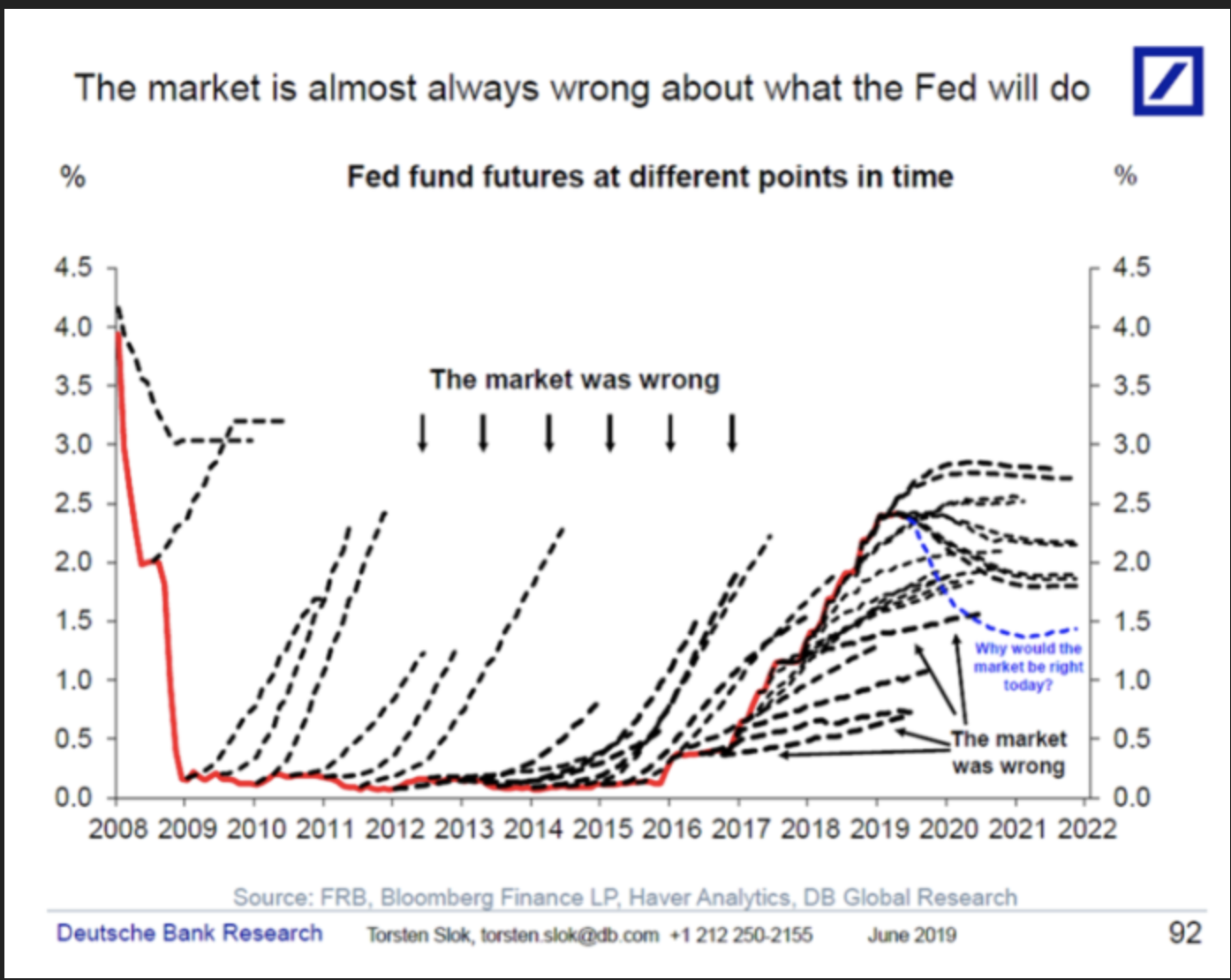
  • Interest rate markets often, if not almost always, are incorrect in their pricing of future Fed policy moves.  The below chart from Deutsche Bank Research shows the actual Fed funds rate (red line) and the way the futures market was pricing things at various points in time (black dashed lines).  As you can see, there are a lot more bad outcomes than correct ones.

I know I regularly discuss the Fed funds futures market, but I do so as an indicator of market sentiment, not an expectation of what the Fed will actually do.  And FWIW, this morning the futures market is pricing a 75% chance of a 50bp cut in September, up from Friday’s level of 25%, but down from the peak of 95% yesterday morning.

Ok, let’s tour markets very quickly now.  The Nikkei rebounded by 10.2% last night, its largest rise ever in a single session.  The other big decliners yesterday, South Korea (+3.3%) and Taiwan (+3.4%) also rebounded, although not nearly as impressively.  Chinese shares have basically sat this movement out, little changed last night after modest declines on Monday.  In Europe, the picture is mixed with the DAX (+0.1%) managing a gain while the CAC (-0.25%) and IBEX (-0.4%) both still lag.  The only data of note was Eurozone Retail Sales which disappointed at -0.3%.  US futures are rebounding as well, up about 1.0% at this hour (7:30).

In the bond market, Treasury yields bottomed yesterday morning at about 8:30 printing at 3.68% but have risen since then by a total of 20bps, with 7 of those occurring this morning.  Meanwhile, European sovereign yields are generally a touch softer, down between 1bp and 3bps as the European markets have ultimately seen limited impact from the big moves.  I guess, nobody was buying European stocks or bonds with their short yen funded positions.  As to JGB’s they also rebounded last night, closing higher by 11bps, although still well below the 1.0% level.

In the commodity markets, oil (-0.2%) spent most of yesterday rebounding alongside Treasury yields, and likely showing a little concern over the imminent (?) retaliation by Iran on Israel.  However, in the big scheme of things, it remains in its 70/90 range and obviously needs a bigger catalyst than we saw yesterday to break it.  Gold (+0.4%), which sold off yesterday, was the least impacted of risk assets and it is no surprise it is rebounding this morning.  The rest of the metals markets, though, remain under modest pressure after sharp declines yesterday.

Finally, the dollar has reversed some of yesterday’s moves, but there continues to be a wide range of movement.  Starting with the yen, during the NY session yesterday, the dollar rebounded sharply, more than 1.5% and though that move continued into the early Asian hours, right now, the yen is stronger (dollar lower) by 0.5%.  Elsewhere, though, the dollar is showing its haven status as it rallies vs. the rest of the G10, in some cases pretty substantially (GBP -0.75%, AUD -0.6%) and it is rallying against virtually all of the EMG bloc with the worst performers the MXN (-1.1%) and CE4 currencies, mostly lower by about -0.5%.

On the data front, today’s only release is the Trade Balance (exp -$72.5B) and I do not see any Fed speakers listed on the calendar.  Perhaps yesterday was a one-off, a type of warning shot across the bow of the economy that things are out of balance and subject to some jarring impacts.  Or perhaps it was just one of those things that markets periodically do irrespective of the economic fundamentals.  This poet remains in the camp that economic activity is slowing, and a recession is coming soon, although that will not necessarily help inflation decline.  But right now, it is anybody’s guess.  As to the dollar, nothing has changed its haven status I believe, so if fear continues to drive things, it should hold its own.

Good luck

Adf

The World is Ending

The world is ending
At least, that’s the way it feels
Owning equities
 
The narrative writers are caught
‘Cause stories those writers had wrought
No longer apply
And folks now decry
The idea that dips should be bought


Remember the idea of the summer doldrums where everybody is on vacation, so markets move very little? Yeah, neither do I!  Here’s a different idea though, when risk is under pressure, all correlations go to 1.0.  Look at the following three charts (source: tradingeconomics.com) and explain to me how they behave independently:

There is rioting in the streets today, perhaps not in your neighborhood directly, but in many places around the world (the UK, Bangladesh, Kenya, others), as the global order that we have known for the past X years gets tested.  How big is X?  There will be many different answers to that question, but in this poet’s mind, what we are witnessing in its full glory today is the beginning of the unwinding of the market excesses that began when global interest rates headed to 0.00% in the wake of the GFC in 2009, so X=15 years.  

It is easy to wax philosophical on this subject, discussing the merits of moderating the business cycle and why interest rate policy is a net benefit, and you can be sure that before this week is over, we will get policy interventions.  But ultimately, markets need to clear to function effectively, and I would argue that the last time markets actually cleared was in 1974.  The next big opportunity to allow markets to clear was in October 1987 and the Maestro, although he had not yet earned that moniker, stepped in after that Black Monday and promised unlimited liquidity to prevent too much damage. 

Ever since then, central bankers around the world, led by the Federal Reserve, but do not forget actions like Mario Draghi’s “whatever it takes” moment, have decided that they need to manage the global economy, and market responses, and that markets were only effective if they were going higher.  (It’s ironic that TradFi people scoffed at the crypto maxim ‘number go up’, yet they believed exactly the same thing, only in a different wrapper.) As well, we all know that the concept of political will does not exist anymore, at least not in the West, as no elected politician will ever choose to fight for a policy that has short-term pain and long-term gain.  The result of this constant intervention and guidance from policymakers is that things get overdone, and bubbles inflate.  And it is much easier to inflate a bubble when you maintain policy rates at 0.00% (or negative rates in some cases).  

At this point, you will read many stories about which particular catalyst drove this market reaction, whether it was last week’s BOJ meeting where Ueda-san surprised the market and hiked rates as well as promised to reduce QQE, or whether it was the fact that Chairman Powell did not cut rates, or if it was the weak payroll report.  Others will point to the escalation in hostilities in Ukraine and the Middle East as flashpoints getting people to exit risk positions.  But in the end, the catalyst is not important.  As I wrote on Friday, and is so well explained in Mark Buchanan’s book, Ubiquity, the market was rife with ‘fingers of instability’ and an avalanche has begun.

To this poet’s eye, there needs to be more excess wrung from the market.  After all, given the underlying trade of virtually the entire bull market has been the JPY carry trade, where traders and investors borrowed JPY at 0.00%, converted it to another currency and either held that currency to earn the interest rate differential, or for the truly aggressive, used the currency to buy other risky assets (NVDA anyone?), and that trade has been building for years.  Deutsche Bank has estimated that it grew to $20 trillion in size.  I assure you it is not completely unwound!

However, as I mentioned above, I am confident that central bankers are already getting intense pressure from their respective governments to ‘do something’ to stop the rout.  But central bankers are already (save Japan) in cutting mode.  And the Fed just passed on cutting rates last week.  If they were to cut today, no matter what they said, it would remove any doubt that the only thing they care about is the stock market.  It would destroy whatever credibility they still retain.  But do not count out that response, at this stage, it’s probably 50:50 they cut this week if things continue.  After all, the Fed funds futures market is now pricing in a 95% probability of a 50bp cut in September and a total of 125bps of cuts by December!

I will be the first to say I have no idea where things are going to head from here because while market internals point to further unwinding of risky assets, policy responses have not yet been seen.  So, the best advice I can offer if you are not leveraged is do not panic.  If you are, you have probably been stopped out already anyway.  In the meantime, let’s take a look at the damage overnight.

Equity Markets in Asia:

  • Nikkei 225       -12.4%
  • Hang Seng       -1.5%
  • CSI 300            -1.2%
  • ASX 300           -3.7%   
  • KOSPI               -8.8%
  • TAIEX               -8.3%
  • Nifty 50           -2.7%

In other words, it was quite the rout, with tech shares getting hammered everywhere.  Perhaps the most surprising thing to me as that the CSI 300 didn’t fall further, although I suspect that there was significant intervention by the government to prevent that from happening.  (After all, you don’t need to be a western government to want the number to go up!)

Equity Markets in Europe:

  • DAX                 -2.6%   
  • CAC                 -2.4%
  • FTSE 100         -2.4%
  • IBEX                 -2.8%’
  • FTSE MIB         -3.0%

This tells me that these markets were not nearly as leveraged as Asian markets, likely because prospects throughout Europe have been relatively less interesting to many investors.  After all, if you are leveraging up via borrowing yen, you want to buy growth, not value, stocks, and there aren’t that many growth names in Europe.

Finally, US futures, at this hour (7:00) are lower by:

  • S&P 500          -3.0%
  • NASDQ            -4.5%
  • DJIA                 -2.1%

Bond markets are also seeing very significant movement, in the opposite direction as they are performing their safe haven role brilliantly today.  While the movements today are solid, with Treasury and European sovereign yields all lower by between 5bps and 7bps, to see the real story, you need to see the move since Friday’s opening (these are all 10-year yields).

  • US                    -20bps
  • Germany         -10bps
  • UK                   -9bps
  • Japan               -20bps
  • Australia          -17bps

The US yield curve, at least the 2yr-10yr measurement, is virtually flat today and 30yr yields are now higher than both of those maturities.  Also, look at JGB yields, down to 0.77%, as Japanese investors take their toys and go home.  The thing about this move, and the reason I don’t believe the unwinding is over yet, is that once the Japanese investment community starts to move, it takes a long time for them to get to be where they want given the amount of the assets involved.  And despite all the clutching of pearls about the US ability to sell the amount of debt they need to fund themselves; it won’t be a problem for right now.  Many people around the world will be all too happy to buy Treasury bonds regardless of some political foibles in the US.

Commodity markets are under pressure this morning, but not seeing the same type of pain as equity markets. The story here is that commodities are not directly impacted by the current movements (if anything declining interest rates should help them) but when margin calls come, people sell whatever they can that is liquid.  So, gold (-1.6%) is being liquidated to cover margin calls, not because people don’t want it.  Oil (-1.6%) is likely feeling pressure because these equity moves presage potential economic weakness and a reduction in demand, and we are seeing the same response from the industrial metals.  My take is gold is the one thing, besides bonds, that people are going to be willing to hold, and will rebound first.

Finally, the dollar is under pressure, net, but we are seeing massive movements in both directions.

  • JPY       +2.5%
  • EUR     +0.4%
  • GBP     -0.3%   
  • AUD     -0.9%
  • MXN    -3.3%
  • NOK     -1.0%
  • ZAR      -2.0%
  • CNY     +0.8%  
  • CHF      +0.8%
  • KRW    -0.5%

See if you can determine which were the favorite currencies to hold long against short JPY (AUD, MXN, ZAR). Meanwhile, the renminbi is able to gain as it continues to weaken, net against the yen, its most important competitor.  Remember, currencies are the outlet valves for economies when other markets cannot move enough.  The thing to keep in mind, especially as a hedger, is that volatility is going to be very high for a while yet.  This will not all quiet down and go away in a week’s time. 

At this point, it’s fair to ask, does data matter anymore?  Probably not today, but it will be key for the central banks if for no other reason than to cloak their actions in some fundamental story.  Alas for the Fed, there is virtually nothing to be released this week.  All we see is:

TodayISM Services51.0
TuesdayTrade Balance-$72.4B
ThursdayInitial Claims250K
 Continuing Claims1880K

Source: tradingeconomics.com

As well, and perhaps remarkably, so far on the calendar we only have three Fed speakers, Goolsbee, Daly and Barkin.  However, it seems almost certain we will hear from others, especially if the rout continues.

Right now, fundamentals do not matter.  My sense is we will see a bounce of some sort after the first wave ends, perhaps as soon as tomorrow, but the narrative of the soft landing has been discarded.  Look for more political pressure on the Fed to act, and to act soon.  Also, do not be surprised if the rest of the week ultimately sees a slower, but steady, decline in risk assets as those who haven’t panicked react to the situation and reevaluate just how much they love their positions.  Consider, Warren Buffet sold some of his favorite positions last week and is loaded with cash to act.  But there is nobody who is more patient than he.  

Good luck

Adf